20 Minutes, Medium
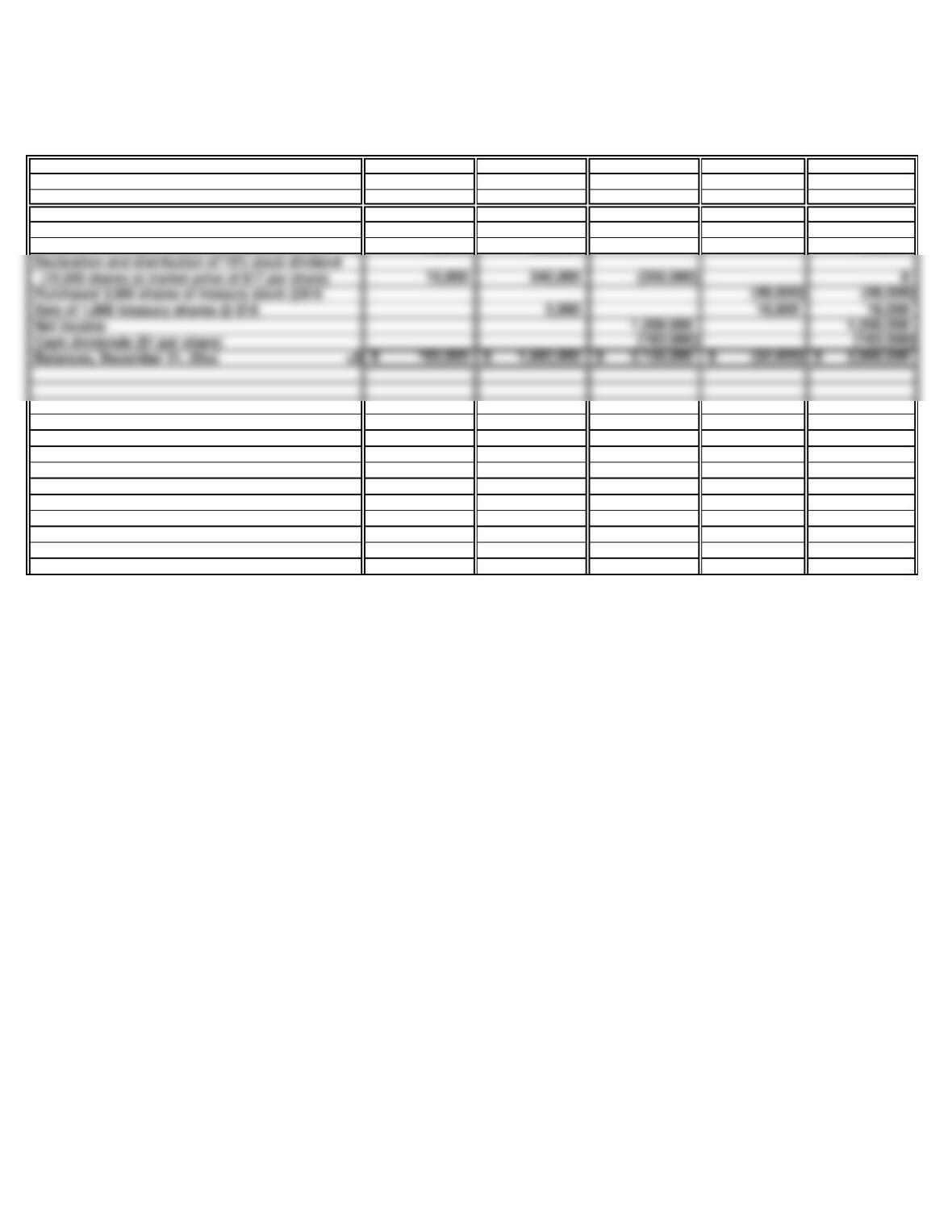
a. Capital Stock Additional Total
($1 par Paid-in Retained Treasury Stockholders’
value) Capital Earnings Stock Equity
Balances, January 1, 20xx 130,000$ 1,170,000$ 1,400,000$ –$ 2,700,000$
Prior period adjustment (net of income tax benefit)
(47,000) (47,000)
Issuance of common stock; 20,000 shares @ $15 20,000 280,000 300,000
(part b is on following page)
PROBLEM 12.5B
DRY WALL, INC.
DRY WALL, INC.
Statement of Stockholders’ Equity
For the Year Ended December 31, 20xx
Declaration and distribution of 10% stock dividend
b.
Declaration/distribution of a 10% stock dividend has no effect on total stockholders’
equity. Declaration of a cash dividend reduces total stockholders’ equity by the amount of
the dividend.
PROBLEM 12.5B
DRY WALL, INC. (concluded)
The two types of dividends do not have the same impact upon stockholders’ equity. A cash
40 Minutes, Strong
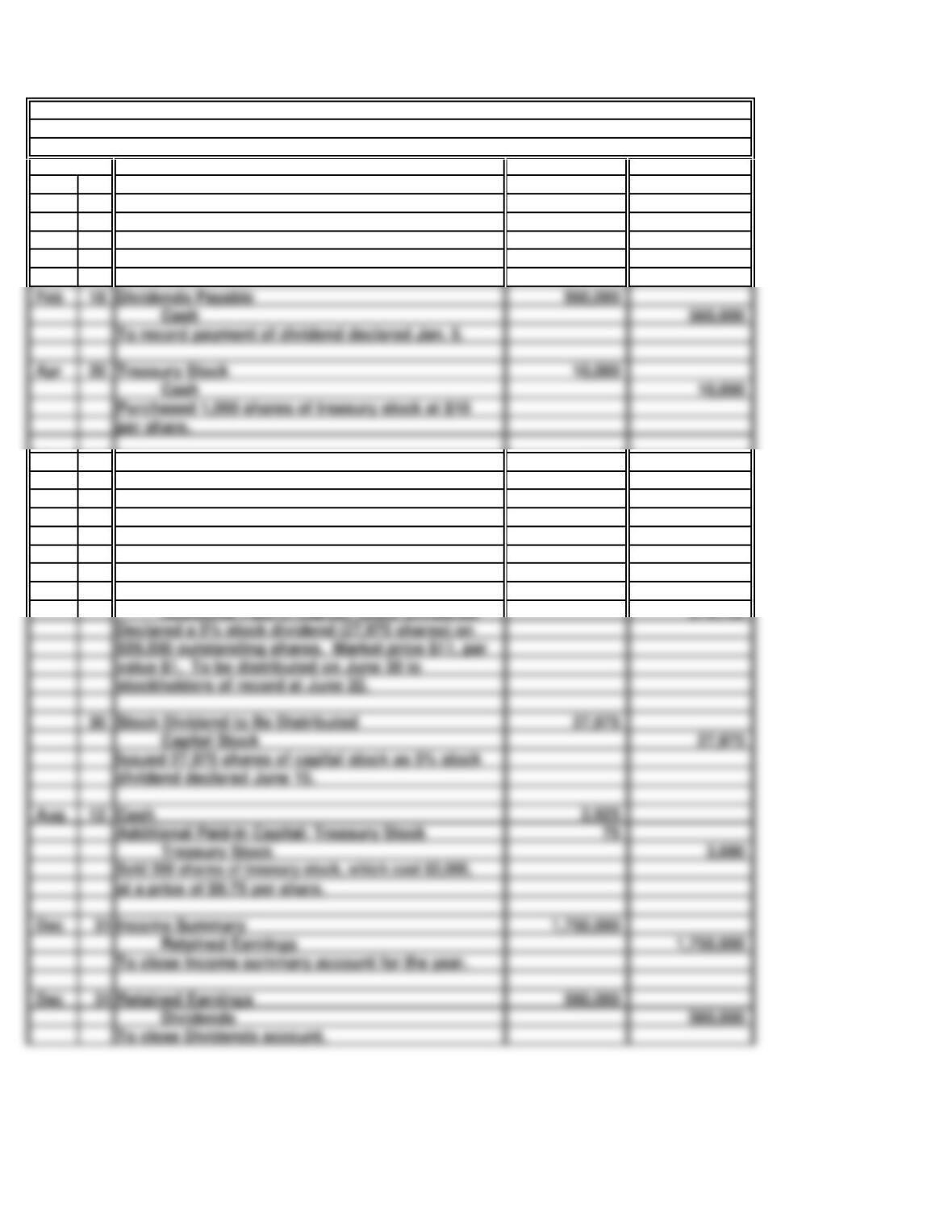
Jan 5 Dividends 560,000
Dividends Payable 560,000
May 25 Cash 6,000
Treasury Stock 5,000
1,000
June 15 307,725
27,975
279,750
Aug 12 2,925
Treasury Stock 3,000
Dec 31 1,750,000
1,750,000
Dec 31 560,000
at a price of $9.75 per share.
Income Summary
Retained Earnings
To close Dividends account.
Retained Earnings
To close Income summary account for the year.
Declared a 5% stock dividend (27,975 shares) on
Issued 27,975 shares of capital stock as 5% stock
Additional Paid-in Capital: Treasury Stock
value $1. To be distributed on June 30 to
stockholders of record at June 22.
Stock Dividend to Be Distributed
dividend declared June 15.
Cash
559,500 outstanding shares. Market price $11, par
dividend payable on Feb. 18 to stockholders of
PROBLEM 12.6B
a.
General Journal
GREENE, INC.
record on Jan. 31.
2018
To record declaration of $1 per share cash
Additional Paid-in Capital: Stock Dividends
Sold 500 shares of treasury stock, which cost
$5,000, at a price of $12 per share.
Additional Paid-in Capital: Treasury Stock
Retained Earnings
Stock Dividend to Be Distributed
Feb 18 560,000
Apr 20 10,000
Dividends Payable
To record payment of dividend declared Jan. 5.
Cash
per share.
Purchased 1,000 shares of treasury stock at $10
Treasury Stock
b.
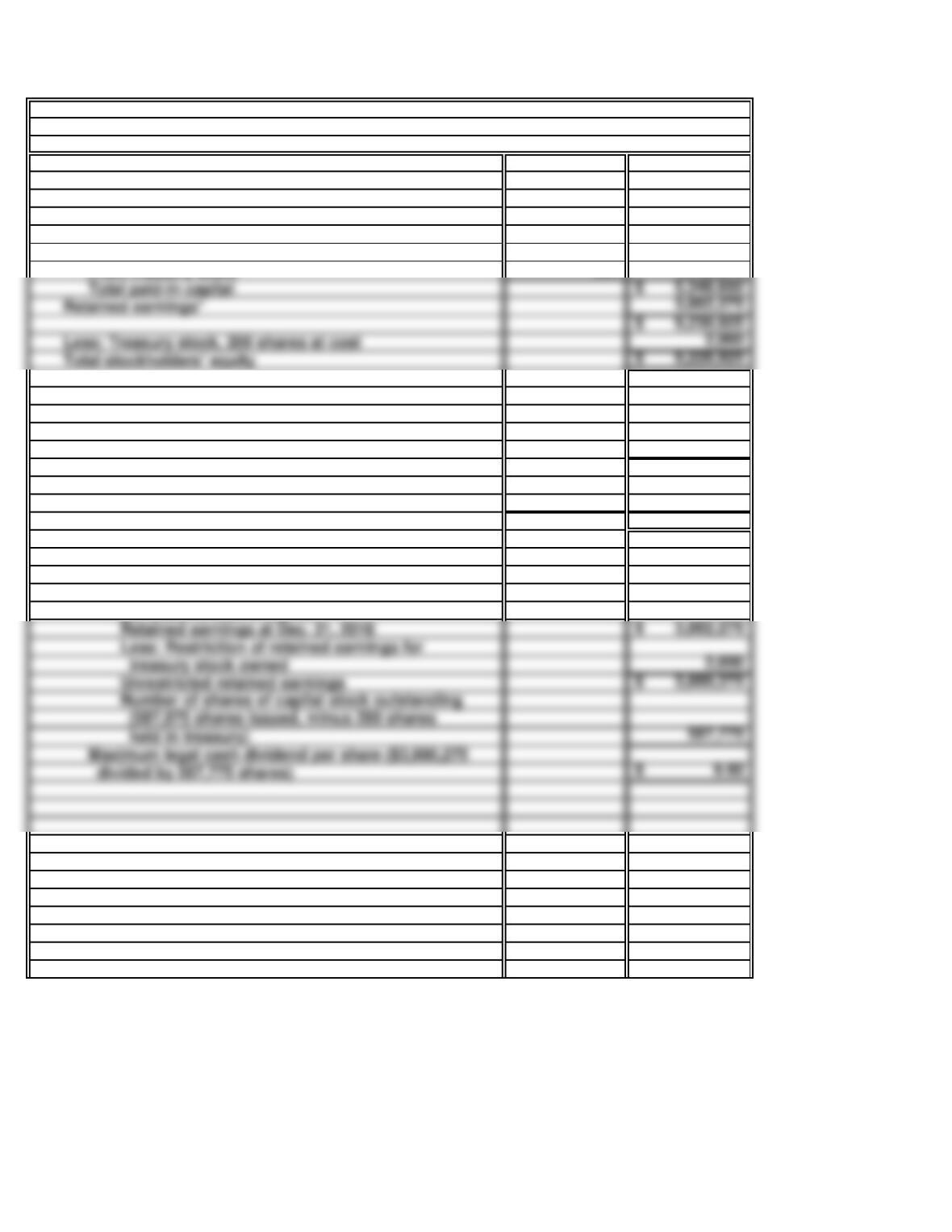
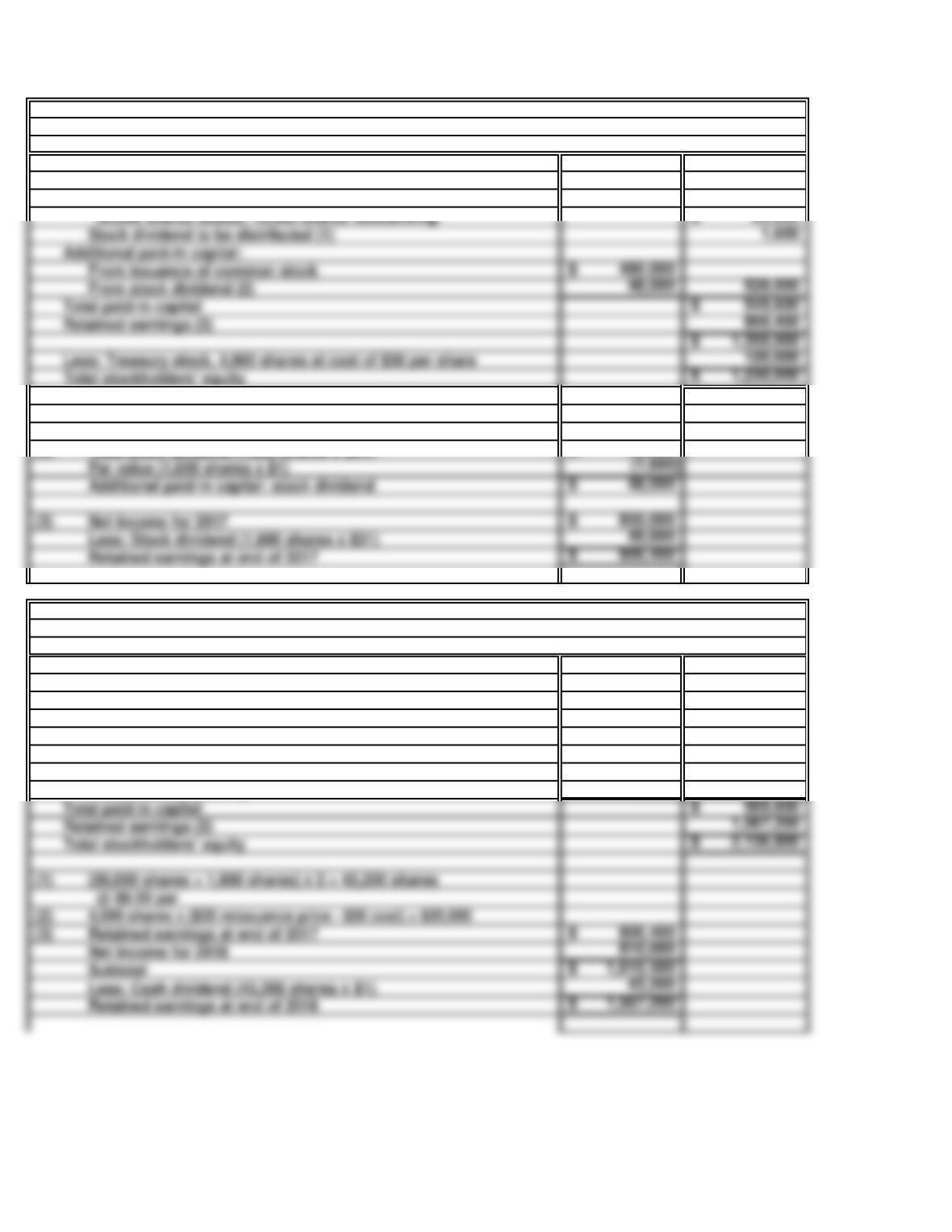
Stockholders’ equity:
Capital stock, $1 par value, 1,000,000 shares authorized,
587,975 shares issued, of which 200 are held in the treasury 587,975$
Additional paid-in capital:
From issuance of capital stock 4,480,000$
From stock dividend 279,750
From treasury stock 925 4,760,675
*Computation of retained earnings at Dec. 31, 2018:
Retained earnings at beginning of year 3,000,000$
Add: Net income for year 1,750,000
Subtotal 4,750,000$
Less: Cash dividend declared Jan. 5 560,000$
Stock dividend declared June 15 307,725 867,725
Retained earnings, Dec. 31, 2018 3,882,275$
c. Computation of maximum legal cash dividend
per share at Dec. 31, 2018:
Unrestricted retained earnings 3,880,275$
Maximum legal cash dividend per share ($3,880,275
divided by 587,775 shares) 6.60$
PROBLEM 12.6B
GREENE, INC.
December 31, 2018
Partial Balance Sheet
GREENE, INC. (concluded)
Total paid-in capital 5,348,650$
Retained earnings* 3,882,275
Less: Treasury stock, 200 shares at cost 2,000
30 Minutes, Strong
Net
(from
Income Source)
NE DNE NE
b. 1.
2.
3.
4.
5.
The purchase of treasury stock has no effect on either revenue or expenses and,
Reissuance of treasury stock at a price less than its original cost results in a loss, but
HOT WATER, INC.
Payment of a cash dividend has no effect on revenue or expenses, but it reduces cash.
1
PROBLEM 12.7B
Stockholders’
Equity
Current
Assets
Net Cash Flow
Declaration of a cash dividend has no immediate effect upon net income or cash flows.
a.
Event
2
3
4
5
50 Minutes, Strong
a.
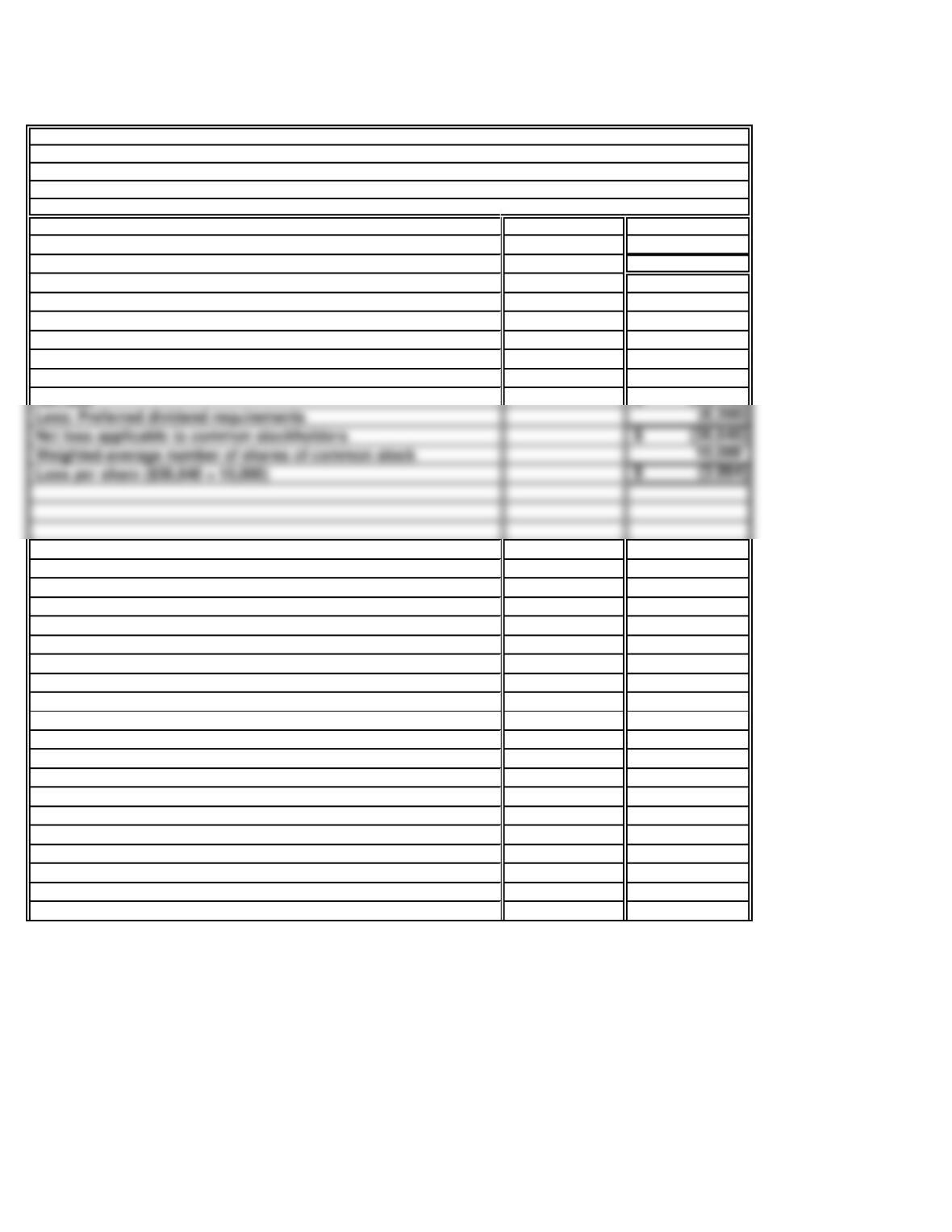
Stockholders’ equity:
Capital stock:
Common stock, $1 par, 100,000 shares authorized,
(1) (20,000 shares – 4,000 shares) x 10% = 1,600 shares
@$1 par
(2) Total stock dividend (1,600 shares x $31) 49,600$
Par value (1,600 shares x $1) (1,600)
Additional paid-in capital: stock dividend 48,000$
Less: Stock dividend (1,600 shares x $31) 49,600
Retained earnings at end of 2017 800,400$
b.
Stockholders’ equity:
Capital stock:
Common stock, $0.50 par, 200,000 shares authorized,
43,200 shares issued and outstanding (1) 21,600$
Additional paid-in capital:
From issuance of common stock 480,000$
From stock dividend 48,000
From treasury stock (2) 20,000 548,000
Total paid-in capital 569,600$
(1) (20,000 shares + 1,600 shares) x 2 = 43,200 shares
@ $0.50 par
(2) 4,000 shares x ($35 reissuance price – $30 cost) = $20,000
(3) Retained earnings at end of 2017 800,400$
Retained earnings at end of 2018 1,567,200$
December 31, 2018
PROBLEM 12.8B
ADAMS CORPORATION
December 31, 2017
Partial Balance Sheet
ADAMS CORPORATION
ADAMS CORPORATION
Partial Balance Sheet
20,000 shares issued, 16,000 shares outstanding 20,000$
Stock dividend to be distributed (1) 1,600
Additional paid-in capital:
From issuance of common stock 480,000$
From stock dividend (2) 48,000 528,000
Total paid-in capital 549,600$
25 Minutes, Strong
CORP.
a.
(Dollars in
Thousands)
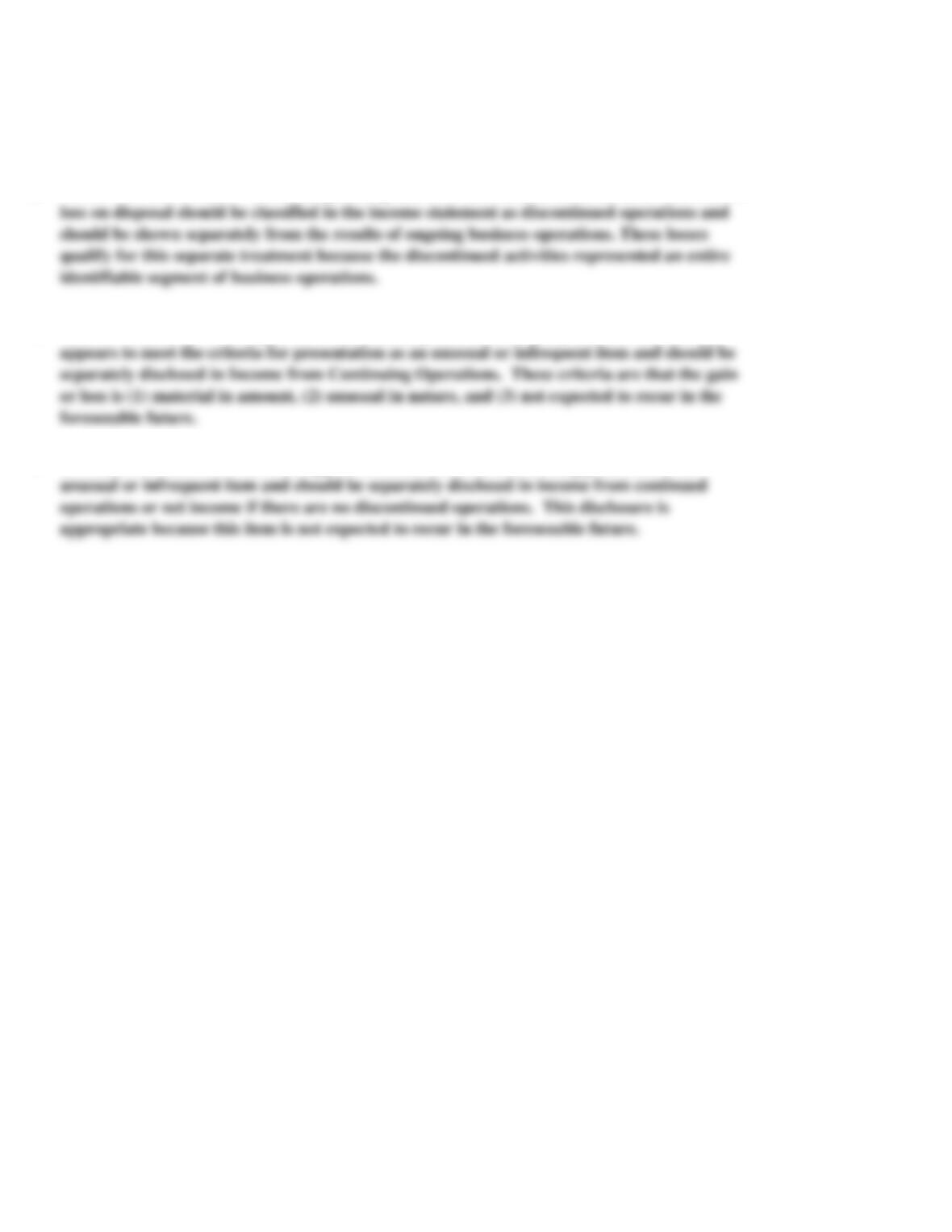
Loss from continuing operations [($(38,940) – $(17,500)] (56,440)$
Income from discontinued operations 24,000
Net loss (32,440)$
b.
Net loss (32,440)$
PROBLEM 12.9B
CARDINAL MANUFACTURING CORPORATION
For the Year Ended December 31, Current Year
Partial Income Statement
CARDINAL MANUFACTURING
Less: Preferred dividend requirements (6,200)
Net loss applicable to common stockholders (38,640)$
Weighted-average number of shares of common stock 10,000
20 Minutes, Easy
a.
b.
c.
SOLUTIONS TO CRITICAL THINKING CASES
WHAT’S THIS?
CASE 12.1
ATLANTIC RICHFIELD: Both the operating loss from the noncoal minerals activities and the
GEORGIA PACIFIC: This item appears to meet the criteria for being presented as an
UNION CARBIDE: The explosion of a chemical plant for a company like Union Carbide
20 Minutes, Medium
b.
d.
CASE 12.2
The operating loss incurred by the baseball team in 2018 indicates that the team’s expenses (net of tax
In 2018, JPI’s newspaper business earned $4,500,000, as shown by the subtotal, Income from
IS THERE LIFE WITHOUT BASEBALL?
30 Minutes, Strong
a.
The diluted earnings per share figures show the effect that conversion of all of the
convertible preferred stock into common shares would have had upon this year’s
CASE 12.3
USING EARNINGS PER SHARE FIGURE
The company reports earnings per share computed on both a basic and a diluted basis
because it has outstanding convertible preferred stock. The conversion of these securities
35 Minutes, Strong
a.
c.
e.
g.
CASE 12.4
INTERPRETING A STATEMENT OF
STOCKHOLDERS’ EQUITY
Beginning of year: 77,987,500 shares outstanding (82,550,000 issued – 4,562,500 held in
treasury)
This answer appears reasonable, since the number of common shares outstanding ranged
The stock issued during the year for the stock option plans consisted of treasury shares, not
newly issued shares. The Treasury Stock account is used to account for repurchases of a
The aggregate reissue price for the treasury shares must have been lower than the cost to
acquire those treasury shares, because the Additional Paid-in Capital account was reduced
60 Minutes, Strong
a.
b.
c
d.
Writing assets down, or writing them entirely off, now should have a positive effect on
One would expect the earnings per share to be less as the losses flow through the income
CASE 12.5
An asset represents something with future economic benefit. But if the amount at which the
These losses appear to be unusual and/or infrequent. At least, management would hope
CLASSIFICATION OF UNUSUAL ITEMS—
AND THE POTENTIAL FINANCIAL IMPACT
e.
Note to instructor: This case is adapted from an incident involving an international
pharmaceutical company. The details of the situation have been altered for the purpose of
creating an introductory level textbook assignment, and the so-called quotations from corporate
Who were the losers? Anyone who bought the stock between the release of the original earnings
figures and the announcement that substantial losses would be reclassified.
Writing off losses currently would be expected to positively effect earnings in future periods.
The assets that are being written down or written completely off will no longer be
CASE 12.5
CLASSIFICATION (continued)
30 Minutes, Medium
The fact that sales are sluggish but net income is steadily increasing at least raises an issue that
should be explored. All other things being equal, which they rarely are, one would not expect this
A possible explanation that is at least worth exploring is whether management has taken
conscious steps to overstate inventory. The motivation would be to increase reported net income
to enhance the position of management. The relationship of inventory to net income is as follows:
an overstatement of inventory is offset by an understatement of cost of goods sold which, in turn,
overstates net income. By overstating inventory, either intentionally or in error, net income is
improved and the company appears to be more profitable that it actually is.
CASE 12.6
MANAGING PROFITABILITY
This case is tended to encourage students to think about how certain financial statement numbers
should ordinarily be expected to move in relation to other numbers (e.g., net income in
comparison with sales) and steps that might be taken by management to manage, or manipulate
Relationship of sales revenue and net income
ETHICS, FRAUD & CORPORATE GOVERNANCE
CASE 12.6
MANAGING PROFITABILITY (concluded)
Reduction in allowance for inventory obsolescence
The allowance to reduce inventory for obsolescence functions much as an allowance for
uncollectible accounts does to reduce accounts receivable to their net realizable value. If
inventory includes some obsolescence, but the specific obsolete items are not known in advance,
an allowance is established to reduce the total inventory to a lower recoverable amount with the
specific items that include the obsolescence to be determined at some later time. From the
30 Minutes, Medium
c. There is no direct relationship between the amount the stock originally sold for and
d. The three-year trend in basic earnings per share (EPS), including discontinued
CASE 12.7
INTERNET
a. Martin Marietta Materials, Inc. is a leading supplier of aggregate and heavy building
b. The number of shares of common stock outstanding on Dec. 31, 2015 was
STOCKHOLDERS’ EQUITY AND EPS