
Solutions to Problems
12–45. Evaluating Management Control Systems: SPG Company.
Answers will vary. It is important to discuss all three elements of control systems
(delegation of decision authority, performance measurement, and compensation
systems) to ensure that recommended changes result in an efficient control system.
Decision Authority: Marilyn has an incentive to produce low cost (and possibly low
quality) products. One change would be to let Jack decide quality levels (and adjust
the cost budget appropriately).

12–46. (40 min.) Analyze Performance Report for Decentralized Organization: Hall
O’ Fame Products.
a. An evaluation of the performance of James Davenport for the nine months ending
September Year 3 would appear favorable if only the divisional performance measure
figure were considered. The actual performance measure is well above the nine-month
budgeted figure. However, closer examination of the report reveals that overall
performance cannot be considered satisfactory for the following reasons:
• Variable cost of sales (direct materials and labor) has increased significantly as a
percentage of sales.
Corporate policy dictates that division managers minimize their investment in
inventories and maintain control over plant fixed assets. In this respect, James
Davenport has not performed as well as expected for reasons described as follows:
• Inventories have increased significantly relative to sales volume and to divisional
investment.
12-46. (continued)
b. A performance evaluation system should reflect the division manager’s (D.M.)
responsibilities (i.e., those things that are specifically controllable by the D.M. and
for which the D.M. is held accountable). A good division performance measurement
should present the performance of the manager unobscured by extraneous items
that are not subject to the D.M.’s control. In this instance, Hall O’ Fame’s divisional
management is solely responsible for the production and distribution of corporate
products.
Specific features of the performance measurement reporting and evaluation system,
which should be revised, are as follows:
• A flexible budget based upon production as well as sales should be used so that
divisions can better reflect the actual level of activity achieved.
• Fixed divisional costs should be so identified and subtracted from a divisional
contribution margin.
12–47. (40 min.) Divisional Performance Measurement—Behavioral Issues: Paulista
Corporation.
a. The proposed Achievement of Objectives System (AOS) would be an improvement
over the current measure of divisional performance for the following reasons:
• There appears to be greater participation in the establishment of objectives by
divisional managers.
• The use of multiple criteria for performance measures should be a more equitable
standard of evaluation. This performance measure tends to reduce overemphasis
on single measurement criteria and might also balance extremes in performance in
one area versus another.
b. Specific performance measures for the criterion “doing better than last year” could
include total sales, contribution margin, controllable costs, net income, net income as a
function of sales, return on investment, market share, and productivity. Measurement
of these items should be compared in absolute terms or by percentages to the prior
year.
Specific performance measures for the criterion “planning realistically” could include an
analysis of variance between actual and budget and the use of a budget that is
adjusted to reflect some variables outside the managers control to determine sales, net
income, net income as a function of sales, and return on investment.
12-47. (continued)
c. The motivational and behavioral aspects of the achievement of objectives system
depend upon the level of acceptance of the system by top management and the
divisional managers.
• Divisional managers could have a sense of participation in the role of goal setting
Programs that might be instituted to promote morale and give incentives to divisional
managers in conjunction with the achievement of objectives system include the
following:
• Intrinsic motivators can be provided by allowing the manager to assess his/her own
achievements and his/her own worth.
CMA adapted
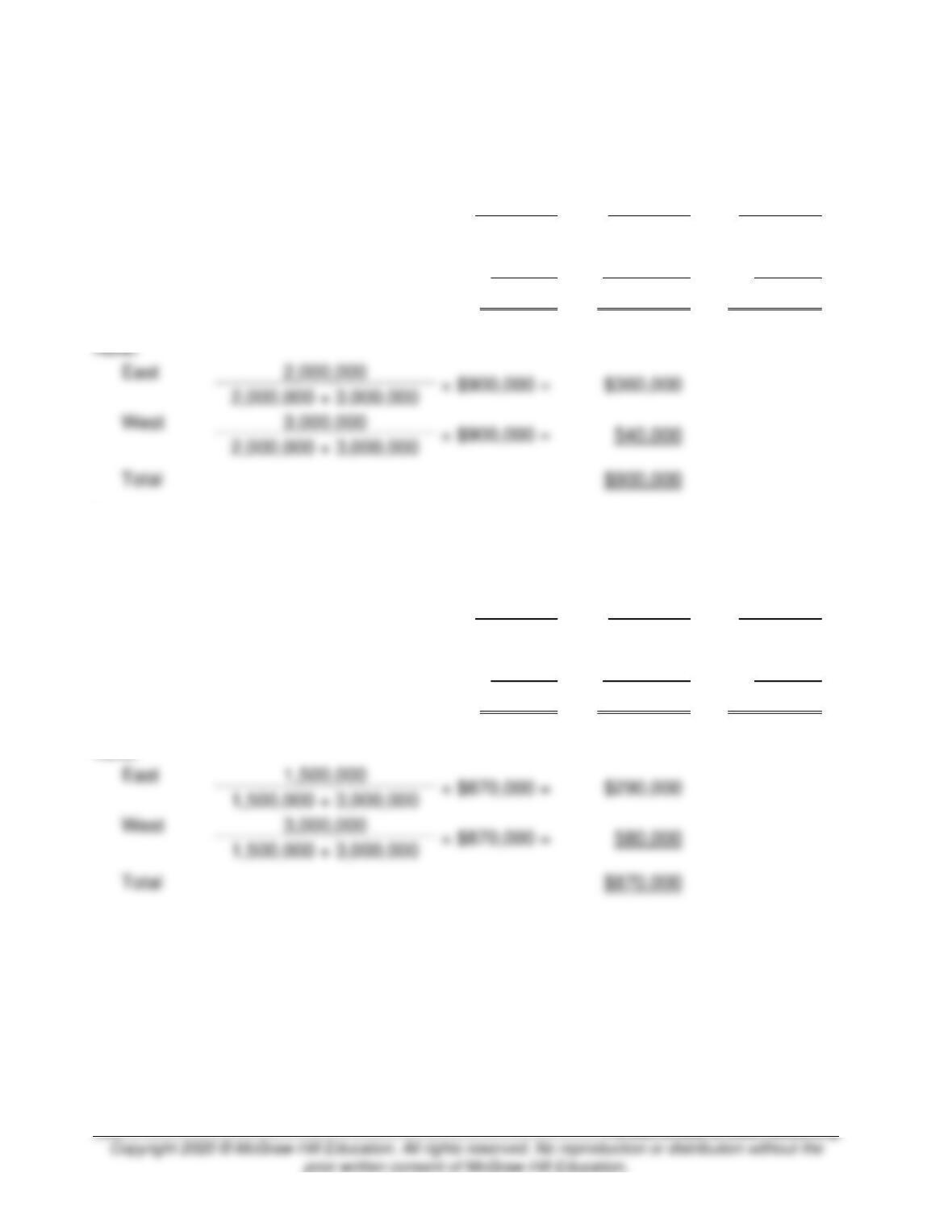
12–48. (40 min.) Dual and Single Allocation Rates: Bright Corporation.
a.
East
West
Total
Revenues ………………………………
$2,000,000
$3,000,000
$5,000,000
Direct costs …………………………….
1,200,000
1,400,000
2,600,000
Operating profit before allocations
$800,000
$1,600,000
$2,400,000
Corporate costs (Note) …………….
360,000
540,000
900,000
Operating profit ……………………….
$440,000
$1,060,000
$1,500,000
b.
East
West
Total
Revenues ………………………………
$1,500,000
$3,000,000
$4,500,000
Direct costs …………………………….
1,000,000
1,400,000
2,400,000
Operating profit before allocations
$500,000
$1,600,000
$2,100,000
Corporate costs (Note) …………….
290,000
580,000
870,000
Operating profit ……………………….
$210,000
$1,020,000
$1,230,000
c.
As the manager of the West Division, the division has performed exactly as planned
(revenues and direct costs), yet my actual profit is $40,000 less than planned. The
reasons are that the East Division did not perform as planned and corporate costs
were higher than they should have been.
12–48. (continued)
d. The corporate costs should be allocated using a dual rate. Revenue should be used to
allocate the variable costs, based on the budgeted rate. The fixed costs allocated
should be the same in the budget and actual calculations. Any remaining costs should
be assigned to corporate managers.
East
West
Total
Revenues ……………………………….
$1,500,000
$3,000,000
$4,500,000
Direct costs …………………………….
1,000,000
1,400,000
2,400,000
Operating profit before allocations
$500,000
$1,600,000
$2,100,000
Corporate costs
Unallocated costs (Note 3)
0
Operating profit ……………………….
$1,060,000
$1,230,000
Note 1: The variable cost rate is 8% of revenue. This is calculated by dividing
$400,000 in budgeted variable costs by $5,000,000 in budgeted revenue (8% =
$400,000 ÷ $5,000,000). The 8% rate should be applied to actual division revenue
to allocate variable corporate costs to the divisions:
East:
0.08
× $1,500,000 =
$120,000
West:
0.08
× $3,000,000 =
240,000
Total
$360,000
East:
0.40
× $500,000 =
$200,000
West:
0.60
× $500,000 =
300,000
Note 3: The total overhead allocated to the divisions is $860,000 (= $360,000 in
variable costs and $500,000 in fixed costs). The remaining $10,000 (= $870,000
actual overhead – $860,000 allocated) is assigned to the corporate managers
responsible for the expenditures (for example, personnel, marketing, and so on).
12–49. (40 min.) Dual and Single Allocation Rates: Stable Enterprises.
a.
Asia
Europe
Total
Revenues ………………………………
$28,600
$36,400
$65,000
Direct costs …………………………….
14,300
21,840
36,140
Operating profit before allocations
$14,300
$14,560
$28,860
Corporate costs (Note) …………….
6,600
8,400
15,000
Operating profit ……………………….
$7,700
$6,160
$13,860
28,600
28,600 + 36,400
36,400
× $15,000 =
28,600 + 36,400
b.
East
West
Total
Revenues ………………………………
$36,400
Direct costs …………………………….
14,300
21,840
36,140
Corporate costs (Note) …………….
7,840
14,000
Operating profit ……………………….
$8,140
$6,720
$14,860
Note:
Asia
28,600
× $14,000 =
$6,160
28,600 + 36,400
Europe
36,400
× $14,000 =
7,840
28,600 + 36,400
Total
$14,000
c.
12-49. (continued)
d. The corporate costs should be allocated using a dual rate. Revenue should be used to
allocate the variable costs, based on the budgeted rate. The fixed costs allocated
should be the same in the budget and actual calculations. Any remaining costs should
be assigned to corporate managers.
Asia
Europe
Total
Revenues ……………………..
Direct costs …………………..
Operating profit before allocations
Corporate costs
Unallocated costs (Note 3)
Operating profit ……………..
Note 1: The variable cost rate is 10% of revenue. This is calculated by dividing
$6,500 in budgeted variable costs by $65,000 in budgeted revenue (10% = $6,500
÷ $65,000). The 10% rate should be applied to actual division revenue to allocate
variable corporate costs to the divisions:
Asia:
0.10
x $28,600 =
$2,860
Europe:
0.10
x $36,400 =
3,640
Total
$6,500
Note 2: Allocated fixed costs should be equal to the budgeted fixed cost allocation,
based on budgeted revenue of 44% (= $28,600 ÷ $65,000) in the Asia Division and
56% (= $36,400 ÷ $65,000) in the Europe Division:
Asia:
0.44
x $8,500 =
$3,740
Europe:
0.56
x $8,500 =
4,760
Total
$8,500
12–50. (40 min.) Cost Allocations—Comparison of Dual and Single Rates: Pacific
Hotels.
a. Allocations based on time usage:
(1)
Luxury ………………………
Resort ………………………
.10
Standard …………………..
.40
Budget ……………………..
.30
Proportion of
Allocated Cost
a 400 (400 + 200 + 800 + 600) = 400 2,000 = .20; .10 = 200 2,000;
.40 = 800 2,000; .30 = 600 2,000.
b .20 × ($840,000 + 650,000) = $180,000; $149,000 = .10 × $1,490,000;
$596,000 = .40 × $1,490,000; $447,000 = .30 × $1,490,000.
(2) Dual allocations
(1)
Proportion
of Time
Usage
(2)
Allocated
Time Cost
(3)
Proportion of
Reservations
(4)
Allocated
Equipment
Cost
(5)
Total
Allocated
Cols. 2 + 4
Luxury ……..
.20a
$168,000b
.08c
$52,000d
$220,000
Resort ……..
.10
84,000
.10
65,000
149,000
Standard ….
.40
336,000
.24
156,000
492,000
Budget …….
.30
252,000
.58
377,000
629,000
$1,490,000
a from part (a)

12–50. (continued)
b. Dual rates should be used. If a single rate (time usage) is used, there might not be a

12–51. (30 min.) Cost Allocation for Travel Reimbursement.
a.
(1) Since the round-trip cost of the Chicago-Paris portion (2 × $3,650 = $7,300) is less
than the cost of the business-class ticket, the employee could request as much as
$7,300.
(2) The minimum cost to the company would be $4,900, the restricted round-trip fare from
Chicago to Paris assuming company policy allows business-class travel for
international trips.
b. One alternative is to reimburse the employee for an unrestricted round-trip fare from
Chicago to Paris, $7,300 (= 2 × $3,650).
12–52. (30 min.) Incentives, Illegal Activities, and Ethics.
This situation is based on the alleged fraud at the company, Leslie Fay.
a. Invoice backdating records revenues in periods earlier than they should be recorded.
The dressmaker would have reported revenues and cost of goods sold for Year 1 that
should have been reported in Year 2. Profits are overstated just for that period. The
profits that were “moved’ into Year 1 are no longer available to be reported in Year 2.
Consequently, frauds sometimes grow because managers continue to backdate
invoices to make up for profits moved into earlier periods.
b. The bonus plan provided the executives with a lot of benefits if the company met its
earnings goals. Also, the chief executive officer put a lot of pressure on his
subordinates to achieve short-term results. (This is not unusual in companies.)
Statements of shock and dismay, such as those made by the CEO, are usually not
12–53. (60 min.) River Beverages Case.
Note: It is important to understand the regional structure of the organization (Exhibit
12.3) as well as the production plant structure for the company’s Noncarbonated
Drinks plant in St. Louis (Exhibit 12.4). Instructors might want to present an
overview of this case before assigning it to students.
a. Sales projections are made at three levels:
• Division managers submit a report to the vice president for the region that includes
forecasts for capital, sales, and income. This report is used for strategic planning
purposes.
After the sales budget is approved by top management, it is separated into a sales
budget for each plant. Since the sales budget is already established, plant managers
are responsible for establishing the budget for costs and profit given specific
predetermined sales projections. The plant budgets are established as follows:
• Each department within the plant is required to develop cost standards and cost
reduction targets. (The department personnel will likely know more about these
costs than upper management. Thus, it is reasonable to have them be involved in
the process.)

12–53. (continued)
• The final budgets are fine tuned by the vice presidents and CEO and submitted to
the board of directors for approval in early June. (The vice presidents and CEO
must be able to justify the budgets to the board, and thus, review it and make any
necessary changes before submitting it.)
b. The question is should the plants be treated as profit centers (responsible for sales
and costs), or as cost centers (responsible only for costs)?
The plant managers have very little control (if any) over sales projections. As shown in
Exhibit 12.4, the division and district sales managers report separately to the division
manager, and do not discuss the sales budget with the plant managers. It is very
c. The primary question is what behavior is top management trying to promote with the
budgeting process? In general, River Beverages’ management wants its employees to
maximize production efficiency (thus minimizing production costs), and maximize
profits.
Answers concerning the advantages and disadvantages of the budget process will
vary. One example follows:

12–54. (60 min.) Pepsi and Old Bottles
Here are some of the factors contributing to the fraud.
• Pepsi had strong incentives to perform well.
• The company was decentralized, which reduced oversight by top management.
• Pepsi’s top management relied heavily on its trust of employees for assurance that
12–55. (60 min.) Business Environment, Performance Measures, Compensation, and
Ethics: Kidder Peabody (GE)
a. You should report the flaw to managers responsible for the system.
b. Even though you know the system is flawed and your superiors do not change the
system, you should not use the flaw to improve your performance. You should also
report the flaw to someone in authority or on the board of directors and alert them to
this problem.
c. The percentage of salary that can be earned as bonus differs greatly from industry to
industry. There are (at least) two reasons for this:
d. (1) Apparently the managers have some money in the budget that could be used for
investment or other opportunities that had not been used and, as a result, could
beused to offset the surprise. For example, rather than spending $10 million on an
R&D project, which would be an expense, the $10 million could not be spent.