
chapter
12
Accounting for
Partnerships and Limited
Liability Companies
______________________________________________
OPENING COMMENTS
This chapter compares and contrasts proprietorships, partnerships, and limited liability companies. After
reviewing the characteristics and equity reporting of these business forms, the chapter focuses on
partnerships and limited liability companies. The topics covered include partnership formation,
dissolution, and liquidation. The chapter also discusses arrangements for distributing partnership income
and loss. It ends with a presentation of the significance of the revenue to employee computation.
After studying the chapter, your students should be able to:
2. Describe and illustrate the accounting for forming a partnership and for dividing the net income and
net loss of a partnership.
4. Describe and illustrate the accounting for liquidating a partnership.
6. Analyze and interpret employee efficiency.
STUDENT FAQS
• What is the best business form to use when setting up a business?
• Do all partners have to agree to accept a new partner into the company?

198 Chapter 12 Accounting for Partnerships and Limited Liability Companies
• How many people does it take to set up an LLC at the beginning?
• Can one person set up an LLC?
• Can LLC owners take money out of a business as they desire?
• Why do we have bonuses paid to existing partners or paid to a new partner when a new partner is
admitted to the partnership? Why doesn’t the new partner just pay for his or her share of the
partnership based on what it is worth?
• What is the difference or advantage of an LLC versus a partnership?
• How could a partner’s capital account end up with a debit (or deficit) balance?
OBJECTIVE 1
Describe the characteristics of proprietorships, partnerships, and limited liability
companies.
KEY TERMS
Limited Liability Company (LLC) Partnership Agreement
Partnership
SUGGESTED APPROACH
The proprietorship form of business has been covered in previous chapters. The corporate form of
business will be covered in the next chapter. In this objective, you will need to introduce your students to
partnerships and limited liability companies. Ask for volunteers to describe the partnership form of
organizing a business. Next, ask your class to identify characteristics of partnerships. Write your students’
ideas on the board. Use Transparency Master (TM) 12-1 to review any partnership characteristics not
identified by your class.
Emphasize that the same journals, ledgers, and procedures to record transactions described in previous
chapters are used by partnerships. The only change is in the owner’s equity accounts. Each partner will
have his or her own capital and drawing accounts.
The limited liability corporation is a relatively new business form that is a hybrid between a partnership
and a corporation. Use TM 12-2 to explain the characteristics of the limited liability corporation. Finally,
use text Exhibit 1 to compare proprietorships, partnerships, and limited liability companies.
TM 12-3 can be used to demonstrate the differences in reporting the equity section of the balance sheet
for the various business forms. Equity reporting for partnerships and LLCs is described in Objective 5 of
this chapter. TM 12-4 is a review of the changes in owner’s capital from Chapter 2.

Chapter 12 Accounting for Partnerships and Limited Liability Companies 199
OBJECTIVE 2
Describe and illustrate the accounting for forming a partnership and for dividing the net
income and net loss of a partnership.
SUGGESTED APPROACH — Forming a Partnership
Each partner usually contributes cash and/or other assets to form a partnership. Remind students that the
following rules are used in recording each partner’s contribution.
Noncash Assets: Recorded at their current market value.
Receivables: Any receivable that will not likely be collected is written off. The remaining receivables are
recorded at their face amount. An allowance for uncollectible accounts is established for the possibility of
bad debts that cannot be detected when the partnership is formed.
Liabilities: Any liabilities assumed by the partnership are credited to the appropriate liability account.
Capital: Each partner’s capital account is credited for the net amount of his/her contribution.
Remind students that contributions from members of an LLC are recorded using the same rules. The only
difference is the name of the equity account credited. In an LLC, the equity account is called “Member
Equity” instead of “Capital.”
DEMONSTRATION PROBLEM — Journal Entry for Partnership Formation
Willis Gibs and George Reed each own a landscape business. They decide to combine their resources and
form a partnership. Just before the partnership is formed, the trial balance of Gibs Landscaping (TM 12-5)
is as follows:
Cash $ 8,500
Accounts Receivable 12,000
All of Gibs’s assets and liabilities will be contributed to the partnership. Although all of the receivables
appear to be collectible at this time, the partners agree to a $1,000 allowance for doubtful accounts. The
partners also agree that the current market value of the equipment is $24,000.
200 Chapter 12 Accounting for Partnerships and Limited Liability Companies
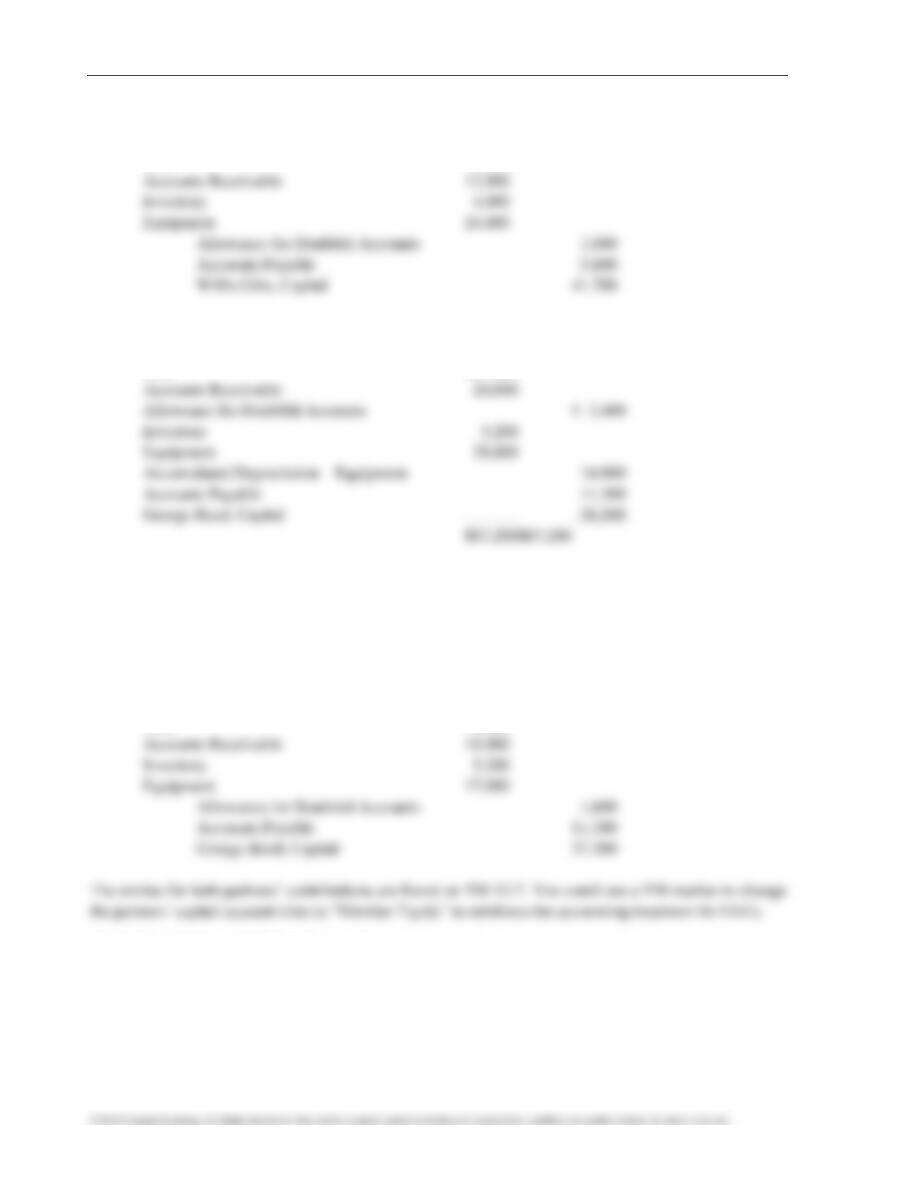
The partnership’s entry to record Gibs’s contribution is as follows:
Cash 8,500
Just before the partnership is formed, the trial balance of Reed Landscaping (TM 12-6) is as follows:
Cash $14,000
Reed has agreed to transfer all of his business assets and liabilities except $4,000 of his cash. The partners
agree that Reed’s equipment has a current market value of $17,000. In addition, it is agreed that $2,000 of
Reed’s accounts receivable should be written off as uncollectible, and a $1,600 allowance for doubtful
accounts will be sufficient for future bad debts.
The partnership’s entry to record Reed’s contribution is as follows:
Cash 10,000
SUGGESTED APPROACH — Dividing the Net Income and Loss of a
Partnership
Use TM 12-8 to explain the steps in allocating partnership income/loss. Following that explanation, use
the Demonstration Problems below to show one or more examples of how partnership income is
allocated.

Chapter 12 Accounting for Partnerships and Limited Liability Companies 201
DEMONSTRATION PROBLEM — Division of Net Income/Net Loss
The partnership agreement of Gibs and Reed Landscaping provides an $18,000 salary allowance to Willis
Gibs and a $24,000 salary allowance to George Reed. Both partners are given 10 percent interest on their
capital balances at the beginning of the year. The beginning capital balance for Gibs was $41,700 and for
Reed, $37,300. Any remaining income or loss is shared equally.
Assume that the business had net income of $56,000 during its first year of operations. Calculate the net
income distributed to each partner.
Gibs Reed Total
Salary allowance $18,000 $24,000 $42,000
You may want to point out that allocating a portion of the partnership income as interest on each partner’s
capital account provides an incentive for partners to retain investments in the business. Ask your class if it
is more equitable to allocate interest on the partners’ beginning capital balances, end-of-year balances, or
Assume that the business formed by Gibs and Reed had net income of $40,000 during its first year of
operations. Calculate the net income distributed to each partner.
Gibs Reed Total
Salary allowance $18,000 $24,000 $42,000
Assume that the Gibs/Reed partnership agreement has the following provisions:
1. Salary allowances are $20,000 for Gibs and $30,000 for Reed.

202 Chapter 12 Accounting for Partnerships and Limited Liability Companies
Gibs Reed Total
Salary allowance $20,000 $30,000 $50,000
Remainder = $18,000
GROUP LEARNING ACTIVITY — Closing Entries for a Partnership
Divide your class into small groups. Instruct them to prepare the entry to close the income summary
account for Gibs and Reed Landscaping under each of the preceding scenarios. The correct closing entries
are illustrated on TM 12-9.
LECTURE AID — Partnership Financial Statements
The textbook illustrates that the division of net income may be reported at the bottom of the partnership
income statement. Otherwise, there are no differences between the income statements for a partnership
and a sole proprietorship.
OBJECTIVE 3
Describe and illustrate the accounting for partner admission and withdrawal.
A partnership is dissolved whenever there is any change in the ownership of a partnership. When a
partner leaves the firm or a new partner is added, legally the former partnership is dissolved and a new
partnership must be formed. Many partnerships provide for admitting new partners and for partner
withdrawals by amending the existing partnership agreement. Under this provision, the company may
continue to operate without having to form a new partnership and prepare a new partnership agreement.

Chapter 12 Accounting for Partnerships and Limited Liability Companies 203
LECTURE AID — Admission of a New Partner
TMs 12-10 and 12-11 outline the two methods for admitting a new partner: (1) purchase of a partnership
interest from one or more of the current partners and (2) contribution of new assets to the partnership.
The purchase of a partnership interest from current partners is a transaction between the new partner and
existing partners acting as individuals. It is not a transaction between the new partner and the partnership.
DEMONSTRATION PROBLEM — Admission of a New Partner through
Contribution of New Assets
Melanie Sherby and Nancy Libby operate a partnership. Sherby’s capital account balance is $47,000 and
Libby’s is $36,000. Sherby and Libby have decided to admit a new partner to their business—Jim Fittro.
Fittro will contribute $20,000 cash to receive a one-third interest in the partnership. Prior to admitting
Fittro, Sherby and Libby hired a certified public accountant to determine the current market values of the
partnership assets. The CPA determined that the building owned by the partnership has a market value
$15,000 greater than the book value shown on the financial statements. In addition, the partnership’s
inventory is undervalued by $2,000 in the accounting records. Sherby and Libby share any income/loss
equally.
a. Revalue the partnership assets.
b. Determine the total equity of the partnership after the new partner is admitted.

c. Determine the new partner’s share of the total equity.
d. Compare the new partner’s equity to his contribution.
Fittro’s equity in the partnership $40,000
Instead, assume that Fittro had contributed $80,000 to join the partnership.
a. Revalue the partnership assets.
Building 15,000
b Determine the total equity of the partnership after the new partner is admitted.
Sherby, capital ($47,000 + $8,500) $ 55,500
d. Compare the new partner’s equity to his contribution.

Chapter 12 Accounting for Partnerships and Limited Liability Companies 205
Entry to record admission:
Cash 80,000
WRITING EXERCISE — Admission of a Partner
To stimulate critical thinking, ask your students to write answers to the following questions (TM 12-12):
1. Why are the assets contributed by each partner recorded at their current market values?
2. In what circumstances would existing partners be willing to pay a bonus to a new partner?
Possible response: If the new partner brings additional value in the form of expertise, management
DEMONSTRATION PROBLEM — Withdrawal of a Partner
Remind students that a partner generally cannot withdraw without permission of the remaining partners,
nor can a partner be forced to withdraw by the other partners. When a partner does withdraw from a
partnership, he or she may either sell his or her interest in the partnership to another individual or sell the
interest directly to the partnership. For example, assume Bruce Jordan, Ken Kohlenberg, and Dan Greene
are partners in a music publishing business with capital accounts of $28,000, $42,000, and $35,000,
respectively. Jordan has decided to retire. Prepare the journal entry to record Jordan’s retirement under
the three independent assumptions that follow.
1. Jordan sells half of his interest to Kohlenberg and half to Greene. Each partner pays $10,000.
2. Jordan sells his entire interest in the partnership to Bob Ruckman for $25,000.

206 Chapter 12 Accounting for Partnerships and Limited Liability Companies
3. Jordan sells his interest directly to the partnership. Jordan will receive cash equal to the value of his
capital account after all partnership assets are adjusted to their current market values. If the
partnership does not have sufficient cash to pay Jordan, a liability may be created for the amount
owed the withdrawing partner.
The partnership currently has $17,000 in cash. The book value of its inventory is $5,000 below the
current market value. The book value of its equipment is $8,000 greater than the current market
value. The three partners split income or losses equally. To revalue the partnership assets:
Inventory 5,000
To record Jordan’s withdrawal:
Death of Partner
You may wish to mention the steps taken when a partner dies:
1. Close the partnership accounts as of the date of death.
3. Adjust asset accounts to current values and divide adjustments among the partners’ capital accounts.
5. Remaining partner or partners decide to continue or liquidate the business.
OBJECTIVE 4
Describe and illustrate the accounting for liquidating a partnership.
KEY TERMS
Deficiency Realization
Liquidation Statement of Partnership Liquidation

Chapter 12 Accounting for Partnerships and Limited Liability Companies 207
SUGGESTED APPROACH
There are two basic scenarios when partnerships are liquidated: (1) All partners end up with a positive
capital balance and receive cash or (2) one or more of the partners ends up with a negative capital
balance. If a partner has a negative capital balance, that partner should contribute cash to the partnership
equal to his or her deficit so that the remaining partners may receive the cash they are due. If the partner is
unwilling or unable to make up this deficit, his or her deficit must be allocated to the remaining partners.
DEMONSTRATION PROBLEM — Partnership Liquidation
Mary Hills, Beth Smith, and Kathy Grove are partners in HSG Pharmaceutical Company. They decide to
liquidate their partnership when the partners have capital balances of $45,000, $48,000, and $22,000,
respectively. The partnership has $13,000 in cash, $128,000 of noncash assets, and $26,000 in liabilities.
The noncash assets are sold for $78,000. The partners split all income/losses using a 4:3:3 ratio. (Note:
All gains and losses in liquidation are split using the partners’ income-sharing ratio.)
Noncash Capital
Cash Assets Liabilities Hills Smith Grove
Beginning balance 13,000 128,000 26,000 45,000 48,000 22,000
Assets sold + 78,000 –128,000 –20,000 –15,000 –15,000
Balance 91,000 0 26,000 25,000 33,000 7,000
Pay liabilities –26,000 –26,000
Balance 65,000 0 0 25,000 33,000 7,000
In this case, all three partners end up with a positive balance in their capital accounts. All partners will
receive cash equal to their capital balances.
What if the noncash assets of HSG Pharmaceutical Company were sold for $48,000?
Noncash Capital
Cash Assets Liabilities Hills Smith Grove
Beginning balance 13,000 128,000 26,000 45,000 48,000 22,000
In this case, Grove has a deficit in her capital balance. If Grove will contribute the $2,000 needed to make
up her capital deficiency, the partnership will have $37,000 in cash, of which $13,000 will be distributed
to Hills and $24,000 to Smith. If Grove will not contribute an additional $2,000 to the partnership, her
deficit must be split between Hills and Smith in their 4:3 ratio, as follows:

208 Chapter 12 Accounting for Partnerships and Limited Liability Companies
Noncash Capital
Cash Assets Liabilities Hills Smith Grove
Beginning balance 13,000 128,000 26,000 45,000 48,000 22,000
Assets sold + 48,000 – 128,000 –32,000 –24,000 –24,000
In this case, the $35,000 cash is distributed to Hills and Smith, based on their capital balances after
Grove’s deficit is allocated. Point out that the most common error in partnership liquidation is the
improper distribution of cash to partners. It is wise to always double-check these calculations and
compare them to any liquidation procedures outlined in the partnership agreement.
After completing this explanation, ask your students to journalize the accounting entries to record this
third scenario (noncash assets sold for $48,000; Grove does not contribute cash to make up her deficit).
Solution:
Cash 48,000
Loss on realization 80,000

Chapter 12 Accounting for Partnerships and Limited Liability Companies 209
OBJECTIVE 5
Prepare the statement of partnership equity.
KEY TERMS
Statement of Members’ Equity
Statement of Partnership Equity
SUGGESTED APPROACH
TM 12-3 lists the names of the equity reports for each form of business. In reality, the equity reports for
proprietorships, partnerships, and limited liability companies (LLCs) are all built on the basic structure
(TM 12-4):
Capital, beginning of the year
+ Investments (also called “Capital Additions”)
+ Net Income (or – Net Loss)
– Withdrawals
Capital, end of the year
Use the Group Learning Activity below to review the equity reports for proprietorships, partnerships, and
LLCs.
GROUP LEARNING ACTIVITY — Equity Reports for Proprietorships,
Partnerships, and LLCs
Handout 12-1 presents a statement of owner’s capital for Vince Gray, owner of Woodhaven Spas. Divide
your students into groups and ask them to complete the handout. It will instruct them to modify the
statement of owner’s capital assuming Vince has a partner. Next, the handout will instruct them to modify
the statement of partnership capital, assuming the business is organized as an LLC. The goal of this
activity is to point out the similarity in equity reporting for proprietorships, partnerships, and LLCs.
The solution is provided below. Note that the change from partnership to LLC will change the
headings to Vince Grey, Member; Anita Carnes, Member; and Total LLC Capital. The amounts
will not change.

210 Chapter 12 Accounting for Partnerships and Limited Liability Companies
Woodhaven Spas
Statement of Owner’s Capital
For the Year ended December 31, 2012
Vince Gray,
Capital
Anita Carnes,
Capital
Total Partnership
Capital
Balance,
Jan. 1
$120,000
75,000
195,000
Net Income
$ 87,000
22,000
109,000
Less: Withdrawals
($61,000)
(13,000)
(74,000)
Balance,
Dec. 31
$161,000
91,000
252,000
Investments
$ 15,000
7,000
22,000
OBJECTIVE 6
Analyze and interpret employee efficiency.
KEY TERMS
Revenue per Employee
SUGGESTED APPROACH
This ratio is often used by service-oriented enterprises to measure the average revenue on a per-employee
basis. Comparisons may be made for the same company for different time periods, one company to its
industry average, or one company to another company in the same industry. Remind students that
comparisons across industries aren’t usually useful since the operations among industries are different
insofar as their use of their labor force.

Handout 12-1
Woodhaven Spas
Statement of Owner’s Capital
For the Year ended December 31, 2012
Vince Gray,
Capital
Balance,
Jan. 1
$120,000
Investments
$ 15,000
Net Income
$ 87,000
Less: Withdrawals
($61,000)
Instructions:
1. Modify the above report, assuming Woodhaven Spas is organized as a partnership. Vince’s
partner is Anita Carnes. Anita’s capital balance on January 1 was $75,000. During the year,
2. Next, modify the above report, assuming Woodhaven Spas is organized as a limited liability
corporation. If possible, make these changes in pen.
DIFFICULTY
BUSPROG
AICPA AICPA ACBSP ACBSP BLOOM’S TIME
Problem
Learning
Objective
Description Primary
Broad
Business
Functional Primary Secondary
Spread–
sheet
GL
DQ12-1 12-1 Easy Analytic Measurement Business Forms Knowledge 5 min.
DQ12-2 12-1 Easy Analytic Measurement Partnership Knowledge 5 min.
DQ12-3 12-1 Easy Analytic Measurement Partnership Knowledge 5 min.
DQ12-4 12-1 Easy Analytic Measurement Partnership Knowledge 5 min.
DQ12-5 12-2 Easy Analytic Measurement Partnership Knowledge 5 min.
DQ12-6 12-3 Easy Analytic Measurement Partnership Knowledge 5 min.
DQ12-7 12-3 Easy Analytic Measurement Partnership Knowledge 5 min.
DQ12-8 12-3 Easy Analytic Measurement Partnership Knowledge 5 min.
DQ12-9 12-3 Easy Analytic Measurement Partnership Knowledge 5 min.
DQ12-10 12-3 Easy Analytic Measurement Partnership Knowledge 5 min.
Journalize partner’s original
PE12-1A 12-2
investment
Easy Analytic Measurement Partnership Application 5 min.
PE12-1B 12-2
Journalize partner’s original
investment
Easy Analytic Measurement Partnership Application 5 min.
PE12-2A 12-2 Dividing partnership net income Easy Analytic Measurement Partnership Application 5 min.
PE12-2B 12-2 Dividing partnership net net income Easy Analytic Measurement Partnership Application 5 min.
PE12-3A 12-3
a partnership
Easy Analytic Measurement Partnership Application 5 min.
PE12-3B 12-3
a partnership
Easy Analytic Measurement Partnership Application 5 min.
PE12-4A 12-3 Partner bonus Easy Analytic Measurement Partnership Application 5 min.
PE12-4B 12-3 Partner bonus Easy Analytic Measurement Partnership Application 5 min.
PE12-5A 12-4 Liquidating partnerships Easy Analytic Measurement Partnership Application 5 min.
PE12-5B 12-4 Liquidating partnerships Easy Analytic Measurement Partnership Application 5 min.
PE12-6A 12-4 Liquidating partnerships-deficiency Easy Analytic Measurement Partnership Application 5 min.
PE12-7A 12-6 Revenue per employee Easy Analytic Measurement Partnership Application 10 min.
PE12-7B 12-6 Revenue per employee Easy Analytic Measurement Partnership Application 10 min.
HOMEWORK CHART WITH LEARNING OUTCOMES TAGGING

DIFFICULTY
BUSPROG
AICPA AICPA ACBSP ACBSP BLOOM’S TIME
Problem
Learning
Objective
Description Primary
Broad
Business
Functional Primary Secondary
Spread–
sheet
GL
Ex12-1 12-2 Record partner‘s original investment Easy Analytic Measurement Partnership Application 10 min.
Recording partner’s original
Ex12-2 12-2
investment
Easy Analytic Measurement Partnership Application 10 min.
Ex12-3 12-2 Dividing partnership income Easy Analytic Measurement Partnership Application 15 min.
Ex12-4 12-2 Dividing partnership income Easy Analytic Measurement Partnership Application 15 min.
Ex12-5 12-2 Dividing partnership net loss Easy Analytic Measurement Partnership Application 5 min.
Ex12-6 12-2 Negotiating income-sharing ratio Moderate Analytic Measurement Partnership Application 10 min.
Ex12-7 12-2 Dividing LLC income Easy Analytic Measurement Partnership Application 10 min.
Ex12-8 12-2, 12-5
statement of members’ equity
Moderate Analytic Measurement Partnership Application 15 min.
Ex12-9 12-2
Partner income and withdrawal
journal entries
Moderate Analytic Measurement Partnership Application 15 min.
Ex12-10 12-3 Admitting new partners Easy Analytic Measurement Partnership Application 5 min.
Ex12-11 12-3
Admitting new partners who buy an
interest and contribute assets
Easy Analytic Measurement Partnership Application 10 min.
Ex12-12 12-3
contributes assets
Easy Analytic Measurement Partnership Application 10 min.
Ex12-13 12-3 Admitting new partner with bonus Moderate Analytic Measurement Partnership Application 15 min.
Admitting new LLC member with
Ex12-14 12-3
bonus
Moderate Analytic Measurement Partnership Application 15 min.
Ex12-15 12-3 Admitting new partner with bonus Moderate Analytic Measurement Partnership Application 15 min.
Ex12-16
12-2, 12-3,
12-5
Partner bonuses, statement of
partners‘ equity
Ex12-17 12-3 Withdrawal of partner Moderate Analytic Measurement Partnership Application 15 min.
Ex12-18
12-2, 12-3,
12-5
Statement of members‘ equity,
admitting new member
Challenging Analytic Measurement Partnership Application 20 min.
Ex12-19 12-4 Distribution of cash upon liquidation Easy Analytic Measurement Partnership Application 5 min.
Ex12-20 12-4 Distribution of cash upon liquidation Easy Analytic Measurement Partnership Application 5 min.
Ex12-21 12-4
deficiency
Easy Analytic Measurement Partnership Application 15 min.
Ex12-22 12-4 Distribution of cash upon liquidation Easy Analytic Measurement Partnership Application 10 min.
Ex12-23 12-4
deficiency
Easy Analytic Measurement Partnership Application 5 min.
Ex12-24 12-4 Statement of partnership liquidation Moderate Analytic Measurement Partnership Application 15 min. X
Ex12-25 12-4 Statement of LLC liquidation Moderate Analytic Measurement Partnership Application 15 min. X

DIFFICULTY
BUSPROG
AICPA AICPA ACBSP ACBSP BLOOM’S TIME
Problem
Learning
Objective
Description Primary
Broad
Business
Functional Primary Secondary
Spread–
sheet
GL
Ex12-26 12-2, 12-5
partners’ equity
Moderate Analytic Measurement Partnership Application 15 min. X
Ex12-27 12-6 Revenue per professional staff Easy Analytic Measurement Partnership Application 10 min.
Ex12-28 12-6 Revenue per employee Easy Analytic Measurement Partnership Application 10 min.
Pr12-1A 12-2
partnership
Moderate Analytic Measurement Partnership Application 1 hour X X
Pr12-2A 12-2 Dividing partnership income Moderate Analytic Measurement Partnership Application 1 hour
Pr12-3A 12-2, 12-5 Financial statements for partnership Challenging Analytic Measurement Partnership
Financial
Statements
Application 1.5 hours X
Pr12-4A 12-3 Admitting new partner Challenging Analytic Measurement Partnership Application 1.5 hours X
Pr12-5A 12-4 Statement of partnership liquidation Moderate Analytic Measurement Partnership Application 1 hour X
Pr12-6A 12-4 Statement of partnership liquidation Moderate Analytic Measurement Partnership Application 1 hour X
Pr12-1B 12-2
partnership
Moderate Analytic Measurement Partnership Application 1 hour X X
Pr12-2B 12-2 Dividing partnership income Moderate Analytic Measurement Partnership Application 1 hour
Pr12-3B 12-2, 12-5
partnerships
Challenging Analytic Measurement Partnership Application 1.5 hours X
Pr12-4B 12-3 Admitting new partner Challenging Analytic Measurement Partnership Application 1.5 hours X
Pr12-5B 12-4 Statement of partnership liquidation Moderate Analytic Measurement Partnership Application 1 hour X
Pr12-6B 12-4 Statement of partnership liquidation Moderate Analytic Measurement Partnership Application 1 hour X
CP12-1 12-1 Partnership agreement Easy Ethics Industry Partnership Analysis 10 min.
CP12-2 12-2 Dividing partnership income Easy Analytic Measurement Partnership Analysis 10 min.
CP12-3 12-6 Revenue per employee Moderate Analytic Measurement Partnership Analysis 20 min.
CP12-5 12-1 Information on LLC Moderate Analytic Measurement Partnership Knowledge 20 min.