12
Fundamentals of Management Control Systems
Solutions to Review Questions
12–1.
Decentralization is the delegation of decision-making authority to subordinates in an
organization.
12–2.
In a decentralized organization, subordinates (agents) make decisions on behalf of the
owners (principals). Performance measurement is important, because it allows principals
to assess how well subordinates are doing their job.
12–3.
The advantages of decentralization include:
• Better use of local knowledge;
12–4.
Dysfunctional decision-making is the situation in which local managers make decisions in
their interests, which can differ from the interests of the organization.
12–5.
The three elements of a management control system are:
1. Delegated decision authority
3. Compensation and reward systems.
12–6.
The five basic kinds of decentralized units in a responsibility accounting system are:
1. Cost centers;
3. Revenue centers;
5. Investment centers.
12–7.
Goal congruence refers to agreement by all members of a group or an organization on a
common set of objectives. Behavioral congruence refers to alignment of individual
behavior with the best interests of the group, regardless of the individual’s own goals.
12–8.
12–9.
12–10.
Contingent compensation is compensation that is based (contingent) on measured
performance.
12–11.
The dual-rate method of corporate cost allocation separates corporate costs into fixed and
variable components and then allocates the two components using different allocation
bases.

12–12.
Separation of duties helps prevent financial fraud because it limits the opportunity to
commit the fraud. When a separation of duties exists, two or more individuals must
engage in collusion to commit fraud. While collusion can and does occur, it increases the
Solutions to Critical Analysis and Discussion Questions
12–13.
Local managers often have better information about local conditions. This information is
12–14.
Sales people can often influence costs by offering expedited delivery or other “extras” that
do not reduce the revenue used to determine commissions but can increase costs.
12–15.
12–16.
The division president would be the principal relative to subordinate managers.
12–17.
There is a strong incentive to “find” $100,000 in income. The manager might defer
12–18.
Although there are well-developed standards for many accounting transactions,
accounting decisions still depend on the judgment of managers. There are also many
estimates (for example, the depreciable lives of fixed assets) that are subject to
managerial discretion. Performance measures based on accounting estimates are
affected by these judgments, just as are the reported accounting numbers.
12–19.
Frequently managers will wait until near the end of the budget period to make
discretionary expenditures. Sometimes managers will use “excess” funds from one period
12–20.
The service costs are being allocated on the basis of use when, in fact, some of the costs
were incurred to provide capacity. Dual rates might be established so that the capacity
12–21.
The allocation method affects the costs (and profits in a profit center) of the different units.
If a manager’s compensation depends on costs or profits, he or she will have an interest in
showing as good performance as possible. This means that although one allocation
method led to better performance (as measured) in one unit, a different allocation method
will likely show better performance in the new unit.
12–22.
Large divisions are, all other things being equal, more likely to rank in the upper half.
12–23.
Although there is no explicit bonus, better performance is likely to lead to greater chances
for promotion (and higher salary).
12–24.
Answers will vary. There are many reasons for pay not to reflect performance. In some
cases, the reasons are because of collusion or other unethical or illegal reasons. Some
other reasons, which might be defensible for business reasons include a desire to keep
certain managers or how the performance of the firm compared to that of competitors.
It is important when discussing performance measurement that the performance of the
manager(s) be separated from the performance of the company (or business unit). Often,
the managers might be performing well (poorly) although the organization is performing
poorly (well). It is not uncommon for companies to place their best managers in units that
are struggling.
12–25.
In many cases managers are content to take a stated salary and perform optimally.
However, in other organizations managers appear to perform better when given profit
targets and other incentive devices. Lower-level managers are also closer to their
respective markets. With an incentive system, these managers are more likely to take
actions to respond to changes in their respective markets. However, an executive
manager elects the performance evaluation and incentive system that is best for the
specific organization. Hence, these comments would make sense in the right organization
setting.
12–26.
The Treadway Commission listed the pressures to achieve unrealistically high, short-term

12–27.
Two explanations for the existence of unrealistic profit objectives for division managers are
that upper management might be uninformed about the division, and that they might be
12–28.
Committing financial fraud in the current period might seem to outweigh future problems
that the fraud might cause. The perpetrator of the fraud might be promoted before the
negative consequences of the fraud are revealed. Alternatively, the perpetrator of fraud
might believe he or she will be fired if the short-run targets are not met, so he or she has
little to lose by committing fraud to meet the targets.

Solutions to Exercises
12–29. (15 min.) Evaluating Management Control Systems: Chama Car Detailing.
a. Based on the company’s method for measuring performance, Deana has done well.
The actual wage was $3.01 (= $20.13 – $17.12) below the target wage. Mike has not
performed well. Actual profits are $108,000 (= $745,000 – $637,000) below target
profits.
b. The management control system at Chama is possibly flawed. The low actual wages
might indicate that the quality of employees hired is below the level needed to achieve
the target profits. For example, the employees hired might require more training than
12–30. (20 min.) Evaluating Management Control Systems – Ethical Considerations:
Magnolia Manufacturing.
a. Income with the new technique will be $7.2 million (= $6 million × 1.20) or 20% above
target. Without the new technique, there will be no bonus. With the new technique,
Kevin’s bonus will be 2% (= 20% ÷ 10) of salary, or $3,600 (= 2% × $180,000).
Michelle’s bonus will be 2% or $4,800 (= 2% × $240,000).
c. Income with the new technique will be $5.76 million (= $4.8 million × 1.20) or below the
target profit. Neither Kevin nor Michelle will be eligible for the bonus.
d. Kevin should not consider his bonus when deciding whether to employ the technique.
If he finds that the current management control system leads to incentives to take
actions not in the interests of the company, he should identify these to the CFO or
another executive responsible for the system.
12–31. (15 min.) Management Control Systems and Incentives: DC.
This problem represents part of the incentive plan of a U.S.-based international
conglomerate. This part of the incentive system was designed to focus managers on
maximizing short-term earnings.
a. This plan creates the following incentives for division managers:
• Short-term orientation.
• Incentives to manipulate accounting numbers to meet targets.
b. Is this a good plan? Would you want to be a division manager?
• It’s a good plan if the company wants a short-run, financial focus, which it does.
• The plan does not encourage inter-division activity. Each “tub” (i.e., division) is on
its own “bottom.”
12–32. (15 min.) Management Control Systems and Incentives: Heavy.
This problem represents the change in an incentive plan at a company that
manufactures machinery and engines. In negotiating a wage contract with the
employees’ union, the company offered and the union agreed to a profit-sharing
arrangement for workers instead of a wage increase. This agreement provided two
good results from management’s point of view. First, the employees took on some risk
because part of their pay was a function of profits instead of a fixed amount regardless
of the company’s profit performance. Second, the arrangement addressed bad press
that the company received because it had paid the workers “so little” while making ‘big
profits.” Although management talked about the motivational effect of profit sharing, it
acknowledged the reality that an individual worker had so little effect on company
profits that there was no real motivational effect of the profit-sharing plan.
12–33. (10 min.) Advantages and Disadvantages of Decentralization: Whole Foods.
E. Both A and B. Whole Foods likely hoped that local managers had better knowledge
of suppliers in the area and the tastes and interests of local customers. Although
there might be some savings of management time, it is not likely an important
benefit, because top managers would generally not be involved with day–to-day
sourcing decisions. There also might be some training and motivational benefits to
allowing managers to make operational decisions, but that is unlikely to be the main
reason.
12–34. (10 min.) Advantages and Disadvantages of Decentralization: Whole Foods.

12–35. (10 min.) Organization Structure and Responsibility Centers: Worldwide
Electronics.
Manager
Responsibility Center
1. Jill Green, Corporate Personnel Officer
C. Discretionary cost center
2. Katya Borodina, Sales Manager, Peru
E. Revenue center
3. Jay Smith, Chief Executive Office
A. Investment center
4. Andres Goya, Vice-President, South America
B. Profit center
5. Irene Chan, Mexico City Plant Manager
D. Cost center
12–36. (15 min.) Alternative Allocation Bases: Bartolo Delivery.
a. Number of calls basis.
Air Express
490,000
× $8,000,000 = $5,600,000
490,000 + 210,000
Ground Service
210,000
× $8,000,000 = $2,400,000
490,000 + 210,000
Check: $8,000,000 = $5,600,000 + $2,400,000
b. Time on Network
× $8,000,000 = $2,000,000
× $8,000,000 = $6,000,000

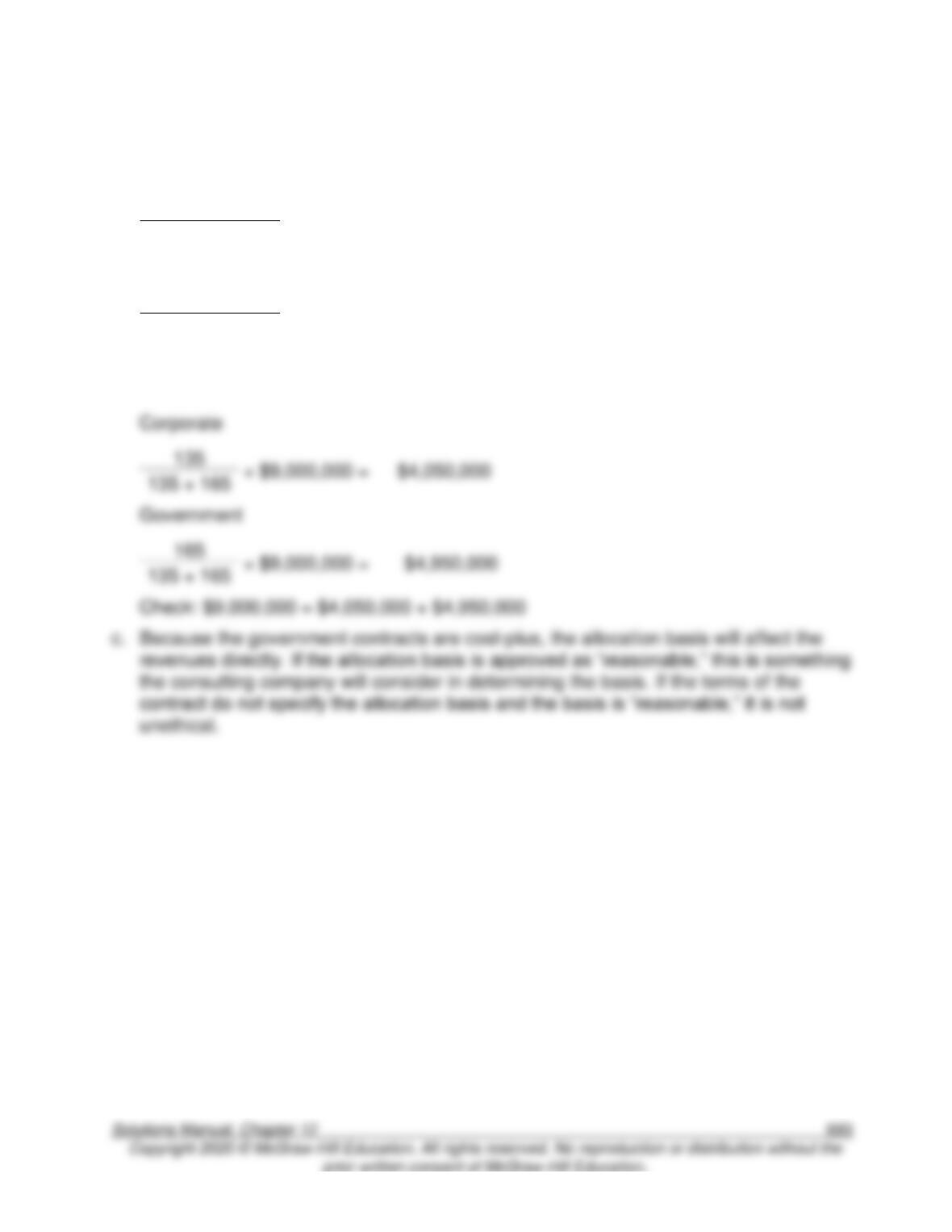
12–37. (10 min.) Single versus Dual Rates: Bartolo Delivery.
Air Express
Fixed
350,000
× $5,200,000 =
$1,300,000
350,000 + 1,050,000
Variable
490,000
× $2,800,000 =
1,960,000
490,000 + 210,000
Total
$3,260,000
Ground Service
× $2,800,000 =
12–38. (20 min.) Single versus Dual Rates—Ethical Considerations.
a. Gigabytes of Storage Basis
Corporate
97,500
× $9,000,000 =
$5,850,000
97,500 + 52,500
Government
52,500
× $9,000,000 =
$3,150,000
97,500 + 52,500
Check: $9,000,000 = $5,850,000 + $3,150,000
b. Number of Consultants Basis
× $9,000,000 =
× $9,000,000 =

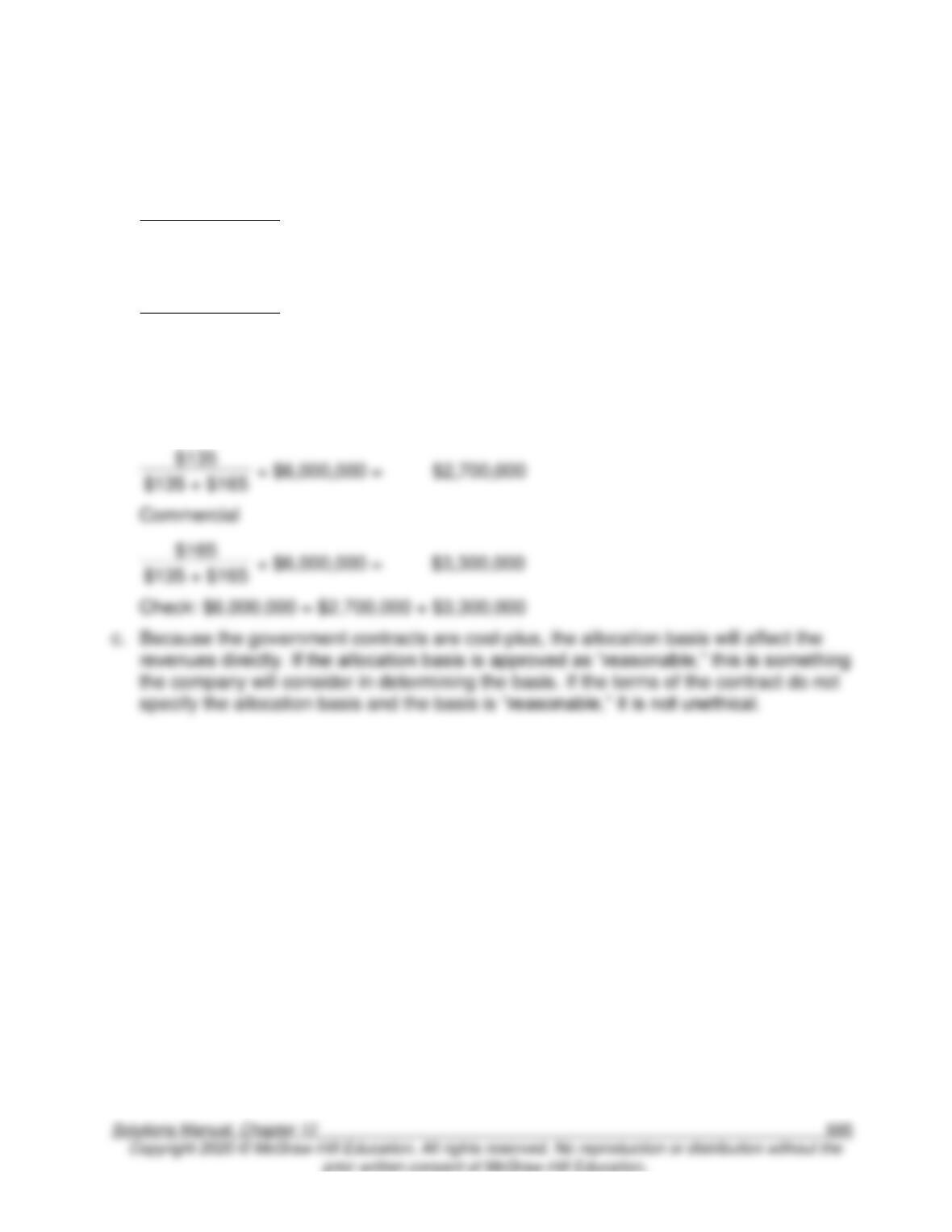
12–39. (25 min.) Single versus Dual Rates.
Corporate
Fixed
135
× $7,000,000 =
$3,150,000
135 + 165
Variable
97,500
× $2,000,000 =
1,300,000
97,500 + 52,500
Total
$4,450,000
× $7,000,000 =
$3,850,000
× $2,000,000 =
12–40. (20 min.) Alternative Allocation Bases: Thompson Aeronautics.
a. Number of Purchase Orders Basis
Defense
7,500
× $6,000,000 =
$900,000
7,500 + 42,500
Commercial
42,500
× $6,000,000 =
$5,100,000
7,500 + 42,500
Check: $6,000,000 = $900,000 + $5,100,000
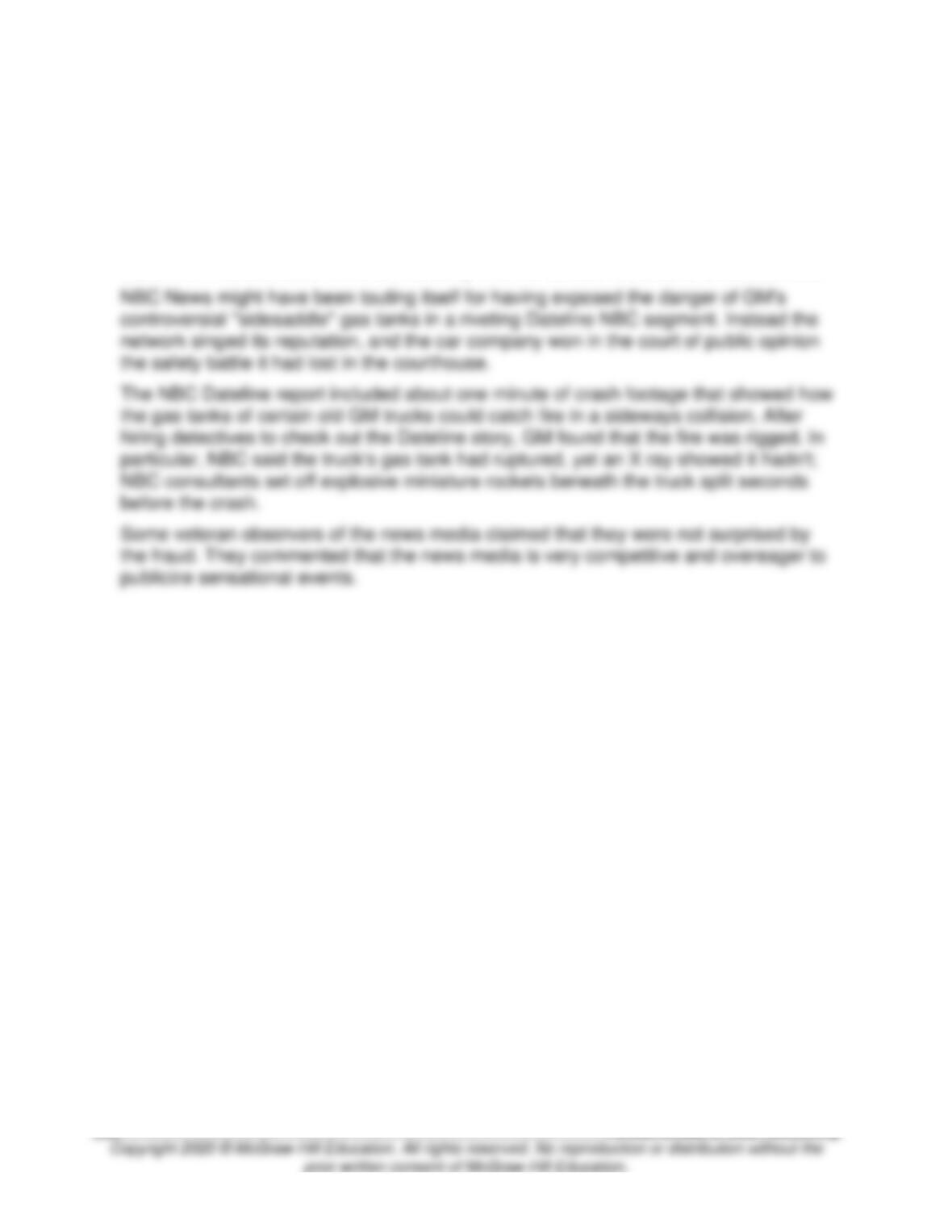
b. Dollar Amount of Purchases Basis
Defense
× $6,000,000 =
× $6,000,000 =
12–41. (20 min.) Tone at the Top – Ethics.
This case refers to an incident reported by NBC’s Dateline. The news group committed
fraud (not financial fraud) when it rigged the GM trucks to blow up. The executive in
this case set a tone that the behavior was not the problem, but getting caught was. The
news group believed that the GM trucks would explode upon collision, they just didn’t
in the demonstration for the cameras. This is analogous to executives believing that
their companies are performing well, but the financial statements just don’t show that
the company is performing well. So the executives “dress up” (that is, commit fraud) to
make the financial statements tell the story that the executives believe should be told.
12–42. (20 min.) Incentives and Ethics.
The situation in this question is based on an actual case. In the actual case, the
fraudulent activities were discovered by people who worked in the accounting
department who discovered the invoices and shipping documents tucked away in the
desk drawer of the accountant who colluded to commit the fraud. The “friend” was
among those charged with the fraud because she knew about it and was suspected to
be involved. She was eventually cleared of wrongdoing, but not until after several
years of defending herself against the charges. She lost her job, and she spent a lot of
time defending herself.
12–43. (20 min.) Internal Controls.
a. The internal control is separation of duties between producing the sandwich and the
financial transaction of recording the sale and taking the money. This separation of
duties is a key element of internal controls. By separating production (that is, sandwich
making) from the financial transaction, the shop owner is reasonably assured that the
sandwich maker is not giving away free sandwiches, or even charging the customer for
a half sandwich when the customer got a full sandwich. Separation of duties prevents
12–44. (20 min.) Internal Controls.
a. The internal control is separation of duties. Because the most senior member pays for
the meal, his or her expense report will be reviewed by someone who was not at the
meal. If a more junior person paid for the meal, the expense report might be reviewed
and approved by someone attending the meal, who might have an incentive to
approve “extravagant” expenditures. This separation of duties is a key element of
internal controls.