CHAPTER 12
Statement of Cash Flows
Learning Objectives
1. Indicate the usefulness of the statement of cash flows.
2. Distinguish among operating, investing, and financing activities.
3. Explain the impact of the product life cycle on a company’s cash flows.
4. Prepare a statement of cash flows using the indirect method.
5. Use the statement of cash flows to evaluate a company.
*6. Prepare a statement of cash flows using the direct method.
Summary of Questions by Learning Objectives and Bloom’s Taxonomy
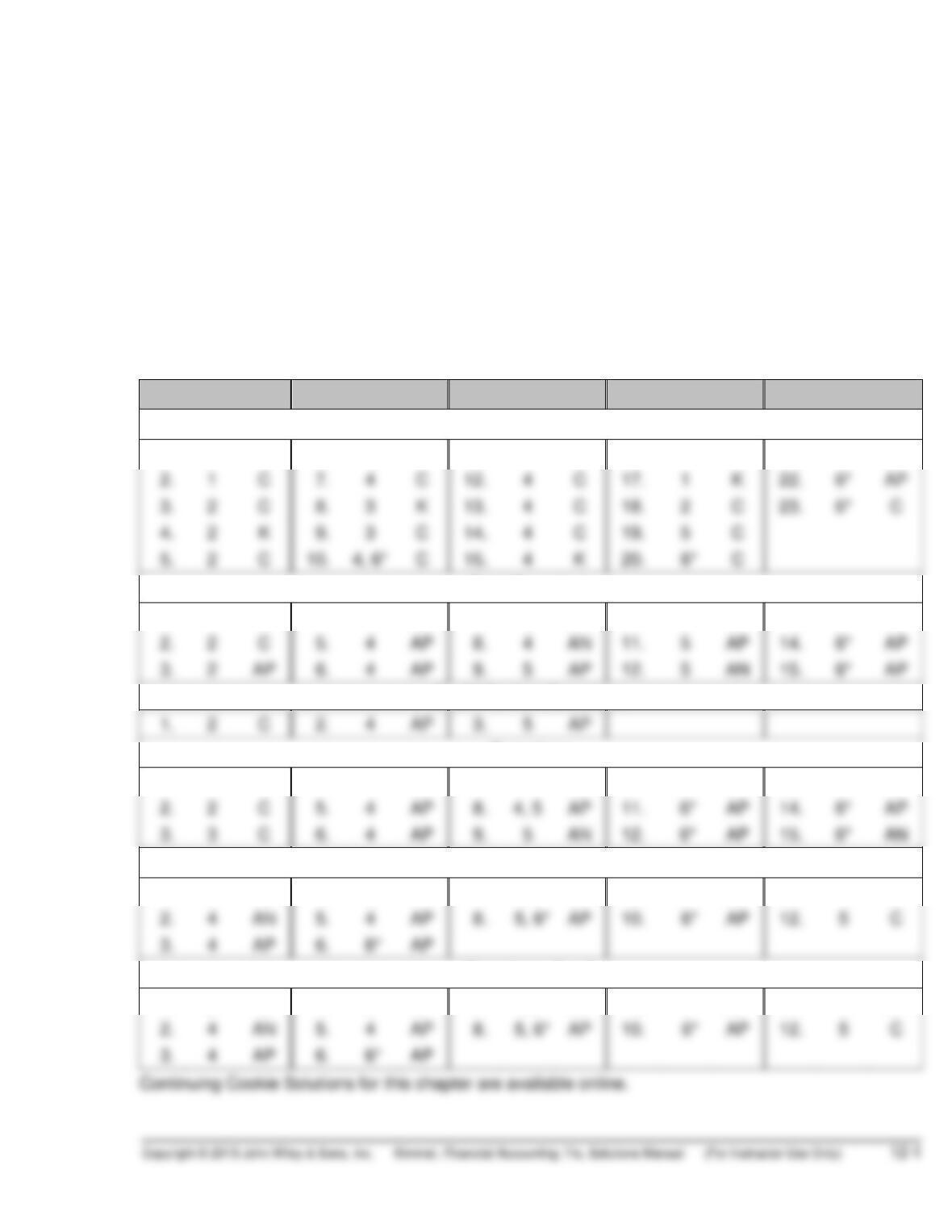
Item LO BT Item LO BT Item LO BT Item LO BT Item LO BT
Questions
1. 1 C 6. 2 K 11. 2 C 16. 4 C 21. 6* K
Brief Exercises
1. 2 K 4. 3 C 7. 4 AP 10. 5 AP 13. 6* AP
Do It! Review Exercises
Exercises
1. 2 C 4. 4 AP 7. 4 AN 10. 5 AN 13. 6* AP
Problems: Set A
1. 2 C 4. 6* AP 7. 4, 5 AP 9. 4 AP 11. 4 AP
Problems: Set B
1. 2 C 4. 6* AP 7. 4, 5 AP 9. 4 AP 11. 4 AP
ASSIGNMENT CHARACTERISTICS TABLE
Problem
Number
Description
Difficulty
Level
Time
Allotted (min.)
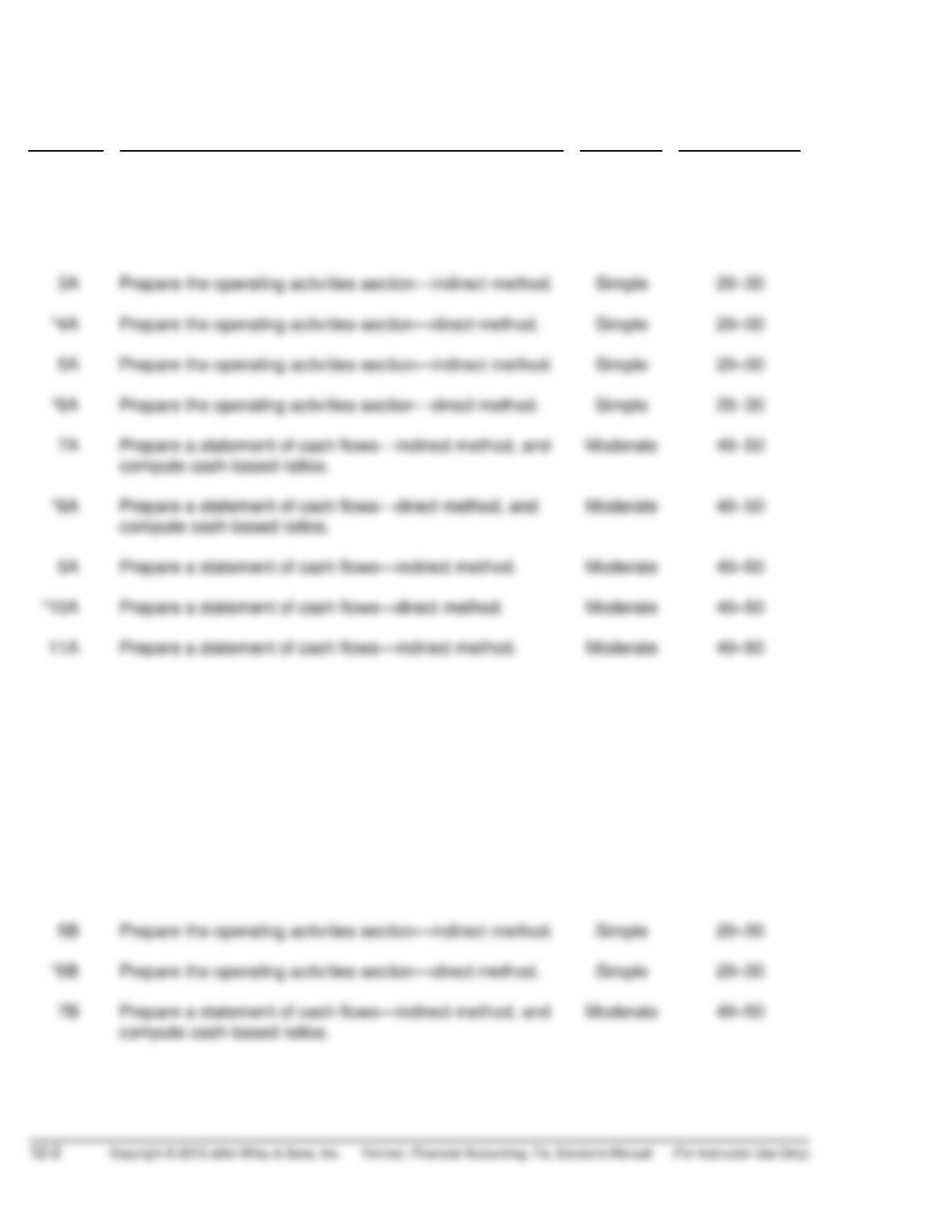
1A Distinguish among operating, investing, and financing
activities.
Simple 10–15
2A Determine cash flow effects of changes in equity accounts. Simple 10–15
12A Identify the impact of transactions on ratios. Moderate 25–35
1B Distinguish among operating, investing, and financing
activities.
Simple 10–15
2B Determine cash flow effects of changes in plant asset
accounts.
Simple 10–15
3B Prepare the operating activities section—indirect method. Simple 20–30
*4B Prepare the operating activities section—direct method. Simple 20–30
ASSIGNMENT CHARACTERISTICS TABLE (Continued)
Problem
Number
Description
Difficulty
Level
Time
Allotted (min.)
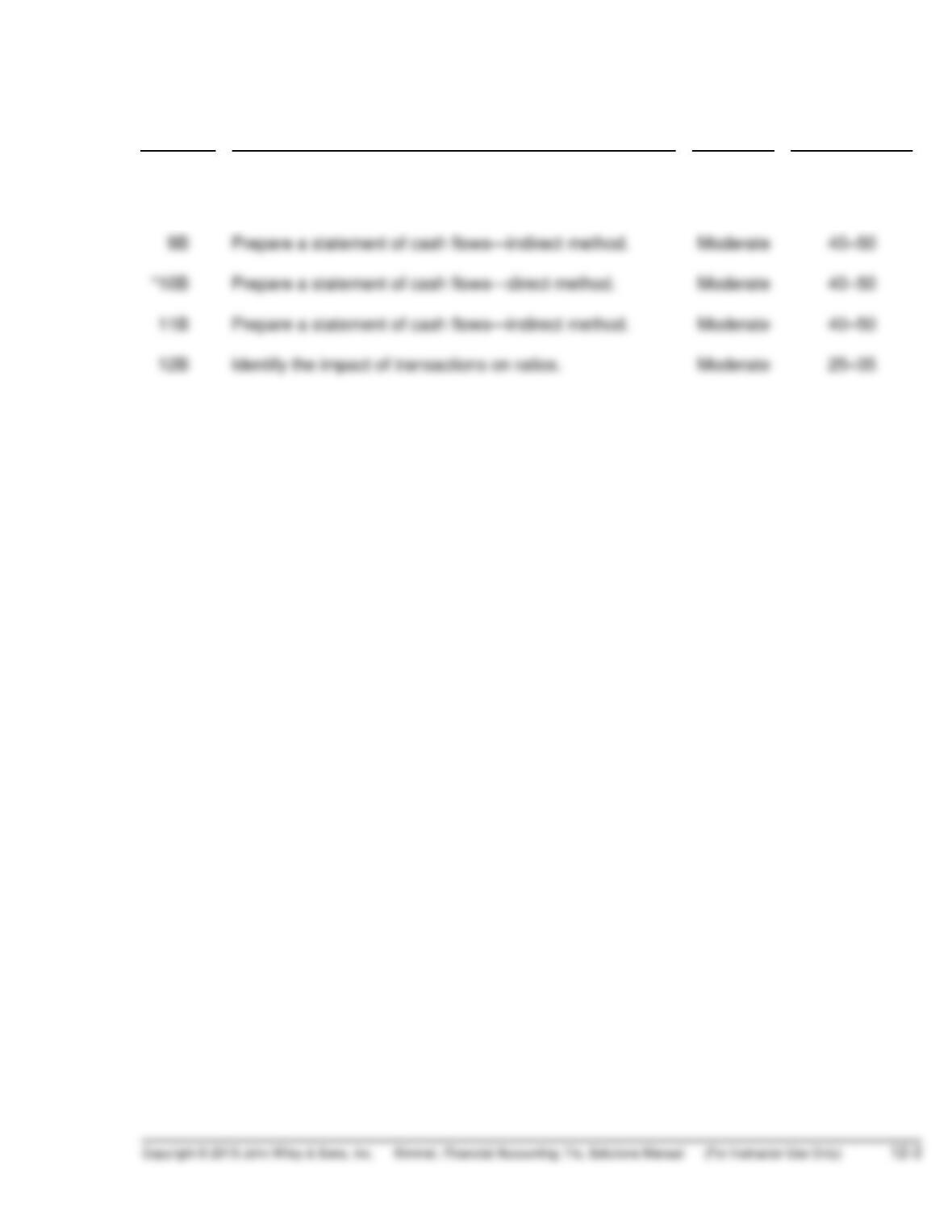
*8B Prepare a statement of cash flows—direct method, and
compute cash-based ratios.
Moderate 40–50
ANSWERS TO QUESTIONS
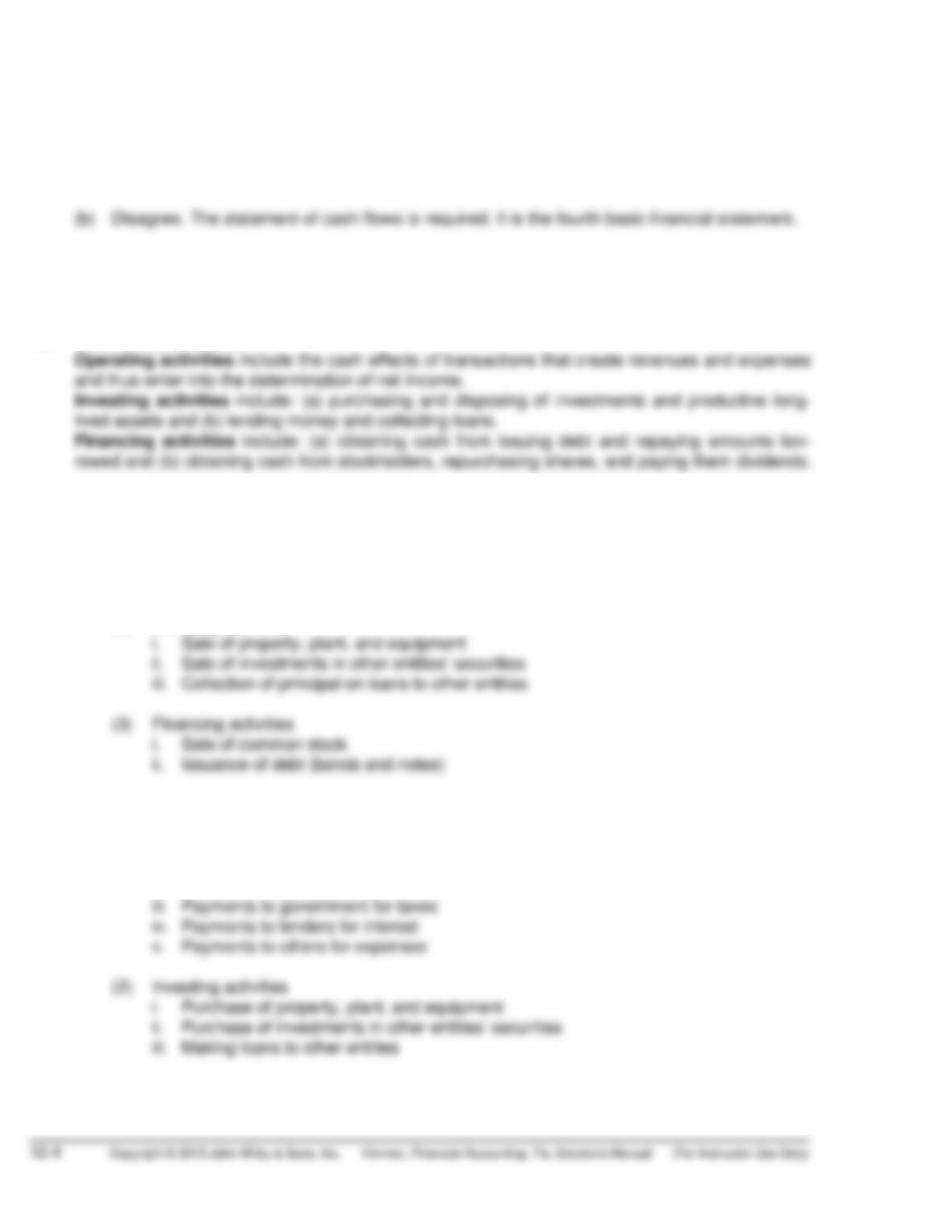
1. (a) The statement of cash flows reports the cash receipts and cash payments from operating,
investing, and financing activities during a period in a format that reconciles the beginning
and ending cash balances.
2. The statement of cash flows answers the following questions about cash: (a) Where did the cash
come from during the period? (b) What was the cash used for during the period? and (c) What
was the change in the cash balance during the period?
3. The three activities are:
4. (a) The sources of cash (inflows) in the statement of cash flows come from:
(1) Operating activities
i. Sale of goods or services
ii. Interest and dividends received
(2) Investing activities
(b) The uses of cash (outflows) in the statement of cash flows come from:
(1) Operating activities
i. Payments to suppliers for inventory
ii. Payments to employees for services
Questions Chapter 12 (Continued)
(3) Financing activities
i. Payment of cash dividends to stockholders
ii. Redeeming principal of long-term debt
iii. Payment to reacquire capital stock (treasury stock)
5. The statement of cash flows presents investing and financing activities so that even noncash
transactions of an investing and financing nature are disclosed in the financial statements. If they
6. Examples of significant noncash activities are: (1) issuance of stock for assets, (2) conversion of
bonds into common stock, (3) issuance of bonds or notes for assets, and (4) noncash exchanges
of property, plant, and equipment.
7. Comparative balance sheets, a current income statement, and certain transaction data all provide
information necessary for preparation of the statement of cash flows. Comparative balance sheets
8. (a) The phases of the corporate life cycle are the introductory phase, growth phase, maturity
phase, and decline phase.
(b) During the introductory phase, net cash provided by operating and investing activities would
9. Tootsie Roll has positive net cash provided by operating activities that exceeds its net income.
Net cash provided by operating exceeded its investing needs and it retired shares of stock and
paid dividends. Tootsie Roll appears to be in the middle to late maturity phase.
10. The advantage of the direct method is that it presents the major categories of cash receipts and
cash payments in a format that is similar to the income statement and familiar to statement users.
Its principal disadvantage is that the necessary data can be expensive and time-consuming to
accumulate.
Questions Chapter 12 (Continued)
11. When total cash inflows exceed total cash outflows, the excess is identified as a “net increase in
cash” near the bottom of the statement of cash flows.
12. The indirect method involves converting accrual net income to net cash provided (used) by
operating activities. This is done by starting with accrual net income and adjusting for items that
13. It is necessary to convert accrual basis net income to cash basis income because the unadjusted
net income includes items that do not provide or use cash. An example would be an increase in
14. A number of factors could have caused an increase in cash despite the net loss. These are (1) high
cash revenues relative to low cash expenses; (2) sales of property, plant, and equipment; (3) sales
15. Student answers will vary, however the five items selected should come from the following list:
Depreciation/amortization/depletion expense.
16. Under the indirect method, depreciation is added back to net income to reconcile net income to net
cash provided (used) by operating activities because depreciation is an expense but not a cash
payment.
17. The statement of cash flows is useful because it provides information to the investors, creditors,
and other users about: (1) the company’s ability to generate future cash flows, (2) the company’s
18. This transaction is reported in the note or schedule entitled “Noncash investing and financing
activities” as follows: “Acquired land through issuance of common stock, $1,700,000.”
*20. Net cash provided (used) by operating activities under the direct approach is the difference
between cash revenues and cash expenses. The direct approach adjusts the revenues and
expenses directly to reflect the cash basis. This results in cash net income, which is equal to “net
cash provided by operating activities.”
Questions Chapter 12 (Continued)
+ Decrease in accounts receivable
*21. (a) Cash receipts from customers = Revenues from sales – Increase in accounts receivable
*22. Sales revenue …………………………………………………………………………………………… $2,000,000
Add: Decrease in accounts receivable …………………………………………………………. 150,000
SOLUTIONS TO BRIEF EXERCISES
BRIEF EXERCISE 12-1
(a) Cash inflow from financing activity, $200,000.
BRIEF EXERCISE 12-2
(a) Investing activity. (d) Operating activity.
BRIEF EXERCISE 12-3
Cash flows from financing activities
Proceeds from issuance of bonds payable …………………… $300,000)
BRIEF EXERCISE 12-4
(a) Net cash provided by operating activities would be lower than net
income during the growth phase because inventory must be purchased
for future projected sales. Since sales during the growth phase are
(b) Cash from investing is often positive during the late maturity phase
and the decline phase because the firm may sell off excess long-term
assets that are no longer needed for productive purposes.
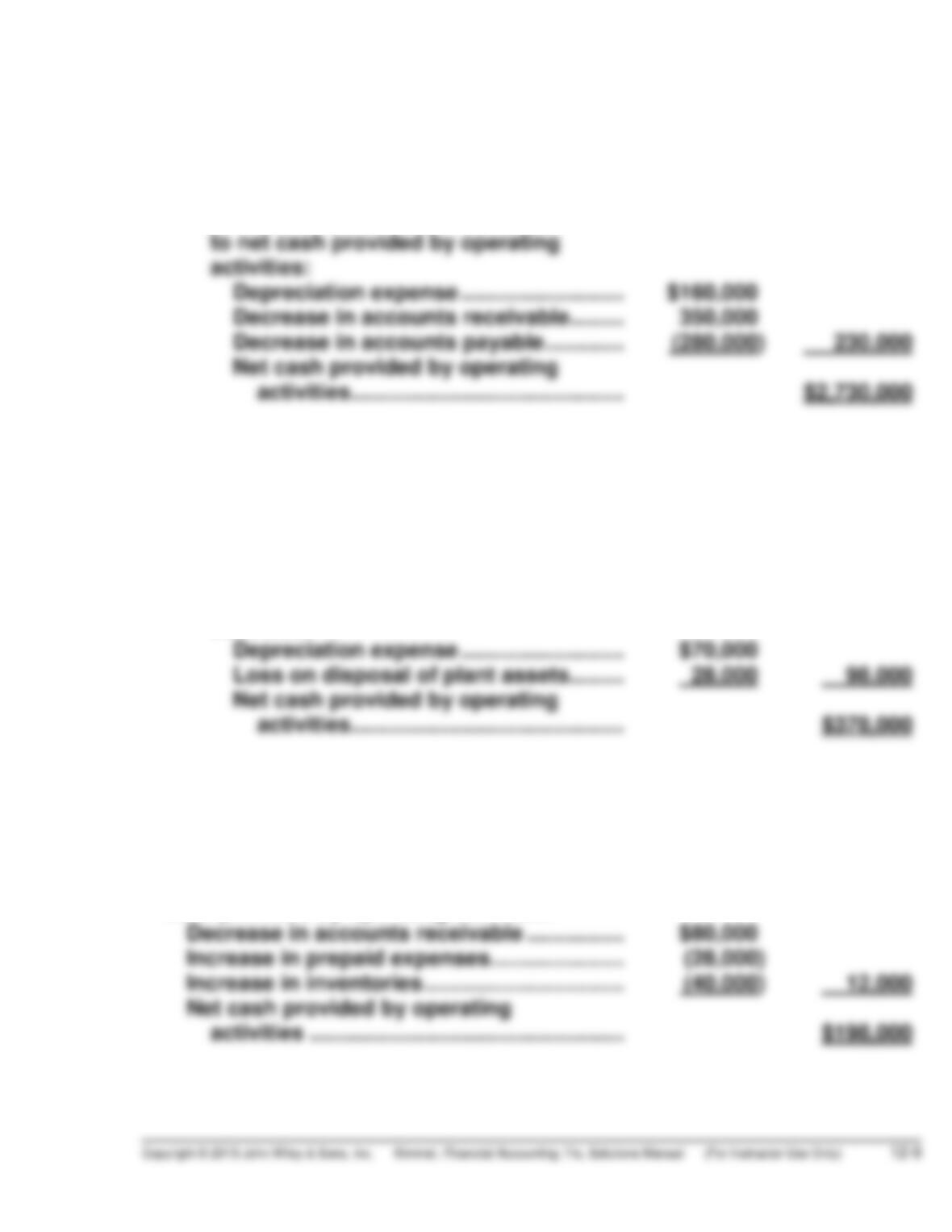
BRIEF EXERCISE 12-5
Net cash provided by operating activities is $2,730,000. Using the indirect
approach, the solution is:
Net income ……………………………………………. $2,500,000
Adjustments to reconcile net income
BRIEF EXERCISE 12-6
Cash flows from operating activities
Net income ……………………………………………. $280,000
Adjustments to reconcile net income
to net cash provided by operating
activities:
BRIEF EXERCISE 12-7
Net income …………………………………………………… $186,000
Adjustments to reconcile net income to net
cash provided by operating activities:
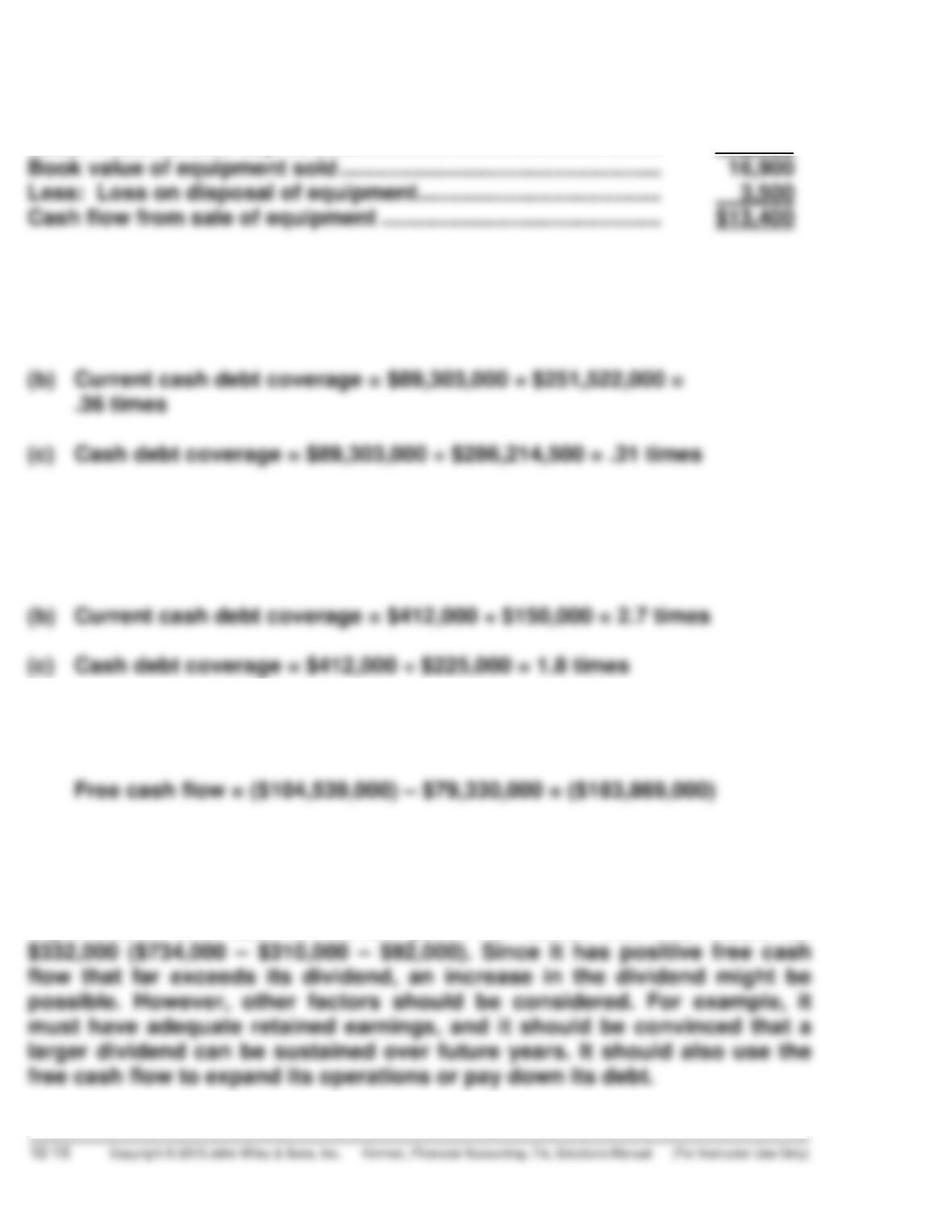
BRIEF EXERCISE 12-8
Original cost of equipment sold ………………………………………….. $22,000
Less: Accumulated depreciation ………………………………………… 5,100
BRIEF EXERCISE 12-9
(a) Free cash flow = $89,303,000 – $25,823,000 – $0 = $63,480,000
BRIEF EXERCISE 12-10
(a) Free cash flow = $412,000 – $200,000 – $0 = $212,000
BRIEF EXERCISE 12-11
BRIEF EXERCISE 12-12
Free cash flow is net cash provided by operating activities less capital
expenditures and cash dividends paid. For Unruh Inc. this would be
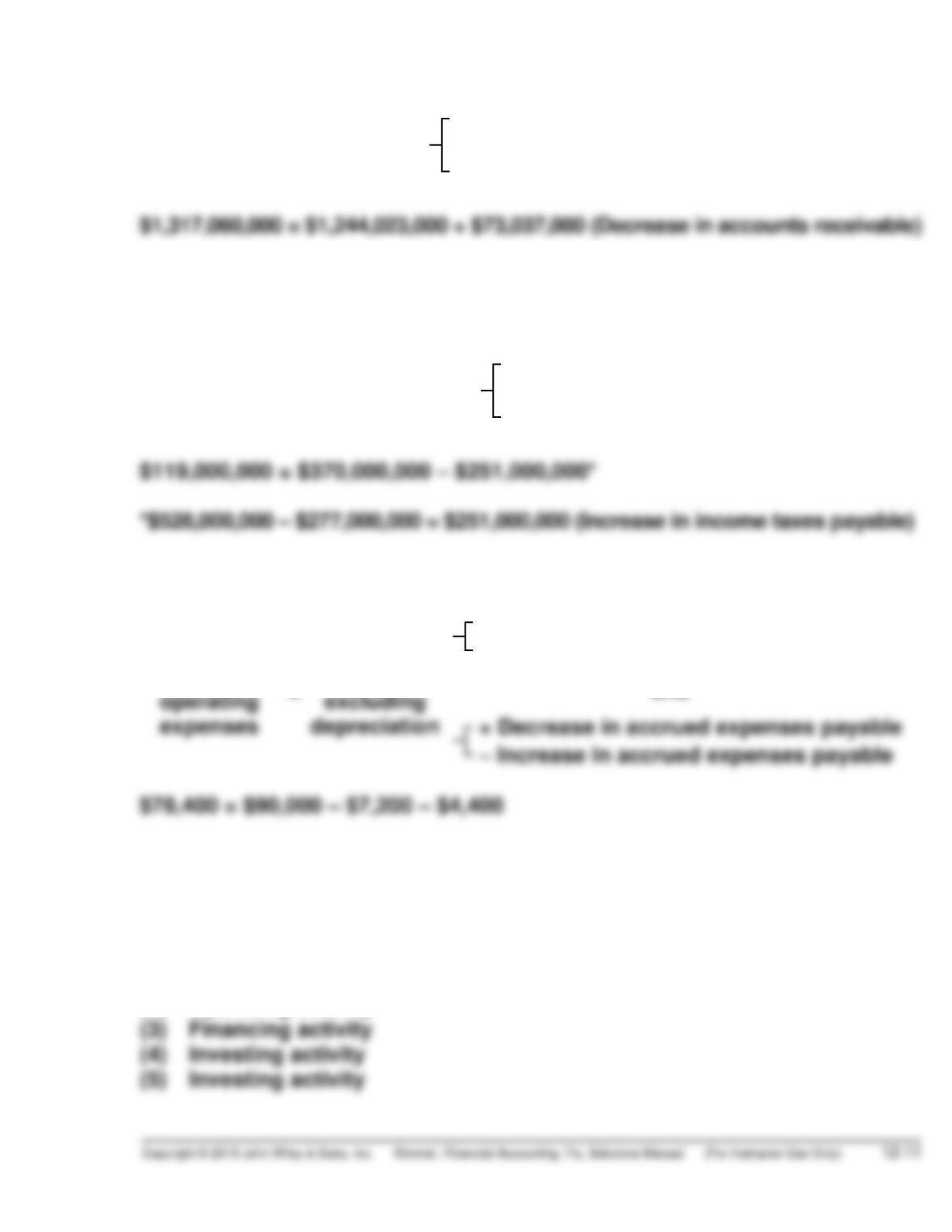
*BRIEF EXERCISE 12-13
+ Decrease in accounts receivable
Receipts from
customers = Sales
revenue – Increase in accounts receivable
*BRIEF EXERCISE 12-14
+ Decrease in income taxes payable
Cash payment
for income taxes = Income Tax
Expense – Increase in income taxes payable
*BRIEF EXERCISE 12-15
+ Increase in prepaid expenses
Cash
payments for
=
Operating
expenses,
– Decrease in prepaid expenses
and
SOLUTIONS TO DO IT! REVIEW EXERCISES
DO IT! 12-1
(1) Financing activity
(2) Operating activity
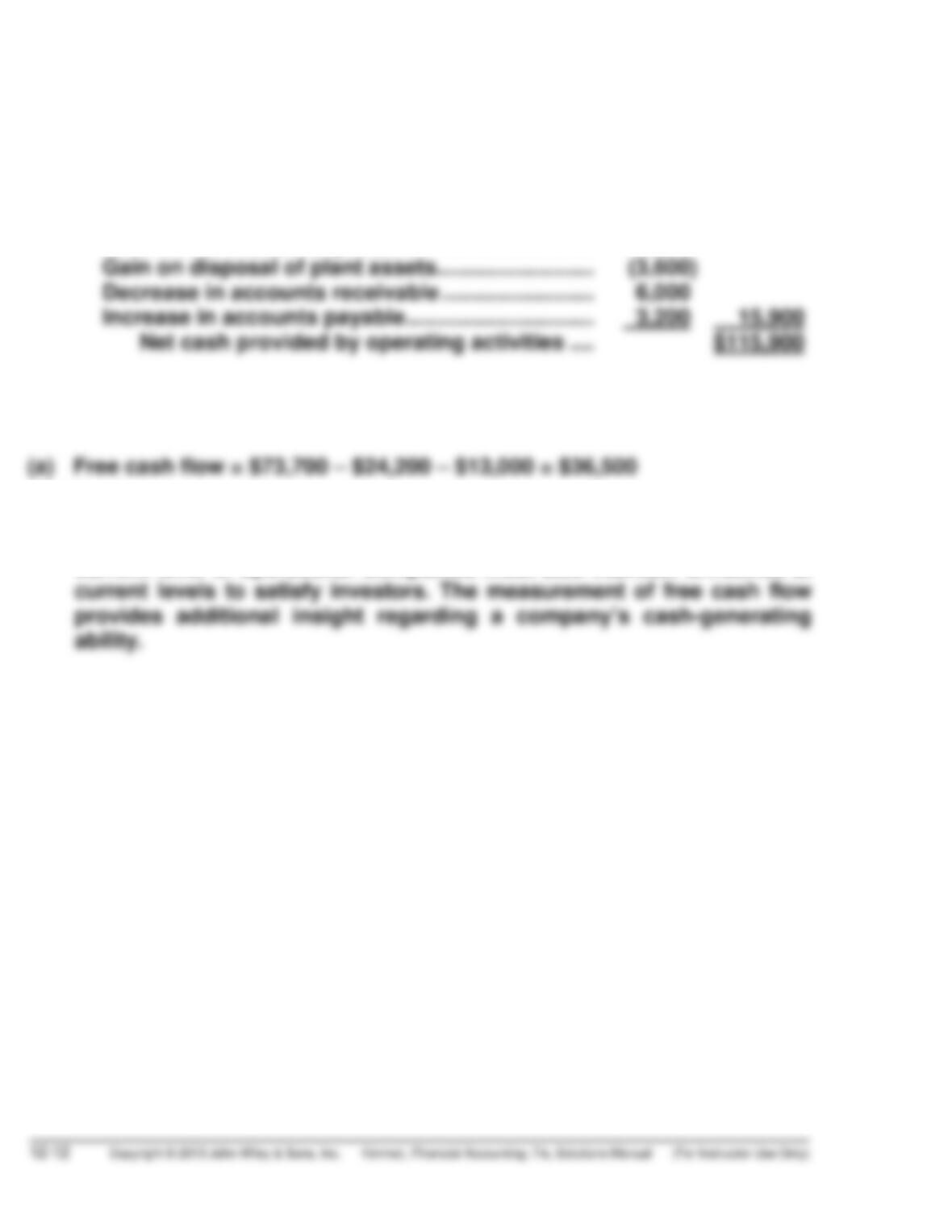
DO IT! 12-2
Cash flows from operating activities
Net income …………………………………………………………. $100,000
Adjustments to reconcile net income to net cash
provided by operating activities:
Depreciation expense ……………………………………. $6,300
Patent amortization expense ………………………….. 4,000
DO IT! 12-3
(b) Net cash provided by operating activities fails to take into account that
a company a must invest in new plant assets just to maintain the
current level of operations. Companies must also maintain dividends at
SOLUTIONS TO EXERCISES
EXERCISE 12-1
(a) Noncash investing and financing activities.
(b) Financing activities.
EXERCISE 12-2
(a)
(b)
Operating activity.
Noncash investing and
(h)
(i)
Financing activity.
Operating activity.
EXERCISE 12-3
Point in Time Phase
A
B
Introductory phase
Decline phase
EXERCISE 12-3 (Continued)
During the maturity phase (point C), net cash provided by operating
activities and net income would be approximately the same. Net cash
EXERCISE 12-4
COSI COMPANY
Partial Statement of Cash Flows
For the Year Ended December 31, 2014
Cash flows from operating activities
Net income ………………………………………………… $190,000
Adjustments to reconcile net income to net
cash provided by operating activities:
Depreciation expense …………………………. $35,000
EXERCISE 12-5
SANFORD INC.
Partial Statement of Cash Flows
For the Year Ended December 31, 2014
Cash flows from operating activities
Net income ……………………………………………….. $153,000
Adjustments to reconcile net income to net
cash provided by operating activities:
Depreciation expense …………………………. $27,000)
EXERCISE 12-6
RAMOS CORPORATION
Statement of Cash Flows—Indirect Method
For the Year Ended December 31, 2014
Cash flows from operating activities
Net income ………………………………………………………….. $284,100
Adjustments to reconcile net income to net cash
provided by operating activities:
Depreciation expense …………………………………… $162,000
Cash flows from investing activities
Sale of land ………………………………………………….. 35,000
Net increase in cash ……………………………………………. 335,900
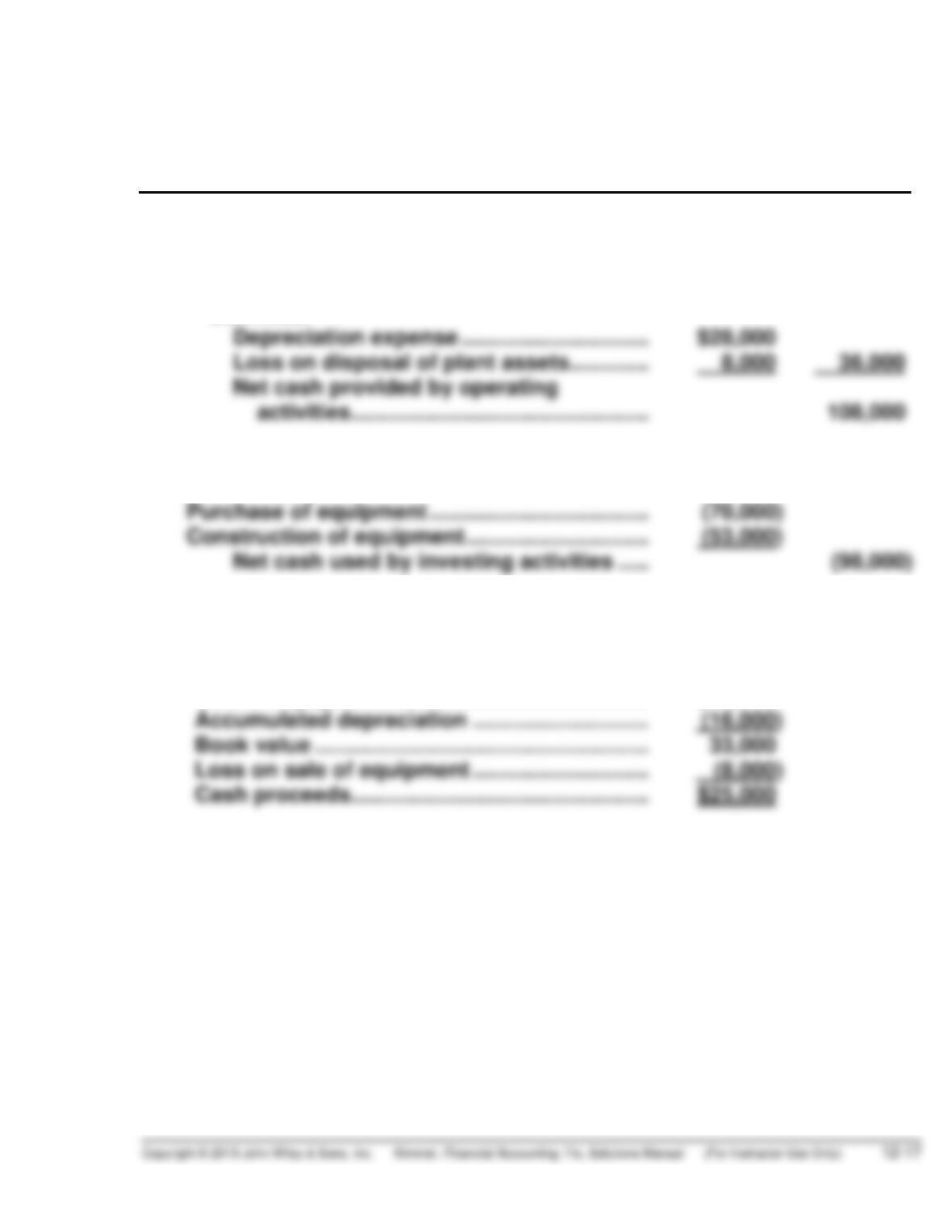
EXERCISE 12-7
LAUBER CORP
Partial Statement of Cash Flows
For the Year Ended December 31, 2014
Cash flows from operating activities
Net income ……………………………………………….. $ 72,000)
Adjustments to reconcile net income
to net cash provided by operating
activities:
Cash flows from investing activities
Sale of equipment ……………………………………… 25,000*
Cash flows from financing activities
Payment of cash dividends ……………………….. (14,000)
*Cost of equipment sold ……………………………. $49,000)
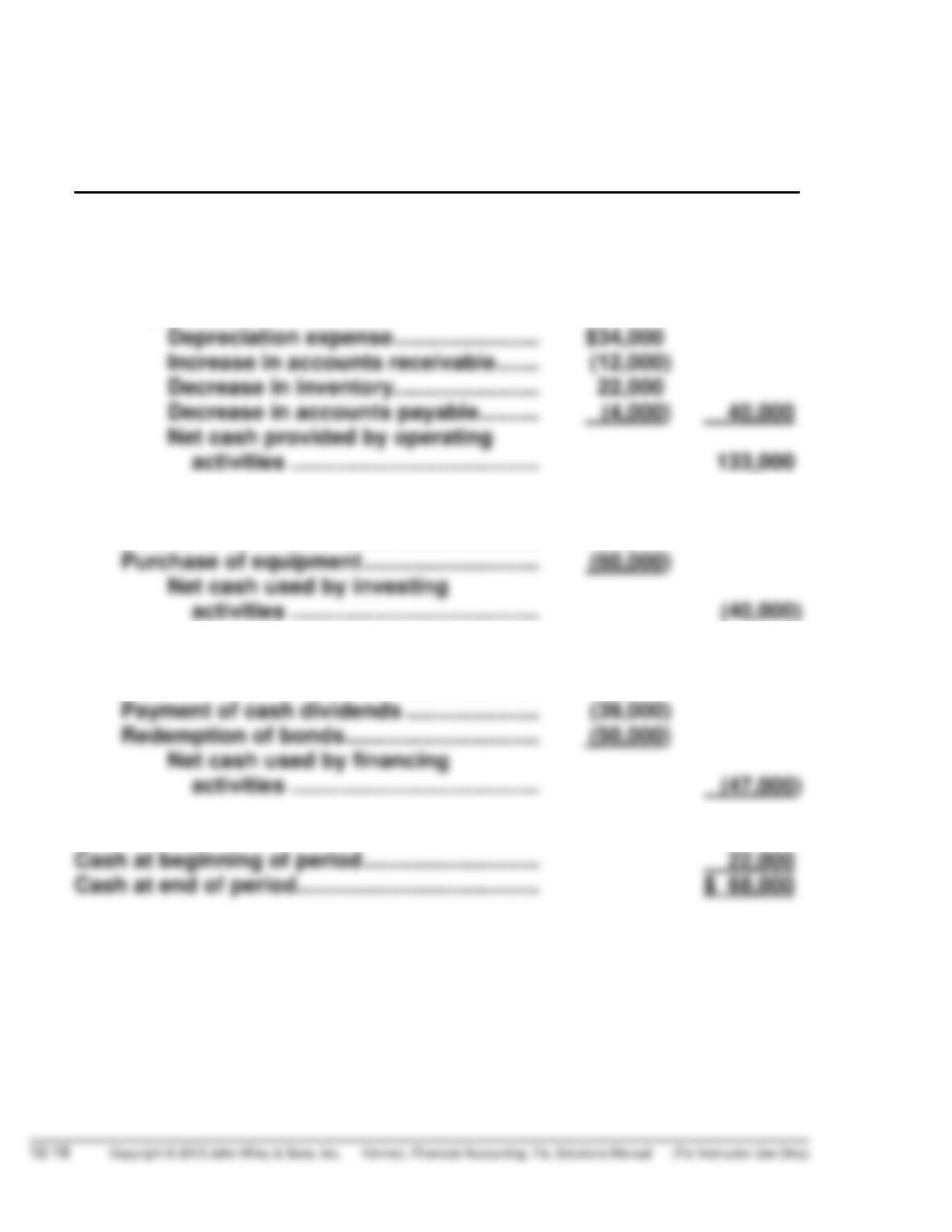
EXERCISE 12-8
(a) SCHMITT COMPANY
Statement of Cash Flows
For the Year Ended December 31, 2014
Cash flows from operating activities
Net income …………………………………………. $ 93,000)
Adjustments to reconcile net income
to net cash provided by operating
activities:
Cash flows from investing activities
Sale of land ………………………………………… 20,000)
Cash flows from financing activities
Issuance of common stock …………………. 42,000)
Net increase in cash ………………………………….. 46,000)
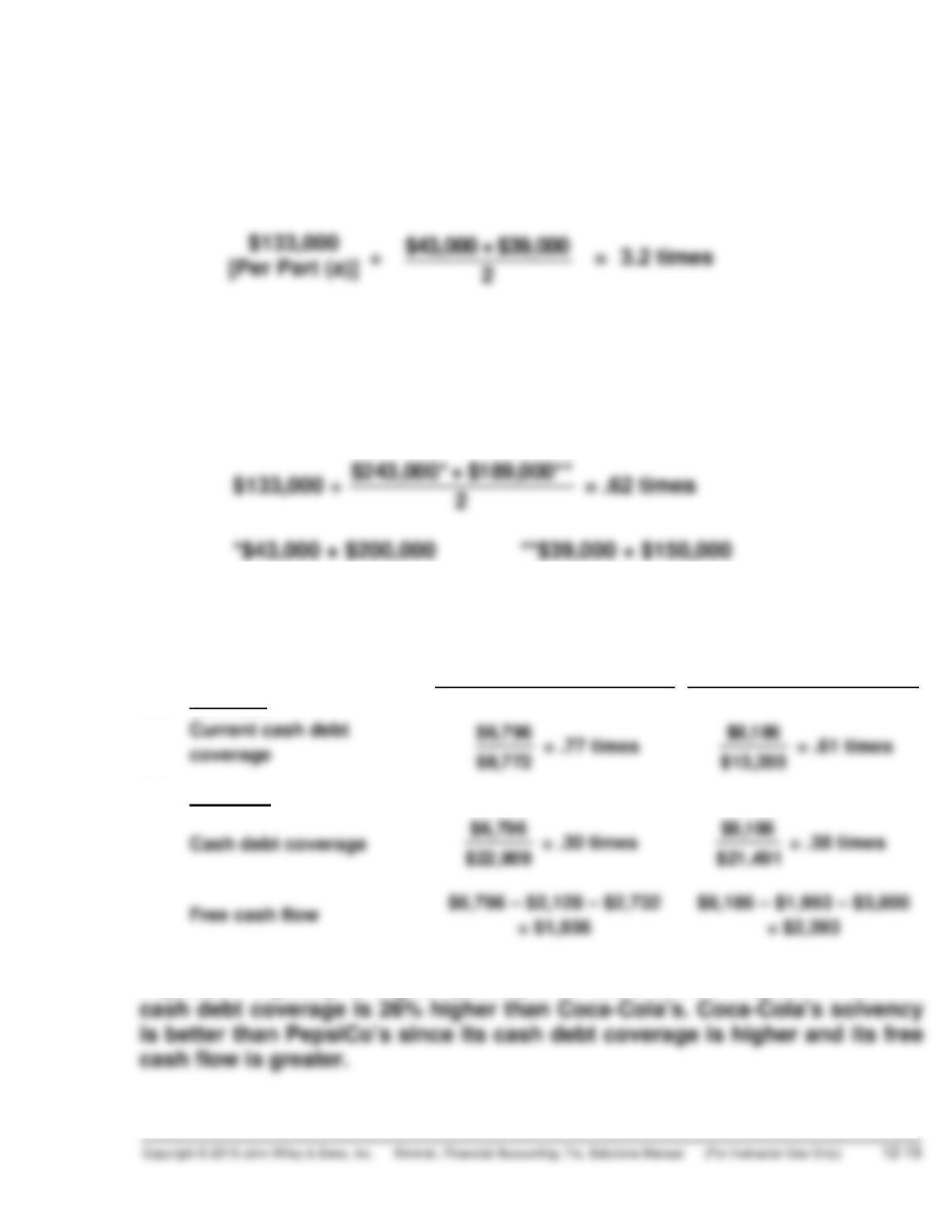
EXERCISE 12-8 (Continued)
(b) 1. Current cash debt coverage:
Net cash provided
by operating activities ÷
A
verage current
liabilities
2. Cash debt coverage:
Net cash provided
by operating activities ÷
A
verage total
liabilities
EXERCISE 12-9
PepsiCo Coca-Cola
(a) Liquidity
(b) Solvency
PepsiCo’s liquidity is higher (better) than Coca-Cola’s. PepsiCo’s current
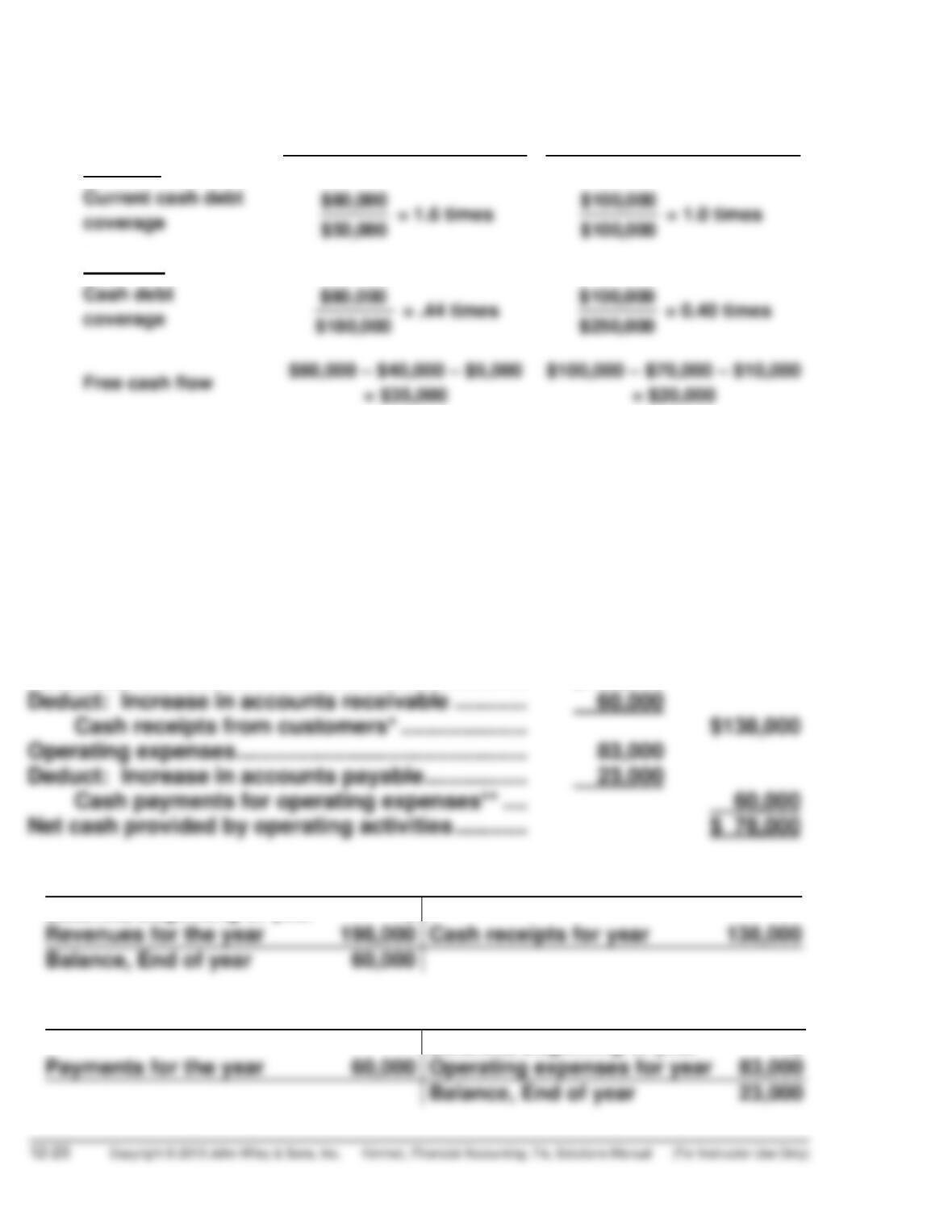
EXERCISE 12-10
Patton
Corporation
Sager
Corporation
(a) Liquidity
(b) Solvency
Patton’s liquidity and solvency ratios are higher (better) than Sager’s
comparable ratios. In particular, Patton’s current cash debt coverage ratio
is 60% higher than Sager’s. This ratio indicates that Patton is substantially
more liquid than Sager. Patton’s solvency, as measured by the cash debt
coverage ratio and free cash flow, is also better than Sager’s.
*EXERCISE 12-11
Revenues ……………………………………………………….. $198,000)
** Accounts Receivable
Balance, Beginning of year 0
** Accounts Payable
Balance, Beginning of year 0