John J. Wild, Financial Accounting: Information for Decisions, 8th Edition
12-1
CHAPTER 12
REPORTING AND ANALYZING CASH FLOWS
Related Assignment Materials
Student Learning Objectives
Questions
Quick
Studies*
Exercises*
Problems*
Beyond the
Numbers
Conceptual objectives:
C1. Distinguish between operating,
investing, and financing
activities, and describe how
noncash investing and financing
activities are disclosed
1, 2, 3, 5, 7,
8, 9,14
12-1, 12-20
12-1, 12-14
12-3, 12-8,
12-7, 12-8,
12-9, 12-10
Analytical objectives:
A1. Analyze the statement
of cash flows and apply the
cash flow on total assets ratio.
1, 9, 12, 13
12-17
12-10, 12-11
12-3,
GL 12-1
12-1, 12-2,
12-3, 12-4,
12-5, 12-6,
12-7, 12-8
Procedural objectives:
P1. Prepare a statement of cash
flows.
12-2, 12-9,
12-19
12-9, 12-11,
12-12, 12-17,
12-18
12-3, 12-4,
12-5, 12-6,
12-7, 12-8,
SP 12
P2. Compute cash flows from
operating activities using
the indirect method.
6, 10, 11
12-3, 12-4,
12-5, 12-6,
12-11,
12-19
12-2, 12-3,
12-4, 12-5,
12-6, 12-11
12-1, 12-3,
12-4, 12-6,
12-7, SP 12,
GL 12-1,
GL 12-2,
GL 12-3
12-6
P3. Determine cash flows from
both investing and financing
activities.
2, 3, 7, 8, 9,
15
12-7, 12-8,
12-9, 12-10,
12-12, 12-13,
12-19
12-7, 12-8,
12-11, 12-12,
12-17, 12-18
12-1
cash flows (Appendix 12A)
operating activities using
the direct method.
(Appendix 12B)
4, 5
12-14, 12-15,
12-16
12-12, 12-14,
12-15, 12-16,
12-17, 12-18
12-2, 12-5,
12-8
12-6
12-3, 12-4,
12-5, 12-6,
12-7, 12-8,
SP 12, GL
John J. Wild, Financial Accounting: Information for Decisions, 8th Edition
12-2
Additional Information on Related Assignment Material
Connect
Available on the instructor’s course-specific website) repeats all numerical Quick Studies, all Exercises and
Problems Set A. Connect also provides algorithmic versions for Quick Study, Exercises and Problems. It allows
instructors to monitor, promote, and assess student learning. It can be used in practice, homework, or exam mode.
Connect Insight
The Serial Problem for Success Systems continues in this chapter.
General Ledger
Assignable within Connect, General Ledger (GL) problems offer students the ability to see how transactions post
Excel Simulations
Assignable within Connect, Excel Simulations allow students to practice their Excel skills—such as basic formulas
and formatting—within the context of accounting. These questions feature animated, narrated Help and Show Me
tutorials (when enabled). Excel Simulations are auto-graded and provide instant feedback to the student.
Synopsis of Chapter Revisions
• NEW opener—Amazon
• New infographics for operating, investing, and financing activities.
John J. Wild, Financial Accounting: Information for Decisions, 8th Edition
12-3
Chapter Outline
Notes
I. Basics of Cash Flow Reporting
A. Purpose of a Statement of Cash Flows
To report all major cash receipts (inflows) and cash payments
(outflows) during a period. This report classifies cash flows into
operating, investing, and financing activities. It answers important
questions such as:
4. How much is paid in cash dividends?
B. Importance of Cash Flows
Information about cash flows, and its sources and uses, can
influence decision makers in important ways.
C. Measurement of Cash Flows
The phrase, cash flows refers to both cash and cash equivalents. A
cash equivalent must satisfy two criteria:
2. Be sufficiently close to its maturity date so its market value is
D. Classifications of Cash Flows
Cash receipts and cash payments are classified and reported in one
of three categories:
1. Operating activities include transactions and events that
determine net income (with some exceptions such as unusual
gains and losses). Specific examples:
2. Investing activities include transactions and events that affect
long-term assets, namely the purchase or sale of these assets.
Specific examples:
John J. Wild, Financial Accounting: Information for Decisions, 8th Edition
12-4
Chapter Outline
Notes
3. Financing activities include transactions and events that affect
long-term liabilities and equity:
a. Cash inflows from owner contributions, from issuing
purchasing treasury stock.
disclosed at the bottom of the statement of cash flows or in a note
E. Noncash Investing and Financing Activities
Activities that do not affect cash receipts or payments but because
F. Format of the Statement of Cash Flows
1. Lists cash flows by categories (operating, financing and
investing) and identifies the net cash inflow or outflow in each
category.
2. Combines the net cash flow in each of the three categories and
identifies the net change in cash for the period.
G. Preparing the Statement of Cash Flow
1. Five steps:
a. Compute the net increase or decrease in cash (bottom line
or target number).
b. Compute and report net cash provided (used) by operating
John J. Wild, Financial Accounting: Information for Decisions, 8th Edition
12-5
Chapter Outline
Notes
2. Sources of information for preparing the statement of cash
flows
3. Alternative approaches to preparing the statement:
a. Analyzing the cash account.
b. Analyzing noncash accounts.
II. Cash Flows from Operating Activities
is identical under both the direct and indirect method.
A. Indirect and Direct Methods of Reporting—Two ways of reporting
that apply only to the operating activities section.
1. Direct Method—separately lists each major item of operating
cash receipts and each major item of operating cash payments.
B. Applying the Indirect Method of Reporting
1. Reports net income and then adjusts it for three types of items
necessary to obtain net cash provided (used) by operating
activities.
2. The types of adjustments are:
a. to income statement items involving operating activities
that do not affect
i. Revenues and gains are deducted from net income.
C. Summary of Adjustments for the Indirect method—see
Exhibit 12-12 in text.
John J. Wild, Financial Accounting: Information for Decisions, 8th Edition
12-6
Chapter Outline
Notes
III. Cash Flows from Investing—identical under direct and indirect
methods. Three-stage process of analysis to determine cash provided
(used) by investing activities:
A. Identify changes in investing-related accounts (all non-current
IV. Cash Flows from Financing— identical under direct and indirect
methods. Three-stage process of analysis to determine cash provided
(used) by financing activities:
A. Identify changes in financing-related accounts (all non-current
V. Proving Cash Balances
Last step in preparing the statement is to report the beginning and
ending cash balances and provide that the net change in cash is
explained by operating, investing and financing cash flows. Exhibit
12.13 in text.
VI. Global View—Compares U.S. GAAP to IFRS
A. Both systems permit the direct or indirect approach to reporting
cash flows from operating activities and the application of both
methods are fairly consistent under both systems. Two basic
differences are:
investing and financing activities.
1. U.S. GAAP requires cash inflows from interest and dividend
revenue is classified as operating activities, whereas IFRS
permits classification under operating or investing provided it
is consistent across periods.
John J. Wild, Financial Accounting: Information for Decisions, 8th Edition
12-7
Chapter Outline
Notes
VII. Decision Analysis—Cash Flow Analysis
3. Operating cash flows are generally considered to be most
A. Analyzing Cash Sources and Uses
1. Managers stress understanding and predicting cash flows for
business decisions.
operations.
B. Cash Flow on Total Assets
2. Computed by dividing cash flow from operations by average
1. Similar to return on total assets except the return is analyzed
based on operating cash flows rather than net income.
VIII. Spreadsheet Preparation of the Statement of Cash Flows
(Appendix 12A)
A spreadsheet approach may be used to organize and analyze the
information to prepare a statement of cash flows by the indirect
method, including the supplemental disclosures of noncash investing
and financing activities.
A. The spreadsheet has four columns containing dollar amounts.
1. Columns one and four contain the beginning and ending
noncash investing and financing activities.
B. Separate sections on the working paper present (a) balance
C. Information for sections (c) – (f) is developed in four steps in
the Analysis of Changes columns:
John J. Wild, Financial Accounting: Information for Decisions, 8th Edition
12-8
Chapter Outline
Notes
sheet accounts.
3. By eliminating from net income any gains or losses from
investing and financing activities. This involves the
IX. Direct Method of Reporting Operating Cash Flows (Appendix
12B)
A. Separately list each major item or class of operating cash
receipts and cash payments.
B. Classes of operating cash receipts include cash received from
customers, renters, interest, and dividends.
the net cash provided (used) by operating activities.
using the indirect method.
E. The items to be listed are determined by adjusting individual
accrual basis income statement items to cash basis items. This
is done by determining the impact from changes in their
related balance sheet accounts.
John J. Wild, Financial Accounting: Information for Decisions, 8th Edition
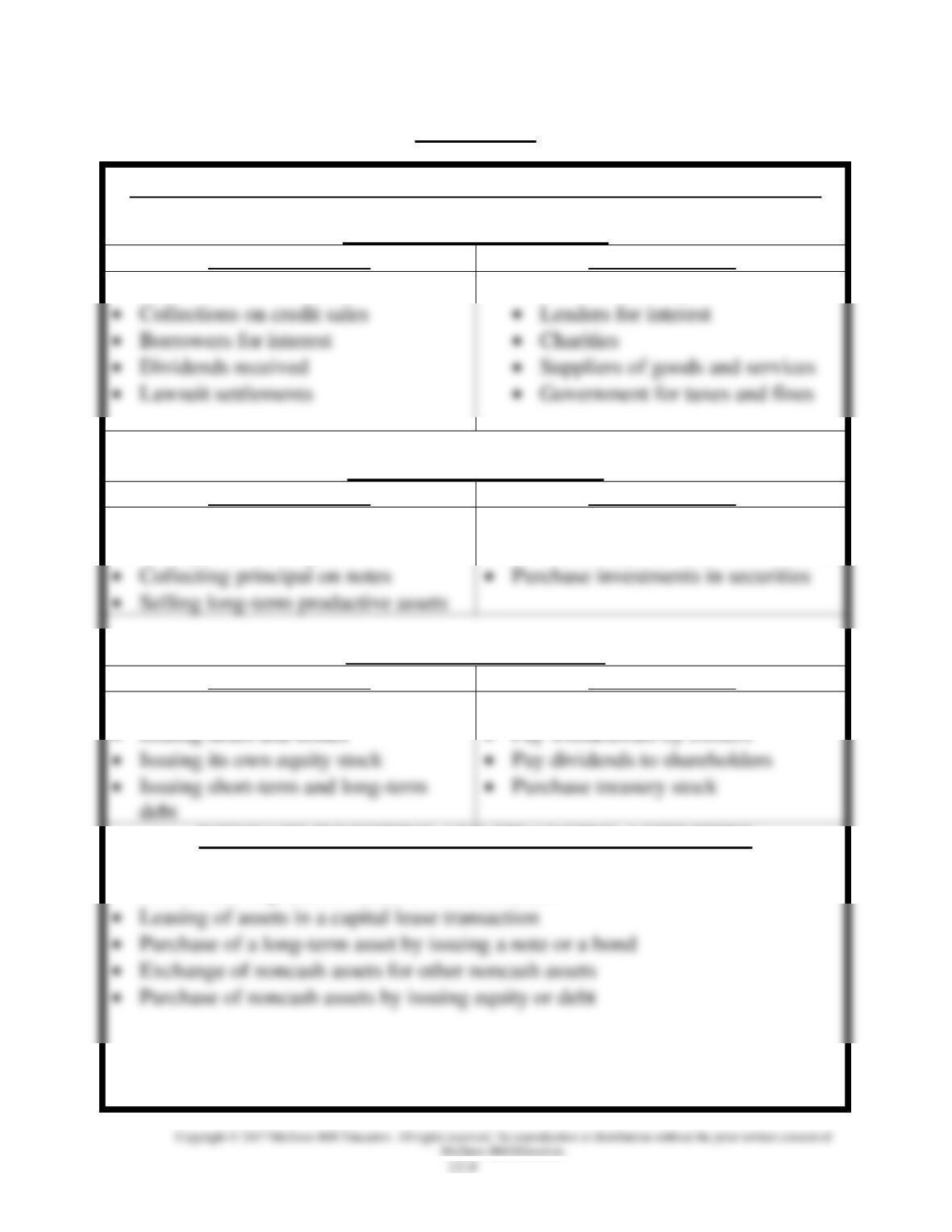
VISUAL #12-1
CLASSIFYING ACTIVITIES IN THE STATEMENT OF CASH FLOWS
OPERATING ACTIVITIES
Cash inflows from
Cash outflows to
• Customers for cash sales
• Salaries and wages
INVESTING ACTIVITIES
Cash inflows from
Cash outflows to
• Selling investments in securities
• Selling (discounting) notes
• Make loans to others
• Purchase long-term productive assets
FINANCING ACTIVITIES
Cash inflows from
Cash outflows to
• Contributions by owners
• Repay cash loans
NONCASH INVESTING AND FINANCING ACTIVITIES
• Retirement of debt by issuing equity stock
• Conversion of preferred stock to common stock

John J. Wild, Financial Accounting: Information for Decisions, 8th Edition
12–10
John J. Wild, Financial Accounting: Information for Decisions, 8th Edition
12–11
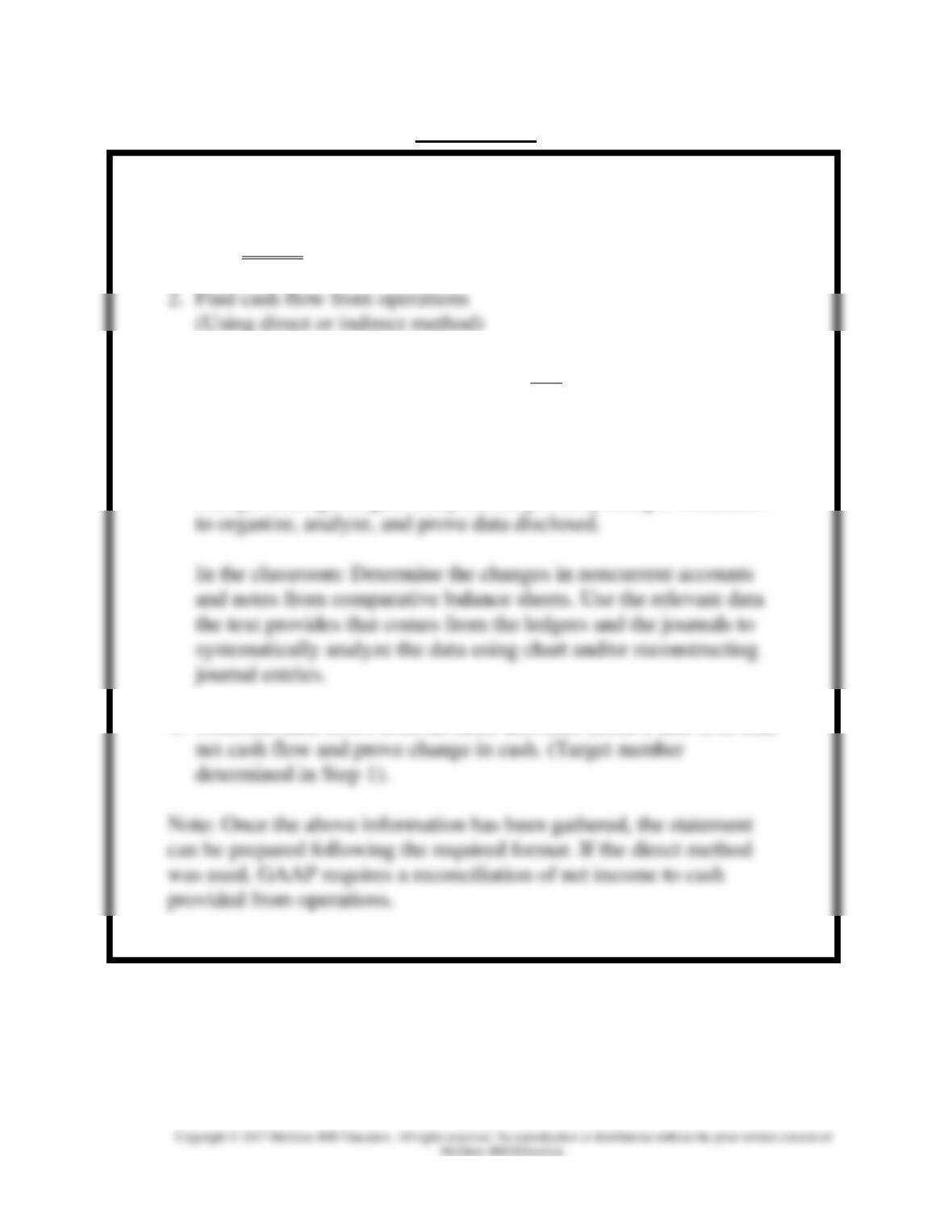
VISUAL #12-2
STEPS TO DETERMINE INFORMATION
STATEMENT OF CASH FLOWS
1. Find change in Cash—This is the target number.
3. Find Cash Flow from A. Financing and
B. Investing
Procedure:
In real life: Using data from comparative balance sheets, trace
changes through ledgers and journals probably using a worksheet
4. Combine cash flows from all three activities (from 2 and 3) to find

John J. Wild, Financial Accounting: Information for Decisions, 8th Edition
12–12
John J. Wild, Financial Accounting: Information for Decisions, 8th Edition
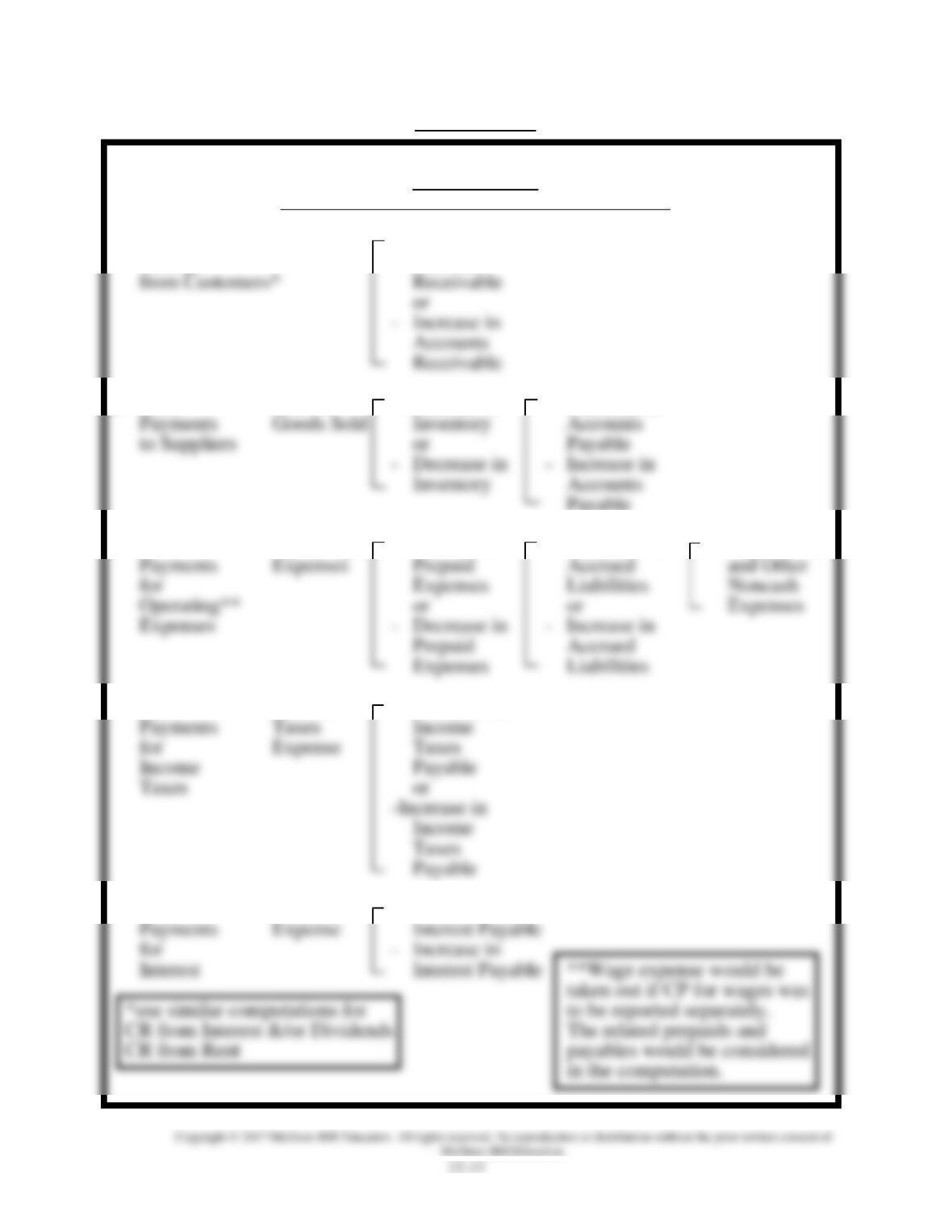
VISUAL #12-3
Determining Cash Flows from Operating Activities
Direct Method
(Need income statement and balance sheet data)
1. Cash = Sales + Decrease in
Receipts Accounts
2. Cash = Cost of + Increase in + Decrease in
Payable
3. Cash = Operating + Increase in + Decrease in – Depreciation
4. Cash = Income + Decrease in
5. Cash = Interest + Decreases in

John J. Wild, Financial Accounting: Information for Decisions, 8th Edition
12–14
John J. Wild, Financial Accounting: Information for Decisions, 8th Edition
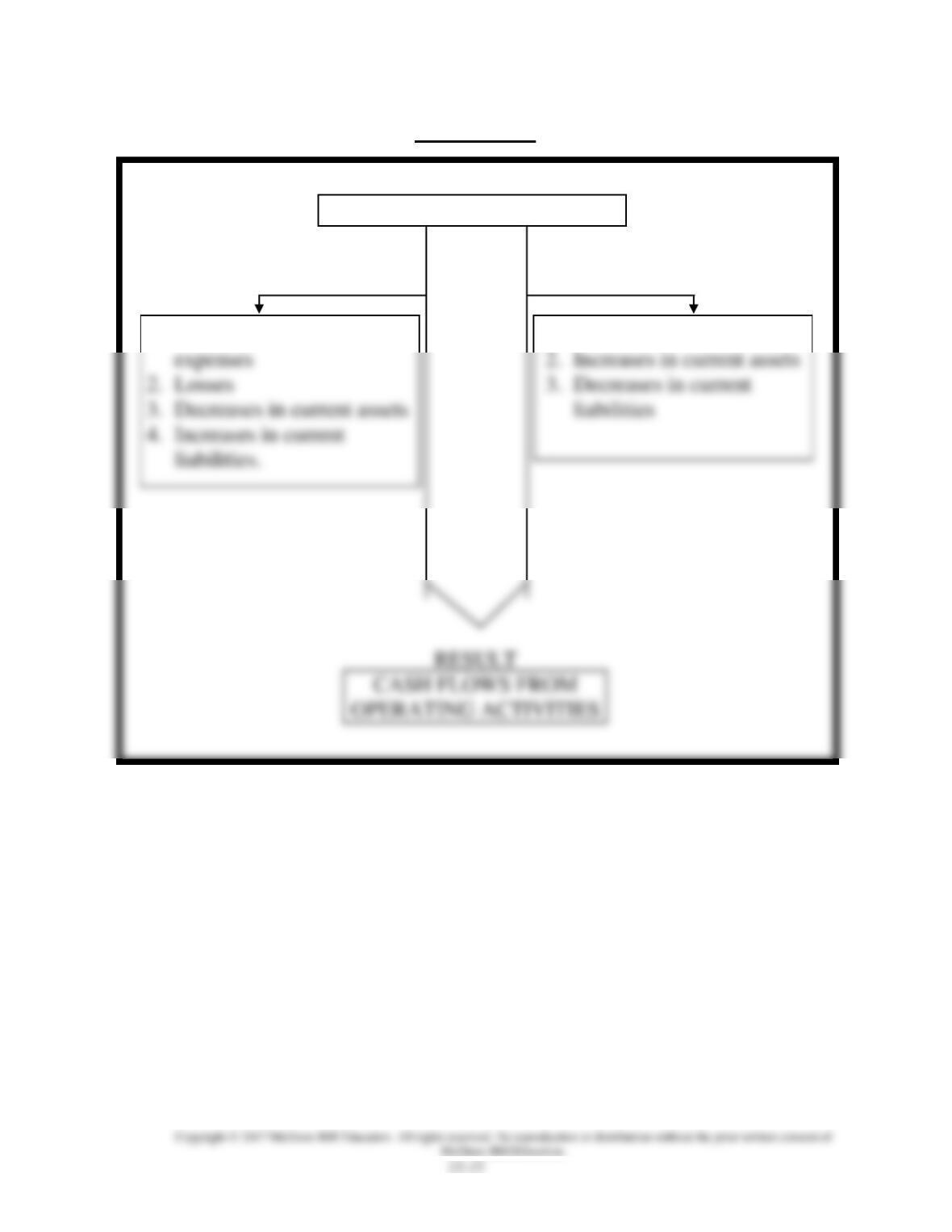
VISUAL #12-4
START WITH
NET INCOME OR (NET LOSS)
Add Subtract
1. Write-offs or noncash 1. Gains

John J. Wild, Financial Accounting: Information for Decisions, 8th Edition
12–16

John J. Wild, Financial Accounting: Information for Decisions, 8th Edition
12–17
Alternate Demonstration Problem
Chapter 12
The Carpet Company’s 2017 and 2018 balance sheets included the
following items:
December 31
2018
2017
Debits
Cash ……………………………………………………………………
$10,500
$ 4,000
Accounts receivable …………………………………………….
8,000
9,000
Merchandise inventory …………………………………………
21,000
18,000
Equipment ……………………………………………………………
18,000
15,000
Totals ………………………………………………………….
$57,500
$46,000
Credits
Accumulated depreciation, equipment ………………….
$ 4,000
$ 3,000
Accounts payable …………………………………………………
7,000
5,000
Taxes payable ………………………………………………………
1,000
2,000
Dividends payable ………………………………………………..
1,500
0
Common stock, $10 par value ……………………………….
27,000
25,000
Contributed capital in excess of par, common stock
6,000
5,000
Retained earnings ………………………………………………..
11,000
6,000
Totals ………………………………………………………….
$57,500
$46,000
The Carpet Company’s income statement was as follows:
CARPET COMPANY
Income Statement
For the Year Ended December 31, 2018
Sales ……………………………………………………………………
$61,000
Cost of goods sold ……………………………………………….
$40,000
Wages and other operating expenses……………………
6,300
Income taxes expense ………………………………………….
4,200
Depreciation expense …………………………………………..
1,500
52,000
Net income …………………………………………………………..
$ 9,000

John J. Wild, Financial Accounting: Information for Decisions, 8th Edition
12–18
Required:
Prepare the statement of cash flows under both the direct method and the
indirect method for the year ended December 31, 2018. Additional
information includes the following:
a. Equipment costing $3,500 was purchased during the year.
b. Fully depreciated equipment that cost $500 was discarded and its
cost and accumulated depreciation were removed from the
accounts.
c. Two hundred shares of stock were sold and issued at $15 per
share.
d. The company declared $4,000 of cash dividends and paid $2,500.
John J. Wild, Financial Accounting: Information for Decisions, 8th Edition
12–19
Solution: Alternate Demonstration Problem
Chapter 12
Direct Method:
CARPET COMPANY
Statement of Cash Flows
For Year Ended December 31, 2018
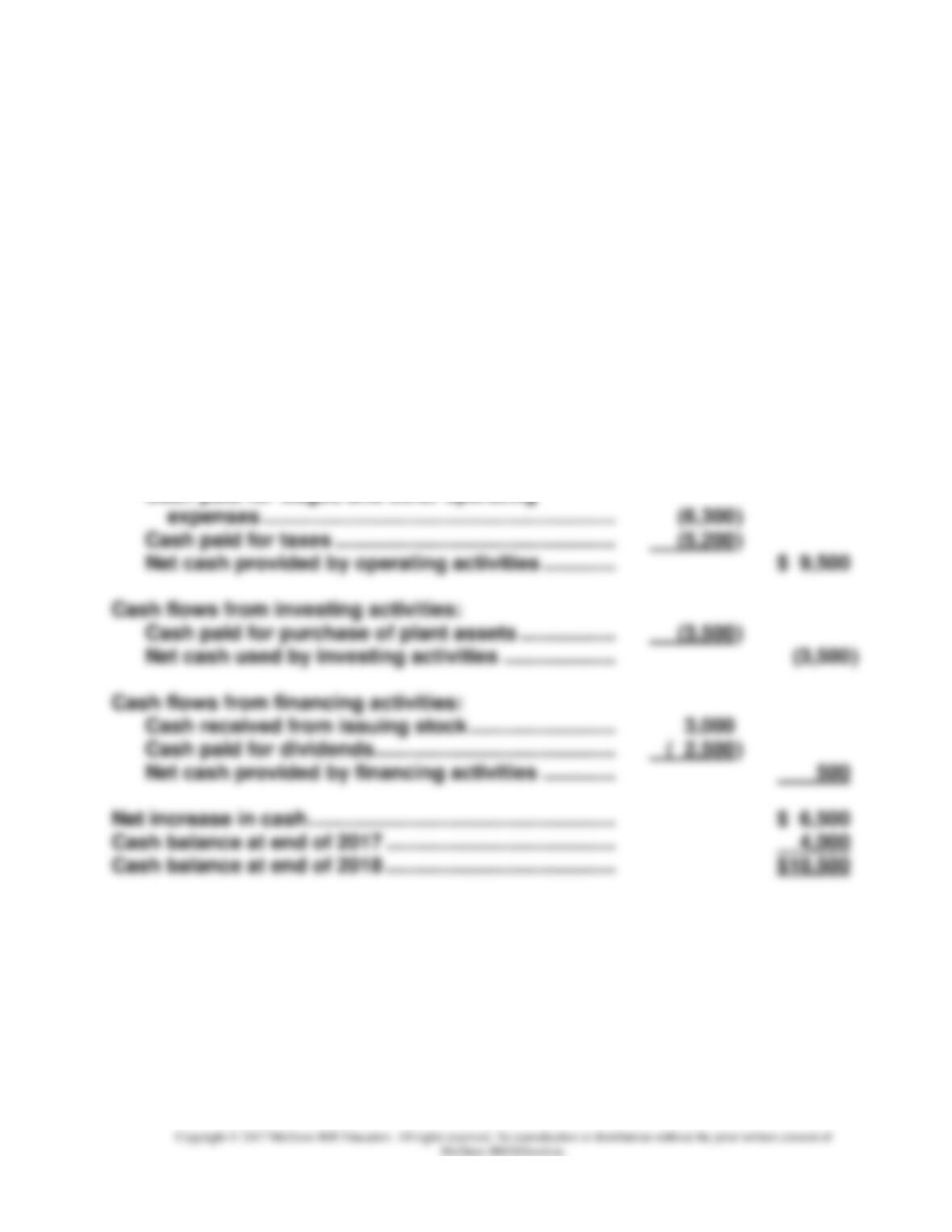
Cash flows from operating activities:
Cash received from customers ………………………….
$ 62,000
Cash paid for merchandise ……………………………….
(41,000
)
expenses ………………………………………………………
)
Cash paid for taxes …………………………………………..
)
Net cash provided by operating activities ………….
Cash flows from investing activities:
Cash paid for purchase of plant assets ……………..
)
Net cash used by investing activities ………………..
)
Cash flows from financing activities:
Cash received from issuing stock ……………………..
Cash paid for dividends …………………………………….
)
Net cash provided by financing activities ………….
Net increase in cash ……………………………………………….
Cash balance at end of 2017 …………………………………..
Cash balance at end of 2018 …………………………………..
Cash paid for wages and other operating
John J. Wild, Financial Accounting: Information for Decisions, 8th Edition
12–20
Indirect Method:
CARPET COMPANY
Statement of Cash Flows
For Year Ended December 31, 2018
Cash flows from operating activities:
Net income …………………………………………………………….
$ 9,000
Adjustments to reconcile net income to net cash
provided by operating activities:
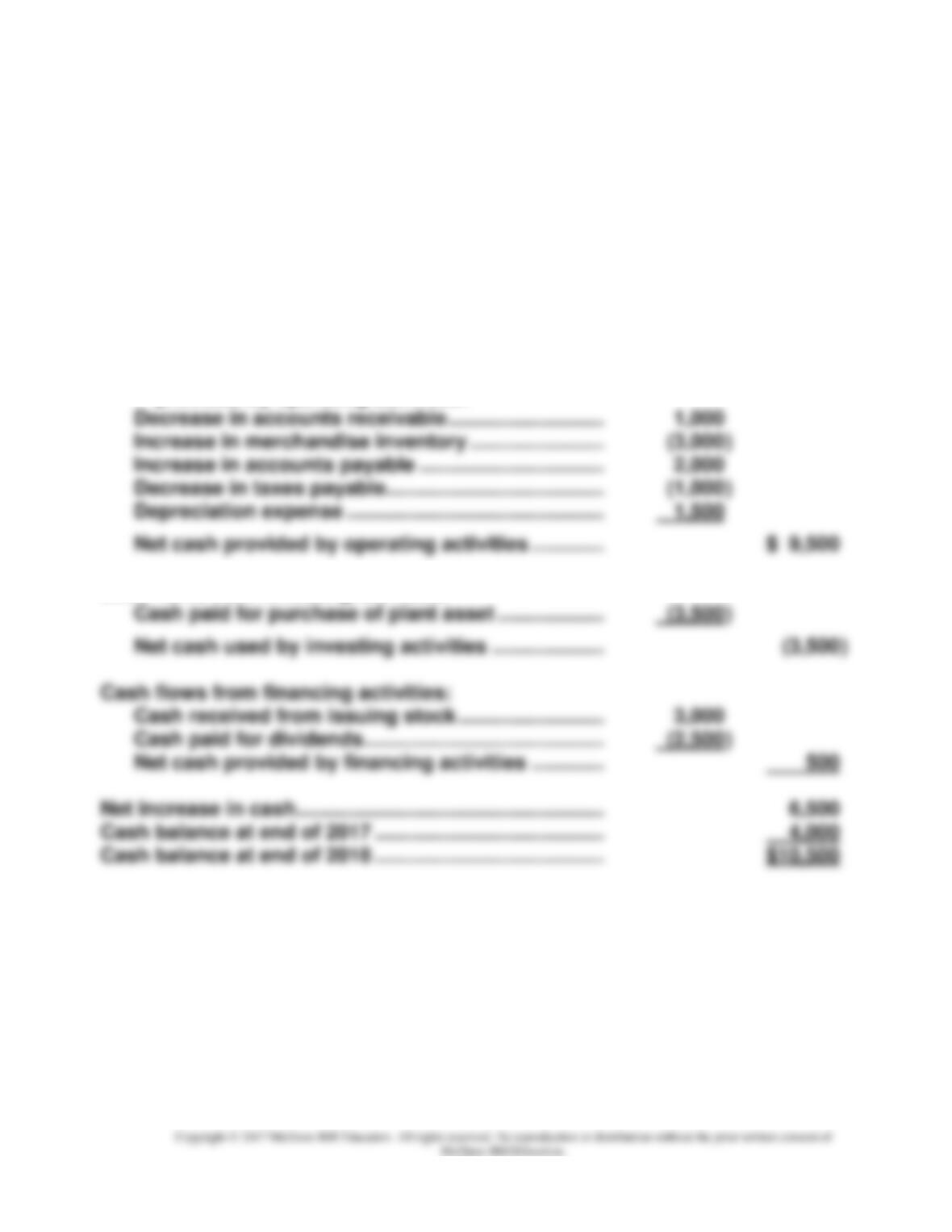
Decrease in accounts receivable ……………………….
Increase in merchandise inventory ……………………
)
Increase in accounts payable …………………………...
Decrease in taxes payable …………………………………
)
Net cash provided by operating activities ………….
Cash flows from investing activities:
Net cash used by investing activities ………………..
)
Cash flows from financing activities:
Cash received from issuing stock ……………………..
Cash paid for dividends …………………………………….
)
Net cash provided by financing activities ………….
Net increase in cash ……………………………………………….
Cash balance at end of 2017 …………………………………..