1. The main advantages for:
a. Proprietorship: Ease of formation and nontaxable entity.
b. Partnership: Expanded owner expertise and capital, nontaxable entity, and moderate
complexity of formation.
c. Limited liability company: Limited liability to owners, expanded access to capital,
nontaxable entity, and moderate complexity of formation.
4. The partnership agreement (partnership) or operating agreement (LLC) establishes the income-
sharing ratio among the partners (members), amounts to be invested, and admission an
d
withdrawal of partners (members). In addition, for an LLC, the operating agreement specifies
whether the LLC is owner-managed or manager-managed.
5. No. Maholic would have to bear his share of losses. In the absence of any agreement as to
division of net income or net loss, his share would be one-third. In addition, because of the
unlimited liability of each partner, Maholic may have to bear more than one-third of the losses
if one partner is unable to absorb his or her share of the losses.
6. Yes. Partnership net income is divided according to the income-sharing ratio, regardless of
the amount of the withdrawals by the partners. Therefore, it is very likely that the partners’
monthly withdrawals from a partnership will not equal their shares of net income exactly.
DISCUSSION QUESTIONS
CHAPTER 12
LIMITED LIABILITY COMPANIES
ACCOUNTING FOR PARTNERSHIPS AND

CHAPTER 12 Accounting for Partnerships and Limited Liability Companies
DISCUSSION QUESTIONS
(C
ont
i
nue
d)
9. It is important to state all partnership assets in terms of current prices at the time of the
admission of a new partner because failure to do so might result in participation by the new
p
artner in gains or losses attributable to the period prior to admission to the partnership.
To illustrate, assume that A and B share net income and net loss equally and operate a
p
p
10. A new partner who is expected to improve the fortunes (income) of the partnership through
such things as reputation or skill might be given equity in excess of the amount invested to
join the partnership.
CHAPTER 12 Accounting for Partnerships and Limited Liability Companies
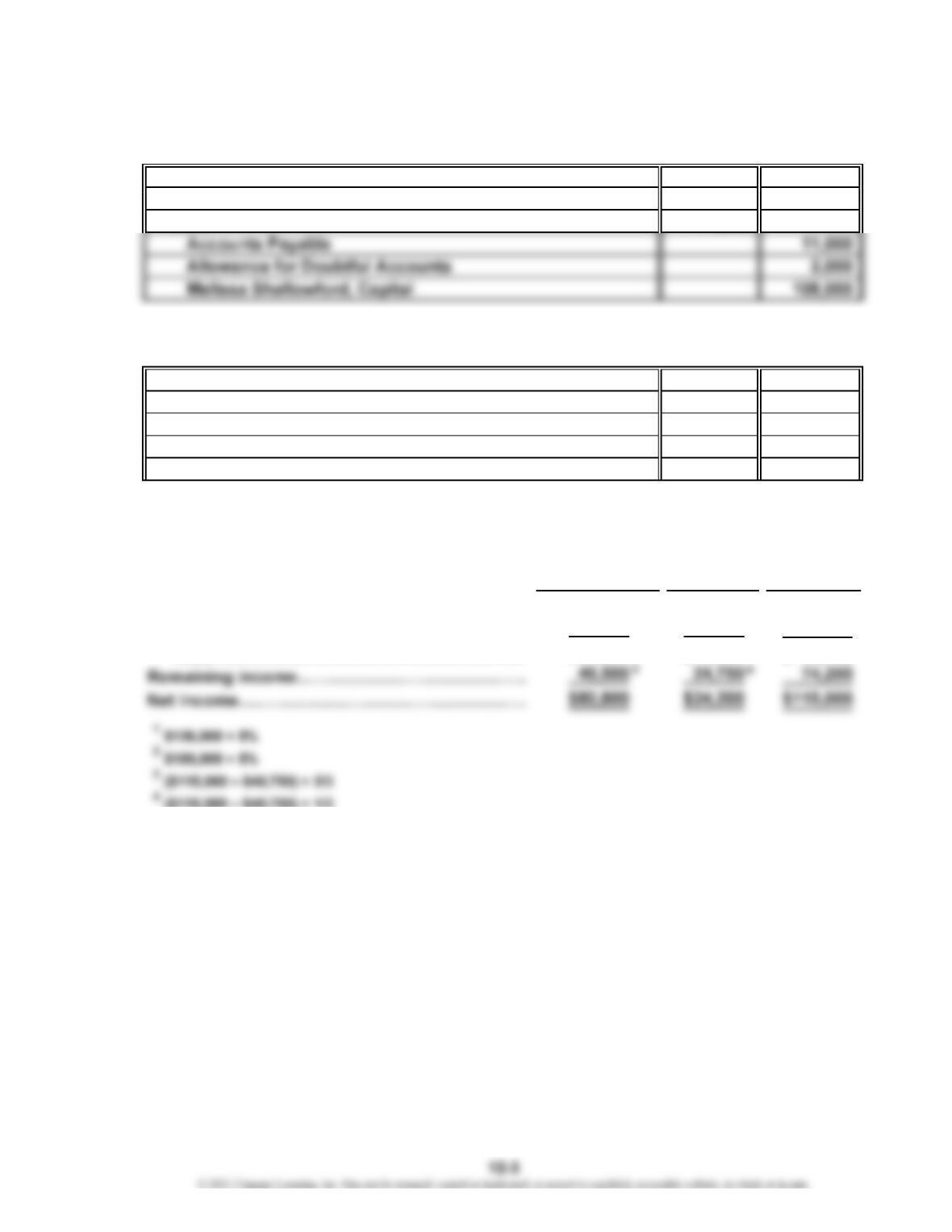
PE 12-1A
Cash
Accounts Receivable
Patent
PE 12-1B
Cash
Inventory
Land
Notes Payable 37,600
Xi Lin, Capital 233,500
PE 12-2A
Distributed to Gonzalez and Van Horne:
Total
Annual salary allowance…………………………
…
$ 25,000
Interest allowance…………………………………
…
15,750
Total………………………………………………
…
$ 40,750
($115,000 – $40,750) × 1/3
Gonzalez: $80,800
Van Horne: $34,200
Gonzalez
$25,000
6,300
$31,300
PRACTICE EXERCISES
15,000
35,000
71,000
38,600
Van Horne
$0
9,450
45,100
187,400
$ 9,450
1
2
CHAPTER 12 Accounting for Partnerships and Limited Liability Companies
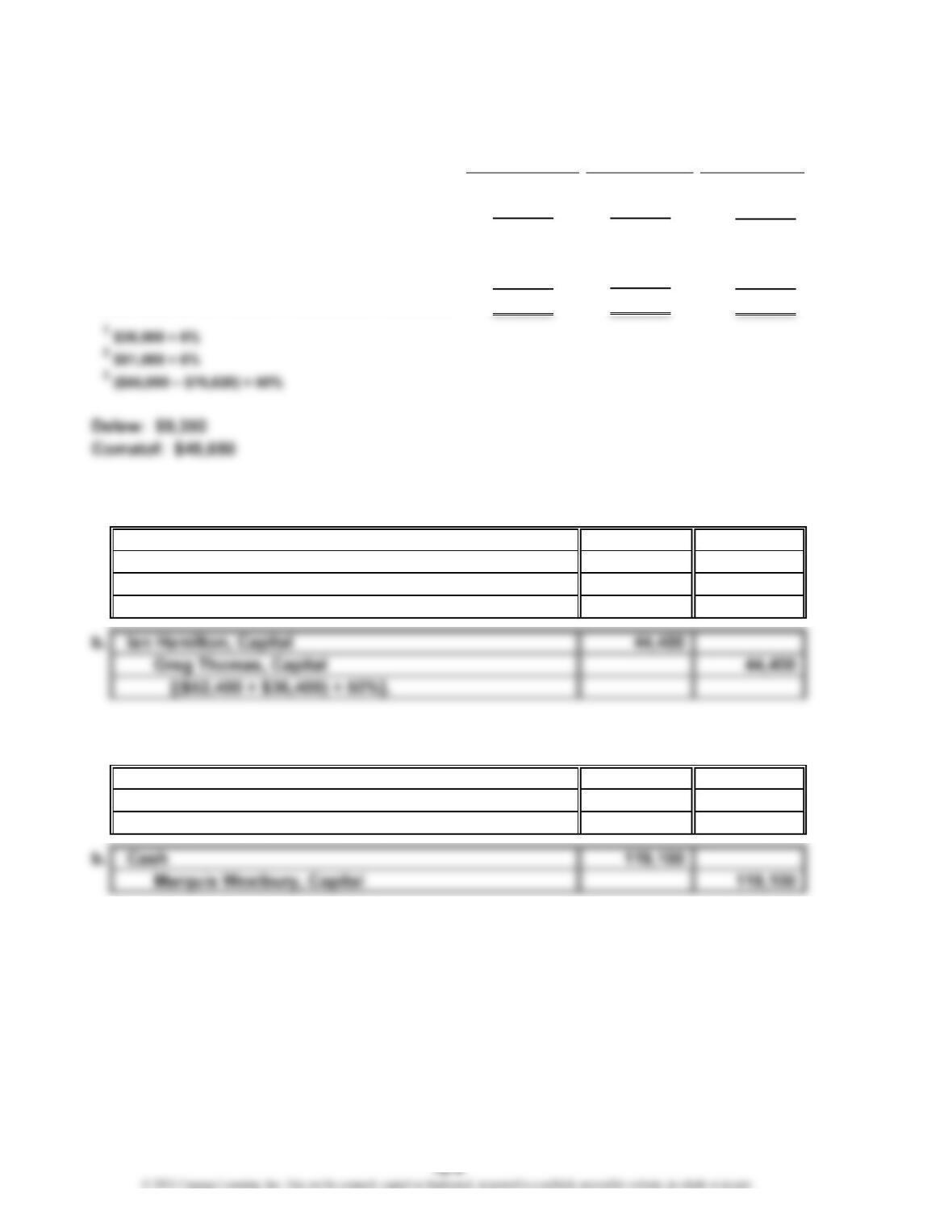
PE 12-2B
Distributed to Delew and Comatof:
Total
Annual salary……………………………………
…
$69,000
Interest……………………………………………
…
7,620
Total……………………………………………
…
$20,160 $76,620
Deduct excess of allowances
over income…………………………………………….. 10,810 21,620
Net income………………………………………
…
$ 9,350 $55,000
PE 12-3A
a. Land
Adam Freidman, Capital 36,400
Ian Hamilton, Capital 36,400
[($189,200 − $116,400) × 50%].
PE 12-3B
a. Equipment
Daniel Trenton, Capital [($77,400 – $57,300) × 2/3] 13,400
Ann Marie Rainwater, Capital 6,700
20,100
Delew
72,800
$18,000
2,160
$51,000
5,460
$56,460
10,810
$45,650
Comatof
12
3
CHAPTER 12 Accounting for Partnerships and Limited Liability Companies
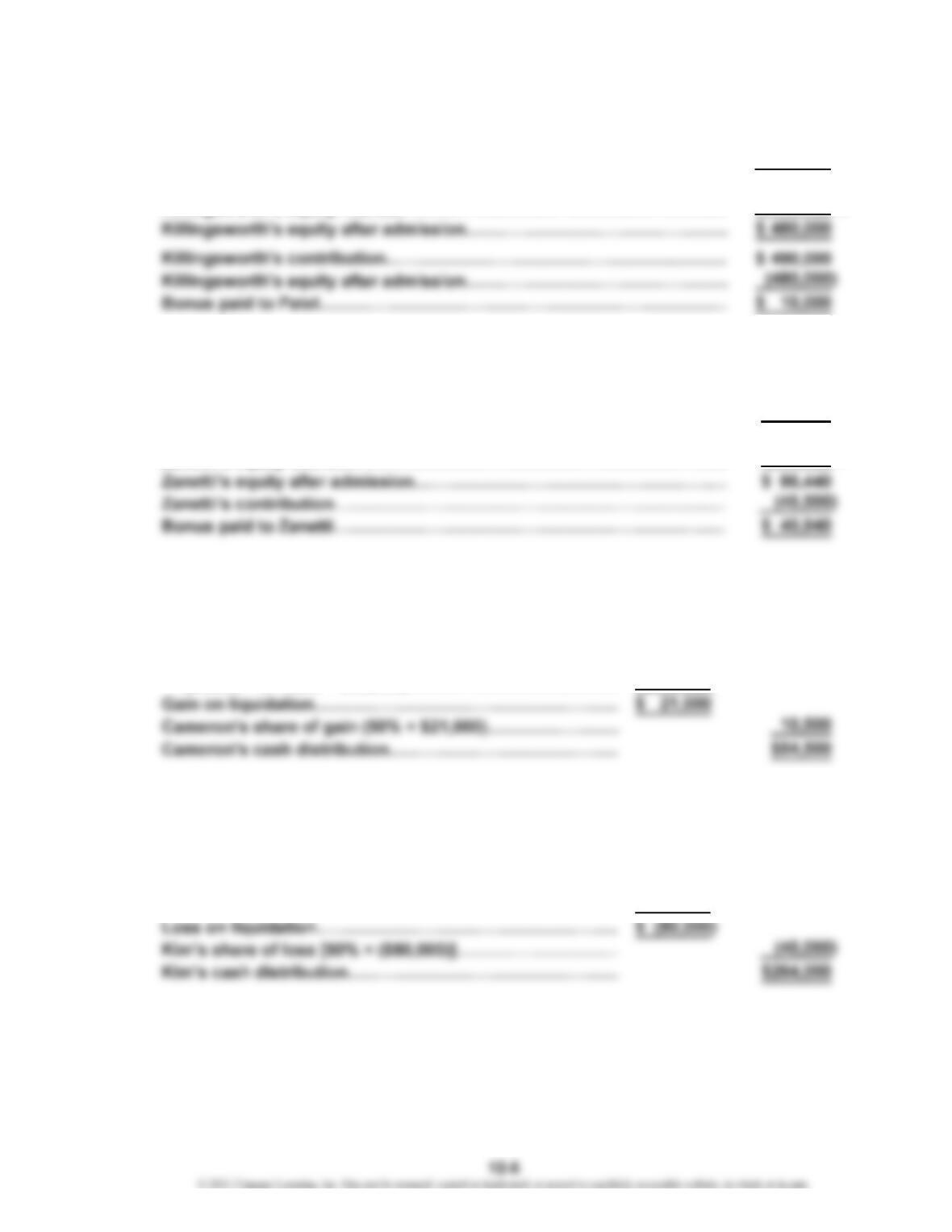
PE 12-4A
Equity of Patel……………………………………………………………………
…
$ 310,000
Killingsworth’s contribution……………………………………………………
…
490,000
Total equity after admitting Killingsworth……………………………………
…
$ 800,000
Killingsworth’s equity interest…………………………………………………
…
60
PE 12-4B
Equity of Todd……………………………………………………………………
…
$170,600
Zanetti’s contribution……………………………………………………………
…
45,500
Total equity after admitting Zanetti……………………………………………
…
$216,100
Zanetti’s equity interest…………………………………………………………
…
40
…
…
…
PE 12-5A
Cameron’s equity prior to liquidation………………………
…
$44,000
Realization of asset sales……………………………………… $ 166,000
Book value of assets (liabilities + owner’s equity)
($9,000 + $44,000 + $92,000)………………………………
…
(145,000)
…
…
PE 12-5B
Kim’s equity prior to liquidation………………………………
…
$304,000
Realization of asset sales……………………………………… $ 520,000
Book value of assets (liabilities + owner’s equity)
($106,000 + $304,000 + $190,000)…………………………
…
(600,000)
…
…
×
×
%
%
…
…
…
…
CHAPTER 12 Accounting for Partnerships and Limited Liability Companies
PE 12-6A
a. Warren’s equity prior to liquidation…………………………
…
$ 67,000
Realization of asset sales………………………………………
…
$ 49,000
Book value of assets (sum of capital accounts)*…………
…
(195,000)
Loss on liquidation………………………………………………
…
$(146,000)
Warren’s share of loss [50% × ($146,000)]…………………
…
(73,000)
$ (6,000)
the amount realized from asset sales)
PE 12-6B
a. Jacobs’s equity prior to liquidation…………………………
…
$ 320,000
Realization of asset sales………………………………………
…
$ 52,000
Book value of assets (sum of capital accounts)*…………
…
(744,000)
…
…
b. $52,000 ($424,000 – $346,000 share of loss – $26,000 Jacobs’s deficiency; also equals
the amount realized from asset sales)
PE 12-7A
$9,338,000
46 employees
b. Schwartz and Beer, CPAs grew revenues by $2,487,000 ($11,825,000 – $9,338,000), or
26.6% ($2,487,000 ÷ $9,338,000). The number of employees expanded by 9, or 19.6%
(9 ÷ 46). The growth in revenue was more than the growth in the number of
a.
=20Y4: $203,000 per employee
Warren’s deficiency………………………………………………

CHAPTER 12 Accounting for Partnerships and Limited Liability Companies
PE 12-7B
$4,400,000
40 employee
s
$3,894,000
33 employee
s
a.
20Y2: = $118,000 per employee
=20Y1: $110,000 per employee
CHAPTER 12 Accounting for Partnerships and Limited Liability Companies
Ex. 12-1
Cash 25,800
Accounts Receivable* 181,600
Merchandise Inventory 131,400
Ex. 12-2
Cash 65,000
Accounts Receivable 125,000
Land 320,000
Equipment 34,800
Allowance for Doubtful Accounts 9,500
Accounts Payable 24,800
EXERCISES
CHAPTER 12 Accounting for Partnerships and Limited Liability Companies
Ex. 12-3
Dawson McDonald
a. ……………………………………………………………………
…
$190,000 $190,000
b. ……………………………………………………………………
…
285,000 95,000
c. ……………………………………………………………………
…
158,440 221,560
d. ……………………………………………………………………
…
184,000 196,000
e. ……………………………………………………………………
…
188,600 191,400
Details: Dawson McDonald Total
a. Net income (1:1)……………………………
…
$190,000 $190,000 $380,000
d. Salary allowance……………………………
…
$ 47,000 $ 59,000 $106,000
Remaining income (1:1)……………………
…
137,000 137,000 274,000
Net income……………………………………
…
$184,000 $196,000 $380,000
…
…
…
…
…
…
CHAPTER 12 Accounting for Partnerships and Limited Liability Companies
Ex. 12-4
Dawson McDonald
a. ……………………………………………………………………
…
$ 68,000 $68,000
b. ……………………………………………………………………
…
102,000 34,000
c. ……………………………………………………………………
…
60,840 75,160
d. ……………………………………………………………………
…
62,000 74,000
e. ……………………………………………………………………
…
66,600 69,400
Details: Dawson McDonald Total
a. Net income (1:1)……………………………
…
$68,000 $68,000 $136,000
d. Salary allowance……………………………
…
$47,000 $59,000 $106,000
Remaining income (1:1)……………………
…
15,000 15,000 30,000
Net income……………………………………
…
$62,000 $74,000 $136,000
…
…
…
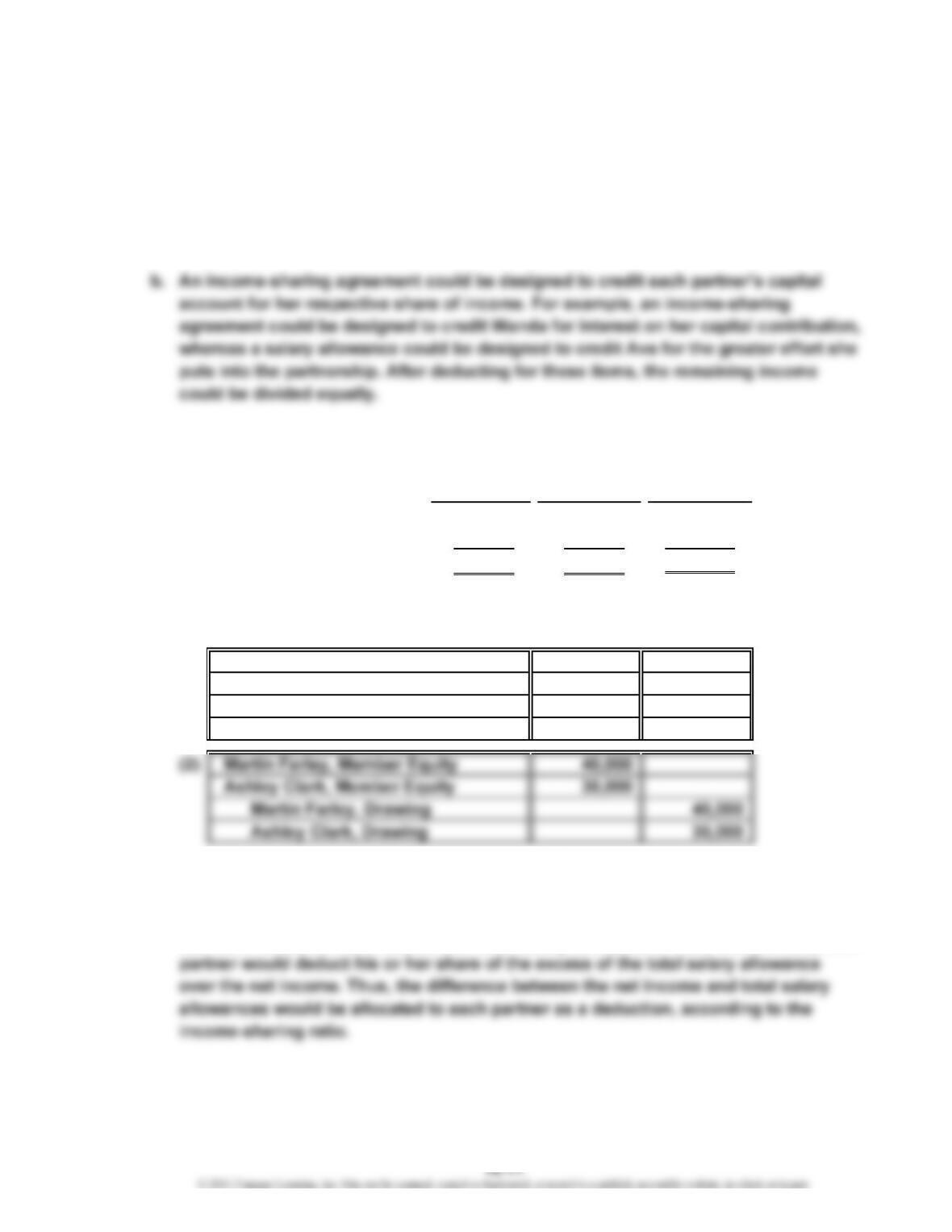
Ex. 12-5
Lynn Matthew
Carpenter Fredrick Total
Salary allowances………………………………
…
$ 58,000 $ 41,000 $ 99,000
Remainder (net loss, $33,000, plus $99,000
salary allowances) divided equally………
…
(66,000) (66,000) (132,000)
Net loss…………………………………………… $ (8,000) $(25,000) $ (33,000)
…
…
…
CHAPTER 12 Accounting for Partnerships and Limited Liability Companies
Ex. 12-6
a. The partners can divide net income in any ratio they wish. However, in the
absence of an agreement, net income is divided equally between the partners.
Therefore, Wanda’s conclusion was correct but for the wrong reasons. In addition,
note that the monthly drawings have no impact on the division of income. These
drawings are not the same as a salary allowance, which is part of a formal income-
sharing agreement.
Ex. 12-7
a. Net income: $148,000
Farley Clark Total
Salary allowance………………… $40,000 $30,000 $ 70,000
Remaining income……………… 46,800 31,200 78,000
Net income………………………
…
$86,800 $61,200 $148,000
Farley’s remaining income: ($148,000 – $70,000) × 3/5
Clark’s remaining income: ($148,000 – $70,000) × 2/5
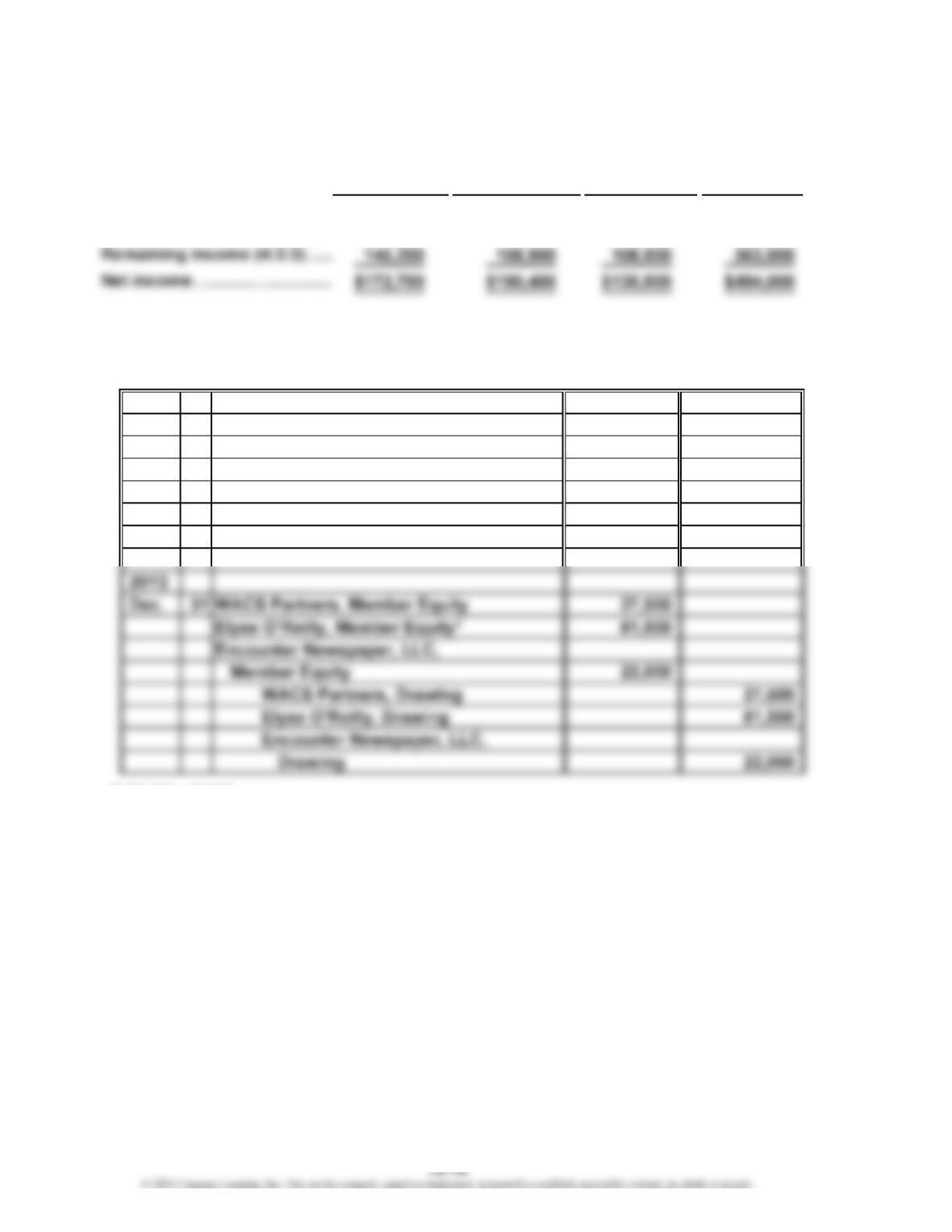
b. (1) Revenues
Expenses 520,000
Martin Farley, Member Equity
Ashley Clark, Member Equity
Note: The reduction in members’ equity from withdrawals would be disclosed on
the statement of members’ equity.
c. If the net income of the LLC was less than the sum of the salary allowances, both
members would still be credited with their salary allowances. From this amount, each
668,000
86,800
61,200
CHAPTER 12 Accounting for Partnerships and Limited Liability Companies
Ex. 12-8
a.
Total
Salary allowance……………
…
$ 76,000 $ 76,000
Interest allowance…………… $ 27,500 5,500 $ 22,000 55,000
1
10% × $275,000
2
10% × $55,000
3
10% × $220,000
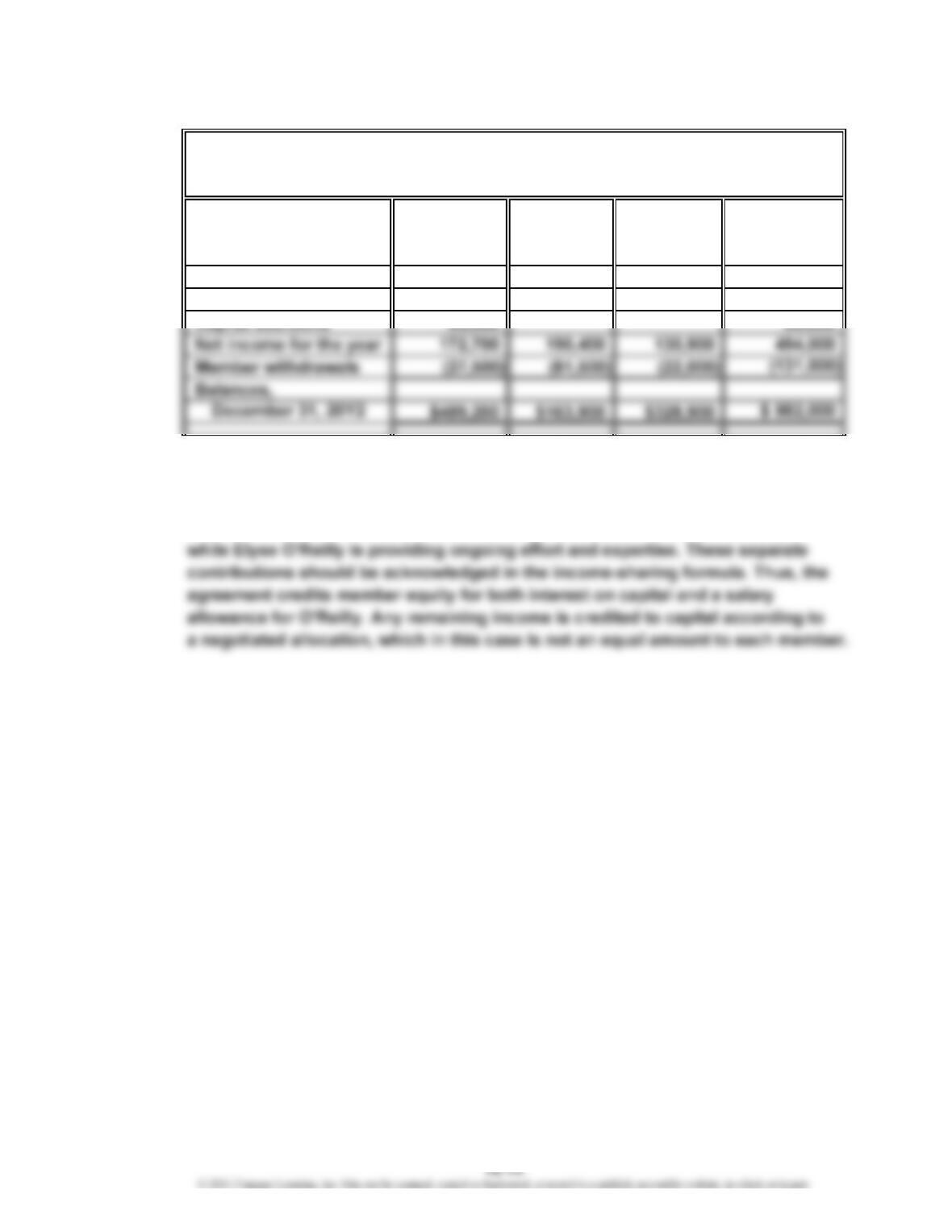
b. 20Y2
Dec. 31 Revenues
Expenses 1,236,000
WACS Partners, Member Equity
Elyse O’Reilly, Member Equity
Encounter Newspaper, LLC,
Member Equity
*
$76,000 + $5,500
Encounter
Partners
WACS
O’Reilly
Elyse
LLC
Newspaper,
130,900
190,400
1,730,000
172,700
12
3
CHAPTER 12 Accounting for Partnerships and Limited Liability Companies
Ex. 12-8 (Concluded)
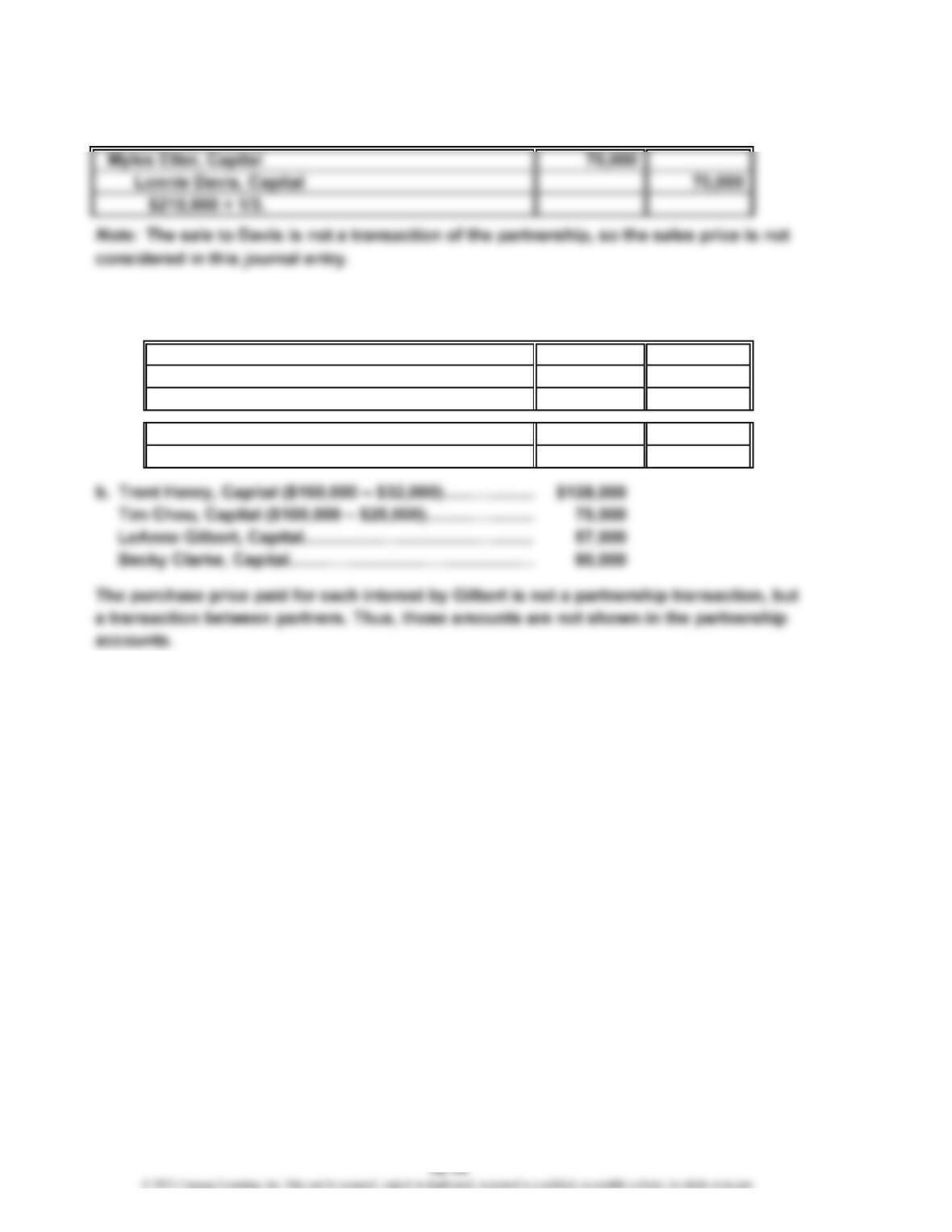
c.
Encounter
WACS Elyse Newspaper, Total LLC
Partners O’Reilly LLC Capital
Balances,
January 1, 20Y2 $275,000 $ 55,000 $220,000 $ 550,000
d. An income-sharing agreement provides flexibility and fairness. Without an income-
sharing agreement, each member would be credited with an equal proportion of
the total earnings, or one-third each. However, the members provide different
capital and effort to the LLC. WACS is a large contributor of capital (funds),
Exploit Media, LLC
Statement of Members’ Equity
For the Year Ended December 31, 20Y2
CHAPTER 12 Accounting for Partnerships and Limited Liability Companies
Ex. 12-9
a. and b.
Ex. 12-10
a. (1) Trent Henry, Capital (1/5 × $160,000) 32,000
Tim Chou, Capital (1/4 × $100,000) 25,000
LeAnne Gilbert, Capital 57,000
(2) Cash 90,000
Becky Clarke, Capital 90,000
CHAPTER 12 Accounting for Partnerships and Limited Liability Companies
Ex. 12-11
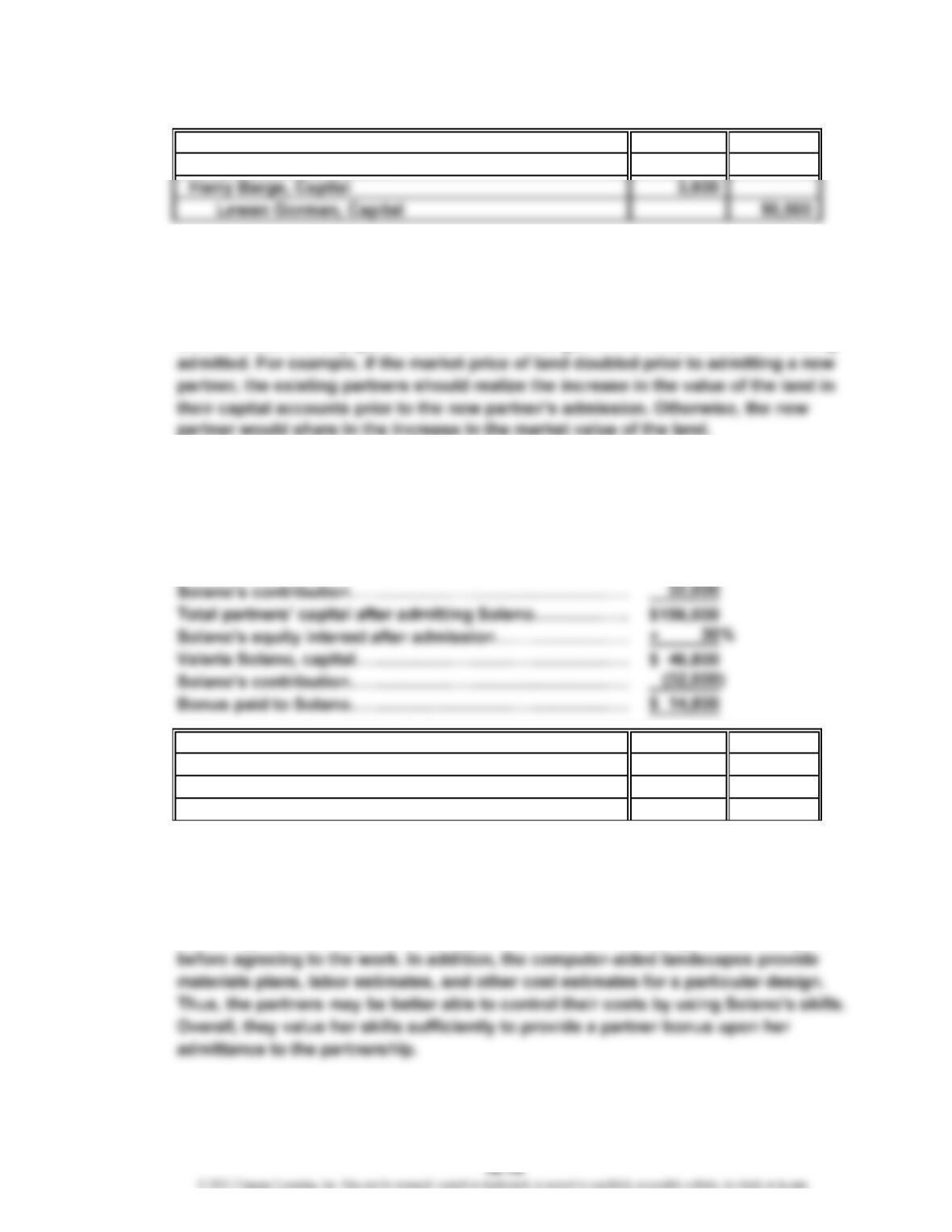
a. Cash 43,300
Grayson Jackson, Capital 3,600
b. Grayson Jackson, Capital ($64,900 – $3,600)……………… $61,300
Harry Barge, Capital ($86,500 – $3,600)……………………
…
82,900
Lewan Gorman, Capital………………………………………
…
50,500
c. Tangible assets should be adjusted to current market prices so that the new partner
does not share in any gains or losses from changes in market prices prior to being
partner would share in the increase in the market value of the land.
Ex. 12-12
a. Bonus received by Solano:
Cody Jenkins, capital…………………………………………
…
$ 78,000
Lacey Tanner, capital…………………………………………
…
46,000
…
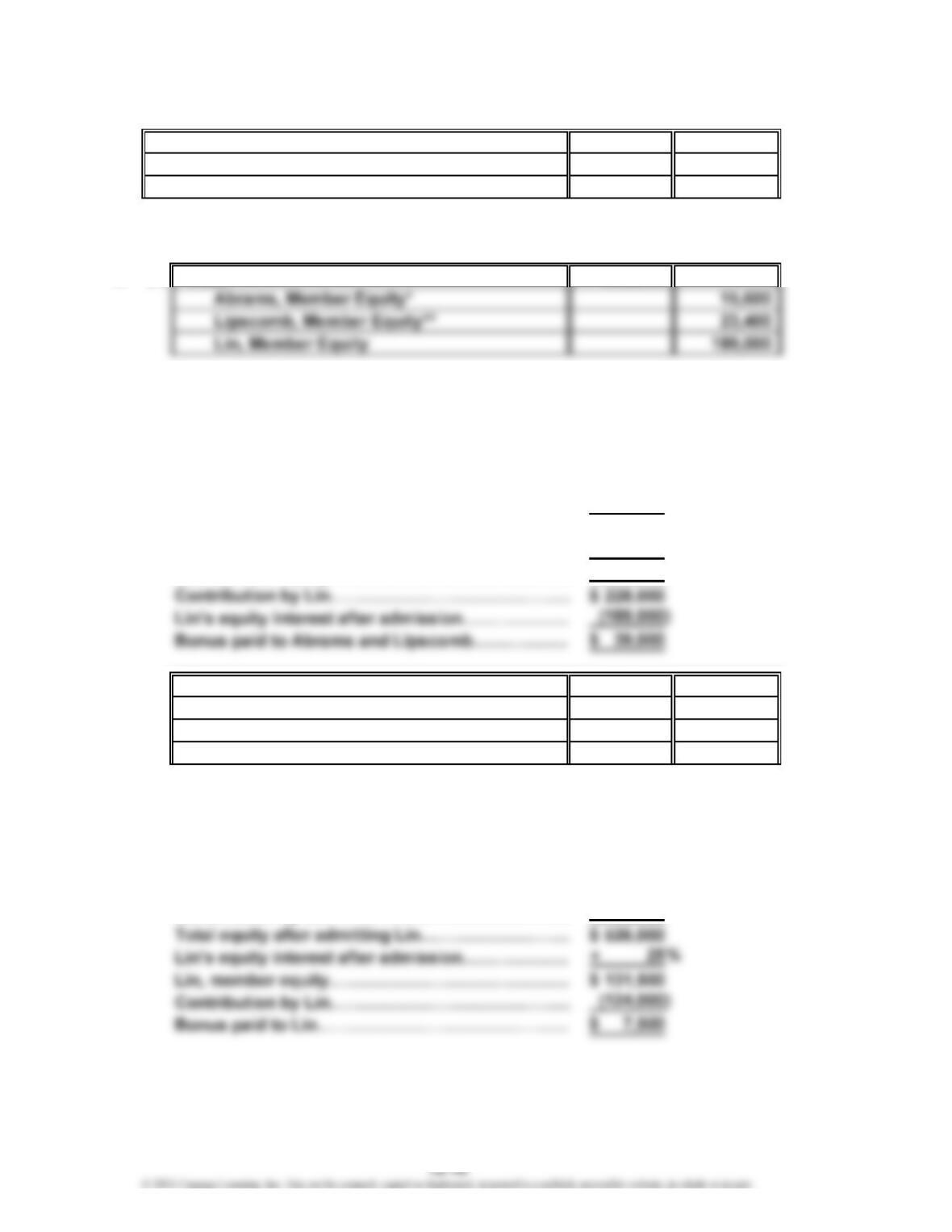
b. Cash 32,000
Cody Jenkins, Capital 7,400
Lacey Tanner, Capital 7,400
Valeria Solano, Capital 46,800
c. Apparently, Jenkins and Tanner value the expertise offered by Solano. Solano is
able to use the computer to design and render landscape designs. This type of
skill is likely to be very useful for both selling and implementing landscape ideas.
Her skills can help the partnership sell ideas to clients by providing computer
renderings of the designs. In this way, a client can see the design on the computer
CHAPTER 12 Accounting for Partnerships and Limited Liability Companies
Ex. 12-13
a. Medical Equipment 40,000
Abrams, Member Equity* 16,000
Lipscomb, Member Equity** 24,000
*
$40,000 × 2/5 = $16,000
**
$40,000 × 3/5 = $24,000
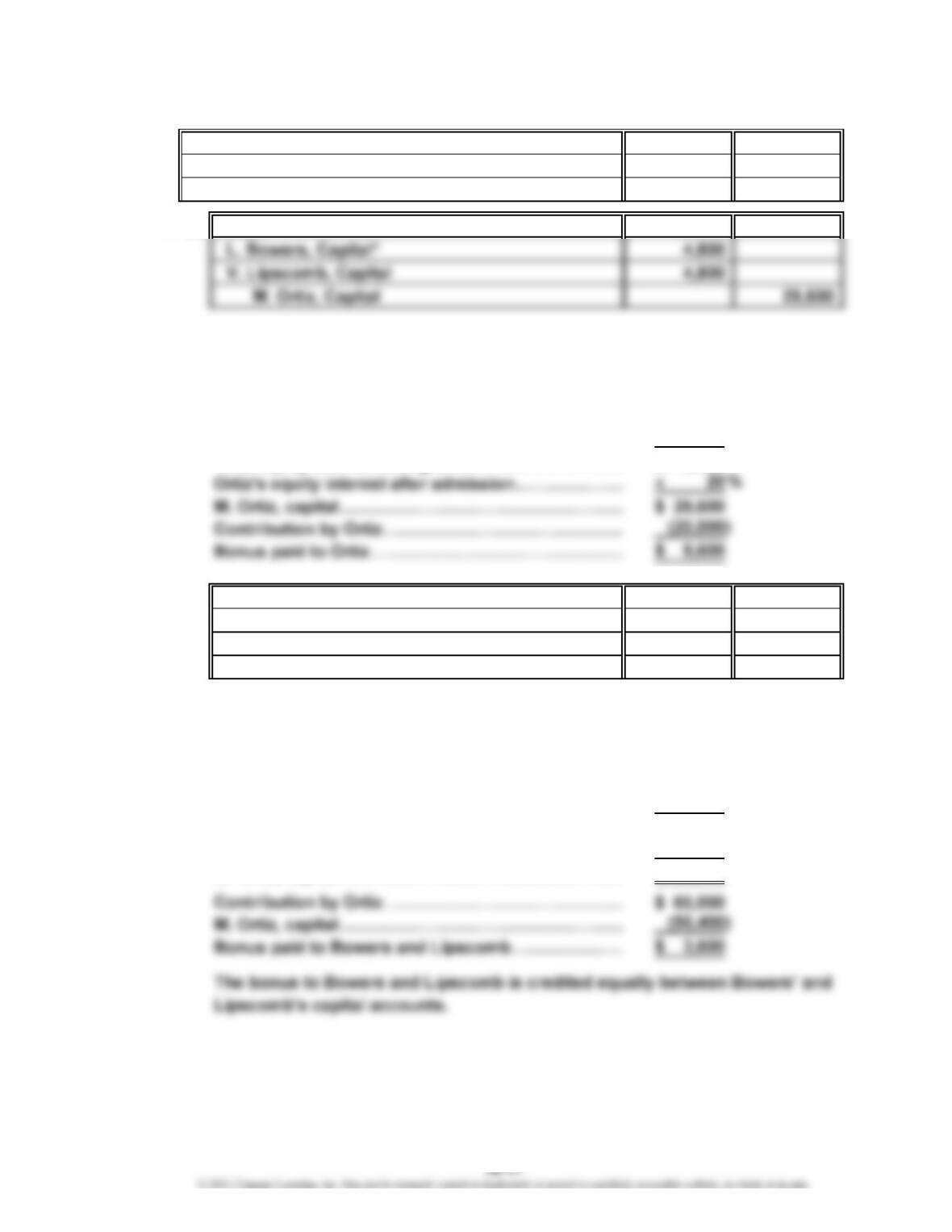
b. (1) Cash 228,000
*
$39,000 × 2/5 = $15,600
**
$39,000 × 3/5 = $23,400
Supporting calculations for the bonus:
Abrams, member equity ($154,000 + $16,000)……
…
$ 170,000
Lipscomb, member equity ($208,000 + $24,000)…
…
232,000
Contribution by Lin……………………………………
…
228,000
Total equity after admitting Lin……………………
…
$ 630,000
Lin’s equity interest after admission………………
…
30
Lin, member equity……………………………………
…
$ 189,000
…
…
(2) Cash 124,000
Abrams, Member Equity* 3,000
Lipscomb, Member Equity** 4,500
Lin, Member Equity 131,500
*
$7,500 × 2/5 = $3,000
**
$7,500 × 3/5 = $4,500
Supporting calculations for the bonus:
Abrams, member equity……………………………… $ 170,000
Lipscomb, member equity…………………………… 232,000
Contribution by Lin……………………………………
…
124,000
…
…
…
…
×
%
CHAPTER 12 Accounting for Partnerships and Limited Liability Companies
Ex. 12-14
a. L. Bowers, Capital 4,000
V. Lipscomb, Capital 4,000
Equipment 8,000
b. (1) Cash 20,000
*
$9,600 × 1/2
Supporting calculations for the bonus:
L. Bowers, capital ($96,000 – $4,000)…………………
…
$ 92,000
V
. Lipscomb, capital ($40,000 – $4,000)……………… 36,000
Contribution by Ortiz……………………………………
…
20,000
Total equity after admitting Ortiz……………………… $148,000
…
…
…
(2) Cash 60,000
L. Bowers, Capital* 1,800
V. Lipscomb, Capital 1,800
M. Ortiz, Capital 56,400
*
$3,600 × 1/2
Supporting calculations for the bonus:
L. Bowers, capital………………………………………
…
$ 92,000
V
. Lipscomb, capital……………………………………
…
36,000
Contribution by Ortiz……………………………………
…
60,000
Total equity after admitting Otiz………………………
…
$188,000
Ortiz’s equity interest after admission………………
…
30
M. Ortiz, capital…………………………………………… $ 56,400
…
…
×
%
CHAPTER 12 Accounting for Partnerships and Limited Liability Companies
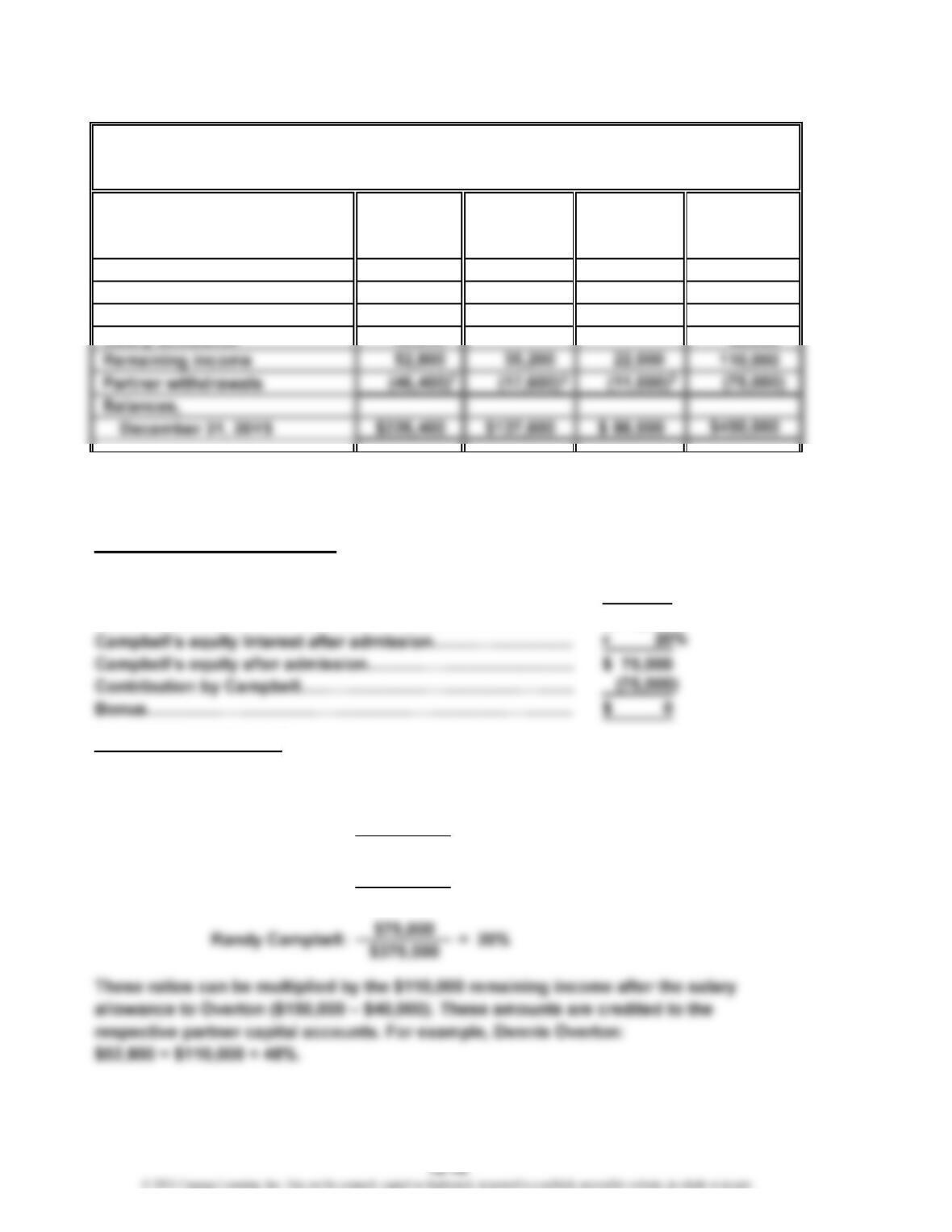
Ex. 12-15
Total
Partnership
Capital
Balances,
January 1, 20Y5 $300,000
Admission of Randy Campbell 75,000
1
($52,800 + $40,000) ÷ 2
2
$35,200 ÷ 2
3
$22,000 ÷ 2
Admission of Randy Campbell
:
Equity of initial partners prior to admission……………………
…
$300,000
Contribution by Campbell…………………………………………
…
75,000
Total……………………………………………………………………
…
$375,000
…
…
Net income distribution
:
The income-sharing ratio is equal to the proportion of the capital balances after
admitting Campbell according to the partnership agreement:
$180,000
$375,000
$120,000
$375,000
Angel Investor Associates
Statement of Partnership Equity
For the Year Ended December 31, 20Y5
Dennis RandyBen
$ 75,000
$180,000
—
$120,000
Capital
Testerman,
Capital
32%
Campbell,
Capital
Dennis Overton:
Ben Testerman:
=
=
—
48%
Overton,
CHAPTER 12 Accounting for Partnerships and Limited Liability Companies
Ex. 12-15 (Concluded)
Withdrawals
:
Half of the remaining income is distributed to the three partners. Overton need not take
the salary allowance as a withdrawal but may allow it to accumulate in the member
equity account. He is taking half of the allowance as a withdrawal.
Ex. 12-16
a. Merchandise Inventory 22,300
Allowance for Doubtful Accounts 1,300
*
($22,300 – $1,300) × 3/7
**
($22,300 – $1,300) × 2/7
b. Lane Stevens, Capital* 159,000
*
$150,000 + $9,000
Ex. 12-17
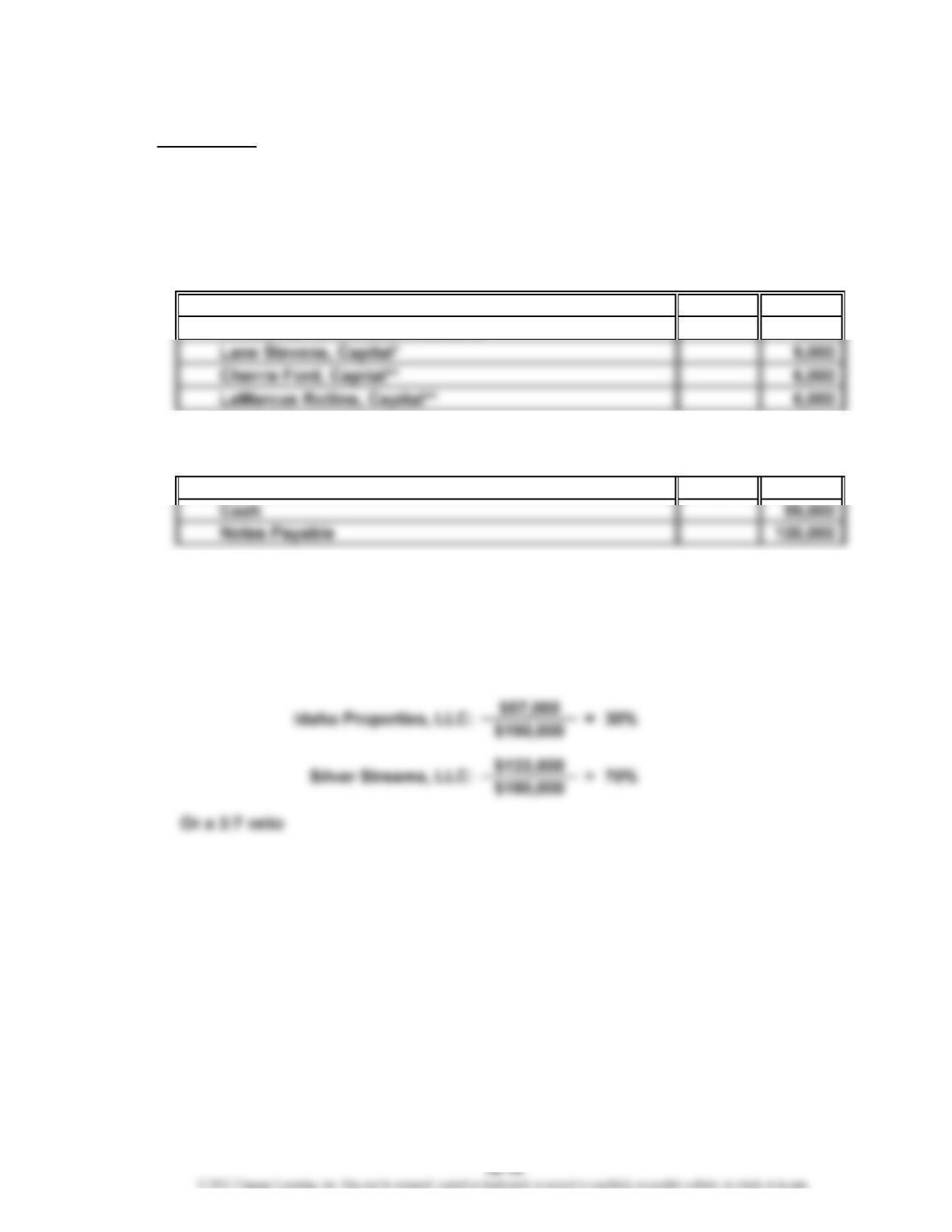
a. The income-sharing ratio is determined by dividing the net income for each member
by the total net income. Thus, in 20Y3, the income-sharing ratio is as follows:
CHAPTER 12 Accounting for Partnerships and Limited Liability Companies
Ex. 12-17 (Concluded)
b. Following the same procedure as in a.:
$62,500
$250,000
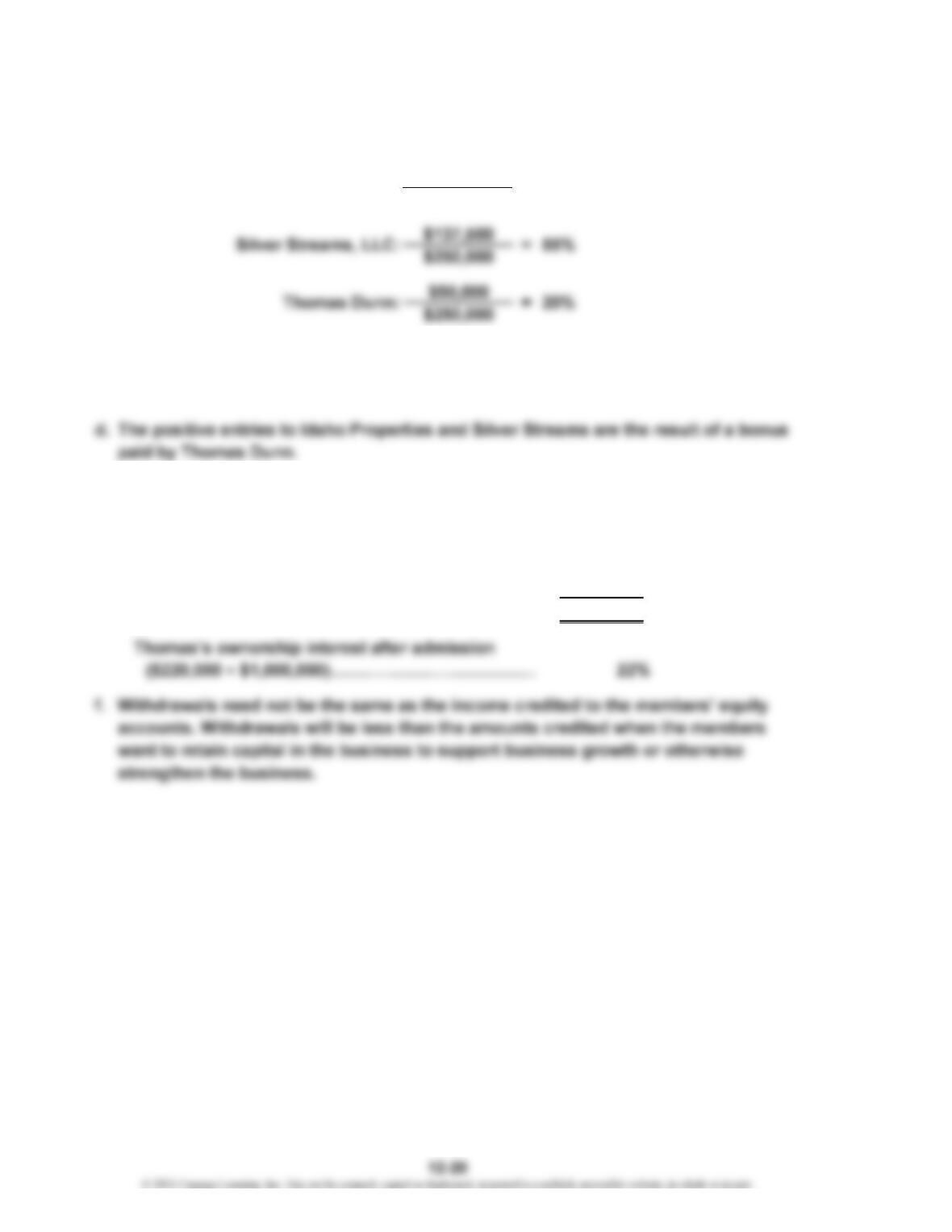
c. Thomas Dunn provided a $230,000 cash contribution to the business. The amount
credited to his member equity account is this amount less a $10,000 bonus paid to
the other two members, or $220,000.
e. Thomas Dunn acquired a 22% interest in the business on January 1, 20Y4, computed
as follows:
Thomas Dunn, member equity………………………
…
$ 220,000
Idaho Properties, LLC, member equity……………… 333,000
Silver Streams, LLC, member equity………………… 447,000
Total………………………………………………………
…
$1,000,000
Idaho Properties, LLC:
25%
=