(continued) P 5-65B
Req. 2
December 31
BALANCE SHEET
2017
2016
Current assets:
Note receivable …………………………………………
$15,600
$38,000
Interest receivable …………………………………….
(30-40 min.) P 5-66B
Req. 1
Dollar amounts in millions
2017
2016
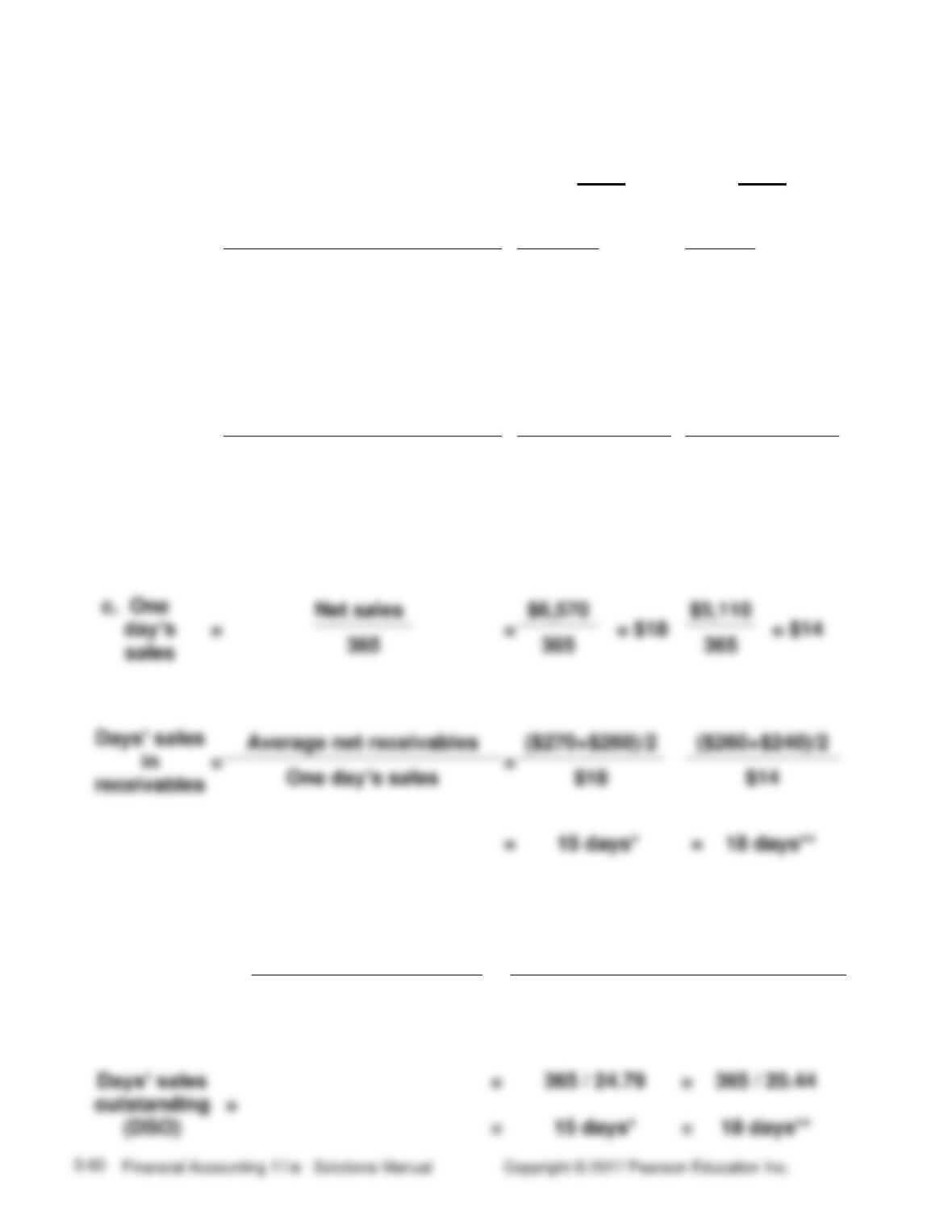
a. Current
=
Total current assets
=
$910
= 1.63
$860
= 1.39
ratio
Total current liabilities
$560
$620
Cash + Short-term
investments
b. Quick
(acid-test)
ratio
=
+ Net current receivables
=
$70 + $150 +
$270
$60 + $175 +
$260
Total current liabilities
$560
$620
=
0.88
= 0.80
($270+$260)/2
=
An alternate way to compute days’ sales outstanding:
Accounts
receivable
turnover
=
Net credit sales
=
$6,570
$5,110
Average net accounts
receivable
($270 + $260) / 2
($260 + $240) / 2
=
24.79 times
= 20.44 times
(continued) P 5-66B
Req. 2
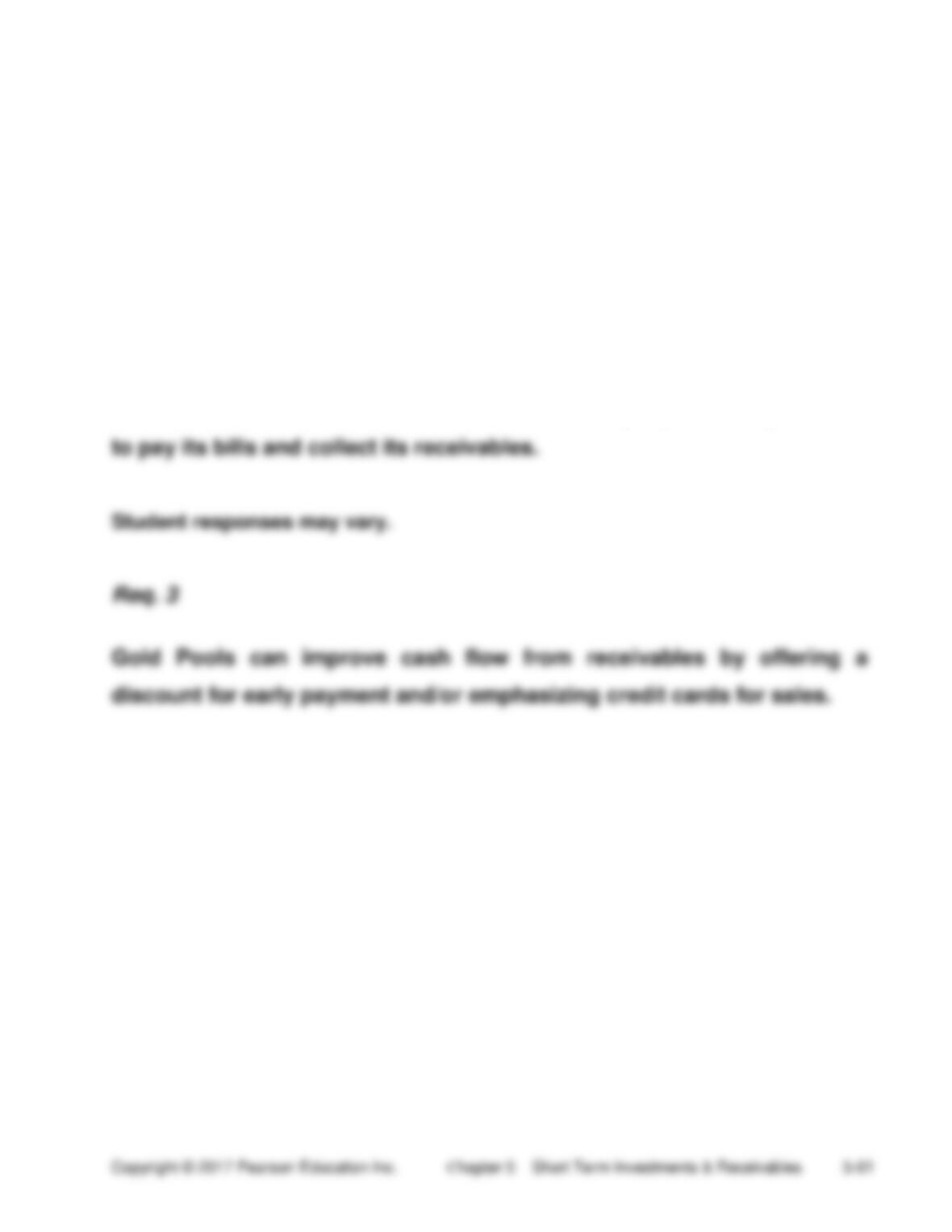
The current ratio improved from 1.39 to 1.63. The quick (acid-test) ratio
increased from 0.80 to 0.88. Days’ sales in receivables improved from 18
days to 15 days.
All three ratio values improved during the current year. This is a
favorable trend because it indicates that the company is finding it easier
Challenge Exercises and Problem
(15-20 min.) E 5-67
Actual without
Bank Cards
Expected with
Bank Cards
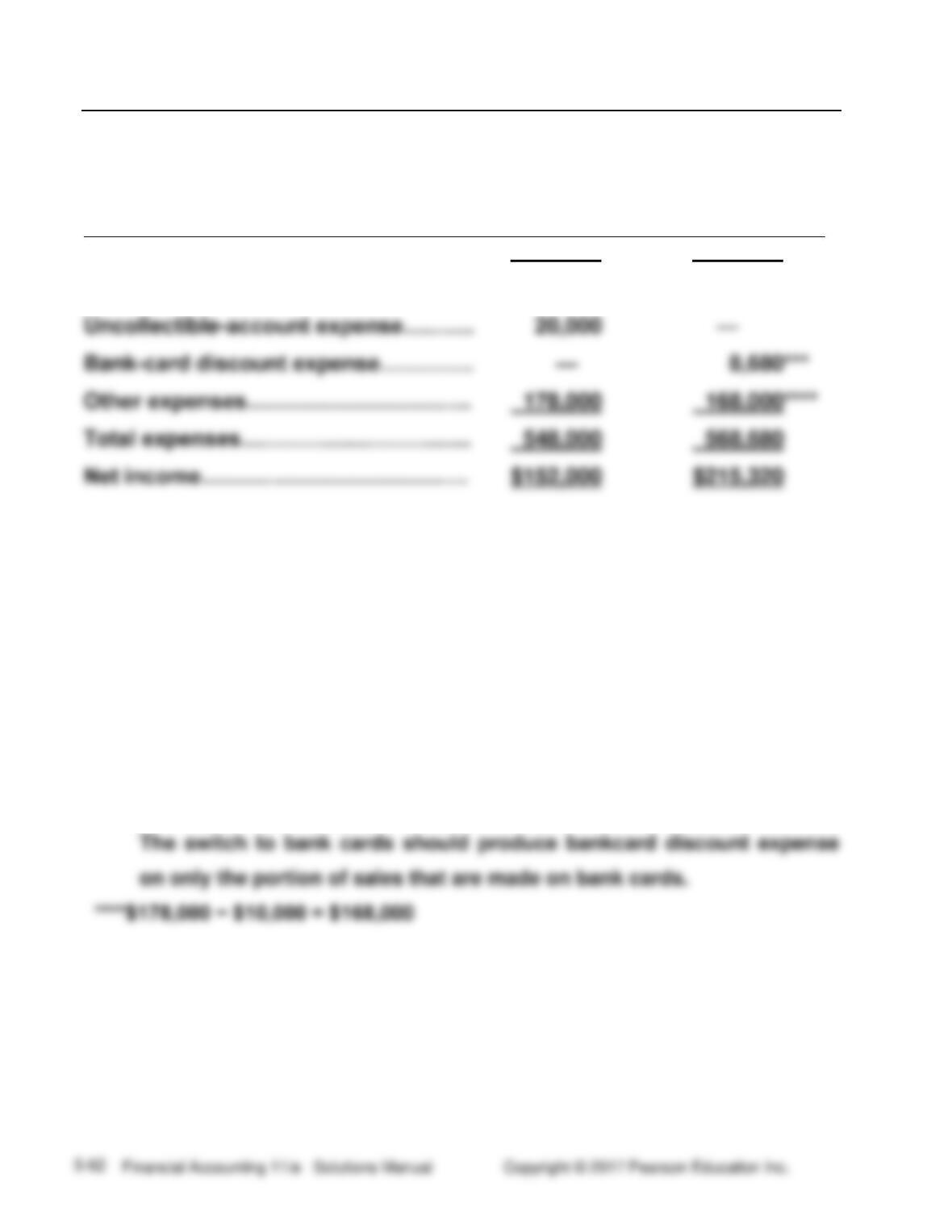
Sales revenue ………………………….
$700,000
$784,000*
Cost of goods sold……………………..
$350,000
$392,000**
—
Other expenses………………………….
Total expenses…………………………..
Net income……………………………….
$152,000
Decision: Accept bank cards because of the expected increase in net
income.
_____
*$700,000 × 1.12 = $784,000
**$350,000 × 1.12 = $392,000
***$784,000 − $350,000 = $434,000 × .02 = $8,680
(15-20 min.) E 5-68
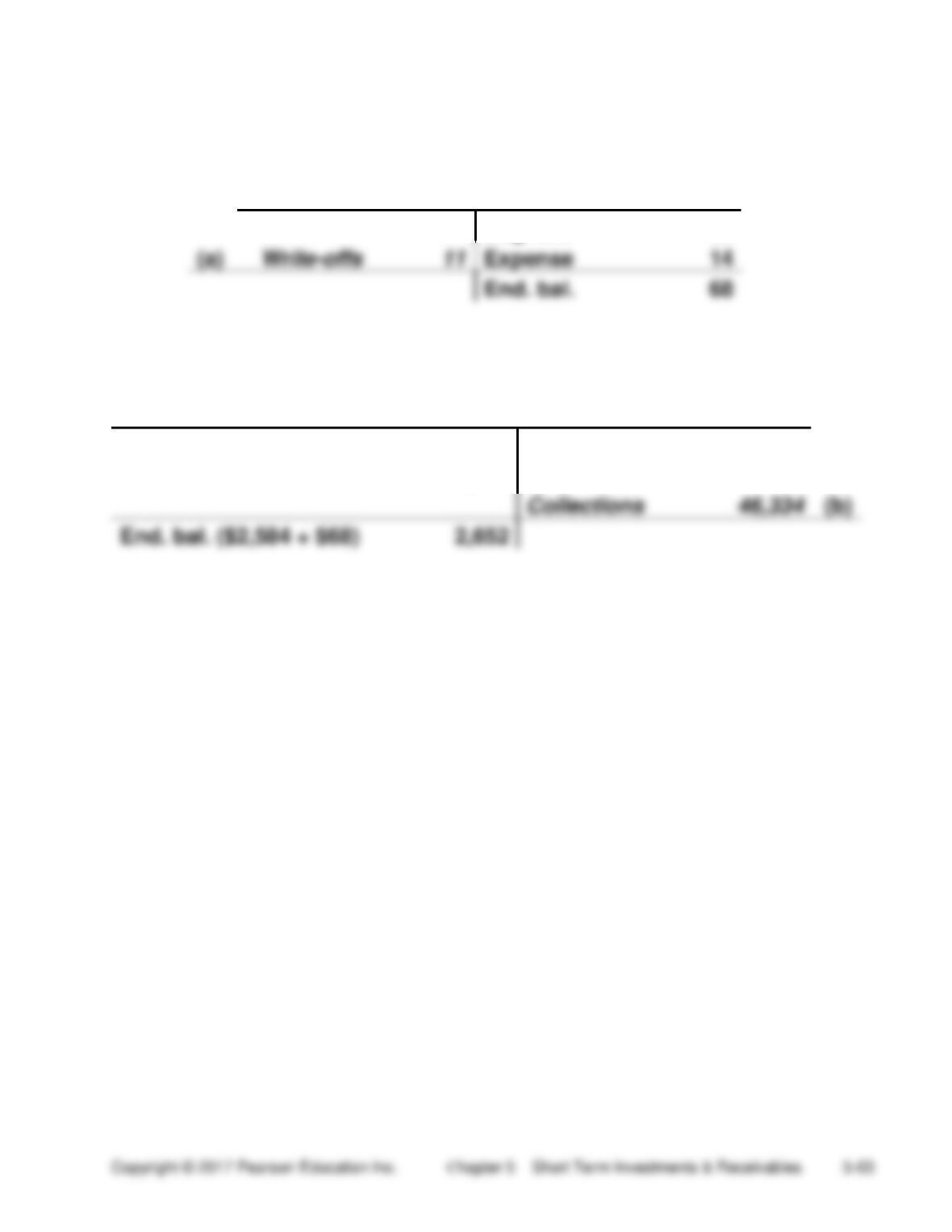
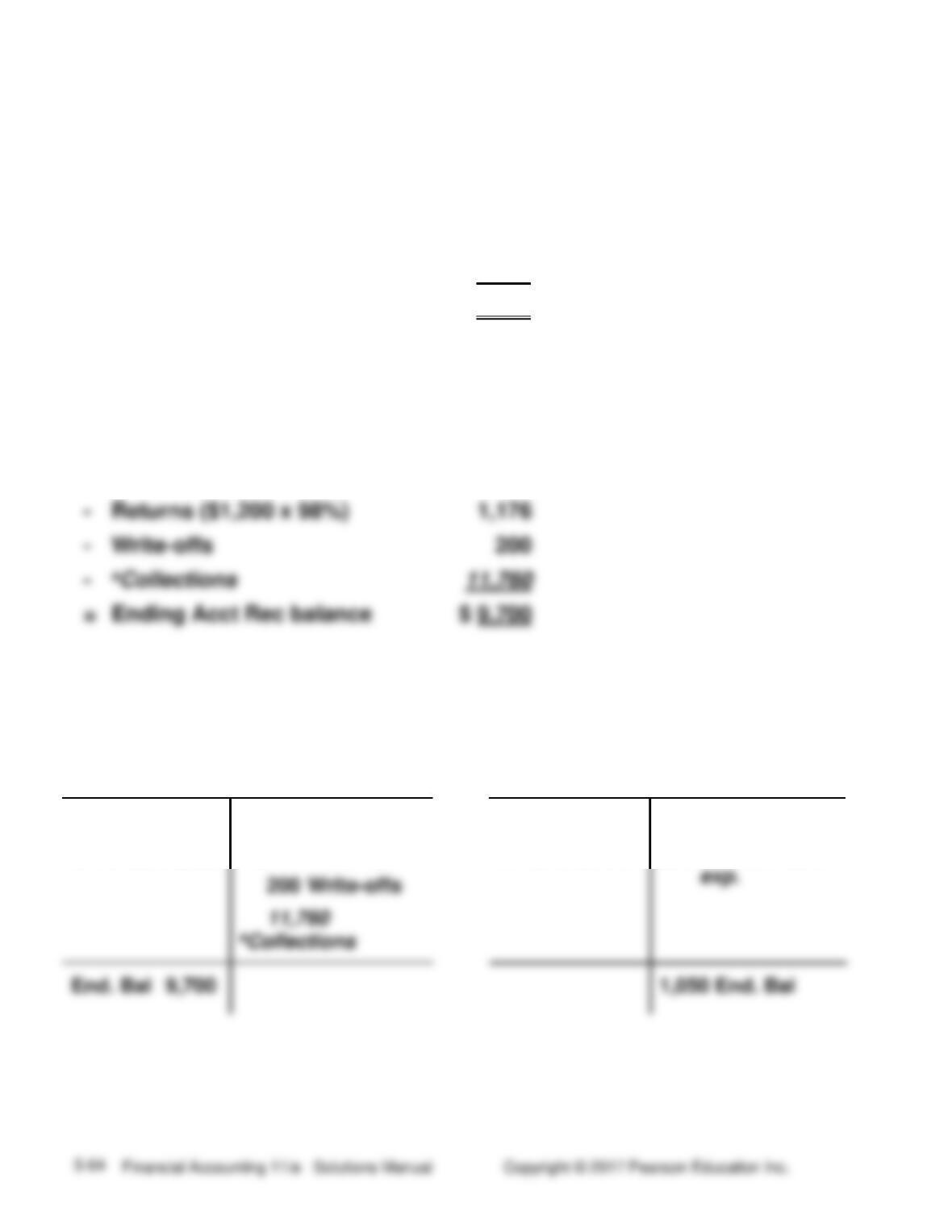
T-accounts are helpful, as follows (in millions):
Allowance for Doubtful Accounts
Beg. bal.
65
End. bal.
Gross Accounts Receivable
Beg. bal. ($2,265 + $65)
2,330
Total revenue
46,667
Write-offs
11
End. bal. ($2,584 + $68)
2,652
(15-20 min.) P 5-69
Req. 1
Beginning Allowance balance $ 990
+ Uncollectible account expense b 260
– Write-offs 200
= Ending Allowance balance $1,050
Req. 2
Beginning Acct Rec balance $ 9,900
+ Credit sales ($13,200 x 98%) 12,936
Total cash collections = $11,760 + $96* = $11,856
*$96 = $12,000 x 40% x 2% = Sales Discounts Forfeited
Req. 3
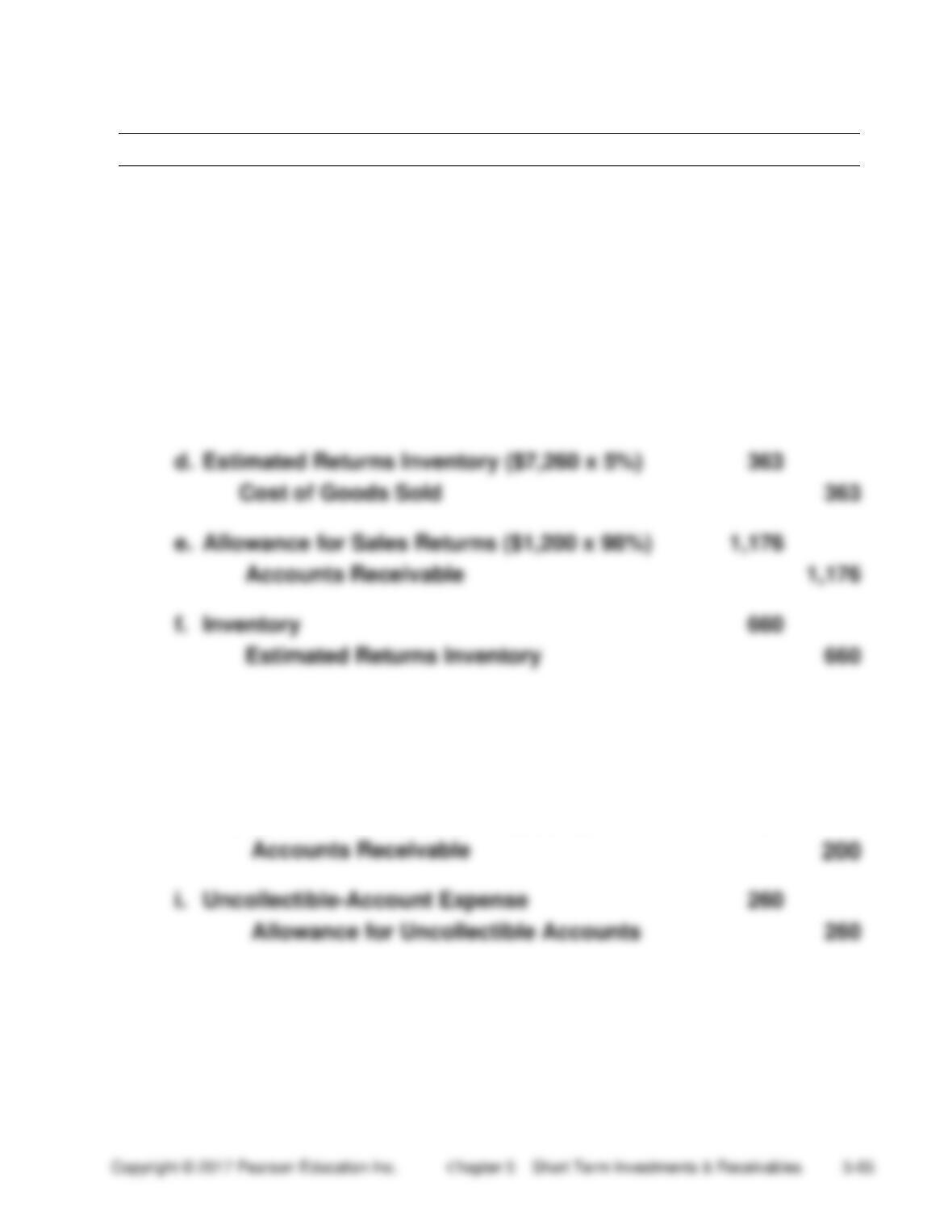
Allowance for
Accounts Receivable Uncollectible Accounts
Beg. Bal 9,900
Cr. sales12,936
1,176 Returns
Write-offs 200
990 Beg. Bal
260bUncoll. Acct.
Journal entries:
Journal
DATE
ACCOUNT TITLES AND EXPLANATION
DEBIT
CREDIT
2016
a.
Accounts Receivable ($13,200 x 98%)
12,936
Sales Revenue
12,936
b.
Cost of Goods Sold
7,260
Inventory
7,260
c.
Sales Revenue ($12,936 x 5%)
647
d.
Estimated Returns Inventory ($7,260 x 5%)
363
Cost of Goods Sold
363
e.
Allowance for Sales Returns ($1,200 x 98%)
1,176
Accounts Receivable
Inventory
660
Estimated Returns Inventory
Allowance for Sales Returns
647
g.
Cash
11,856
Accounts Receivable ($12,000 x .98)
11,760
Sales Discounts Forfeited ($12,000 x 2% x 40%)
96
h.
Allowance for Uncollectible Accounts
200
Accounts Receivable
i.
Uncollectible-Account Expense
260
Allowance for Uncollectible Accounts
Decision Cases
(20-25 min.) Decision Case 1
Sinclair Entertainment, Inc.
Summary Income Statement
Year Ended December 31, 2016
Service revenue ………………………………………….
$940,000
Total expenses, excluding bad debt ……………..
(670,000)
Bad-debt expense ($940,000 × .05) ……………….
Net income …………………………………………………
$223,000
Computation:
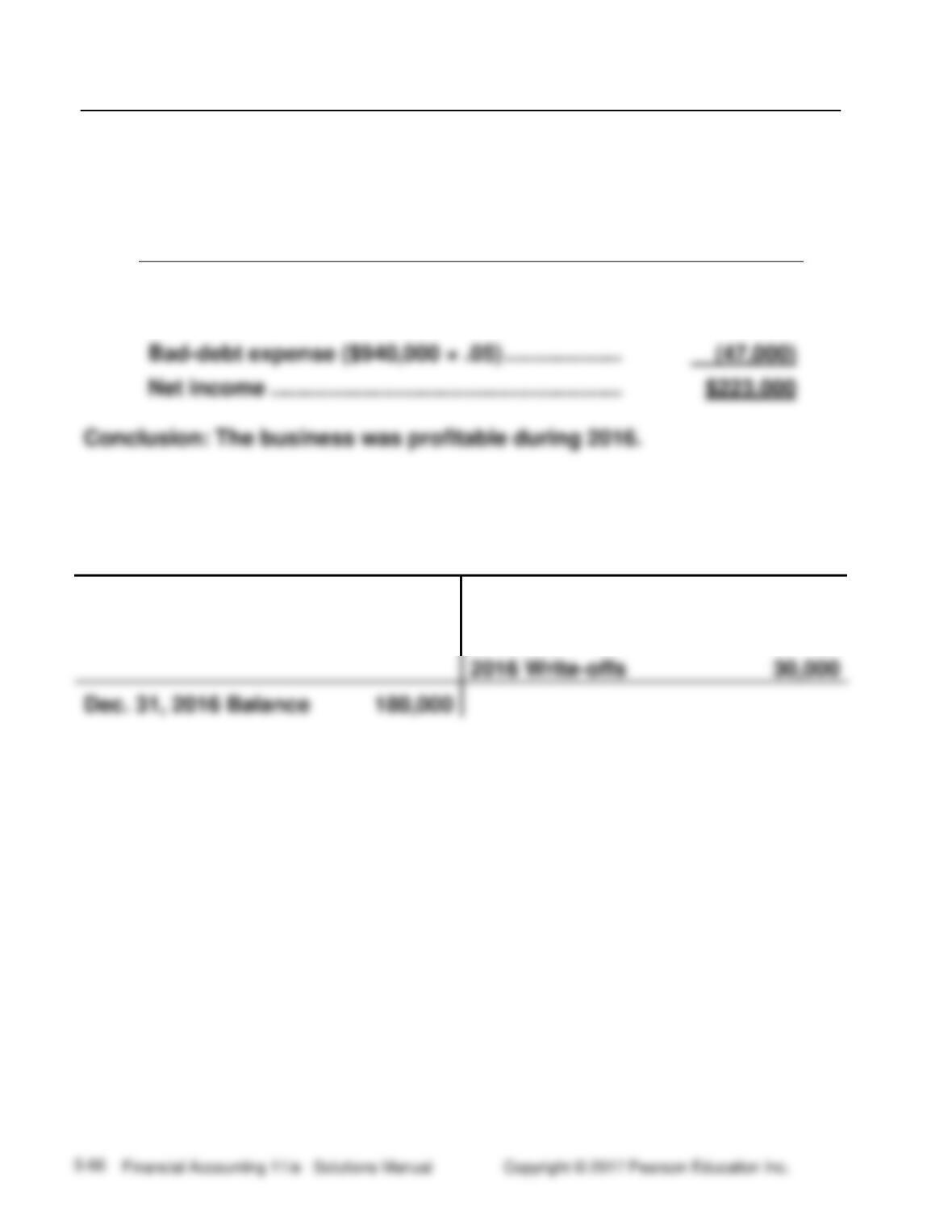
Accounts Receivable
Dec. 31, 2015 Balance
110,000
2016 Revenues
940,000
2016 Collections
840,000
Dec. 31, 2016 Balance
180,000
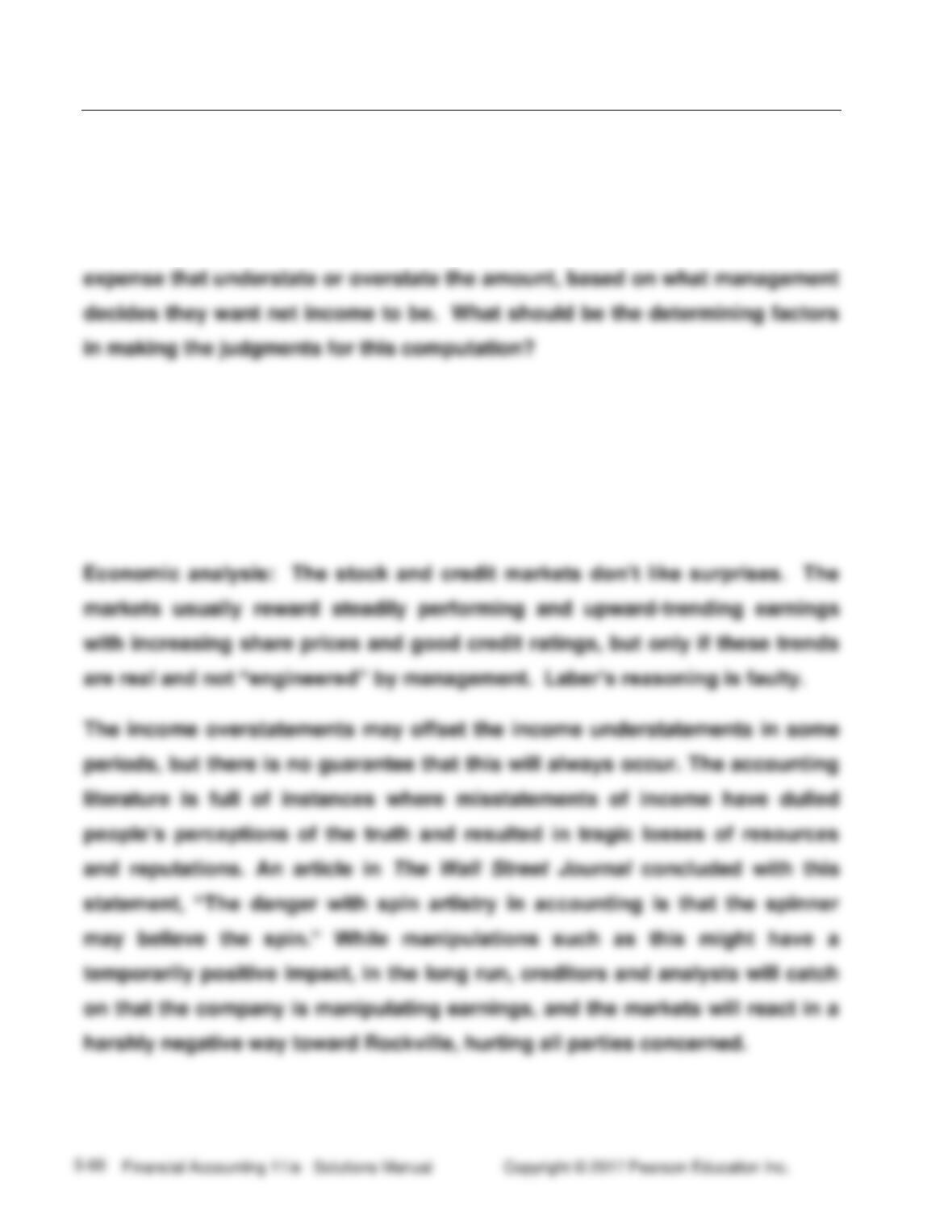
(15-20 min.) Decision Case 2
The trend of sales is increasing.
(Dollars in thousands)
2017
2016
26 days
= 33 days
_____
*Net accounts receivable
Days’ sales in receivables decreased nicely during 2017.
Cash collections from customers for 2017 and 2016:
2017
2016
Beginning gross accounts receivable
$ 107
$ 94
+
Sales revenue
1,475
1,001
Ending gross accounts receivable
=
Estimated cash collections
Ethical Issue
(20-30 minutes)
Req. 1
The ethical issue in this case is whether it is acceptable to “smooth” earnings
by way of judgmental positive or negative changes to uncollectible accounts
Req. 2 and Req. 3
The stakeholders to this decision are Rockville Loan Company, its officers
and directors, its shareholders, its creditors, Rockville’s banker, securities
analysts, and the equity and credit markets.
(continued) Ethical Issue
Legal analysis: As explained in chapter 4, material and intentional
manipulations of earnings are known as fraudulent financial reporting, and are
illegal. Such dealings will eventually result in adverse legal and regulatory
consequences for the company, as well as its officers and directors.
Req. 4
Uncollectible accounts expense and the allowance for uncollectible accounts
should be based on a truthful and accurate projection of how much a
company truly expects to collect over the next operating cycle, rather than
Focus on Financials: Apple Inc.
(30-40 min.)
Req. 1
a. According to Note 1, the “Short-Term Marketable Securities”
account includes short-term debt or equity securities. Debt
b. The company could invest its excess cash in these accounts. This
is done in order to earn a return on excess cash balances or to
mitigate from other riskier securities.
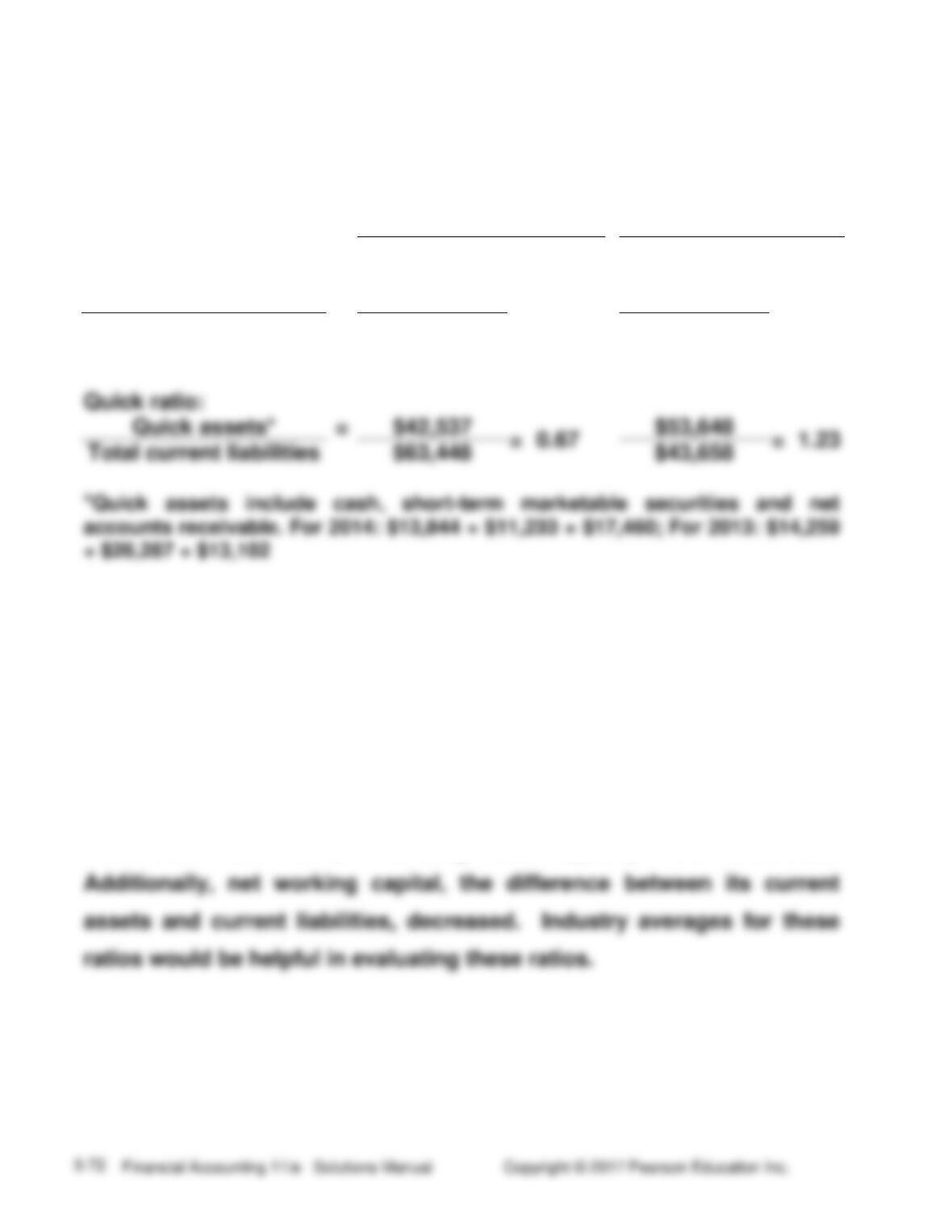
c. The balance in Marketable Securities decreased by 57%, from
$26,287 million in 2013 to $11,233 million in 2014. The company
(continued) Apple Inc.
Req. 2
Apple recognizes revenue from product sales or services rendered when
the following four criteria are met:
• Persuasive evidence of an arrangement exists,
Req. 3
“Less Allowances” means “net of allowance for doubtful accounts.”
Req. 4
According to Note 2, “Accounts Receivable” includes only trade
receivables.
Req. 5
According to Note 1, the allowance for doubtful customer and vendor
accounts receivable is $86 million in 2014 and $99 million in 2013.
(continued) Apple Inc.
Req. 6
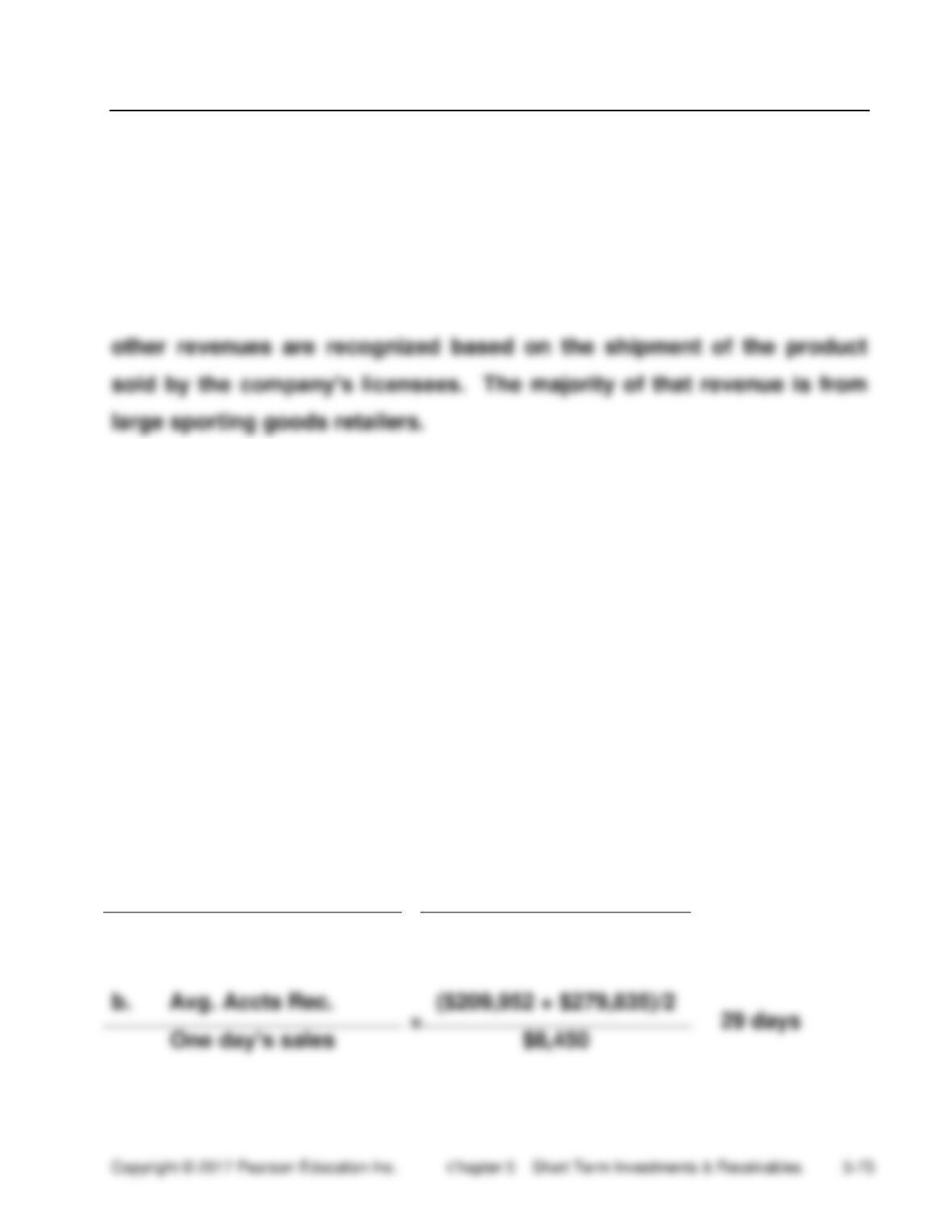
2014
2013
Current ratio:
(Dollar amounts in millions)
Total current assets
=
$68,531
=
1.08
$73,286
=
1.68
Total current liabilities
$63,448
$43,658
Quick ratio:
$42,537
=
0.67
$53,648
=
1.23
Total current liabilities
$63,448
$43,658
Net working capital:
Current assets
– Current liabilities
=
$68,531
–$63,448
$73,286
–$43,658
=
$5,083
=
$29,628
As of the end of 2014, Apple, Inc.’s current ratio and quick ratio
decreased from 2013, indicating that liquidity has decreased.
Focus on Analysis: Under Armour, Inc.
(20 min.)
Req. 1
According to Note 2, Under Armour, Inc.’s revenue primarily comes from
net sales and license and other revenues. Sales are recognized at the
time of ownership and risk of loss is transferred. License revenues and
Req. 2
In Note 2 (Concentration of Credit Risk), the company indicates that the
receivables primarily result from business with its large sporting goods
retailers. Two of its customers accounted for 34.5% of the receivables.
These receivables are necessary for more sales, maintaining
relationships, and ensuring cash payment happens.
Req. 3 (in thousands)
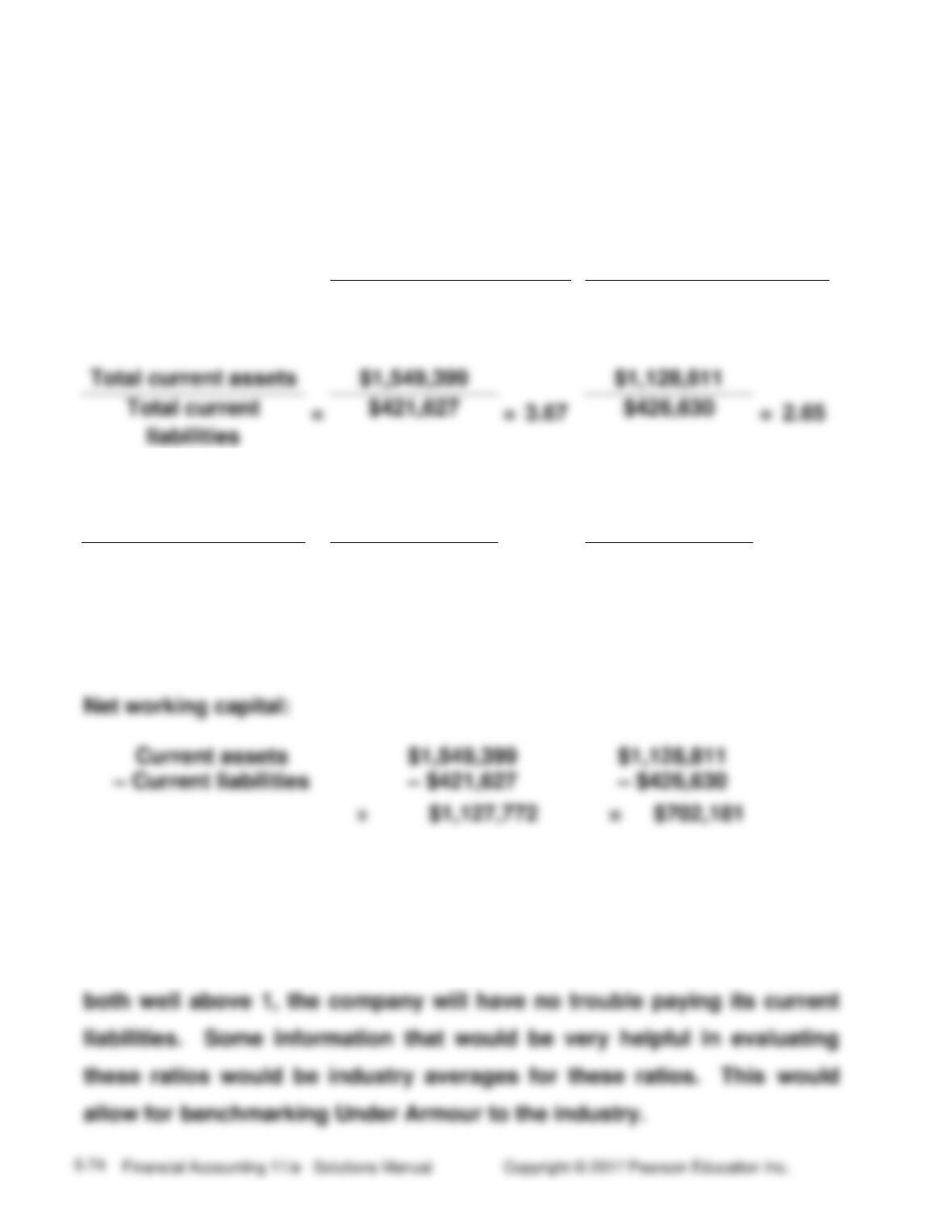
a. Net Sales
=
$3,084,370
=
$8,450
365
365
=
(continued) Under Armour, Inc.
Req. 4
Current ratio:
2014
2013
(Dollar amounts in thousands)
Quick ratio:
Quick assets*
=
$873,010
=
2.07
$557,441
=
1.31
Total current
liabilities
$421,627
$426,630
*Quick assets include cash and accounts receivable.
The current ratio, quick ratio, and net working capital have increased
significantly from 2013 to 2014. Thus, the company’s liquidity has
increased from 2013 to 2014. Since the current ratio and quick ratio are

Group Project
Student responses will vary.