(continued) Ethical Issue 1
Req. 3 Legal and ethical consequences
Banks have legal requirements in loan agreements that require debtors
to maintain certain ratios of assets and liabilities on their books or risk
default. Failure of a company to report its contingent liabilities to a bank
requesting this disclosure could subject the company to a lawsuit later
on.
From an ethical standpoint, reporting a contingent liability requires a
delicate balancing act. Ethics require that outsiders’ interests be
protected. The company must disclose enough information to give
outsiders a reasonable basis for making informed decisions about the
Req. 4
As discussed in the chapter, changes are being discussed between the
FASB and IASB about a new standard for reporting contingencies. It is
likely that, in the future, more losses resulting from lawsuits and other
Ethical Issue 2
1. The ethical issue is whether to structure this lease to avoid its having
to be disclosed as a capital lease. The company will do that if it is
possible. It appears that Gocker and Morgan have some flexibility in
setting the life of the lease (4-5 years). If they set the term of the lease at
4 years, it will be only 66 2/3 percent of the economic life of the asset (6
2. The stakeholders are Gocker, the lessee; Morgan, the lessor; and
Last National Bank, Gocker’s present creditor. The potential
consequences to the stakeholders are:
a. economic: If the lease is structured as a capital lease, Gocker
will violate its long-term loan covenant with Last National Bank. As a
result, the bank might demand immediate payment of their loan. This
may damage Gocker’s credit rating and create difficulty getting future
(continued) Ethical Issue 2
b. legal: If we assume that GAAP substitutes for legal requirements, if
Gocker is careful to structure the lease terms so that it avoids the
c. ethical: The substance of a capital lease is one that transfers the
risks and rewards of ownership to the lessee. If in fact, the substance of
the terms of this lease do that, the equipment should be capitalized by
3. Student responses will vary on this question. Some will say that, if
the rules allow it, then why not engineer the transaction in such as way
as to benefit Gocker by keeping the asset, and the lease obligation, off
the books. After all, this is perfectly legal, and perfectly in accordance
with existing U.S. GAAP (FAS 13). In the view of the authors, Gocker
(continued) Ethical Issue 2
4. The FASB and IASB are working on a proposed new lease standard
that removes the mechanical criteria for lease capitalization discussed in
the chapter in favor of the more theoretically and substantively correct,
but also more subjective, “risks and rewards” approach. As a result,
Focus on Financials: Apple Inc.
(20 min.)
Req. 1
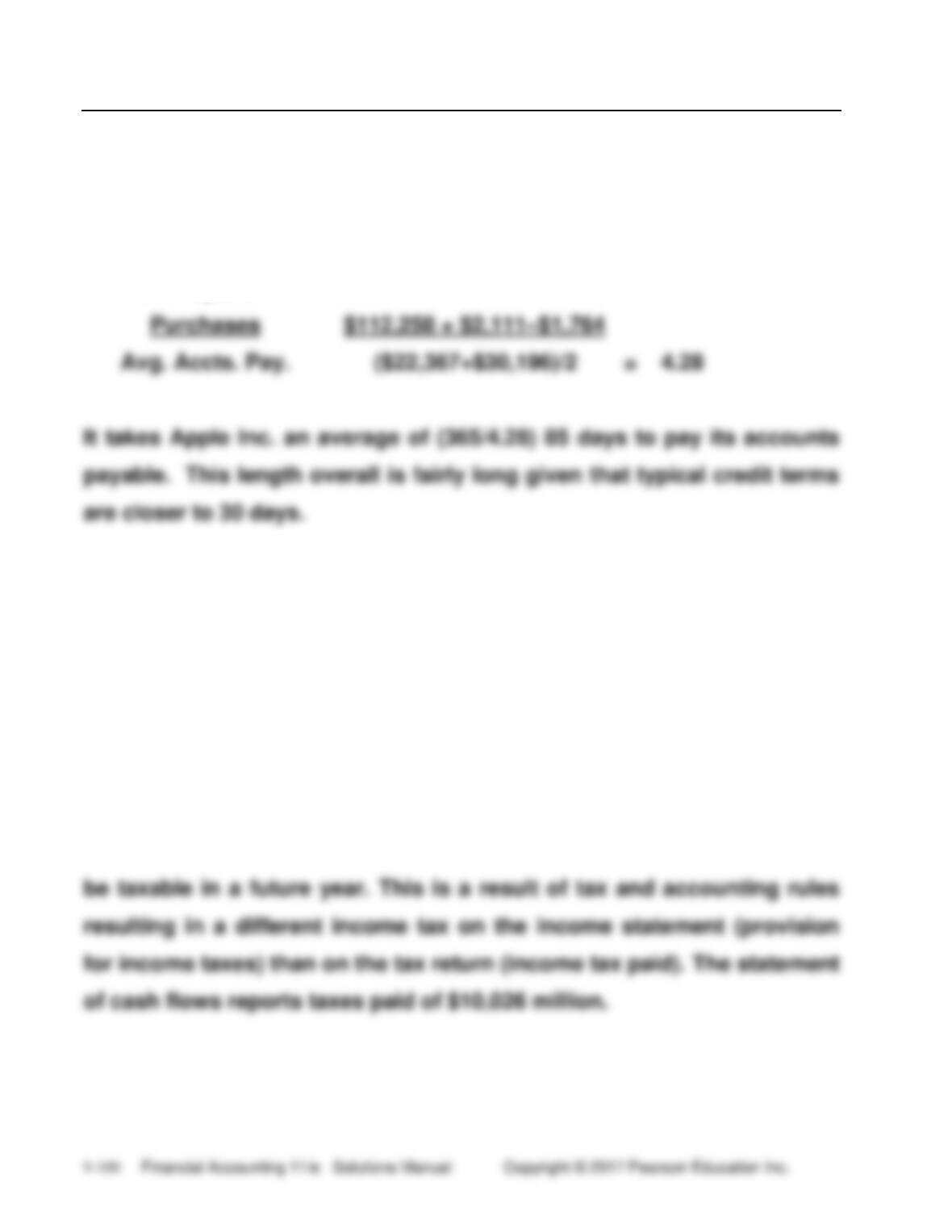
Apple Inc.’s accounts payable increased from $22,367 million in 2013 to
$30,196 million in 2014, an increase of about 35 percent. Accordingly,
Account Payable Turnover is:
Req. 2
Provision for income taxes $13,973 million
Effective tax rate 26.1%
Apple is not going to have to pay its provision for income taxes amount
during 2014. Some of the items included in that amount are “deferred.”
This means the activity that gave rise to the tax increase or decrease will
(continued) Apple Inc.
Req. 3
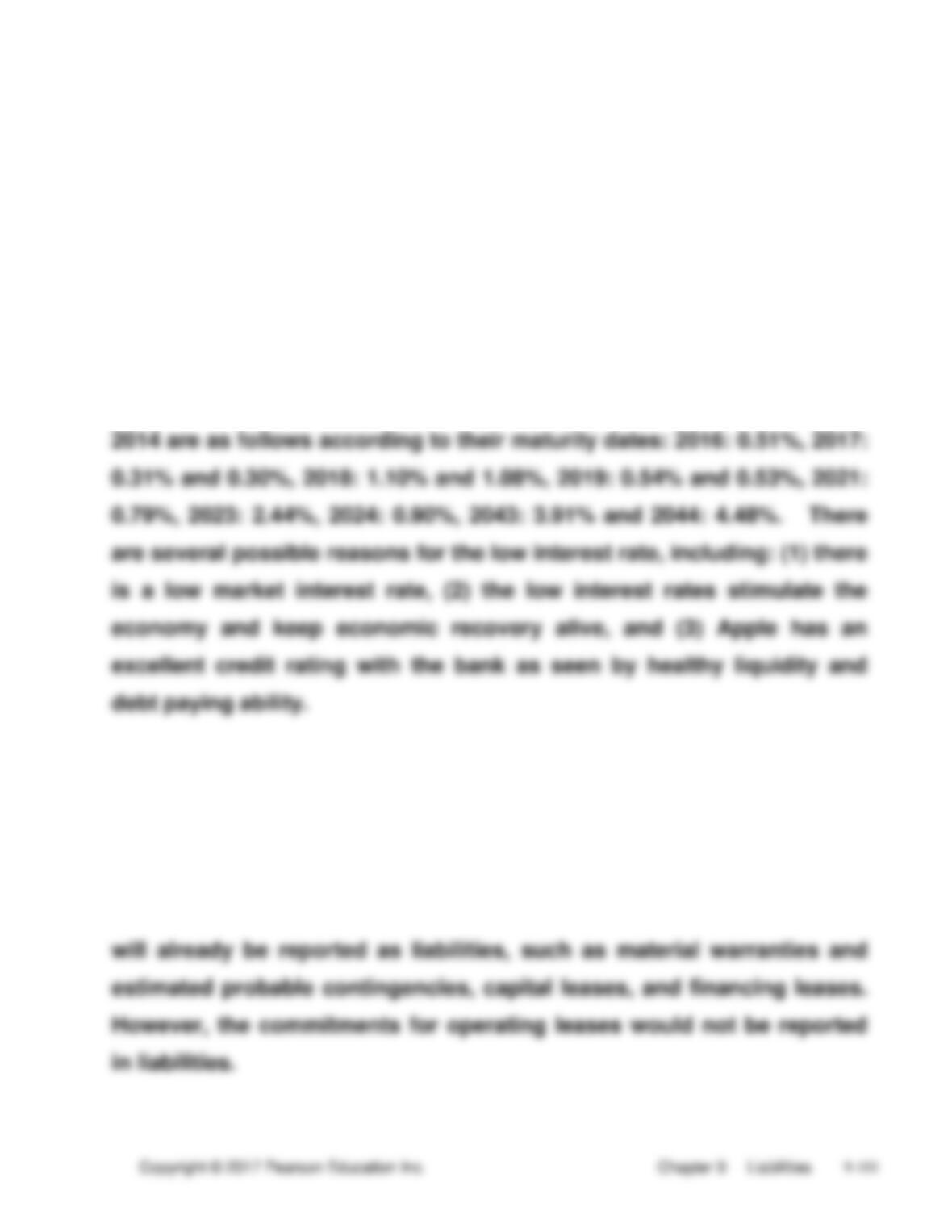
Refer to Note 6—Debt. Based on this information, the company’s long
term debt (after current maturities) increased their principal long-term
debt amount from $17,000 million in 2013 to $29,000 million in 2014.
From this increase, you can tell that Apple Inc. borrowed more than they
paid off during 2014.
The effective interest rates of the debt outstanding at September 27,
Req. 4
Refer to Note 10—Commitments and Contingencies.
The footnotes disclose commitments for accrued warranty, operating
leases, commitments, and contingencies. Some of these commitments
(continued) Apple Inc.
The contingent legal proceedings are of the nature of “disclosed” loss
contingencies, as discussed in the chapter, and therefore, are not
included in the financial statements. The criterion for disclosure of
Req. 5
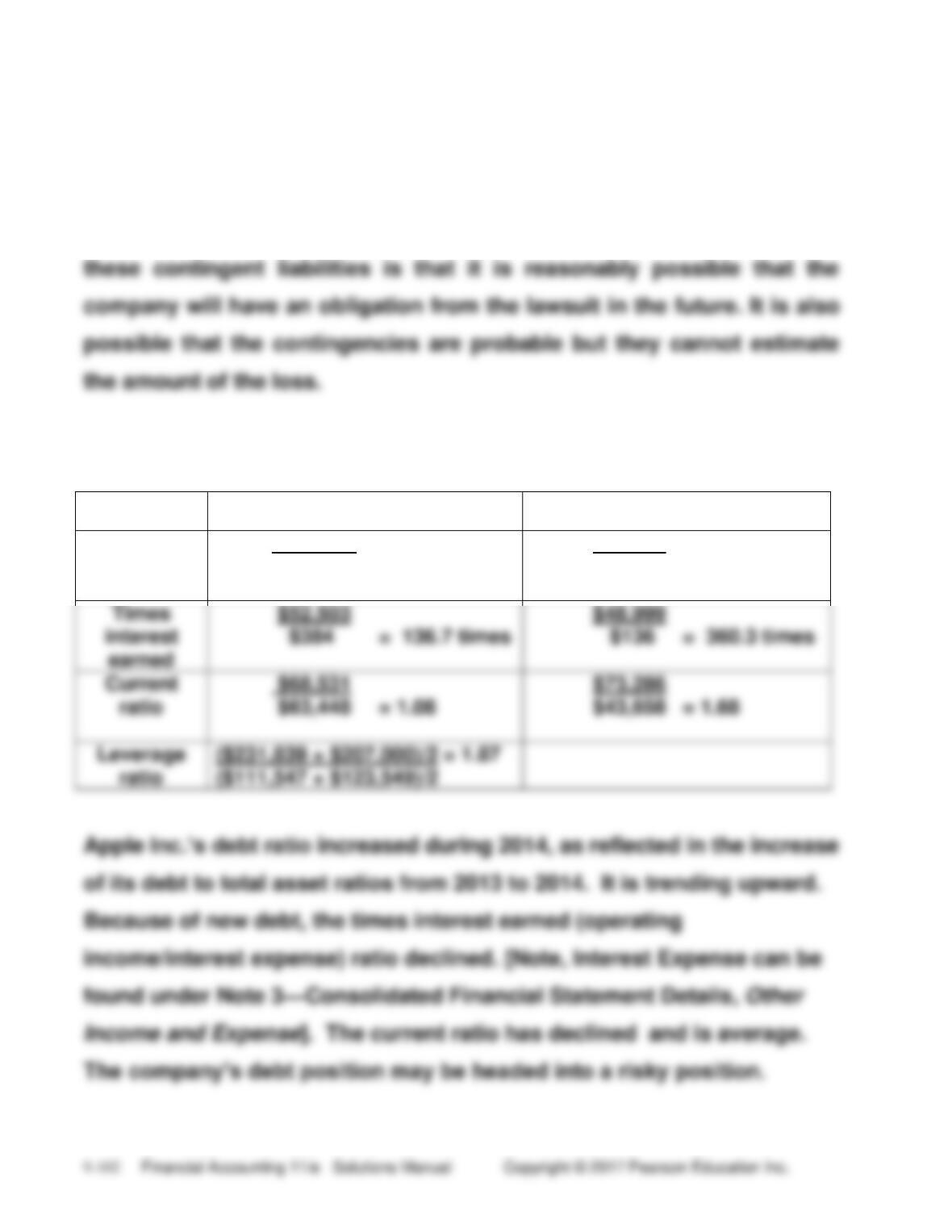
Ratio
2014
2013
Debt ratio
$120,292
$231,839 = 51.9%
$83,451
$207,000 = 40.3%
$68,531
$73,286
Focus on Analysis: Under Armour, Inc.
(20 min.)
Req. 1
• Revolving credit facility- financial institution that allows the
borrower to borrow an amount whenever the borrower wants and
at what amount, up to a limit set by the bank
• Accounts payable- the amount owed for products or services
purchased on account
Req. 2
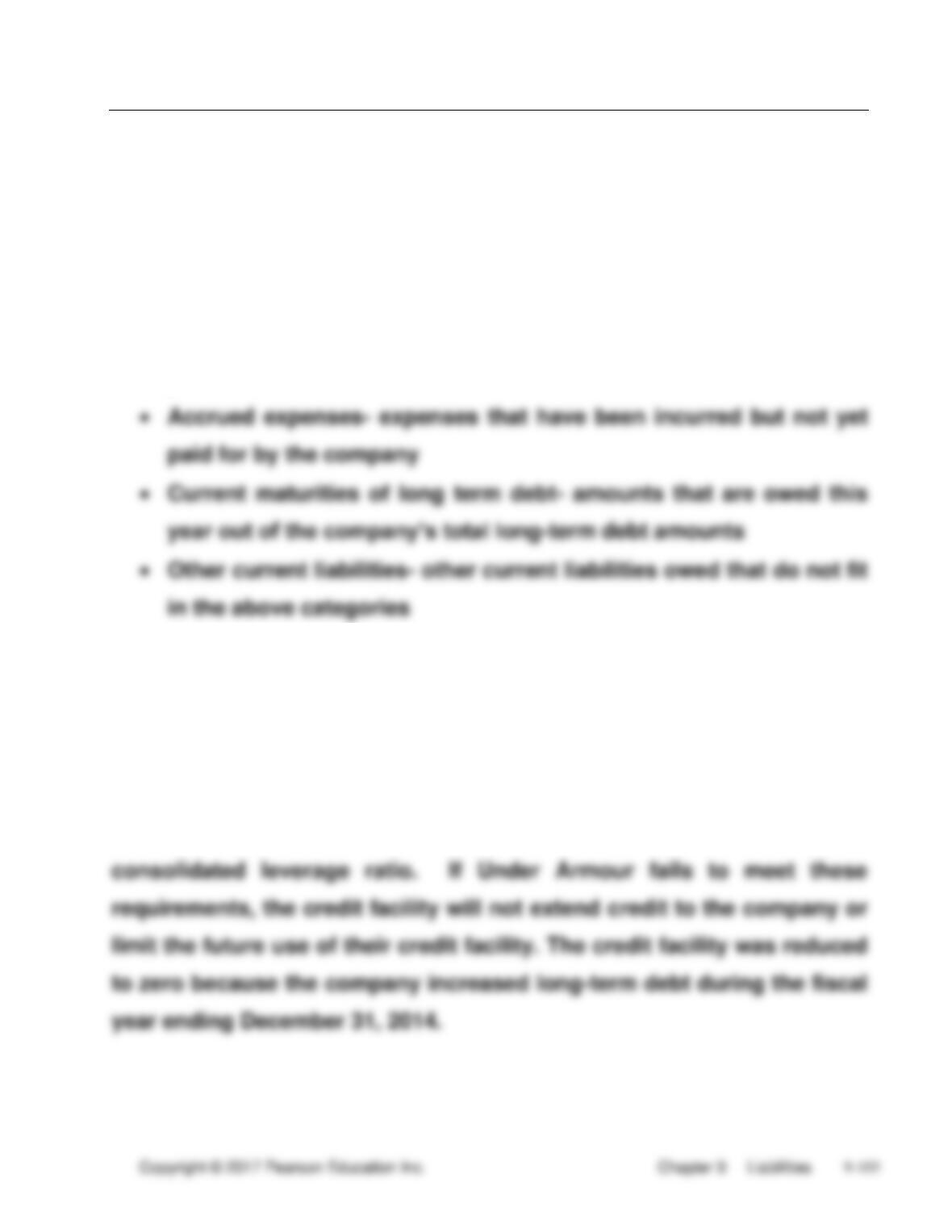
A credit facility is an agreement that a financial institution provides for a
committed revolving credit. This is a place where the company can take
out amounts (with an upper limit) as long as all covenants are met. Some
negative covenants are maintaining a certain EBITDA ratio amount,
(continued) Under Armour, Inc.
Req. 3
In Millions
AP
Turnover
Purchases
Avg. Accts. Pay.
$1,572 + $537 – $469
($165 + $210)/2
8.75
Days in
AP
365
AP Turnover
365
8.75
42
Current
Ratio
Current assets
Current liabilities
$1,549
$422
3.67
Ratio
$422
2.07
Avg. Accts. Rec.
$3,084
Days in
AR
365
AR Turnover
365
29
Turnover
Days in
Inv.
365
Inventory Turnover
365
3.13
116.61
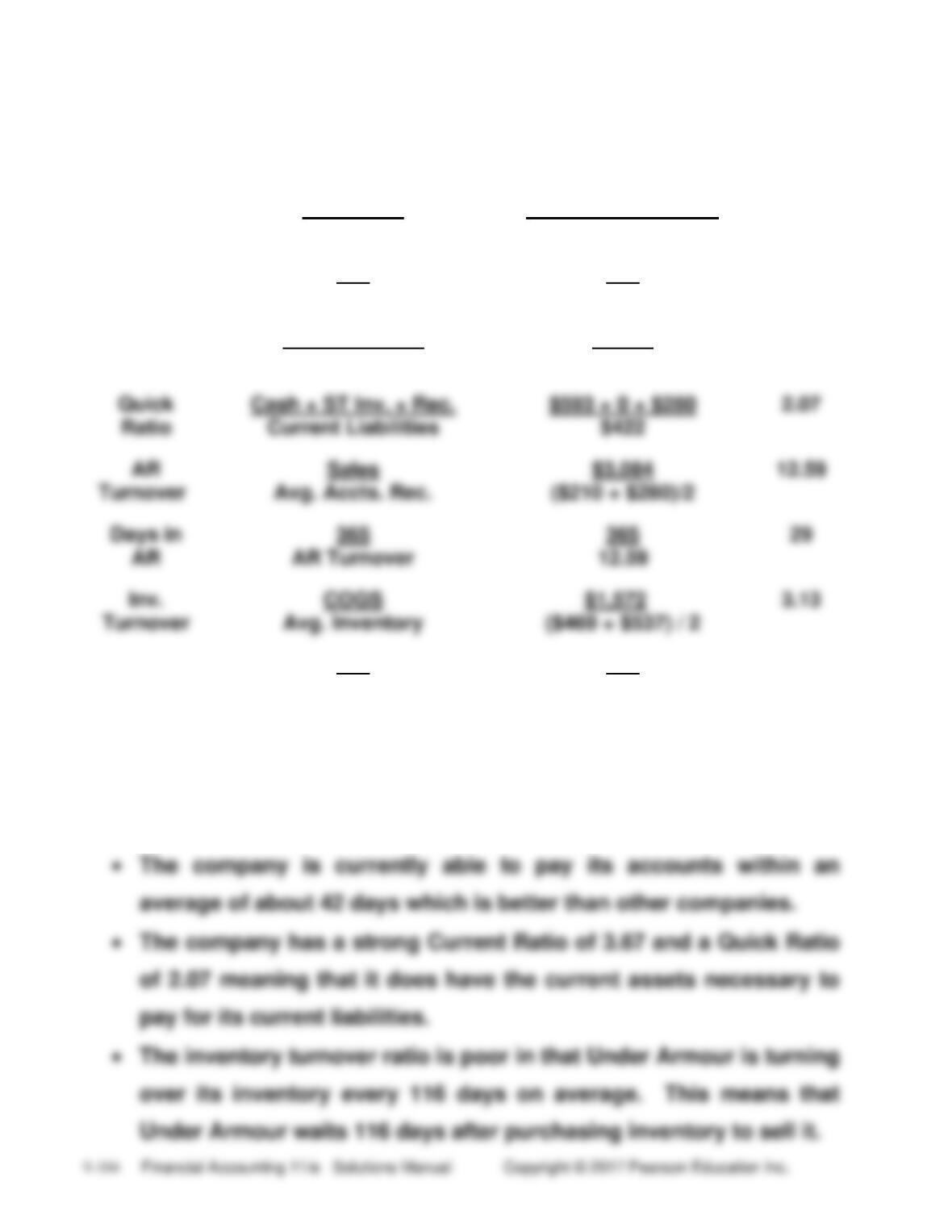
• Accounts payable turnover measures the number of times a
company pays its accounts payable in a year. Days’ payables
outstanding measure the number of days it takes to pay accounts
payable on average.
(continued) Under Armour, Inc.
• Under Armour is in a poor position as it turns inventory purchases
back into cash via sales and collections (116+29) after it actually
pays for the purchases (42). A comparison to previous years
Req. 4
The note has the following items:
Under Armour has a weighted average interest rate of 3.1% on
Req. 5
In Note 7—Commitments and Contingencies, there is information about:
(1) operating leases, (2) sponsorship and marketing commitments, and
(3) other. Under Armour describes the types of operating leases it uses
(continued) Under Armour, Inc.
Req. 6
The operating lease arrangements involve warehouse space, office
facilities, space for its brand and factor house stores, and certain
equipment. Under Armour has to pay a rent to the owner of the property
subject to the agreement and reports that amount as rent expense on its
income statement. The company expects that until 2028, the total lease
payments the company will have to make is $472,575 thousand.
Original facts
Original facts with
Operating leases
capitalized
Return
on
assets
$208
($2,095 +$1,578)/2
= 0.113
$208
($2,095 + $1,578 + $473)/2
= 0.100
(continued) Under Armour, Inc.
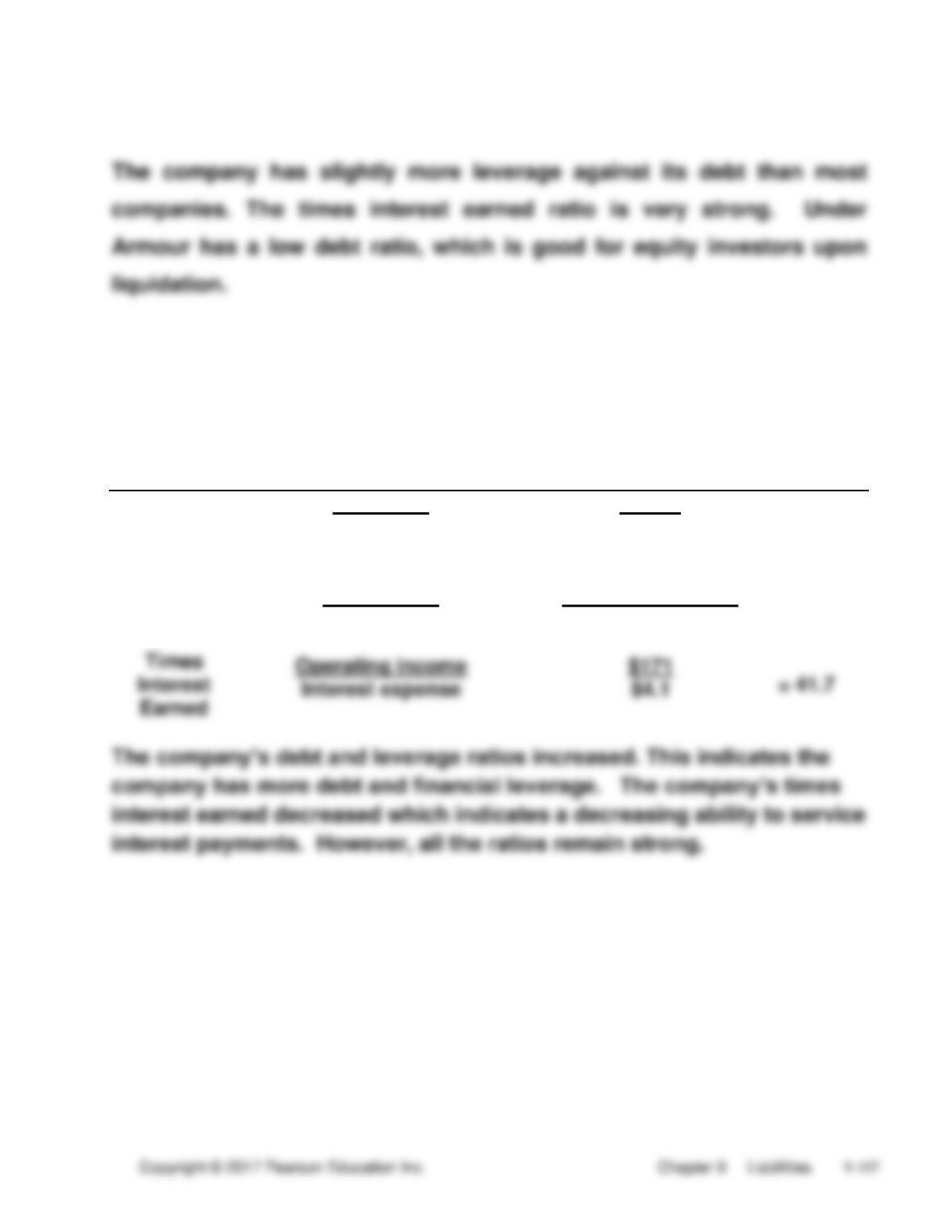
Req. 8
(Solution depends on financial statements selected. Student responses
will vary.) For the quarter ending September 30, 2015:
(in millions)
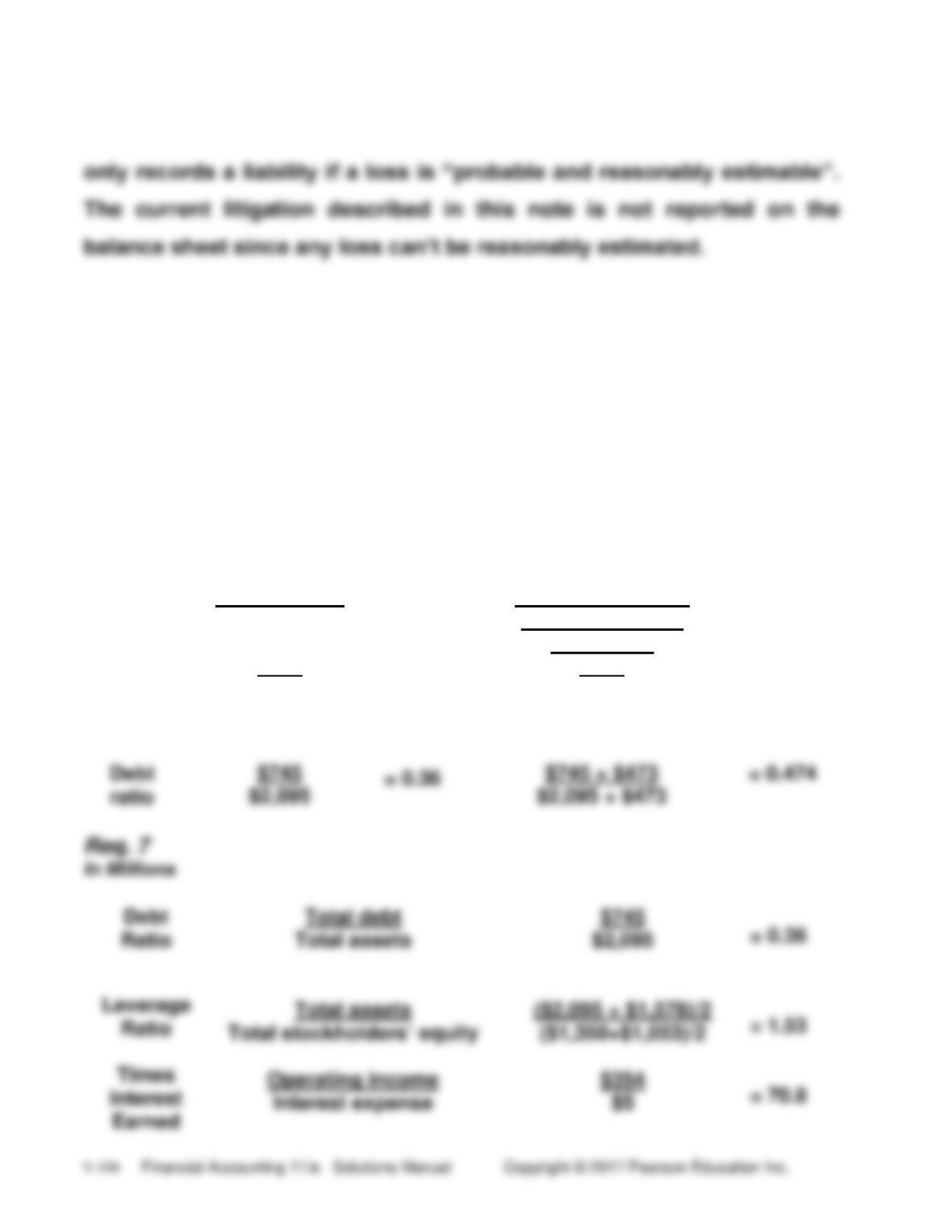
Debt
Ratio
Total debt
Total assets
$1,500
$3,036
= 0.49
Leverage
Ratio
Total assets
Total stockholders’ equity
($2,095 + $3,036)/2
($1,350+$1,535)/2
= 1.78

Group Projects
Student responses will vary.