Chapter 11 – Statement of Cash Flows
11-1
Chapter 11
Statement of Cash Flows
INSTRUCTOR’S MANUAL
Authors’ Perspectives
Students should begin by understanding that the overall purpose of the statement of cash flows is
very simple—to explain the change in cash for the period. Students can easily relate to their own
PART A: Classification of Cash Flow Activities
LO11-1 Classify cash transactions as operating, investing, or financing activities.
Classification – Classification of cash flows into operating, investing, and financing activities
relates closely to how the related transactions are recorded in the income statement and balance
sheet. Introducing the types of cash flows in relation to the more familiar income statement and
balance sheet helps to provide meaning to the classifications.
PART B: Preparing the Statement of Cash Flows
LO11-2 Understand the steps and basic format in preparing the statement of cash flows.
LO11-3 Prepare the operating activities section of the statement of cash flows using the
indirect method.
Chapter 11 – Statement of Cash Flows
11-2
Preparation – To keep preparation of the statement of cash flows simple, the text introduces
four steps.
• Illustration 11-5 details the four steps.
Indirect Method for Operating Activities – Nearly every major U.S. company reports
Investing Activities – We can find a firm’s investing activities by analyzing changes in long-
term asset accounts from the balance sheet. Students generally find identification of these cash
flows fairly easy.
Financing Activities – We can find a firm’s financing activities by examining changes in long–
ANALYSIS
LO11-6 Perform financial analysis using the statement of cash flows.
Cash Flow Analysis – The main text concludes with a cash flow analysis that re-examines the
APPENDIX
LO11-7 Prepare the operating activities section of the statement of cash flows using the
direct method.
Direct Method – The direct method is explained in the appendix to the chapter using data from
Chapter 11 – Statement of Cash Flows
11-3
Chapter 11 – Statement of Cash Flows
11-4
Self-Study Materials
■ Let’s Review—Types of cash flows (p. 543).
■ Let’s Review—Indirect method for operating cash flows (p. 553).
Chapter 11 – Statement of Cash Flows
11-5
Key Points by Learning Objective
Throughout the chapter, Key Points provide quick synopses of the critical pieces of information
LO11-1 Classify cash transactions as operating, investing, or financing activities.
Operating activities generally relate to income statement items and changes in current assets and
LO11-2 Understand the steps and basic format in preparing the statement of cash flows.
The steps in preparing the statement of cash flows involve calculating: (1) net cash flows from
operating activities, (2) net cash flows from investing activities, (3) net cash flows from
LO11-3 Prepare the operating activities section of the statement of cash flows using the
indirect method.
Using the indirect method, we start with net income and adjust this number for (1) revenue and
LO11-4 Prepare the investing activities section of the statement of cash flows.
Cash transactions (inflows and outflows) involving long-term assets and current investments are
LO11-5 Prepare the financing activities section of the statement of cash flows.
Cash transactions (inflows and outflows) with creditors and shareholders are reported in the
Chapter 11 – Statement of Cash Flows
11-6
Analysis
LO11-6 Perform financial analysis using the statement of cash flows.
Cash return on assets indicates the amount of operating cash flow generated for each dollar
Appendix
LO11-7 Prepare the operating activities section of the statement of cash flows using the
direct method.
The indirect method and direct method differ only in the presentation of operating activities. In
Chapter 11 – Statement of Cash Flows
11-7
A
As
ss
si
ig
gn
nm
me
en
nt
t
C
Ch
ha
ar
rt
ts
s
Questions
Learning
Objective(s)
Topic
Time
(Min.)
1
LO11-1
Describe the three categories of cash flows reported
in the statement of cash flows
5
LO11-1
Classify changes in balance sheet accounts with
operating, investing, and financing activities
5
3
LO11-1
Explain what we mean by noncash activities and
provide an example
5
LO11-1
Discuss the information necessary to prepare a
statement of cash flows
5
5
LO11-2
Describe the basic format used in preparing a
5
statement of cash flows
6
LO11-2
Briefly describe the four steps outlined in the text
for preparing a statement of cash flows
5
7
LO11-2
operating activities
8
LO11-3
Describe the most common adjustments we use to
convert net income to net cash flows from
operations under the indirect method
5
have positive operating cash flows
10
LO11-3
Explain how we report depreciation expense using
the indirect method
5
11
LO11-3
Describe how we report a gain or loss on the sale of
an asset using the indirect method
5
Distinguish between the indirect method and the
direct method for reporting net cash flows from
5
12
LO11-3
Indicate the effect of changes in current assets and
current liabilities using the indirect method
5
13
LO11-3
Explain how a change in accounts receivable affects
net income and operating cash flows
5
14
LO11-3, 11-4
Discuss how the sale of an investment affects
operating, investing, and financing activities
5
15
LO11-5
16
Describe the proper reporting of noncash activities
5
17
LO11-6
Explain the difference in the calculation of return on
assets and cash return on assets
5
LO11-6
Describe the two primary strategies firms use to
increase cash return on assets
5
under the direct method
Provide examples of financing activities reported in
5
Chapter 11 – Statement of Cash Flows
20
LO11-7
Explain why we exclude depreciation expense and
the gain or loss on sale of an asset from the
operating activities section under the direct method
5
Brief
Exercises
Learning
Objective(s)
Topic
Time
(Min.)
BE11-1
LO11-1
Determine proper classification
5
BE11-2
LO11-1
Determine proper classification
5
BE11-3
LO11-2
Understand the basic format for the statement of
cash flows
5
BE11-4
LO11-3
Calculate operating activities—indirect method
5
BE11-5
LO11-3
Calculate operating activities—indirect method
5
BE11-6
LO11-3
Calculate operating activities—indirect method
5
BE11-7
LO11-3
Calculate operating activities—indirect method
5
BE11-8
LO11-4
Calculate net cash flows from investing activities
5
BE11-9
LO11-4
Determine investing cash flows from lending
5
BE11-10
LO11-4
Calculate investing cash flows from sale of land
5
BE11-11
LO11-5
Calculate net cash flows from financing activities
5
LO11-5
Determine investing cash flows from borrowing
5
BE11-13
Understand significant noncash activities
5
11-5
BE11-14
LO11-6
Calculate the cash return on assets
10
BE11-15
LO11-6
Calculate the net cash flows from operating
activities
5
BE11-16
LO11-7
Determine cash received from customers
5
BE11-17
LO11-7
Determine cash paid to suppliers
5
BE11-18
LO11-7
Determine cash paid for operating expenses
5
BE11-19
LO11-7
Determine cash paid for income taxes
5
BE11-20
Determine cash paid for dividends
5
Exercises
Learning
Objective(s)
Topic
Time
(Min.)
E11-1
LO11-1, 11-2, 11-
3,11- 4,11-5, 11-6,
11-7
Match terms with their definitions
10
E11-2
LO11-1
Determine proper classification
15
E11-3
LO11-1
Determine proper classification
10
E11-4
LO11-1
Determine proper classification
10
E11-5
LO11-1
Determine proper classification
10
E11-6
LO11-1
Determine proper classification
10
Prepare the basic format for the statement of cash
flows
E11-8
LO11-3
Calculate operating activities—indirect method
15
E11-9
LO11-3
Calculate operating activities—indirect method
15
Chapter 11 – Statement of Cash Flows
11-9
E11-10
LO11-2, 11-3, 11-
4, 11-5
Prepare a statement of cash flows—indirect method
30
E11-11
LO11-3
Calculate operating activities—indirect method
15
E11-12
LO11-4
Calculating investing cash flows
10
E11-13
LO11-5
Calculate financing cash flows
10
E11-14
LO11-6
Calculate financial ratios
20
E11-15
LO11-7
Calculate operating activities—direct method
20
E11-16
LO11-7
Calculate operating activities—direct method
20
E11-17
LO11-7
Calculate operating activities—direct method
15
LO11-7
Determine cash received from customers
15
LO11-7
Determine cash paid to suppliers
20
LO11-7
Determine cash paid for operating expenses
20
Problems
Learning
Objective(s)
Topic
Time
(Min.)
P11-1A
LO11-1
Determine proper classification
15
P11-2A
LO11-1, 11-3,
11-4, 11-5
Classify items and prepare the statement of cash
flows
20
P11-3A
LO11-3
Calculate operating activities—indirect method
20
P11-4A
LO11-2, 11-3,
11-4, 11-5
Prepare a statement of cash flows—indirect method
30
P11-5A
LO11-6
Calculate and analyze ratios
30
P11-6A
LO11-7
Calculate operating activities—direct method
20
P11-7A
LO11-7
Calculate operating activities—direct method
20
P11-8A
Prepare an income statement using operating cash
flow information—indirect and direct methods
25
LO11-1
Determine proper classification
15
P11-2B
LO11-1, 11-3,
11-4, 11-5
Classify items and prepare the statement of cash
flows
20
P11-3B
LO11-3
Calculate operating activities—indirect method
20
P11-4B
LO11-2, 11-3,
11-4, 11-5
Prepare a statement of cash flows—indirect method
30
P11-5B
LO11-6
Calculate and analyze ratios
30
P11-6B
LO11-7
Calculate operating activities—direct method
20
P11-7B
LO11-7
Calculate operating activities—direct method
20
flow information—indirect and direct methods
Additional
Perspectives
Topic
Time
(Min.)
AP11-1
Continuing Problem: Great Adventures
30
Financial Analysis: American Eagle Outfitters, Inc.
20
AP11-3
Financial Analysis: The Buckle, Inc.
20
Chapter 11 – Statement of Cash Flows
11-10
Chapter 11 – Statement of Cash Flows
Alternate Let’s Review
Problem #1
Required:
Indicate whether each of the following items is classified as an operating activity, investing
activity, financing activity, or significant noncash activity.
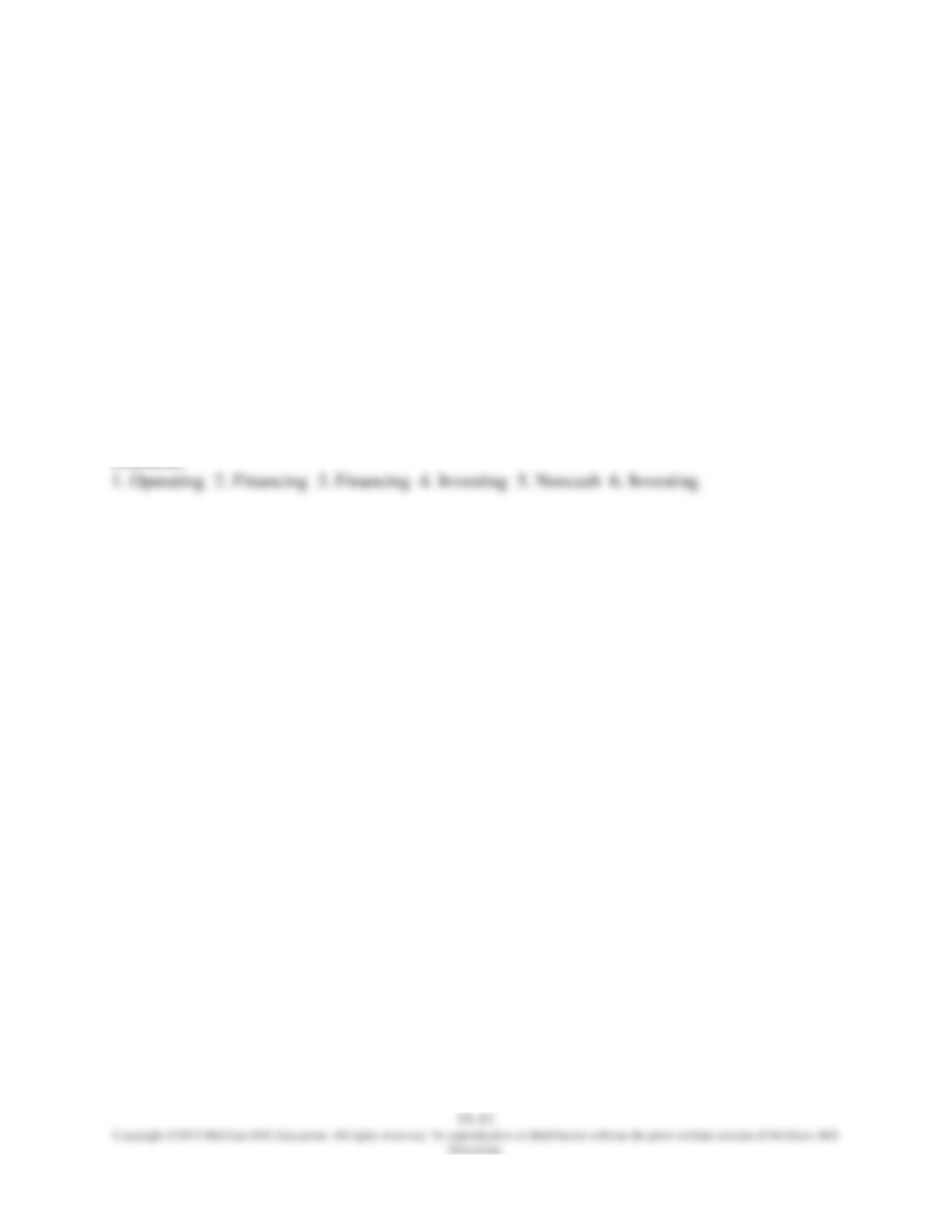
1. Payment of employee salaries.
2. Issuance of bonds.
3. Purchase of treasury stock.
4. Collection of notes receivable.
5. Purchase of equipment by issuing long-term debt.
6. Sale of equipment for cash.
Solution:
Chapter 11 – Statement of Cash Flows
11-12
Problem #2
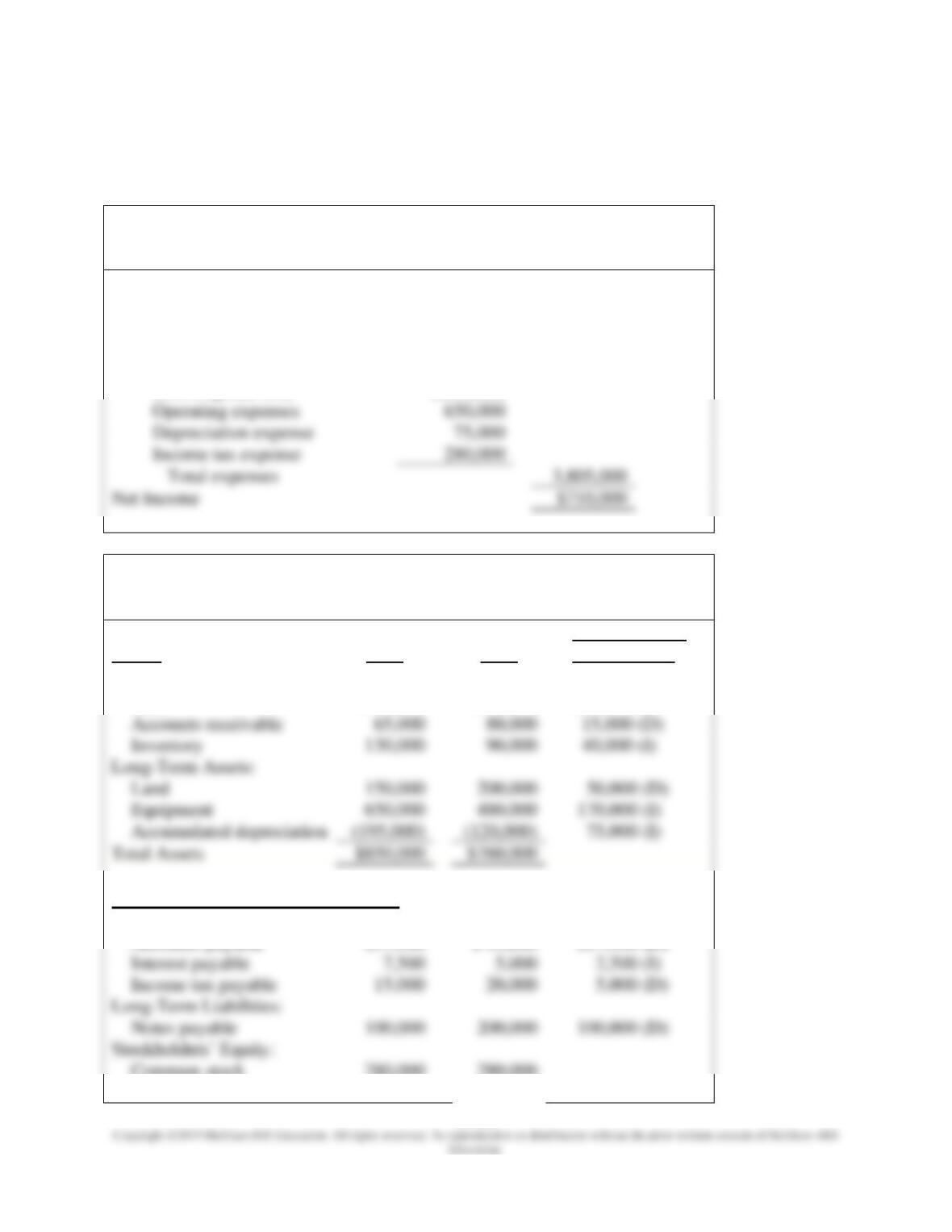
The income statement, balance sheets, and additional information for Surround Sound, Inc., are
provided below.
Surround Sound, Inc.
Income Statement
For the Year Ended December 31, 2021
Sales revenue
$4,500,000
Gain on sale of land
15,000
Expenses:
Cost of goods sold
2,800,000
Operating expenses
Depreciation expense
Income tax expense
Net Income
$710,000
Surround Sound, Inc.
Balance Sheets
December 31
Assets
2021
2020
Increase (I) or
Decrease (D)
Current Assets:
Cash
$ 50,000
$ 30,000
$20,000 (I)
Accounts receivable
15,000 (D)
Inventory
130,000
40,000 (I)
Long-Term Assets:
Land
150,000
200,000
50,000 (D)
Equipment
650,000
480,000
170,000 (I)
Accumulated depreciation
(120,000)
75,000 (I)
$850,000
Liabilities and Stockholders’ Equity
Current Liabilities:
Accounts payable
$37,500
$ 55,000
$17,500 (D)
Interest payable
5,000
2,500 (I)
Income tax payable
5,000 (D)
Long-Term Liabilities:
Notes payable
100,000
200,000
100,000 (D)
Common stock
280,000
280,000
Chapter 11 – Statement of Cash Flows
11-13
Retained earnings
410,000
200,000
210,000 (I)
Total Liabilities and Equity
$850,000
$760,000
Additional Information for 2021:
1. Sold land costing $50,000 for $65,000, resulting in a gain on sale of $15,000.
2. Purchased equipment for $170,000 cash.
3. Repaid $100,000 in notes payable at the beginning of the year.
4. Declared and paid a cash dividend of $500,000.
Required:
Prepare the statement of cash flows using the indirect method.
Solution:
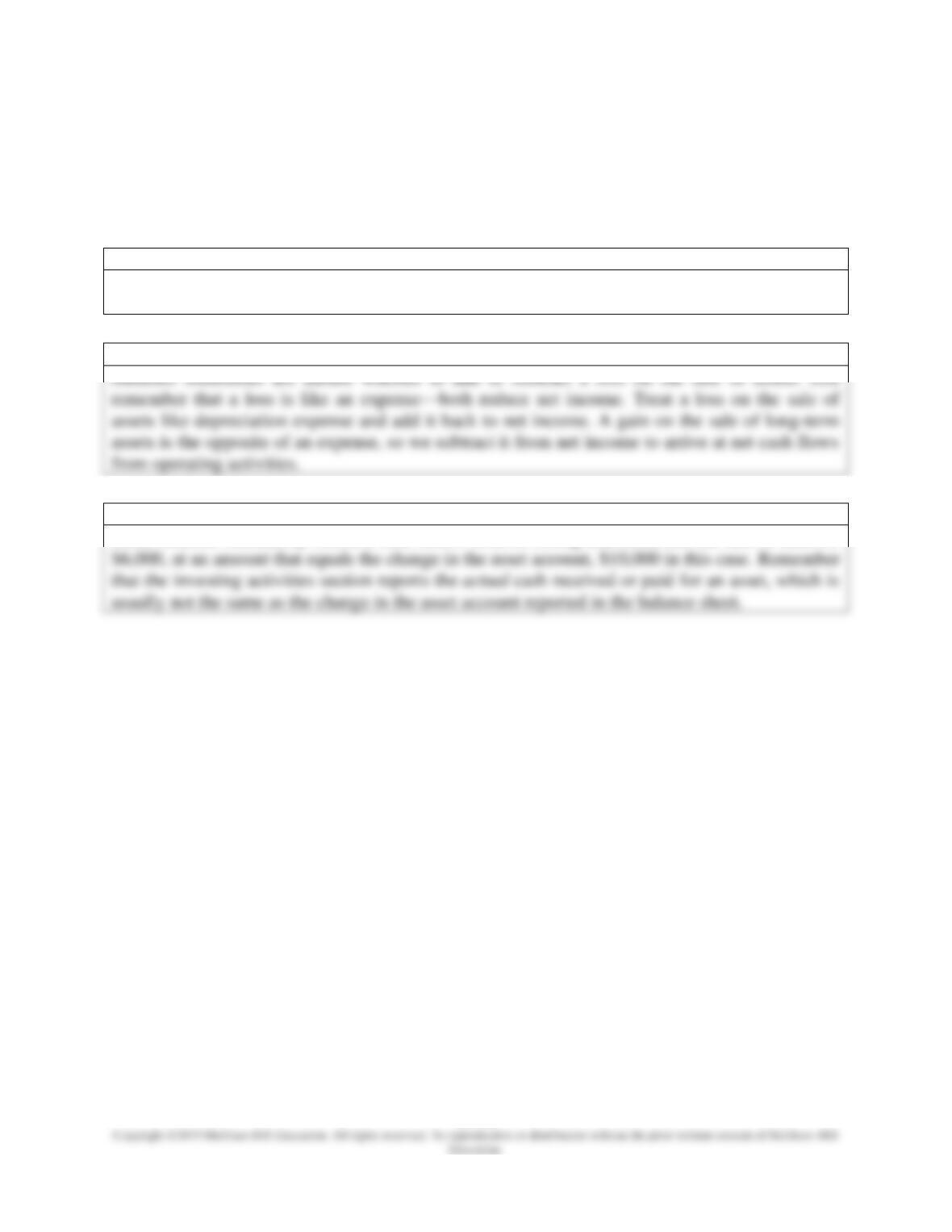
Surround Sound, Inc.
Statement of Cash Flows
For the Year Ended December 31, 2021
Cash Flows from Operating Activities
Net income
$710,000
cash flows from operating activities:
$725,000
Cash Flows from Investing Activities
Sale of land
Purchase of equipment
Repaid notes payable
Payment of cash dividends
Net increase (decrease) in cash
Cash at the beginning of the period
Cash at the end of the period
$50,000
Adjustments to reconcile net income to net
Chapter 11 – Statement of Cash Flows
11-14
Common Mistakes
Common Mistakes made by students are highlighted in each of the chapters. With greater
awareness of the potential pitfalls, student can avoid making the same mistakes and gain a deeper
understanding of the chapter material.
Common Mistake
Students sometimes misclassify dividends in preparing the statement of cash flows. Dividends
received are included in operating activities. Dividends paid are included in financing activities.
Common Mistake
remember that a loss is like an expense—both reduce net income. Treat a loss on the sale of
assets is the opposite of an expense, so we subtract it from net income to arrive at net cash flows
Common Mistake
that the investing activities section reports the actual cash received or paid for an asset, which is
Some students mistakenly record a cash inflow from investing activities, like the sale of land for
Chapter 11 – Statement of Cash Flows
11-15
Decision Points and Decision Maker’s Perspective
Decision Points and Decision Maker’s Perspectives are provided throughout each chapter to give
insight into how measurement and communication of financial accounting information help
decision makers.
Decision Points
Question
Accounting Information
Analysis
activities.
Question
Accounting Information
Analysis
Is a company’s net
Operating activities section of
The operating activities section using
operating cash flows.
Question
Accounting Information
Analysis
more on selling at
from sales to customers in relation to
Are the company’s
cash flows based
Cash flow to sales and asset
turnover ratios
Companies with high cash flow to
sales ratios obtain high cash inflows
through higher sales volume.
Chapter 11 – Statement of Cash Flows
11-16
Decision Maker’s Perspective
Cash Flow Ratios
Analysts often supplement their investigation of income statement and balance sheet amounts
with cash flow ratios. Some cash flow ratios are derived by substituting net cash flows from
Chapter 11 – Statement of Cash Flows
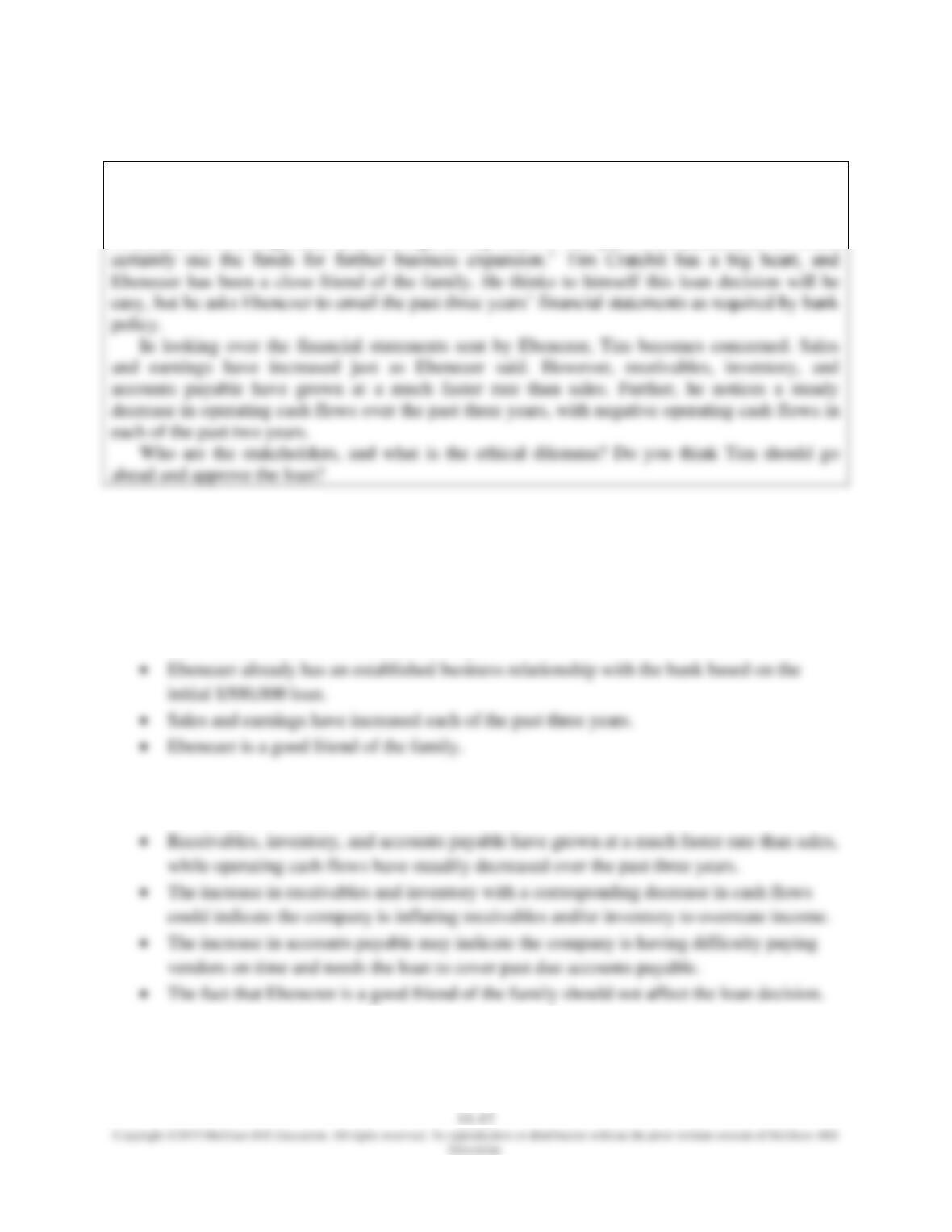
Ethical Dilemma
Ebenezer is CEO of a successful small business. One day he stops by to see Tim Cratchit, the
new branch manager at First National Bank. Ebenezer and his partner Marley would like to
double the size of their loan with the bank from $500,000 to $1 million. Ebenezer explains,
“Business is booming, sales and earnings are up each of the past three years, and we could
Key Issues
• What was it in Tim’s analysis of the financial statements that caused him concern?
• Should Tim go ahead and approve the loan?
Option 1: Approve the loan
• The business has been successful in the past.
Option 2: Deny the loan
• Doubling the loan size will increase the risk of default.