CA 11.2 (Continued)
ii. The application of depreciation to the whole group tends to average out or offset errors,
economic or operating, caused by under-depreciation or over-depreciation.
Arguments against the use of the group and composite-life methods would include:
i. The methods would conceal faulty estimates for a long period of time.
ii. When there is an early heavy retirement of assets a debit balance might appear in the
(c) Under the unit method, retirements are recorded by removing from the accounts the cost of the
asset and its related accumulated depreciation. The difference between the two accounts, adjusted
for salvage and disposal costs, if any, is recognized as gain or loss.
CA 11.3
Situation I. This position relates to the omission of a provision for depreciation during a strike. The same
question could be raised with respect to plant shutdowns for many reasons, such as for a lack of sales
or for seasonal business.
The method of depreciation used should be systematic and rational. The annual provision for
depreciation should represent a fair estimate of the loss in value arising from wear and usage and also
CA 11.3 (Continued)
Decreasing demand indicates use of an accelerated method (declining-balance or sum-of-the-years’–
digits) or the units-of-production method in order to allocate more of the cost to the earlier years of the
machine’s life. Increasing demand indicates the use of the units–of–production method to charge more
of the cost to the later years of the machine’s life; an increasing-charge method (annuity or sinking-
fund) could be employed, though these methods are seldom used except by utilities.
(b) In determining the depreciation method to be used for the machine, the objective should be to
allocate the cost of the machine over its useful life in a systematic and rational manner, so that
costs will be matched with the benefits expected to be obtained. In addition to demand, considera–
indicated.
Another consideration is the expiration of the physical life of the machine. If the machine wears
out in relation to the passage of time, the straight-line method is indicated. Within this maximum
life, if the usage per period varies, the units-of–production method may be appropriate.
The machine may become obsolete because of technological innovation; it may someday be
more efficient to replace the machine even though it is far from worn out. If the probability is
high that such obsolescence will occur in the near future, the shortened economic life should
be recognized. Within this shortened life, the depreciation method used would be determined
by evaluating such consideration as the anticipated periodic usage.
The idle mill should be written off immediately as it appears to have no future service potential.
CA 11.4
To: Phil Perriman, Supervisor of Canning Room
From: Your name, Accountant
Date: January 22, 2020
Subject: Annual depreciation charge to the canning department
This memo addresses the questions you asked about the depreciation charge against your department.
Admittedly, this charge of $625,000 [(1.0/12 x 2) x ($625,000 X 6)] is very high; however, it is not
intended to reflect the wear and tear that the machinery has undergone over the last year. Rather, it is
a portion of the machines’ cost, which has been allocated to this period.
During the earlier years of an asset’s life, the double-declining-balance method results in higher
depreciation charges because it doubles the straight-line rate, which would have been made under the
straight-line method. However, the same percentage depreciation in the first year is applied annually to
the asset’s declining book value. Therefore, the double-declining-balance charge becomes lower than
the straight-line charge during the last several years of the asset’s life. For this year, as mentioned
above, the charge is $625,000, but in subsequent years, this expense will become lower. By the end of
the twelfth year, the same amount of depreciation will have been taken regardless of the method used.
CA 11.5
(a) The stakeholders are Beeler’s employees, including Jerry, current and potential investors and
creditors, and upper-level management.
CA 11.5 (Continued)
(c) Jerry should review the estimated useful lives and salvage values of the depreciable assets.
Since they are estimates, it is possible that some should be changed. Any changes should be
FINANCIAL REPORTING PROBLEM
(a) P&G classifies its property, plant and equipment as “Property Plant,
and equipment, net”, with additional details in the notes.
Buildings are depreciated over an estimated useful life of 40 years.
(d) P&G’s Statement of Cash Flows reports depreciation and amortization
of $2,820 million in 2017, $3,078 million in 2016, and $3,134 million was
charged to expense in 2015.
COMPARATIVE ANALYSIS CASE
(a) Property, plant, and equipment, net of accumulated depreciation:
Coca-Cola at 12/31/17 $8,203 million
(b) Coca-Cola and PepsiCo depreciate property, plant, and equipment
principally by the straight-line method over the estimated useful lives
(c) (1) Asset turnover:
Coca-Cola
PepsiCo
(2) Profit margin on sales:
Coca-Cola
PepsiCo
COMPARATIVE ANALYSIS CASE (Continued)
(3) Return on assets:
Coca-Cola
PepsiCo
With the exception of profit margin, each of PepsiCo’s ratios are
stronger compared to Coca-Cola’s. PepsiCo’s lower profit margin is
(d) Coca-Cola’s capital expenditures were $1,675 million in 2017 while
FINANCIAL STATEMENT ANALYSIS CASE
(a) McDonald’s used the straight–line method for depreciating its property
and equipment.
(b) Depreciation and amortization charges do not increase cash flow
from operations. In a cash flow statement, these two items are often
(c) The schedule of cash flow measures indicates that cash provided by
operations is expected to cover capital expenditures over the next few
ACCOUNTING, ANALYSIS, AND PRINCIPLES
Accounting
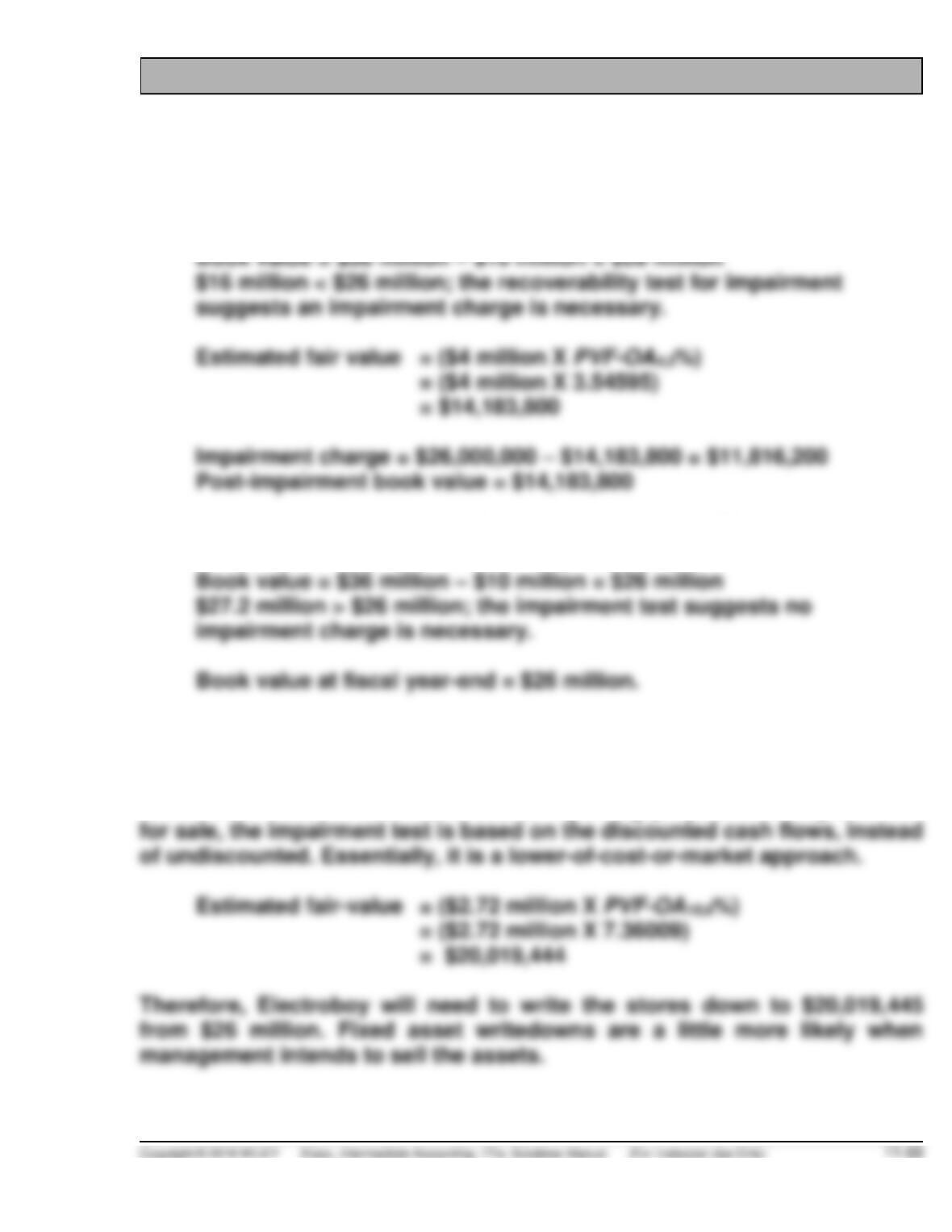
(a) Undiscounted future cash flows = (4 years X $4 million per year)
= $16 million
(b) Undiscounted future cash flows = (10 years X $2.72 million per year)
= $27.2 million
Analysis
If the stores are in the process of being sold, they would likely be
considered ‘held for sale’ for financial reporting purposes. If they are held
ACCOUNTING, ANALYSIS, AND PRINCIPLES (Continued)
Principles
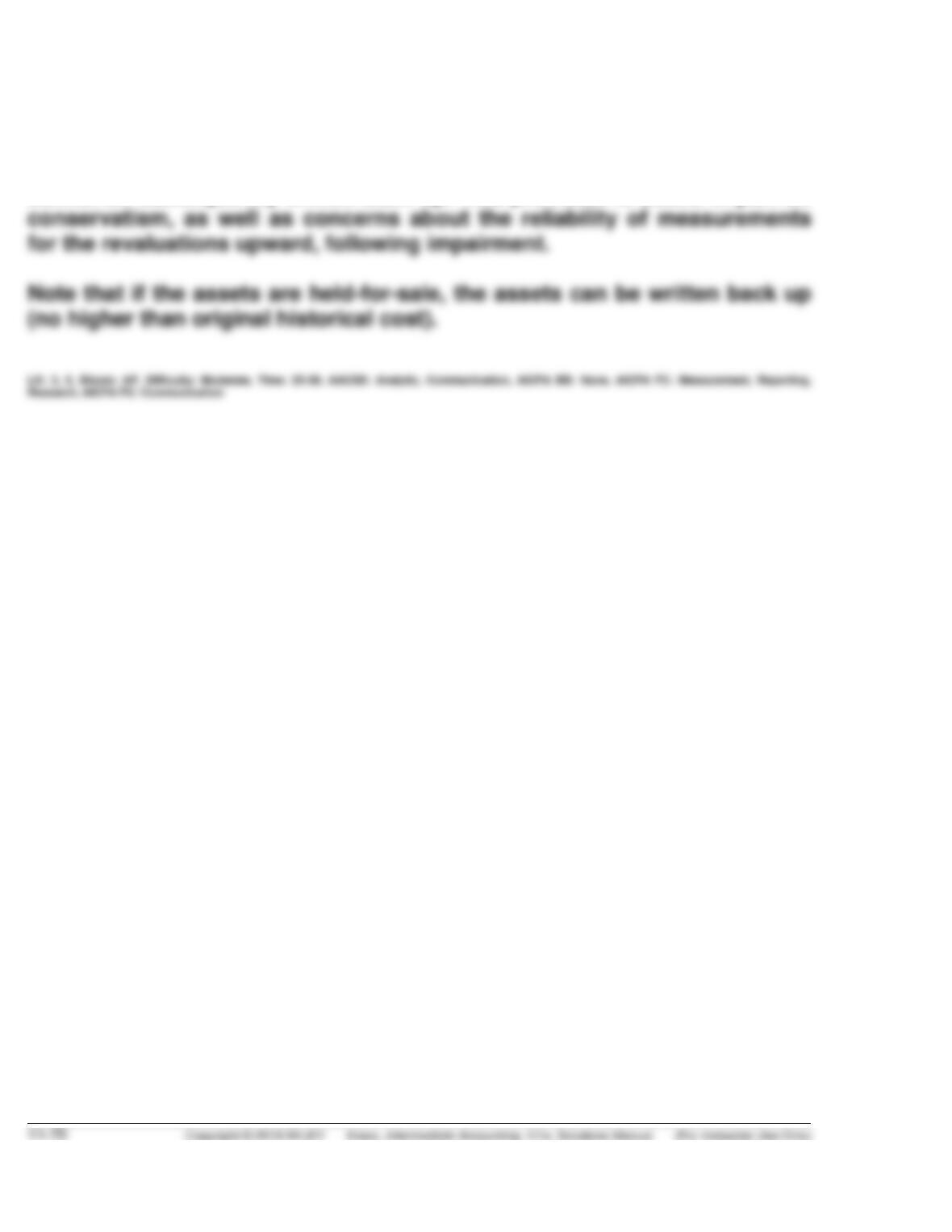
Under GAAP, once an asset is written down to an impairment value, it
cannot be subsequently written back up. This provision is based in part on
CODIFICATION EXERCISES
CE11.1
(a) The master glossary provides two entries for amortization:
Amortization
The process of reducing a recognized liability systematically by recognizing revenues or reducing
Amortization
The process of reducing a recognized liability systematically by recognizing revenues or by
reducing a recognized asset systematically by recognizing expenses or costs. In accounting for
CE11.2
According to FASB ASC 360-10–40-4 through 6 (Impairment or Disposal of Long-Lived Assets . . .
Long-Lived Assets to Be Exchanged or to Be Distributed to Owners in a Spinoff):
40-4 For purposes of this Subtopic, a long-lived asset to be disposed of in an exchange measured
based on the recorded amount of the nonmonetary asset relinquished or to be distributed to
owners in a spinoff is disposed of when it is exchanged or distributed. If the asset (asset group)
CE11.2 (Continued)
40-5 A gain or loss not previously recognized that results from the sale of a long-lived asset
(disposal group) shall be recognized at the date of sale.
CE11.3
According to FASB ASC 360-10–35-1 through 10 (Subsequent Measurement):
35-1 This Subsection addresses depreciation of property, plant, and equipment, and the acquisition
accounting for an interest in the residual value of a leased asset.
35-4 The cost of a productive facility is one of the costs of the services it renders during its useful
economic life. Generally accepted accounting principles (GAAP) require that this cost be spread
35-6 See paragraph 360–10–35–43 for a discussion of cessation of deprecation on long-lived assets
classified as held for sale.
35-7 The declining-balance method is an example of one of the methods that meet the requirements
of being systematic and rational. If the expected productivity or revenue-earning power of the
35-8 In practice, experience regarding loss or damage to depreciable assets is in some cases one of the
CE11.3 (Continued)
35-9 If the number of years specified by the Accelerated Cost Recovery System of the Internal
35–10 Annuity methods of depreciation are not acceptable for entities in general.
CE11.4
According to FASB ASC 210-10-S99 (Balance Sheet-Overall-SEC Materials)
S99-1 The following is the text of Regulation S-X Rule 5-02, Balance Sheets.
The purpose of this rule is to indicate the various line items and certain additional disclosures
Assets and Other Debits
13. Property, plant and equipment.
– (a) State the basis of determining the amount.
– (b) Tangible and intangible utility plant of a public utility company shall be segregated
CODIFICATION RESEARCH CASE
(a) According to FASB ASC 360-10-05 (Property, Plant, and Equipment)
05-2 The guidance in the Overall Subtopic is presented in the
following two Subsections:
a. The General Subsections address the accounting and
05-4 The Impairment of Disposal of Long-Lived Assets Subsections
provide guidance for:
(b) When to Test a Long-Lived Asset for Recoverability is addressed in
FASB ASC 360-10–35–21:
35–21 A long-lived asset (asset group) shall be tested for recoverability
whenever events or changes in circumstances indicate that its
carrying amount may not be recoverable. The following are
examples of such events or changes in circumstances:
CODIFICATION RESEARCH CASE (Continued)
e. A current-period operating or cash flow loss combined with
a history of operating or cash flow losses or a projection or
(c) According to FASB ASC 360-10–35-36, for long-lived assets (asset
According to FASB ASC 820–10–35-37 through 43 (Fair Value Hierarchy):
35–37 To increase consistency and comparability in fair value
measurements and related disclosures, this Topic establishes
a fair value hierarchy that categorizes into three levels (see
35–37A In some cases, the inputs used to measure the fair value of an
asset or a liability might be categorized within different levels
of the fair value hierarchy. In those cases, the fair value
measurement is categorized in its entirety in the same level of