Problem 11-13A (continued)
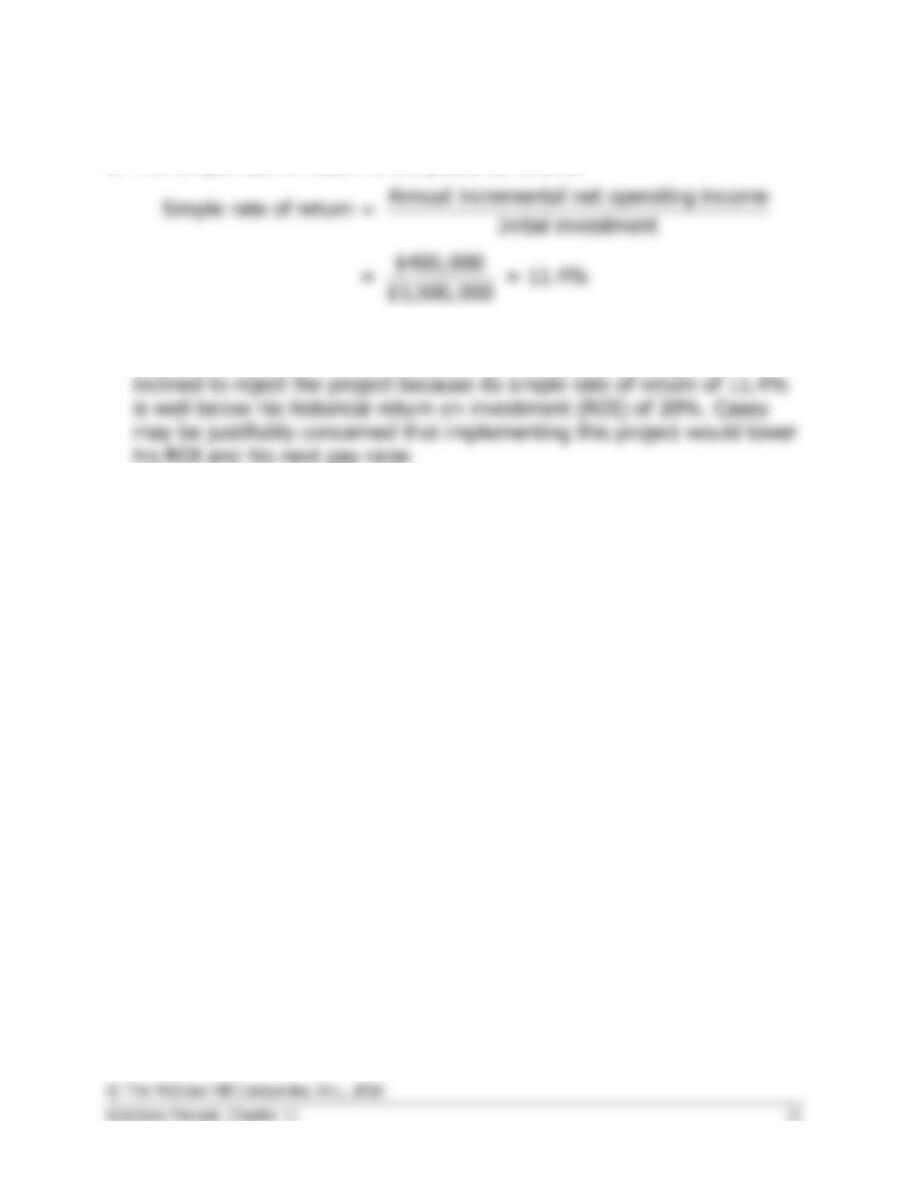
2. The simple rate of return is computed as follows:
3. The company would want Casey to invest in the project because it has a
positive net present value of $101,400. However, Casey might be
Problem 11-14A (20 minutes)
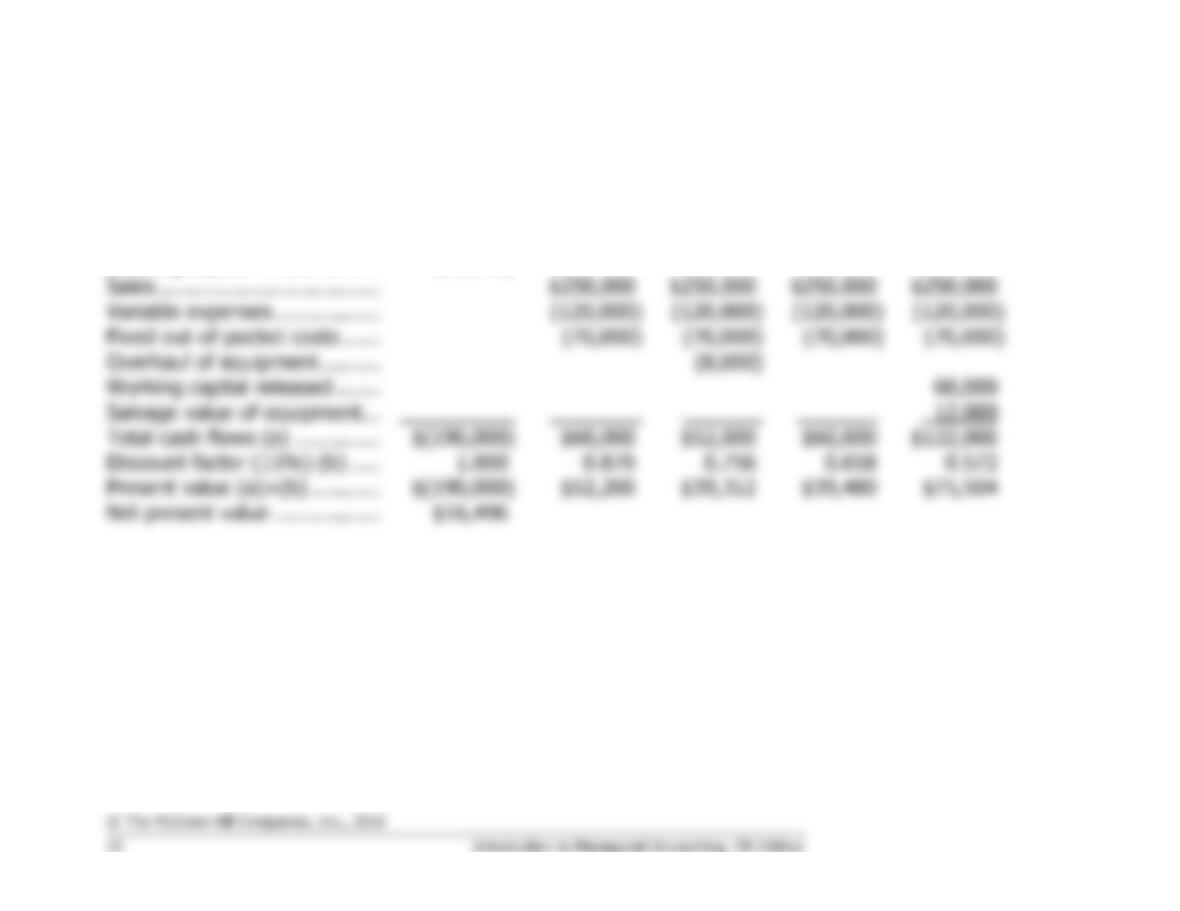
The net present value is computed as follows:
Now
1
2
3
4
Purchase of equipment ……….
$(130,000)
Working capital investment …
(60,000)
Sales ………………………………
Variable expenses ……………..
Fixed out–of-pocket costs ……
Overhaul of equipment ……….
Working capital released …….
Salvage value of equipment …
Total cash flows (a) …………..
$(190,000)
Discount factor (15%) (b) …..
Present value (a)×(b) ………..
$(190,000)
$39,312
Net present value ……………..
Problem 11-15A (30 minutes)
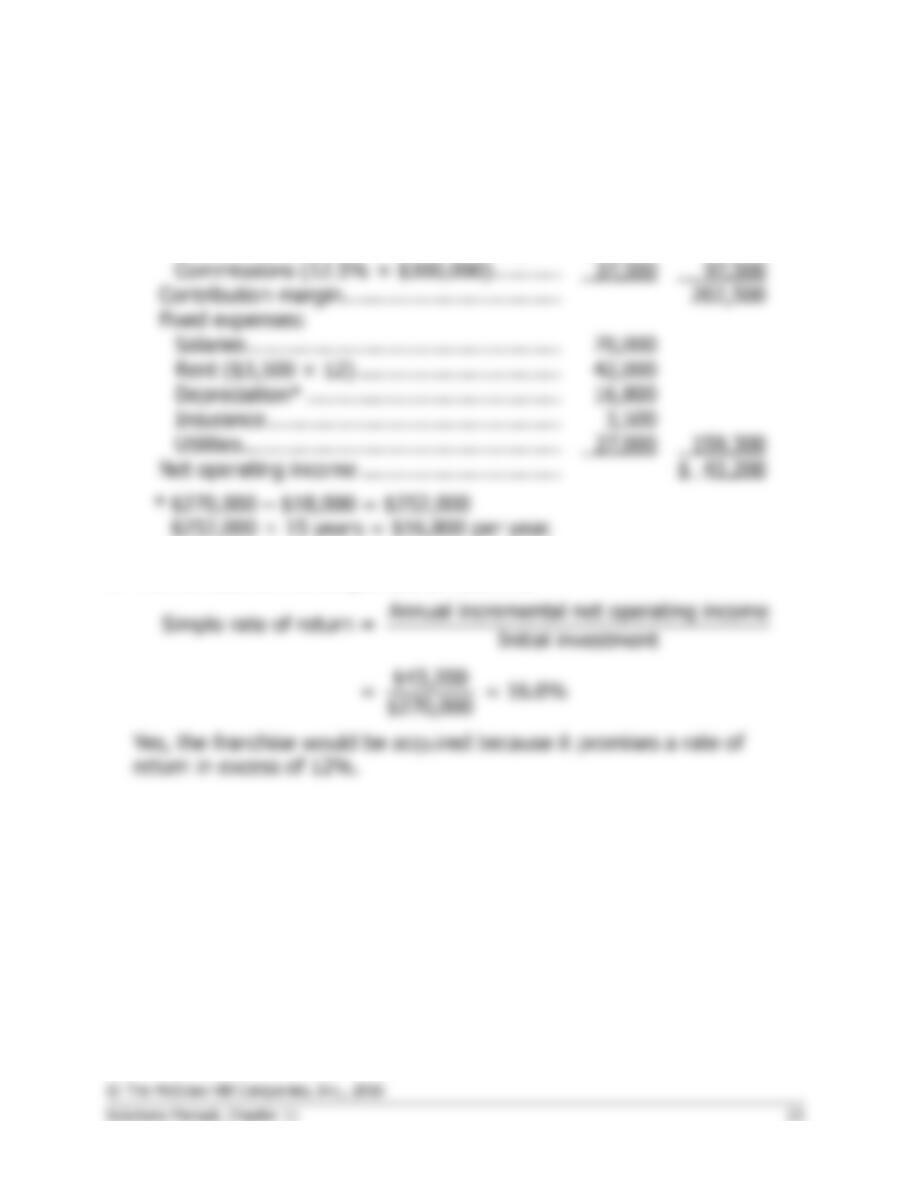
1. The income statement would be:
Sales ………………………………………………..
$300,000
Variable expenses:
Cost of ingredients (20% × $300,000) …..
$60,000
Commissions (12.5% × $300,000) ………..
Contribution margin ……………………………..
Fixed expenses:
Salaries …………………………………………..
Rent ($3,500 × 12) …………………………...
Depreciation* …………………………………..
Insurance ………………………………………..
Utilities ……………………………………………
Net operating income …………………………..
2. The formula for the simple rate of return is:
Problem 11-15A (continued)
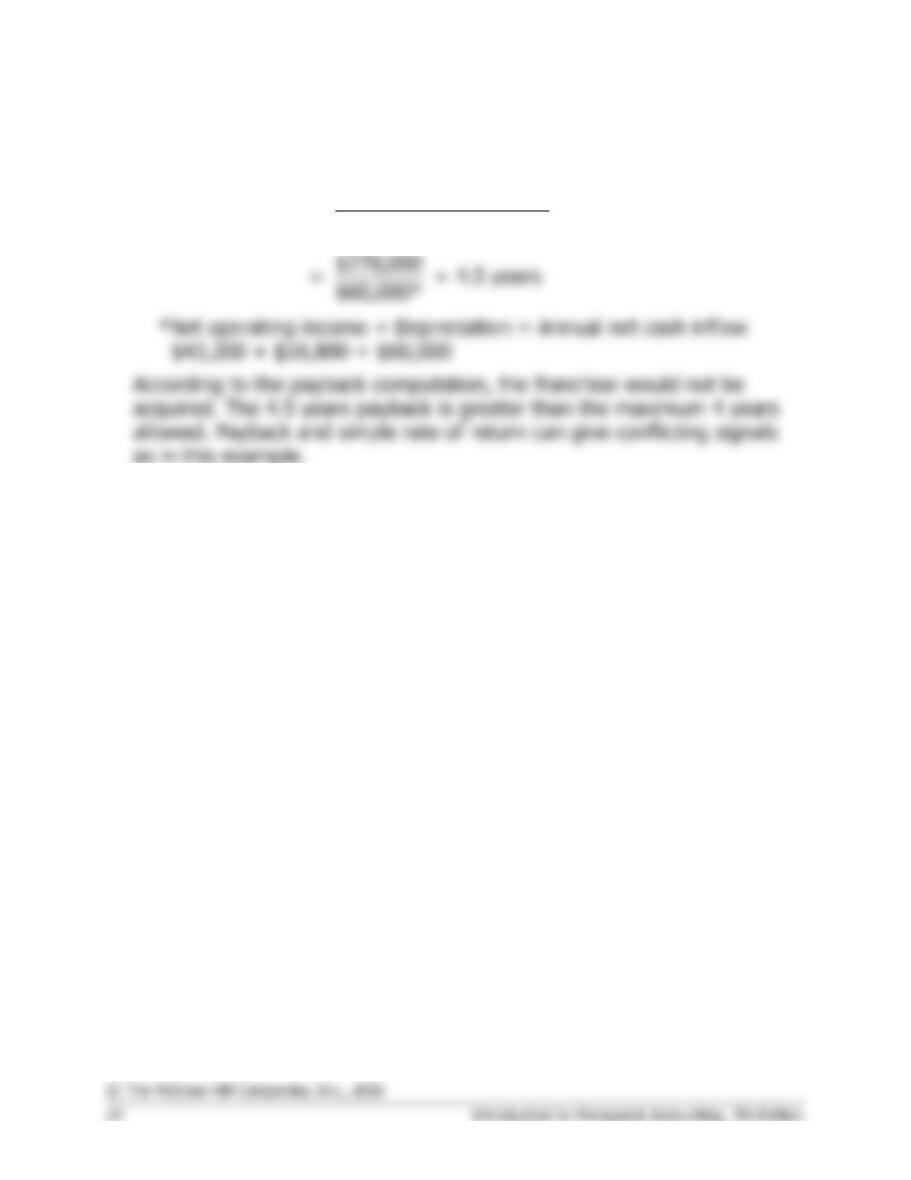
3. The formula for the payback period is:
Investment required
Payback period = Annual net cash inflow
Problem 11-16A (30 minutes)
1. The annual net cost savings would be:
Reduction in labor costs …………………………………..
$108,000
Reduction in material waste ……………………………..
Annual net cost savings …………………………………..
2. Using this cost savings figure, and other data from the text, the net present value analysis would be:
Now
1
2
3
4
5
6
Cost of machine …………….
$(250,000)
Software and installation …
(80,000)
Replacement of parts ……..
Total cash flows (a) ……….
$(318,000)
Discount factor (16%) (b) .
Present value (a)×(b) …….
$(318,000)
$21,474
$43,332
$37,366
Net present value ………….
Problem 11-17A (30 minutes)
1. The formula for the project profitability index is:
Net present value of the project
Project profitability index = Investment required by the project
The indexes for the projects under consideration would be:
Project 1:
$66,140 ÷ $270,000 = 0.24
Project 2:
$72,970 ÷ $450,000 = 0.16
Project 3:
$73,400 ÷ $360,000 = 0.20
Project 4:
$87,270 ÷ $480,000 = 0.18
2. a., b., and c.
Net Present
Value
Project
Profitability
Index
Internal Rate
of Return
First preference ……..
4
1
2
Second preference ….
3
3
1
Third preference …….
2
4
4
Fourth preference …..
1
2
3
Problem 11-17A (continued)
3. Which ranking is best will depend on Revco Products’ opportunities for
reinvesting funds as they are released from the project. The internal
rate of return method assumes that any released funds are reinvested at
the internal rate of return. This means that funds released from project
Problem 11-18A (20 minutes)
1. The annual net cash inflows would be:
Reduction in annual operating costs:
Increased annual contribution margin:
Total annual net cash inflows …………………
2. The net present value is computed as follows:
Now
1
2
3
4
5
Purchase of machine ……..
$(120,000)
Annual net cash inflows ….
$32,000
$32,000
$32,000
$32,000
$32,000
Replacement parts ………..
Salvage value of machine .
_______
Total cash flows (a) ………
$32,000
$39,500
Discount factor (20%) (b)
Present value (a)×(b) ……
$22,208
Net present value …………
Problem 11-19A (45 minutes)
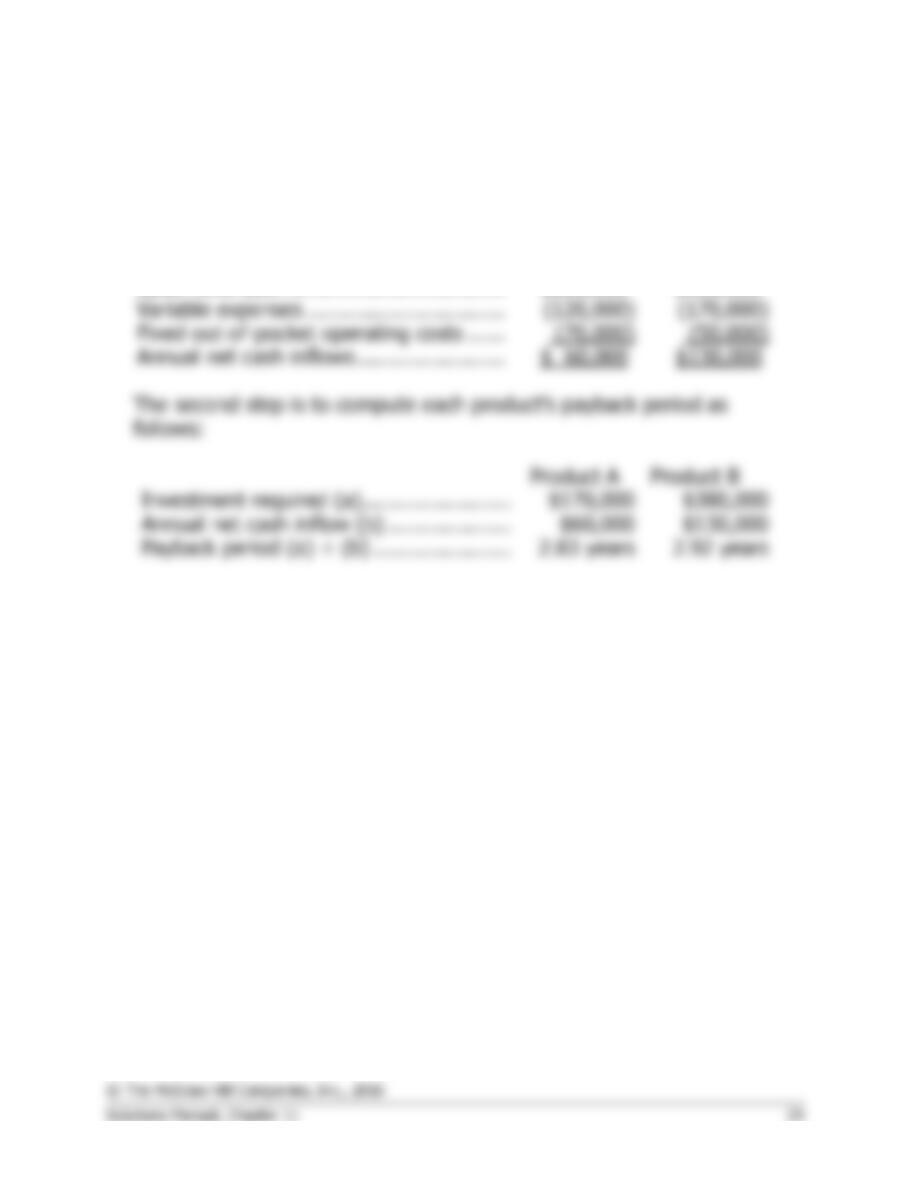
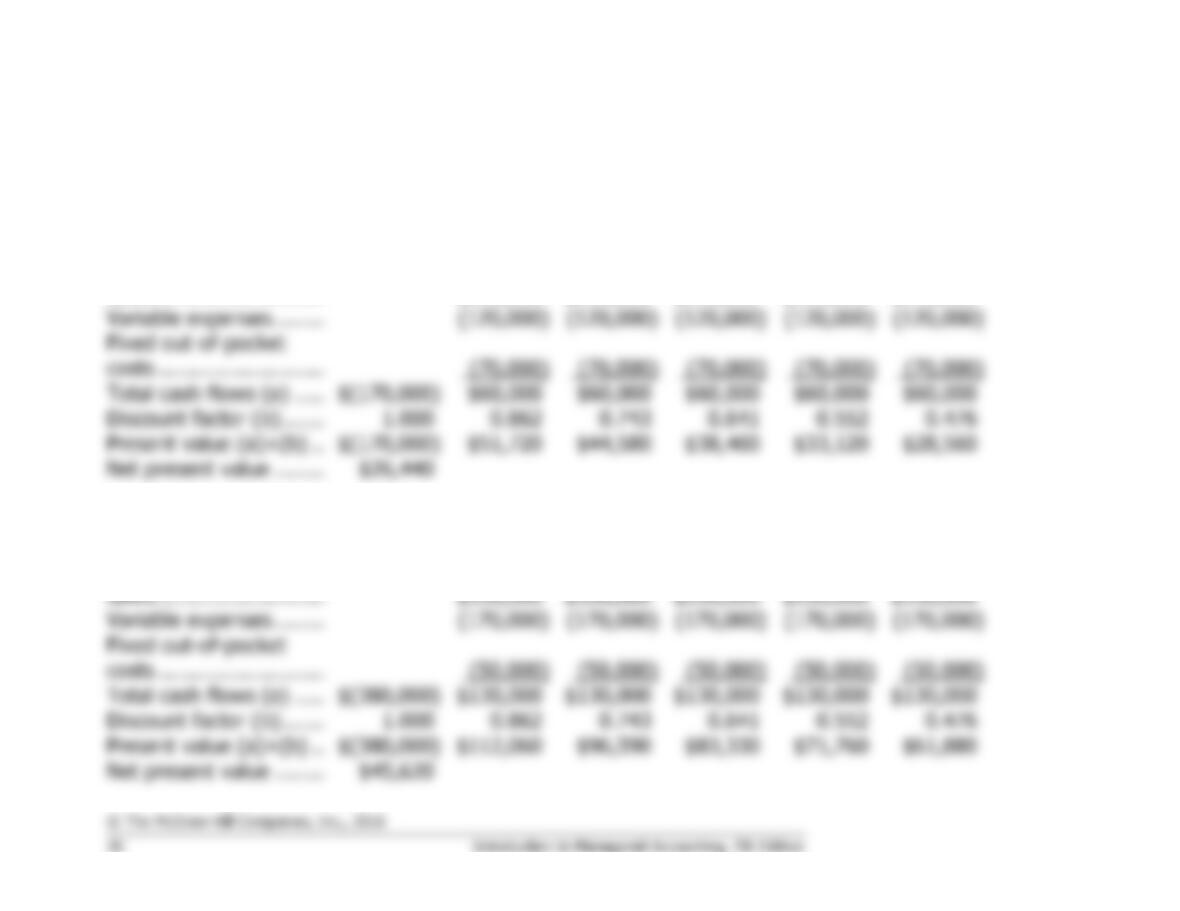
1. The payback periods for Products A and B are calculated using a two-
step process. First, the annual net cash inflows are calculated as
follows:
Product A
Product B
Sales revenues ……………………………….
$250,000
$350,000
Variable expenses …………………………..
Fixed out-of-pocket operating costs ……
Product A
Product B
Investment required (a) ……………………
Annual net cash inflow (b) ………………..
Payback period (a) ÷ (b) ………………….
Problem 11-19A (continued)
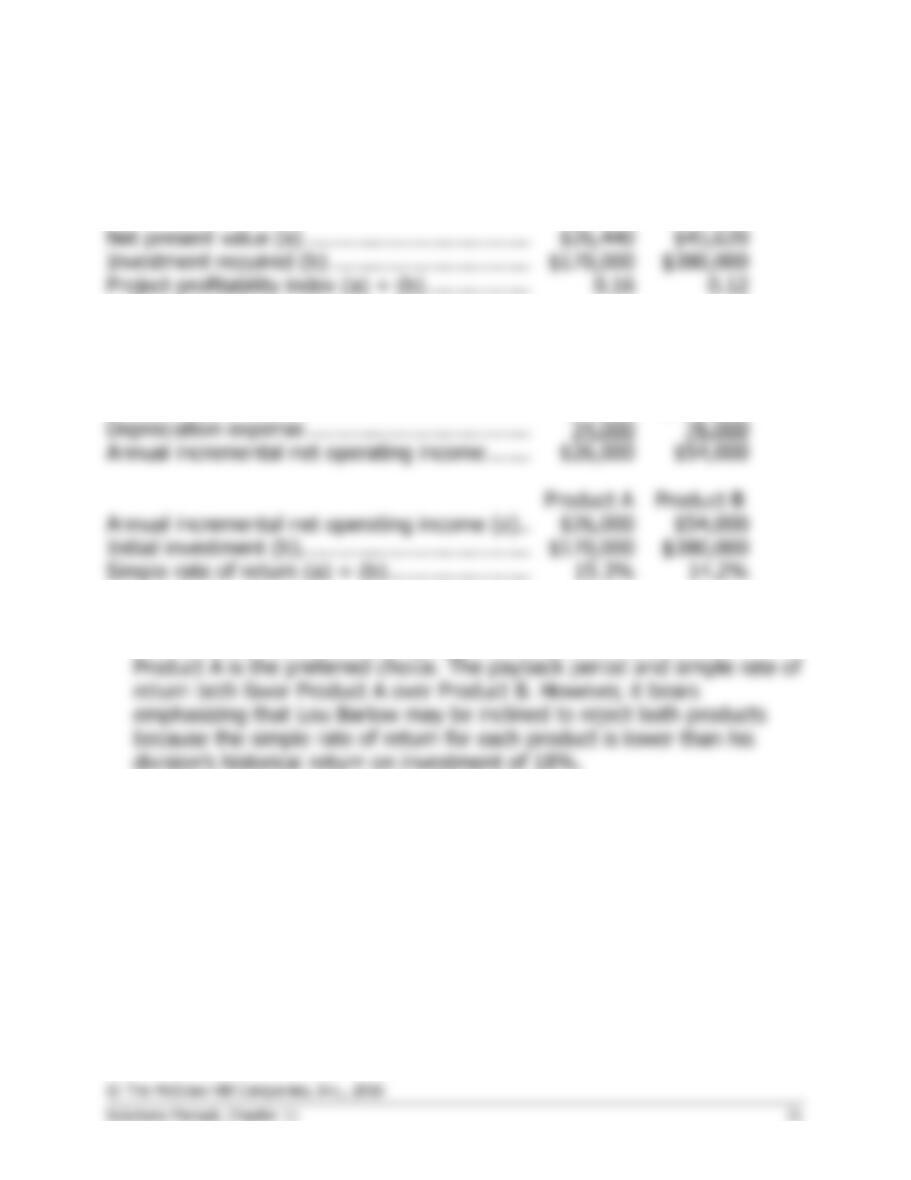
2. The net present values for Products A and B are computed as follows:
Product A:
Now
1
2
3
4
5
Purchase of equipment ……
$(170,000)
Sales …………………………..
$250,000
$250,000
$250,000
$250,000
$250,000
Variable expenses ………….
Total cash flows (a) ……….
$(170,000)
Discount factor (b) …………
Present value (a)×(b) …….
$(170,000)
Net present value ………….
Product B:
Now
1
2
3
4
5
Purchase of equipment ……
$(380,000)
Sales …………………………..
$350,000
$350,000
$350,000
$350,000
$350,000
Variable expenses ………….
costs …………………………..
Total cash flows (a) ……….
$(380,000)
$130,000
$130,000
$130,000
$130,000
$130,000
Discount factor (b) …………
Present value (a)×(b) …….
$(380,000)
$112,060
Problem 11-19A (continued)
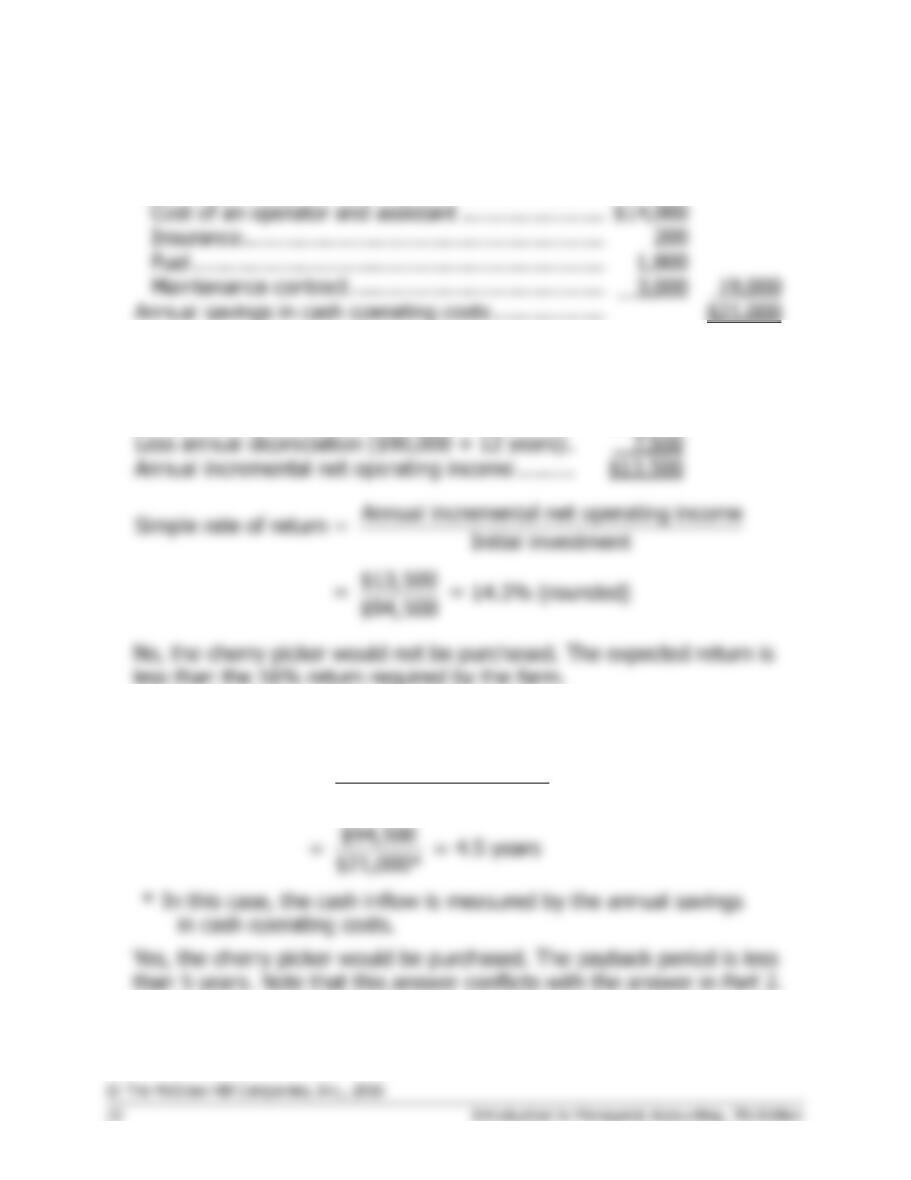
3. The project profitability index for each product is computed as follows:
Product A
Product B
Net present value (a) ………………………………
$26,440
Investment required (b) …………………………..
$170,000
$380,000
Project profitability index (a) ÷ (b) ……………..
4. The simple rate of return for each product is computed as follows:
Product A
Product B
Annual net cash inflow …………………………….
$60,000
$130,000
Depreciation expense ………………………………
Annual incremental net operating income …….
$26,000
Product A
Product B
Annual incremental net operating income (a)..
$26,000
Initial investment (b) ……………………………….
$170,000
$380,000
Simple rate of return (a) ÷ (b) …………………..
5. The net present value calculations suggest that Product B is preferable
to Product A. However, the project profitability index reveals that
Problem 11-20A (45 minutes)
1.
Present cost of transient workers ……………………..
$40,000
Less out–of-pocket costs to operate the cherry picker:
Annual savings in cash operating costs ………………
$21,000
2. The first step is to determine the annual incremental net operating
income:
Annual savings in cash operating costs ………….
$21,000
Less annual depreciation ($90,000 ÷ 12 years) .
Annual incremental net operating income ………
$13,500
3. The formula for the payback period is:
Investment required
Payback period = Annual net cash inflow
Problem 11-21A (30 minutes)
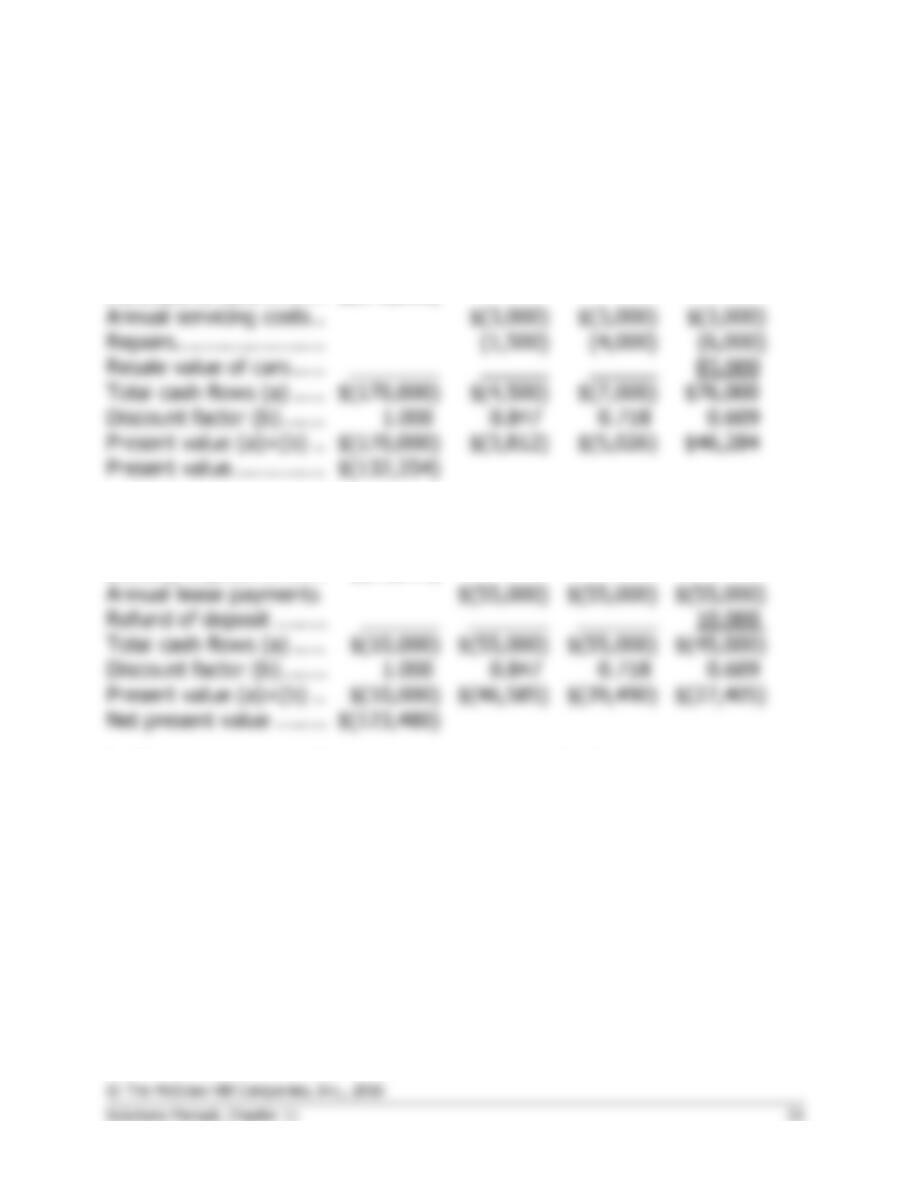
1. The present value of each alternative’s cash flows is computed as
follows:
Purchase Alternative:
Now
1
2
3
Purchase of cars ……….
$(170,000)
Annual servicing costs ..
Resale value of cars …..
Total cash flows (a) …..
$(170,000)
Discount factor (b) …….
Present value (a)×(b) ..
$(170,000)
Present value ……………
$(132,554)
Lease Alternative:
Now
1
2
3
Security deposit …………….
$(10,000)
Annual lease payments …..
Refund of deposit ………….
Total cash flows (a) ……….
$(10,000)
Discount factor (b) …………
Present value (a)×(b) …….
Net present value ………….
$(123,480)
2. The company should lease the cars because this alternative has the
lowest present value of total costs.
Problem 11-22A (30 minutes)
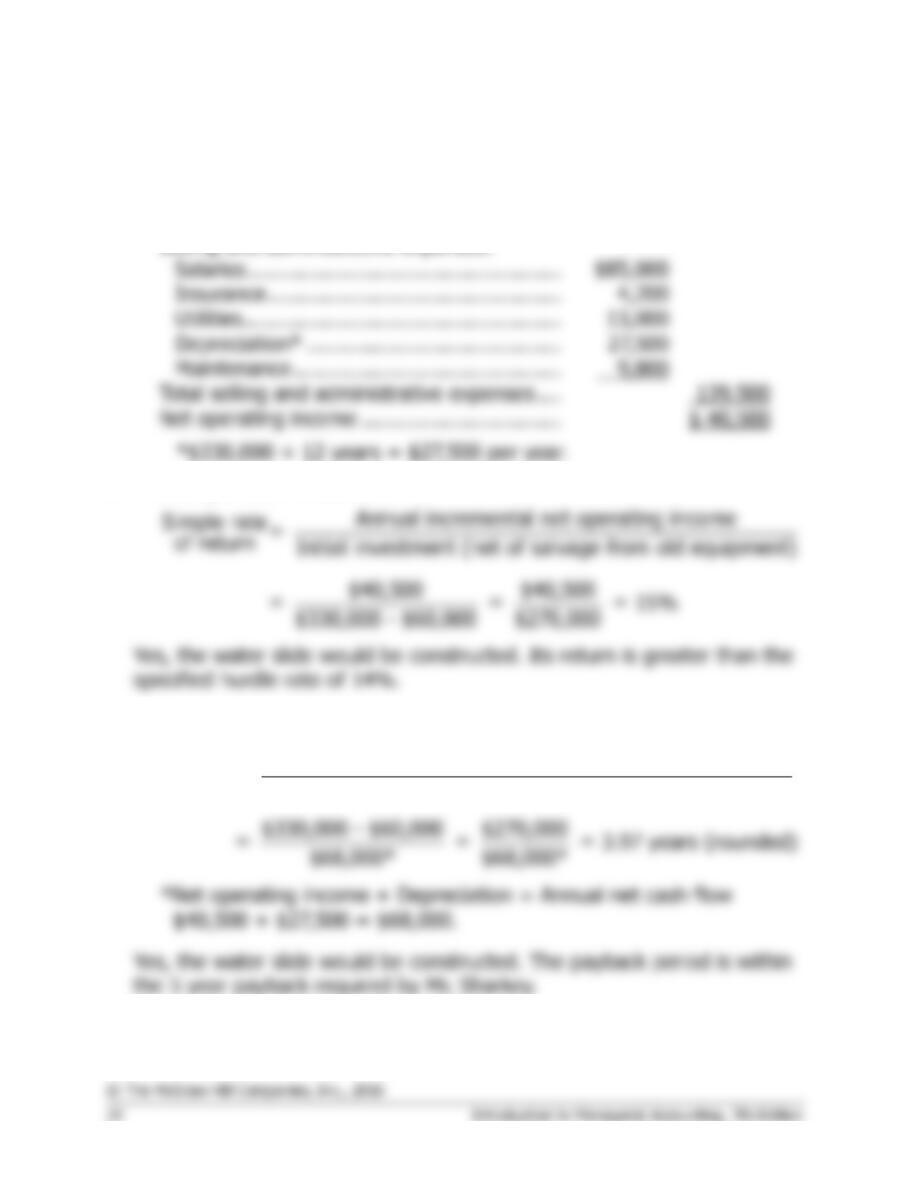
1. The annual incremental net operating income can be determined as
follows:
Ticket revenue (50,000 × $3.60) …………….
$180,000
Selling and administrative expenses:
Total selling and administrative expenses ….
2. The simple rate of return is:
3. The payback period is:
Investment required (net of salvage from old equipment)
Payback =
period Annual net cash inflow
Problem 11-23A (30 minutes)
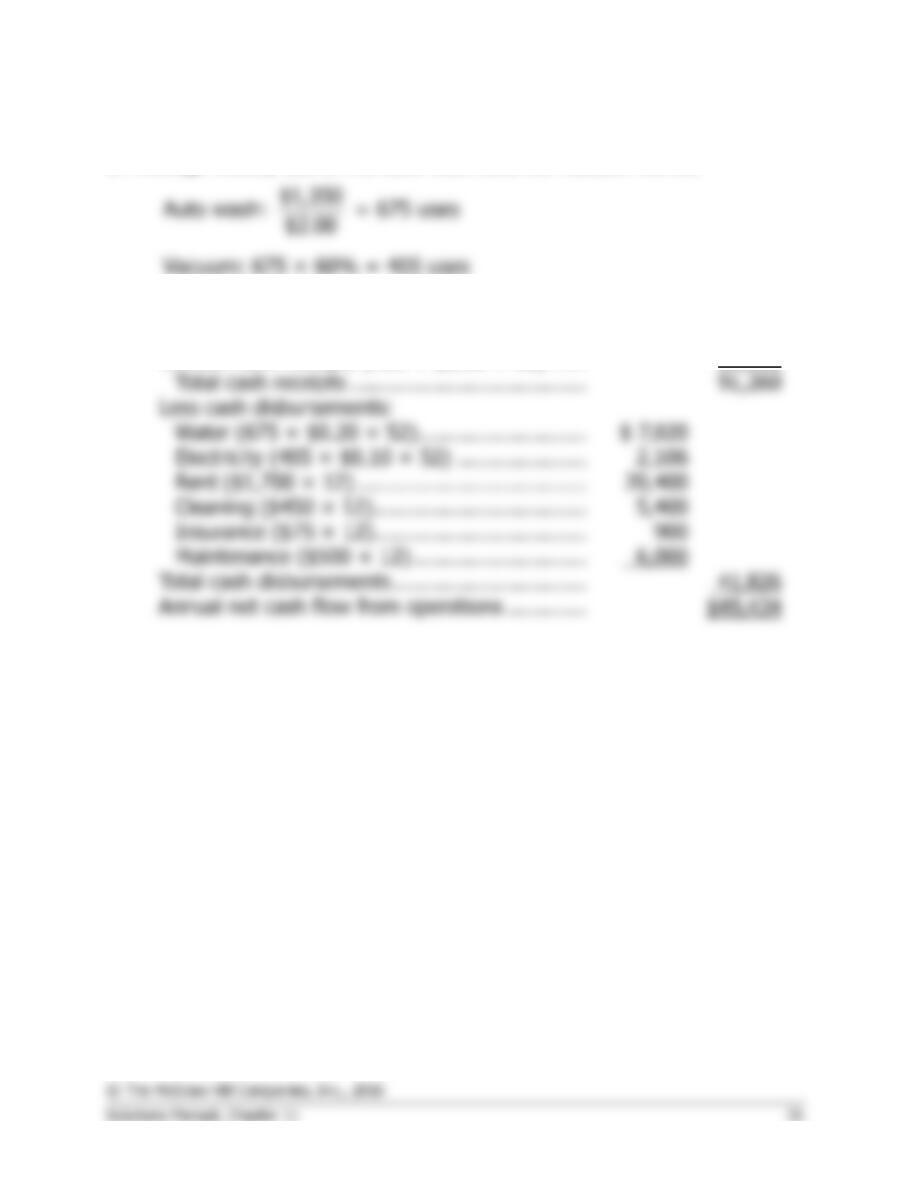
1. Average weekly use of the auto wash and the vacuum will be:
The expected annual net cash flow from operations would be:
Auto wash cash receipts ($1,350 × 52) ………..
$70,200
Vacuum cash receipts (405 × $1.00 × 52) ……
21,060
Problem 11-23A (continued)
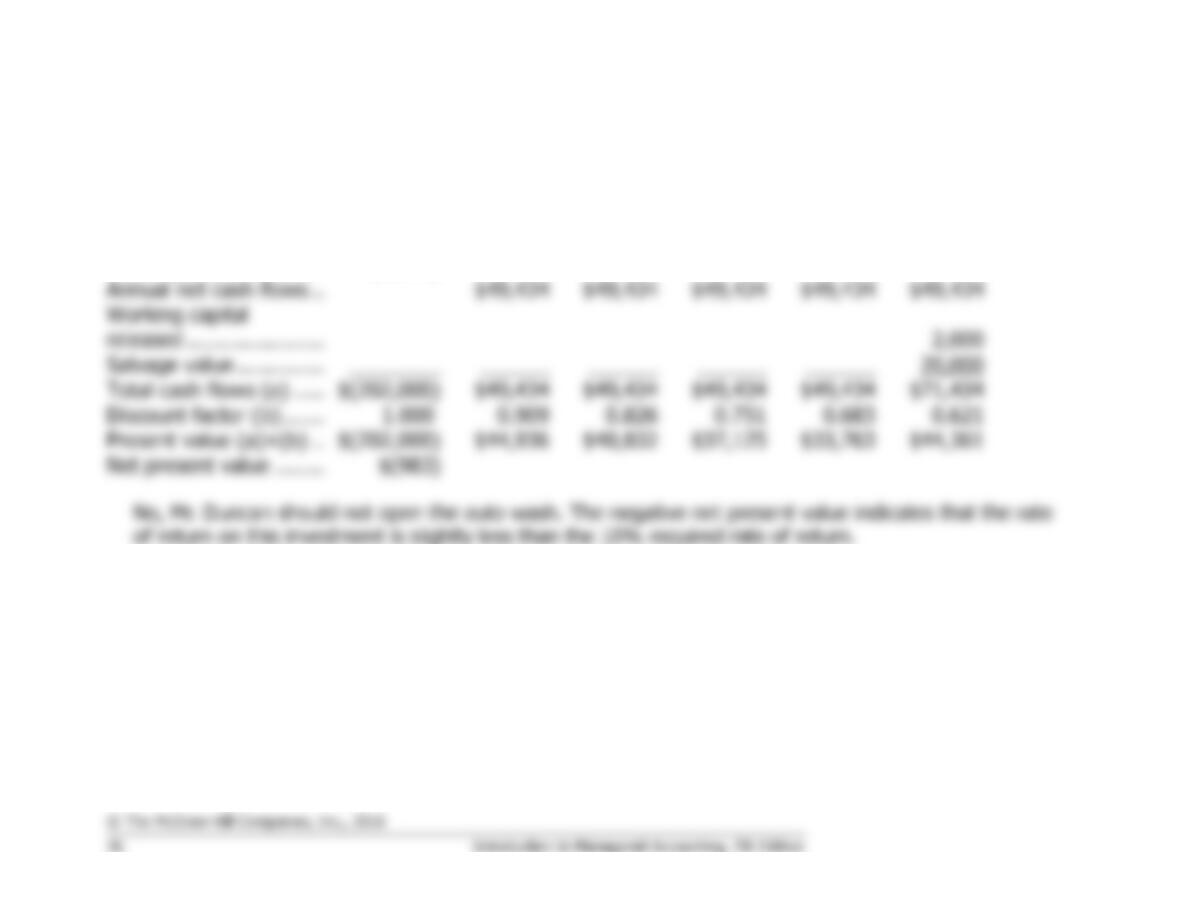
2. The net present value is computed as follows:
Now
1
2
3
4
5
Purchase of equipment .
$(200,000)
Working capital …………
(2,000)
Annual net cash flows ..
Salvage value …………..
Total cash flows (a) …..
Discount factor (b) …….
Present value (a)×(b) ..
Problem 11-24A (20 minutes)
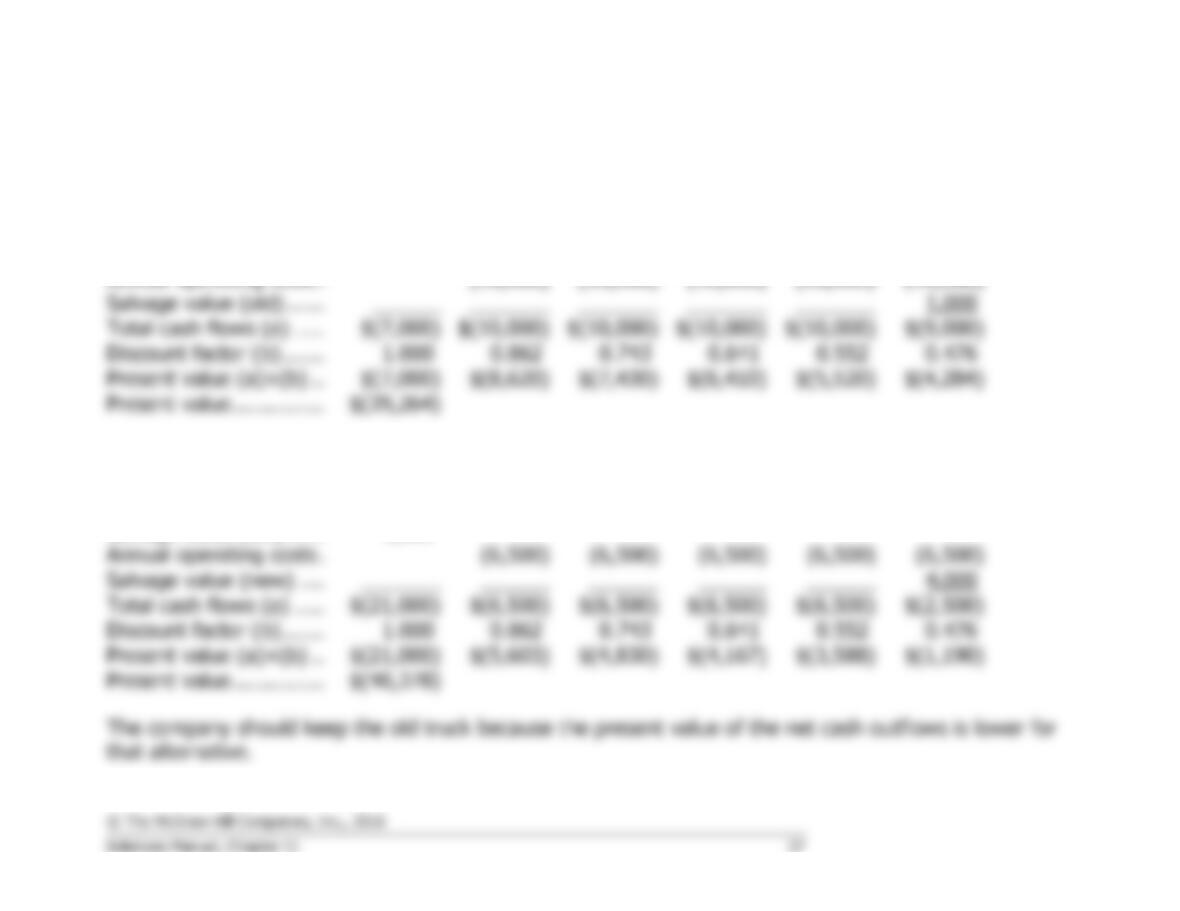
The net present value of each alternative is computed as follows:
Keep the old truck:
Now
1
2
3
4
5
Overhaul needed now ..
$(7,000)
Annual operating costs .
(10,000)
(10,000)
(10,000)
(10,000)
(10,000)
Salvage value (old) ……
_______
_______
_______
_______
Total cash flows (a) …..
$(7,000)
$(9,000)
Discount factor (b) …….
1.000
Present value (a)×(b) ..
$(7,000)
$(8,620)
$(7,430)
$(6,410)
$(5,520)
$(4,284)
Present value ……………
$(39,264)
Purchase the new truck:
Now
1
2
3
4
5
Purchase new truck ……
$(30,000)
Salvage value (old) ……
9,000
Annual operating costs .
(6,500)
(6,500)
(6,500)
(6,500)
(6,500)
Salvage value (new) ….
_______
Total cash flows (a) …..
$(6,500)
$(6,500)
$(6,500)
$(6,500)
$(2,500)
Discount factor (b) …….
1.000
Present value (a)×(b) ..
$(5,603)
$(4,830)
$(4,167)
$(3,588)
$(1,190)
Present value ……………
$(40,378)
Problem 11-25A (45 minutes)
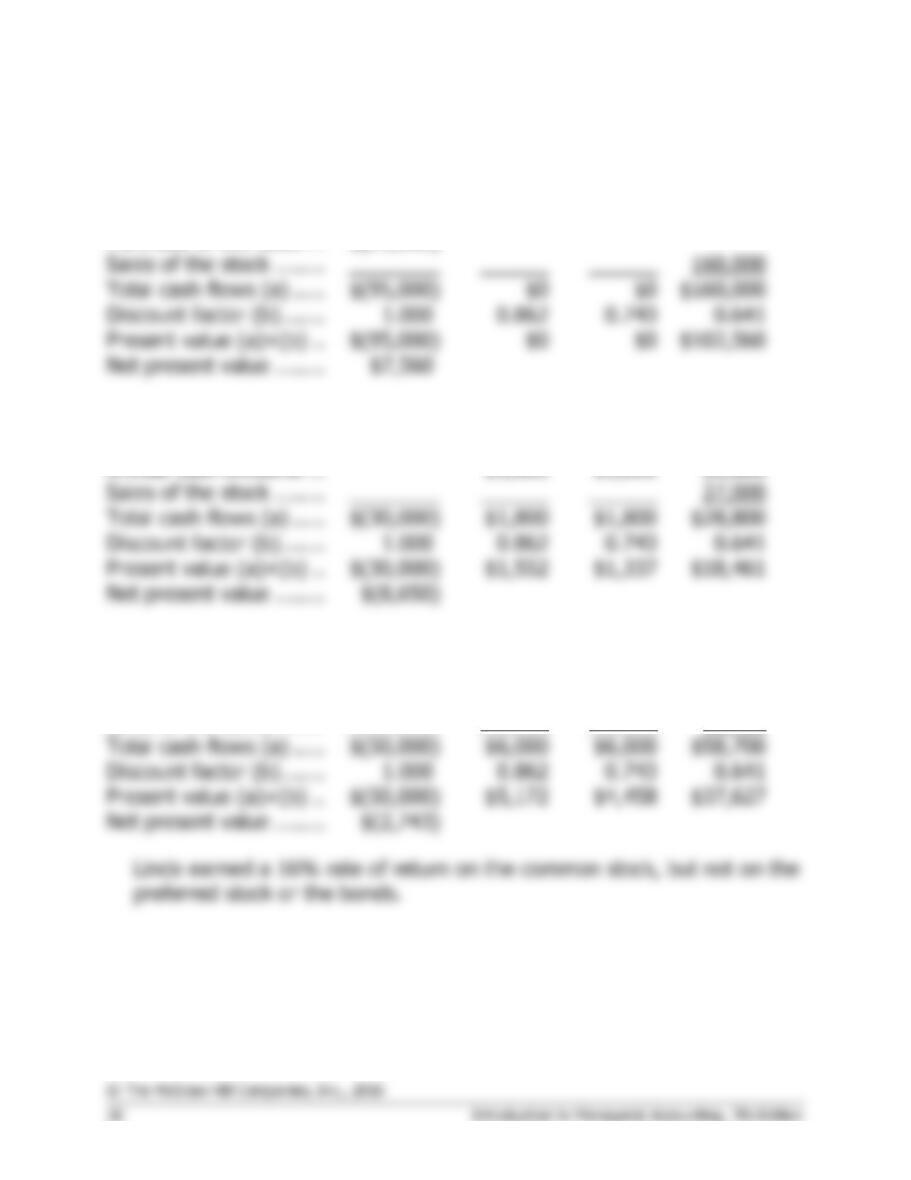
1. A net present value computation for each investment follows:
Common stock:
Now
1
2
3
Purchase of the stock …
$(95,000)
Sales of the stock ……..
________
______
______
Total cash flows (a) …..
$(95,000)
Discount factor (b) …….
Present value (a)×(b) ..
Net present value ……..
Preferred stock:
Now
1
2
3
Purchase of the stock …
$(30,000)
Annual cash dividend …
Sales of the stock ……..
________
______
______
27,000
Total cash flows (a) …..
$(30,000)
Discount factor (b) …….
Present value (a)×(b) ..
$(30,000)
Net present value ……..
Bonds:
Now
1
2
3
Purchase of the bonds..
$(50,000)
Annual interest income .
$6,000
$6,000
$6,000
Sales of the bonds …….
________
______
______
52,700
Total cash flows (a) …..
$(50,000)
Discount factor (b) …….
Present value (a)×(b) ..
$(50,000)
Net present value ……..