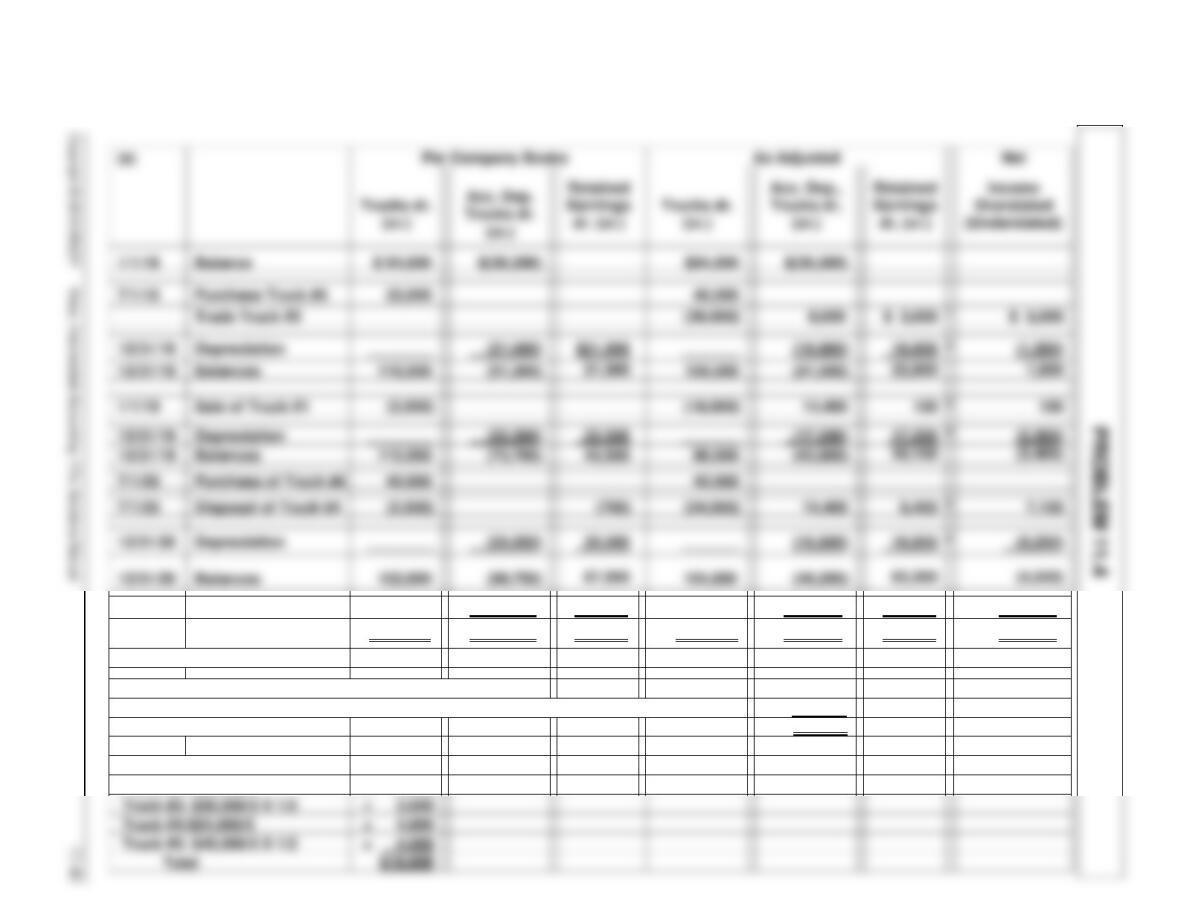
(14,000)
$(18,550)
7
16,400
$79,700
(16,400)
$(62,600)
$18,000
(21,000)
$ 3,000
_______
$104,000
Book value of Truck #3 [$30,000 – ($30,000/5 X 1 1/2 yrs.)] = $30,000 – $9,000 =
30,400
$98,250
(30,400)
$(129,150)
1Implied fair value of Truck #3 ($40,000 – $22,000)
________
$152,000
= $3,600
= 4,400
Depreciation
Balances
Income effect
Loss on Trade
2Truck #1: $18,000/5
Truck #2: $22,000/5
12/31/21
12/31/21
$ 3,000
104,000
Trade Truck #3
Balances
Sale of Truck #1
12/31/18
PROBLEM 11.4 (Continued)
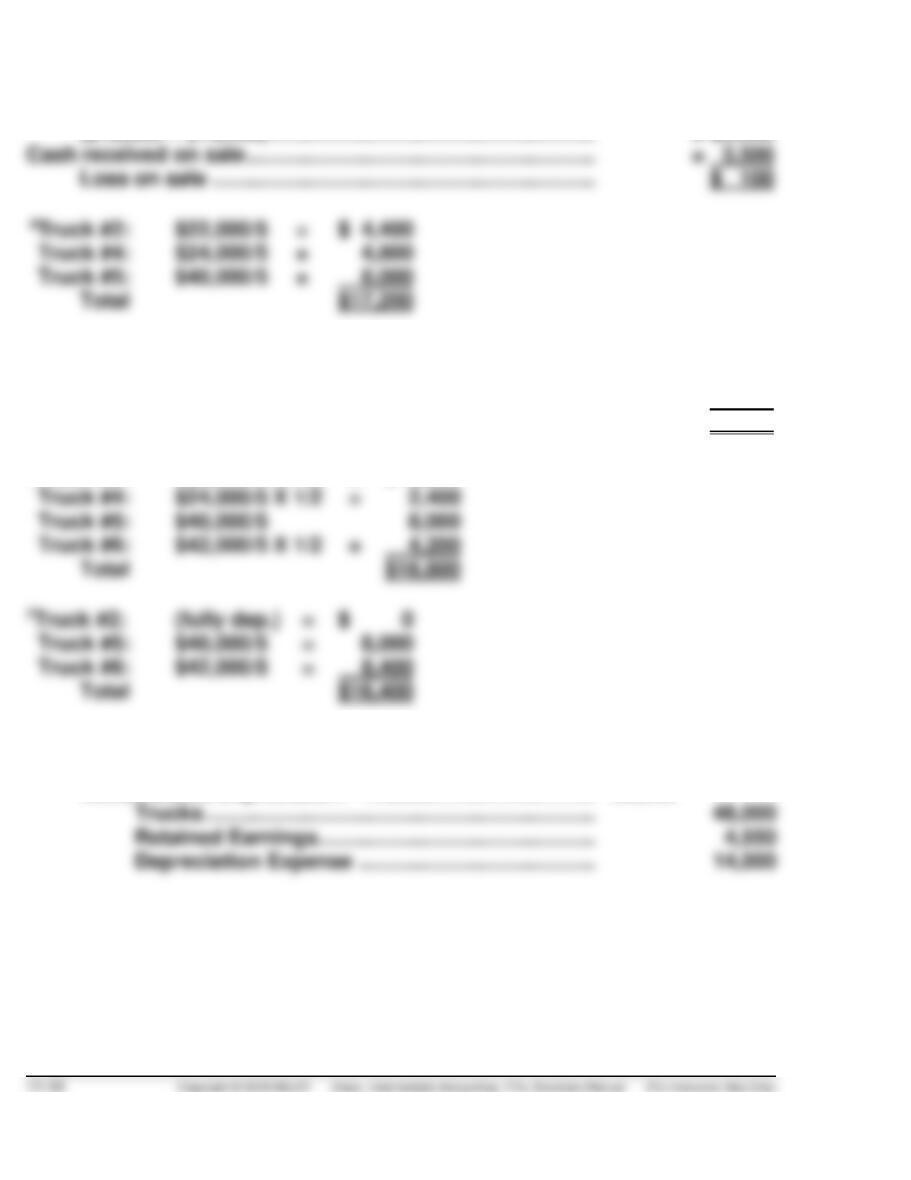
3Book value of Truck #1 [$18,000 – ($18,000/5 X 4 yrs.)] =
($18,000 – $14,400) ………………………………………………….
= $3,600
Cash received on sale ……………………………………………………..
= 3,500
Loss on sale …………………………………………………………..
$ 100
$22,000/5
=
$ 4,400
$24,000/5
=
$40,000/5
=
Total
5Book value of Truck #4 [$24,000 – ($24,000/5 X 3 yrs.)] =
($24,000 – $14,400)………………………
= $9,600
Cash received ($700 + $2,500) ………………………………………….
= 3,200
Loss on disposal …………………………………………………….
$6,400
6Truck #2:
$22,000/5 X 1/2
=
$ 2,200
$24,000/5 X 1/2
=
$40,000/5
$42,000/5 X 1/2
=
4,200
Total
(fully dep.)
=
$ 0
$40,000/5
=
$42,000/5
=
Total
(b)
Compound journal entry December 31, 2021:
Accumulated Depreciation—Trucks ………………………
66,550
Trucks …………………………………………………………
Retained Earnings ………………………………………..
Depreciation Expense ………………………………….
PROBLEM 11.4 (Continued)
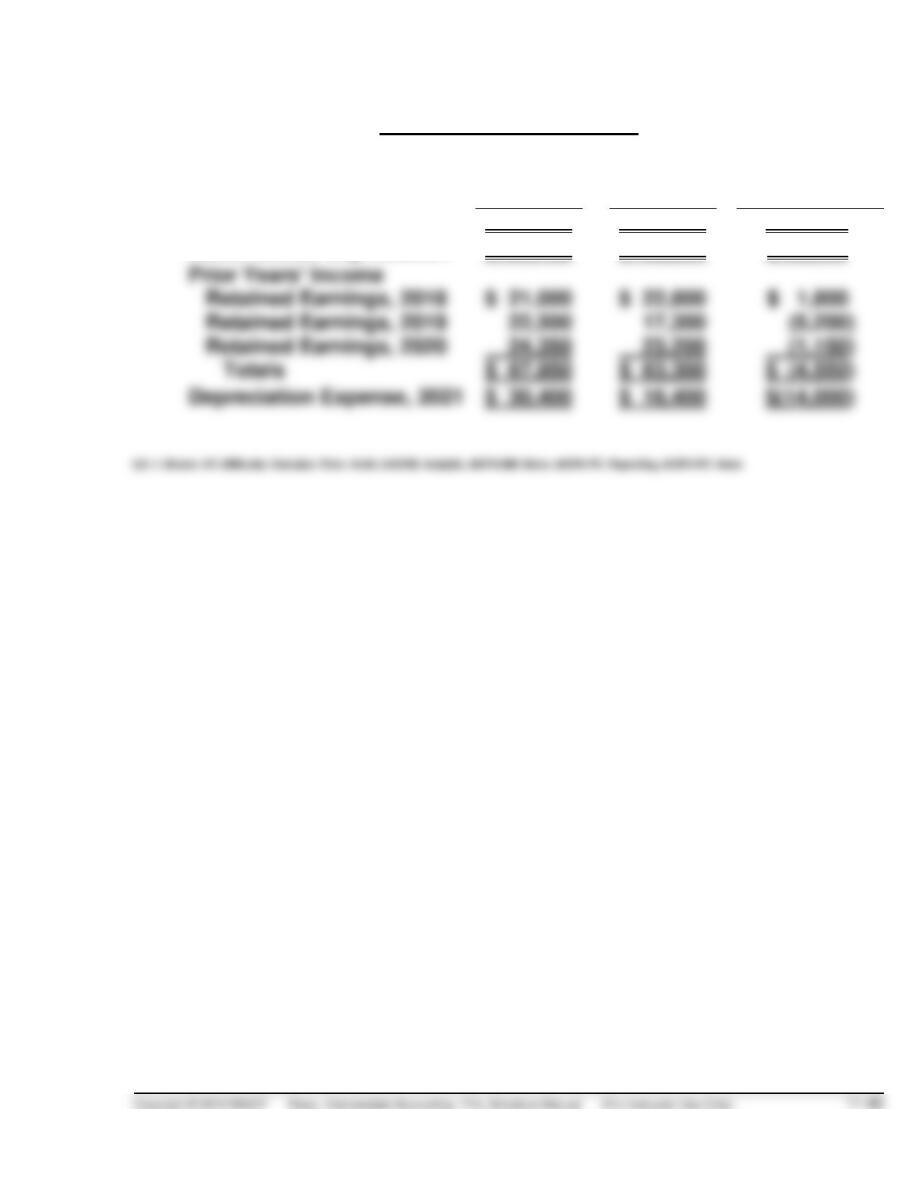
Summary of Adjustments:
Per
Books
As
Adjusted
Adjustment
Dr. or (Cr.)
Trucks
$152,000
$104,000
$(48,000)
Accumulated Depreciation
$129,150
$ 62,600
$ 66,550
Totals
$ 67,850
$ 63,300
$ (4,550)
Depreciation Expense, 2021
$ 30,400
$ 16,400
$(14,000)
PROBLEM 11.5
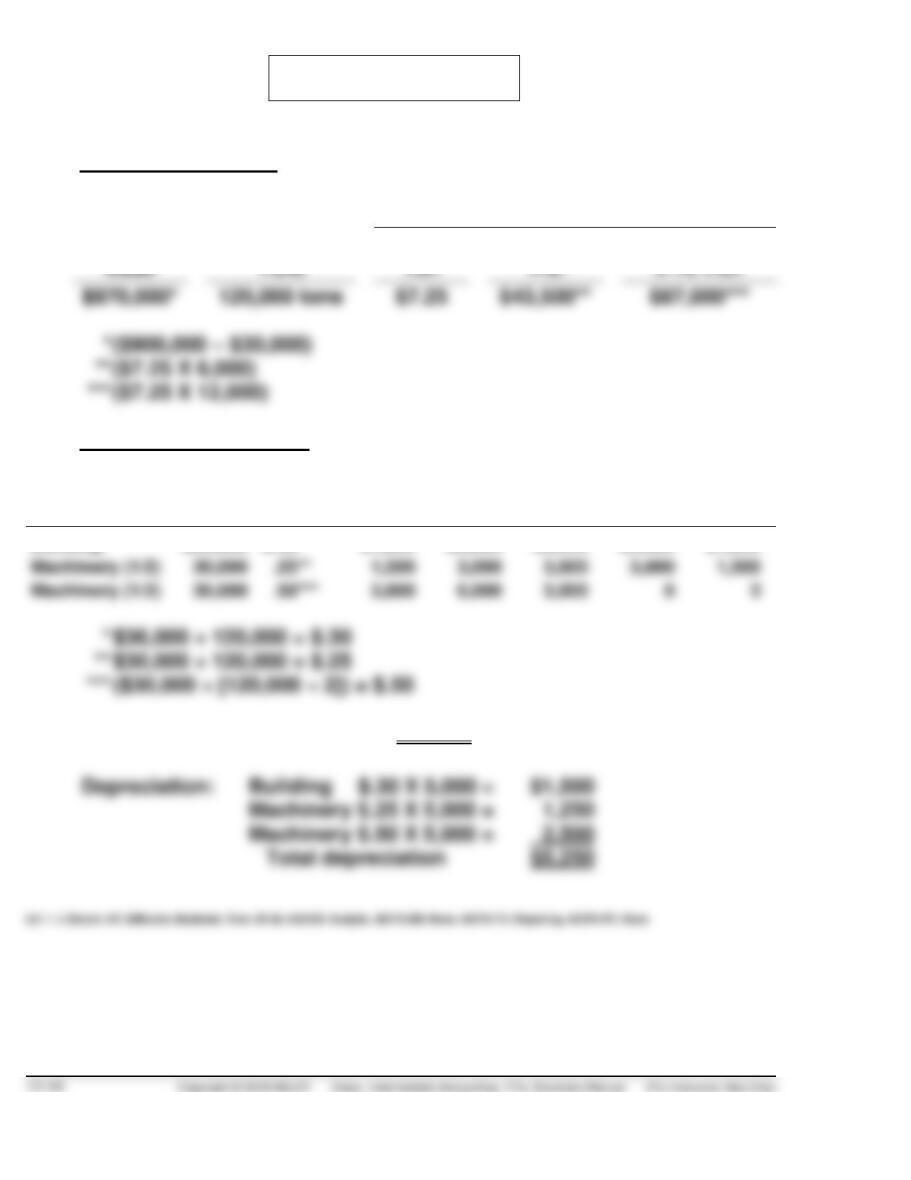
(a) Estimated depletion:
Estimated Depletion
Depletion
Estimated
Per
1ST & 11th
Each of Yrs.
Estimated depreciation:
Asset
Cost
Per ton
Mined
1st
Yr.
Yrs.
2–5
6th
Yr.
Yrs.
7–10
11th
Yr.
Building
$36,000
$.30*
$1,800
$3,600
$3,600
$3,600
$1,800
(b) Depletion: $7.25 X 5,000 tons = $36,250
Total depreciation
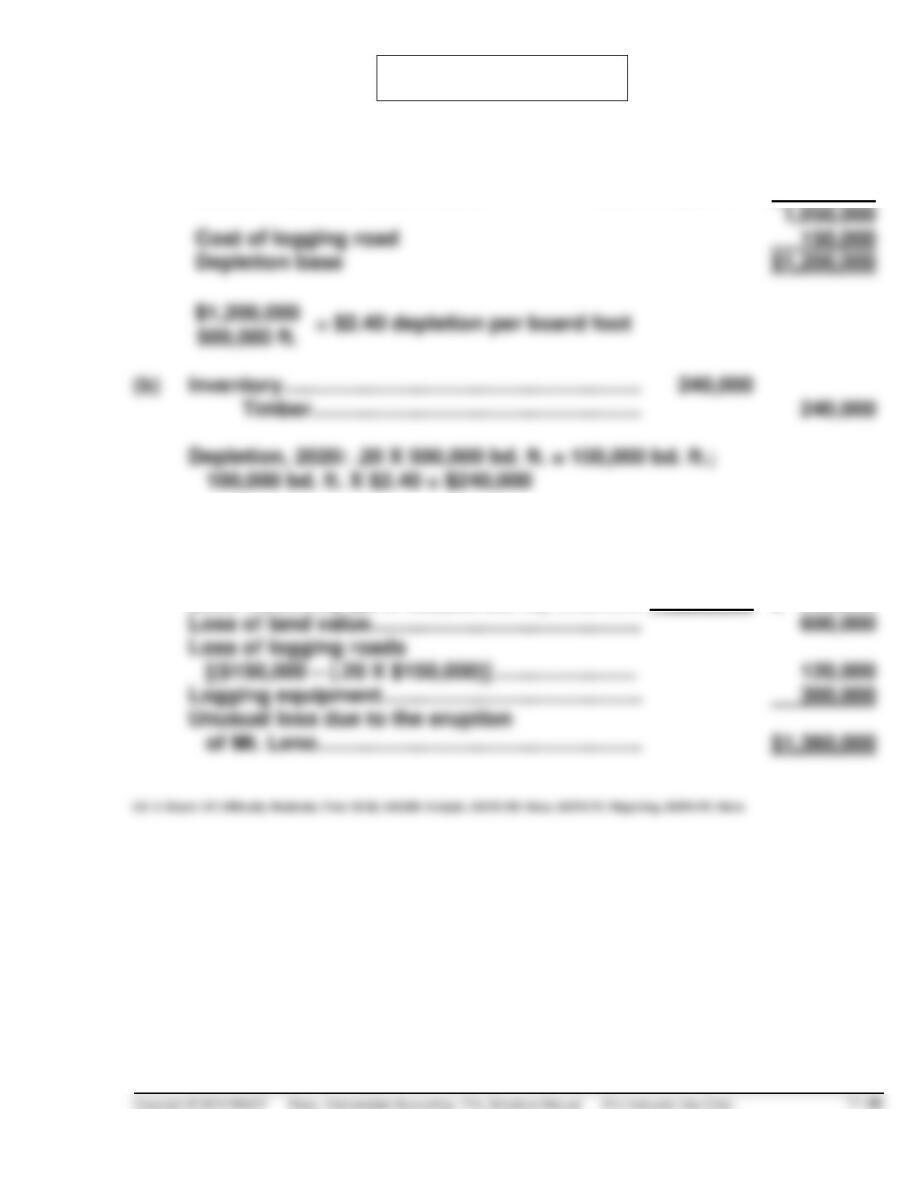
PROBLEM 11.6
(a)
Original cost
$550 X 3,000 =
$1,650,000
Deduct residual value of land
$200 X 3,000 =
600,000
Cost of logging road
150,000
$1,200,000
(b)
Inventory ……………………………………………………….
Timber ……………………………………………………….
Depletion, 2020: .20 X 500,000 bd. ft. = 100,000 bd. ft.;
100,000 bd. ft. X $2.40 = $240,000
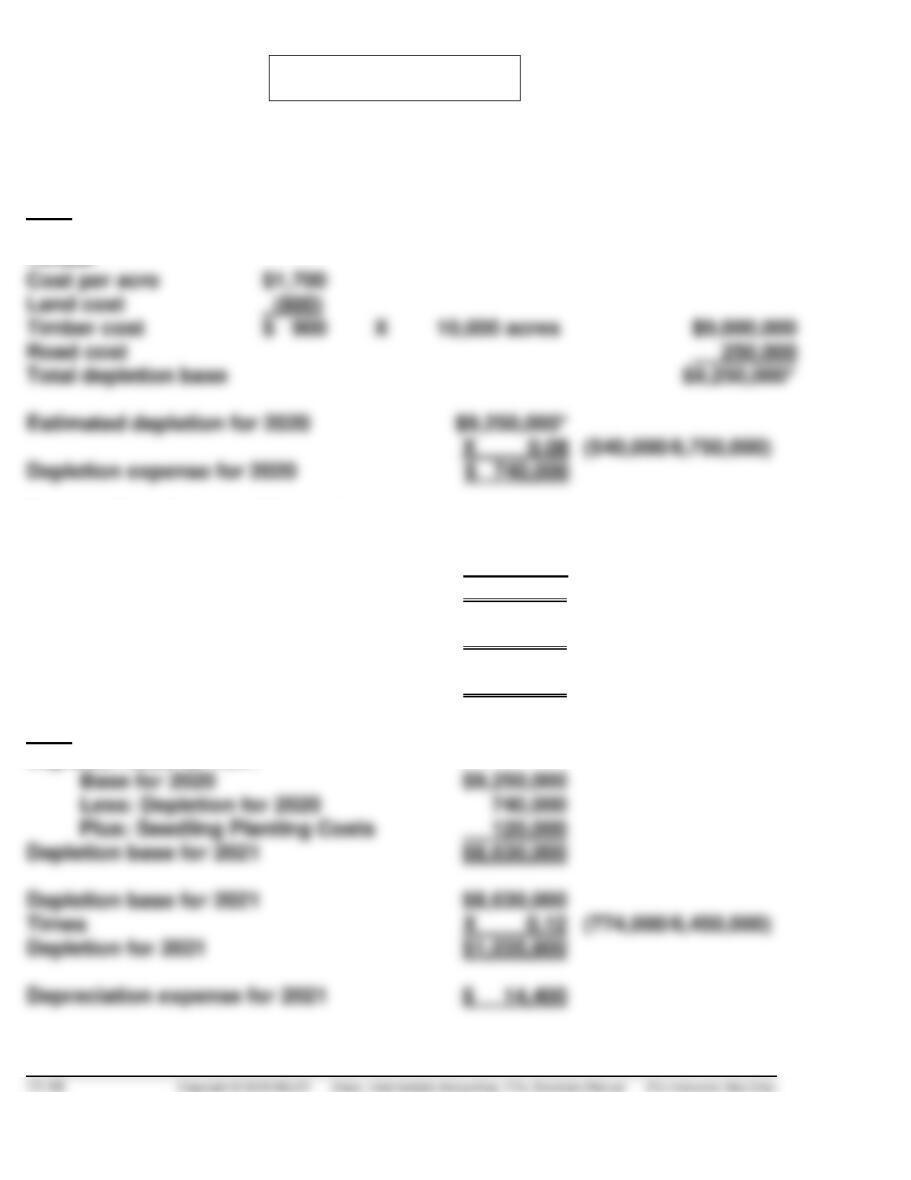
(c)
Loss of timber
[$1,050,000 – ($1,050,000 X .20)] ………………………
$ 840,000
Cost of salvaging timber ……………………………………
700,000
Less: Recovery ($3 X 400,000 bd. ft.) ………………….
1,200,000
$ 340,000
Loss of land value ……………………………………………..
Logging equipment ……………………………………………
300,000
Unusual loss due to the eruption
PROBLEM 11.7
Instructors should note the changing depletion base in this problem.
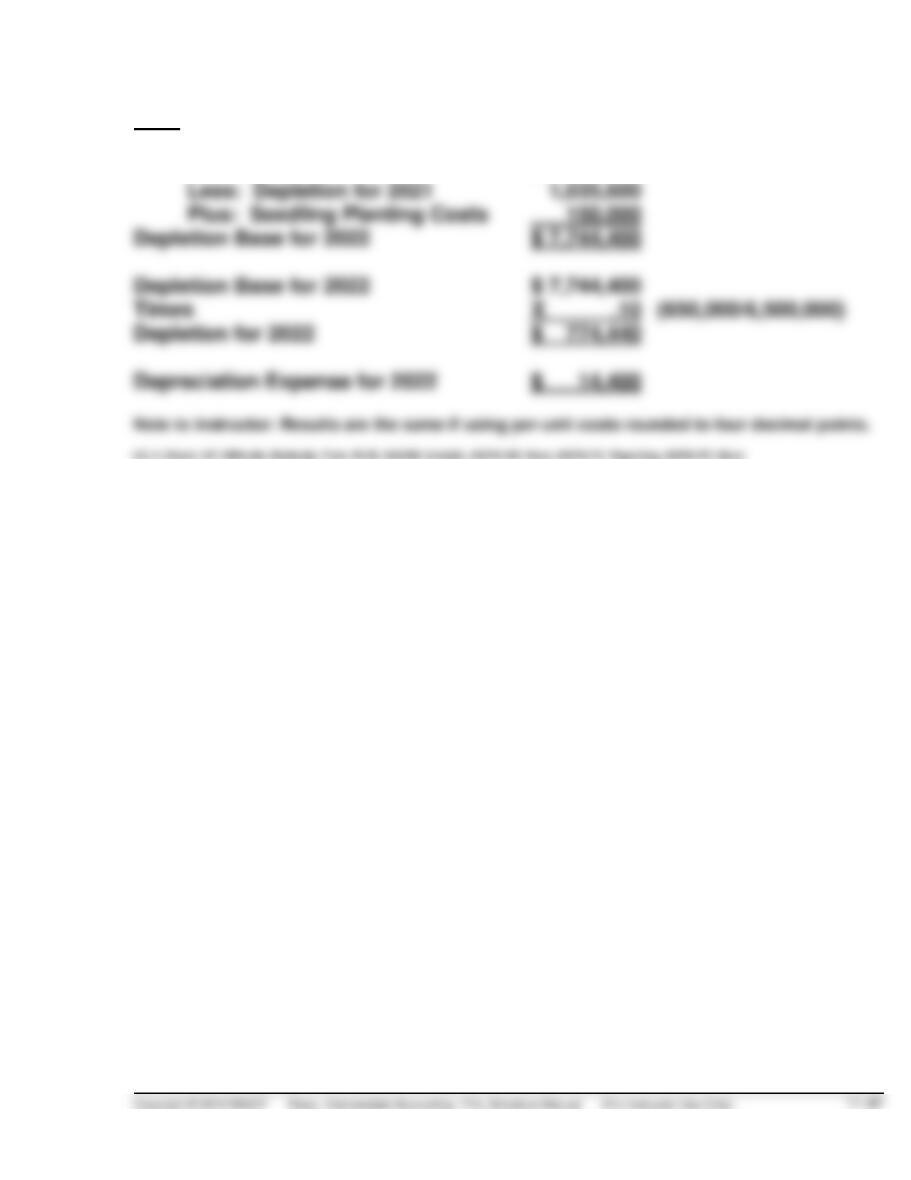
2020
Computation of depletion base for 2020
Timber
Cost per acre
Land cost
Timber cost
10,000 acres
Road cost
Total depletion base
Estimated depletion for 2020
X 0.08
(540,000/6,750,000)
Depletion expense for 2020
Depreciation of removable equipment
Cost
$ 225,000
Salvage value
(9,000)
Depreciable base
$ 216,000
Annual depreciation using SL ($216,000/15)
$ 14,400
Depreciation expense for 2020
$ 10,800
(9/12 X $14,400)
2021
Depletion base for 2021
Base for 2020
$9,250,000
Less: Depletion for 2020
Plus: Seedling Planting Costs
120,000
Depletion base for 2021
$8,630,000
Depletion base for 2021
$8,630,000
Times
(774,000/6,450,000)
Depletion for 2021
Depreciation expense for 2021
$ 14,400
PROBLEM 11.7 (Continued)
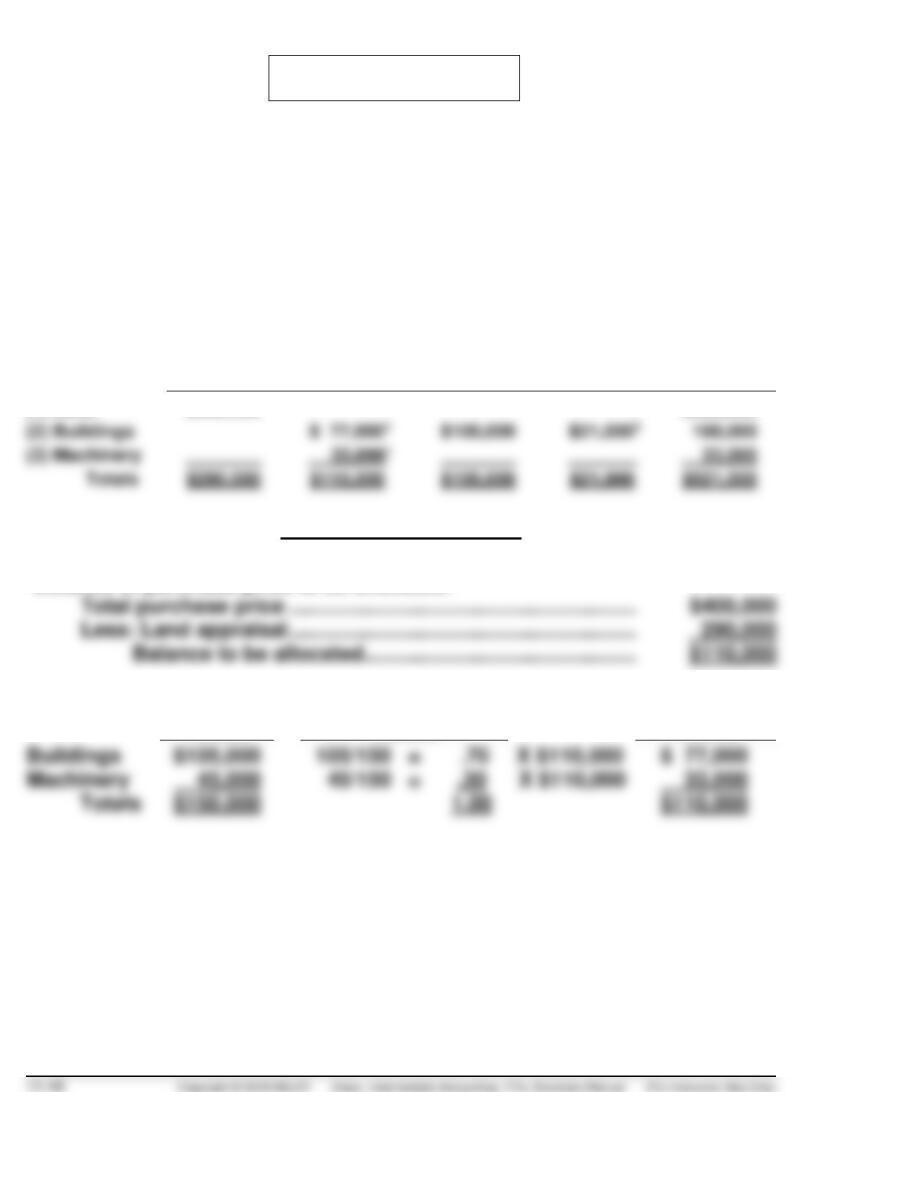
2022
Depletion Base for 2022
Base for 2021
$ 8,630,000
Less: Depletion for 2021
Plus: Seedling Planting Costs
Depletion Base for 2022
$ 7,744,400
Depletion Base for 2022
Times
(650,000/6,500,000)
Depletion for 2022
Depreciation Expense for 2022
$ 14,400
PROBLEM 11.8
(a) The amounts to be recorded on the books of Darby Sporting Goods
Inc. as of December 31, 2020, for each of the properties acquired from
Encino Athletic Equipment Company are calculated as follows:
Cost Allocations to Acquired Properties
Appraisal
Value
Remaining
Purchase
Price
Allocations
Renovations
Capitalized
Interest
Total
(1) Land
$290,000
$290,000
(2) Buildings
Supporting Calculations
1Balance of purchase price to be allocated.
Appraisal
Values
Ratios
Allocated
Values
PROBLEM 11.8 (Continued)
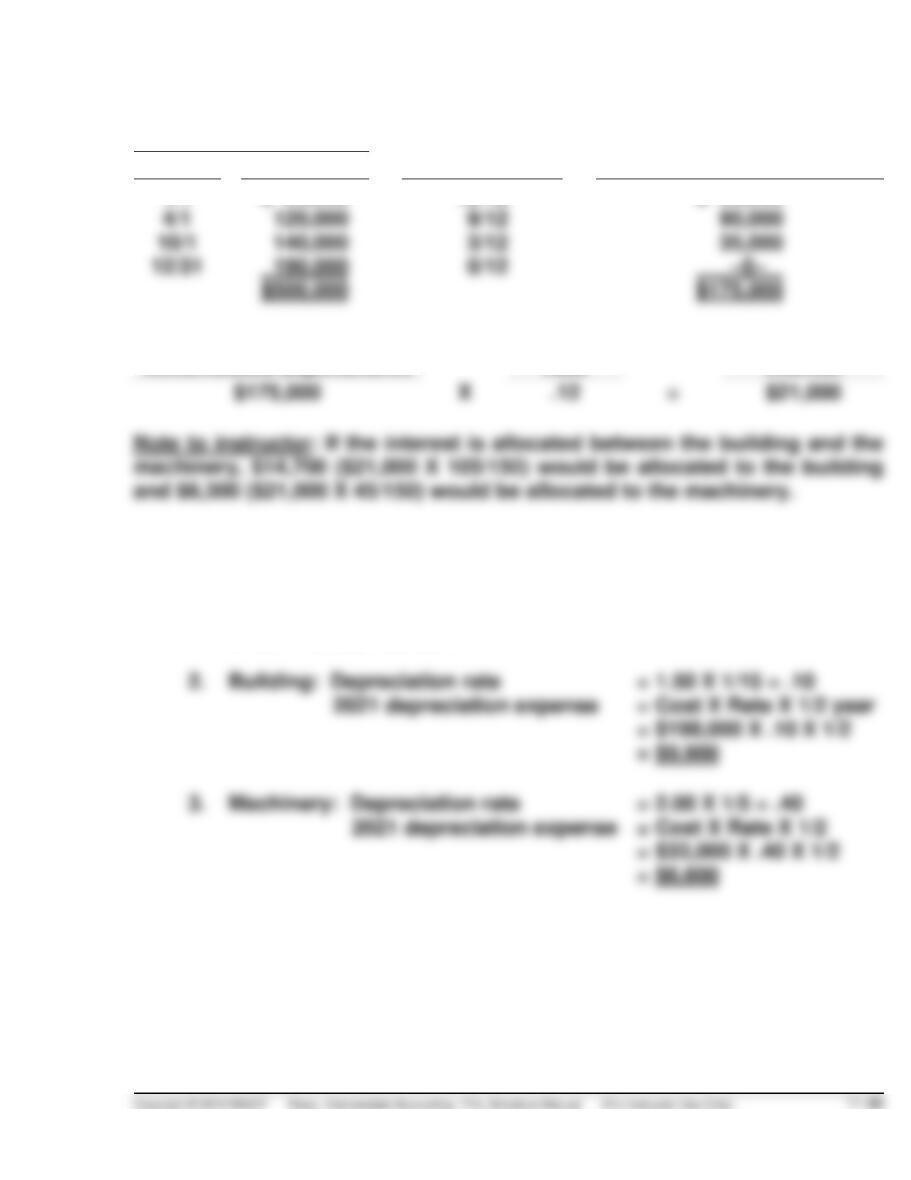
2Capitalizable interest.
Expenditures
Capitalization
Period
Weighted-Average
Accumulated Expenditures
Date
Amount
1/1
$ 50,000
12/12
$ 50,000
4/1
90,000
$500,000
Weighted-Average
Interest
Capitalized
Accumulated Expenditures
Rate
Interest
$175,000
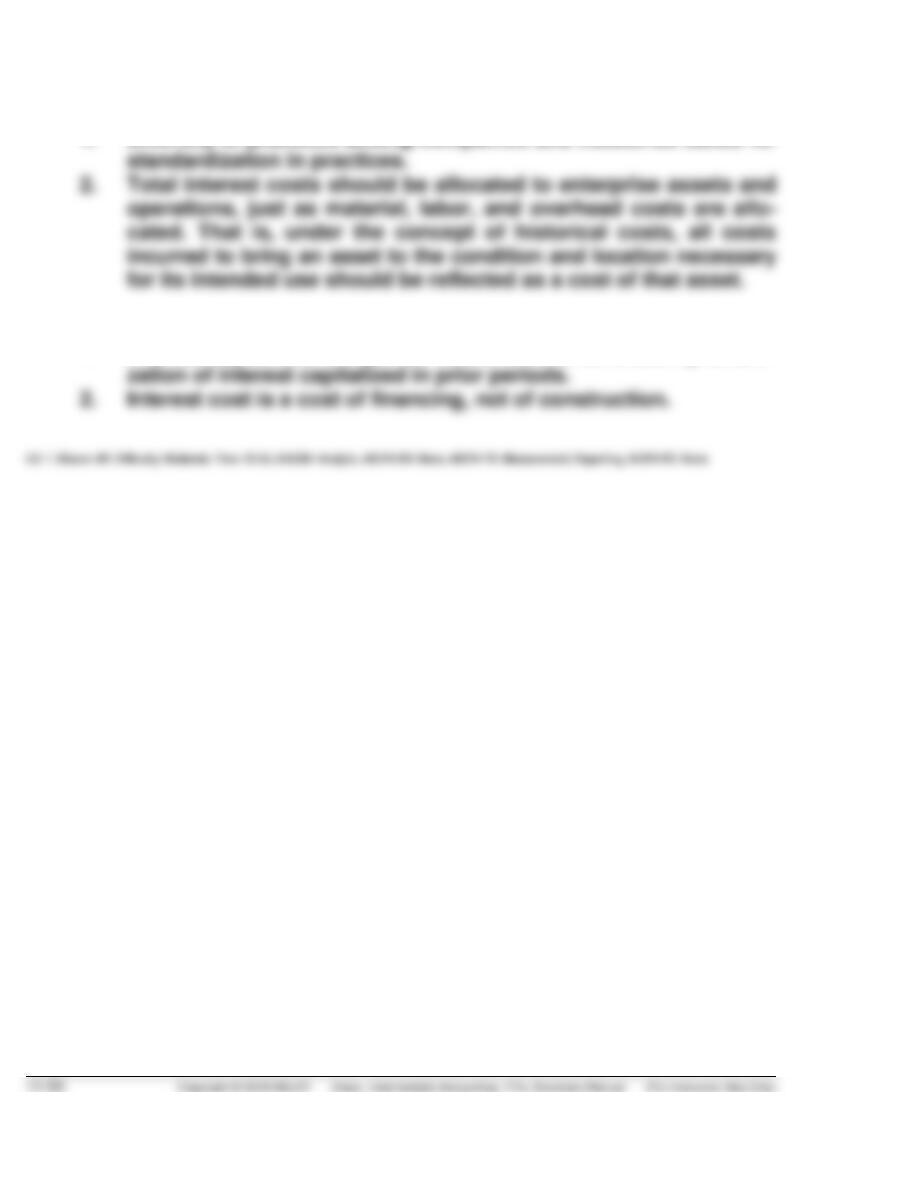
(b) Darby Sporting Goods Inc.’s 2021 depreciation expense, for book
purposes, for each of the properties acquired from Encino Athletic
Equipment Company is as follows:
1.
Land: No depreciation.
= Cost X Rate X 1/2 year
3.
Machinery: Depreciation rate
= 2.00 X 1/5 = .40
PROBLEM 11.8 (Continued)
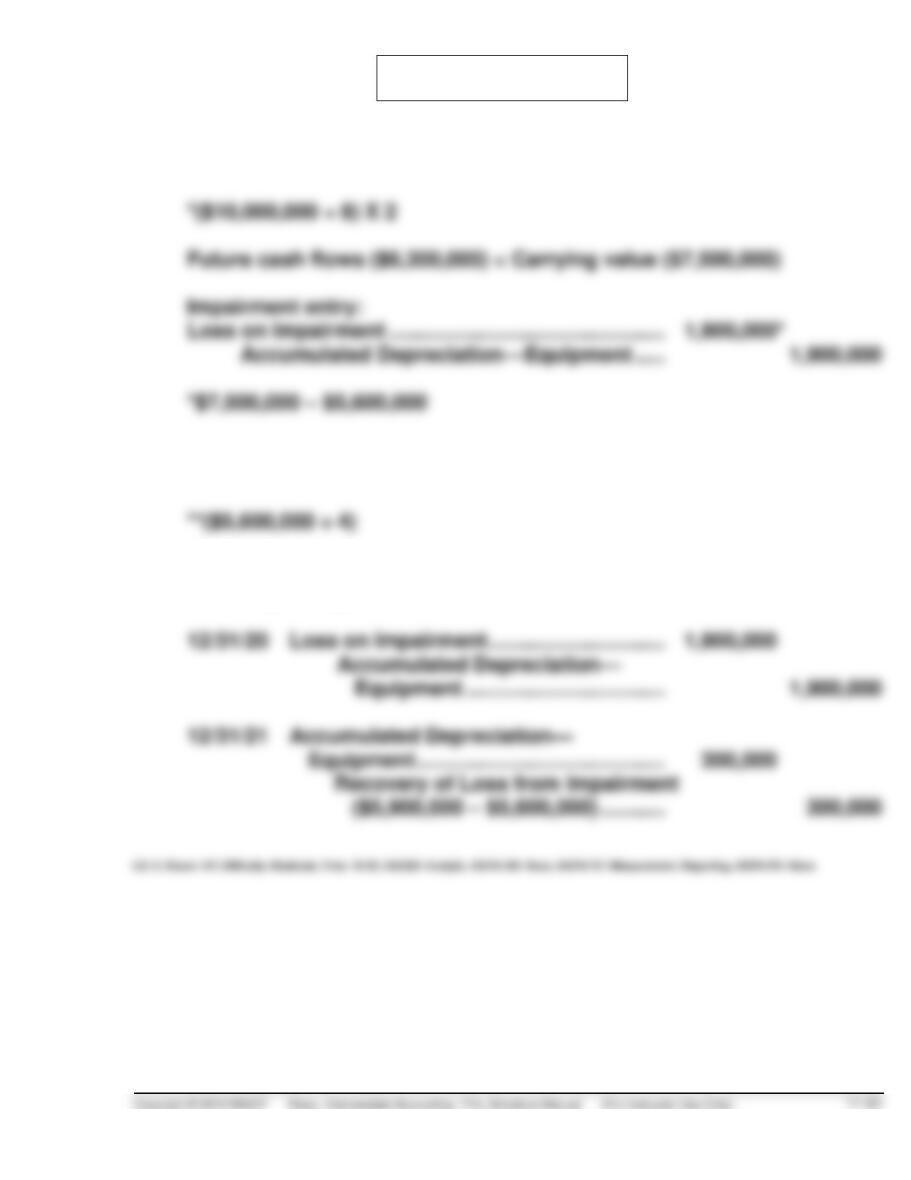
(c) Arguments for the capitalization of interest costs include the following.
1. Diversity of practices among companies and industries called for
Arguments against the capitalization of interest include the following:
1. Interest capitalized in a period would tend to be offset by amorti–
PROBLEM 11.9
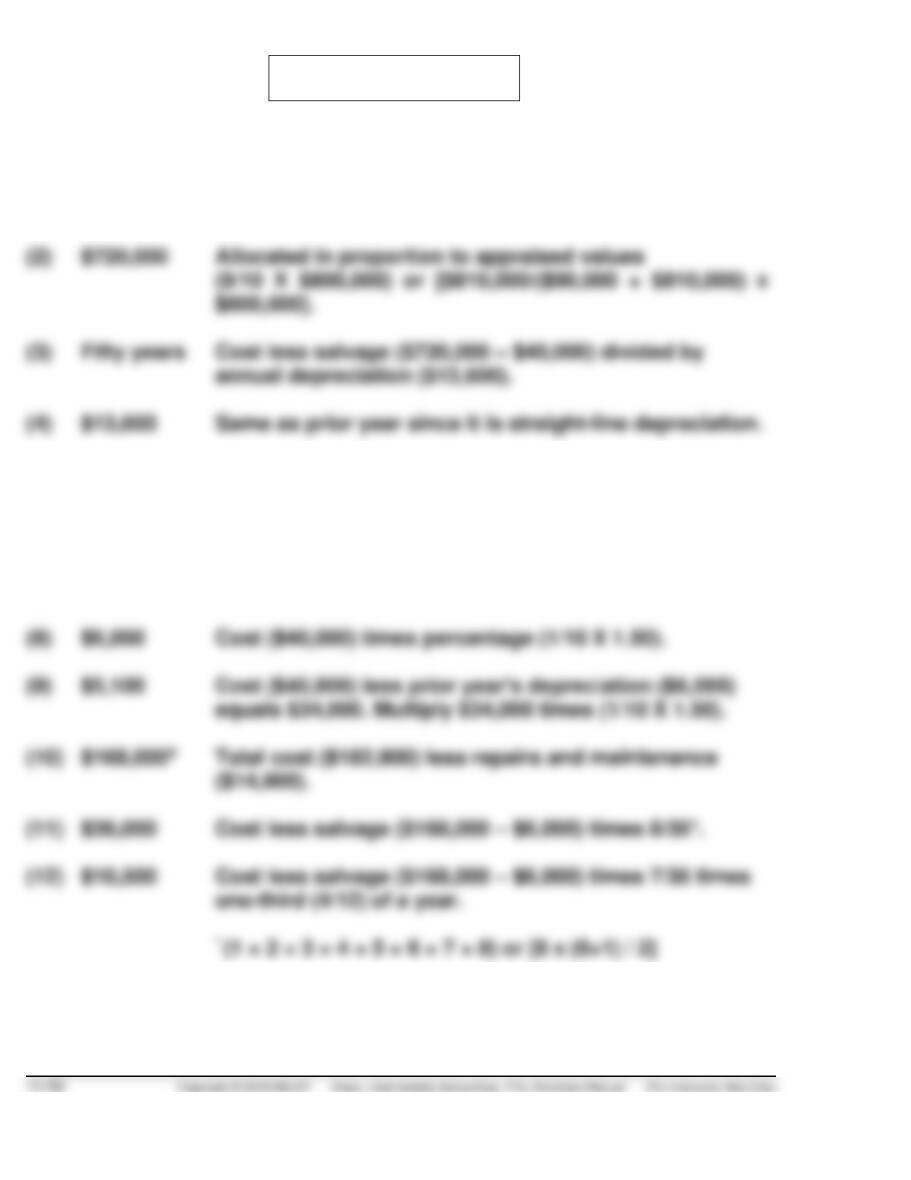
(a) Carrying value of asset: $10,000,000 – $2,500,000* = $7,500,000.
(b) Depreciation Expense …………………………………….. 1,400,000**
Accumulated Depreciation—Equipment ….. 1,400,000
(c) No depreciation is recorded on impaired assets held for disposal.
Recovery of impairment losses are recorded.
PROBLEM 11.10
(1)
$80,000
Allocated in proportion to appraised values
(1/10 X $800,000) or [$90,000/($90,000 + $810,000) x
$800,000].
(2)
Allocated in proportion to appraised values
(3)
Fifty years
annual depreciation ($13,600).
(4)
$13,600
Same as prior year since it is straight-line depreciation.
(5)
$91,000
[Number of shares (2,500) times fair value ($30)]
plus demolition cost of existing building ($16,000).
(6)
None
No depreciation before use.
(7)
$40,000
Fair value.
(8)
(9)
$5,100
equals $34,000. Multiply $34,000 times (1/10 X 1.50).
(10)
Total cost ($182,900) less repairs and maintenance
($14,900).
(11)
$36,000
(12)
$10,500
PROBLEM 11.10 (Continued)
(13)
$52,000
Annual payment ($6,000) times present value of annuity
due at 8% for 11 years (7.710) plus down payment ($5,740).
This can be found in an annuity due table since the
(14)
$2,600
Cost ($52,000) divided by estimated life (20 years).
PROBLEM 11.11
(a)
(1)
Straight-line Method:
$90,000 – $6,000
= $16,800 a year for
all 5 years
5 years
Year
2018
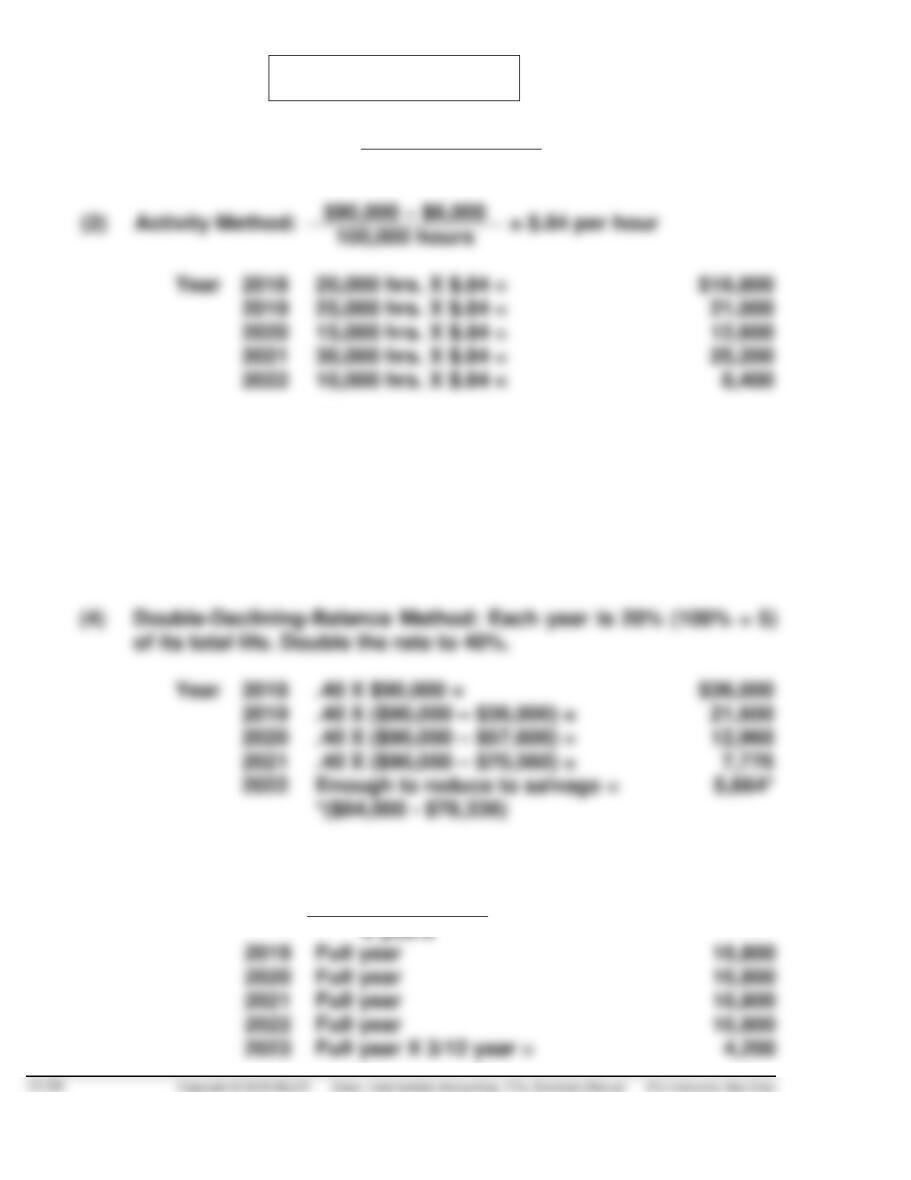
20,000 hrs. X $.84 =
2019
25,000 hrs. X $.84 =
2020
15,000 hrs. X $.84 =
2022
10,000 hrs. X $.84 =
(3) Sum-of-the-Years’-Digits: (5 + 4 + 3 + 2 + 1) = 15 or [5 X (5 + 1)/2]
Year
2018
5/15 X ($90,000 – $6,000) =
$28,000
2019
4/15 X ($90,000 – $6,000) =
22,400
2020
3/15 X ($90,000 – $6,000) =
16,800
2021
2/15 X ($90,000 – $6,000) =
11,200
2022
1/15 X ($90,000 – $6,000) =
5,600
Year
2018
.40 X $90,000 =
2019
.40 X ($90,000 – $36,000) =
2020
.40 X ($90,000 – $57,600) =
2021
.40 X ($90,000 – $70,560) =
2022
Enough to reduce to salvage =
(b) (1) Straight-line Method:
Year
2018
$90,000 – $6,000
X 9/12 =
$12,600
2019
Full year
2020
Full year
2021
Full year
2022
Full year
PROBLEM 11.11 (Continued)
(2) Sum-of-the-Years’-Digits Method:
2018
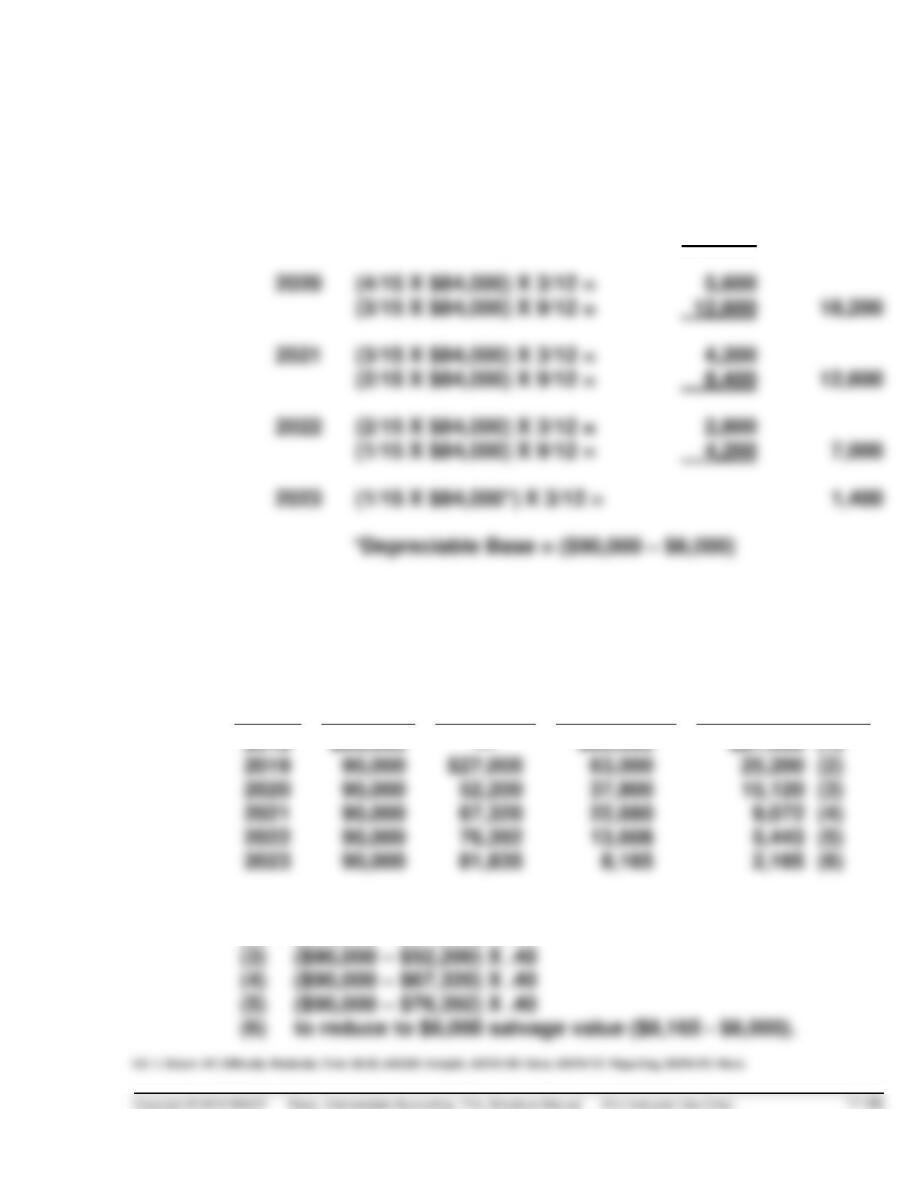
(5/15 X $84,000*) X 9/12 =
$21,000
2019
(5/15 X $84,000) X 3/12 =
$ 7,000
(4/15 X $84,000) X 9/12 =
16,800
23,800
2020
(4/15 X $84,000) X 3/12 =
(3/15 X $84,000) X 9/12 =
12,600
(2/15 X $84,000) X 9/12 =
12,600
2022
(2/15 X $84,000) X 3/12 =
(1/15 X $84,000) X 9/12 =
2023
(1/15 X $84,000*) X 3/12 =
(3) Double-Declining Balance Method:
Year
Cost
Accum.
Depr. at
beg. of
year
Book
Value at
beg. of
year
Depr.
Expense
(1) $90,000 X .40 X 9/12
(2) ($90,000 – $27,000) X .40
*PROBLEM 11.12
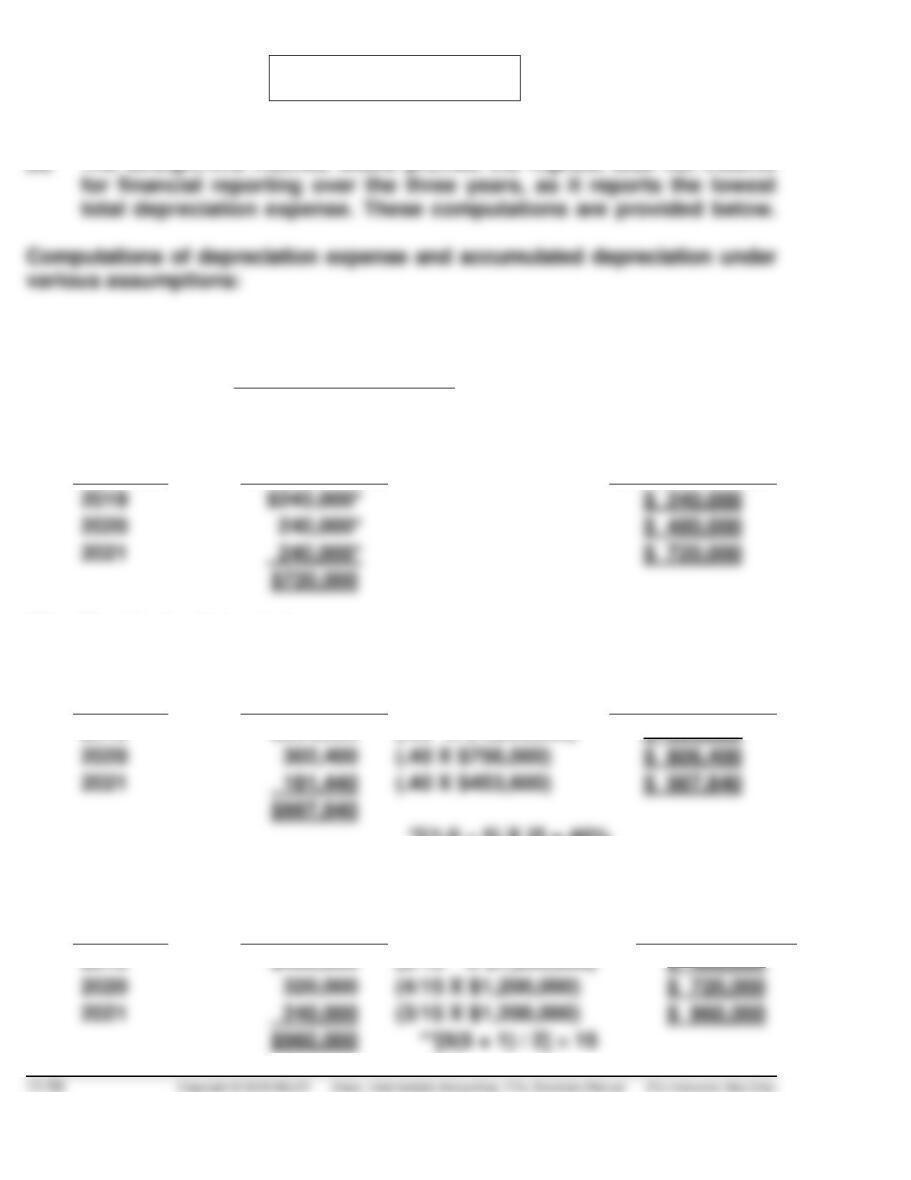
(a) The straight-line method would provide the highest total net income
(1) Straight-line:
$1,260,000 – $60,000
= $240,000
5 years
Year
Depreciation
Expense
Accumulated
Depreciation
(2) Double-declining-balance:
Year
Depreciation
Expense
Accumulated
Depreciation
2019
$504,000
(.40* X $1,260,000)
$ 504,000
*[(1.0 ÷ 5) X 2] = 40%
(3) Sum-of-the-years’-digits:
Year
Depreciation
Expense
Accumulated
Depreciation
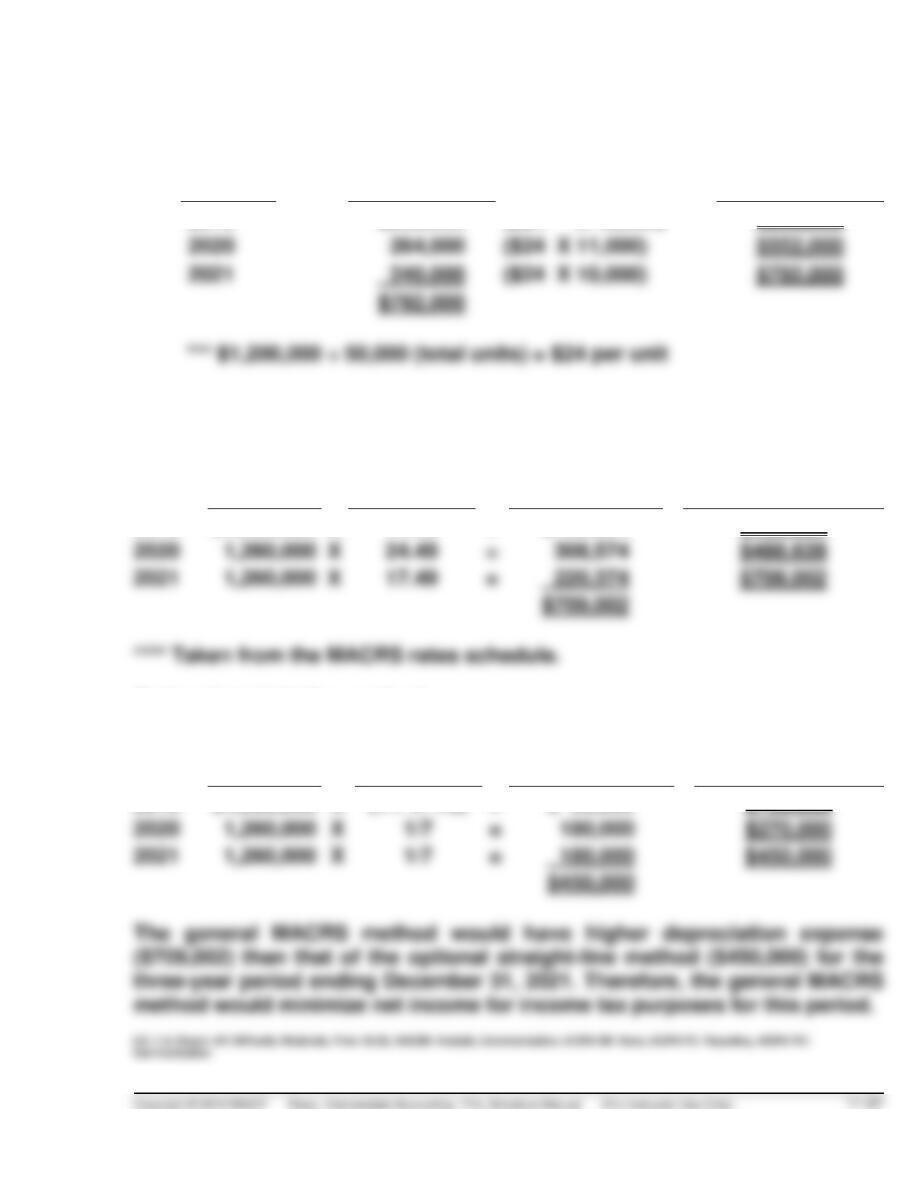
*PROBLEM 11.12 (Continued)
(4) Units-of-output:
Year
Depreciation
Expense
Accumulated
Depreciation
2019
$288,000
($24*** X 12,000)
$288,000
2021
($24 X 10,000)
$792,000
$792,000
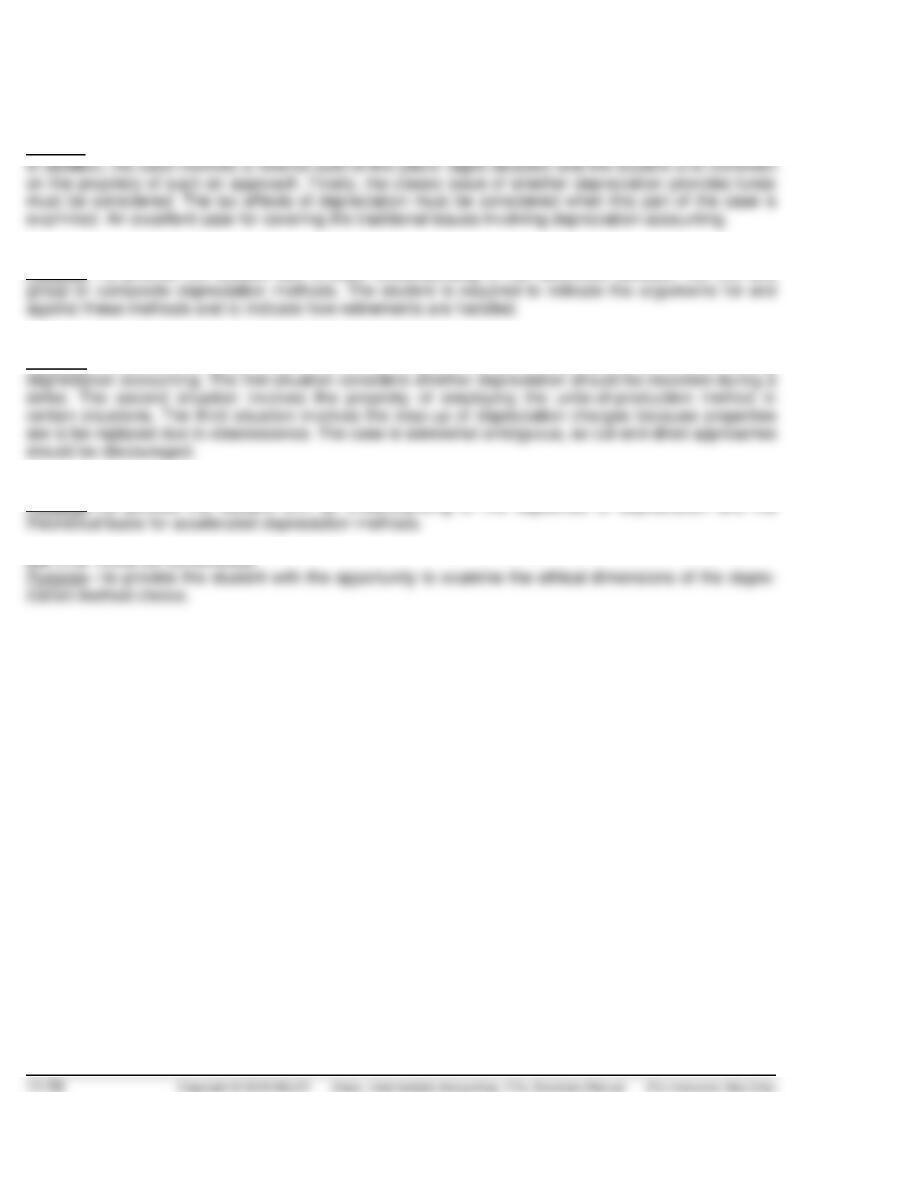
(b) General MACRS method:
Total Cost
MACRS
Rates
(%)****
Annual
Depreciation
Accumulated
Depreciation
2019
$1,260,000
X
14.29
=
$180,054
$180,054
2020
X
24.49
=
$488,628
2021
X
17.49
=
$709,002
Optional straight-line method:
Total Cost
Depreciation
Rate
Annual
Depreciation
Accumulated
Depreciation
2019
$1,260,000
X
(1/7 X 1/2)
=
$ 90,000
$ 90,000
2020
X
=
$270,000
$450,000
TIME AND PURPOSE OF CONCEPTS FOR ANALYSIS
CA 11.1 (Time 25–35 minutes)
Purpose—to provide the student with an understanding of the basic objective of depreciation accounting.
CA 11.2 (Time 20–25 minutes)
Purpose—to provide the student with a basic understanding of the difference between the unit and
CA 11.3 (Time 25–35 minutes)
Purpose—to provide the student with an understanding of a number of unstructured situations involving
CA 11.4 (Time 25–35 minutes)
Purpose—to provide the student with an understanding of the objectives of depreciation and the
SOLUTIONS TO CONCEPTS FOR ANALYSIS
CA 11.1
(a) The purpose of depreciation is to distribute the cost (or book value) of tangible plant assets, less
salvage, over their useful lives in a systematic and rational manner. Under generally accepted
(b) The proposed depreciation method is, of course, systematic. Whether it is rational in terms of cost
allocation depends on the facts of the case. It produces an increasing depreciation charge, which
is usually not justifiable in terms of the benefit from the use of the asset because manufacturers
typically prefer to use their new equipment as much as possible and their old equipment only as
(c) (1) Depreciation charges neither recover nor create funds. Revenue-producing activities are the
sources of funds from operations: if revenues exceed out-of-pocket costs during a fiscal period,
funds are available to cover other than out-of-pocket costs; if revenues do not exceed out-of–
pocket costs, no funds are made available no matter how much, or little, depreciation is charged.
(2) Depreciation may affect funds in two ways. First, depreciation charges affect reported income
and hence may affect managerial decisions such as those regarding pricing, product selection,
and dividends. For example, the proposed method would result initially in higher reported
income than would the straight-line method, consequently stockholders might demand higher
dividends in the earlier years than they would otherwise expect.
CA 11.1 (Continued)
If Burnitz is not profitable now, it would not benefit from higher deductions now and should
CA 11.2
(a) (1) The unit method of recording depreciation involves the treatment of plant assets or substantial
(2) Under the group or composite-life methods, assets are aggregated into accounting units. Such
grouping might be horizontal, vertical, or geographical. Horizontal grouping combines all assets
(b) 1. Arguments for the use of the unit method are:
i. The method is simple in that it does not require involved mathematical computations.
Arguments against the unit method are:
i. Considerable additional bookkeeping is necessary to account for each asset and its
related depreciation. (Computers reduce the work burden, however.)
ii. There is a point of diminishing returns in the accumulation of accounting data under this
2. Arguments for the use of the group and composite-life methods are:
i. The methods require less detailed bookkeeping.