CODIFICATION RESEARCH CASE (Continued)
35–38 The availability of relevant inputs and their relative subjectivity
might affect the selection of appropriate valuation techniques
(see paragraph 820-10–35–24). However, the fair value hierarchy
35–38A If an observable input requires an adjustment using an
unobservable input and that adjustment results in a
significantly higher or lower fair value measurement, the
35–39 The remainder of this guidance is organized as follows:
a. Level 1 inputs
CODIFICATION RESEARCH CASE (Continued)
35–36 Valuation techniques used to measure fair value shall
35–36A Examples of markets in which inputs might be observable for
35–41 A quoted price in an active market provides the most reliable
35–41B A Level 1 input will be available for many financial assets and
financial liabilities, some of which might be exchanged in
multiple active markets (for example, on different exchanges).
35–41C A reporting entity shall not make an adjustment to a Level 1
input except in the following circumstances:
a. When a reporting entity holds a large number of similar (but
not identical) assets or liabilities (for example, debt
securities) that are measured at fair value and a quoted
CODIFICATION RESEARCH CASE (Continued)
b. When a quoted price in an active market does not represent
fair value at the measurement date. That might be the case
if, for example, significant events (such as transactions in a
principal-to-principal market, trades in a brokered market,
c. When measuring the fair value of a liability or an instrument
classified in a reporting entity’s shareholders’ equity using
the quoted price for the identical item traded as an asset in
an active market and that price needs to be adjusted for
factors specific to the item or the asset (see paragraph 820–
IFRS CONCEPTS AND APPLICATION
IFRS11.1
To determine whether an asset is impaired, on an annual basis, companies
review the asset for indicators of impairment – that is, a decline in the
IFRS11.2
Under IFRS, impairment losses on plant assets may be restored as long as
IFRS11.3
An impairment is deemed to have occurred if, in applying the impairment
test, the carrying amount of the asset exceeds the recoverable amount of
IFRS11.4
Impairment losses are reported as part of operating income generally in the
“Other income and expense” section. Impairment losses (and recovery of
IFRS11.5
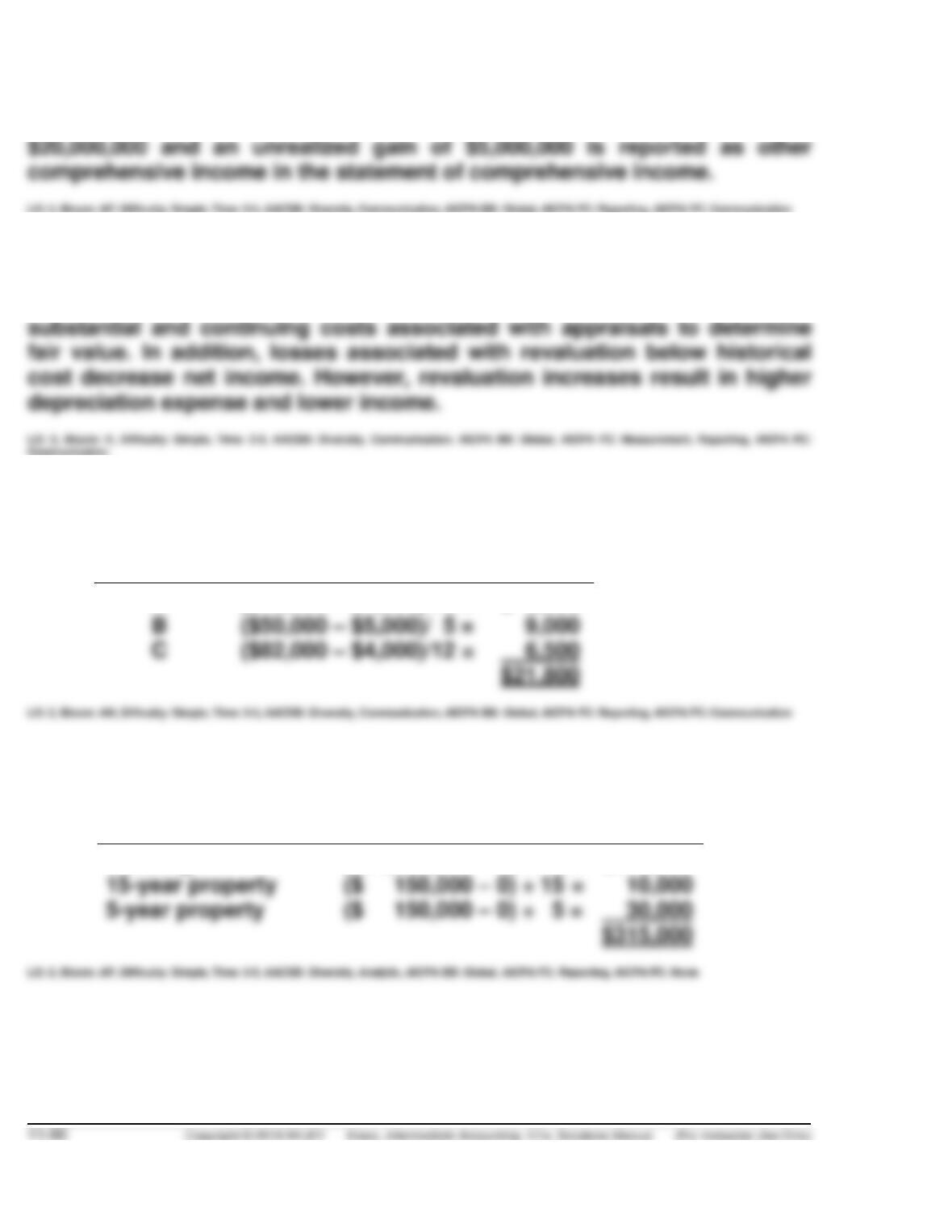
The land should be reported on the statement of financial position at
IFRS11.6
A major reason most companies do not use revaluation accounting is the
IFRS11.7
Component
Depreciation Expense
A
($70,000 – $7,000)/10 = $ 6,300
$21,800
IFRS11.8
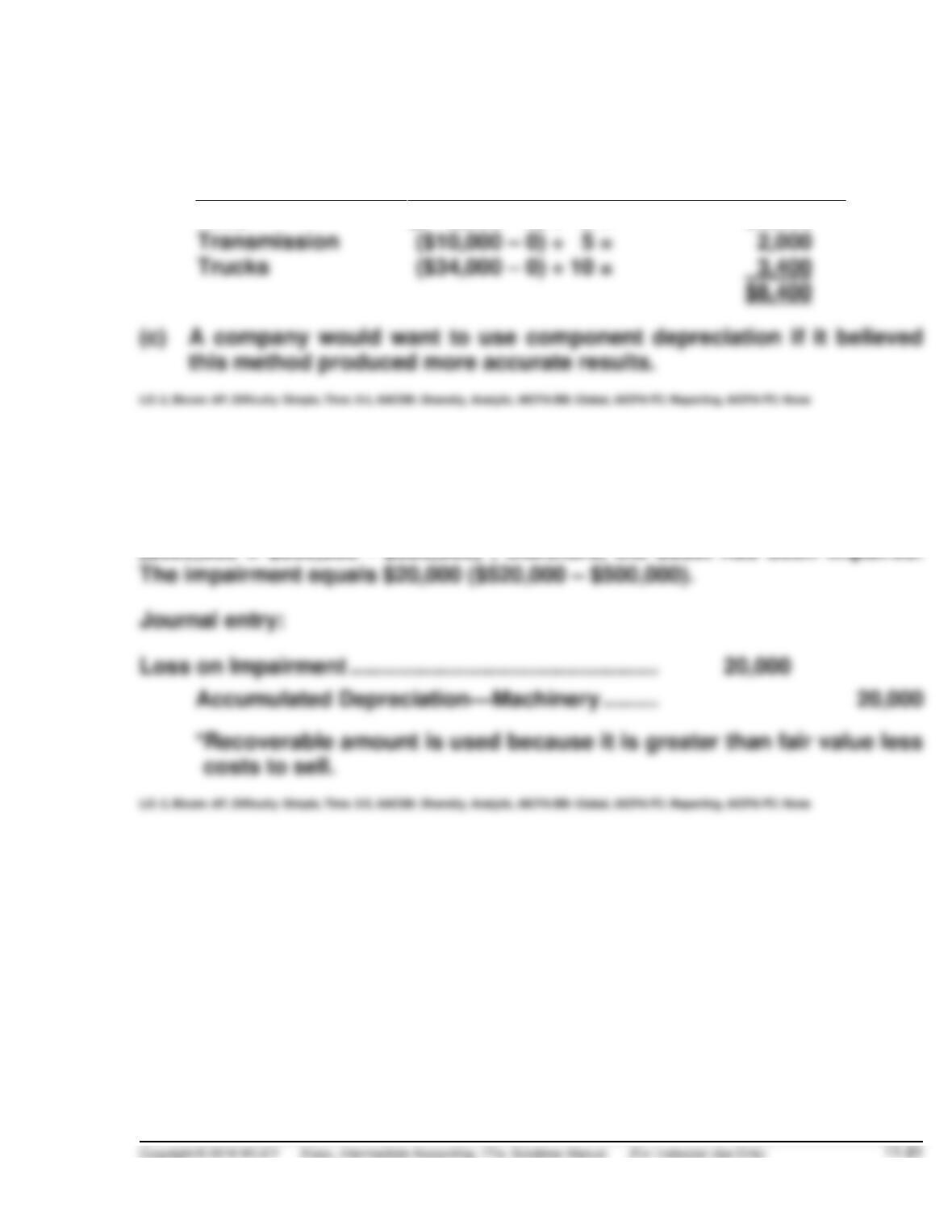
Component
Depreciation Expense
Building
($11,000,000 – 0) ÷ 40 = $275,000
IFRS11.9
(a) ($50,000 – 0) ÷ 10 = $5,000
(b)
Component
Depreciation Expense
Tires
($ 6,000 – 0) ÷ 2 = $3,000
Trucks
IFRS11.10
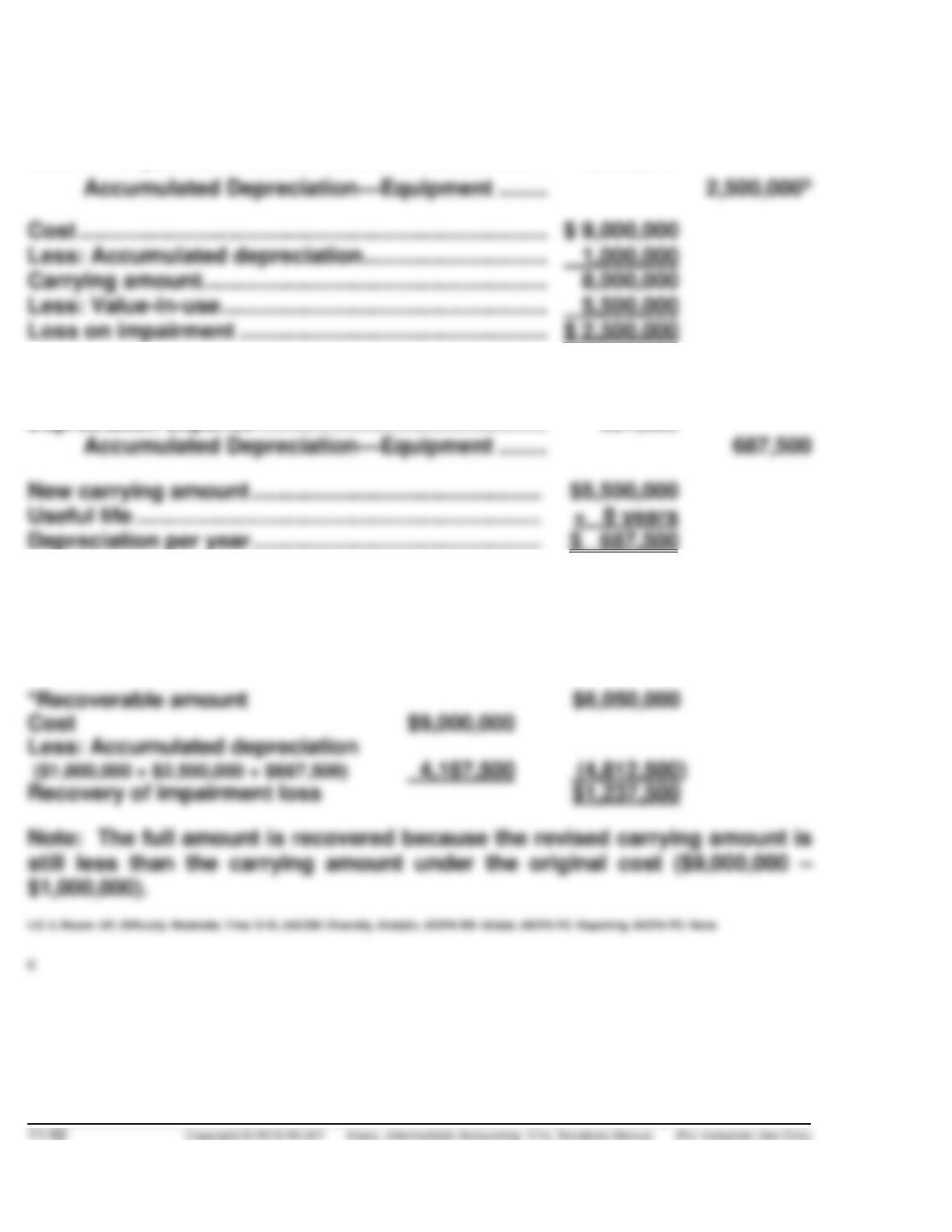
Impairment test:
Present value of future net cash flows* ($500,000) < Carrying amount
($520,000 = $900,000 – $380,000)*; therefore, the asset has been impaired.
IFRS11.11
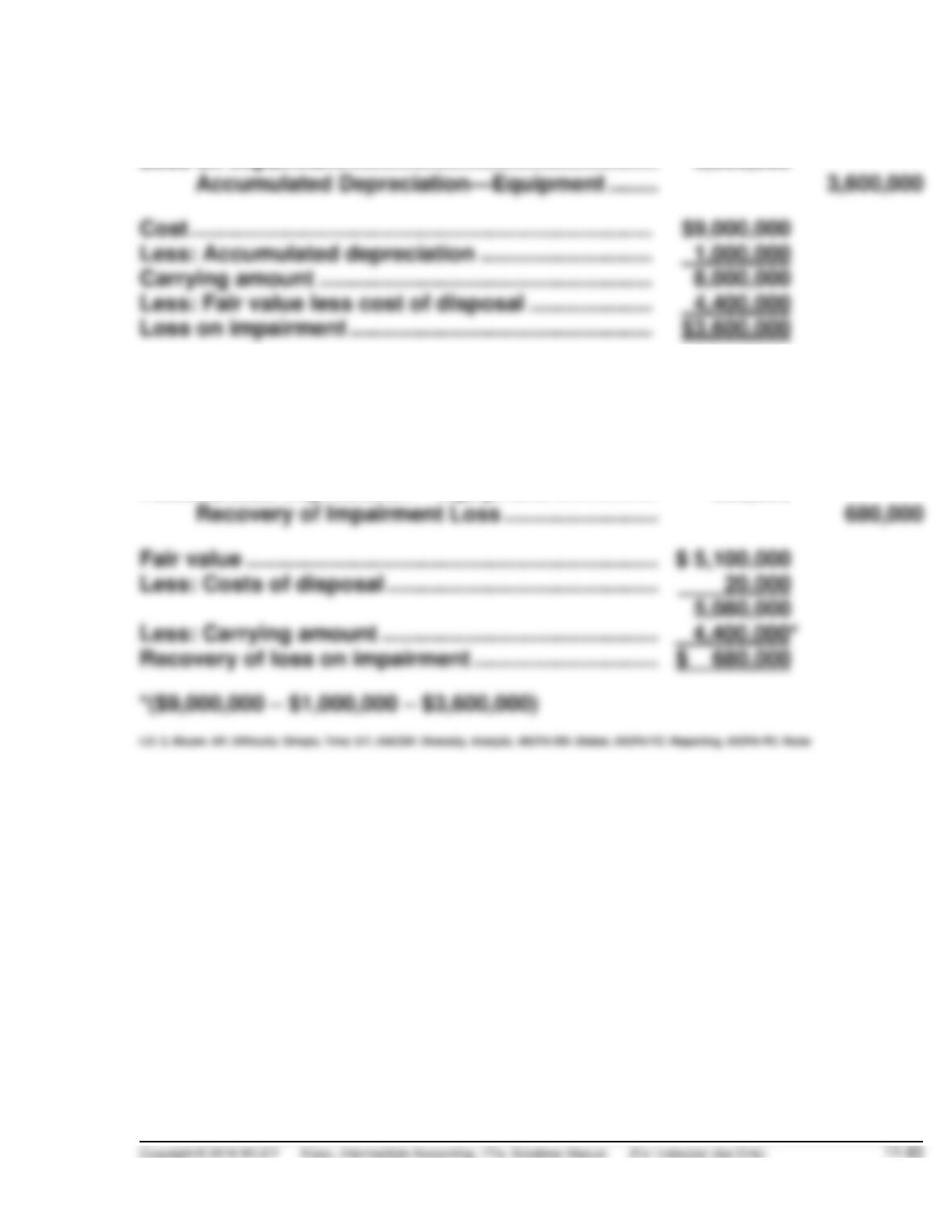
(a) December 31, 2020
Loss on Impairment ………………………………………………..
2,500,000
Accumulated Depreciation—Equipment …………..
Cost ………………………………………………………………….
(b) December 31, 2021
Depreciation Expense ……………………………………………..
687,500
Accumulated Depreciation—Equipment …………..
New carrying amount ………………………………………..
Useful life …………………………………………………………
÷ 8 years
Depreciation per year ………………………………………..
(c) December 31, 2021
Accumulated Depreciation—Equipment ……………………
1,237,500*
Recovery of Impairment Loss ………………………….
1,237,500
IFRS11.12
(a) December 31, 2020
Loss on Impairment ………………………………………………..
3,600,000
Accumulated Depreciation—Equipment …………..
Cost …………………………………………………………………
Less: Accumulated depreciation ……………………….
Carrying amount ………………………………………………
8,000,000
Less: Fair value less cost of disposal ………………..
Loss on impairment ………………………………………….
(b) No entry necessary. Depreciation is not taken on assets intended to
be sold.
(c) December 31, 2021
Accumulated Depreciation—Equipment …………………..
680,000
Recovery of Impairment Loss ………………………….
Fair value ……………………………………………………………….
Less: Costs of disposal …………………………………………..
5,080,000
Recovery of loss on impairment …………………………..
IFRS11.13
(a) January 1, 2019
Equipment ………………………………………………………………
12,000a
Cash ………………………………………………………………
Depreciation Expense ($12,000 ÷ 6 years) …………………
Accumulated Depreciation—Equipment …………..
(b) December 31, 2020
Depreciation Expense ($12,000 ÷ 6 years) …………………
2,000
Accumulated Depreciation—Equipment …………..
2,000
Loss on Impairment ……………………………………………….
Equipment ($12,000 – $7,000) …………………………..
IFRS11.14
Liberty
Kimco
(a)
(1) Return on
£125
= 2.2%
$297
= 6.32%
Assets
£5,577
$4,696
(ROA)
Liberty
Kimco
(2) Profit
£125
$297
Liberty
Kimco
(3) Asset
£741
= .13
$517
= .11
Turnover
£5,577
$4,696
(b) Summary Entry
Investment Properties …………………………………….. 1,550
Unrealized Gain on Revaluation ………………. 1,550
(c) Relative to GAAP, an argument can be made that assets and equity
For example, after adjusting Liberty’s assets downward by the amount
of the revaluation reserve, Liberty’s ROA increases to:
IFRS11.14 (Continued)
Note to instructors: An alternative way to make Liberty and Kimco compa–
rable is to adjust Kimco’s assets to fair values. This approach could be
IFRS11.15
(a) The authoritative guidance for asset impairments is IAS 36: Impairment
of Assets. This Standard shall be applied in accounting for the impair–
ment of all assets, other than:
a. inventories;
This Standard applies to financial assets classified as:
(a). subsidiaries, as defined in IFRS 10 Consolidated Financial
Statements; IAS 36
IFRS11.15 (Continued)
(b) In assessing whether there is any indication that an asset may be
impaired, an entity shall consider, as a minimum, the following
indications. (para. 12):
External sources of information
a. during the period, an asset’s fair value has declined significantly
more than would be expected as a result of the passage of time or
Internal sources of information
e. evidence is available of obsolescence or physical damage of an
asset.
f. significant changes with an adverse effect on the entity have taken
IFRS11.15 (Continued)
Dividend from a subsidiary, jointly controlled entity or associate
h. for an investment in a subsidiary, jointly controlled entity or
associate, the investor recognizes a dividend from the investment
and evidence is available that:
(i) the carrying amount of the investment in the separate financial
Evidence from internal reporting that indicates that an asset may be
impaired includes the existence of:
a. cash flows for acquiring the asset, or subsequent cash needs for
operating or maintaining it, that are significantly higher than those
originally budgeted;
IFRS11.15 (Continued)
(c) Different situations may lead to the best evidence of fair value (i.e.
could be market value, revalued asset, etc.).
a. if the asset’s fair value is its market value, the only difference
between the asset’s fair value and its fair value less costs to sell is
the direct incremental costs to dispose of the asset:
(i) if the disposal costs are negligible, the recoverable amount of
the revalued asset is necessarily close to, or greater than, its
b. if the asset’s fair value is determined on a basis other than its
market value, its revalued amount (i.e., fair value) may be greater or
lower than its recoverable amount. Hence, after the revaluation
IFRS11.16
(a) M&S classifies its property, plant, and equipment in its balance sheet:
IFRS11.16 (Continued)
(c) M&S depreciates freehold and leasehold buildings with a remaining
lease term over 50 years over their estimated remaining economic lives;
leasehold buildings with a remaining lease term of less than 50 years