Problem 11.29
1. Target cost = Target price – Target profit
= $130 – $15
2. a. New target cost = $125 – $15 = $110 per unit
d. Three general approaches are used to reduce costs in the design stage:
(1) reverse engineering, to see if some efficiencies can be learned from
competitors; (2) value analysis, to see if the functional design can be im-
3. Projected life-cycle profits, new designs:
Design A:
Sales ($125 × 70,000) …………………………………….. $ 8,750,000
Problem 11.29 (Concluded)
Design B:
Sales ($125 × 100,000)a …………………………………. $ 12,500,000
Less life-cycle costs:
Production and logistics ($106 × 100,000) … (10,600,000)
Design B should be chosen. It meets the target profit and provides the great-
est life-cycle income. If Design B costs an additional $500,000 instead of an
4. Benefit/cost analysis:
Life-cycle profits, Design B ……………… $ 1,500,000
Life-cycle profits, initial design ………… 400,000*
Increase in profits ………………………. $ 1,100,000
Problem 11.30
1. Controller’s formula: (original plus reduction for Design Z):
Total cost (original) = $200,000 + $10(25,000) = $450,000
Total cost (Design Z adjustment) = $200,000 + $8(25,000) = $400,000
Unit cost = $400,000/25,000 = $16
2. Design W per-unit gross profit:
Total cost = $100,000 + $8(30,000) + $3,000(30) + $2,000(10) = $450,000
Problem 11.30 (Concluded)
3. The dollar benefit can be estimated assuming that there was no reduction in
post-purchase costs and calculating the gross profit based on 25,000 units
sold and then comparing this figure with the 30,000 units sold because of the
expanded market share (attributable to reducing post-purchase costs).
Profit based on 25,000 units:
Total costs = $100,000 + $8(25,000) + $3,000(25) + $2,000(10) = $395,000
Unit cost = $395,000/25,000 = $15.80
Problem 11.31
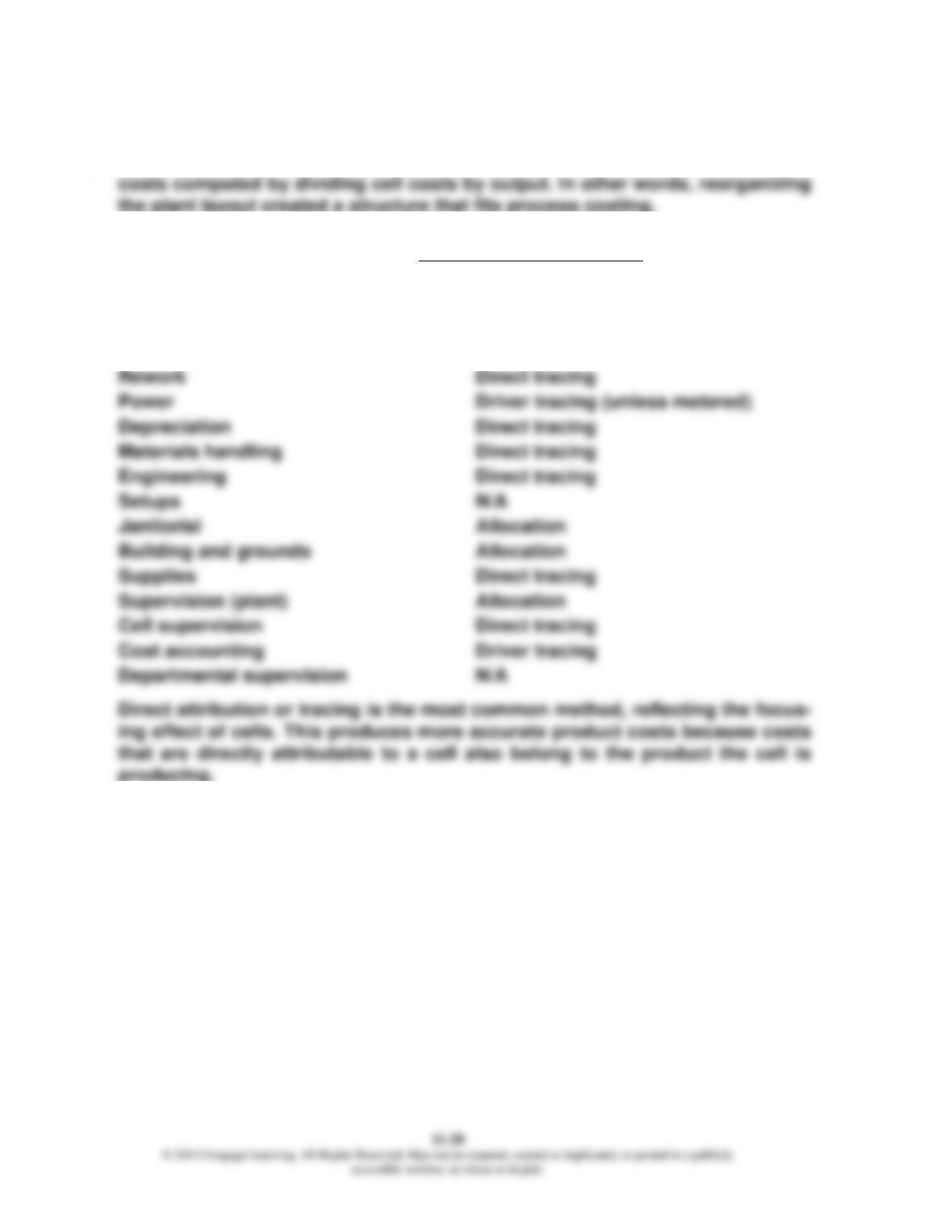
2. JIT produces a more accurate unit cost because there are more costs that are
directly attributable to the product. Under JIT, costs may decrease because of
the following reasons: (1) Costs are more easily traced to the product. Exam-
ples: The assignment of an engineer to the cell makes engineering cost di-
Problem 11.31 (Concluded)
3. The switch was made because the costs can be accumulated by cell and unit
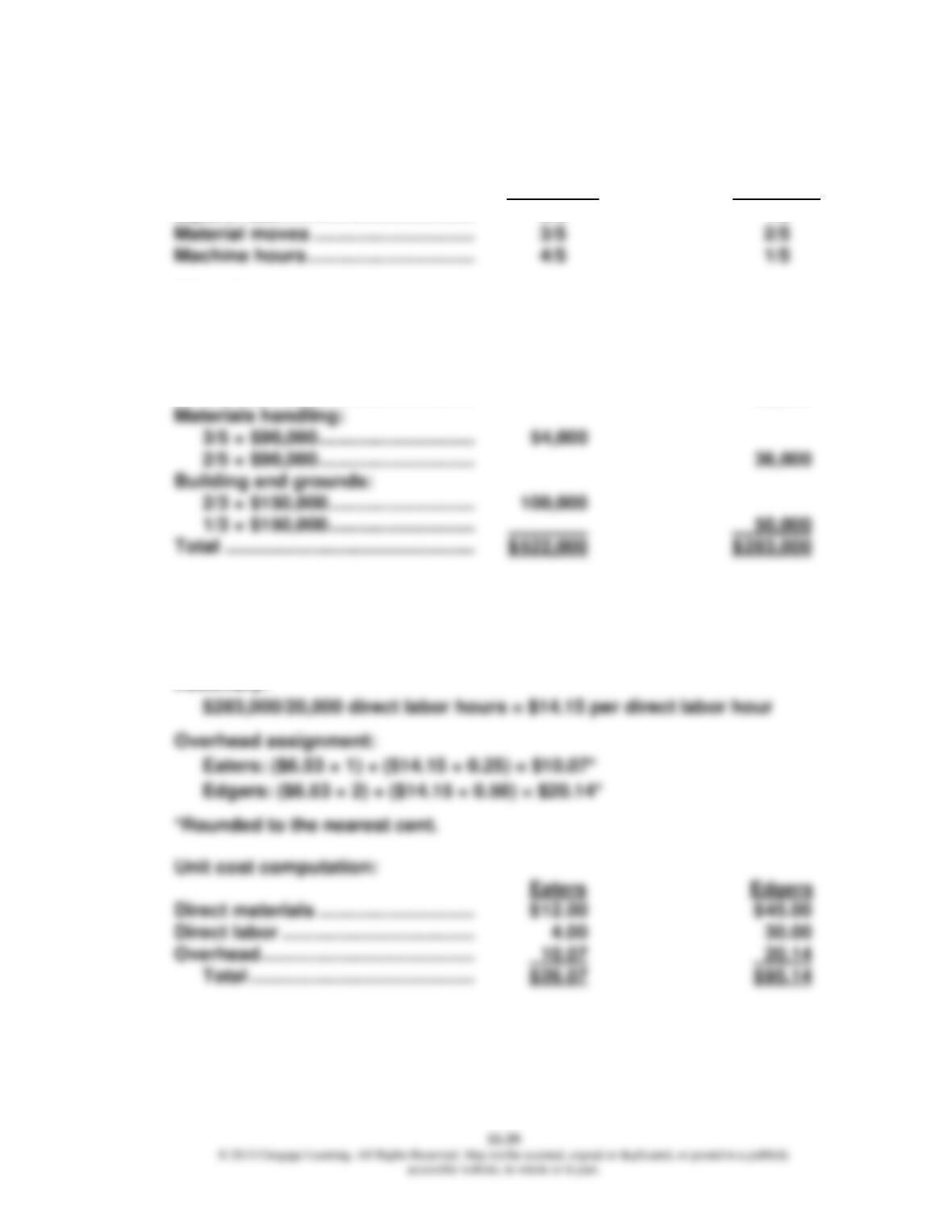
4. Cost Assignment Method
Direct materials Direct tracing
Direct labor Direct tracing
Maintenance Direct tracing
Inspection Direct tracing
Problem 11.32
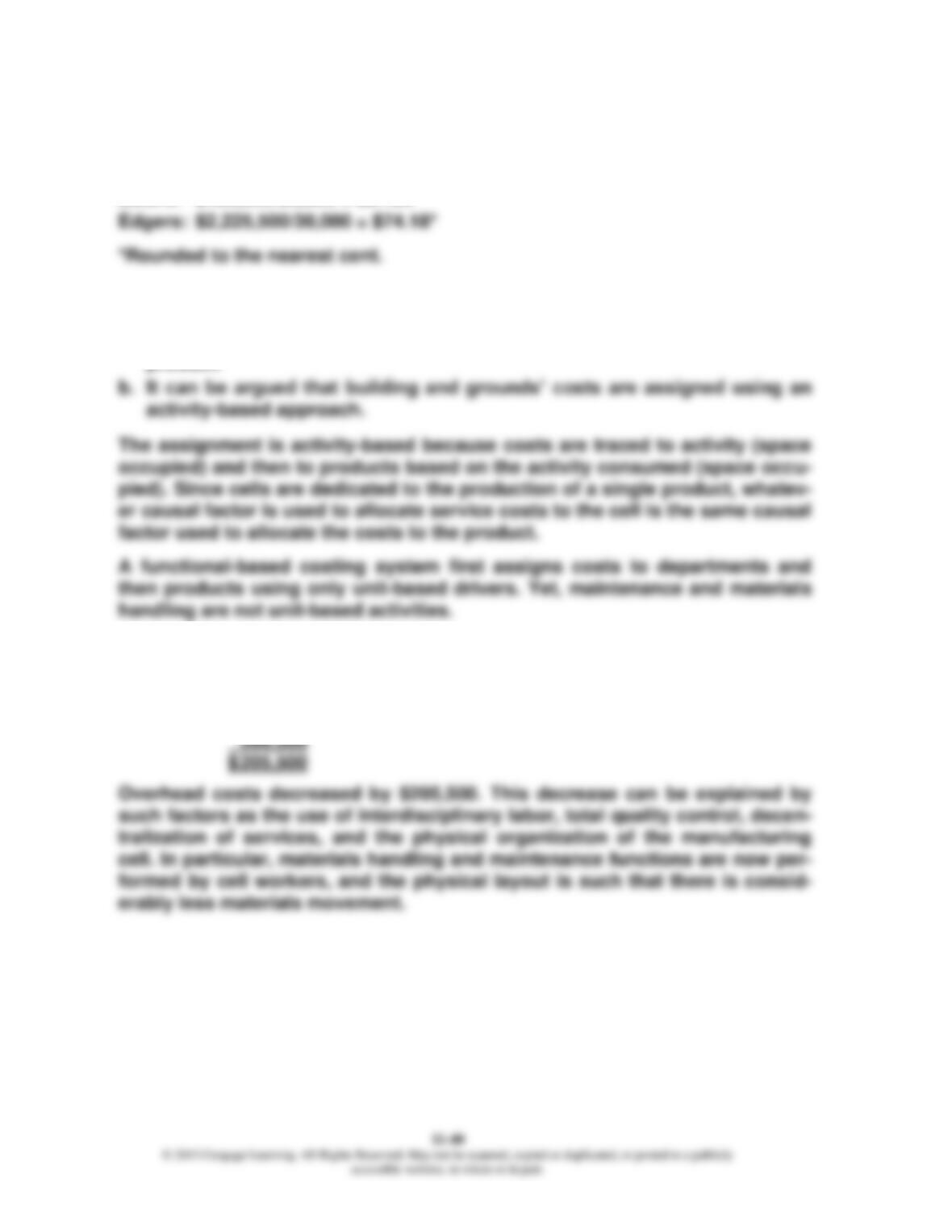
1. Allocation ratios:
Machining Assembly
Square feet ……………………………….. 2/3 1/3
Allocation:
Direct overhead costs ……………….. $ 280,000 $ 175,000
Maintenance:
4/5 × $110,000 ………………………. 88,000
1/5 × $110,000 ………………………. 22,000
Departmental rates:
Machining:
$522,000/80,000 machine hours = $6.53* per machine hour
Assembly:
Problem 11.32 (Concluded)
2. Unit cost under JIT:
Eaters: $425,000/20,000 = $21.25
3. JIT costs are more accurate because of the following reasons:
a. All costs except building and grounds are directly attributable to each
product.
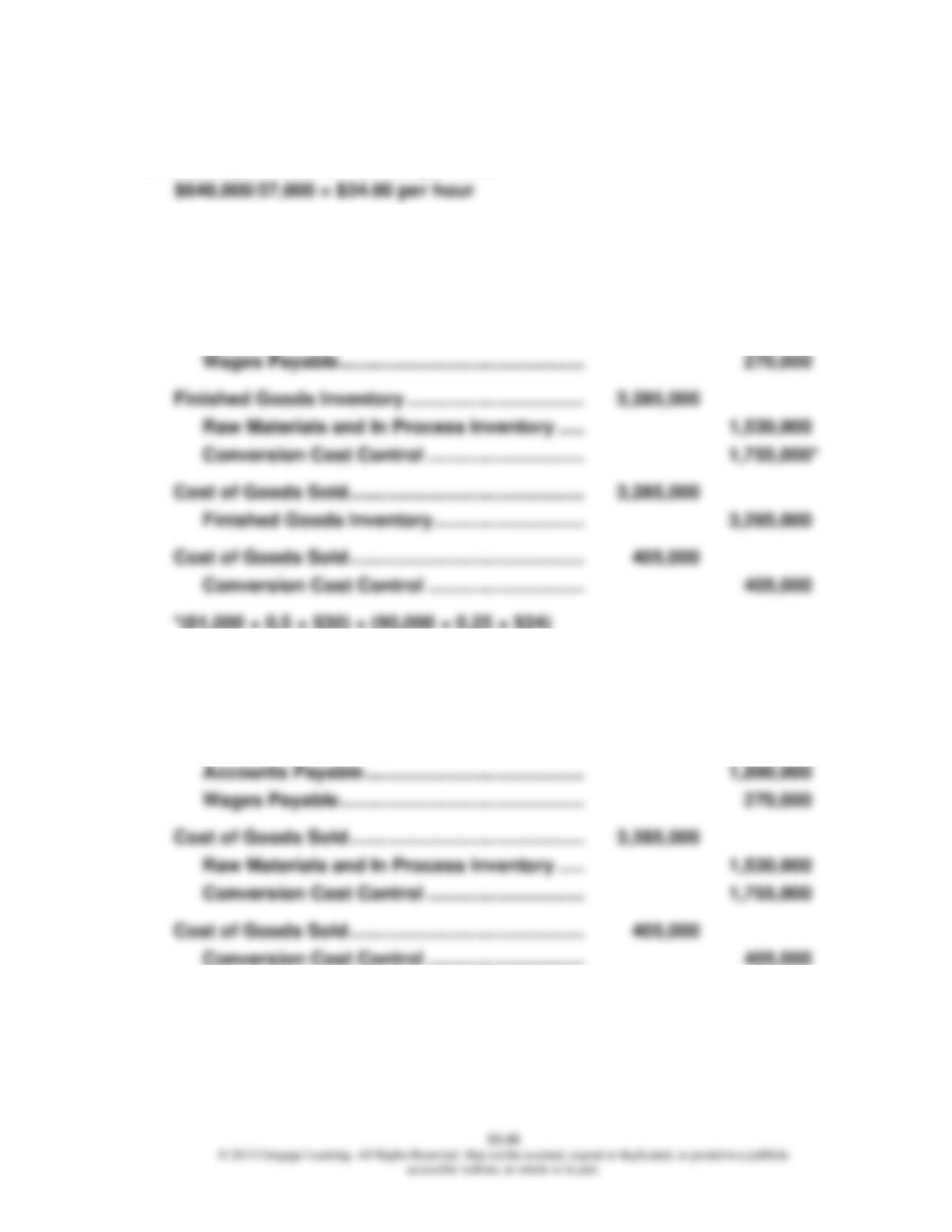
4. JIT overhead costs: $599,500 ($99,000 + $75,000 + $350,500 + $75,000)
Pre-JIT overhead costs: $805,000
Decrease: $ 805,000
Problem 11.33
1. $1,350,000/45,000 = $30.00 per hour
2. Raw Materials and In Process Inventory ……….. 1,530,000
Accounts Payable …………………………………… 1,530,000
Conversion Cost Control ……………………………… 2,160,000
Accounts Payable …………………………………… 1,890,000
3. Raw Materials and In Process Inventory ……….. 1,530,000
Accounts Payable …………………………………… 1,530,000
Conversion Cost Control ……………………………… 2,160,000
Problem 11.33 (Concluded)
4. Under JIT, there are no departments, and the lead time is very short so that it
5. If the only trigger point is when goods are sold, then the entries would be as
follows:
Conversion Cost Control …………………………..…. 2,160,000
Accounts Payable …………………………………… 1,890,000
Problem 11.34
1. The manufacturing cell should be organized with a cutter, laser, wrapping
machine, welder, and testing equipment so that one heater can be produced
from start to finish in the cell. In addition to physically grouping all of the
equipment needed for production, workers are trained to operate and main-
Problem 11.34 (Continued)
2. In a cell structure, as soon as a unit is completed, it is passed on to the next
process. Thus, for the first unit, laser must wait 10 minutes, welding must
wait 20 minutes, and testing must wait 30 minutes. After the first unit, there is
3. Structural activities: Grouping employees and selecting process technology.
Procedural activities: Using employees, providing quality, and providing plant
layout. Operational activities: Materials movement, using labor, inspecting
batches. The driver for grouping employees is the number and type of work
4. Initially, the workers felt threatened by the changes, as their sense of comfort
and routine altered. Further, some were irritated by the need for retraining.
However, once the training was completed and the cell workers gained expe-
11–44
Problem 11.34 (Concluded)
5. JIT tends to produce higher-quality products, shorter lead times, and lower,
more accurate production costs. These factors explain the ability to increase
demand. JIT adopts a philosophy of total quality control, striving for zero
defects. This requires working closely with suppliers to ensure that the materi-
6. JIT can mean that more manufacturing costs are traceable to individual
products, increasing product costing accuracy. For example, the cutting ma-
7. JIT enhances the power of management accounting models by increasing the
accuracy of the inputs to those models. For example, by increasing trace–
CYBER RESEARCH CASE
11.35
Answers will vary.
The Collaborative Learning Exercise Solutions can be found on the
graded. See the last page of each chapter for descriptions of these new assign-
ments.
• Integrative Problem—Activity Based Costing, Strategic Cost Management, Ac-
tivity Based Management (Covers chapters 4, 11 and 12)
• Integrative Problem—Balanced Scorecard, Quality and Environment Costing,