chapter
11
Current Liabilities and
Payroll
______________________________________________
OPENING COMMENTS
Chapter 11 covers a variety of obligations included in the Current Liabilities section of the balance sheet:
notes payable, payroll, employee fringe benefits, and contingent liabilities. The quick ratio is introduced
in the Financial Analysis and Interpretations portion of this chapter as a tool to analyze the level of
current liabilities held by a business.
After studying the chapter, your students should be able to:
2. Determine employer liabilities for payroll, including liabilities arising from employee earnings and
deductions from earnings.
4. Journalize entries for employee fringe benefits, including vacation pay and pensions.
6. Describe and illustrate the use of the quick ratio in analyzing a company’s ability to pay its current
liabilities.

184 Chapter 11 Current Liabilities and Payroll
STUDENT FAQS
• Why does it make a difference if liabilities are divided properly between current and long-term
liabilities? What is the current operating cycle again, and why can’t we just always use one year?
• Why is correct payroll calculation so important?
• Why can’t vacation pay and regular pay be combined?
• What has been the recent trend of the cost of product warranties on a company’s books, up or down?
• Are pension benefits going up or down at this time in the economy?
• Why do we have to record product warranty liability when only a small percentage of goods are ever
repaired or replaced?
• Can’t a company record a large product warranty liability one year in an effort to reduce income and
then not record any next year to increase income?
• How can a company record pension liabilities when it doesn’t know how much an employee will
receive or how long an employee will draw the pension? Why can’t a company record the pension as
an expense when it is paid?
• Is a defined benefit or a defined contribution plan better for an employee? for an employer?
OBJECTIVE 1
Describe and illustrate current liabilities related to accounts payable, current portion of
long-term debt, and notes payable.
SUGGESTED APPROACH — Current Liability Identification
Transparency Master (TM) 11-1 lists current liability accounts already discussed in previous chapters.
Ask your students what these accounts have in common. Hopefully, they will realize that these are all
debts that are settled within one year. You may want to add the following new accounts, which are
introduced in Chapter 11, to this list:
Product Warranty Payable
Social Security Tax Payable
Medicare Tax Payable
Employees Federal Income Tax Payable
State Unemployment Tax Payable
Federal Unemployment Tax Payable
Vacation Pay Payable
Unfunded Pension Liability
Chapter 11 Current Liabilities and Payroll 185
SUGGESTED APPROACH — Notes Payable
The entries for notes payable are parallel to the entries discussed in Chapter 9 for notes receivable.
Therefore, it is helpful to use this objective to review the entries for notes receivable and show their
relationship to notes payable.
GROUP LEARNING ACTIVITY — Short-Term Notes Payable
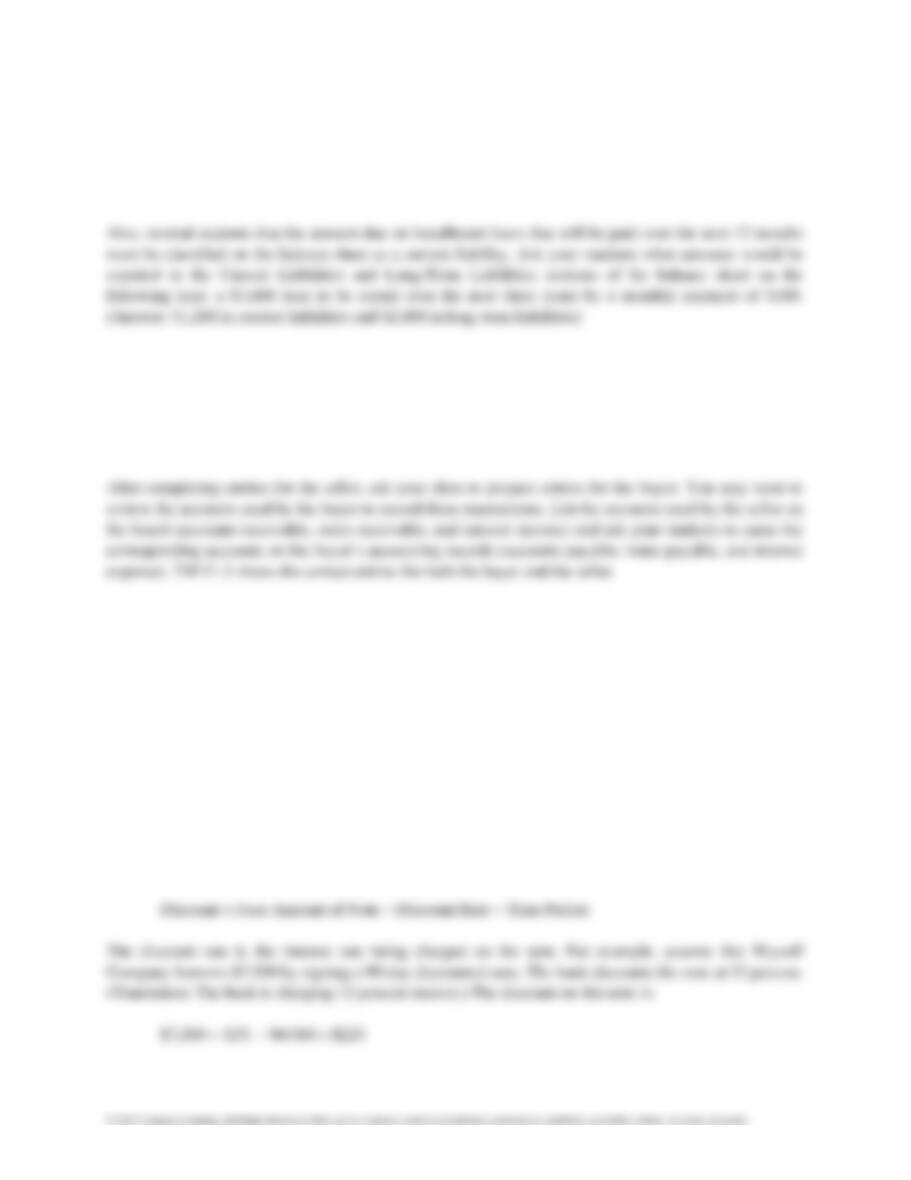
TM 11-2 presents three transactions related to a promissory note issued as a time extension on an open
account. Ask your class to record these entries on the accounting records of the seller. This will force
students to review entries for notes receivable from Chapter 9.
DEMONSTRATION PROBLEM — Discounted Notes Payable
Many of your students will be familiar with the saying, “There’s no such thing as a free lunch!” Notes
that truly have no interest charged are just as rare. For example, if a company borrows cash from a bank
by signing a discounted note, the interest is simply deducted from the cash proceeds received on the note.
At maturity, only the face value of the note is repaid. Therefore, interest is deducted up front, rather than
paid at the end. Tell students that discounted notes are also referred to as noninterest-bearing notes.
You can explain the steps to account for a discounted note as follows:
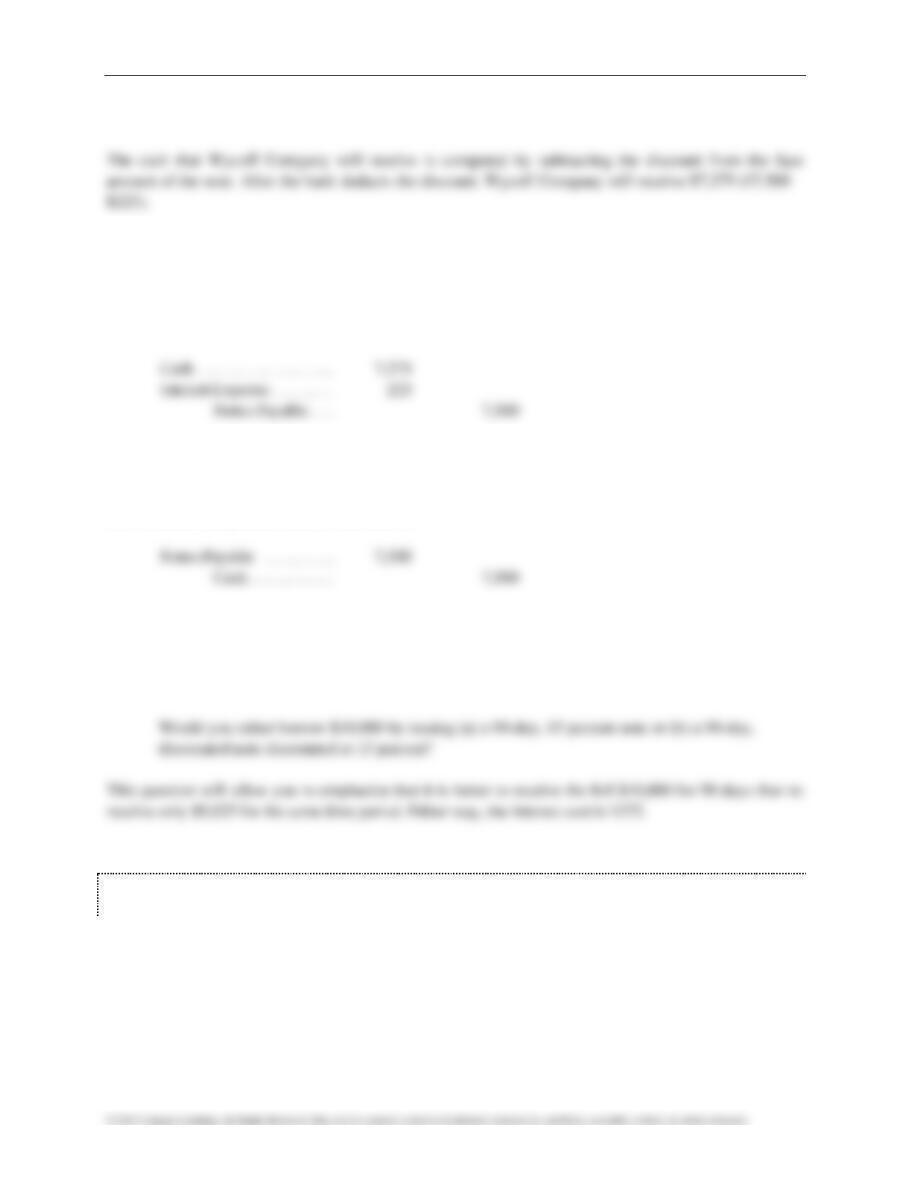
STEP 1: Calculate the Discount on the Note
The discount on a discounted note is computed using the following formula:
186 Chapter 11 Current Liabilities and Payroll
STEP 2: Calculate the Cash Proceeds Received on the Note
STEP 3: Record the Liability Resulting from the Note and the Cash Received
Wycoff must record the note payable at its full face amount, since this is the amount to be repaid in 90
days. The discount retained by the bank is recorded as Interest Expense. The journal entry for this
transaction is:
STEP 4: Record Payment When the Note Matures
Wycoff will repay the full $7,500 when the note becomes due. Since the interest on the note has already
been recorded, the journal entry at that time is:
WRITING EXERCISE — Short-Term Notes Payable
Stimulate critical thinking by asking your students to write an answer to the following question (TM 11–
4):
OBJECTIVE 2
Determine employer liabilities for payroll, including liabilities arising from employee
earnings and deductions from earnings.
KEY TERMS
FICA Tax Net Pay
Gross Pay Payroll
Chapter 11 Current Liabilities and Payroll 187
SUGGESTED APPROACH
Payroll is the largest expense for most service businesses, such as public accounting firms, law firms, and
advertising agencies. As a result of jobs they have held, many of your students will be familiar with the
calculation of gross pay and the typical payroll deductions. Therefore, it is usually effective to review
payroll information simply by asking a few questions.
LECTURE AID — Calculation of Gross Pay
The Fair Labor Standards Act specifies that all employers engaged in interstate commerce must pay their
workers one-and-a-half times the regular wage rate for all hours worked in excess of 40 per week.
Executive, administrative, and certain supervisory positions are exempt from this requirement. As a
result, some employers simply refer to a position as “exempt” or “nonexempt.” Workers in nonexempt
positions can expect to receive time-and-a-half for overtime because they are not exempt from the Fair
Labor Standards Act.
Ask students to give examples, from their experiences, of premiums paid for overtime (such as working at
night or on holidays).
CLASS DISCUSSION — Gross Pay and Deductions from Gross Pay
Begin by asking your students to define gross pay and state how it is calculated (hours worked wage
rate). Next, ask them to name items that can be deducted from an employee’s gross pay. List these items
on the board as they are named. Examples are federal and state income taxes, social security tax, union
dues, Medicare taxes, charitable contributions, medical insurance contribution, and retirement savings
plans.
Once the list is compiled, the following items will merit further explanation.
FICA — Federal Insurance Contributions Act. This represents the amount withheld for social security and
Medicare. These tax rates are set by Congress, and they change frequently. The textbook uses a social
security rate of 6 percent and a Medicare rate of 1.5 percent on all earnings. (In addition to mentioning the
rates used in the text, you may want to announce the current social security and Medicare tax rates.)
188 Chapter 11 Current Liabilities and Payroll
GROUP LEARNING ACTIVITY — Calculation of Net Pay
Ask your students to determine net pay (or take-home pay) for Blake Edwards, an employee described on
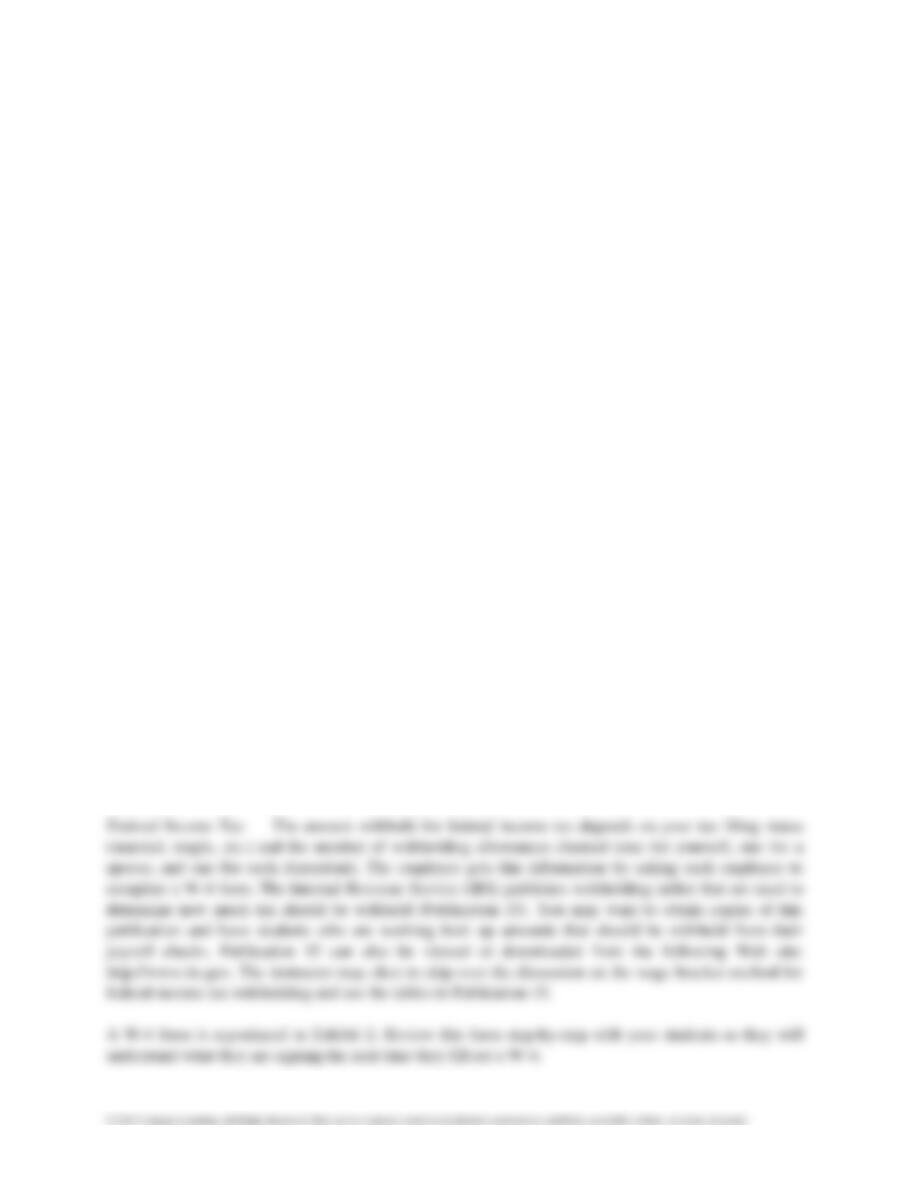
TM 11-5. They will need to use the federal income tax withholding table included in Exhibit 3 in the
textbook. See TM 11-6 for the solution.
LECTURE AID — Employer’s Payroll Taxes
Employers must pay the payroll taxes listed below. These taxes are considered an operating expense.
Employer payroll taxes are a significant expense for most businesses.
FICA Tax — The employer must match the amount paid by the employee for social security and
Medicare.
INTERNET ACTIVITY — SUTA
Have the students do a Web search to determine the state unemployment withholding for their particular
state or the state where they were born. Ask them to report on the various withholdings regulations for the
state they have chosen.
OBJECTIVE 3
Describe payroll accounting systems that use a payroll register, employee earnings records,
and a general journal.
Chapter 11 Current Liabilities and Payroll 189
KEY TERMS
Employee’s Earnings Record
Payroll Register
SUGGESTED APPROACH
Review the accounts used in the journal entries to record payroll and payroll taxes. Next, use the group
learning activity below to ask your students to complete a payroll register. They will need to follow the
example in text Exhibit 5 and the instructions on TM 11-7. Using the data from the payroll register, ask
your students to prepare payroll journal entries. The solution is provided on TM 11-8 and 11-9.
TM 11-10 presents a Form 941. Although not covered in the core text, you may want to show this TM as
an example of the many payroll-related forms that must be filed with federal and state agencies. Current
IRS publications can be found at http://www.irs.gov/formspubs/index.html. TM 11-10 is an example of
Form 941 from 2012.
This is a good time to point out that the record-keeping requirements to maintain payroll data for each pay
period and each employee can be burdensome for small businesses. Some small businesses use outside
firms to process their payroll data. Another option for small businesses is to purchase a computer
accounting package. Most of the popular accounting software packages include a payroll system.
LECTURE AID — Journal Entries for Payroll
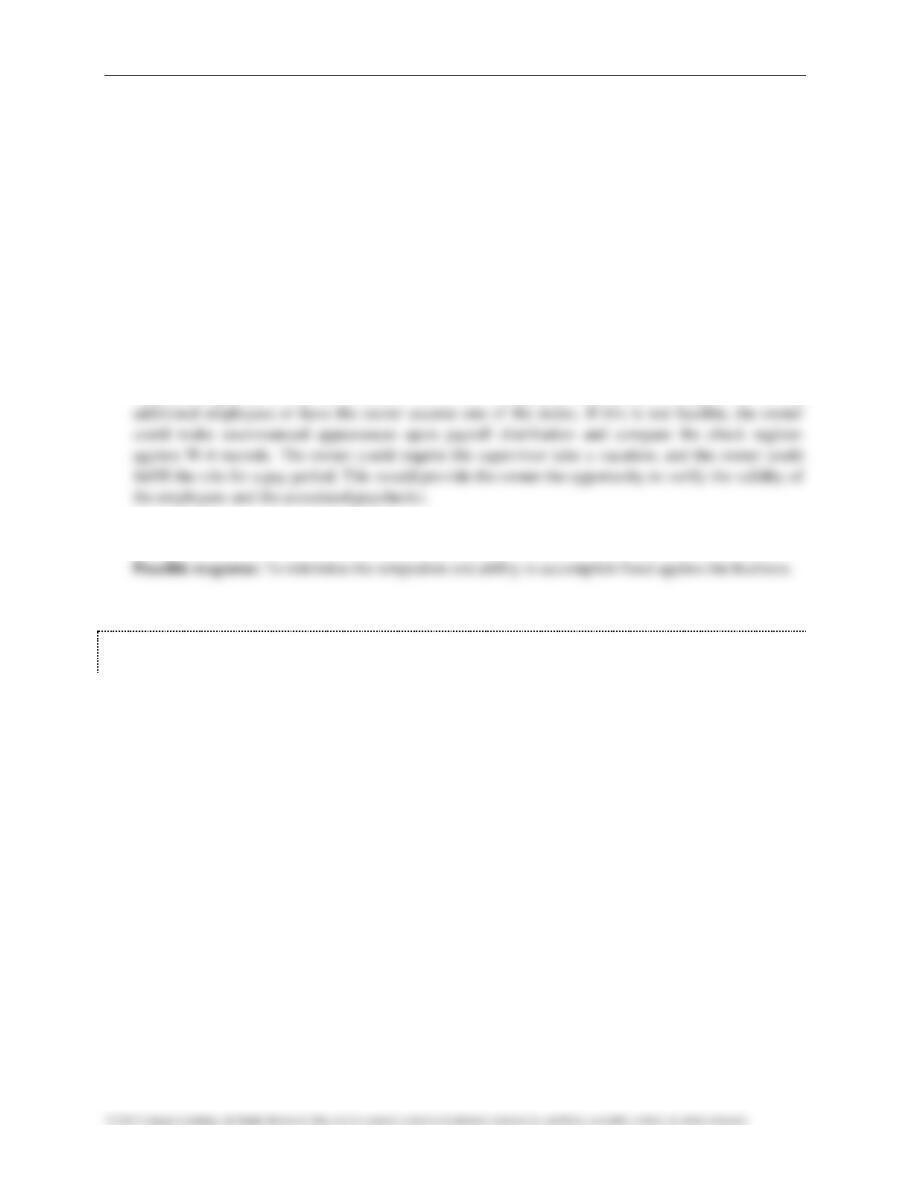
The journal entry to record employee paychecks is:
Salaries Expense (gross pay)…………………… .. XXX
Social Security Tax Payable…………….. XXX
190 Chapter 11 Current Liabilities and Payroll
CLASS DISCUSSION — Internal Controls over Payroll
Objective 3 also discusses internal controls related to payroll. TMs 11-11 and 11-12 summarize internal
controls related to payroll. To stimulate class discussion, ask your students to identify the internal control
implications of using direct deposits to pay employees through electronic funds transfers.
WRITING EXERCISE — Internal Controls over Payroll
Ask your students to write answers to one or both of the following questions (TM 11-13):
1. How might the owner of a construction company determine whether a supervisor who distributes
payroll and has authority to hire and fire employees has fictitious employees on the payroll and is
cashing the related payroll checks?
Possible response: One possible solution would be to separate the duties of the supervisor among
2. Why is it desirable to have at least two officials approve pay rate changes?
Possible response: To minimize the temptation and ability to accomplish fraud against the business.
OBJECTIVE 4
Journalize entries for employee fringe benefits, including vacation pay and pensions.
KEY TERMS
Defined Benefit Plan Fringe Benefits
Defined Contribution Plan Pension
SUGGESTED APPROACH
When covering this objective, be sure to point out the relationship between the matching concept and
accounting requirements for accruing fringe benefits.
CLASS DISCUSSION — Fringe Benefits
Begin this discussion by asking your class to name fringe benefits they are eligible for through their jobs.
After you have exhausted that list, ask students to name any fringe benefits provided to their family
members or friends.
Chapter 11 Current Liabilities and Payroll 191
LECTURE AID — Journalizing Entries for Vacation Benefits
The matching concept is the key concept directing the accounting entries for fringe benefits. This concept
dictates that the cost of providing fringe benefits must be recorded in the same accounting period as they
are earned. This may be a different accounting period from the one in which the benefit is actually paid.
For example, a company may have a vacation policy stating that an employee earns one day of vacation
for each month worked. If an employee does not take that vacation day in the month it is earned,
theoretically it should be accrued. In practice, many companies accrue earned vacation time only at the
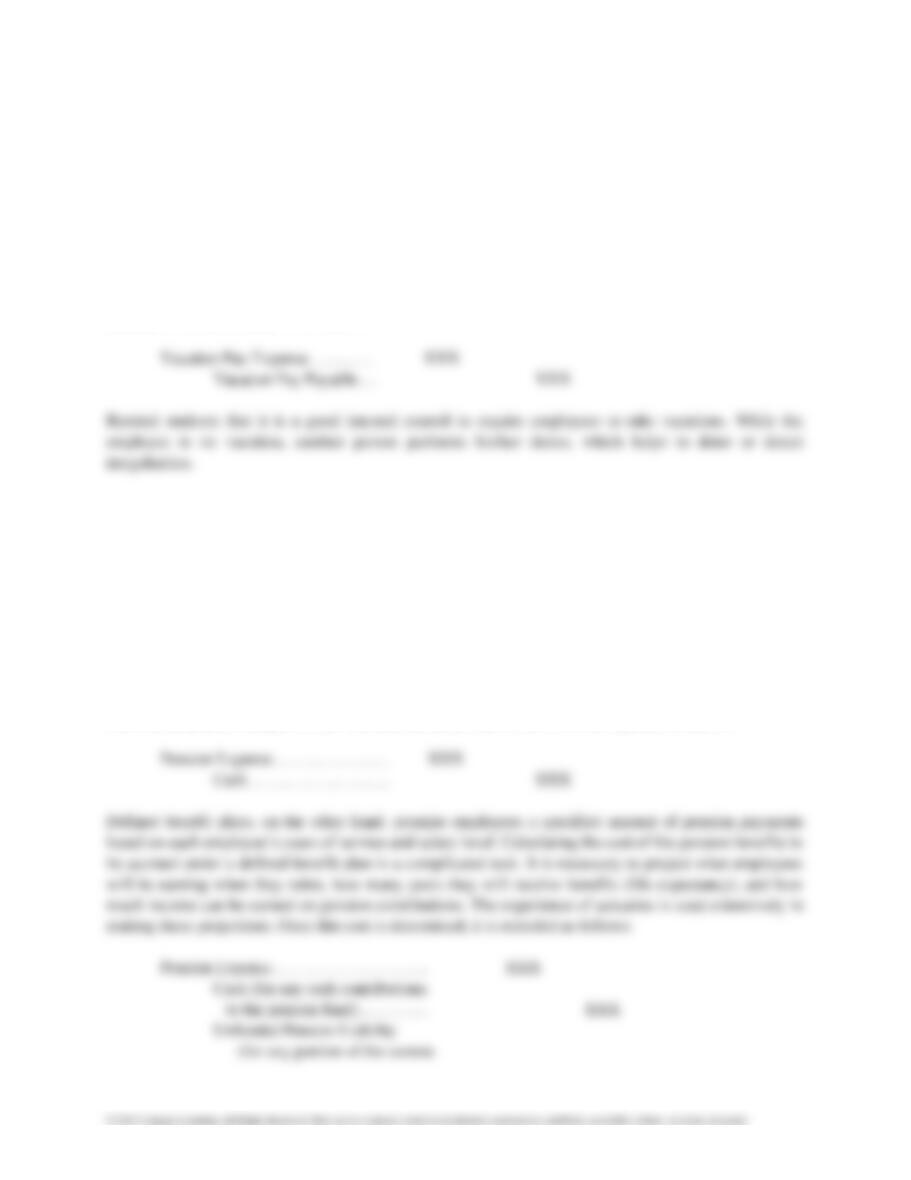
end of the year instead of monthly. The journal entry to accrue vacation pay that has been earned by
employees but not yet paid is as follows:
LECTURE AID — Journalizing Entries for Pension Benefits
Pensions are another benefit that may be earned and paid at different times. Employees earn their
pensions over the period that they work for a company. That pension is not paid until retirement. The
matching concept dictates that the cost of pension benefits that will be paid after retirement must be
accrued as they are earned.
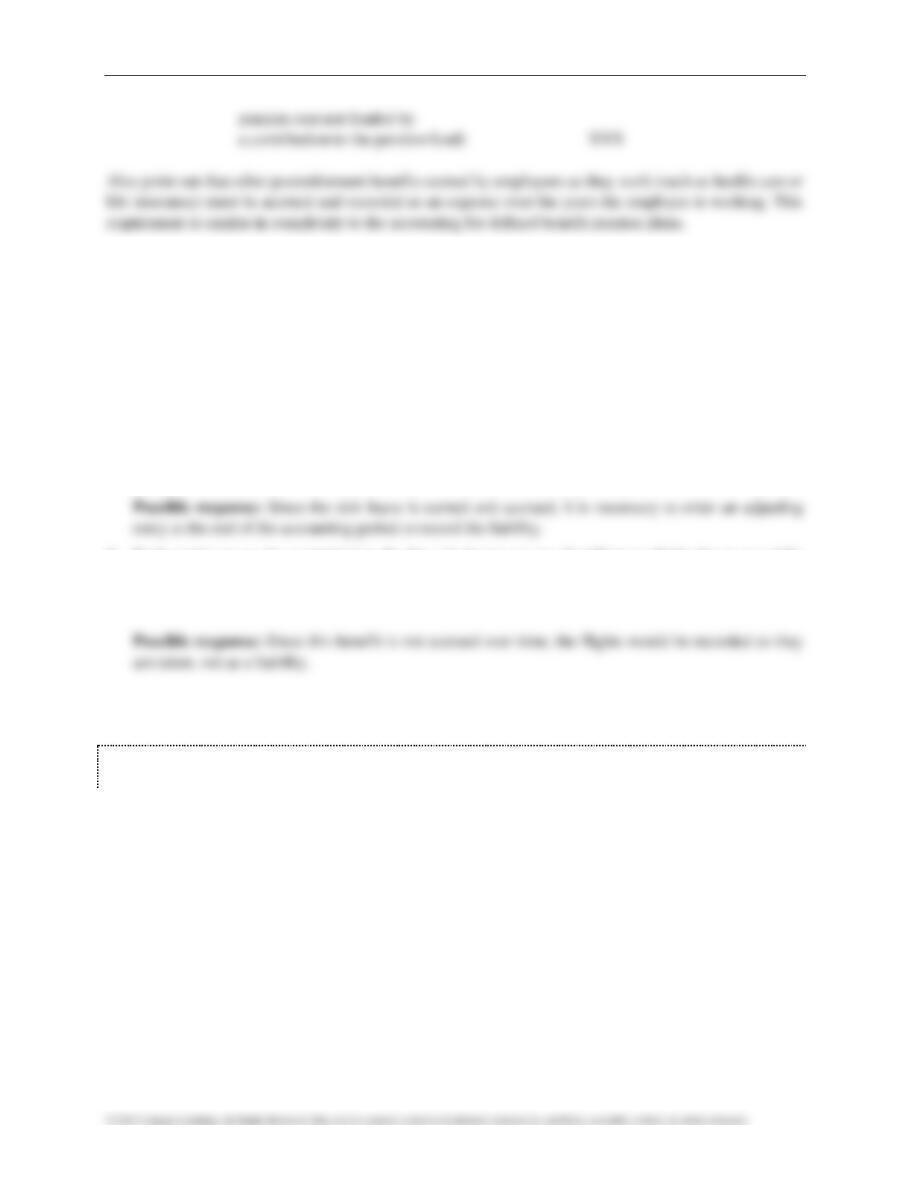
In a defined contribution plan, the employer has an obligation to make annual payments into a pension
fund. This annual payment is the extent of the employer’s liability for pensions, since these plans do not
make specific promises regarding the pension benefits a retiree will receive. The accounting for a defined
contribution plan is straightforward. The annual contribution is shown as an expense as follows:
192 Chapter 11 Current Liabilities and Payroll
WRITING EXERCISE — Fringe Benefits
Ask your students to respond to the following scenario (see TM 11-14).
ComExpress Airlines provides the following fringe benefits to its employees. For each benefit, state
whether or not an accounting entry would be needed at the end of the year to accrue the cost of the
benefit. State your justification for each answer.
1. Each employee earns two days of paid sick leave for each 160 hours he or she works for the
company.
2. Each employee is also permitted to fly free of charge on any ComExpress flight that is not fully
booked with customers. The employee may take as many flights in the course of a year as he or she
wishes.
OBJECTIVE 5
Describe the accounting treatment for contingent liabilities and journalize entries for
product warranties.
KEY TERMS
Contingent Liabilities
SUGGESTED APPROACH
Begin coverage of this objective by defining a contingent liability. A contingent liability is an obligation
that (1) resulted from a past transaction but is (2) contingent on a future event. Exhibit 8 shows that
contingent liabilities are only recorded in the accounting records if they are probable and the amount can
be estimated. Other contingent liabilities are simply disclosed in the financial statements.
Chapter 11 Current Liabilities and Payroll 193
Contingent liabilities can be effectively illustrated by looking at product warranties. As the result of a past
transaction (a sale to a customer), a future event may create a liability (the product may require warranty
repairs). A demonstration problem illustrating the accounting for warranties is included below.
You may want to stress that the matching concept also guides the accounting for warranties. The cost of
repairs made under warranties must be recorded as an expense in the same period as the sales revenue is
recognized. Since warranty repairs are often not made until months or years after the sale occurs, these
potential warranty costs must be estimated and accrued.
DEMONSTRATION PROBLEM — Warranties
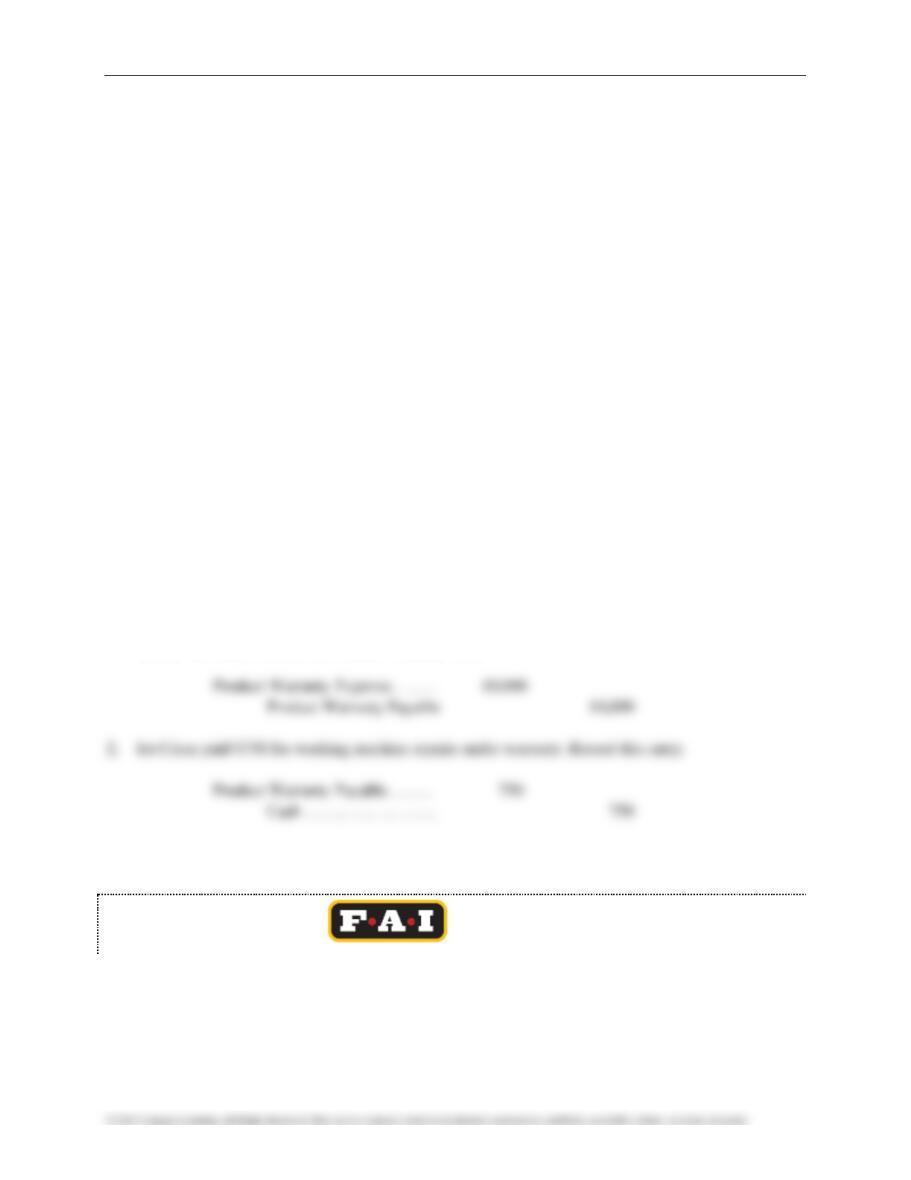
Explain that the entry to accrue warranty costs is as follows:
Product Warranty Expense…………… XXX
Product Warranty Payable……. XXX
Read the following problem to your class. Ask your students to record in their notes the entry to accrue
warranty costs. This should be a relatively simple task if you have just reviewed the accounts involved in
this entry. Next, ask your students to record the entry to pay warranty costs.
Jet-Clean sold washing machines totaling $1 million. Each washing machine carries a three-year
warranty. Jet-Clean estimates that warranty repairs on the washing machines will cost 1 percent of the
sales price.
1. Record the entry to accrue Jet-Clean’s warranty costs.
OBJECTIVE 6
Describe and illustrate the use of the quick ratio in analyzing a company’s ability to pay its
current liabilities.
194 Chapter 11 Current Liabilities and Payroll
KEY TERMS
Current Position Analysis Quick Assets
Quick Ratio
SUGGESTED APPROACH
This chapter introduces the quick ratio, sometimes called the acid-test ratio.
DIFFICULTY
BUSPROG
AICPA AICPA ACBSP ACBSP ACBSP ACBSP BLOOM’S TIME
Problem
Learning
Objective
Description Primary
Broad
Business
Functional Primary Secondary Teritary Quaternary
Spread-
sheet
GL
DQ11-1 11-1 Easy Analytic Measurement Current Liabilities Knowledge 5 min.
DQ11-2 11-1 Easy Analytic Measurement Payroll/Other Compensation Knowledge 5 min.
DQ11-3 11-2 Easy Analytic Measurement Payroll/Other Compensation Knowledge 5 min.
DQ11-4 11-2 Easy Analytic Measurement Payroll/Other Compensation Knowledge 5 min.
DQ11-5 11-3 Easy Analytic Measurement Payroll/Other Compensation Knowledge 5 min.
DQ11-6 11-3 Easy Analytic Measurement Payroll/Other Compensation Knowledge 5 min.
DQ11-7 11-4 Easy Analytic Measurement Payroll/Other Compensation Knowledge 5 min.
DQ11-8 11-4 Easy Analytic Measurement Payroll/Other Compensation Knowledge 5 min.
DQ11-9 11-5 Easy Analytic Measurement Current Liabilities Knowledge 5 min.
DQ11-10 11-5 Easy Analytic Measurement Current Liabilities Knowledge 5 min.
PE11-1A 11-1 Proceeds from notes payable Easy Analytic Measurement Current Liabilities Application 5 min.
PE11-1B 11-1 Proceeds from notes payable Easy Analytic Measurement Current Liabilities Application 5 min.
PE11-2A 11-2 Federal income tax withholding Easy Analytic Measurement Payroll/Other Compensation Application 5 min.
PE11-2B 11-2 Federal income tax withholding Easy Analytic Measurement Payroll/Other Compensation Application 5 min.
PE11-3A 11-2 Employee net pay Easy Analytic Measurement Payroll/Other Compensation Application 5 min.
PE11-3B 11-2 Employee net pay Easy Analytic Measurement Payroll/Other Compensation Application 5 min.
PE11-4A 11-3 Journalize period payroll Easy Analytic Measurement Payroll/Other Compensation Application 5 min.
PE11-4B 11-3 Journalize period payroll Easy Analytic Measurement Payroll/Other Compensation Application 5 min.
PE11-5A 11-3 Journalize tax payroll Easy Analytic Measurement Payroll/Other Compensation Application 5 min.
PE11-5B 11-3 Journalize tax payroll Easy Analytic Measurement Payroll/Other Compensation Application 5 min.
PE11-6A 11-4 Vacation pay and pension benefits Easy Analytic Measurement Payroll/Other Compensation Application 5 min.
PE11-6B 11-4 Vacation pay and pension benefits Easy Analytic Measurement Payroll/Other Compensation Application 5 min.
PE11-7A 11-5 Estimated warranty liability Easy Analytic Measurement Current Liabilities Application 10 min.
PE11-7B 11-5 Estimated warranty liability Easy Analytic Measurement Current Liabilities Application 10 min.
PE11-8A 11-6 Quick ratio Easy Analytic Measurement
Financial Statement
Analysis Application 10 min.
PE11-8B 11-6 Quick ratio Easy Analytic Measurement
Ex11-1 11-1 Current liabilities Easy Analytic Measurement Current Liabilities Application 10 min.
Ex11-2 11-1
Entries for discounting notes
payable
Easy Analytic Measurement Current Liabilities Application 15 min.
Ex11-3 11-1 Evaluate alternative notes Moderate Analytic Measurement Current Liabilities Application 15 min.
Ex11-4 11-1 Entries for notes payable Easy Analytic Measurement Current Liabilities Application 10 min.
Ex11-5 11-1 Entries for discounted note payable Easy Analytic Measurement Current Liabilities Application 10 min.
Ex11-6 11-1 Fixed asset purchases with note Moderate Analytic Measurement Current Liabilities Application 15 min.
Ex11-7 11-1 Current portion of long-term debt Easy Analytic Measurement Current Liabilities Application 10 min.
Ex11-8 11-2 Calculate payroll Easy Analytic Measurement Payroll/Other Compensation Application 10 min.
Ex11-9 11-2 Calculate payroll Moderate Analytic Measurement Payroll/Other Compensation Application 15 min.
Ex11-10 11-2, 11-3 Summary payroll data Moderate Analytic Measurement Payroll/Other Compensation Application 15 min.
Ex11-11 11-3 Payroll tax entries Easy Analytic Measurement Payroll/Other Compensation Application 10 min.
Ex11-12 11-3 Payroll entries Easy Analytic Measurement Payroll/Other Compensation Application 10 min.
Ex11-13 11-3 Payroll entries Easy Analytic Measurement Payroll/Other Compensation Application 10 min.
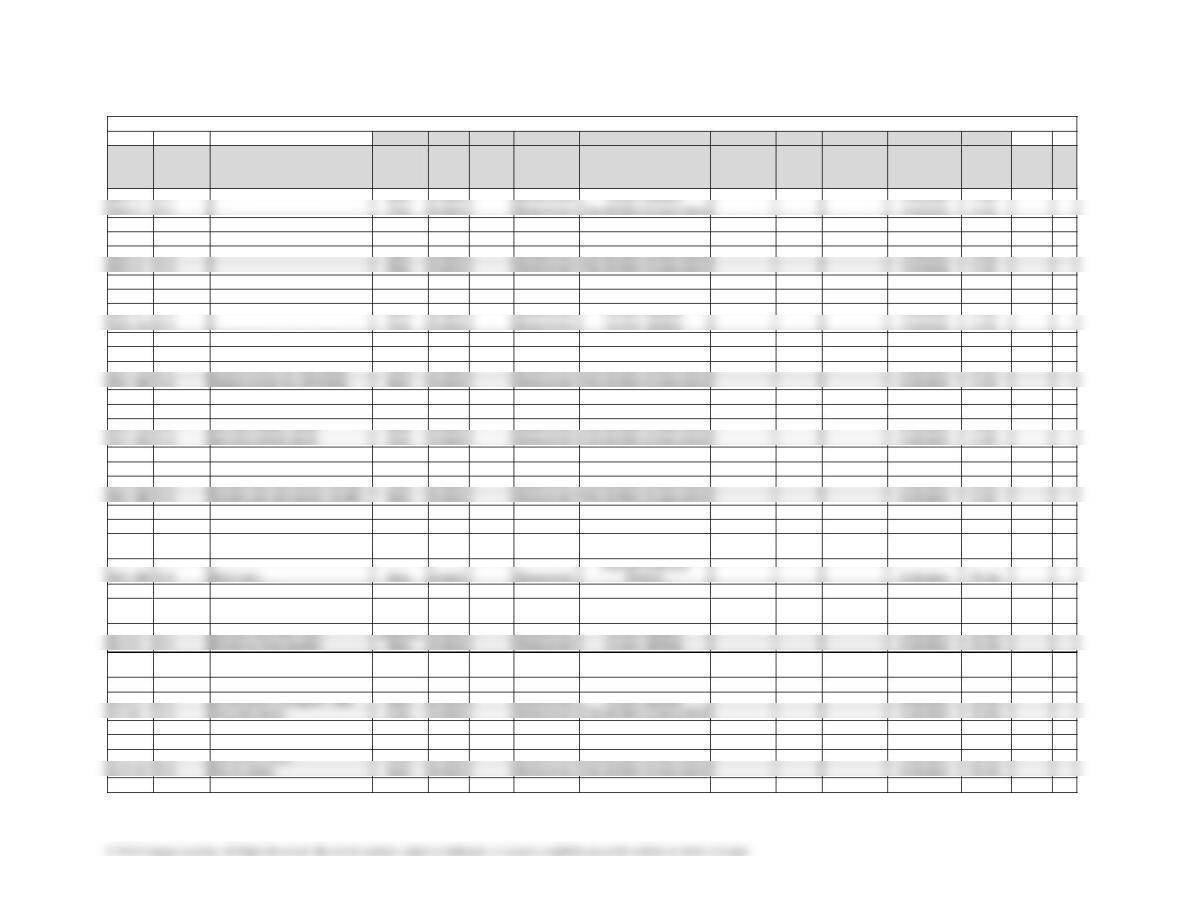
HOMEWORK CHART WITH LEARNING OUTCOMES TAGGING
DIFFICULTY
BUSPROG
AICPA AICPA ACBSP ACBSP ACBSP ACBSP BLOOM’S TIME
Problem
Learning
Objective
Description Primary
Broad
Business
Functional Primary Secondary Teritary Quaternary
Spread–
sheet
GL
Ex11-14 11-3 Payroll internal control procedures Easy Analytic Measurement Payroll/Other Compensation Comprehension 10 min.
Ex11-15 11-3 Internal control procedures Moderate Analytic Measurement Payroll/Other Compensation Application 15 min.
Ex11-16 11-4 Accrued vacation pay Easy Analytic Measurement Payroll/Other Compensation Application 5 min.
Ex11-17 11-4 Pension plan entries Easy Analytic Measurement Payroll/Other Compensation Application 10 min.
Ex11-18 11-4 Defined benefit pension plan terms Easy Analytic Measurement Payroll/Other Compensation Application 5 min.
Ex11-19 11-5 Accrued product warranty Easy Analytic Measurement Current Liabilities Application 10 min.
Ex11-20 11-5 Accrued product warranty Easy Analytic Measurement Current Liabilities Application 5 min.
Ex11-21 11-5 Contingent liabilities Moderate Analytic Measurement Current Liabilities Application 15 min.
Ex11-22 11-6 Quick ratio Easy Analytic Measurement
Financial Statement
Analysis Application 10 min.
Ex11-23 11-6 Quick ratio Easy Analytic Measurement
Analysis Application 10 min.
Pr11-1A 11-1, 11-5 Liability transactions Moderate Analytic Measurement Current Liabilities Application 45 min. X
Pr11-2A 11-2, 11-3 Entries for payroll and payroll taxes Moderate Analytic Measurement Payroll/Other Compensation Application 1 hour X
Pr11-3A 11-2, 11-3
employer FICA tax
Challenging Analytic Measurement Payroll/Other Compensation Application 1.5 hours X
Pr11-4A 11-2, 11-3 Payroll register Moderate Analytic Measurement Payroll/Other Compensation Application 1 hour X
Payroll accounts and year-end
Wage and tax statement data and
Pr11-5A 11-2, 11-3
entries
Challenging Analytic Measurement Payroll/Other Compensation Application 1.5 hours X
Pr11-1B 11-1, 11-5 Liability transactions Moderate Analytic Measurement Current Liabilities Application 45 min. X
Pr11-2B 11-2, 11-3 Entries for payroll and payroll taxes Moderate Analytic Measurement Payroll/Other Compensation Application 1 hour X
Pr11-3B 11-2, 11-3
Wage and tax statement data and
employer FICA tax
Challenging Analytic Measurement Payroll/Other Compensation Application 1.5 hours x
Pr11-4B 11-2, 11-3 Payroll register Moderate Analytic Measurement Payroll/Other Compensation Application 1 hour X
Pr11-5B 11-2, 11-3
Payroll accounts and year-end
entries
Challenging Analytic Measurement Payroll/Other Compensation Application 1.5 hours X
3
11-5
adjusting entries, balance sheet
Reconciliation
Cp11-1 11-3 Ethics and professional conduct Easy Ethics Industry Payroll/Other Compensation Analysis 3 hours
Problem
11-3, 11-4,
Journal entries, bank reconciliation,
Bank
Adjusting
Compensatio
Cp11-2 11-4 Recognizing pension expense Easy Analytic Measurement Payroll/Other Compensation Comprehension 15 min.
Cp11-3 11-2 Ethics and professional conduct Easy Ethics Industry Payroll/Other Compensation Comprehension 15 min.
Cp11-4 11-3 Payroll forms Moderate Analytic Measurement Payroll/Other Compensation Comprehension 15 min.