Exercise 11-11 (20 minutes)
1.
(b)
(c)
Net
Average
(a)
Operating
Operating
ROI
Sales
Income*
Assets
(b) ÷ (c)
$2,500,000
$475,000
$1,000,000
47.5%
$2,600,000
$500,000
$1,000,000
50.0%
$2,700,000
$525,000
$1,000,000
52.5%
$2,800,000
$550,000
$1,000,000
55.0%
$2,900,000
$575,000
$1,000,000
57.5%
$3,000,000
$600,000
$1,000,000
60.0%
2. The ROI increases by 2.5% for each $100,000 increase in sales. This
happens because each $100,000 increase in sales brings in an additional
profit of $25,000. When this additional profit is divided by the average
operating assets of $1,000,000, the result is an increase in the
company’s ROI of 2.5%.
Increase in sales ……………………………………………
Contribution margin ratio …………………………………
(b)
$25,000
Average operating assets…………………………………
(d)
Increase in return on investment (c) ÷ (d) ………….
Exercise 11-12 (30 minutes)
1.
Net operating income
Margin = Sales
$70,000
= = 5%
$1,400,000
2.
Net operating income
Margin = Sales
$70,000 + $18,200
=
$1,400,000 + $70,000
$88,200
= = 6%
$1,470,000
Exercise 11-12 (continued)
3.
Net operating income
Margin = Sales
$70,000 + $14,000
=
$1,400,000
$84,000
= = 6%
$1,400,000
4.
Net operating income
Margin =
Sales
$70,000
= = 5%
$1,400,000
Exercise 11-13 (20 minutes)
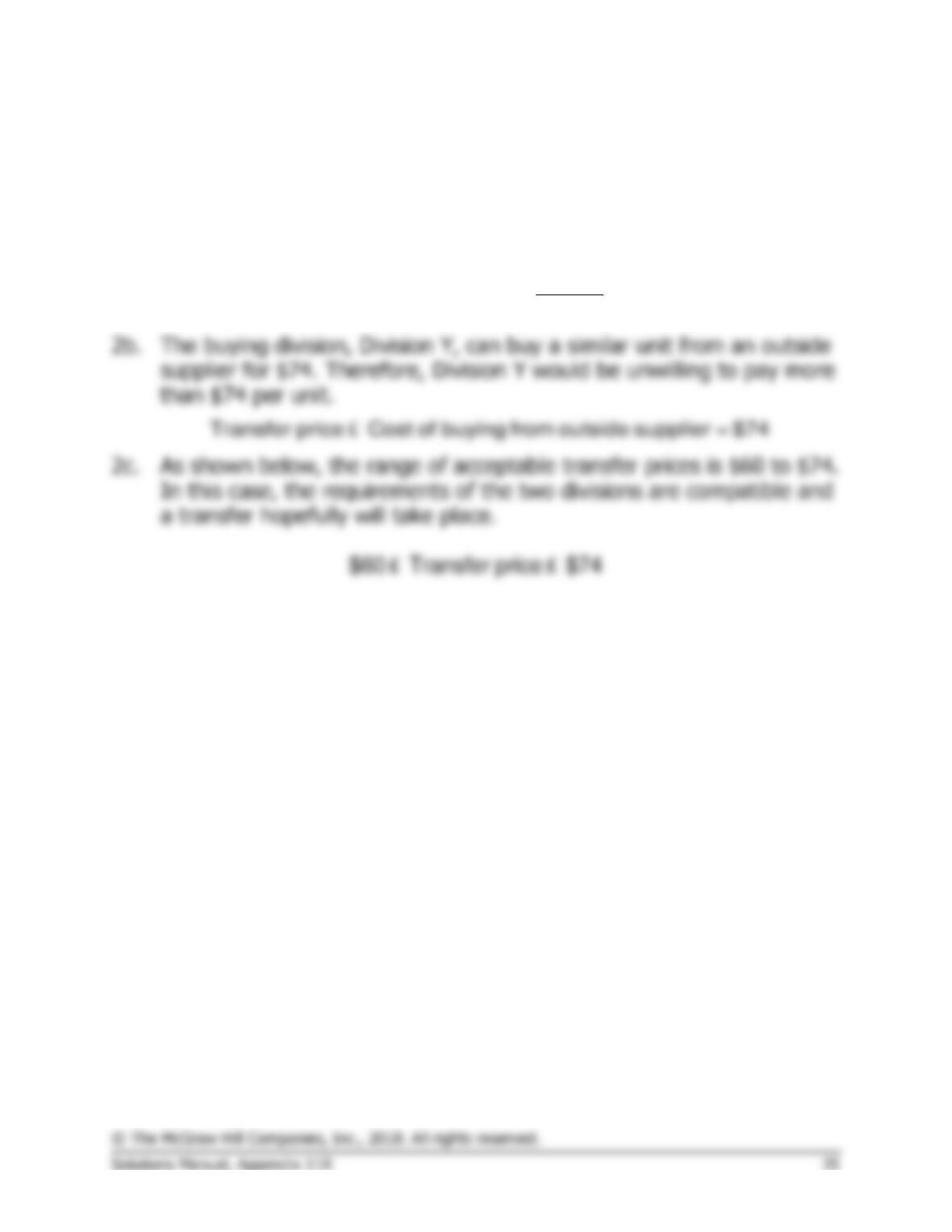
1a. The lowest acceptable transfer price from the perspective of the selling
division is given by the following formula:
Total contribution margin
Exercise 11-13 (continued)
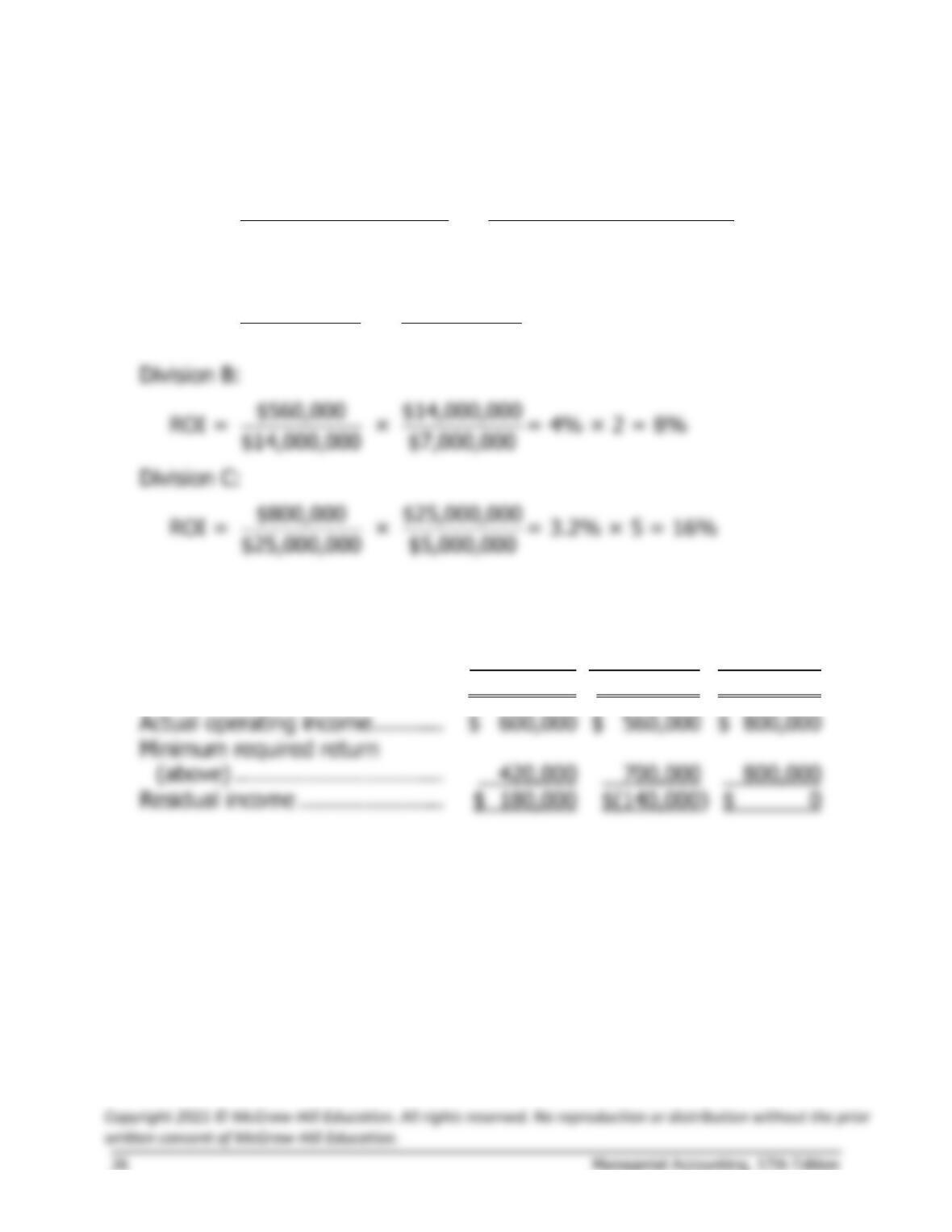
2a. In this case, Division X has enough idle capacity to satisfy Division Y’s
demand. Therefore, there are no lost sales and the lowest acceptable
price as far as the selling division is concerned is the variable cost of
$60 per unit.
³$0
Transfer price $60 + = $60
40,000
Exercise 11-14 (30 minutes)
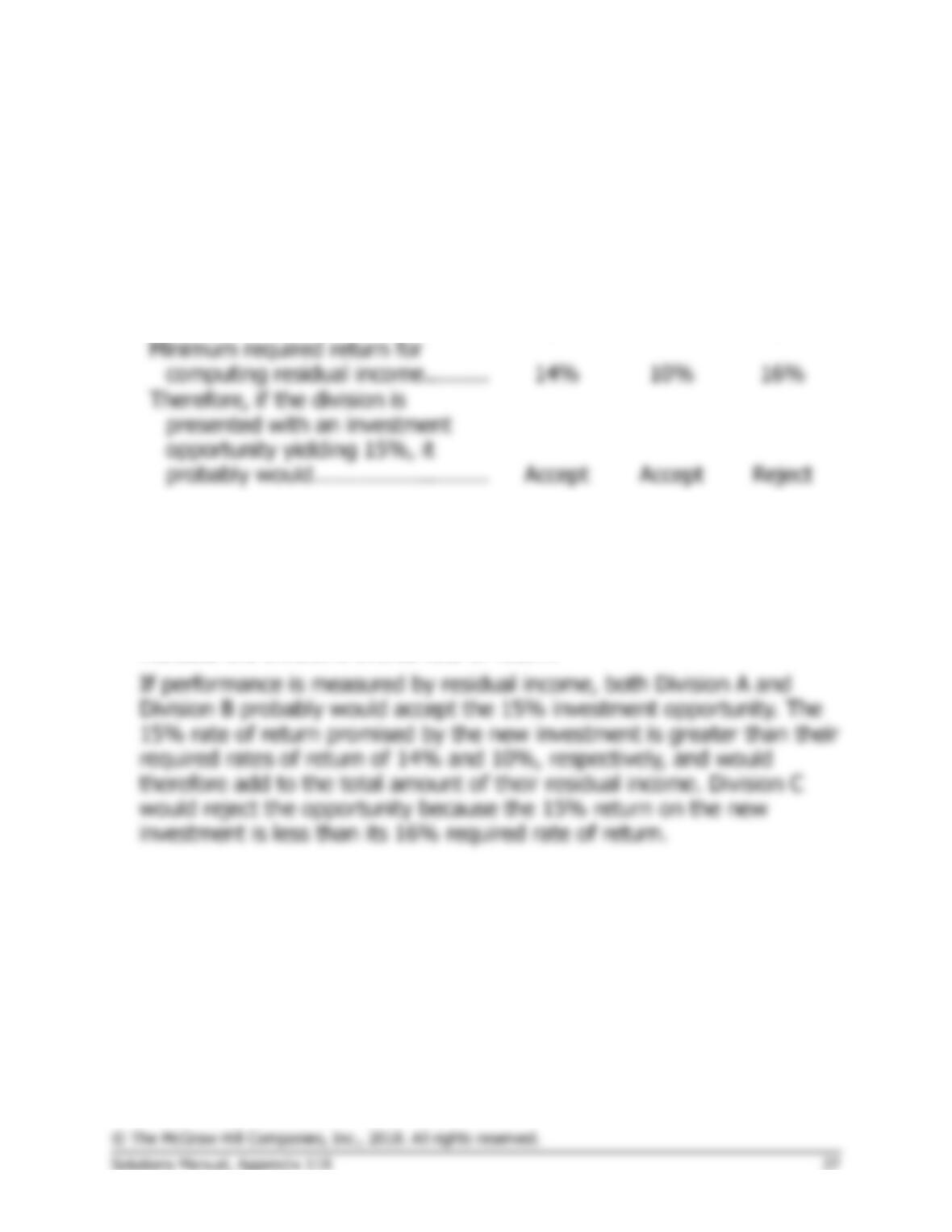
1. ROI computations:
Net operating income Sales
ROI = ×
Sales Average operating assets
Division A:
$600,000 $12,000,000
ROI = × = 5% × 4 = 20%
$12,000,000 $3,000,000
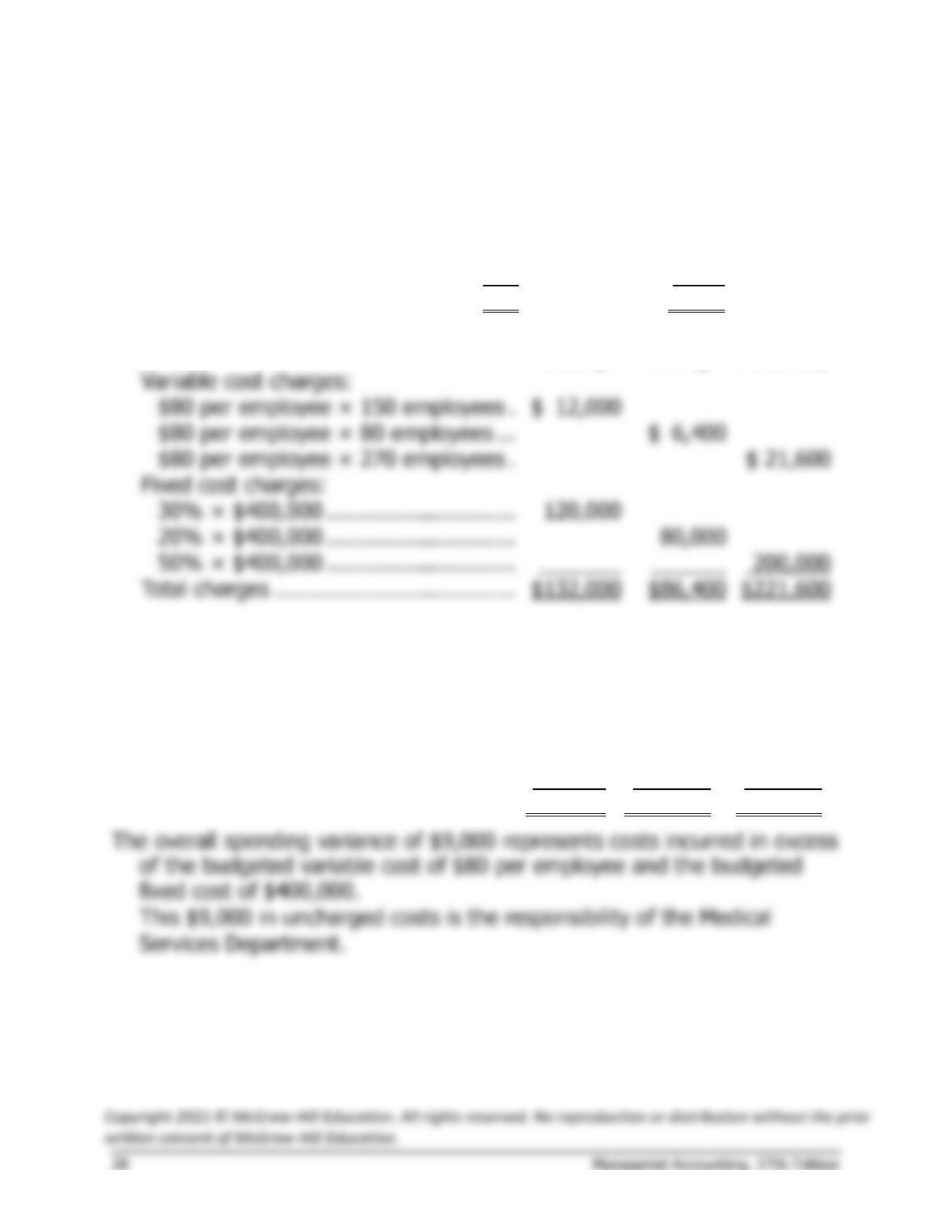
2.
Division A
Division B
Division C
Average operating assets ………
$3,000,000
$7,000,000
$5,000,000
Required rate of return …………
× 14%
× 10%
× 16%
Minimum required return ………
$ 420,000
$ 700,000
$ 800,000
Actual operating income ………..
$ 600,000
$ 800,000
Residual income ………………….
Exercise 11-14 (continued)
3. a. and b.
Division A
Division B
Division C
Return on investment (ROI) ………..
20%
8%
16%
Therefore, if the division is
presented with an investment
opportunity yielding 15%, it
probably would………………………
Reject
Accept
Reject
If performance is being measured by ROI, both Division A and Division C
probably would reject the 15% investment opportunity. These divisions’
ROIs currently exceed 15%; accepting a new investment with a 15%
rate of return would reduce their overall ROIs. Division B probably would
accept the 15% investment opportunity because accepting it would
increase the division’s overall rate of return.
Exercise 11-15 (20 minutes)
1.
Long-Run Average
Number of Employees
Percentage
Cutting Department …….
180
30%
Milling Department ……..
120
20%
Assembly Department ….
300
50%
Total ………………………..
600
100%
Cutting
Milling
Assembly
$ 6,400
Fixed cost charges:
120,000
Total charges ……………………………….
$86,400
2. Part of the total actual cost should not be charged to the operating
departments as shown below:
Variable
Cost
Fixed
Cost
Total
Total actual costs incurred …………..
$41,000
$408,000
$449,000
Total charges …………………………...
40,000
400,000
440,000
Spending variance ……………………..
$ 1,000
$ 8,000
$ 9,000
Exercise 11-16 (15 minutes)
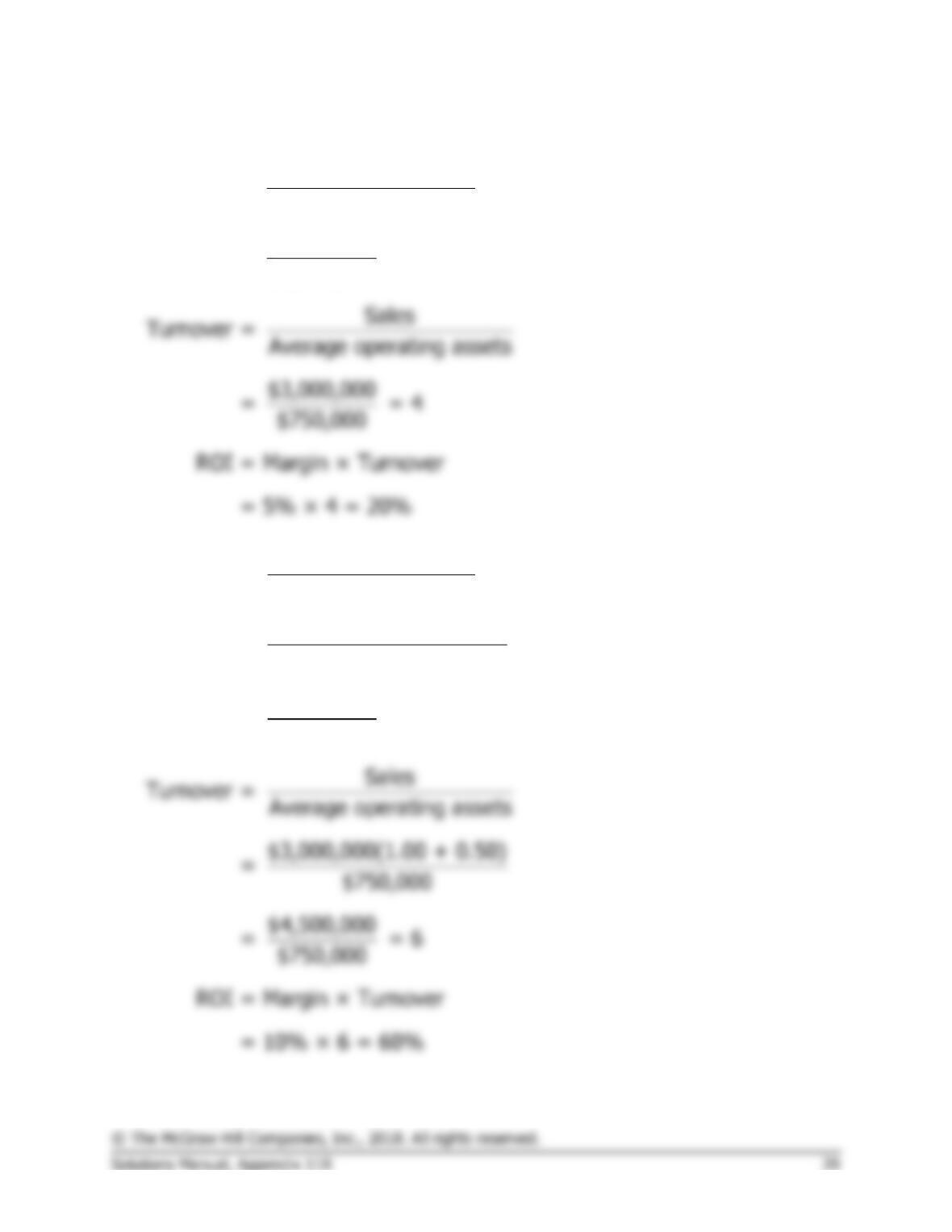
1.
Net operating income
Margin = Sales
$150,000
= = 5%
$3,000,000
2.
Net operating income
Margin = Sales
$150,000(1.00 + 2.00)
=
$3,000,000(1.00 + 0.50)
$450,000
= = 10%
$4,500,000
Exercise 11-16 (continued)
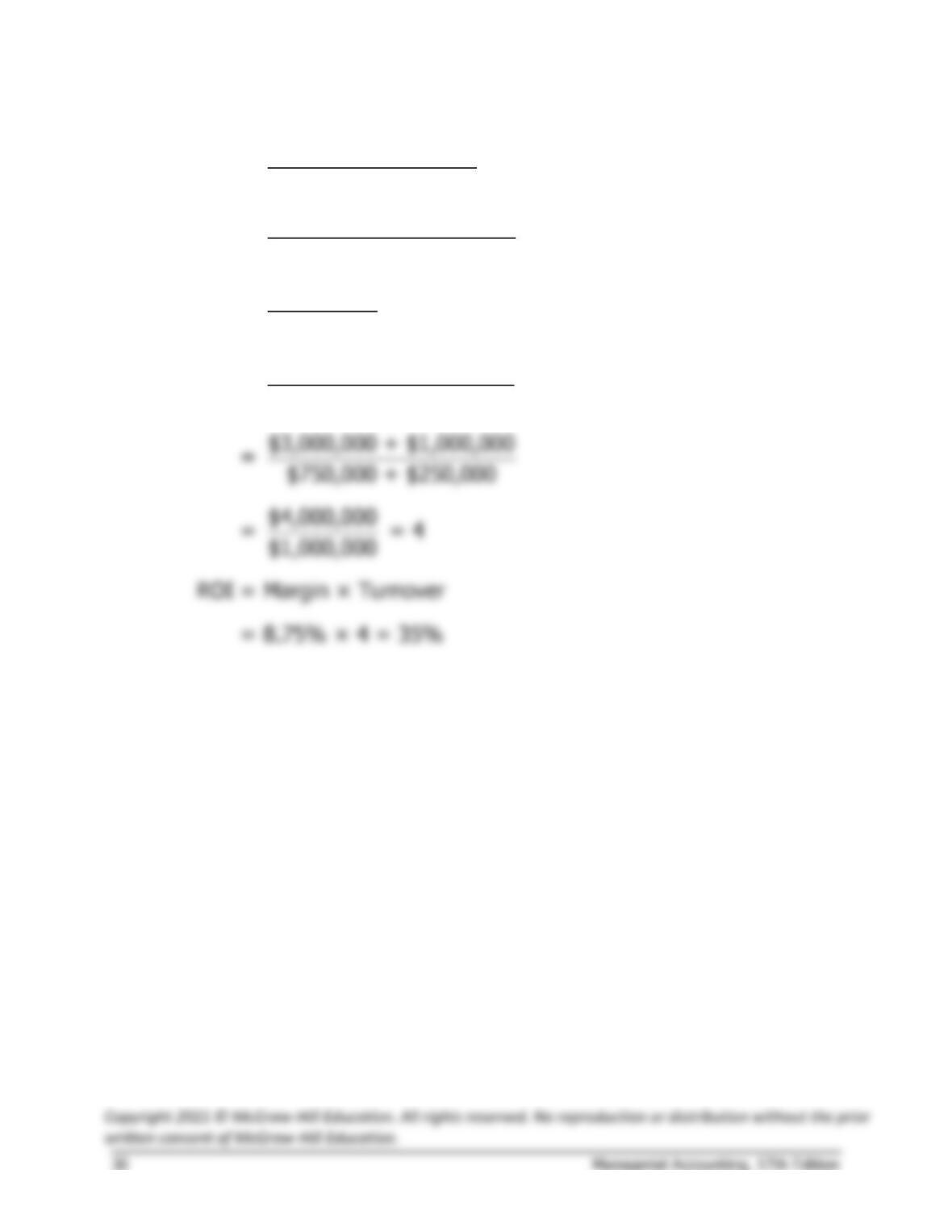
3.
Net operating income
Margin = Sales
$150,000 + $200,000
=
$3,000,000 + $1,000,000
$350,000
= = 8.75%
$4,000,000
Sales
Turnover = Average operating assets
Problem 11-17 (20 minutes)
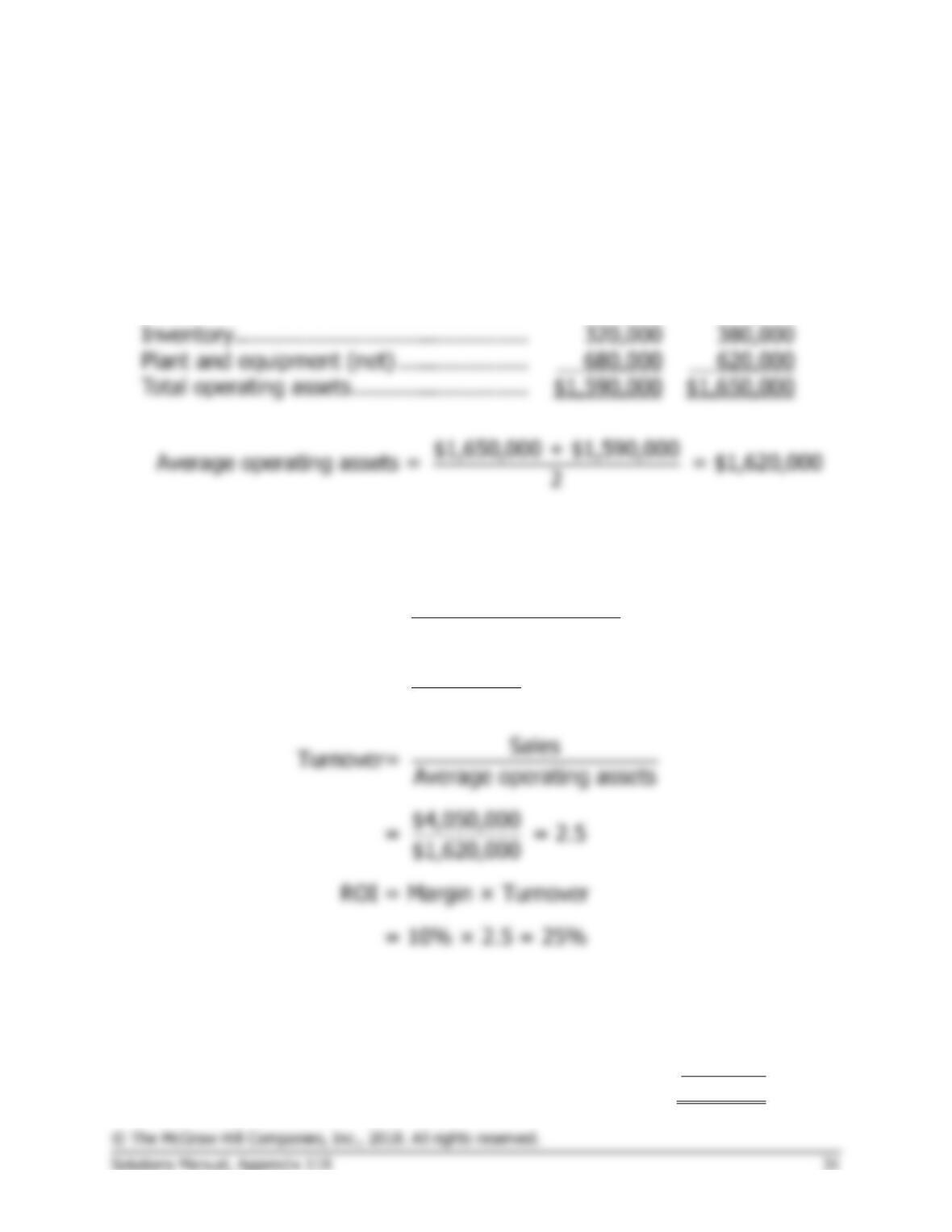
1. Operating assets do not include investments in other companies or in
undeveloped land.
Beginning
Balances
Ending
Balances
Cash …………………………………………….
$ 140,000
$ 120,000
Accounts receivable …………………………
450,000
530,000
Inventory ………………………………………
320,000
380,000
Plant and equipment (net) ………………..
Total operating assets ………………………
2. The margin, turnover, and return on investment (ROI) are calculated as
follows:
Net operating income
Margin = Sales
$405,000
= = 10%
$4,050,000
3. The residual income is calculated as follows:
Net operating income ……………………………………
$405,000
Minimum required return (15% × $1,620,000) …..
243,000
Residual income …………………………………………..
$162,000
Problem 11-18 (20 minutes)
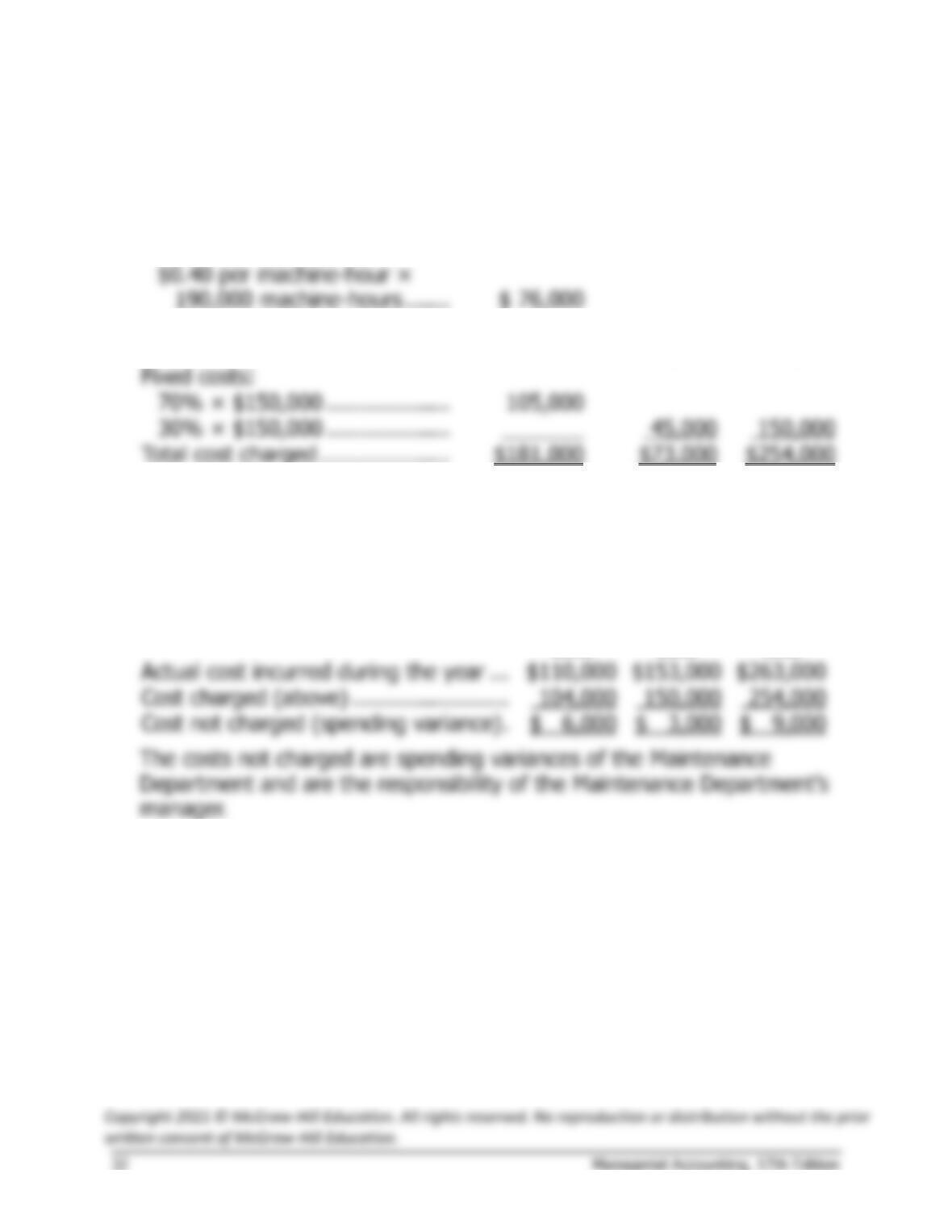
1.
Forming
Department
Assembly
Department
Total
Variable costs:
$0.40 per machine-hour ×
70,000 machine-hours ………
$28,000
$104,000
Fixed costs:
Total cost charged ………………..
2. Any difference between the budgeted and actual variable cost per
machine-hour or between the budgeted and actual total fixed cost
would not be charged to the other departments. The amount not
charged would be:
Variable
Actual cost incurred during the year …
Cost charged (above) ……………………
Cost not charged (spending variance) .
Fixed
Problem 11-19 (30 minutes)
1. Breaking the ROI computation into two separate elements reveals
important relationships that otherwise might remain hidden. First, the
importance of asset turnover as a key element to overall profitability is
emphasized. Prior to use of the ROI formula, managers tended to allow
operating assets to swell to excessive levels. Second, the importance of
2. The missing information is as follows:
Companies in the Same Industry
A
B
C
Sales (a) ………………………….
$600,000
*
$500,000
*
$2,000,000
Net operating income (b) …….
$84,000
*
$70,000
*
$70,000
Average operating assets (c) ..
$300,000
*
$1,000,000
$1,000,000
*
Margin (b) ÷ (a) ………………..
14%
14%
3.5%
*
Turnover (a) ÷ (c) ……………..
2.0
0.5
2.0
*
Return on investment (ROI) …
28%
7%
*
7%
*Given.
NAA Report No. 35
states (p. 35):
“Introducing sales to measure level of operations helps to disclose
specific areas for more intensive investigation. Company B does as well
as Company A in terms of profit margin, for both companies earn 14%
at which Company B purchased its plant?”
Problem 11-19 (continued)
Thus, by including sales specifically in ROI computations the manager is
able to discover possible problems, as well as reasons underlying a
strong or a weak performance. Looking at Company A compared to
Company C, notice that C’s turnover is the same as A’s, but C’s margin
on sales is much lower. Why would C have such a low margin? Is it due
to inefficiency, is it due to geographical location (requiring higher
1. The lowest acceptable transfer price from the perspective of the selling
division is given by the following formula:
+ ³Total contribution margin on lost sales
Variable cost
Transfer price per unit Number of units transferred
Therefore, the Pulp Division will refuse to transfer at a price less than
$70 a ton.
The Carton Division can buy pulp from an outside supplier for $63 a ton.
Therefore, the Division would be unwilling to pay more than $63 per
ton.
2. The price being paid to the outside supplier is only $63. If the Pulp
Division meets this price, then profits in the Pulp Division and in the
company as a whole will drop by $35,000 per year:
Lost revenue per ton ……………………….
$70
Outside supplier’s price …………………….
$63
Total loss in profits ………………………….