11–68. (continued)
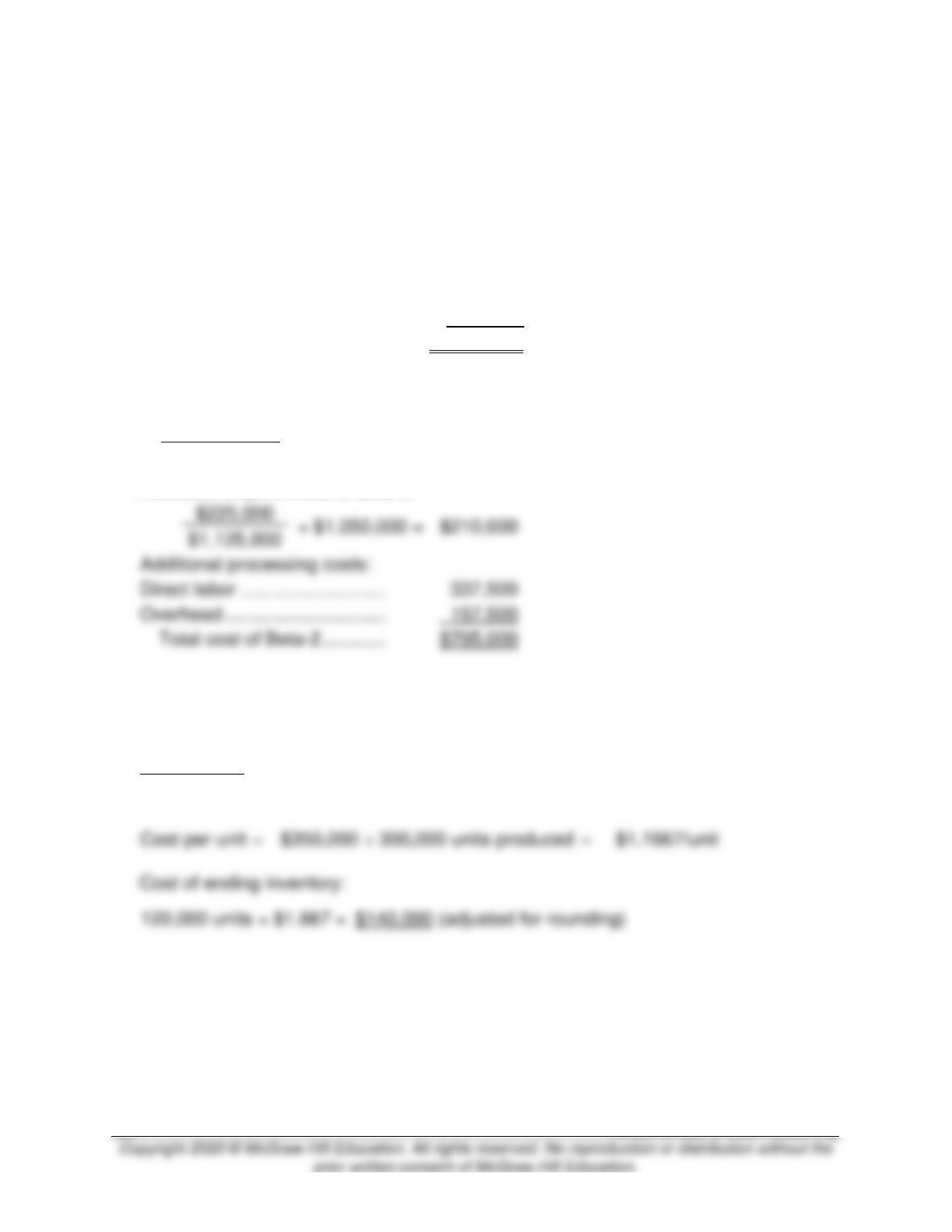
c. $705,000.
Net realizable value of Beta-1
$375,000a
Net realizable value of Beta-2
225,000b
Net realizable value of Beta-3
525,000c
Total ……………………………..
$1,125,000
a From requirement a.
b $720,000 – $337,500 – $157,500 = $225,000
c
$1,063,125
×
720,000 units
–
$487,500
–
$405,000
=
$525,000
540,000 units
Allocation of joint costs to Beta-2:
Additional processing costs:
Direct labor ……………………….
Overhead ………………………….
Total cost of Beta-2 …………
d. $140,000.
Using information from c above, the allocation to Beta-1 is:
$375,000
× $1,050,000 = $350,000
$1,125,000
Cost per unit
=
=
$1.1667/unit
11–69. (40 min.) Estimated Net Realizable Value and Effects Of Processing
Further: Fletcher Fabrication, Inc.
a.
Departments
Production Costs
X
Y
Z
Raw materials ……………………….
$168,000
—
—
Direct labor …………………………...
72,000
$121,350
$ 287,625
Manufacturing overhead …………
30,000
31,650
109,875
Total …………………………………….
$270,000
$153,000
$397,500
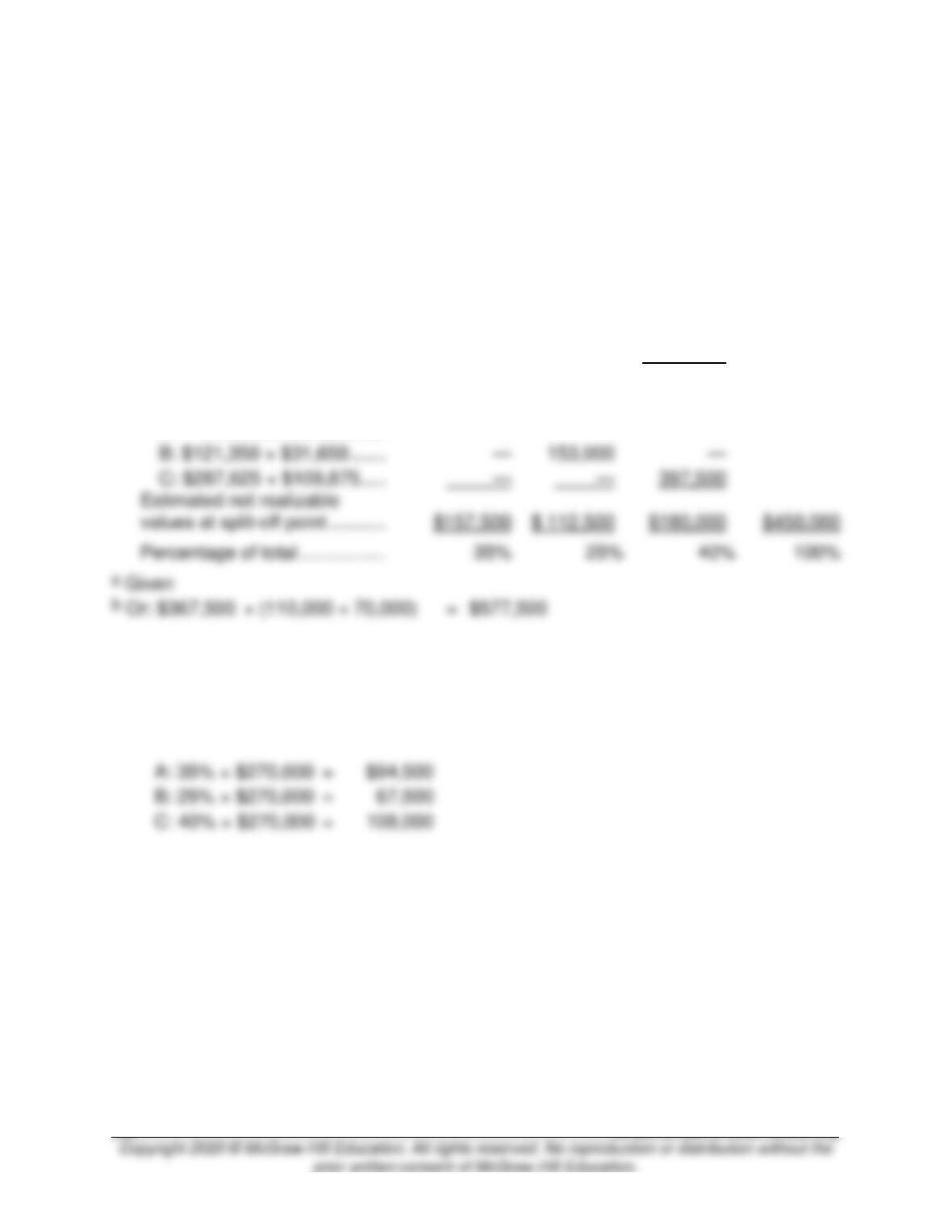
A diagram of the problem follows:
11–69. (continued)
Product A
Product B
Product C
Total
1.
Selling price per pound:
A: $45,000 20,000 ………..
$2.25
C: $367,500 70,000 ………
$5.25
Multiply by pounds produced:
A: 20,000 + 50,000 ………….
× 70,000
C: 70,000 + 40,000………….
_______
_______
× 110,000
Gross sales values …………….
$157,500
$265,500a
$577,500b
Less costs of separate processing:
A: — ……………………………..
—
—
—
B: $121,350 + $31,650 …….
—
—
C: $287,625 + $109,875 …..
Percentage of total ……………..
2. Total joint costs: $168,000 + $72,000 + $30,000 = $270,000
Allocation:
A: 35% × $270,000
=
B: 25% × $270,000
=
C: 40% × $270,000
=
11–69. (continued)
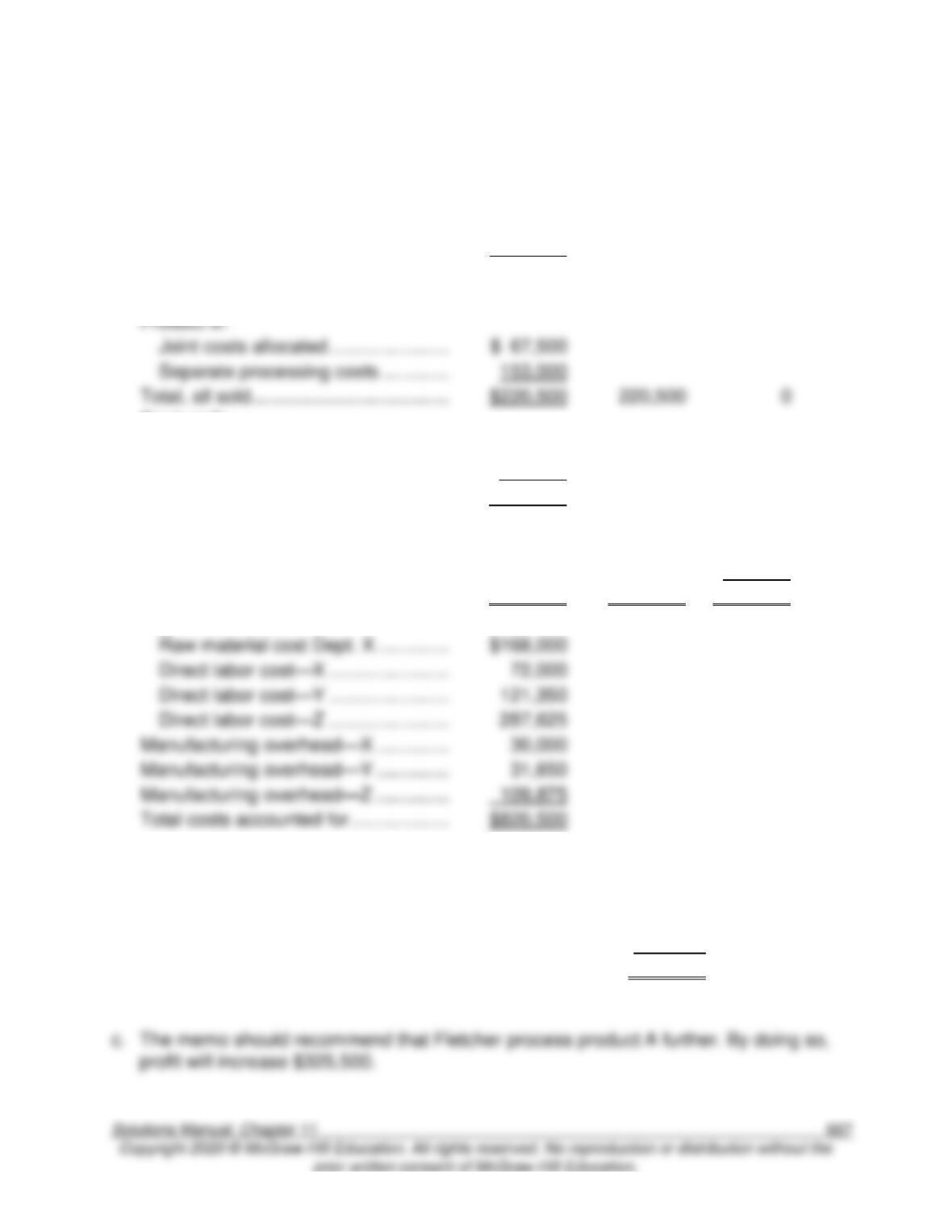
3. and 4.
Total Costs
Cost of
Goods Sold
Ending
Inventory
Product A:
Joint costs allocated …………………..
$ 94,500
Sold: (20,000 70,000) × $94,500 .
$ 27,000
Inventory ………………………………….
$ 67,500
Product B:
Joint costs allocated …………………..
Separate processing costs ………….
Total, all sold ………………………………..
Product C:
Joint costs allocated …………………..
$ 108,000
Separate processing costs ………….
397,500
Total costs of Z ………………………….
$505,500
Sold: (70,000 110,000) ×
$505,500 …………………….
321,682
Inventory ………………………………….
________
________
183,818
Totals ………………………………………….
$820,500
$569,182
$251,318
Proof of total:
Raw material cost Dept. X …………..
$168,000
Direct labor cost—X …………………..
Direct labor cost—Y …………………..
Direct labor cost—Z …………………..
Manufacturing overhead—X …………..
Manufacturing overhead—Y …………..
Manufacturing overhead—Z …………..
Total costs accounted for ……………….
$820,500
b.
Incremental revenue of further processing
A: ($12.90 – $2.25 forgone) × 70,000 …………
$745,500
Incremental costs of further processing
B: $6.00 × 70,000 …………………………………….
420,000
Incremental income from further processing A ..
$325,500
11–70.
(35 min.) Find Missing Data—Net Realizable Value: Spartan Chemicals.
Spartan must be using the net realizable value method because the ratio of G-1’s joint
costs to the total does not equal the ratio of G-1’s physical units to the total.
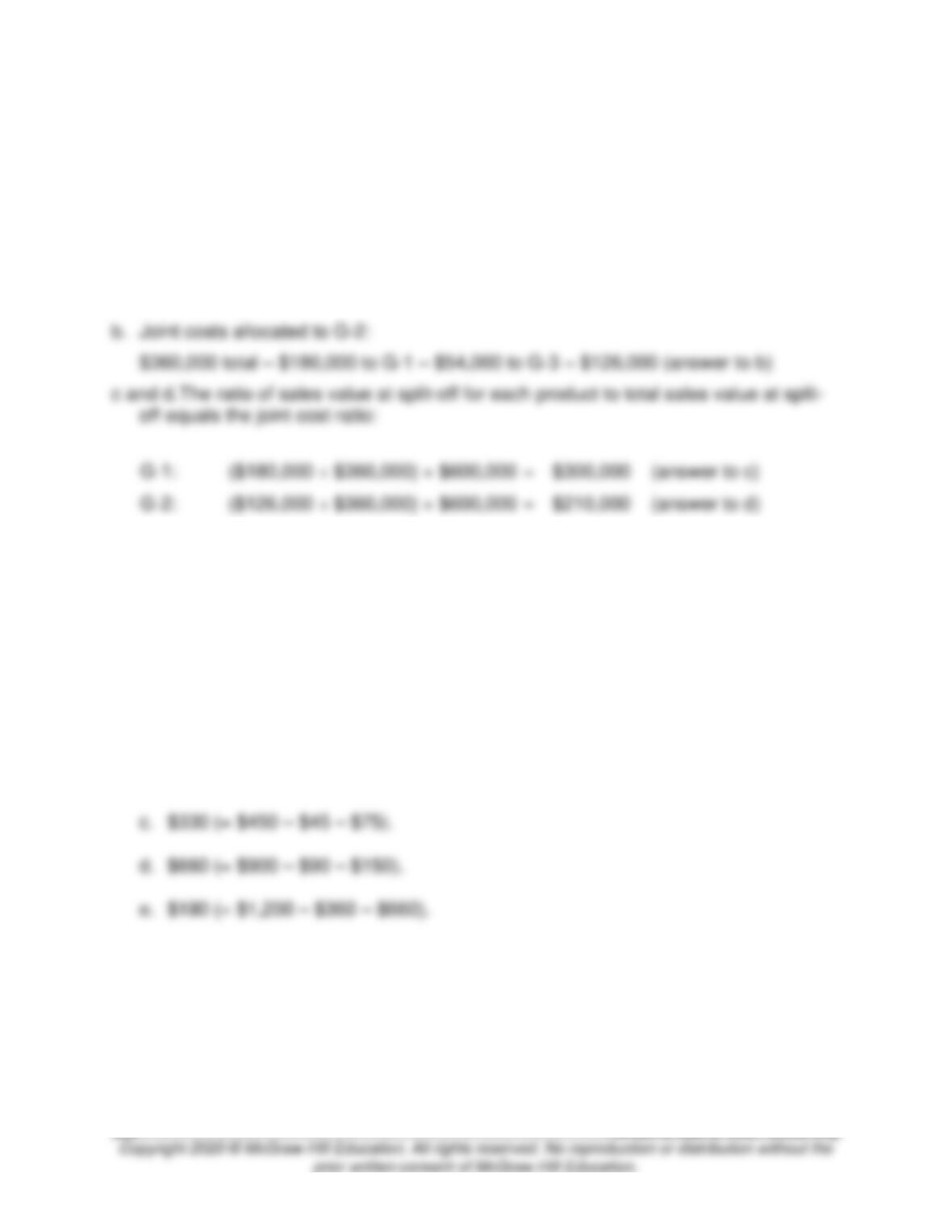
a. Allocate joint costs to G-3:
($90,000 G-3 net realizable value ÷ $600,000) × $360,000 joint costs = $54,000
(answer to a)
11–71.
(35 min.) Find Missing Data—Net Realizable Value: Blaine, Inc.
Blaine must be using the net realizable value method because the ratio of Argon’s joint
costs to the total does not equal the ratio of Argon’s physical units to the total.
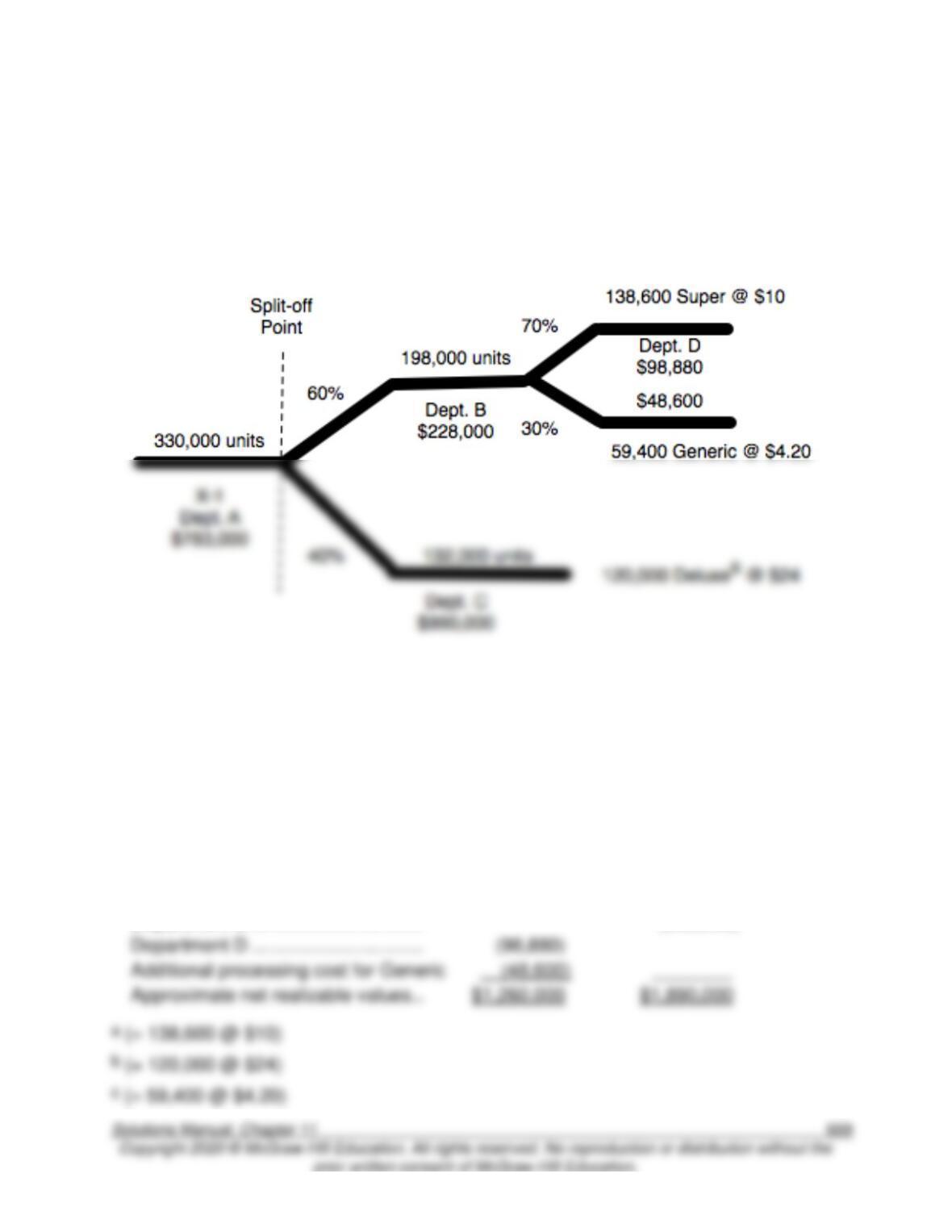
a. $150. The contribution from further processing is $0, so the sales value at split
off must be equal to the sales value from processing less the additional
processing costs, or $150 (= $300 – $150).
b. $75 (= $450 × [$150 ÷ $900]).
11–72. (50 min.) Joint Costing In A Process Costing Context—Estimated Net
Realizable Value Method: West Coast Designs.
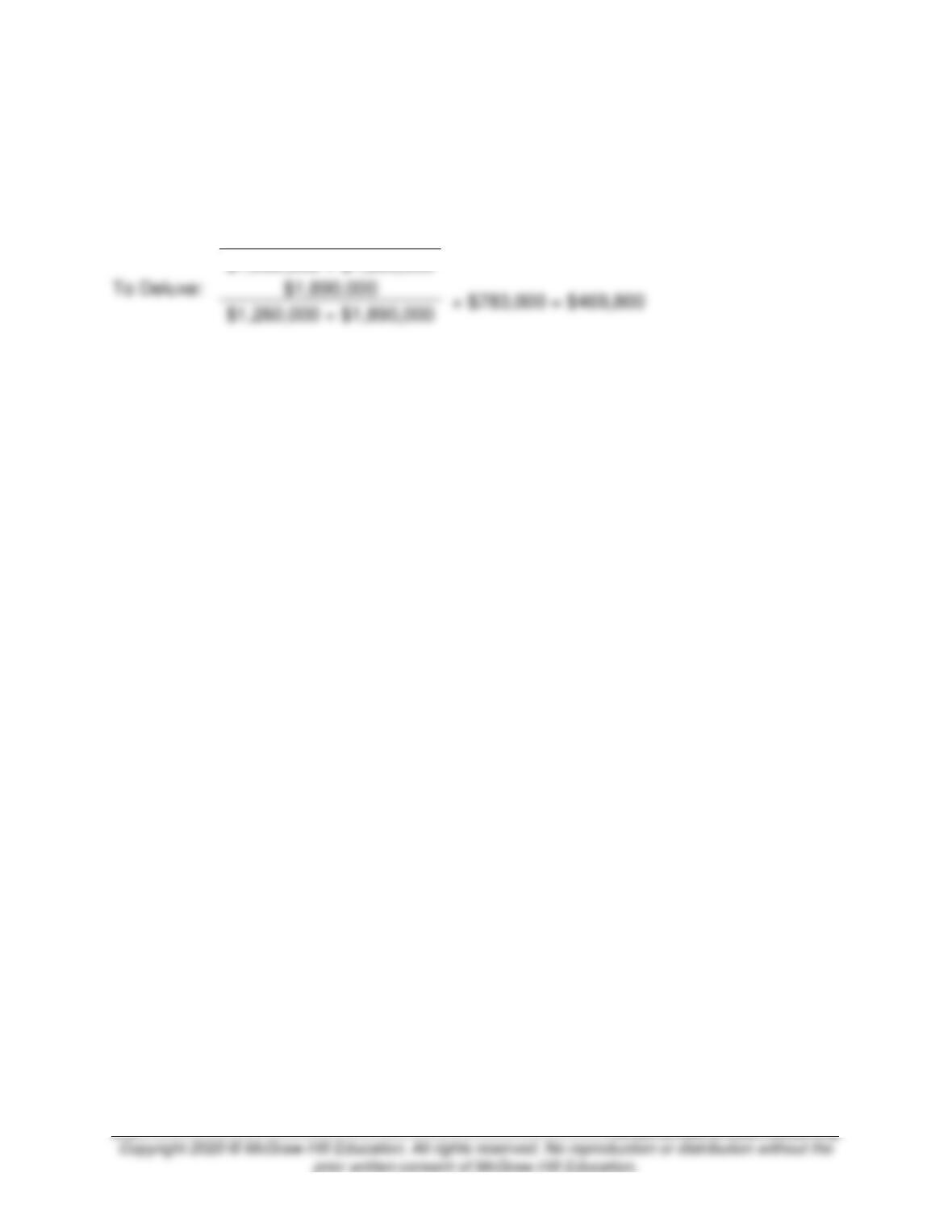
It is helpful to diagram the flow of units before attempting to solve the problem.
a120,000 good output = 132,000 ÷ 110%
The next step is to determine the net realizable values of Super and Deluxe at the first
split-off.
Super
Deluxe
Sales value after completion …………..
$1,386,000a
$2,880,000b
Sales revenue from Generic …………..
249,480c
Separate processing costs:
Department B …………………………...
$ (228,000)
Department C …………………………...
(990,000)
Department D …………………………...
Additional processing cost for Generic
11–72. (continued)
Cost allocation:
To Super:
$1,260,000
× $783,000 = $313,200
To Deluxe:
$1,890,000
× $783,000 = $469,800
11–73. (35 min.) Find Maximum Input Price—Estimated Net Realizable Value
Method: Ticon Corporation.
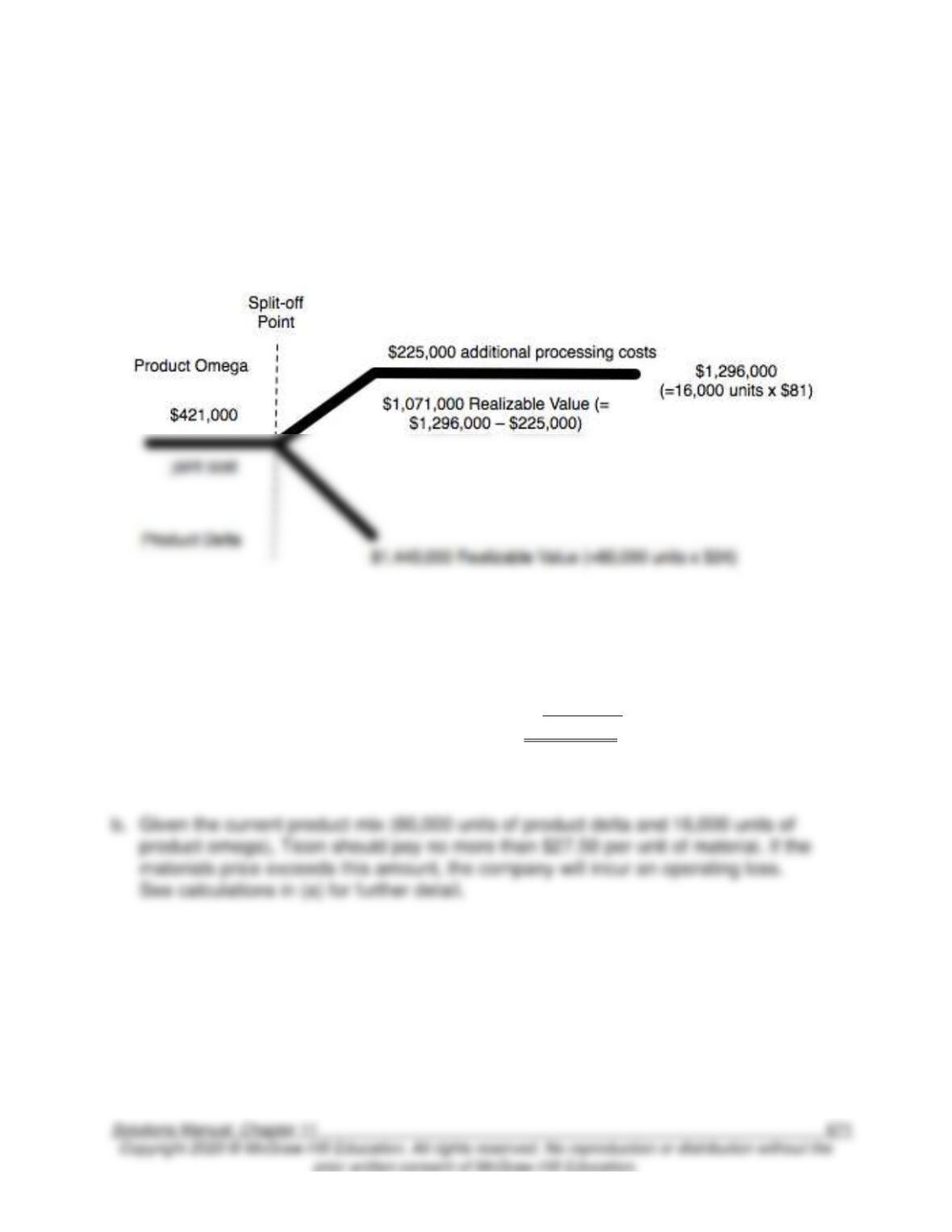
a. A diagram of the operation appears as follows:
The total allowable materials costs would then be:
Sales value of Omega at split-off …………
$1,071,000
Sales value of Delta at split-off ……………
1,440,000
Joint conversion costs ………………………..
(421,000)
Balance (maximum materials cost) …………
$2,090,000
Maximum materials price per unit = $27.50 (= $2,090,000 ÷ 76,000 units).
11–74. (30 min.) Effect Of By-Product versus Joint Cost Accounting: Fisher
Chemicals.
a. (1) Accounted for as a joint product.
Allocation:
Sigma:
60%
×
$640,000
=
$384,000
Tau:
30%
×
$640,000
=
$192,000
Upsilon:
10%
×
$640,000
=
$ 64,000
(2) Allocated for as a by-product.
Allocation:
Sigma:
60% ÷ (60% + 30%)
×
$570,000a
=
$380,000
Tau:
30% ÷ (60% + 30%)
×
$570,000a
=
$190,000
Upsilon:
$70,000, the value of Upsilon is assigned to Upsilon.
11–75. (30 min.) Joint Cost Allocation and Product Profitability: Prescott Lumber
Total cost = $19,200 + $8,192 = $27,392
a. Allocation on the basis of units of output
Grade A:
× $27,392 =
Grade B:
b. Allocation on the basis of market value
Grade A:
$44,800
× $27,392 =
$23,968
$44,800 + $6,400
Grade B:
$6,400
× $27,392 =
3,424
$44,800 + $6,400
$27,392
Revenue from Grade-B Lumber …..
Allocated cost of logs ………………….
11–76. Joint Cost Allocation and Product Profitability: Imperial Mining
11–77.
a. Allocation on the basis of units of output
Joint cost = $1,500,000.
High-Grade
Medium-Grade
Low-Grade
Total
Quantity (tons) ……….
20,000
30,000
10,000
60,000
Price/ton ………………..
$60
$40
$10
Revenue (NRV)………
$1,200,000
$1,200,000
$100,000
$2,500,000
Allocated joint costa …
500,000
750,000
250,000
1,500,000
Product profit …………
$700,000
$450,000
($150,000)
$1,000,000
11-76. (continued)
b. Allocation on the basis of net realizable value. (Note: In this case, NRV is equal
to revenue.)
Joint cost = $1,500,000.
High-Grade
Medium-Grade
Low-Grade
Total
Quantity (tons) ……….
Price/ton ………………..
Revenue (NRV)………
1,500,000
aHigh-Grade:
$1,200,000
× $1,500,000 =
$720,000
$2,500,000
Medium-Grade:
$1,200,000
× $1,500,000 =
720,000
$2,500,000
Low-Grade:
$100,000
× $1,500,000 =
60,000
$2,500,000
$1,500,000
11-76. (continued)
c. 1. In this case, the cost allocation method and treatment of Low-Grade coal that
leads to the lowest reported product cost for the Medium-Grade product would be
to use the physical quantities method and to not treat Low-Grade coal as a by-
product. We know from comparing the answers to requirement a and b that the
physical quantities method leads to lower costs for Medium-Grade coal. In
2. There are two reasons not to agree to use this method just because the
reported costs are lower. First, as is true with any allocation, is that the purpose
11–77. (60 min.) Effect of Cost Allocation on Pricing and Make versus Buy
Decisions: Ag-Coop
a. Output:
Output Mix
Kwh per lb.
Kwh per 100 lbs. Input
Greenup ……………
50
%
32
1,600
Maintane …………..
30
20
600
Winterizer………….
20
40
800
3,000
Maximum processing:
=
750,000 kwh ÷ 3,000 kwh per 100 lbs.
=
25,000 lbs. of input
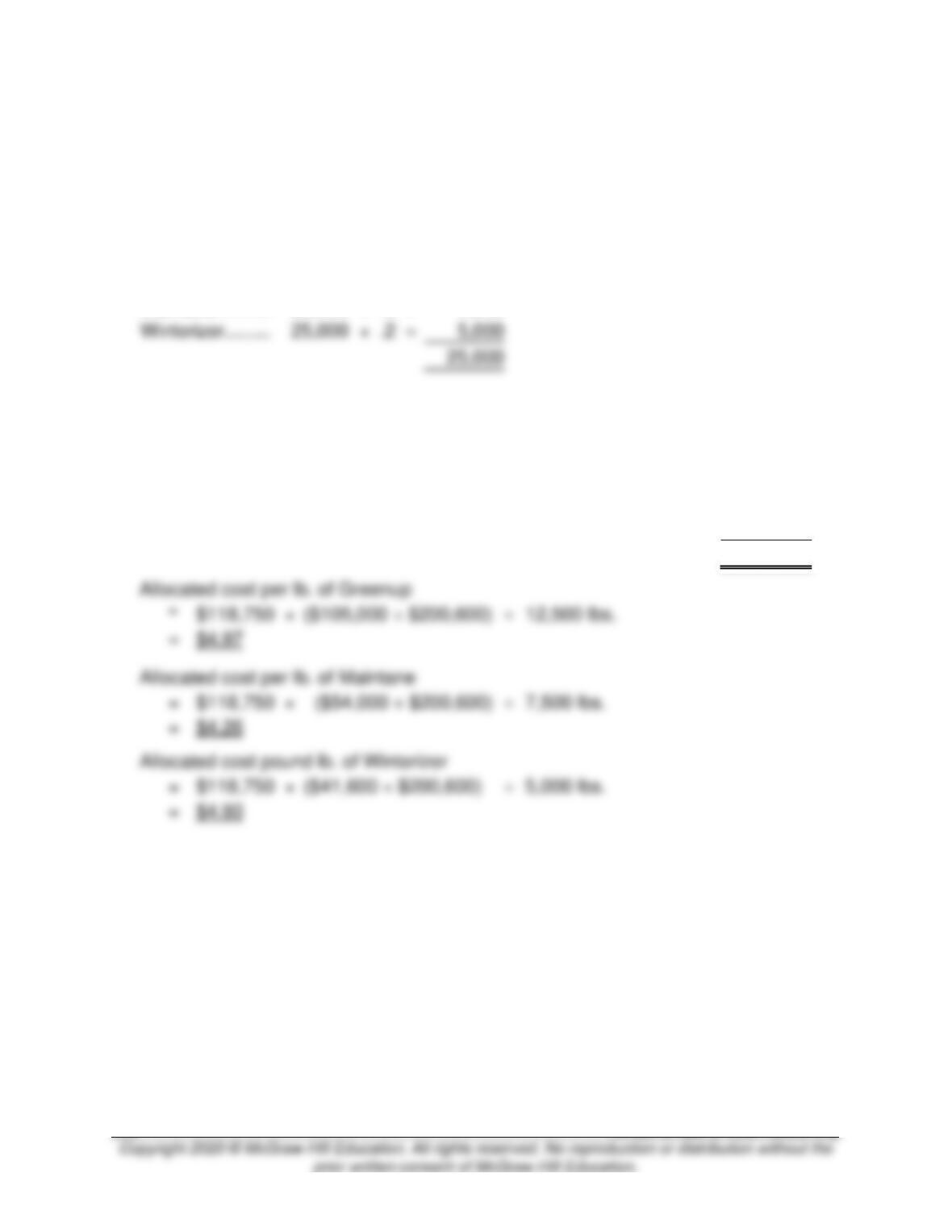
Fixed cost allocation
25,000
=
per lb.
11-77. (continued)
b. Total joint cost incurred in processing 25,000 lbs. of input =
$81,250 + (25,000 × $1.50) = $118,750
Quantities of each product produced:
Greenup ………..
25,000
×
.5
=
12,500
Maintane ……….
25,000
×
.3
=
7,500
25,000
×
=
25,000
Sales Price
per lb.
Selling Cost/lb.
(20% of Sales
Price)
Net
Realizable
Value per lb.
Number
of Lbs.
Total NRV
Greenup …
$10.50
$2.10
$8.40
12,500
$105,000
Maintane ..
9.00
1.80
7.20
7,500
54,000
Winterizer.
10.40
2.08
8.32
5,000
41,600
$200,600
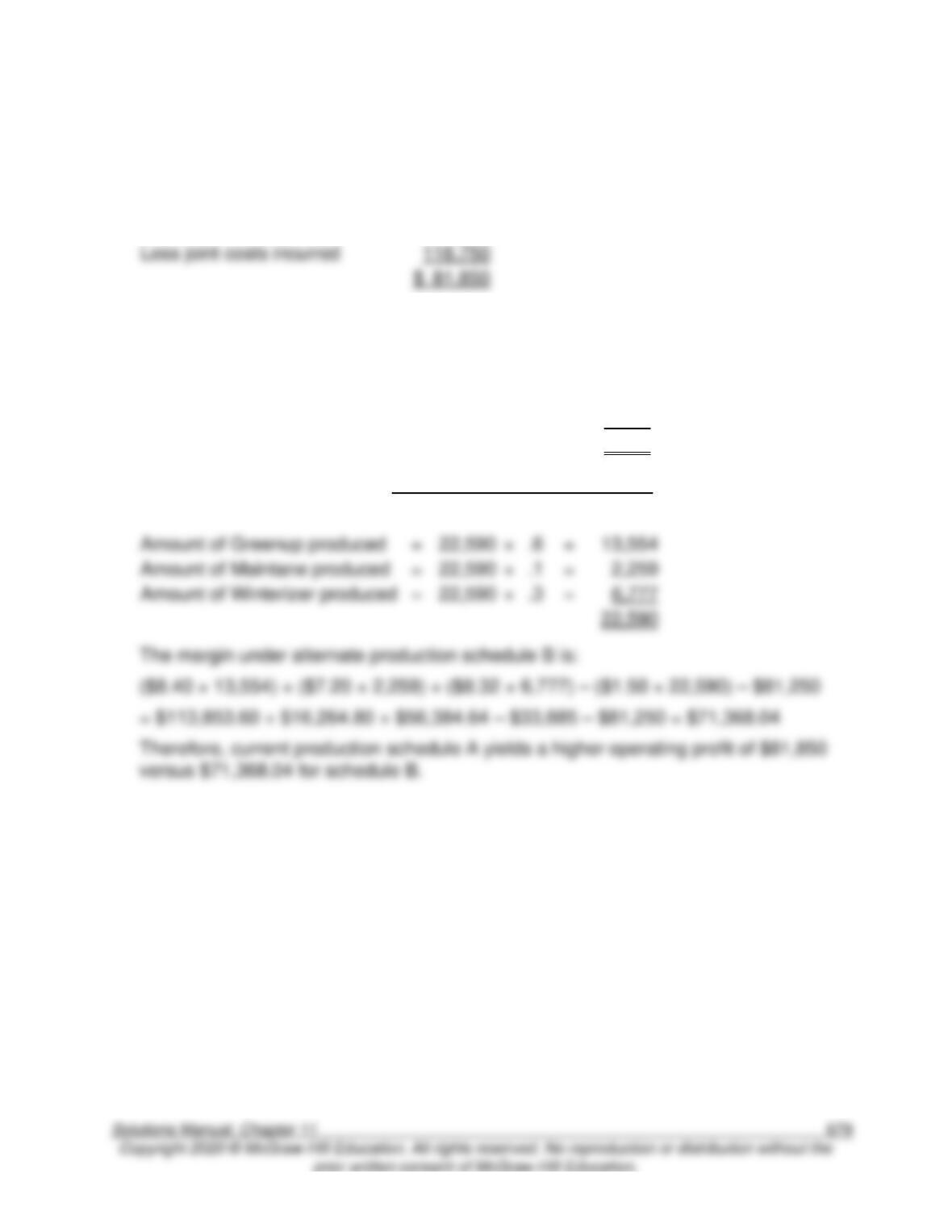
$118,750
×
($105,000 ÷ $200,600)
12,500 lbs.
=
$118,750
×
7,500 lbs.
=
$118,750
×
($41,600 ÷ $200,600)
5,000 lbs.
11–77. (continued)
c. The profit under current production schedule A is:
Total net realizable value
=
$200,600
(from b above)
Less joint costs incurred
Outputs under alternative production schedule B:
Product
Output Mix
Unit kwh Usage
Usage per 100 Lbs. of Input
Greenup
60
%
32
1,920
Maintane
10
20
200
Winterizer
30
40
1,200
3,320
Pounds of input processed =
750,000 kwh
= 22,590 pounds
3,320 kwh per hundred pounds
Amount of Greenup produced
=
22,590
×
Amount of Maintane produced
=
22,590
×
=
2,259
Amount of Winterizer produced
=
22,590
×
6,777
d. The decision would not be different, even if joint costs are allocated based on the net
realizable value method. Given the production schedule, the realizable values and
the joint costs are the same for either allocation method. Therefore, the better
production schedule will not depend on the choice of the allocation method.