————–———————-————–—————CHAPTER 11—————-———-————–——-
REVIEW QUESTIONS
Q11–1 The federal budget cycle begins with an appropriation, which is the authority given by the Congress
to an agency to obligate the government to ultimately make disbursements for expenditures, repayment of
Q11-2 As a general rule, the answer is No. If the Bureau is part of a department, OMB must first apportion
Q11–3 An obligation represents budgetary authority earmarked for a specific purpose, so as to prevent
Q11-4 Earmarked funds are funds that are financed by specifically identified revenues, which may be
supplemented by other financing sources. The specifically identified revenues and other financing sources
Q11-5 Inventory and Related Property. This standard covers primarily inventory (items held for sale,
mostly within the same department), operating materials and supplies, and stockpile materials. Inventory
and operating materials and supplies must be valued at historical cost (first-in, first-out, weighted average,
or moving average) or any other valuation method that approximates historical cost. Inventory and
operating materials and supplies are generally accounted for on the consumption method.
Property, Plant and Equipment (PP&E). There are three categories of PP&E: General PP&E, heritage
assets, and stewardship land. General PP&E (used to provide general government goods and services) must
Q11-6 The federal budgetary equation is “net resources = status of resources.” Net resources accounts
Q11-7 The account Fund balance with Treasury shows the funds on deposit with the Treasury; that is, the
Q11-8 Accrual accounting is incorporated within all the funds used by the federal government and in the
Q11-9 In federal accounting, fixed assets classified as General Property, Plant and Equipment (PP&E) are
capitalized (recorded as a long-term asset) and depreciated over their useful lives, like assets of commercial
Q11–10 Four financial statements prepared by federal agencies are:
o Balance sheet. Reports the agency’s proprietary account assets, liabilities, and net position.
Q11-11 The two components of net position are Cumulative results of operations and Unexpended
appropriations. The Cumulative results of operations is the net difference since inception of the activity
Q11-12 State and local governmental pension plans are generally “advance–funded,” so that each year a
sufficient amount is contributed to the plan to cover the “normal cost” (the amount of benefit earned by the
employees plus amortization of the actuarial accrued liability). The amount contributed together with the
DISCUSSION SCENARIOS AND ISSUES
D11–1 Students are likely to have differing opinions regarding this standard, which was very controversial
when it was debated by the FASAB.
Arguments in favor of the standard as follows:
a. Social security was enacted as compulsory intergenerational transfer program; it was never
intended to be funded in a manner similar to private or state and local government pensions.
D11–2 The supervisor has placed the accountant in a very difficult position. In this situation, the agency
has spent more than the amount appropriated. In fact, the supplies were not only ordered – they were
EXERCISES
E11-1 (10 minutes)
E11-2 (10 minutes)
1. e – Appropriation
E11-3 (10 minutes)
1. Allotments – realized resources
2. Undelivered orders – obligations, unpaid
E11-4 (10 minutes)
1. False. The statement of net cost is prepared on the accrual basis of accounting both in the
E11-5 (30 minutes)
1. Budgetary entry:
Other appropriations realized 3,000,000
2. Budgetary entry:
Unapportioned authority 3,000,000
3. Budgetary entry:
Apportionments 750,000
4. Budgetary entry:
Allotments – realized resources 190,000
5. Budgetary entry:
Commitments 190,000
6. Budgetary entry:
Proprietary entries:
1. General Property, Plant, and Equipment 200,000
2. Unexpended appropriations – used 200,000
7. Budgetary entry: None
Proprietary entry:
8. Budgetary entry:
Delivered orders – obligations, unpaid 200,000
9. Budgetary entry: None
Proprietary entry:
E11-6 (20 minutes)
1. Budgetary entry:
Allotments – realized resources 140,000
2. Budgetary entry:
Commitments 140,000
3. Budgetary entry:
Undelivered orders – obligations, unpaid 150,000
Delivered orders – obligations, unpaid 150,000
4. Budgetary entry: None
Proprietary entry:
5. Budgetary entry:
Delivered orders – obligations, unpaid 150,000
6. Budgetary entry: None
Proprietary entry:
E11-7 (15 minutes)
1. Budgetary entry:
Allotments – realized resources 60,000
Delivered orders – obligations, unpaid 60,000
2. Budgetary entry: None
Proprietary entry:
3. Budgetary entry:
Undelivered orders – obligations, unpaid 15,000
4. Budgetary entry: None
Proprietary entry:
E11-8 (20 minutes)
1. Budgetary entry:
Allotments – realized resources 275,000
Delivered orders – obligations, unpaid 275,000
2. Budgetary entry:
Delivered orders – obligations, unpaid 275,000
3. Budgetary entry:
Allotments – realized resources 18,000
Delivered orders – obligations, unpaid 18,000
4. Budgetary entry: None
Proprietary entry:
E11-9 (45 minutes)
1. Budgetary entry:
Other appropriations realized 400,000
2. Budgetary entry:
Unapportioned authority 400,000
3. Budgetary entry:
Apportionments 400,000
4. Budgetary entry:
Allotments – realized resources 390,000
5. Budgetary entry:
Commitments 375,000
6. Budgetary entry:
Undelivered orders – obligations unpaid 360,000
1. Operating materials and supplies held for use 360,000
2. Unexpended appropriations – used 360,000
7. Budgetary entry: None
Proprietary entry:
8. Budgetary entry: None
Proprietary entries:
9. Budgetary entry:
Delivered orders – obligations, unpaid 360,000
Delivered orders – obligations, paid 360,000
Central Think Tank
Preclosing Trial Balance – Budgetary Accounts
September 30, 2013
Other appropriations realized 400,000
Allotments – realized resources 10,000
Central Think Tank
Statement of Budgetary Resources
For the Year Ended September 30, 2013
Budgetary Resources
Appropriations $ 400,000
PROBLEMS
P11-1 (105 minutes)
1. Budgetary entry:
Other appropriations realized 2,000,000
2. Budgetary entry:
Unapportioned authority 2,000,000
3. Budgetary entry:
Apportionments 500,000
4. Budgetary entry:
Allotments – realized resources 240,000
5. Budgetary entry:
Delivered orders – obligations, unpaid 20,000
6. Budgetary entry:
Undelivered orders – obligations, unpaid 80,000
1. Operating materials and supplies held for use 52,000
Program costs – rental expense 30,000
2. Unexpended appropriations – used 82,000
7. Budgetary entry: None
Proprietary entry:
8. Budgetary entry:
Allotments – realized resources 90,000
1. Program costs – salaries 90,000
2. Unexpended appropriations – used 90,000
9. Budgetary entry:
Delivered orders – obligations, unpaid 172,000
Delivered orders – obligations, paid 172,000
To record confirmed payment by Treasury.
10a Budgetary entry:
Allotments – realized resources 10,000
Proprietary entries:
1. Program costs – salaries 10,000
2. Unexpended appropriations – used 10,000
10b Budgetary entry: None
Proprietary entry:
Department of Transportation
Bureau of Bridge Inspection
Preclosing Trial Balance
October 31, 2013
Budgetary Accounts
Other appropriations realized 2,000,000
Total actual resources – collected 20,000
Proprietary Accounts
Fund balance with Treasury 1,828,000
Unexpended appropriations – used 182,000
Cumulative results of operations 36,000
Department of Transportation
Bureau of Bridge Inspection
Balance Sheet
October 31, 2013
Assets:
Intragovermental:
Fund balance with Treasury $1,828,000
Inventory, operating materials and supplies 46,000
General PP&E $ 30,000
Department of Transportation
Bureau of Bridge Inspection
Statement of Net Costs
For the Month Ended October 31, 2013
Program costs:
Department of Transportation
Bureau of Bridge Inspection
Statement Changes in Net Position
For the Month Ended October 31, 2013
Cumulative Results of Operations
Beginning balance $ 36,000
Budgetary financing sources – appropriations used $ 182,000
P11-2 (90 minutes)
October 1 Budgetary entry:
Other appropriations realized 1,000,000
Unapportioned authority 1,000,000
To record receipt of appropriation authority.
Apportionments 100,000
Allotments – realized resources 100,000
To record allotment of monies for October operations.
Proprietary entry: None
October 1 Budgetary entry:
October 4 Budgetary entry:
Commitments 88,000
October 10 Budgetary entry:
Undelivered orders – obligations unpaid 80,000
October 14 Budgetary entry: None
Proprietary entry:
Accounts payable 80,000
Disbursements in transit 80,000
October 31 Budgetary entry: None
Proprietary entry:
Star Exploration Agency
Preclosing Trial Balance
October 31, 2013
Budgetary Accounts
Other appropriations realized $1,000,000
Unapportioned authority $ 50,000
Proprietary Accounts
Fund balance with Treasury $ 924,000
Operating materials and supplies held for use 15,000
Star Exploration Agency
Balance Sheet
October 31, 2013
Assets
Intragovernmental
Fund balance with Treasury $924,000
Liabilities and Net Position
Liabilities:
Star Exploration Agency
Statement of Net Costs
For the month of October, 2013
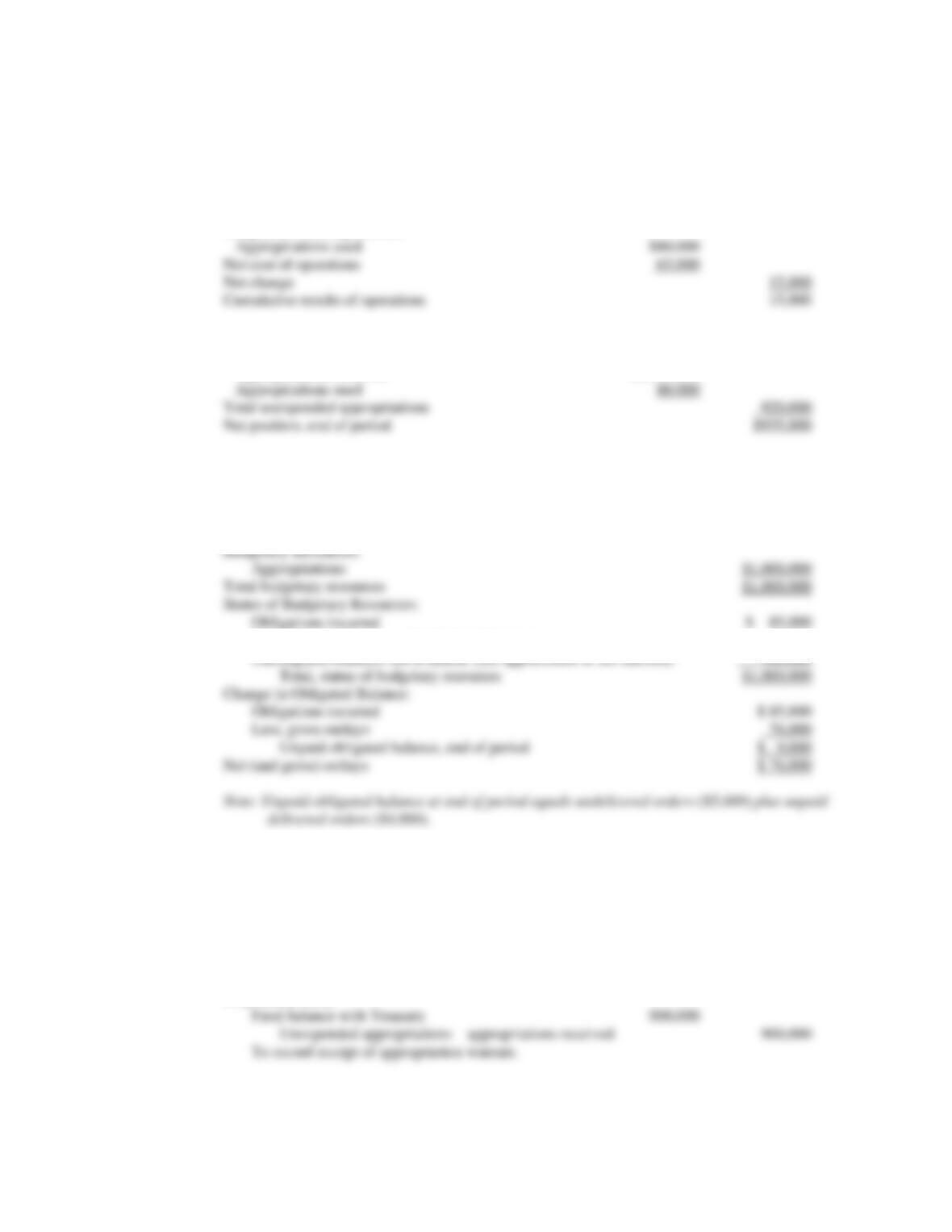
Star Exploration Agency
Statement of Changes in Net Position
For Month Ended October 31, 2013
Cumulative results of operations
Beginning balance $ 0
Budgetary financing sources:
Unexpended appropriations:
Beginning balance 0
Appropriations received $1,000,000
Star Exploration Agency
Statement of Budgetary Resources
For Month Ended October 31, 2013
Unobligated balances available for obligation 15,000
P11-3 (90 minutes)
October 1 Budgetary entry:
Other appropriations realized 900,000
Unapportioned authority 900,000
To record receipt of appropriation authority.
Proprietary entry:
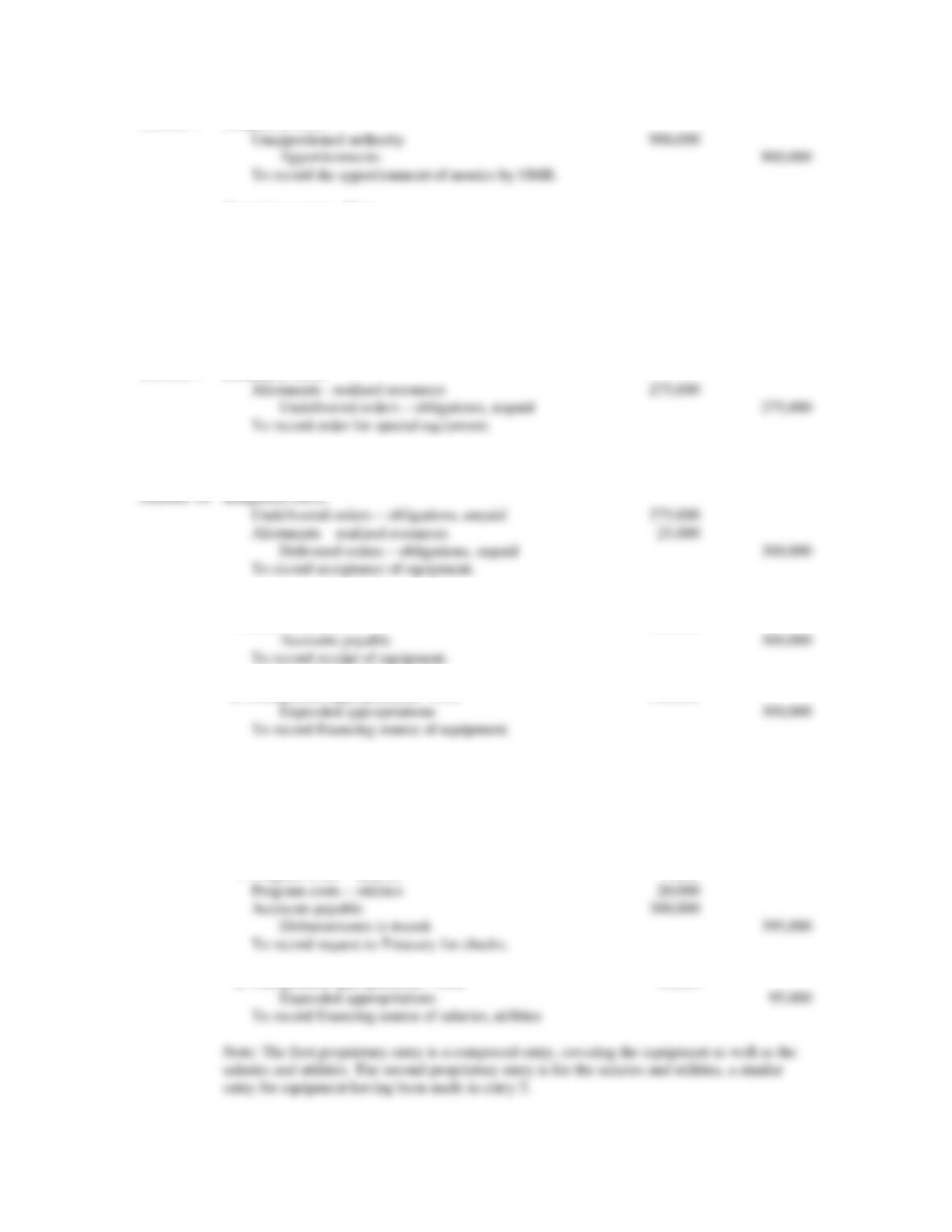
October 1 Budgetary entry:
Proprietary entry: None
October 1 Budgetary entry:
Apportionments 400,000
Allotments – realized resources 400,000
To record allotment for October operations.
Proprietary entry: None
October 4 Budgetary entry:
Proprietary entry: None
Proprietary entries:
1. General PP&E 300,000
2. Unexpended appropriations – used 300,000
October 24 Budgetary entry:
Allotments – realized resources 95,000
Delivered orders – obligations unpaid 95,000
To record use of resources for salaries, utilities
Proprietary entries:
1. Program costs – salaries 75,000
2. Unexpended appropriations – used 95,000
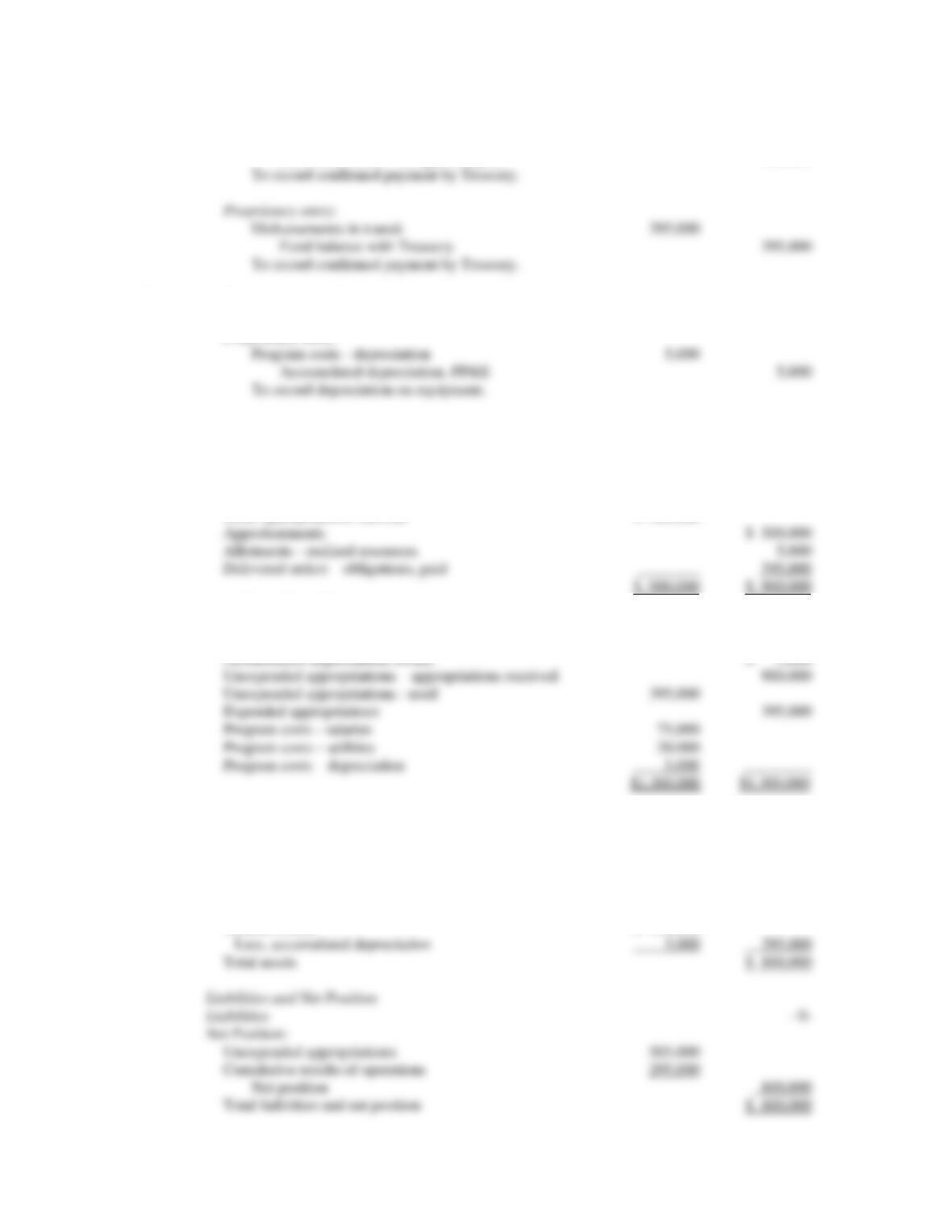
October 27 Budgetary entry:
Delivered orders – obligations, unpaid 395,000
Delivered orders – obligations, paid 395,000
October 31 Budgetary entry: None
Proprietary entry:
Black Hole Bureau
Preclosing Trial Balance
October 31, 2013
Budgetary Accounts
Other appropriations realized $ 900,000
Proprietary Accounts
Fund balance with Treasury $ 505,000
General PP&E 300,000
Black Hole Bureau
Balance Sheet
October 31, 2013
Assets
Intragovermental:
Fund balance with Treasury $ 505,000
General PP&E $ 300,000
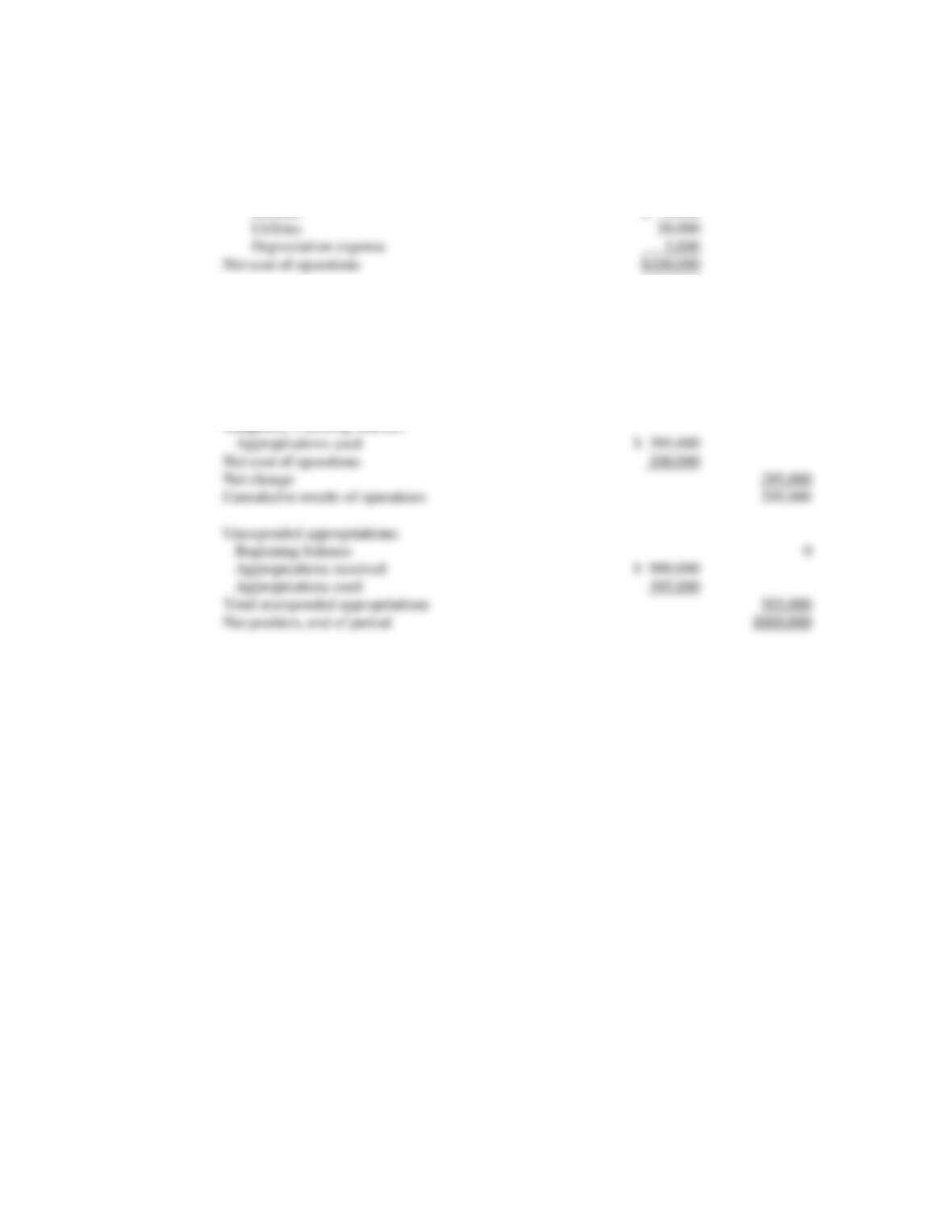
Black Hole Bureau
Statement of Net Costs
For the Month Ended October 31, 2013
Program costs:
Salaries $ 75,000
Black Hole Bureau
Statement of Changes in Net Position
For the Month Ended October 31, 2013
Cumulative results of operations
Beginning balance $ 0