11–18
Learning Objective – 10 – Compare the accounting for transactions
related stockholders’ equity under GAAP
and IFRS.
A Look at IFRS—The accounting for transactions related to
stockholders’ equity, such as issuance of shares, purchase of treasury
stock, and declaration and payment of dividends, are similar under
both IFRS and GAAP. Major differences relate to terminology used,
introduction of items such as revaluation surplus, and presentation of
stockholders’ equity information.
KEY POINTS
▪ Under IFRS, the term reserves is used to describe all equity accounts other than
those arising from contributed capital. This would include, for example, reserves
related to retained earnings, asset revaluations, and fair value differences.
▪ Many countries have a different mix of investor groups than in the United States. For
example, in Germany, financial institutions like banks are not only major creditors of
corporations but often are the largest corporate stockholders as well. In the United
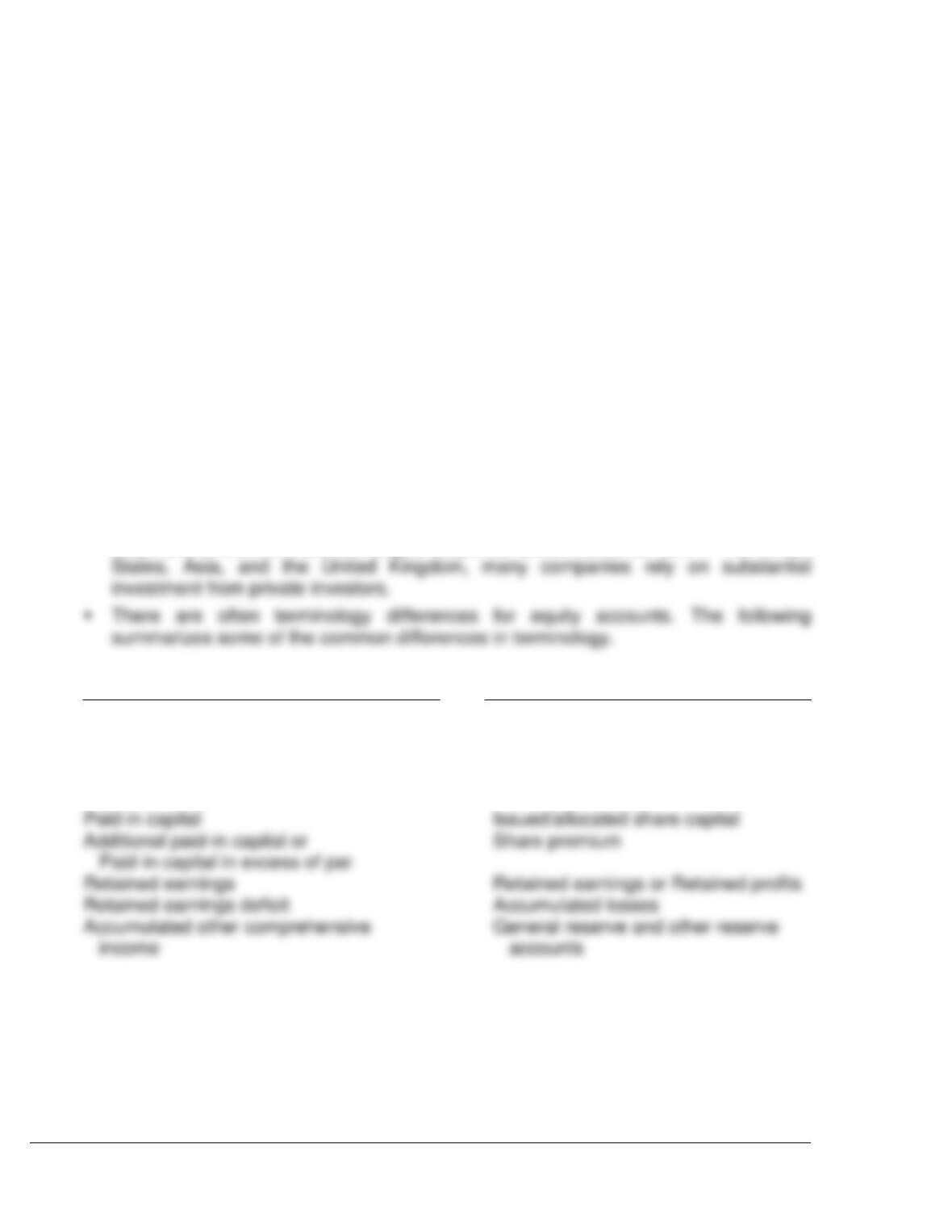
GAAP
IFRS
Capital stock or common stock
Share capital
Stockholders
Shareholders
Par value
Nominal or face value
Authorized stock
Authorized share capital
Preferred stock
Preference shares
Paid-in capital
Issued/allocated share capital
Retained earnings
Retained earnings or Retained profits
Retained earnings deficit
Accumulated losses
The accounting for treasury stock differs somewhat between IFRS and GAAP.
(However, many of the differences are beyond the scope of this course.) Like GAAP,
IFRS does not allow a company to record gains or losses on purchases of its own
shares. One difference worth noting is that, when a company purchases its own shares,
IFRS treats it as a reduction of stockholders’ equity, but it does not specify which
particular stockholders’ equity accounts are to be affected. Therefore, it could be shown
11–19
▪ A major difference between IFRS and GAAP relates to the account Revaluation
Surplus. Revaluation surplus arises under IFRS because companies are permitted to
revalue their property, plant, and equipment to fair value under certain circumstances.
This account is part of general reserves under IFRS and is not considered contributed
capital.
▪ As indicated earlier, the term reserves is used in IFRS to indicate all noncontributed
(non-paid in) capital. Reserves include retained earnings and other comprehensive
income items, such as revaluation surplus and unrealized gains or losses on available–
for-sale securities.
LOOKING TO THE FUTURE
As indicated in earlier discussions, the IASB and the FASB are currently working on a project
related to financial statement presentation. An important part of this study is to determine
whether certain line items, subtotals, and totals should be clearly defined and required to be
displayed in the financial statements. For example, it is likely that the statement of

11–20
Chapter 11 Review
Identify the major characteristics of a corporation and classify the characteristic as being
advantageous or detrimental to a business.
Describe the accounting treatment for the issuance of stock.
Describe what treasury stock is. State why corporations buy back their own stock, and explain
the accounting for the purchase of treasury stock.
Describe how preferred stock is different from common stock.
Describe what is to be done when declaring a dividend and to prepare the entries for cash
dividends and stock dividends.
How do net income, net loss, and dividends affect retained earnings?
State the items listed in the stockholders’ equity section of the balance sheet.
Use the ratios discussed in this chapter—dividend payout ratio and return on common
stockholders’ equity—to evaluate a corporation’s dividend and earnings performance from a
stockholder’s perspective.
What kind of account is Common Stock Dividend Distributable and where is it reported on the
financial statements?

11–21
Vocabulary Quiz Name ________________________ Date ___________
Chapter 11
1. Net income that is retained in the business.
2. The amount per share of stock that must be retained in the business
for the protection of corporate creditors.
3. Capital stock that has contractual preferences over common stock in
certain areas.
4. A corporation that may have thousands of stockholders and whose
stock is regularly traded on a securities market.
5. Capital stock that has been issued and is being held by stockholders.
6. Capital stock that has been assigned a value per share in the
corporate charter.
7. A corporation’s own stock that has been issued, fully paid for, and
reacquired by the corporation but not retired.
8. The issuance of additional shares of stock to stockholders
accompanied by a reduction in the par or stated value per share.
9. The date when ownership of outstanding shares is determined for
dividend purposes.
10. A feature of preferred stock entitling the stockholder to receive current
and unpaid prior-year dividends before common stockholders receive
any dividends.
11–22
Solutions to Vocabulary Quiz
Chapter 11
1. Retained earnings

11–23
Multiple Choice Quiz Name __________________ Date ______________
Chapter 11
1. All the following are true about a corporation except:
a. must abide by the laws.
b. is a legal entity.
c. has the right to vote.
d. must pay taxes.
2. Proof of stock ownership is evidenced by a printed or engraved form known as a:
a. stock dividend.
b. note.
c. debenture.
d. stock certificate.
3. All of the following statements are true concerning treasury stock except:
a. is accounted for by the cost method.
b. does not change the number of shares issued.
c. does not change the number of shares outstanding.
d. reduces stockholder claims on corporate assets.
4. In order to pay a cash dividend:
a. the corporation must have adequate retained earnings.
b. the board of directors must declare a dividend.
c. the corporation must have adequate cash.
d. all of these answer choices are correct.
5. Dividends can take the following forms:
a. cash
b. property
c. script
d. all of these answer choices are correct.
6. When issuing cash dividends, the board of directors commits the corporation to a
binding legal obligation on:
a. the declaration date.
b. the date of record.
c. the date of payment.
d. none of these answer choices are correct.
7. A stock dividend results in:
a. a decrease in retained earnings.
b. an increase in paid-in capital.
c. a decrease in stockholder’s equity and total assets.
d. both a decrease in retained earnings and an increase in paid-in capital.

11–24
8. Upon receiving a stock dividend:
a. a stockholder owns more shares.
b. a stockholder’s interest has increased.
c. a stockholder’s interest has not changed.
d. both a stockholder owns more shares and a stockholder’s interest has not
changed.
9. Corporations issue stock dividends
a. to satisfy stockholders’ dividend expectations without spending cash.
b. to increase the marketability of its stock by increasing the number of shares
outstanding and thereby decreasing the market price per share.
c. to emphasize that a portion of stockholders’ equity has been permanently
reinvested in the business and therefore is unavailable for cash dividends.
d. all of these answer choices are correct.
10. A small stock dividend
a. is less than 20%-25% of the corporation’s issued stock.
b. is recorded at market value per share.
c. is recorded at par or stated value per share.
d. both that it is less than 20%-25% of the corporation’s issued stock and is
recorded at market value per share.
.

11–25
Solutions to Multiple Choice Quiz
Chapter 11
1. c
11–26
Exercise 1 – Library or World Wide Web Research and Forming a Corporation
Activity
Chapter 11
In chapter 11 of the text you will find a sentence that reads, “A corporation is formed by grant
of a state charter.” Conduct research in your school library or on the World Wide Web to find
the “basic steps to incorporating a corporation.” If researching the web, go to
http://www.bizfiling.com. Click on Incorporate a Business. Under ‘Sponsored Links’ click on
Incorporate, then click on Benefits of Incorporate.
Summarize the benefits.
11–27
Exercise 2 – World Wide Web Research and Forming a Corporation Activity
Chapter 11
For over a century, Delaware has been the home for America’s premier corporations. More
than half of the Fortune 500 companies are incorporated in Delaware. To learn more about
incorporating, go to http://www.accessincorp.com. Click on Learn More.
1. What are the advantages and disadvantages of incorporating your business?
2. What is a registered agent and why does your corporation need one?
3. Do you need an attorney to incorporate?
4. What are the advantages of incorporating your business in Delaware?
5. What is a C corporation?
6. What is an S corporation?
7. What is a closed corporation?

11–28
Exercise 3 – Library or World Wide Web Research Activity
Chapter 11
Listed below are well-known corporations. In the space provided, indicate the stock exchange on which
each of the companies is listed—New York Stock Exchange, NASDAQ, or American Stock Exchange.
In addition, show the current market value of the common stock of the company listed.
You can find the information by using http://www.finance.yahoo.com.
Companies Exchange Current Price per Share
American Vanguard ________ ___________
AMR Corp ________ ___________
Applebee’s ________ ___________
Bristol-Myers Squibb ________ ___________
Chiquita Brand ________ ___________
Community Banks, Inc ________ ___________
Facebook, Inc. ________ ___________
Eastman Kodak ________ ___________
Gap, Inc. ________ ___________
Glacier Water Services ________ ___________
Google Inc ________ ___________
Harley-Davidson ________ ___________
Kraft Foods Inc ________ ___________

11–29
Companies Exchange Current Price per Share
Papa John’s International Inc ________ ___________
Pfizer ________ ___________
Snap-On, Inc. ________ ___________
Starbucks Corp ________ ___________
Tootsie Roll ________ ___________
11–30
Exercise 4 – Stockholders’ Equity Activity
Chapter 11
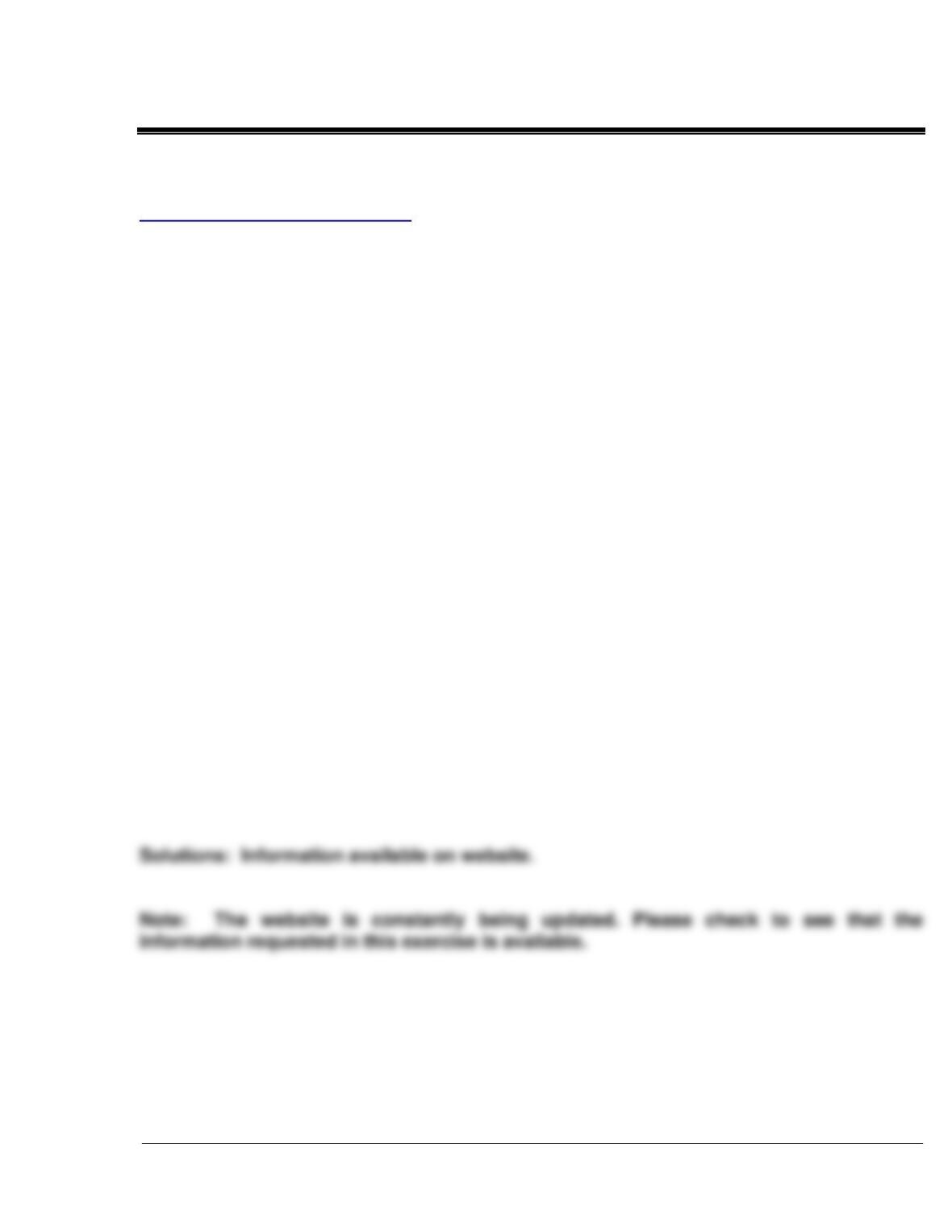
Morgan’s Rating Service has the following amounts at December 31: Common Stock, $1 par, 500
shares issued, $500; Paid-in Capital in Excess of Par Value, $10,000; Retained Earnings, $7,000; and
Treasury Stock, 20 shares, $450.
Prepare the stockholders’ equity section of the balance sheet.
List three reasons why Morgan’s Rating Service may have Treasury Stock.
Solutions:
1.
Morgan’s Rating Service
Balance Sheet (partial)
December 31
Stockholders’ equity
Paid-in Capital
Common stock, $1 par, 500 shares
issued and 480 shares outstanding ……… $ 500
11–31
Exercise 5 – Library or World Wide Web Research and Stockholders’ Equity Activity
Chapter 11
Obtain a copy of Colgate’s Annual Report from your school library or research the World Wide
Web to find information to answer the following questions. If researching the web, go to
http://www.colgatepalmolive.com.
1. What accounting firm is responsible for Colgate’s independent audit?
2. How much did Colgate pay out in dividends during the last fiscal year? Did the
dividends go to preferred or common stockholders?
3. On which financial statement(s) did you find information concerning the amount of
dividends paid?
4. Does Colgate own treasury stock? If so, how much did Colgate pay for the treasury
stock?
5. On which financial statement(s) did you find information concerning Colgate’s treasury
stock?

11–32
Exercise 6 – World Wide Web Research and Stock Exchange Vocabulary Activity
Chapter 11
Stock ownership has grown dramatically. As a student and a potential investor you should be
familiar with terms associated with corporate stocks and the exchanges on which they are
traded. Go to the Internet and find the definitions to the following terms. Be sure to note the
source of your information.
1. American Stock Exchange
2. Blue Chip
3. Bull Market
4. Common Stock
5. Dividend
6. Dow Jones Industrial Average (DJIA)
7. Equity
8. Fiscal Year
9. Listed Stock
10. Market Value
11. Member
12. NASDAQ
13. New York Stock Exchange
14. Over-the-Counter
11–33
15. Record Date
16. Round Lot Order
17. SEC
18. Secondary Distribution
19. Stock Exchange
20. Stock Split
21. Ticker Symbol
22. Treasury Stock

11–34
Exercise 7 – Library and/or World Wide Web Research and Initial Public Offering
Activity
Chapter 11
A company may choose one of several ways to raise needed capital for growth and expansion.
A popular alternative for raising capital is to sell stock to the public. Research your school
library and/or the Internet to find an initial public offering (IPO) of common stock within the last
three years. Some of you might be interested in Facebook, Inc. Answer the following questions
for the company you select.
1. What is the name of the business?
2. What is the primary business of the company?
3. What was the initial selling price of the stock?
4. What was the number of shares originally offered for sale?
5. What is the current selling price of these shares?