11-1
CHAPTER 11
DECISION MAKING AND RELEVANT INFORMATION
11-1 The five steps in the decision process outlined in Exhibit 11-1 of the text are
1. Identify the problem and uncertainties.
2. Obtain information.
3. Make predictions about the future.
4. Make decisions by choosing among alternatives.
5. Implement the decision, evaluate performance, and learn.
11-4 Quantitative factors are outcomes that are measured in numerical terms. Some
quantitative factors are financial––that is, they can be easily expressed in monetary terms. Direct
materials are an example of a quantitative financial factor. Other quantitative nonfinancial
factors, such as on-time flight arrivals, cannot be easily expressed in monetary terms. Qualitative
factors are outcomes that are difficult to measure accurately in numerical terms. An example is
employee morale.
11-6 No. Some variable costs may not differ among the alternatives under consideration and,
hence, will be irrelevant. Some fixed costs may differ among the alternatives and, hence, will be
relevant.
11-8 Opportunity cost is the contribution to income that is forgone (rejected) by not using a
limited resource in its next-best alternative use.
11-2
11-9 No. When deciding on the quantity of inventory to buy, managers must consider both the
purchase cost per unit and the opportunity cost of funds invested in the inventory. For example,
the purchase cost per unit may be low when the quantity of inventory purchased is large, but the
benefit of the lower cost may be more than offset by the high opportunity cost of the funds
invested in acquiring and holding inventory.
11-12 Cost written off as depreciation is irrelevant when it pertains to a past cost such as
equipment already purchased. But the purchase cost of new equipment to be acquired in the
future that will then be written off as depreciation is often relevant.
11-15 The text outlines two methods of determining the optimal solution to an LP problem:
(i) Trial-and-error approach
(ii) Graphic approach
Most LP applications in practice use standard software packages that rely on the simplex method
to compute the optimal solution.
11-3
11-16 (20 min.) Disposal of assets.
Answer the following questions.
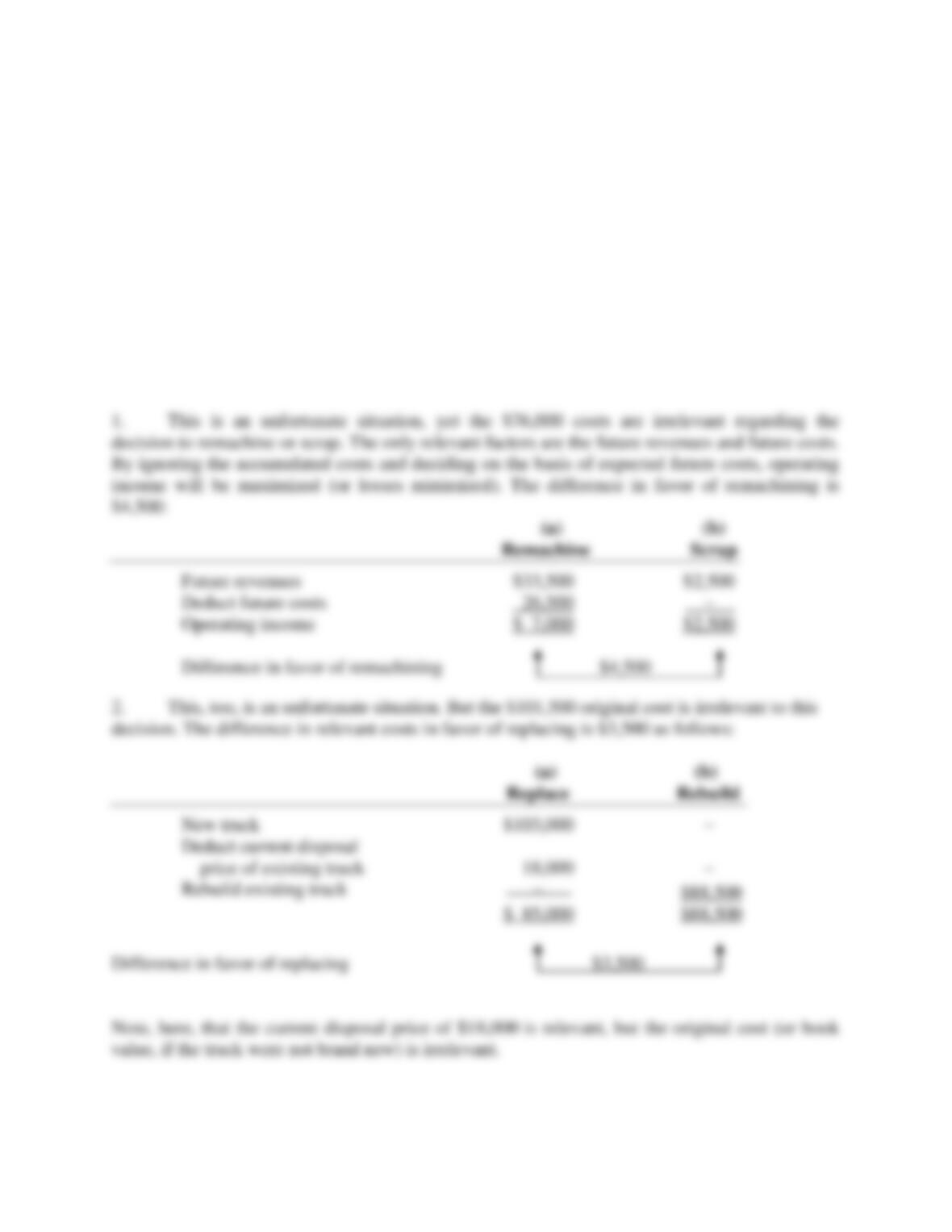
1. A company has an inventory of 1,250 assorted parts for a line of missiles that has been
discontinued. The inventory cost is $76,000. The parts can be either (a) remachined at total
additional costs of $26,500 and then sold for $33,500 or (b) sold as scrap for $2,500. Which
action is more profitable? Show your calculations.
2. A truck, costing $100,500 and uninsured, is wrecked its first day in use. It can be either (a)
disposed of for $18,000 cash and replaced with a similar truck costing $103,000 or (b) rebuilt
for $88,500 and thus be brand-new as far as operating characteristics and looks are
concerned. Which action is less costly? Show your calculations.
SOLUTION
11-4
11-17 (20 min.) Relevant and irrelevant costs.
Answer the following questions.
1. DeCesare Computers makes 5,200 units of a circuit board, CB76, at a cost of $280 each.
Variable cost per unit is $190 and fixed cost per unit is $90. Peach Electronics offers to
supply 5,200 units of CB76 for $260. If DeCesare buys from Peach it will be able to save $10
per unit in fixed costs but continue to incur the remaining $80 per unit. Should DeCesare
accept Peach’s offer? Explain.
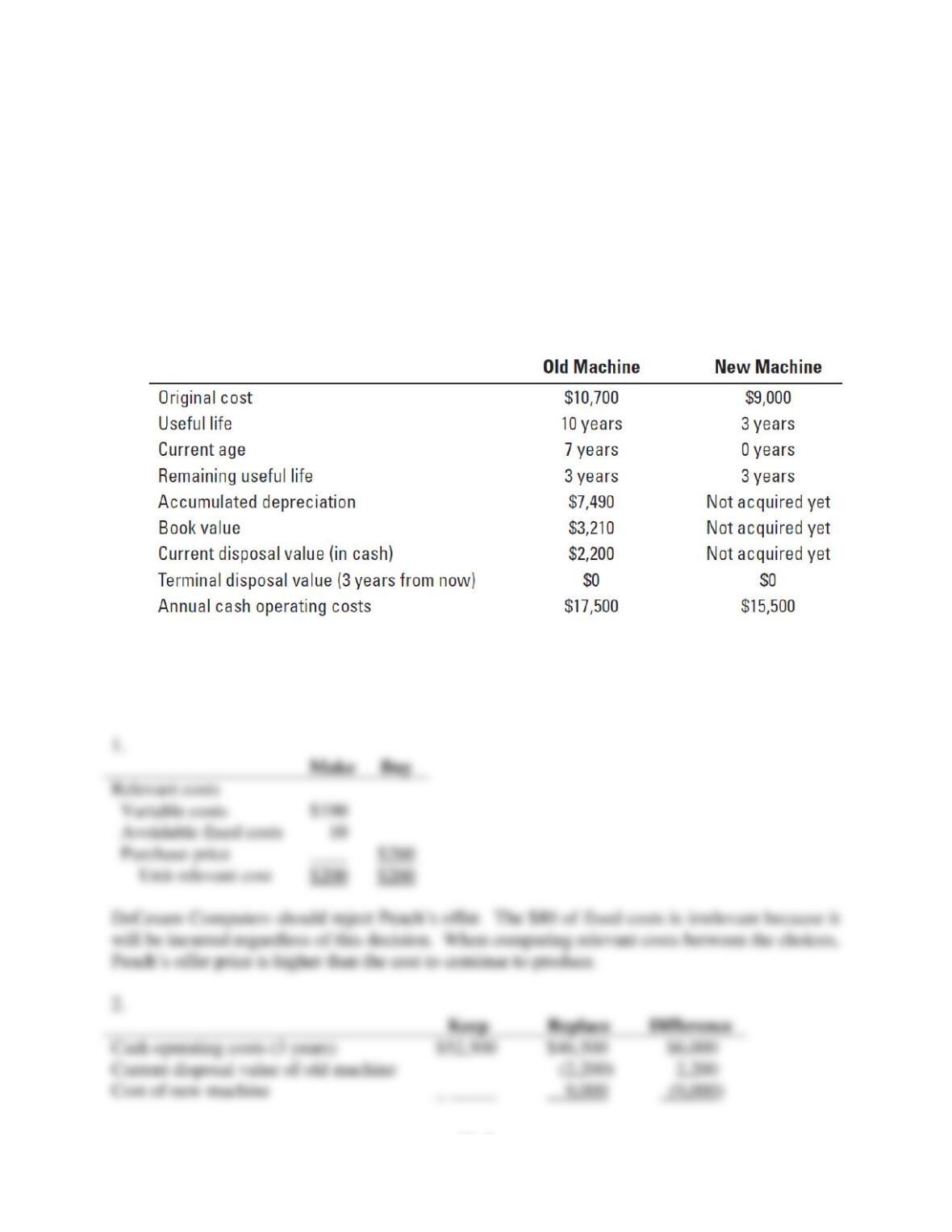
2. LN Manufacturing is deciding whether to keep or replace an old machine. It obtains the
following information:
LN Manufacturing uses straight-line depreciation. Ignore the time value of money and
income taxes. Should LN Manufacturing replace the old machine? Explain.
SOLUTION
11-5
11-18 (15 min.) Multiple choice.
(CPA) Choose the best answer.
1. The Dalton Company manufactures slippers and sells them at $12 a pair. Variable
manufacturing cost is $5.00 a pair, and allocated fixed manufacturing cost is $1.25 a pair. It
has enough idle capacity available to accept a one-time-only special order of 5,000 pairs of
slippers at $6.25 a pair. Dalton will not incur any marketing costs as a result of the special
order. What would the effect on operating income be if the special order could be accepted
without affecting normal sales: (a) $0, (b) $6,250 increase, (c) $28,750 increase, or (d)
$31,250 increase? Show your calculations.
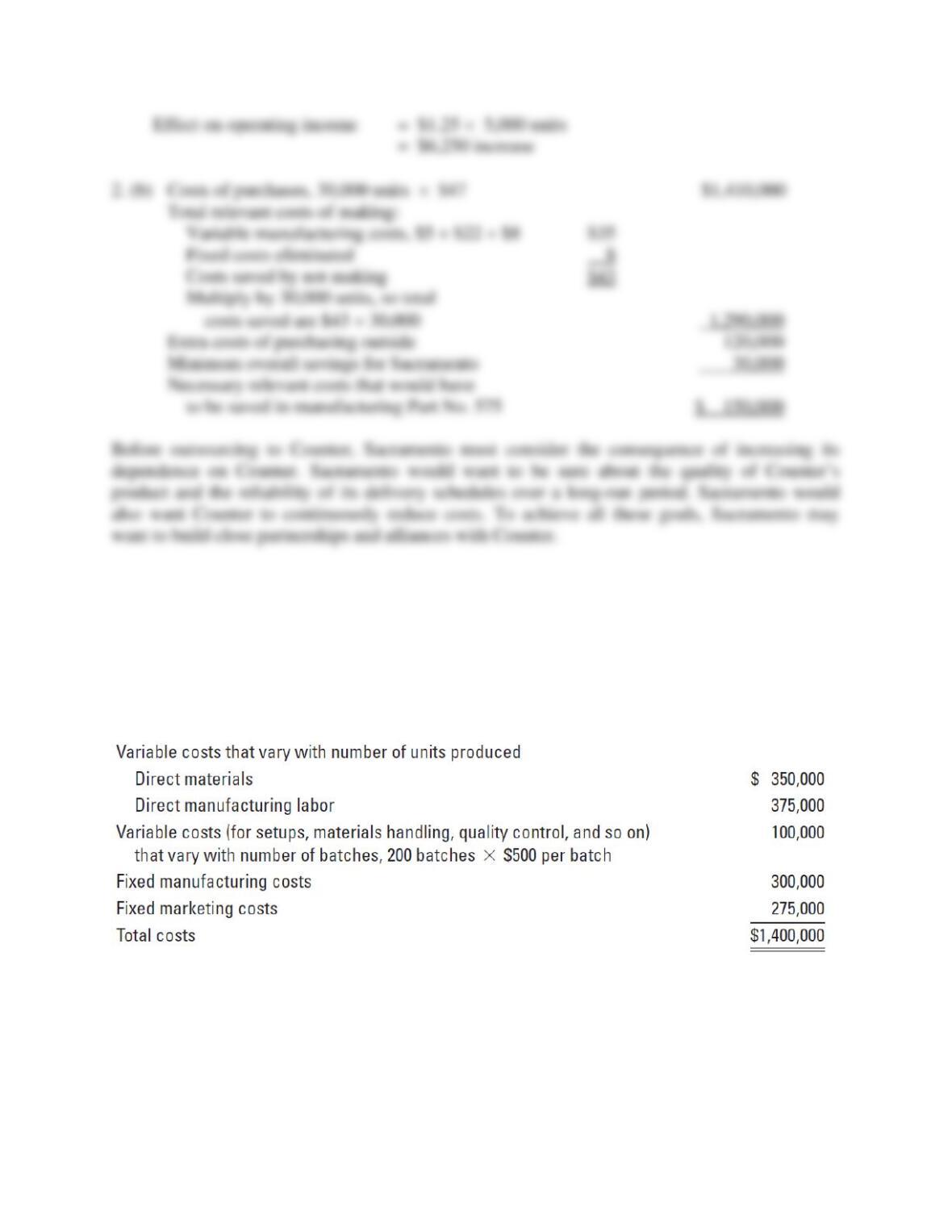
2. The Sacramento Company manufactures Part No. 498 for use in its production line. The
manufacturing cost per unit for 30,000 units of Part No. 498 is as follows:
The Counter Company has offered to sell 30,000 units of Part No. 498 to Sacramento for $47 per
unit. Sacramento will make the decision to buy the part from Counter if there is an overall
savings of at least $30,000 for Sacramento. If Sacramento accepts Counter’s offer, $8 per unit of
the fixed overhead allocated would be eliminated. Furthermore, Sacramento has determined that
the released facilities could be used to save relevant costs in the manufacture of Part No. 575.
For Sacramento to achieve an overall savings of $30,000, the amount of relevant costs that
would have to be saved by using the released facilities in the manufacture of Part No. 575 would
be which of the following: (a) $90,000, (b) $150,000, (c) $180,000, or (d) $210,000? Show your
calculations. What other factors might Sacramento consider before outsourcing to Counter?
SOLUTION
11-6
11-19 (30 min.) Special order, activity-based costing.
(CMA, adapted) The Gold Plus Company manufactures medals for winners of athletic events
and other contests. Its manufacturing plant has the capacity to produce 11,000 medals each
month. Current production and sales are 10,000 medals per month. The company normally
charges $150 per medal. Cost information for the current activity level is as follows:
Gold Plus has just received a special one–time-only order for 1,000 medals at $100 per medal.
Accepting the special order would not affect the company’s regular business. Gold Plus makes
medals for its existing customers in batch sizes of 50 medals (200 batches × 50 medals per batch
= 10,000 medals). The special order requires Gold Plus to make the medals in 25 batches of 40
medals.
11-7
Required:
1. Should Gold Plus accept this special order? Show your calculations.
2. Suppose plant capacity were only 10,500 medals instead of 11,000 medals each month. The
special order must either be taken in full or be rejected completely. Should Gold Plus accept
the special order? Show your calculations.
3. As in requirement 1, assume that monthly capacity is 11,000 medals. Gold Plus is concerned
that if it accepts the special order, its existing customers will immediately demand a price
discount of $10 in the month in which the special order is being filled. They would argue that
Gold Plus’s capacity costs are now being spread over more units and that existing customers
should get the benefit of these lower costs. Should Gold Plus accept the special order under
these conditions? Show your calculations.
11-8
SOLUTION
11-9
11-10
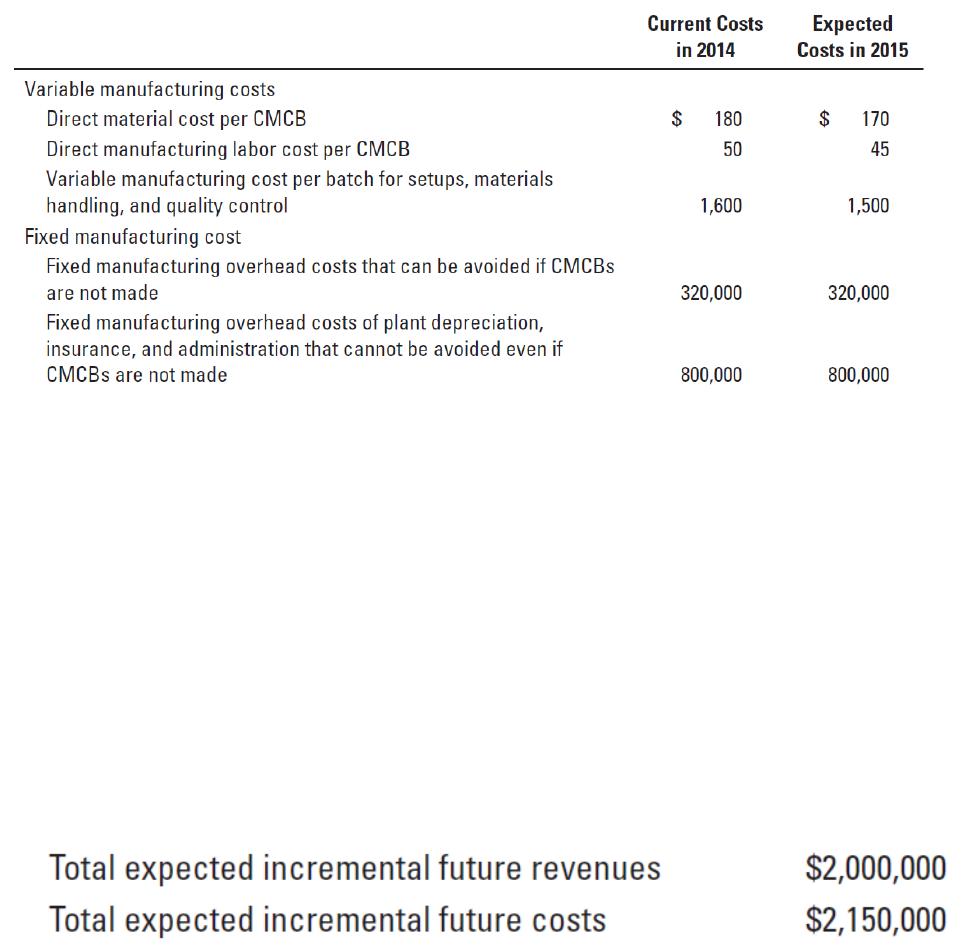
11-20 (30 min.) Make versus buy, activity-based costing.
The Svenson Corporation manufactures cellular modems. It manufactures its own cellular
modem circuit boards (CMCB), an important part of the cellular modem. It reports the following
cost information about the costs of making CMCBs in 2014 and the expected costs in 2015:
Svenson manufactured 8,000 CMCBs in 2014 in 40 batches of 200 each. In 2015, Svenson
anticipates needing 10,000 CMCBs. The CMCBs would be produced in 80 batches of 125 each.
The Minton Corporation has approached Svenson about supplying CMCBs to Svenson in
2015 at $300 per CMCB on whatever delivery schedule Svenson wants.
Required:
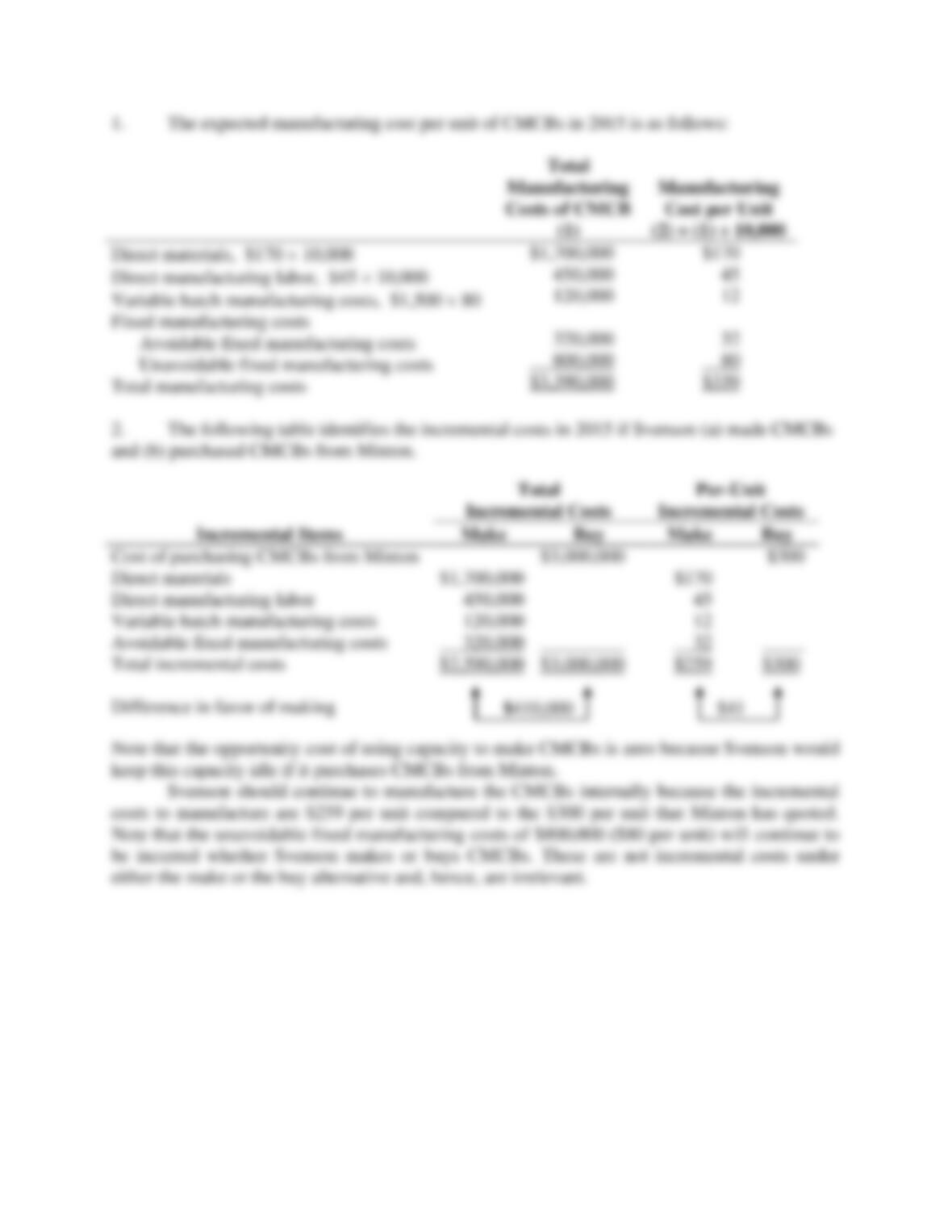
1. Calculate the total expected manufacturing cost per unit of making CMCBs in 2015.
2. Suppose the capacity currently used to make CMCBs will become idle if Svenson purchases
CMCBs from Minton. On the basis of financial considerations alone, should Svenson make
CMCBs or buy them from Minton? Show your calculations.
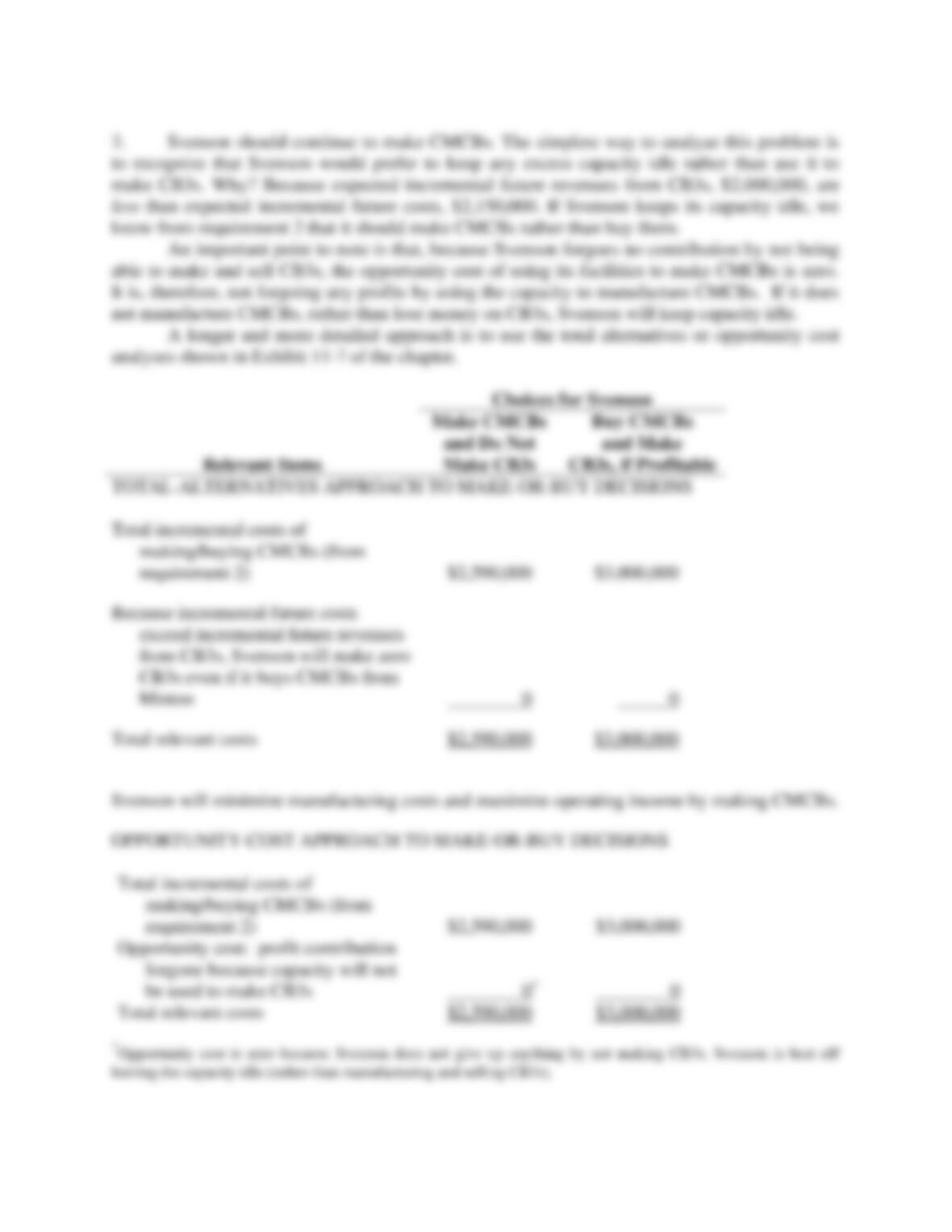
3. Now suppose that if Svenson purchases CMCBs from Minton, its best alternative use of the
capacity currently used for CMCBs is to make and sell special circuit boards (CB3s) to the
Essex Corporation. Svenson estimates the following incremental revenues and costs from
CB3s:
On the basis of financial considerations alone, should Svenson make CMCBs or buy them
from Minton? Show your calculations.
SOLUTION
11-11
11-12
11-13
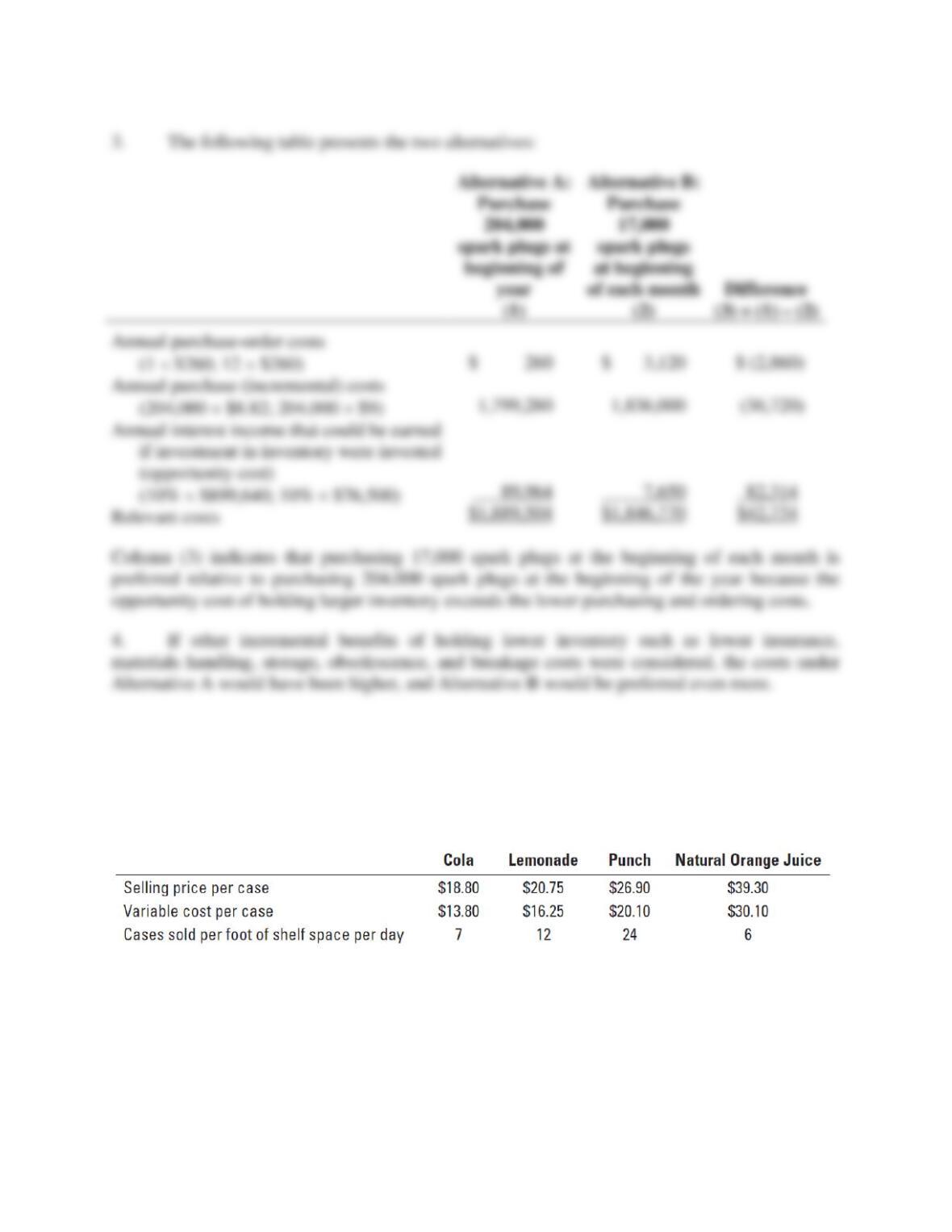
11-21 (10 min.) Inventory decision, opportunity costs.
Best Trim, a manufacturer of lawn mowers, predicts that it will purchase 204,000 spark plugs
next year. Best Trim estimates that 17,000 spark plugs will be required each month. A supplier
quotes a price of $9 per spark plug. The supplier also offers a special discount option: If all
204,000 spark plugs are purchased at the start of the year, a discount of 2% off the $9 price will
be given. Best Trim can invest its cash at 10% per year. It costs Best Trim $260 to place each
purchase order.
Required:
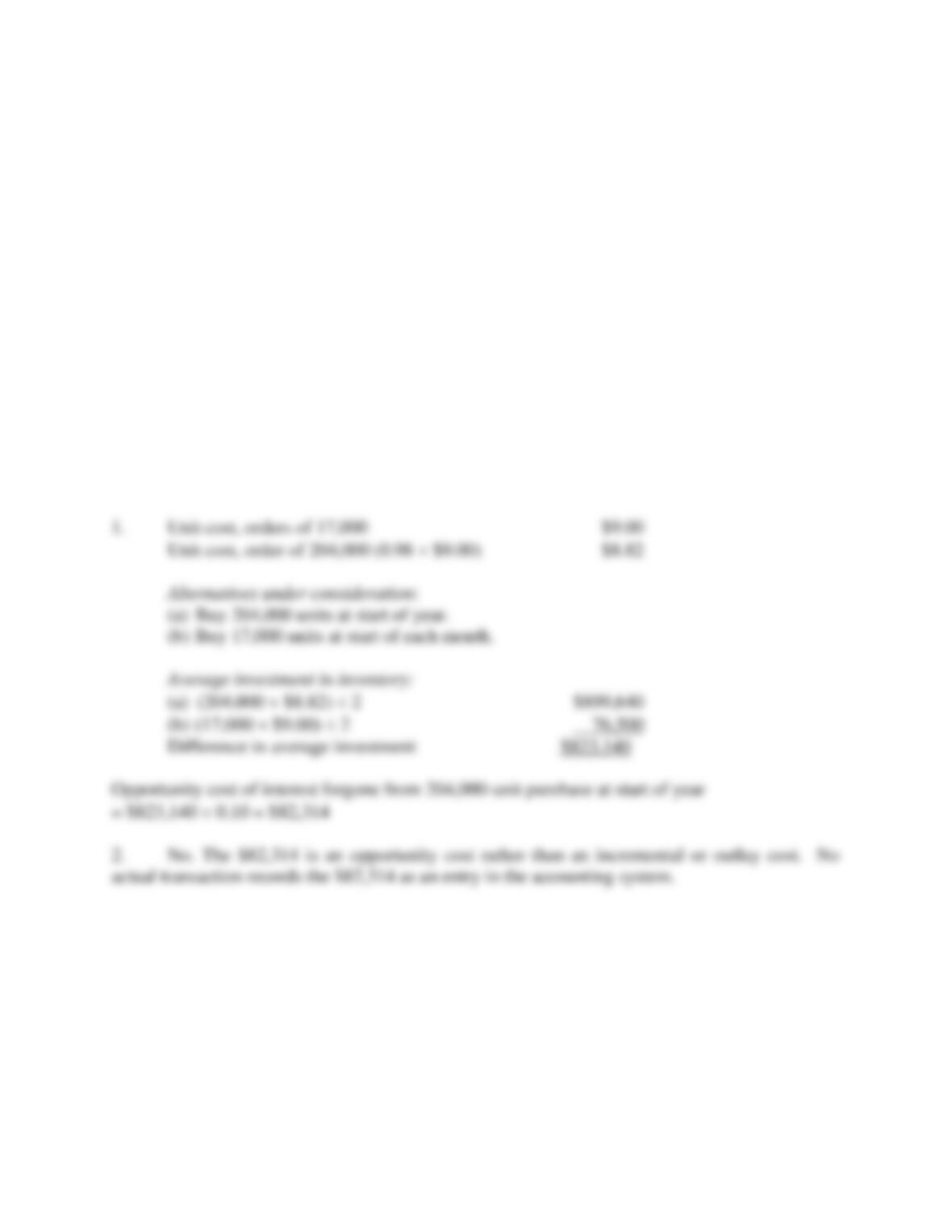
1. What is the opportunity cost of interest forgone from purchasing all 204,000 units at the start
of the year instead of in 12 monthly purchases of 17,000 units per order?
2. Would this opportunity cost be recorded in the accounting system? Why?
3. Should Best Trim purchase 204,000 units at the start of the year or 17,000 units each month?
Show your calculations.
4. What other factors should Best Trim consider when making its decision?
SOLUTION
11-14
11-22 (20–25 min.) Relevant costs, contribution margin, product emphasis.
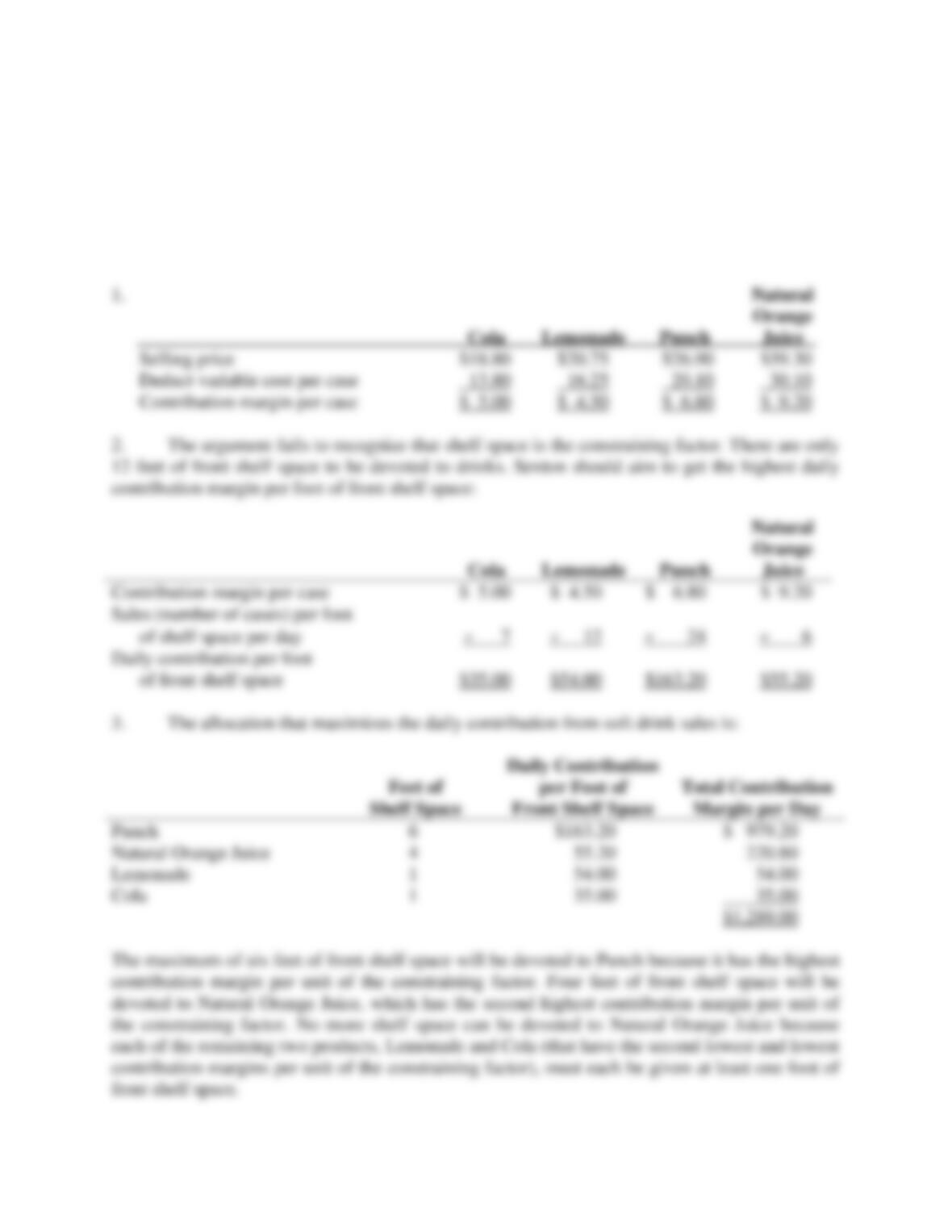
The Snack Shack is a take-out food store at a popular beach resort. Susan Sexton, owner of the
Snack Shack, is deciding how much refrigerator space to devote to four different drinks.
Pertinent data on these four drinks are as follows:
Sexton has a maximum front shelf space of 12 feet to devote to the four drinks. She wants a
minimum of 1 foot and a maximum of 6 feet of front shelf space for each drink.
Required:
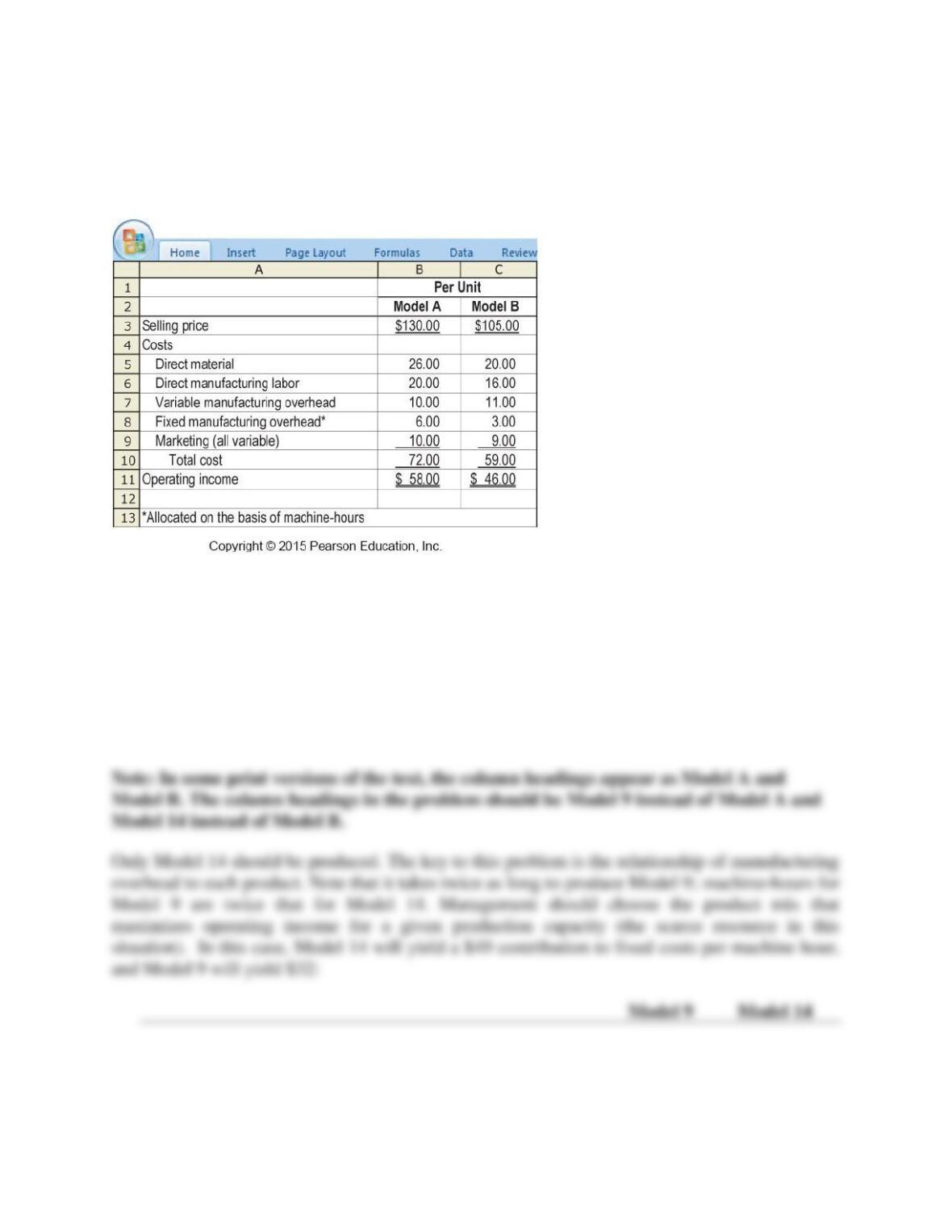
1. Calculate the contribution margin per case of each type of drink.
11-15
2. A coworker of Sexton’s recommends that she maximize the shelf space devoted to those
drinks with the highest contribution margin per case. Do you agree with this
recommendation? Explain briefly.
3. What shelf-space allocation for the four drinks would you recommend for the Snack Shack?
Show your calculations.
SOLUTION
11-16
11-23 (10 min.) Selection of most profitable product.
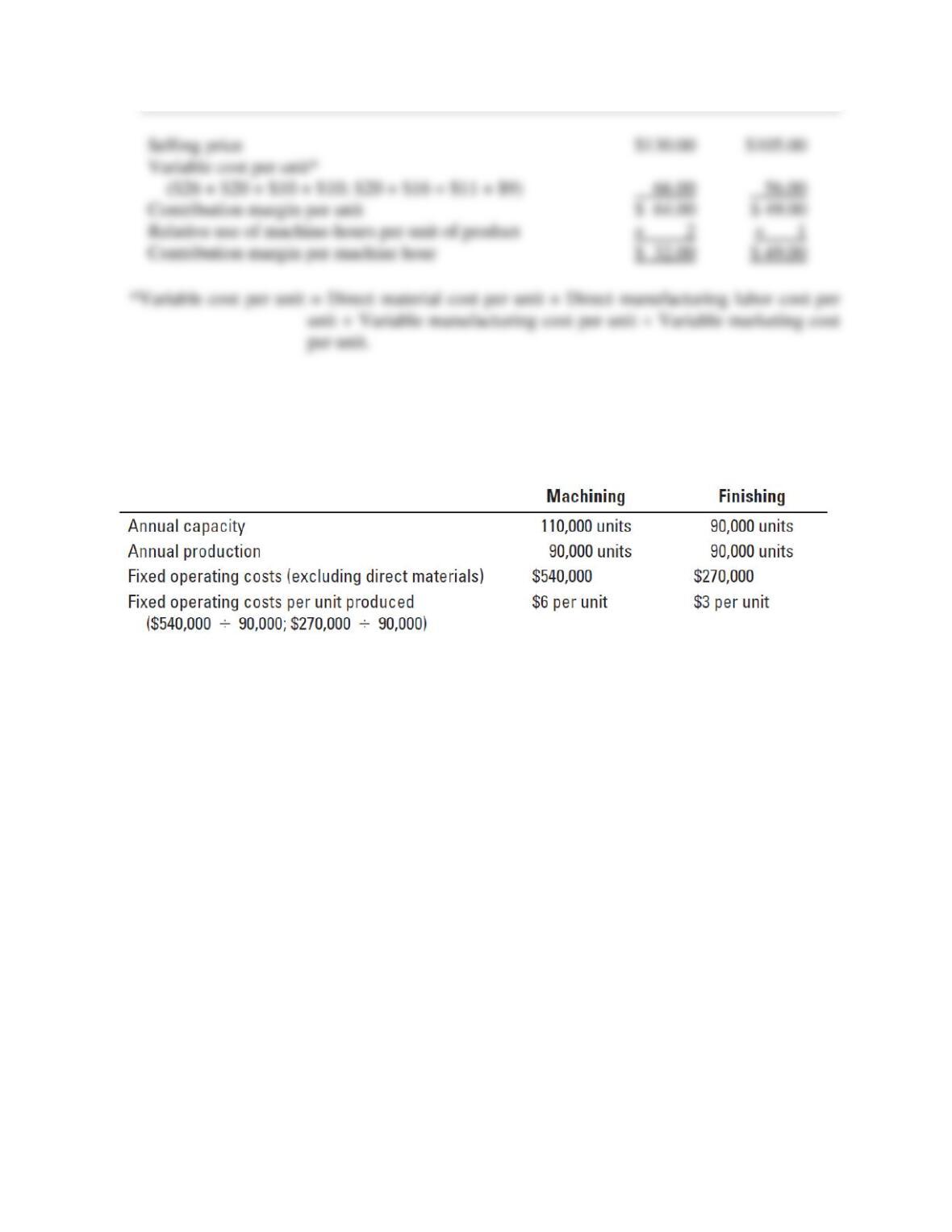
Fitness Gym, Inc., produces two basic types of weight-lifting equipment, Model 9 and Model 14.
Pertinent data are as follows:
The weight-lifting craze suggests that Fitness Gym can sell enough of either Model 9 or Model
14 to keep the plant operating at full capacity. Both products are processed through the same
production departments.
Required:
Which product should the company produce? Briefly explain your answer.
SOLUTION
11-17
11-24 (25 min.) Theory of constraints, throughput contribution, relevant costs.
The Pierce Corporation manufactures filing cabinets in two operations: machining and finishing.
It provides the following information:
Each cabinet sells for $70 and has direct material costs of $30 incurred at the start of the
machining operation. Pierce has no other variable costs. Pierce can sell whatever output it
produces. The following requirements refer only to the preceding data. There is no connection
between the requirements.
Required:
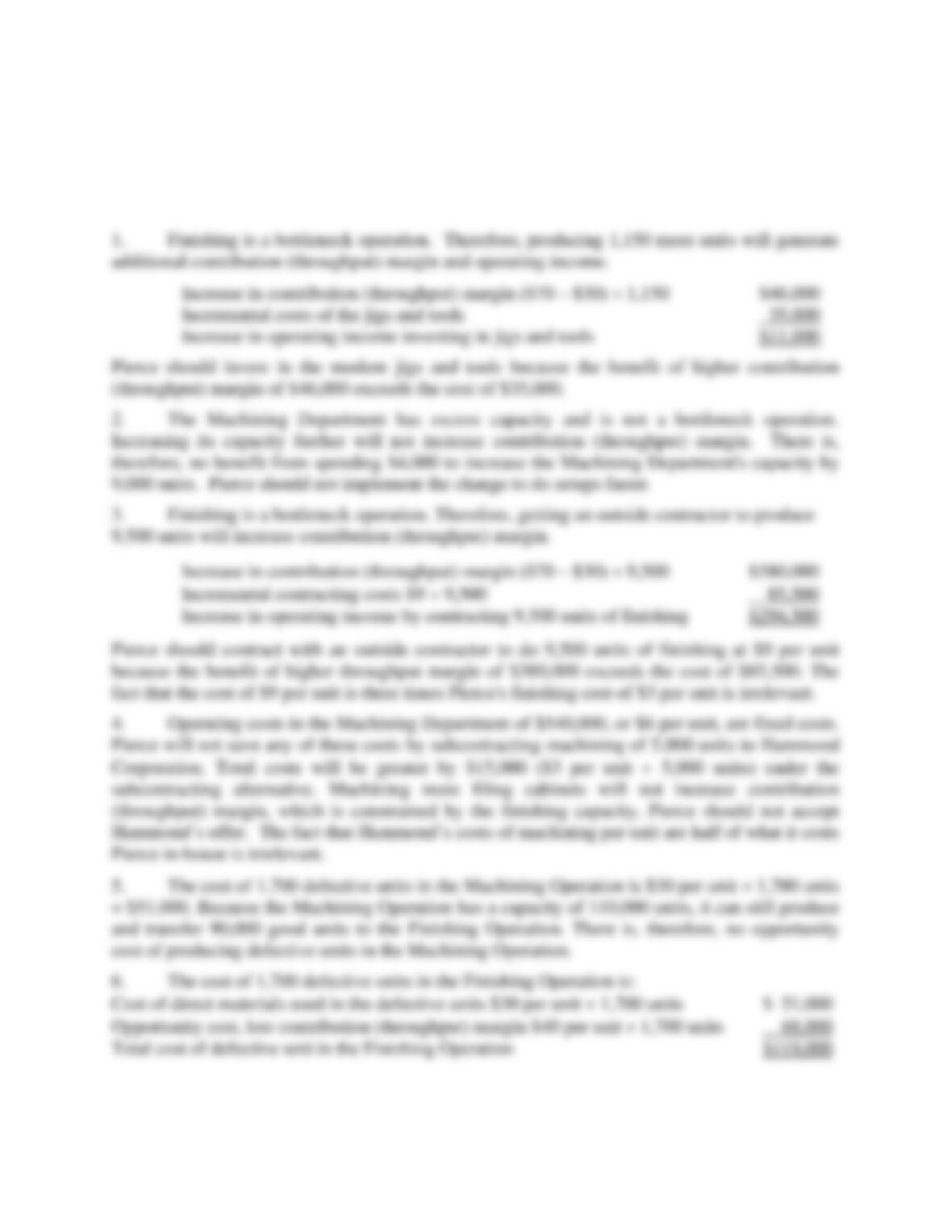
1. Pierce is considering using some modern jigs and tools in the finishing operation that would
increase annual finishing output by 1,150 units. The annual cost of these jigs and tools is
$35,000. Should Pierce acquire these tools? Show your calculations.
2. The production manager of the Machining Department has submitted a proposal to do faster
setups that would increase the annual capacity of the Machining Department by 9,000 units
and would cost $4,000 per year. Should Pierce implement the change? Show your
calculations.
3. An outside contractor offers to do the finishing operation for 9,500 units at $9 per unit, triple
the $3 per unit that it costs Pierce to do the finishing in-house. Should Pierce accept the
subcontractor’s offer? Show your calculations.
4. The Hammond Corporation offers to machine 5,000 units at $3 per unit, half the $6 per unit
that it costs Pierce to do the machining in-house. Should Pierce accept Hammond’s offer?
Show your calculations.
5. Pierce produces 1,700 defective units at the machining operation. What is the cost to Pierce
of the defective items produced? Explain your answer briefly.
11-18
6. Pierce produces 1,700 defective units at the finishing operation. What is the cost to Pierce of
the defective items produced? Explain your answer briefly.
SOLUTION
11-19
11-25 (25−30 min.) Closing and opening stores.
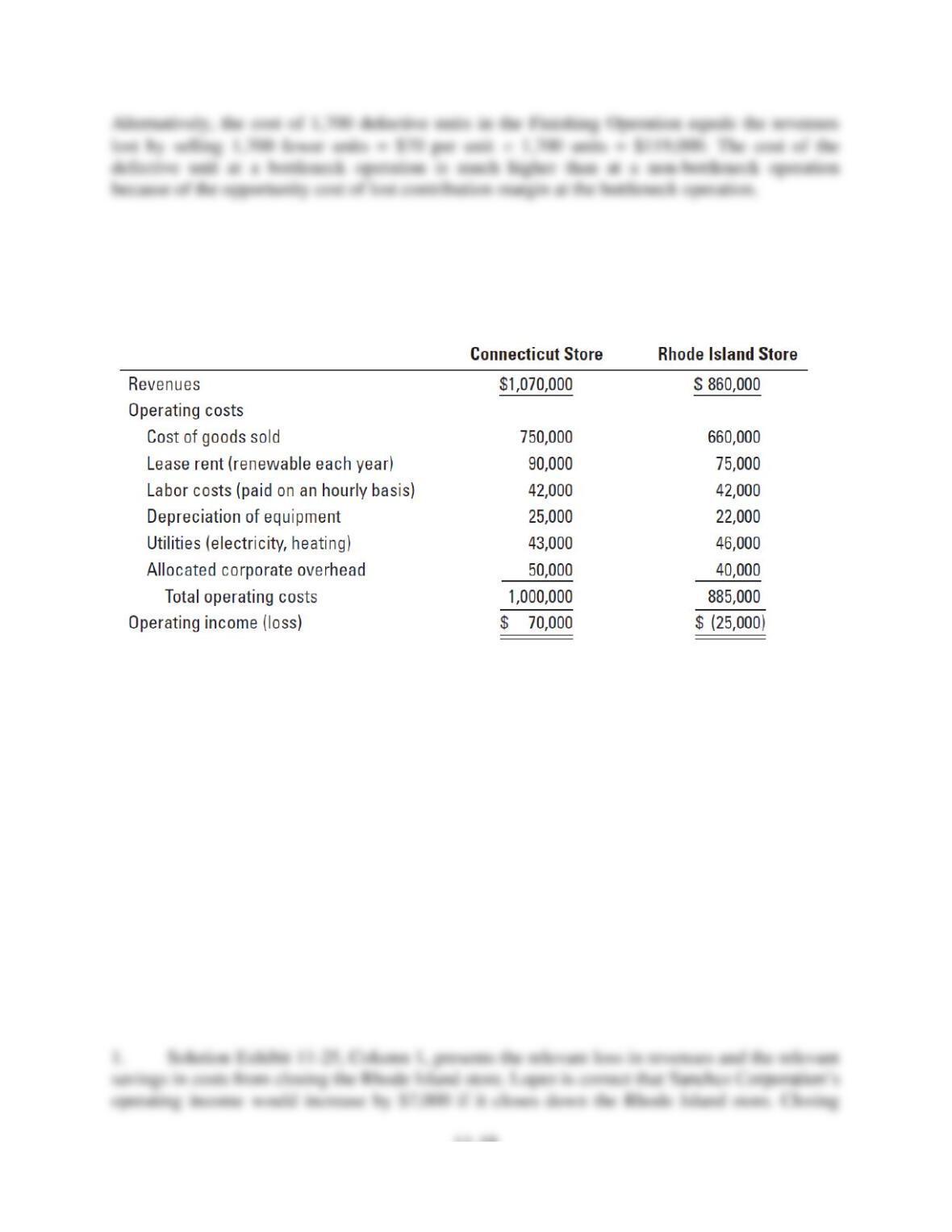
Sanchez Corporation runs two convenience stores, one in Connecticut and one in Rhode Island.
Operating income for each store in 2014 is as follows:
The equipment has a zero disposal value. In a senior management meeting, Maria Lopez, the
management accountant at Sanchez Corporation, makes the following comment, “Sanchez can
increase its profitability by closing down the Rhode Island store or by adding another store like
it.”
Required:
1. By closing down the Rhode Island store, Sanchez can reduce overall corporate overhead
costs by $44,000. Calculate Sanchez’s operating income if it closes the Rhode Island store. Is
Maria Lopez’s statement about the effect of closing the Rhode Island store correct? Explain.
2. Calculate Sanchez’s operating income if it keeps the Rhode Island store open and opens
another store with revenues and costs identical to the Rhode Island store (including a cost of
$22,000 to acquire equipment with a one-year useful life and zero disposal value). Opening
this store will increase corporate overhead costs by $4,000. Is Maria Lopez’s statement about
the effect of adding another store like the Rhode Island store correct? Explain.
SOLUTION
11-20
SOLUTION EXHIBIT 11-25
Relevant-Revenue and Relevant-Cost Analysis of Closing Rhode Island Store and Opening
Another Store Like It.
Incremental
(Loss in Revenues) Revenues and
and Savings in (Incremental Costs)
Costs from Closing of Opening New Store
Rhode Island Store Like Rhode Island Store
(1) (2)
Revenues $(860,000) $ 860,000
Cost of goods sold 660,000 (660,000)
Lease rent 75,000 (75,000)
Labor costs 42,000 (42,000)
Depreciation of equipment 0 (22,000)
Utilities (electricity, heating) 46,000 (46,000)
Corporate overhead costs 44,000 (4,000)
Total costs 867,000 (849,000)
Effect on operating income (loss) $ 7,000 $ 11,000