Problem 11–20 (continued)
Profits in the Carton Division will remain unchanged because it will be
paying the same price internally as it is now paying externally.
3. The Pulp Division has idle capacity, so transfers from the Pulp Division
to the Carton Division do not cut into normal sales of pulp to outsiders.
In this case, the minimum price as far as the Carton Division is
concerned is the variable cost per ton of $42. This is confirmed in the
following calculation:
$0
Transfer price $42 + = $42
5,000
³
4. Yes, $59 is a bona fide outside price. Even though $59 is less than the
Pulp Division’s $60 “full cost” per unit, it is within the range given in Part
3 and therefore will provide some contribution to the Pulp Division.
If the Pulp Division does not meet the $59 price, it will lose $85,000 in
potential profits:
Price per ton ……………………………………
$59
Variable costs …………………………………..
5. No, the Carton Division should be free to go outside and get the best
price it can. Even though this would result in lower profits for the
company as a whole, the buying division should not be forced to buy
inside if better prices are available outside.
Problem 11-20 (continued)
6. The Pulp Division will have an increase in profits:
Selling price ………………………………………
$70
Variable costs …………………………………….
42
Contribution margin per ton ………………….
$28
5,000 tons × $28 per ton = $140,000 increased profits
The Carton Division will have a decrease in profits:
Inside purchase price …………………………..
$70
Outside purchase price …………………………
59
Increased cost per ton …………………………
$11
5,000 tons × $11 per ton = $55,000 decreased profits
The company as a whole will have an increase in profits:
Increased contribution margin in the Pulp Division ………
Decreased contribution margin in the Carton Division…..
Increased contribution margin per ton ……………………..
Problem 11-21 (30 minutes)
Requirements 1., 2., and 3.:
This Year
New Line
Next Year
(1)
Sales ……………………..
$10,000,000
$2,000,000
$12,000,000
(2)
Net operating income ..
$800,000
$160,000
*
$960,000
(3)
Operating assets ………
$1,000,000
(4)
Margin (2) ÷ (1) ………
8%
8%
8%
(5)
Turnover (1) ÷ (3) ……
(6)
ROI (4) × (5) ………….
20.0%
16.0%
19.2%
*
Sales …………………………………………………
$2,000,000
Variable expenses (60% × $2,000,000) …….
1,200,000
Contribution margin ………………………………
Fixed expenses …………………………………….
Net operating income…………………………….
$ 160,000
4. Dell Havasi will be inclined to reject the new product line because
accepting it would reduce his division’s overall rate of return.
5. The new product line promises an ROI of 16%, whereas the company’s
overall ROI this year was only 15%. Thus, adding the new line would
increase the company’s overall ROI.
6a. through 6c.:
This Year
New Line
Next Year
Operating assets …………………
$4,000,000
$1,000,000
$5,000,000
Minimum return required ………
× 12%
× 12%
× 12%
Minimum required return ………
$ 480,000
$ 120,000
$ 600,000
Actual net operating income ….
$ 800,000
$ 160,000
$ 960,000
Residual income ………………….
$ 40,000
Problem 11-22 (45 minutes)
1.
Auto
Division
Truck
Division
Variable costs:
$3 per meal × 20,000 meals …..
$60,000
$3 per meal × 20,000 meals …..
$60,000
Fixed costs:
Total actual cost for the month ……………..
120,000
Spending variance—not allocated ………….
$ 2,000
2.
Actual variable cost ……………
$128,000
Actual fixed cost ………………..
42,000
Total actual cost ………………..
$170,000
One-half of the total cost, or $85,000, would be allocated to each
division, because the same number of meals was served in the two
divisions during the month.
Problem 11-22 (continued)
3. This method has two major problems. First, allocating the total actual
cost of the service department to the operating departments essentially
allocates the spending variances to the operating departments. This
4. Managers may understate their peak-period needs to reduce their
charges for fixed service department costs. Top management can
control such ploys by careful follow-up, with rewards being given to
those managers who estimate accurately, and severe penalties assessed
Problem 11–23 (45 minutes)
1. The Quark Division will probably reject the $340 price because it is
below the division’s variable cost of $350 per set. This variable cost
Division is a variable cost. Thus, it will reject the offered $340 price.
2. If both the Screen Division and the Quark Division have idle capacity,
then from the perspective of the entire company the $340 offer should
be accepted. By rejecting the $340 price, the company will lose $60 in
potential contribution margin per set:
3. If the Screen Division is operating at capacity, any screens transferred
to the Quark Division to fill the overseas order will have to be diverted
from outside customers. Whether a screen is sold to outside customers
Problem 11–23 (continued)
4. When the selling division has no idle capacity, as in part (3), market
price works very well as a transfer price. The cost to the company of a
transfer when there is no idle capacity is the lost revenue from sales to
outsiders. If the market price is used as the transfer price, the buying
division will view the market price of the transferred item as its cost—
which is appropriate because that is the cost to the company. As a
consequence, the manager of the buying division should be motivated
Problem 11–24 (30 minutes)
1.
Net operating income Sales
ROI = ×
Sales Average operating assets
$360,000 $4,000,000
= ×
$4,000,000 $2,000,000
= 9% × 2 = 18%
3.
$392,000 $4,000,000
ROI = ×
$4,000,000 $2,000,000
= 9.8% × 2 = 19.6%
(Increase) (Unchanged) (Increase)
4.
$380,000 $4,000,000
ROI = ×
= 9.5% × 1.6 = 15.2%
(Increase) (Decrease) (Decrease)
Problem 11-24 (continued)
5. The company has a contribution margin ratio of 30% ($24 CM per unit,
divided by the $80 selling price per unit). Therefore, a 20% increase in
sales would result in a new net operating income of:
6.
$320,000 $4,000,000
ROI = ×
$4,000,000 $1,960,000
= 8% × 2.04 = 16.3%
(Decrease) (Increase) (Decrease)
7.
$360,000 $4,000,000
ROI = ×
$4,000,000 $1,800,000
= 9% × 2.22 = 20%
(Unchanged) (Increase) (Increase)
Problem 11-25 (60 minutes)
1a., 1b., and 1c.:
From the standpoint of the selling division, Alpha Division:
Total contribution margin on lost sales
Variable cost
Transfer price +
per unit Number of units transferred
³
( )
³($30 – $18) × 5,000
Transfer price $18 – $2 + = $16 + $12 = $28
5,000
But, from the standpoint of the buying division, Beta Division:
£Transfer price Cost of buying from outside supplier = $27
There is no range of acceptable transfer prices. Beta Division won’t pay
more than $27 and Alpha Division will not accept less than $28, so no
deal is possible. There will be no transfer.
2a., 2b., and 2c.:
From the standpoint of the selling division, Alpha Division:
Total contribution margin on lost sales
Variable cost
Transfer price +
per unit Number of units transferred
³
Problem 11–25 (continued)
2d. The loss in potential profits to the company as a whole will be:
Beta Division’s outside purchase price …………………….
$89
Alpha Division’s variable cost on the internal transfer …
85
Potential added contribution margin lost to the
company as a whole ………………………………………..
$ 4
Number of units ………………………………………………..
× 30,000
Potential added contribution margin and company
profits forgone ………………………………………………..
$120,000
Another way to derive the same answer is to look at the loss in
potential profits for each division and then total the losses for the
impact on the company as a whole. The loss in potential profits in
Alpha Division will be:
Suggested selling price per unit …………………………….
$88
Alpha Division’s variable cost on the internal transfer …
85
Potential added contribution margin per unit ……………
$ 3
Number of units ………………………………………………..
× 30,000
Potential added contribution margin and divisional
profits forgone ………………………………………………..
$90,000
The loss in potential profits in Beta Division will be:
Outside purchase price per unit …………………………….
$89
Suggested price per unit inside …………………………….
88
Potential cost avoided per unit ……………………………..
$ 1
Number of units ………………………………………………..
× 30,000
Potential added contribution margin and divisional
profits forgone ………………………………………………..
$30,000
The total of these two amounts equals the $120,000 loss in potential
profits for the company as a whole.
Problem 11–25 (continued)
3b. and 3c.
From the standpoint of the buying division, Beta Division:
Transfer price Cost of buying from outside supplier
Transfer price $75 – (0.08 × $75) = $69
£
£
In this case, the range of acceptable transfer prices is:
££$40 Transfer price $69
If the managers understand what they are doing and are reasonably
cooperative, they should be able to come to an agreement with a
transfer price within this range.
4. From the standpoint of the selling division, Alpha Division:
Total contribution margin on lost sales
Variable cost
Transfer price +
per unit Number of units transferred
³
( )
$50 – $26 × 45,000
Transfer price $21 + = $21 + $9 = $30
120,000
³
Case 11–26 (60 minutes)
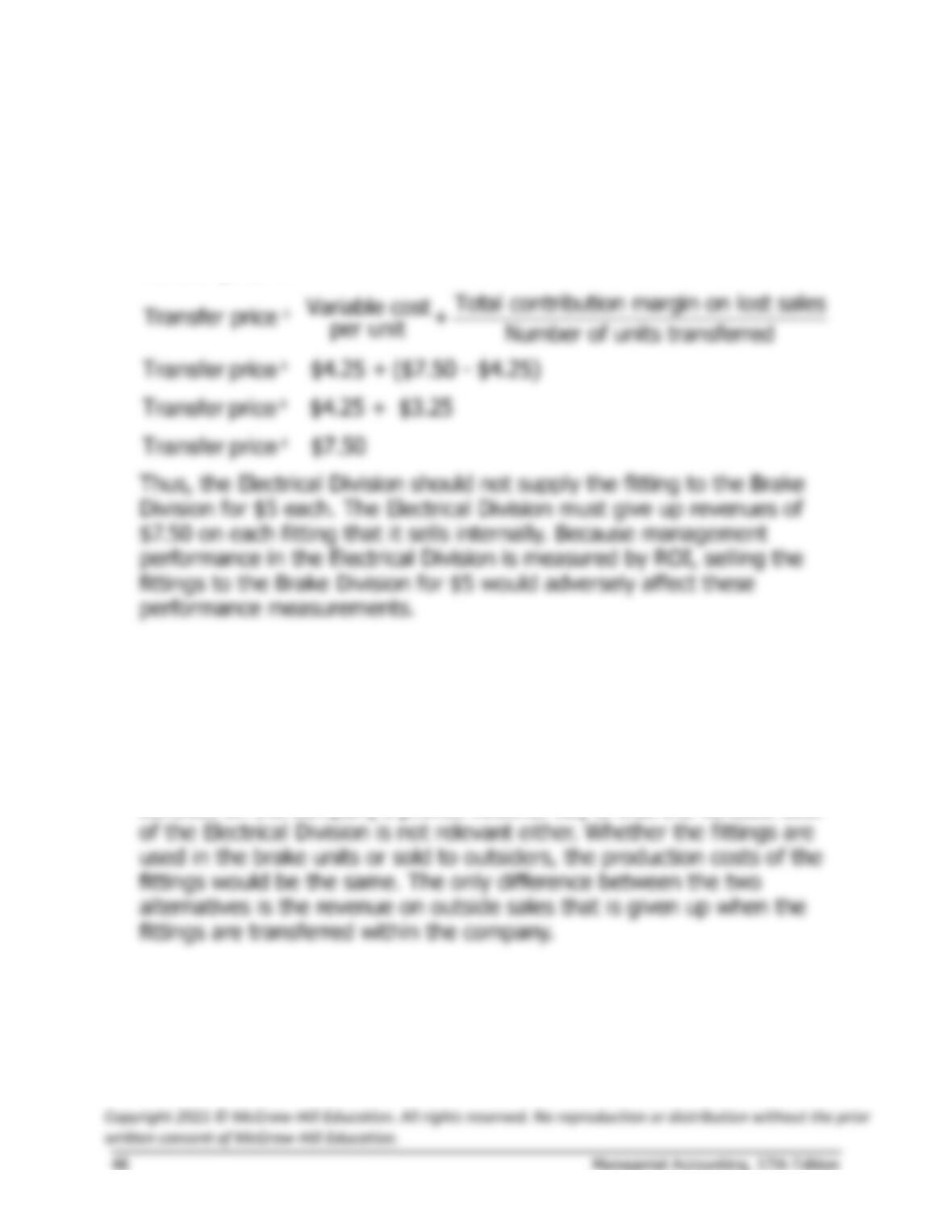
1. The Electrical Division is presently operating at capacity; therefore, any
sales of X52 electrical fittings to the Brake Division will require that the
Electrical Division give up an equal number of sales to outside
customers. Using the transfer pricing formula, we get a minimum
transfer price of:
2. The key is to realize that the $8 in fixed overhead and administrative
costs contained in the Brake Division’s $49.50 “cost” per brake unit is
not relevant. There is no indication that winning this contract would
actually affect any of the fixed costs. If these costs would be incurred
regardless of whether or not the Brake Division gets the airplane brake
contract, they should be ignored when determining the effects of the
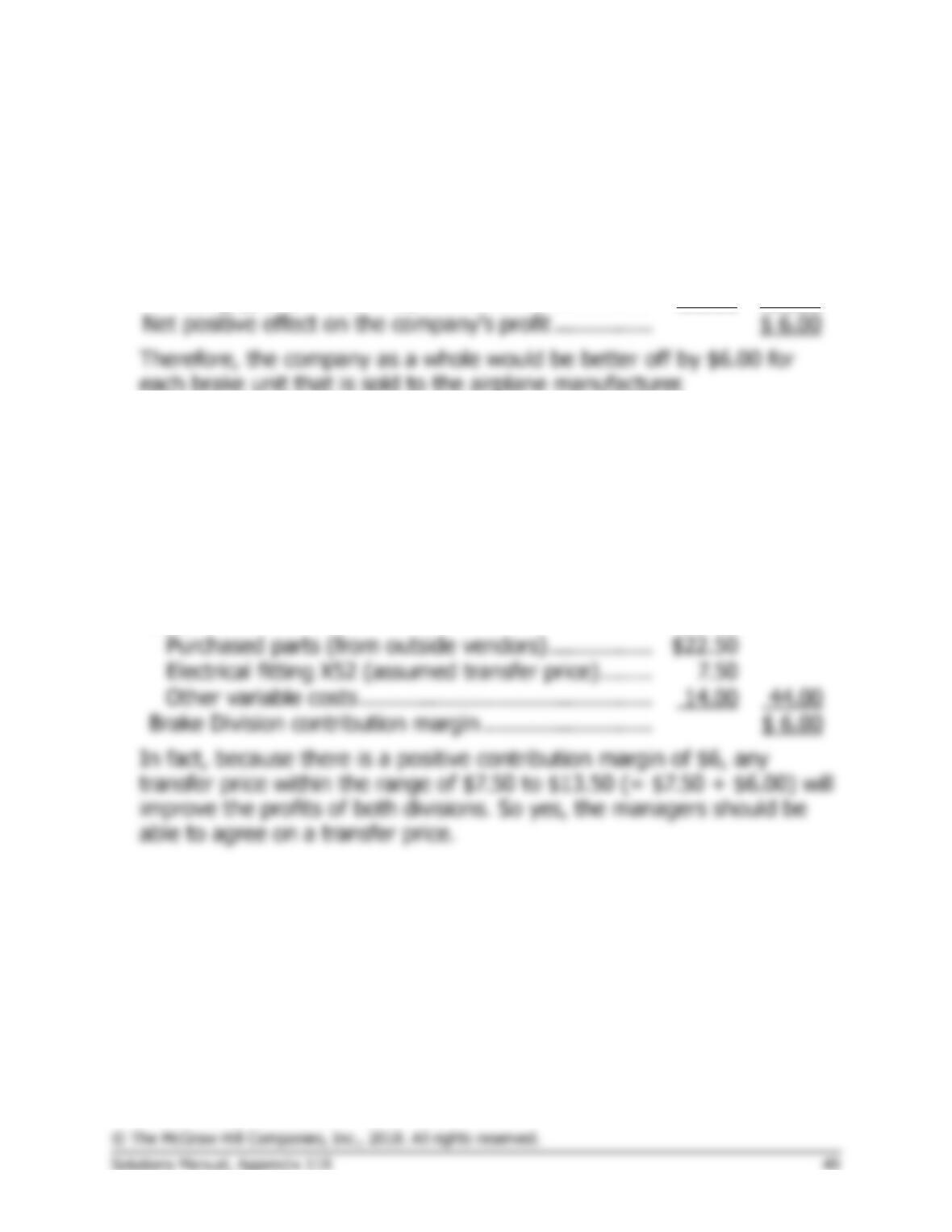
Case 11–26 (continued)
Selling price of the brake units …………………………...
$50.00
Less:
The cost of the fittings used in the brakes (i.e. the
lost revenue from sale of fittings to outsiders) …..
$ 7.50
Variable costs of the Brake Division excluding the
fitting ($22.50 + $14.00) ………………………………
36.50
44.00
$ 6.00
each brake unit that is sold to the airplane manufacturer.
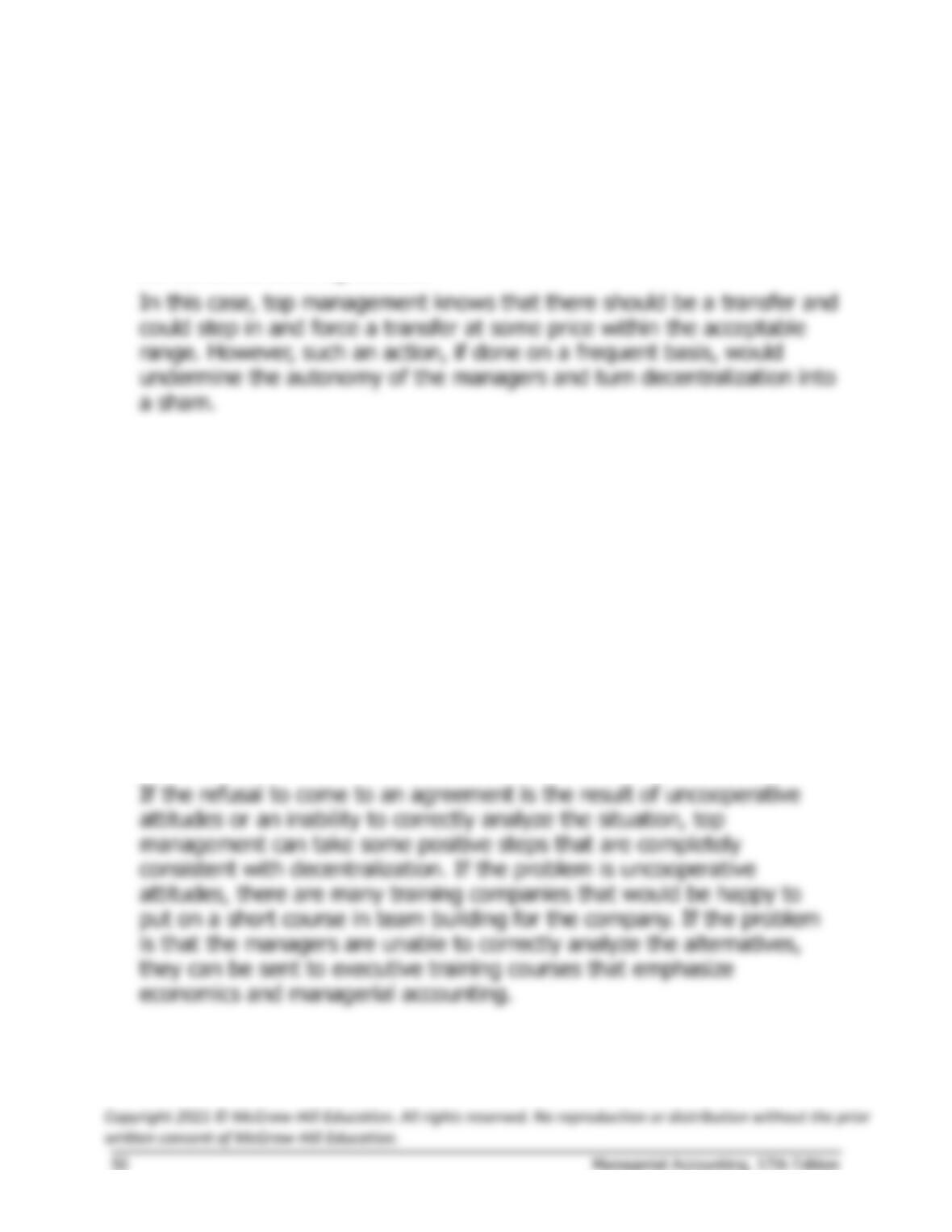
3. As shown in part (1) above, the Electrical Division would insist on a
transfer price of at least $7.50 for the fitting. Would the Brake Division
make any money at this price? Again, the fixed costs are not relevant in
this decision because they would not be affected. Once this is realized, it
is evident that the Brake Division would be ahead by $6.00 per brake
unit if it accepts the $7.50 transfer price.
Selling price of the brake units …………………………..
$50.00
Less:
14.00
Brake Division contribution margin ……………………..
Case 11–26 (continued)
4. It is in the best interests of the company and of the divisions to come to
an agreement concerning the transfer price. As demonstrated in part (3)
above, any transfer price within the range $7.50 to $13.50 would
improve the profits of both divisions. What happens if the two managers
do not come to an agreement?
Our advice to top management would be to ask the two managers to
meet to discuss the transfer pricing decision. Top management should
not dictate a course of action or what is to happen in the meeting, but
should carefully observe what happens in the meeting. If there is no
agreement, it is important to know why. There are at least three
possible reasons. First, the managers may have better information than
the top managers and refuse to transfer for very good reasons. Second,
the managers may be uncooperative and unwilling to deal with each
other even if it results in lower profits for the company and for
themselves. Third, the managers may not be able to correctly analyze
the situation and may not understand what is actually in their own best
interests. For example, the manager of the Brake Division may believe
that the fixed overhead and administrative cost of $8 per brake unit
really does have to be covered in order to avoid a loss.