CHAPTER 25 (FIN MAN); CHAPTER 11 (MAN) Differential Analysis and Product Pricing
Appendix Prob. 25–6B (FIN MAN); Appendix Prob. 11–6B (MAN)
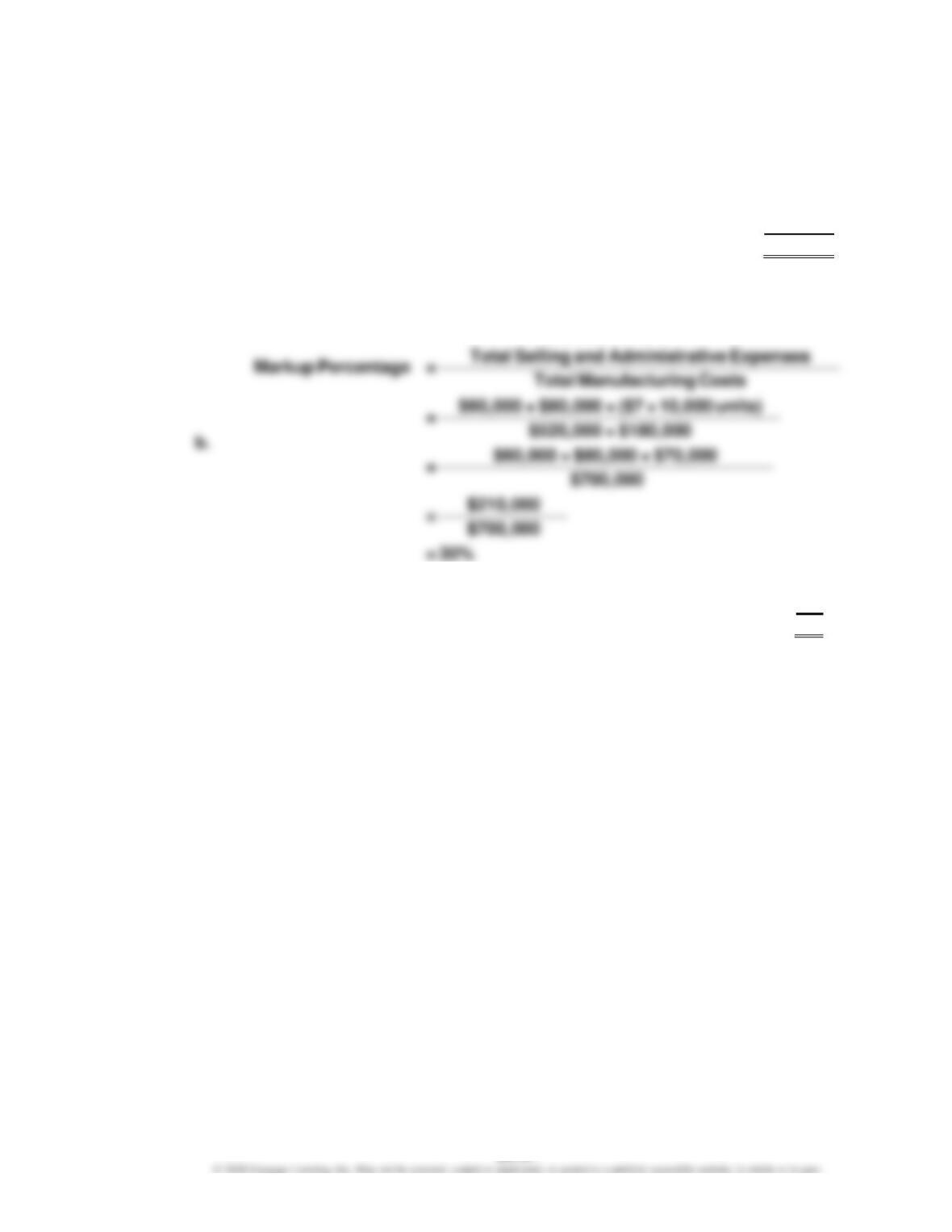
1. $60,000 ($600,000 × 10%)
2.
a.
Total manufacturing costs:
Variable ($52* × 10,000 units) …………………………………………………..
$520,000
Fixed factory overhead ……………………………………………………………
180,000
Total ……………………………………………………….…………………………
$700,000
Cost amount per unit: $700,000 ÷ 10,000 units ………………………………..
$ 70
*
$32 + $12 + $8
Desired Profit +
c.
Cost amount per unit …………………………………………………………………..
$70
Markup ($70 × 30%) …………………………………………………………………….
21
Selling price ……………………………………………………………………………….
$91
CHAPTER 25 (FIN MAN); CHAPTER 11 (MAN) Differential Analysis and Product Pricing
Appendix Prob. 25–6B (FIN MAN); Appendix Prob. 11–6B (MAN) (Continued)
3.
a.
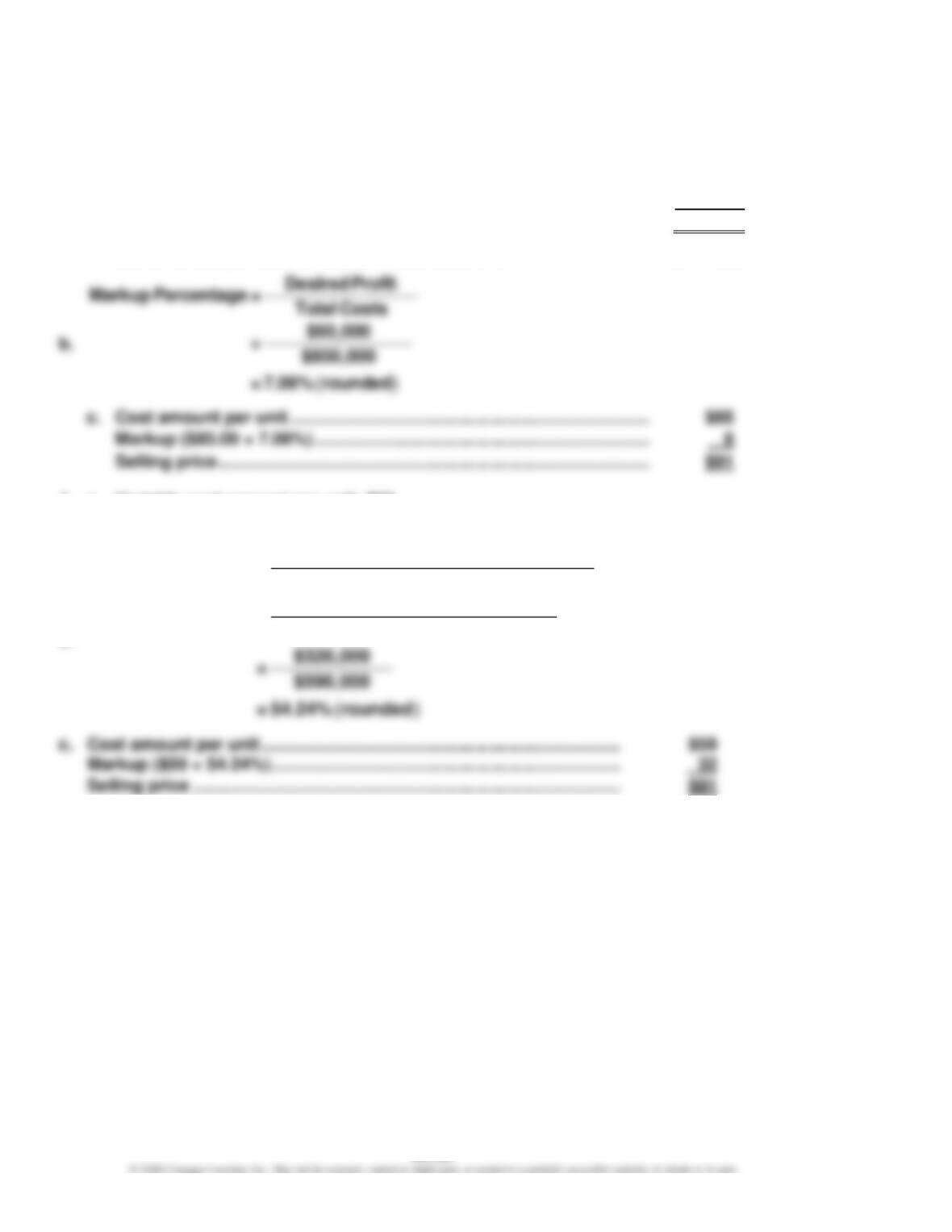
Total costs:
Variable ($59 × 10,000 units) ………………………………………………….
$590,000
Fixed ($180,000 + $80,000) ……………………………………………………..
260,000
Total ………………………………………………………………………………..
$850,000
Cost amount per unit: $850,000 ÷ 10,000 units …………………………...
$ 85.00
c.
Cost amount per unit ………………………………………………………………..
Markup ($85.00 × 7.06%) ……………………………………………………………
4.
a.
Variable cost amount per unit: $59
Total variable costs: $59 × 10,000 units = $590,000
Markup ($59 × 54.24%) ………………………………………………………………
Desired Profit + Total Fixed Costs
Markup Percentage = Total Variable Costs
$60,000 + $180,000 + $80,000
=$590,000
5. The cost-plus approach price of $91 should be viewed as a general guideline for
establishing long-run normal prices. Other considerations, such as the price of
competing products and general economic conditions of the marketplace, could
lead management to establish a short-run price more or less than $91.
CHAPTER 25 (FIN MAN); CHAPTER 11 (MAN) Differential Analysis and Product Pricing
Appendix Prob. 25–6B (FIN MAN); Appendix Prob. 11–6B (MAN) (Concluded)
6. a.
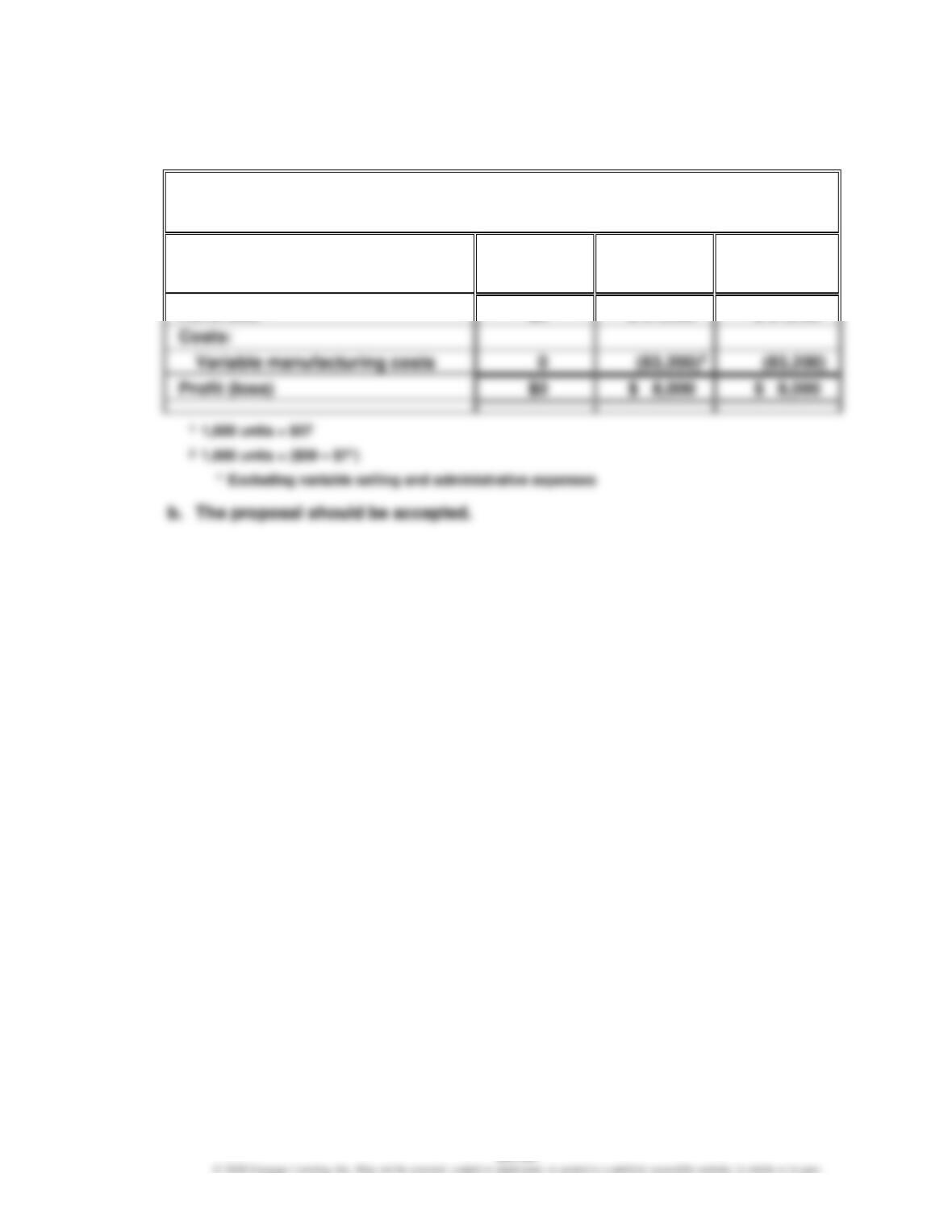
Differential Analysis
Reject (Alt. 1) or Accept (Alt. 2) Order
September 5
Reject
Order
(Alternative 1)
Accept
Order
(Alternative 2)
Differential
Effects
(Alternative 2)
Revenues
$0
$ 91,2001
$ 91,200
CHAPTER 25 (FIN MAN); CHAPTER 11 (MAN) Differential Analysis and Product Pricing
MAKE A DECISION
MAD 25–1 (FIN MAN); MAD 11–1 (MAN)
a.
Contribution Margin
=
Ticket Price – Variable Costs per Passenger
per Passenger
=
$180 – $40
=
$140
c.
Contribution Margin
=
Discounted Ticket Price – Variable Costs
per Passenger
=
$90 – $40
=
$50
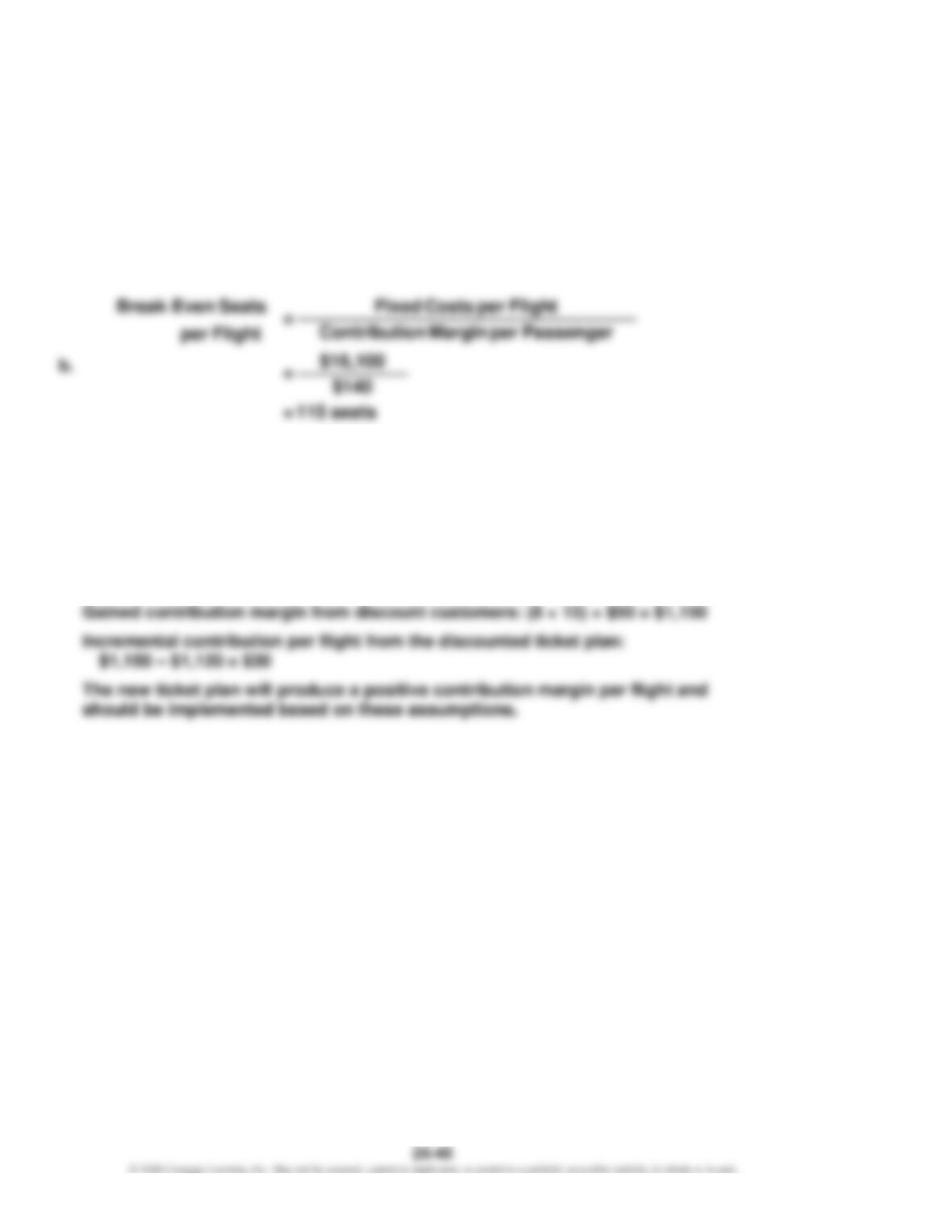
d. Lost contribution margin from customers who switch tickets: 8 × $140 = $1,120
CHAPTER 25 (FIN MAN); CHAPTER 11 (MAN) Differential Analysis and Product Pricing
MAD 25–1 (FIN MAN); MAD 11–1 (MAN) (Concluded)
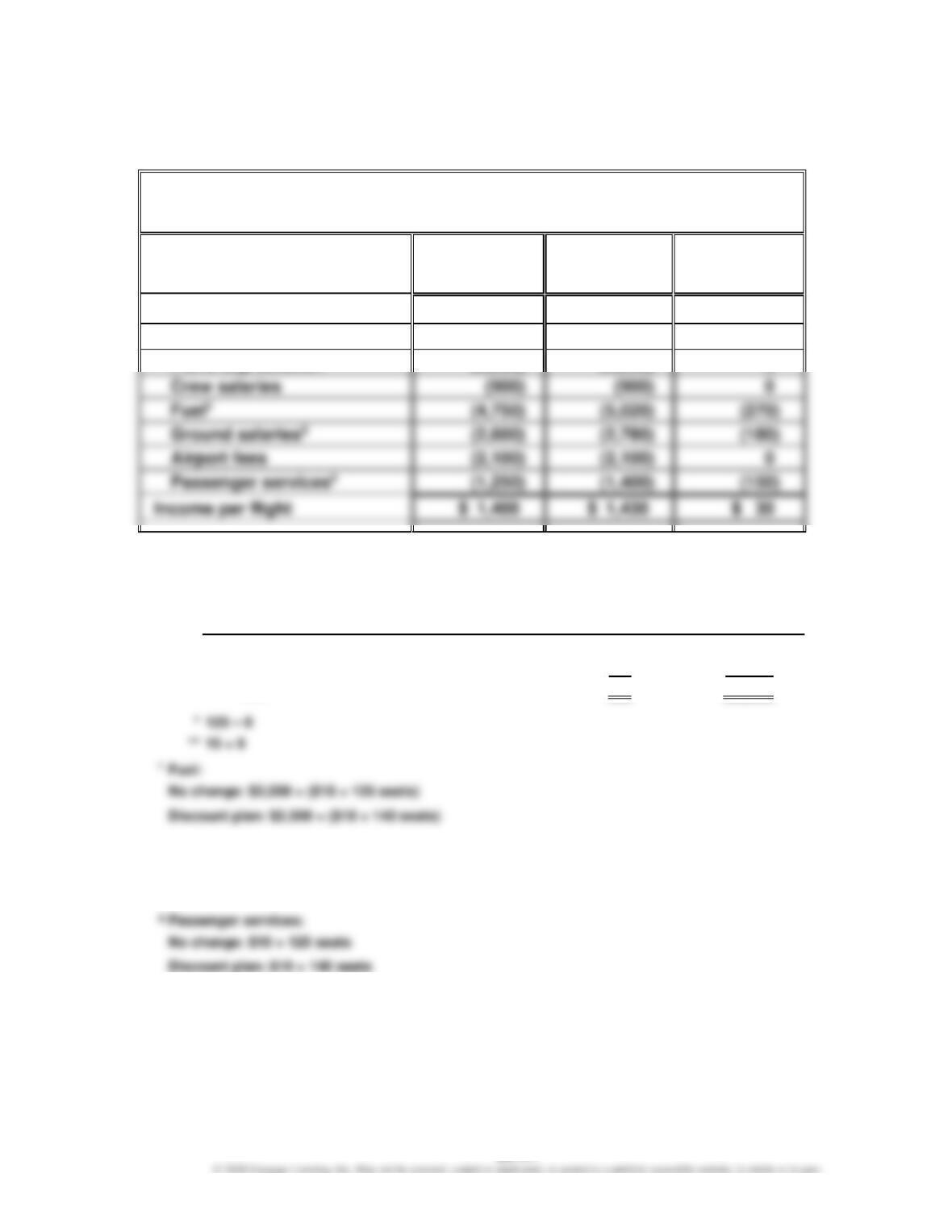
The same answer can be determined from a differential analysis table, as follows:
Differential Analysis
Continue with No Change (Alt. 1) or Offer the Discount Plan (Alt. 2)
February 5
No Change
(Alternative 1)
Discount Plan
(Alternative 2)
Differential
Effects
(Alternative 2)
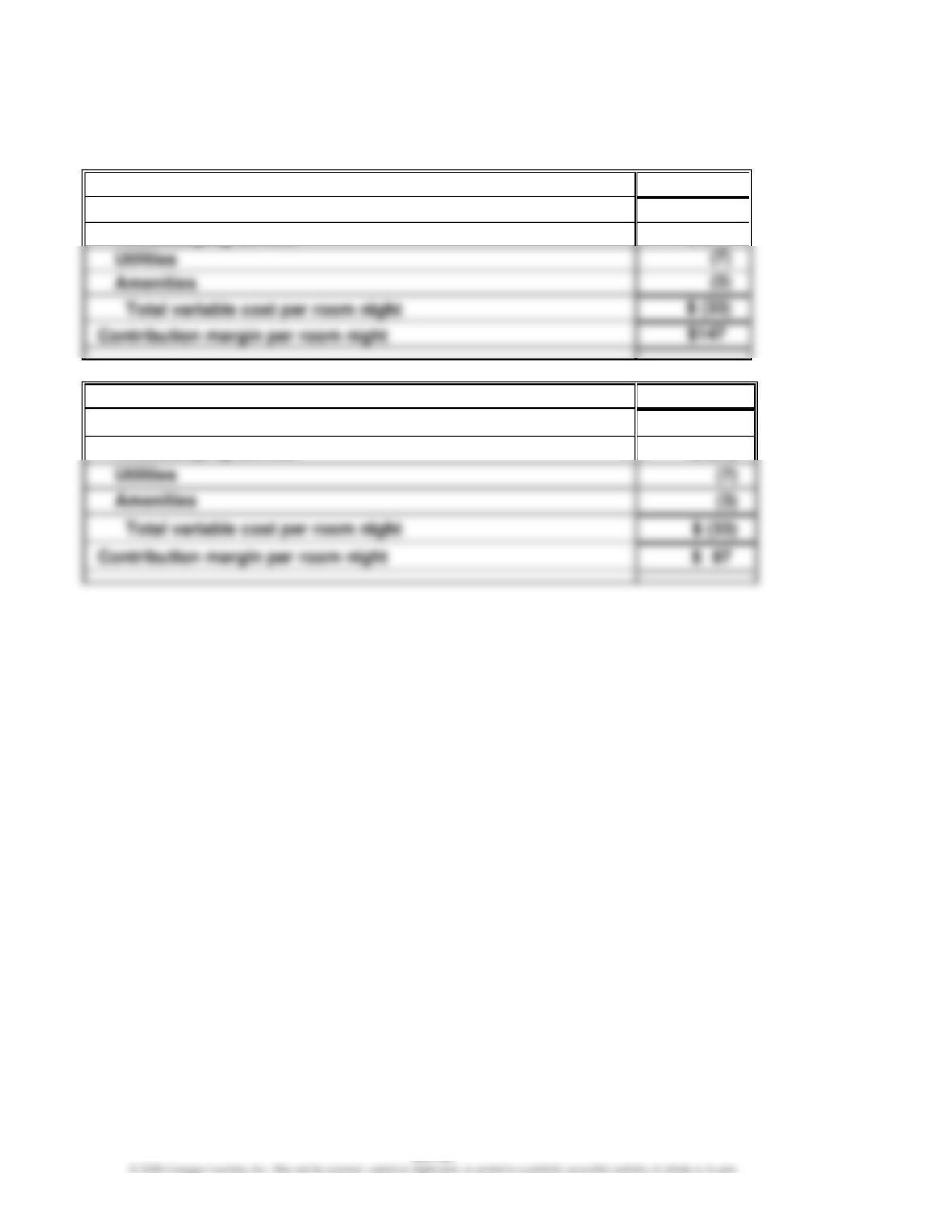
Revenues per flight1
$22,500
$23,130
$ 630
Costs per flight:
Plane depreciation
(9,500)
(9,500)
0
(4,750)
(5,020)
(2,600)
(2,780)
Airport fees
(2,100)
(2,100)
0
(1,250)
(1,400)
i
1
Revenues:
No change revenues: $180 × 125 seats
Discount plan revenues:
Ticket Price
No. of Tickets
Revenue
Full price
$180
117*
$21,060
Discount price
90
23**
2,070
15 + 8
2
No change: $2,500 + ($18 × 125 seats)
Total
140
$23,130
3
Ground salaries:
No change: $1,100 + ($12 × 125 seats)
Discount plan: $1,100 + ($12 × 140 seats)
4
Passenger services:
Discount plan: $10 × 140 seats
CHAPTER 25 (FIN MAN); CHAPTER 11 (MAN) Differential Analysis and Product Pricing
MAD 25–2 (FIN MAN); MAD 11–2 (MAN)
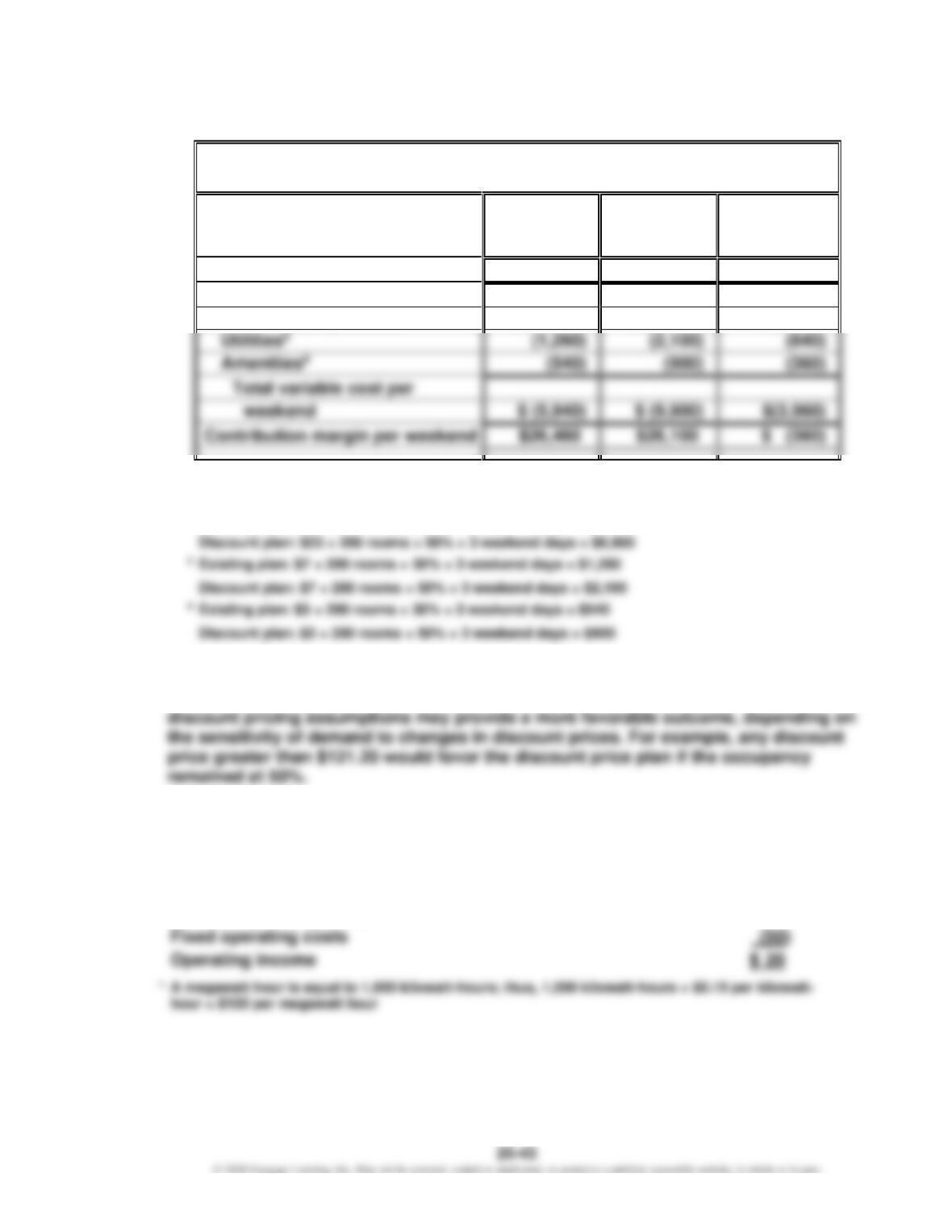
a. Contribution margin per room night:
Rate per room night
$180
Variable costs per room night:
Housekeeping service
$ (23)
$ (33)
Contribution margin per room night
$147
b.
Rate per room night
$120
Variable costs per room night:
Housekeeping service
$ (23)
CHAPTER 25 (FIN MAN); CHAPTER 11 (MAN) Differential Analysis and Product Pricing
MAD 25–2 (FIN MAN); MAD 11–2 (MAN) (Concluded)
c.
Differential Analysis
Continue with Existing Plan (Alt. 1) or Execute the Discount Plan (Alt. 2)
Continue with
Existing Plan
(Alternative 1)
Execute the
Discount Plan
(Alternative 2)
Differential
Effects
(Alternative 2)
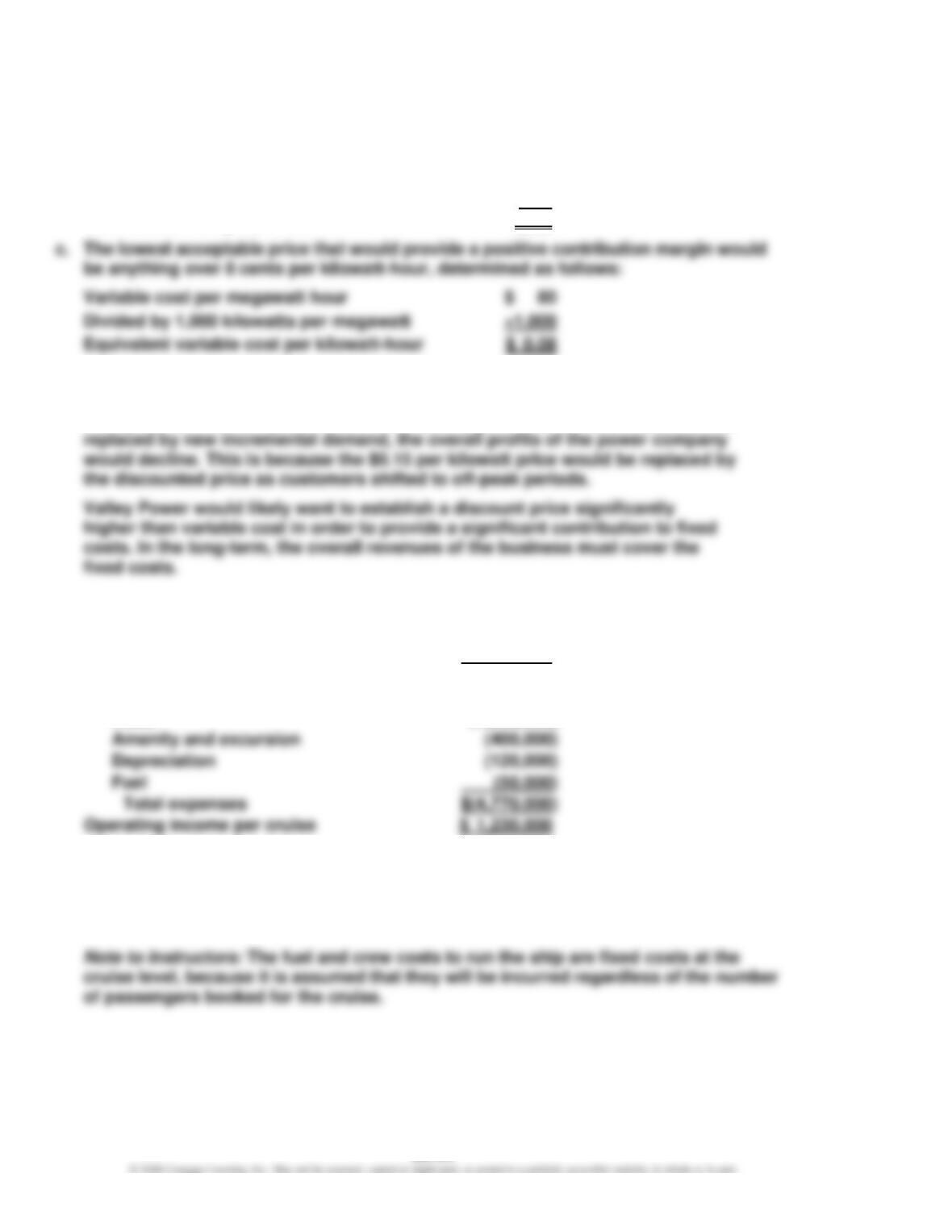
Revenues per weekend1
$32,400
$36,000
$ 3,600
Variable costs per weekend:
Housekeeping service2
$ (4,140)
$ (6,900)
$(2,760)
$ (5,940)
$ (9,900)
$(3,960)
Contribution margin per weekend
$26,460
$26,100
1
Existing plan: $180 × 200 rooms × 30% × 3 weekend days = $32,400
Discount plan: $120 × 200 rooms × 50% × 3 weekend days = $36,000
2
Existing plan: $23 × 200 rooms × 30% × 3 weekend days = $4,140
Discount plan: $23 × 200 rooms × 50% × 3 weekend days = $6,900
Discount plan: $7 × 200 rooms × 50% × 3 weekend days = $2,100
d. The differential analysis indicates that the discount plan will result in a lower
contribution margin per weekend than the existing pricing plan. It is possible that other
MAD 25–3 (FIN MAN); MAD 11–3 (MAN)
a.
Operating income per megawatt hour for industrial customers:
Revenues
$150*
Variable operating costs
(80)
CHAPTER 25 (FIN MAN); CHAPTER 11 (MAN) Differential Analysis and Product Pricing
MAD 25–3 (FIN MAN); MAD 11–3 (MAN) (Concluded)
b. Contribution margin per megawatt hour for industrial customers:
Revenues per unit
$150
Variable operating costs per unit
(80)
Contribution margin per unit
$ 70
d. The discount pricing may become known. Thus, other industrial customers may
request a similar pricing opportunity. This may cause industrial demand to shift
from peak hours to off-peak hours. If the shifted peak hour demand could not be
MAD 25–4 (FIN MAN); MAD 11–4 (MAN)
a.
Revenues
$ 6,000,000
Expenses:
Crew
$(2,700,000)
Depreciation
Fuel
$(4,770,000)
Food
(1,500,000)
b. Divide the variable costs by the number of passengers:
Crew to serve passengers
$1,200,000
÷
1,000
passengers
=
$1,200
per passenger
Food
1,500,000
÷
1,000
passengers
=
1,500
per passenger
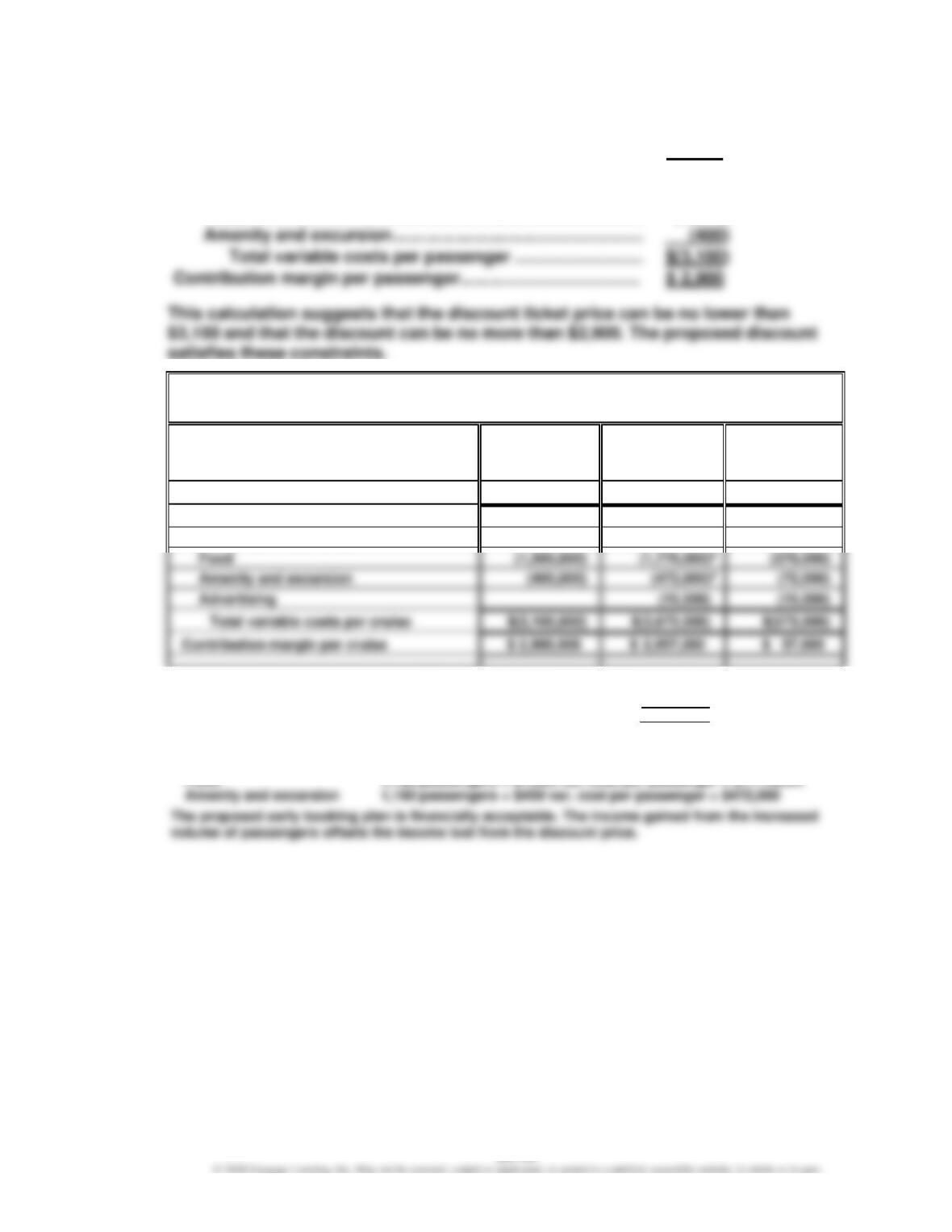
Amenity and excursion
400,000
÷
1,000
passengers
=
400
per passenger
CHAPTER 25 (FIN MAN); CHAPTER 11 (MAN) Differential Analysis and Product Pricing
MAD 25–4 (FIN MAN); MAD 11–4 (MAN) (Concluded)
c.
Ticket price ………………………………………………………………….
$ 6,000
Variable costs per passenger [from (b)]:
Crew to serve passengers …………………………………………….
$(1,200)
Food ……………………………………………………………………………
(1,500)
Amenity and excursion …………………………………………………
Total variable costs per passenger …………………………..
$(3,100)
d.
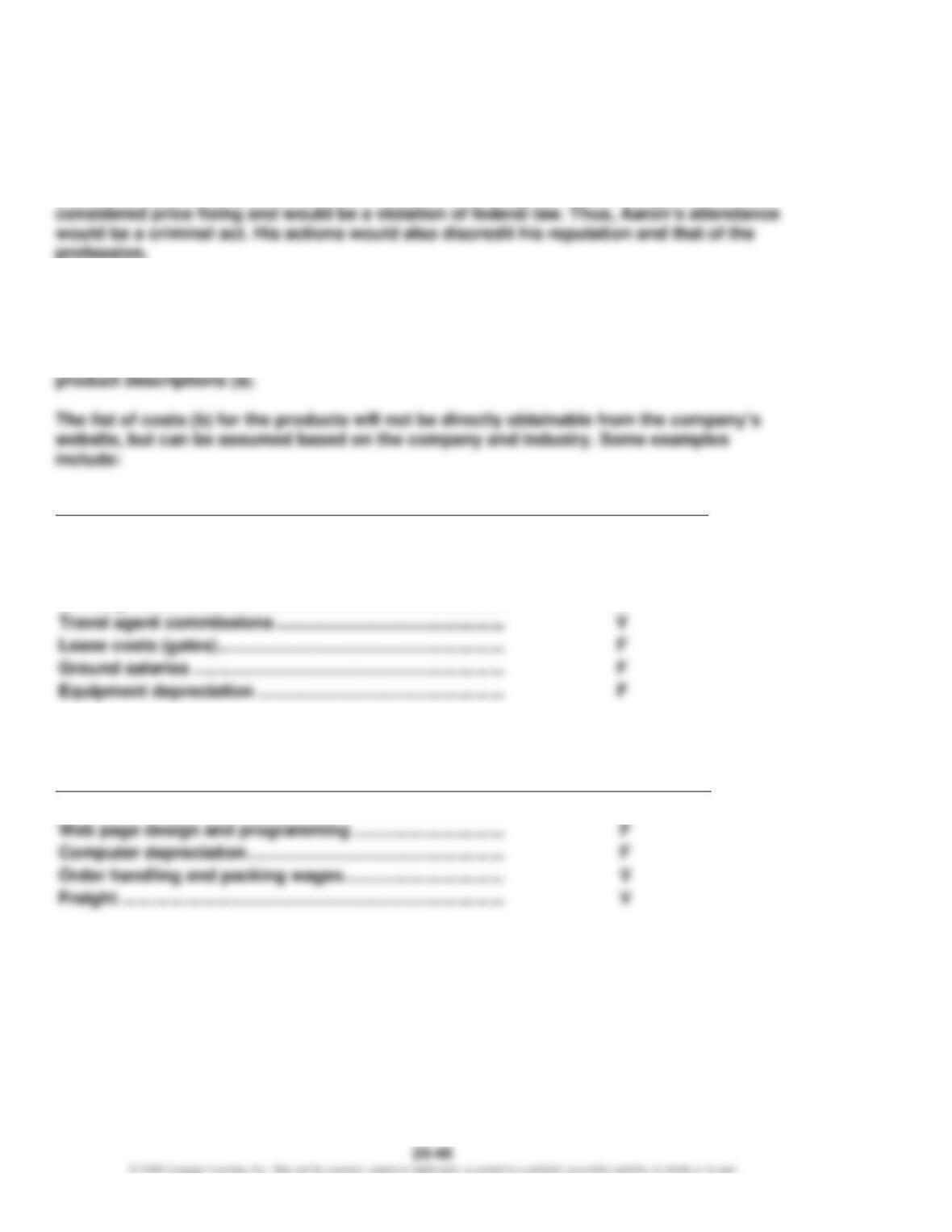
Differential Analysis
Existing Plan (Alt. 1) or Early Booking Program (Alt. 2)
Existing Plan
(Alternative 1)
Early Booking
Program
(Alternative 2)
Differential
Effects
(Alternative 2)
Revenues per cruise
$ 6,000,000
$ 6,630,0001
$ 630,000
Variable costs per cruise:
Crew to serve passengers
$(1,200,000)
$(1,416,000)2
$(216,000)
Amenity and excursion
$(3,100,000)
$(573,000)
Contribution margin per cruise
$ 2,900,000
1
Discount tickets from early booking, 300 tickets × $4,500
$1,350,000
Remaining tickets, (1,180 tickets – 300 tickets) × $6,000
5,280,000
Total revenue
$6,630,000
2
Variable costs per cruise [see (b) for variable cost per passenger]:
Crew to serve passengers
1,180 passengers × $1,200 var. cost per passenger = $1,416,000
1,180 passengers × $1,500 var. cost per passenger = $1,770,000
CHAPTER 25 (FIN MAN); CHAPTER 11 (MAN) Differential Analysis and Product Pricing
TAKE IT FURTHER
TIF 25–1 (FIN MAN); TIF 11–1 (MAN)
No, it would not be ethical for Aaron to attend the meeting. Such a meeting would be
TIF 25–2 (FIN MAN); TIF 11–2 (MAN)
This activity is designed to have students access a number of products and services on
the Internet to see their commercial potential. Each of the listed sites will provide
Delta Air Lines—Airline tickets
Fixed or Variable?
Fuel …………………………………………………………………………
V
Crew salaries ……………………………………………………………
F
Plane depreciation ……………………………………………………
F
Landing fees …………………………………………………………….
V
Lease costs (gates) …………………………………………………..
F
Ground salaries ……………………………………………………….
F
For Delta Air Lines, employee salaries are relatively fixed and only become variable when
there are significant changes to the flight schedule.
Amazon—Various consumer products
Fixed or Variable?
Cost of products (purchased for resale) …………………….
V
Web page design and programming ………………………….
F
Computer depreciation ……………………………………………..
F
Order handling and packing wages …………………………...
V
CHAPTER 25 (FIN MAN); CHAPTER 11 (MAN) Differential Analysis and Product Pricing
TIF 25–2 (FIN MAN); TIF 11–2 (MAN) (Concluded)
HP Inc.—Computers
Fixed or Variable?
Cost of computers (dl, dm, and foh) ………………………….
V (mostly)
Web page design and programming ………………………….
F
Advertising ………………………………………………………………
F
Order handling and packing wages …………………………..
Freight …………………………………………………………………….
Bundled software* ……………………………………………………
* Depends on contract terms with software vendor
The product with the largest markup on variable cost is the airline ticket. The portion
CHAPTER 25 (FIN MAN); CHAPTER 11 (MAN) Differential Analysis and Product Pricing
TIF 25–3 (FIN MAN); TIF 11–3 (MAN)
Memo
To: Juanita Jackson
From: Les Miles
Re: New Product Pricing
Thank you again for taking the time to meet with me and discuss the pricing of our new
computer. While I understand your desire to set an appropriate price for this new product,
Target costing provides a potential solution to the pricing issue. This approach treats
the market price as given and adjusts the cost in order to yield the required profitability.
Target costing is particularly effective in highly competitive product markets where
CHAPTER 25 (FIN MAN); CHAPTER 11 (MAN) Differential Analysis and Product Pricing
TIF 25–4 (FIN MAN); TIF 11–4 (MAN)
The contribution margin is $4 ($22 – $18) per dozen on the special order. Thus,
Varden’s manager can contribute to fixed costs by accepting the order. However, there
are some additional considerations the manager must consider before accepting this
order.
1. Have we ever done business overseas? Exports require additional
administrative activities. Have these additional administrative costs been
considered in the differential analysis?
4. Will the overseas customer want to do business in the future, or is this just a
single sale? If the overseas customer is expected to purchase more golf balls
in the future, then it is likely that the customer will come to expect the $22 price
in the future.
6. Will we help the overseas customer establish a presence in the overseas golf ball
market where we may want to compete in the future?
CHAPTER 25 (FIN MAN); CHAPTER 11 (MAN) Differential Analysis and Product Pricing
TIF 25–5 (FIN MAN); TIF 11–5 (MAN)
First, Marriott has excess capacity for this day, so it should be willing to accept
additional customers. The Priceline.com customer generates incremental revenue
that will not reduce other business. Given this, however, the price must at least cover
variable cost; otherwise, Marriott will incur a loss. The variable cost per room night is
as follows:
Housekeeping labor cost …………………………………………………………………..
$38
These costs are mostly avoidable or are variable to room nights. This answer assumes
Note to Instructors: There could be some discussion about the degree to which some of
these costs are fully variable. For example, it’s likely that some utility cost must be
TIF 25–6 (FIN MAN); TIF 11–6 (MAN)
The product profitability report indicates that the two products are equal in terms
of profitability (on a per-case basis). However, the additional information indicates
that there will be more activities required for Jamaican Punch than for King Kola.
Apparently, the factory overhead costs are being allocated on the basis of a single
activity base that does not capture these product differences. Because the direct
CHAPTER 25 (FIN MAN); CHAPTER 11 (MAN) Differential Analysis and Product Pricing
CERTIFIED MANAGEMENT ACCOUNTANT (CMA®)
EXAMINATION QUESTIONS (ADAPTED)
1. d. The cost of the crane to move materials would most likely be treated as a sunk
cost in differential cost analysis as this cost is not likely to differ among
alternatives.
2. c. If Johnson accepted the special order, the company’s operating income would
increase by $37,500, computed as follows.
3. d. For Aril to benefit from purchasing the units rather than making the units, the purchase
price must be less than $14, computed as follows.
Remaining fixed cost/unit
=
($150,000 × 60%) ÷ 30,000
=
$3
=
$3 + $11
4. b. Oakes should continue to process Beracyl as the incremental revenue exceeds
the incremental cost of processing; Mononate should be sold at split-off as the
incremental revenue is less than the incremental cost of further processing.