Financial Accounting, 9/e 11-1
Chapter 11
Reporting and Interpreting Stockholders’
Equity
ANSWERS TO QUESTIONS
1. A corporation is a legal entity separate and distinct from its owners. Owners are those
who hold stock in the corporation. The primary advantages of the corporate form are:
2. The charter of a corporation, sometimes called the articles of incorporation, is a
legal document issued by a state that authorizes the creation of a corporation as a
3. (a) Authorized shares: The maximum number of shares of stock that a corporation
can issue as specified in the charter of the corporation.
4. Common stock—the usual or normal stock of a corporation. It is the voting stock
and generally ranks after the preferred stock for dividends and assets distributed
upon dissolution. Common stock may have a par value or be no-par value common
stock.
5. Par value is a nominal value per share established in the corporate charter. The
original purpose of establishing a par value was to protect creditors by specifying a
6. When stock with a par value is issued, the par value times the number of shares is
credited to the stock account, and any “additional capital” raised is credited to the
additional paid-in capital account. Thus, the “additional paid-in capital” account
reflects capital raised in excess of a stock’s par value.
7. The stockholders’ equity section of the balance sheet reflects two kinds of capital:
contributed capital and earned capital.
Contributed capital—the amount invested by stockholders. Contributed capital is
8. Treasury stock is a corporation’s own stock that was sold (issued) and
subsequently reacquired by the corporation. Corporations frequently repurchase
shares of their own stock for sound business reasons, such as to obtain shares
needed for employees’ bonus plans, to influence the market price of the stock, to
9. Treasury stock is reported in the stockholders’ equity section of the balance sheet
as a negative amount reflecting its status as a contra-equity account. Any “gain” on
Financial Accounting, 9/e 11-3
10. The two basic requirements to support a cash dividend are: (1) cash on hand or the
11. A stock dividend involves the issuance of additional shares of stock to
stockholders. It differs from a cash dividend in that it does not distribute any assets
of the corporation to stockholders. A cash dividend also reduces total stockholders’
equity by the amount of the dividend. In contrast, a stock dividend does not change
total stockholders’ equity.
12. A stock split distributes additional shares of stock to stockholders by “splitting” their
existing shares into some multiple of additional shares. Though a stock split and a
13. With respect to dividends, the three important dates are:
Declaration date—the date on which the board of directors votes to declare a
dividend. The declaration of a cash dividend creates a liability, and must be
14. Several characteristics typically associated with preferred stock are: (1) lack of
voting rights, (2) less risky than common stock since in the event of bankruptcy
preferred stockholders have preferential rights to assets over common
stockholders, and (3) a fixed dividend rate. Preferred stock may also have a
dividend preference and it may be cumulative.
15. Cumulative preferred stock has a dividend preference such that, should the
dividends on the preferred stock for any year, or series of years, not be paid,

11-4 Solutions Manual
ANSWERS TO MULTIPLE CHOICE
Authors’ Recommended Solution Time
(Time in minutes)
Mini exercises
Exercises
Problems
Alternate
Problems
Cases and
Projects
No.
Time
No.
Time
No.
Time
No.
Time
No.
Time
15
45
45
30
15
45
30
30
30
45
30
20
30
60
35
20
20
30
20
20
30
45
30
15
45
30
20
10
10
15
10
11
20
11
30
12
20
12
45
13
20
14
30
15
30
16
30
17
20
18
30
* Due to the nature of this project, it is very difficult to estimate the amount of time
students will need to complete the assignment. As with any open-ended project, it is
possible for students to devote a large amount of time to these assignments. While
students often benefit from the extra effort, we find that some become frustrated by the
perceived difficulty of the task. You can reduce student frustration and anxiety by
MINI- EXERCISES
M11–1.
At the end of each accounting period, retained earnings is computed via the following
M11–2.
178,000 issued (168,000 outstanding + 10,000 in treasury)
M11–3.
M11–4.
Cash (+A) (170,000 $21) …………………………………………….
3,570,000
Common Stock (+SE) (170,000 $1) ………………………….
170,000
Additional Paid-in Capital (+SE) (remainder) ………………..
3,400,000
Common Stock (+SE) (170,000 $2) …………………………
Additional Paid-in Capital (+SE) (remainder) ………………..
Financial Accounting, 9/e 11-7
M11–5.
Common stock is the basic voting stock issued by a corporation, but ranks behind
M11–6.
Assets
Liabilities
Stockholders’
Equity
Net Income
$250,000
Purchased
20,000 shares
of treasury
Decrease by
$900,000
No change
Decrease by
$900,000
No change
M11–7.
200,000 shares outstanding X $0.65
=
$130,000
M11–8.
April 15:
Retained Earnings (-SE) (100,000 x $0.65) ……………………..
65,000
Dividends Payable (+L) ……………………………………………..
65,000
Dividends Payable (-L) ………………………………………………….
65,000
Cash (-A) ……………………………………………………….
65,000
M11–9.
Dividend Yield = Dividends per share / Market price per share
M11–10.
Stock Dividend
Stock Split
No change in assets
No change in assets
No change in liabilities
No change in liabilities
Increase in common stock
No change in common stock
amount.
Decreases market value
Decrease in market value
M11–11.
EVENT
EFFECT ON STATEMENT OF CASH FLOWS
Issued stock
Financing cash flow increase
Repurchased stock
Financing cash flow decrease
Declared a cash dividend
No effect (when declared)
Financial Accounting, 9/e 11-9
EXERCISES
E11–1.
Computation of end of year balance for treasury stock:
Beginning balance 7,171,269
Net increase 3,034,188
E11–2.
Req. 1 The number of authorized shares is specified in the corporate charter: 300,000.
E11–3.
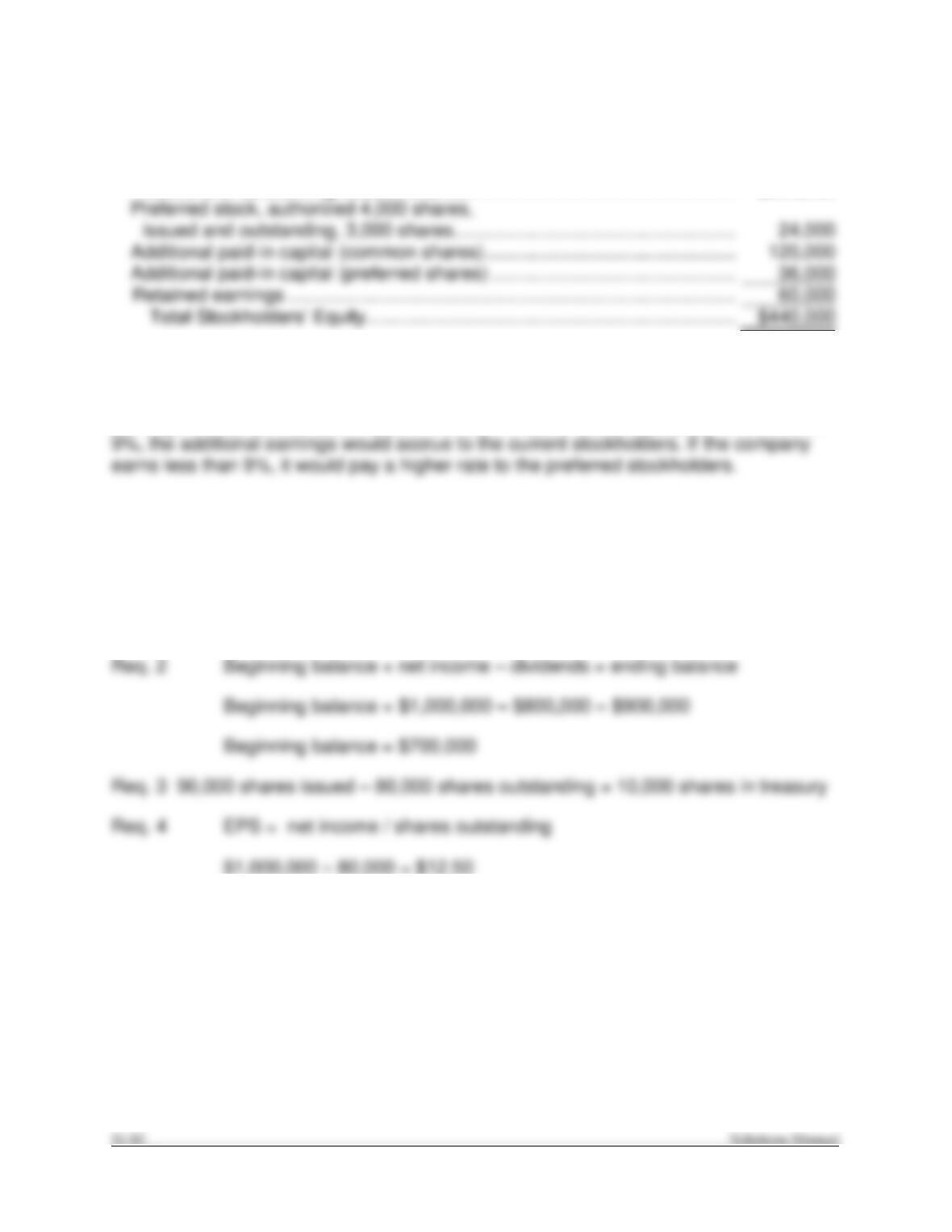
Req. 1
Stockholders’ Equity
Common stock, authorized 103,000 shares,
issued and outstanding, 20,000 shares …………………………………………….
$200,000
Preferred stock, authorized 4,000 shares,
issued and outstanding, 3,000 shares ………………………………………………
Req. 2
The answer would depend on the profitability of the company and the stability of its
earnings. The preferred stock has a 9% dividend rate. If the company earns more than
E11–4.
Req. 1 ($30 x 90,000 shares issued) – $1,600,000 in common stock = $1,100,000
E11–5.
Req. 1
a.
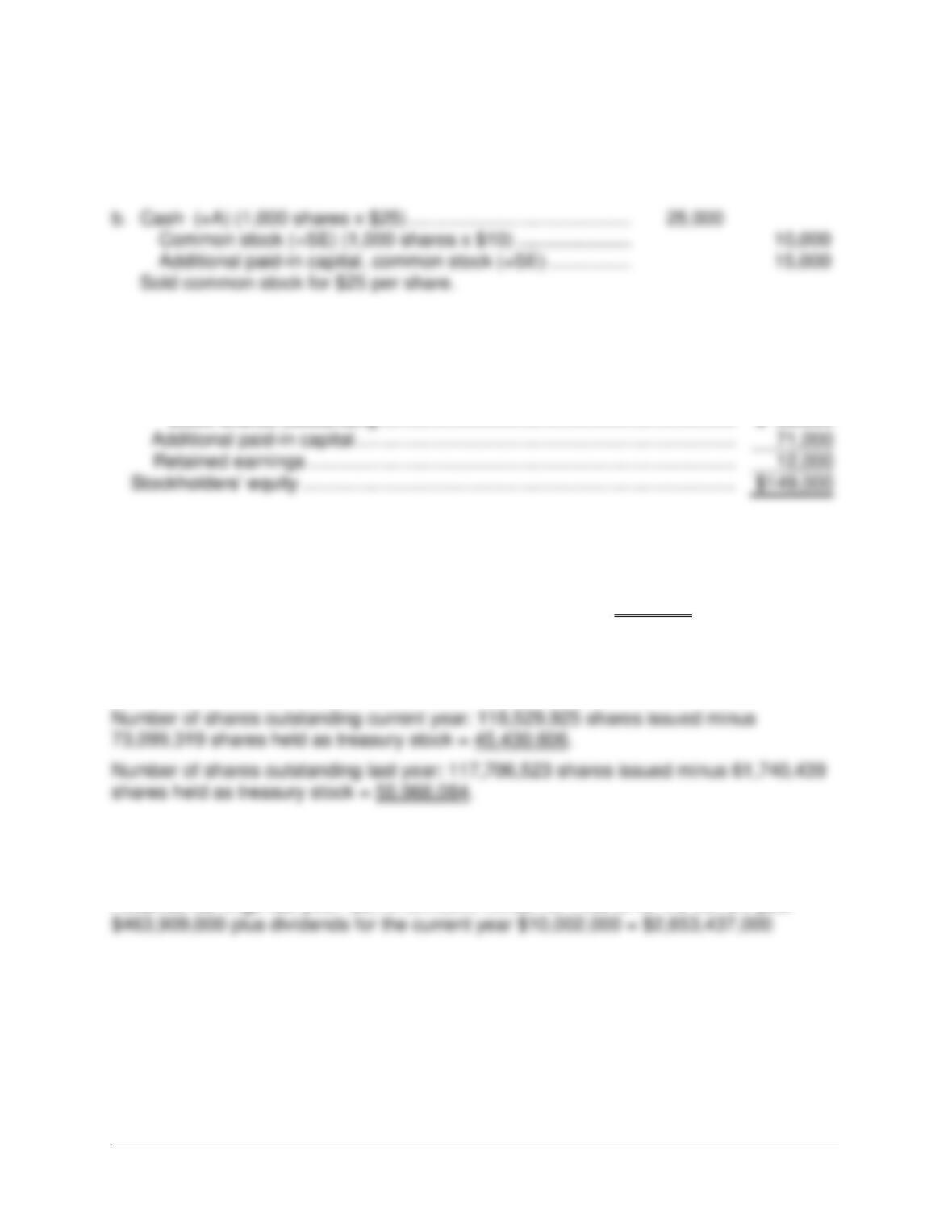
Cash (+A) (5,600 shares x $20) ……………………………………..
112,000
Financial Accounting, 9/e 11–11
Common stock (+SE) (5,600 shares x $10) ………………….
56,000
Additional paid-in capital, common stock (+SE) …………….
56,000
Sold common stock for $20 per share.
Req. 2
Stockholders’ Equity
Common stock, $10 par value, 11,500 shares authorized,
6,600 shares outstanding …………………………………………………………..
$ 66,000
E11–6.
Req. 1
Common stock, class A at par value: 118,529,925 X $0.01 = $118,530
Req. 2
Req. 3
Retained earnings last year: $3,107,344,000 minus net income for the current year
E11–6 (continued).
Req. 4
Cash (+A) (1,000 shares x $25) …………………………………….
25,000
Common stock (+SE) (1,000 shares x $10) ………………….
10,000
Additional paid-in capital, common stock (+SE) …………….
15,000
Sold common stock for $25 per share.
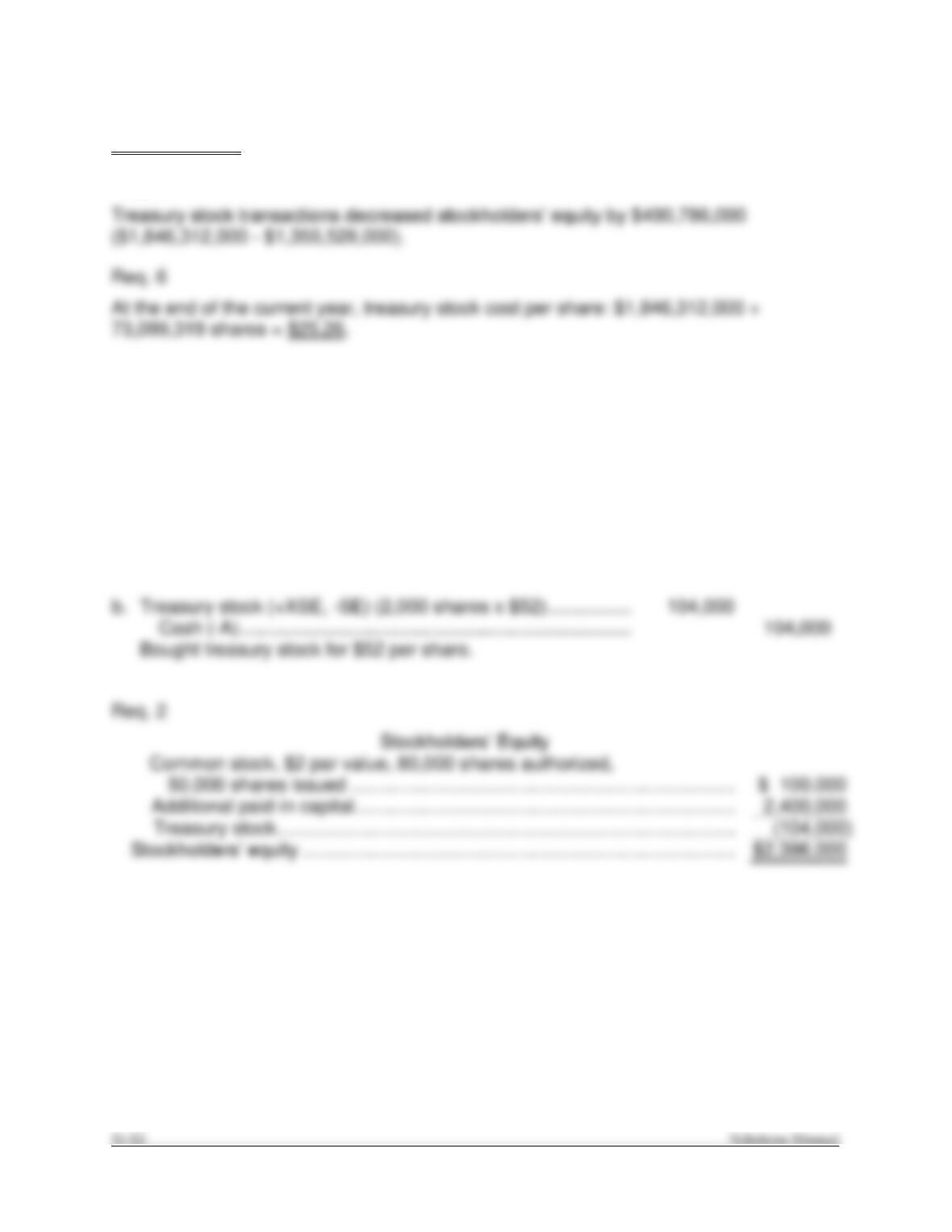
As of the end of the current year, treasury stock had decreased corporate resources by
$1,846,312,000.
Req. 5
E11–7.
Req. 1
a.
Cash (+A) (50,000 shares x $50) ……………………………………
2,500,000
Common stock (+SE) (50,000 shares x $2 par value) …….
100,000
Additional paid-in capital, common stock (+SE) …………….
2,400,000
Sold common stock for $50 per share.
b.
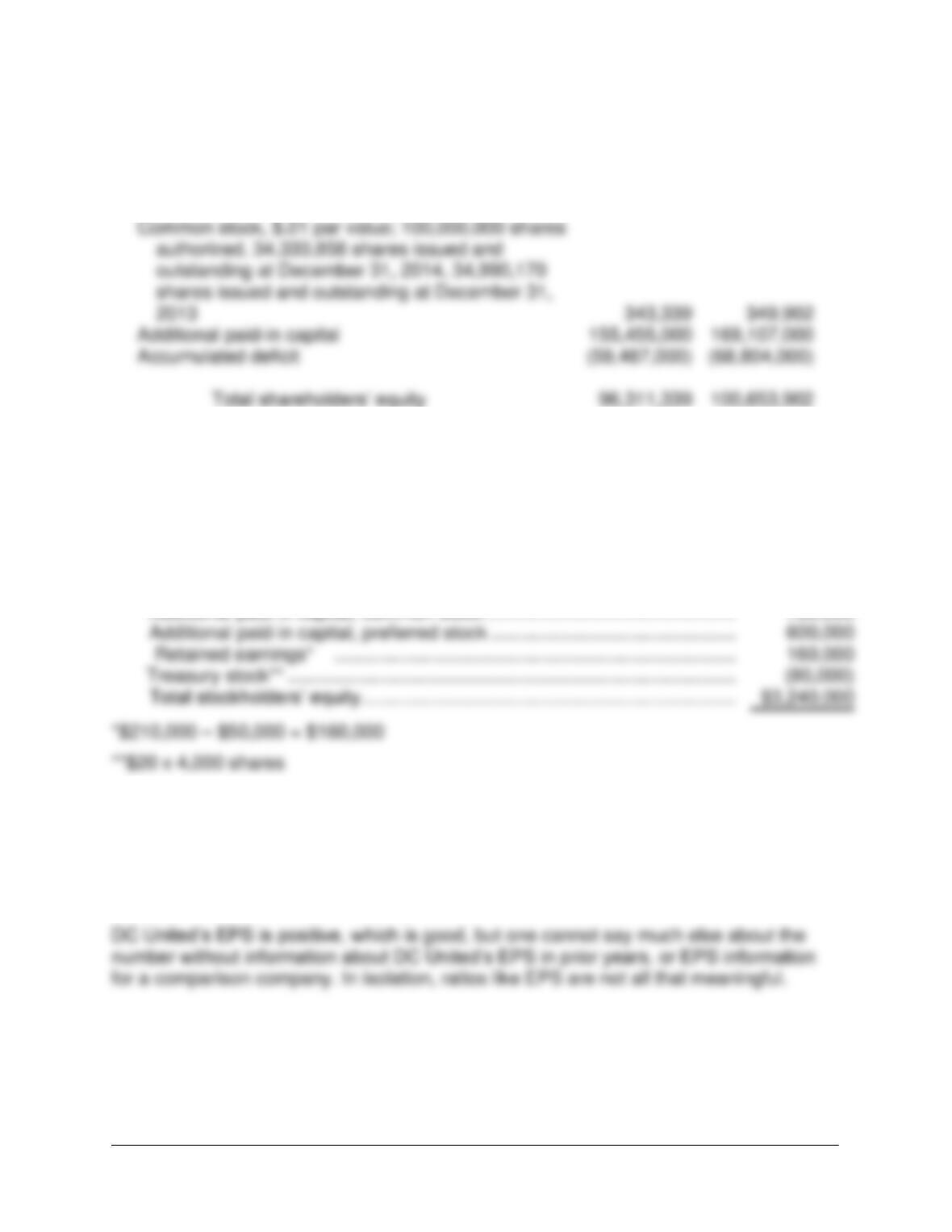
Treasury stock (+XSE, –SE) (2,000 shares x $52) …………….
Cash (-A) …………………………..…………………………………….
104,000
Bought treasury stock for $52 per share.
50,000 shares issued ………………………………………………………………..
2,400,000
)
Financial Accounting, 9/e 11–13
E11–8.
Stockholders’ equity:
Dec. 31,
2014
Dec. 31,
2013
E11–9.
Stockholders’ Equity
Common stock, $10 par value, 98,000 shares authorized,
78,000 shares issued ………………………………………………………………..
780,000
Preferred stock, 8%, $50 par value, 59,000 shares authorized,
20,000 shares issued and outstanding …………………………………………
$1,000,000
Additional paid-in capital, common stock …………………………………………
Additional paid-in capital, preferred stock ………………………………………..
Retained earnings* …………………………………………………………………..
160,000
E11–10.
Net income: $942,000 – $800,000 – $80,000 – $15,000 = $47,000
EPS = $47,000 / 132,000 shares = $0.36
Additional paid-in capital
Accumulated deficit
(59,487,000)
11–14 Solutions Manual
E11–11.
Req. 1
a.
Cash (+A) (20,000 shares x $20) ……………………………………
400,000
Common stock, no-par (+SE) ……………………………………..
400,000
E11–12.
Req. 1
The number of shares that have been issued is computed by dividing the common stock
Retained earnings end of 2013 …………
Net income for 2014 ……………………….
Dividends for 2014 ………………………….
)
Retained earnings end of 2014 …………
b.
Cash (+A) (6,000 shares x $40) …………………………………….
Common stock, no-par (+SE) …………………………………….
c.
Cash (+A) (7,000 shares x $30) ……………………………………..
210,000
Preferred stock (+SE) (7,000 shares x $10) ………………….
Additional paid-in capital, preferred stock (+SE) ……………
140,000
Financial Accounting, 9/e 11–15
E11–13.
Req. 1
Assets will decrease by $329,000,000 ($47 x 7 million shares) and stockholders’ equity
will decrease by $329,000,000. Liabilities are not affected.
Req. 2
Treasury stock (+XSE, -SE) (7 m shares x $47) ……………….
329,000,000
E11–14.
Req. 1
Stockholders’ Equity
Common stock, $20 par value, 100,000 shares authorized,
34,000 shares issued, 32,000 shares outstanding ………………………..
$680,000
Additional paid-in capital ……………………………………………………………..
163,000
Retained earnings …………………………………………………………………….
89,000
Treasury stock …………………………………………………………………………..
(25,000)
Total Stockholders’ Equity …………………………………………………….
$907,000
Req. 2
E11–15.
Req. 1
a.
Treasury stock (+XSE, –SE) (200 shares x $20) ……………….
4,000
Cash (-A) …………………………..…………………………………….
4,000
Bought treasury stock for $20 per share.
Cash (-A) …………………………………………………………………
Bought treasury stock for $47 per share.
Treasury stock (-XSE, +SE) (40 shares x $20) ……………..
800
Additional paid-in capital (+SE) …………………………………..
200
Sold treasury stock for $25 per share.
c.
Cash (+A) (30 shares x $15) ………………………………………….
450
Additional paid-in capital (-SE) ……………………………………….
150
Treasury stock (-XSE, +SE) (30 shares x $20) …………….
600
Sold treasury stock for $15 per share.
Req. 2
Treasury stock transactions do not affect the income statement. A firm may resell
treasury shares for more or less than the original purchase price, but for accounting
purposes the difference is not a gain or loss.
E11–16.
Req. 1
Feb. 1:
Treasury stock (+XSE, –SE) (160 shares x $20) …………….
3,200
Cash (-A) ………………………………………………………………
3,200
July 15:
Cash (+A) (80 shares x $21) ……………………………………..
1,680
Treasury stock (-XSE, +SE) (50 shares x $20) …………..
1,600
Additional paid-in capital (+SE) ………………………………..
Sept. 1:
Cash (+A) (50 shares x $19) ………………………………………
950
Additional paid-in capital (-SE) …………………………..………
50
Treasury stock (-XSE, +SE) (50 shares x $20) …………..
1,000
.
Req. 3
Financial Accounting, 9/e 11–17
The sale of treasury stock for more or less than its original purchase price does not
E11–17.
Req. 1
Case 1: When the company pays the dividend, it will be recorded on the statement
of cash flows as a financing activity cash outflow.
Req. 2
Case 1: Since there is no effect on net income or the weighted number of
commons shares outstanding, EPS is not affected.
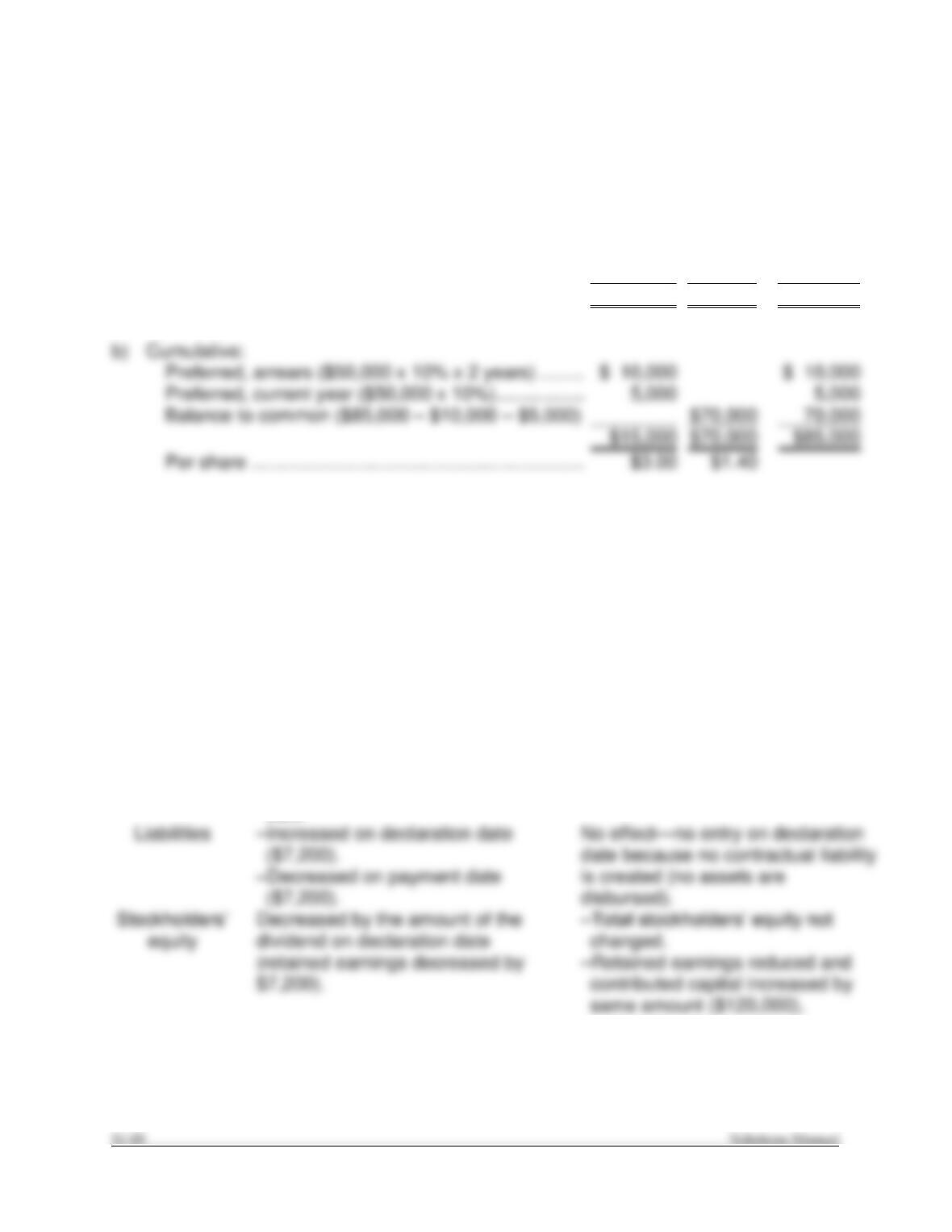
E11–18.
Req. 1
Preferred
(5,000
Shares)
Common
(50,000
Shares)
Total
a)
Noncumulative:
Preferred ($50,000 x 10%) ………………………………..
$ 5,000
$ 5,000
Balance to common ($85,000 – $5,000) ……………..
$80,000
80,000
$ 5,000
$80,000
$85,000
Per share ……………………………………………………….
$1.00
$1.60
b)
Cumulative:
Preferred, arrears ($50,000 x 10% x 2 years) ………
$ 10,000
Preferred, current year ($50,000 x 10%) ……………..
5,000
Balance to common ($85,000 – $10,000 – $5,000)
$70,000
70,000
$15,000
$70,000
$85,000
Per share ……………………………………………………….
$3.00
Req. 2
Since the total dividend ($85,000) does not change under the two assumptions, the
statement of cash flow is impacted in the same manner across the two independent
assumptions. Under both assumptions, the company would report an $85,000 financing
activities cash outflow.
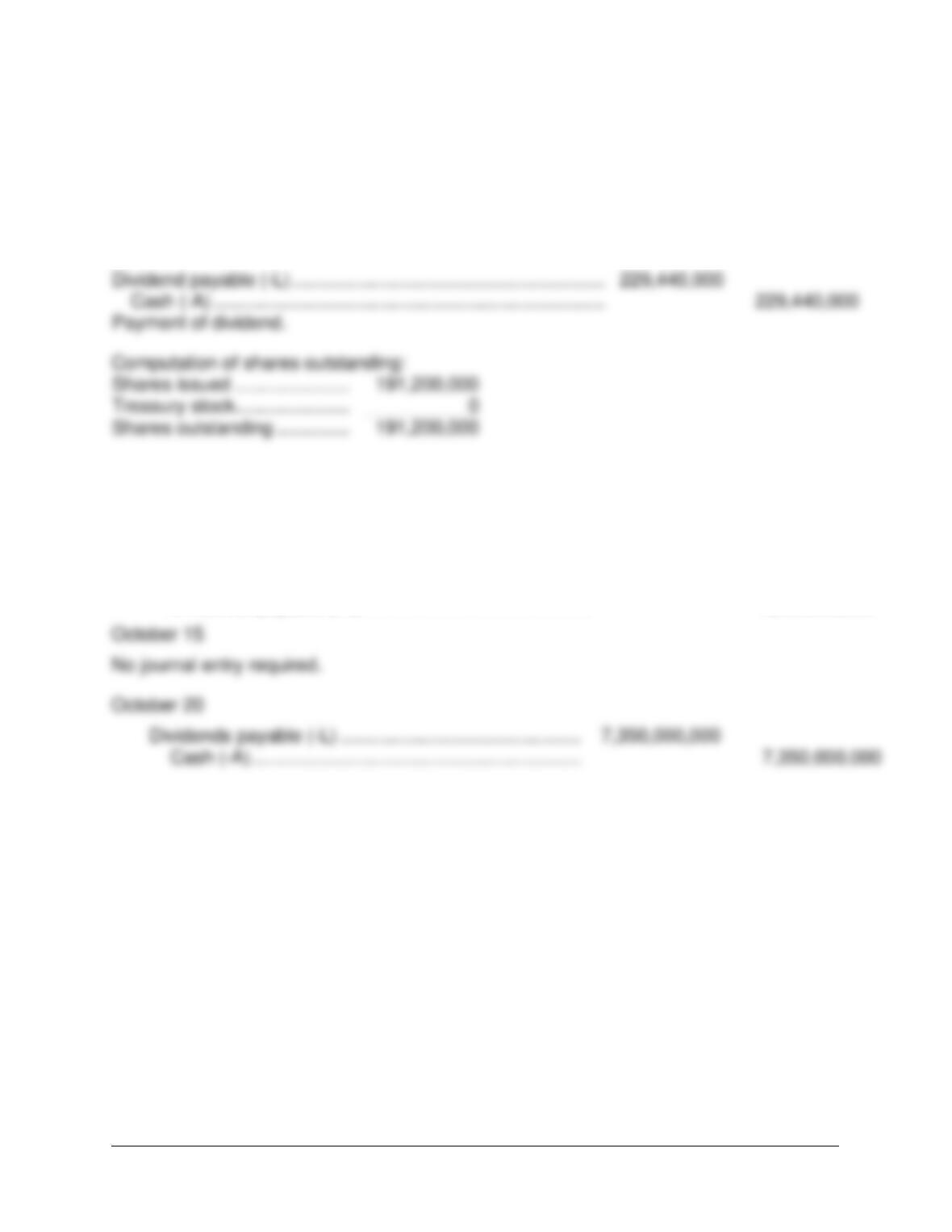
E11–19.
Item
Effect of Cash Dividend (Preferred)
Effect of Stock Dividend (Common)
Assets
–No effect on declaration date.
–Decreased by the amount of the
dividend ($7,200) on payment
date.
No effect because no assets are
disbursed.
–Increased on declaration date
($7,200).
date because no contractual liability
is created (no assets are
disbursed).
dividend on declaration date
(retained earnings decreased by
$7,200).
–Retained earnings reduced and
contributed capital increased by
same amount ($120,000).
Financial Accounting, 9/e 11–19
E11–20.
February 20
Retained earnings (-SE) (191.2 m shares x $1.20) ……………
229,440,000
Dividends payable (+L) ………………………………………………
229,440,000
Declaration of dividend.
March 1
E11–21.
October 1
Retained earnings (-SE) (3 b shares x $2.45) …………………..
7,350,000,000
Dividends payable (+L) ……………………………………………..
7,350,000,000
Dividends payable (-L) ………………………………………………….
Cash (-A) ……………………………………………………….
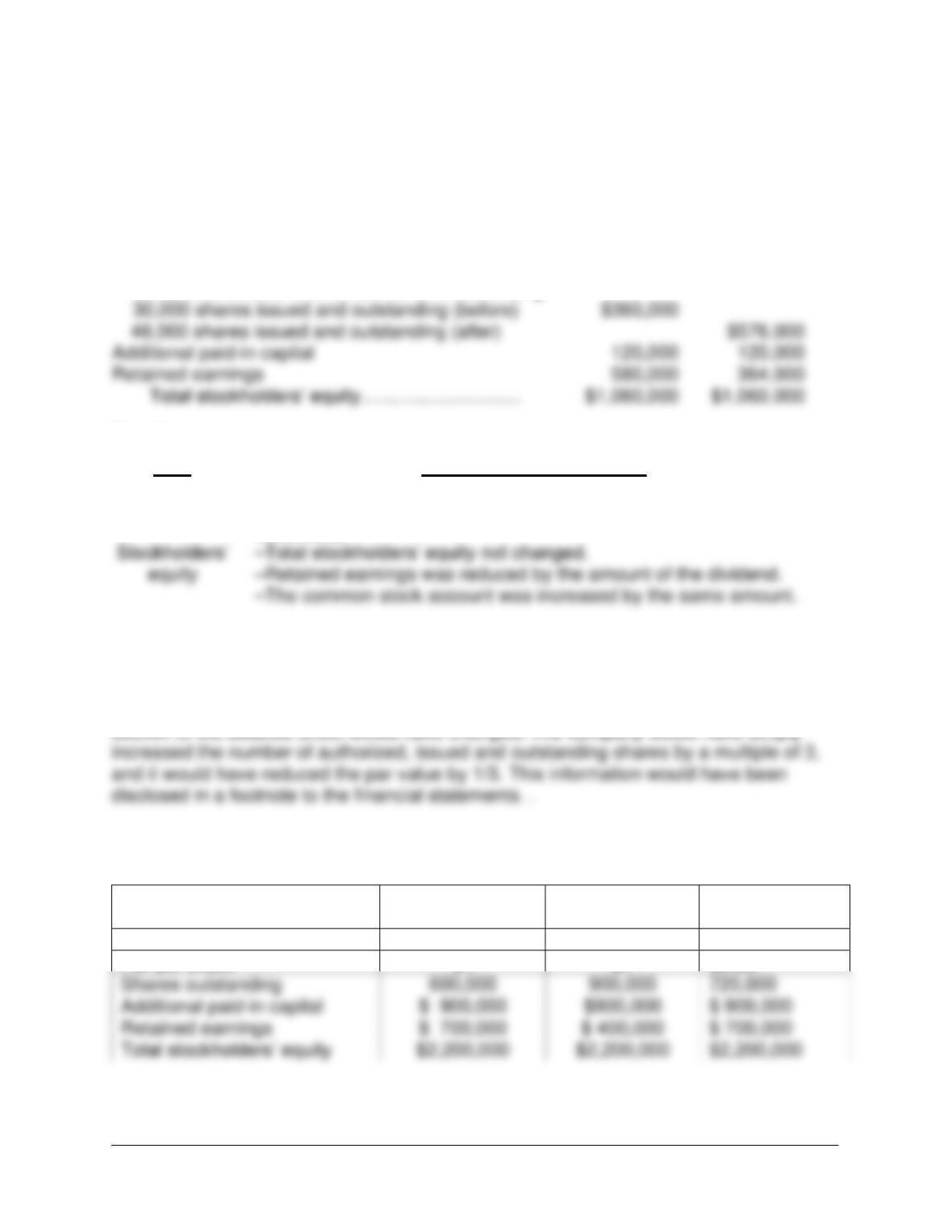
Dividend payable (-L) …………………………..……………………….
229,440,000
Cash (-A) …………………………………………………………………
229,440,000
Payment of dividend.
Treasury stock ………………….
Shares outstanding …………..
11–20 Solutions Manual
E11–22.
Req. 1
Stockholders’ Equity
Before Stock
Dividend
After Stock
Dividend
Common stock, $12 par value; 65,000 shares
authorized, 30,000 shares issued and outstanding
Req. 2
Item
Effects of Stock Dividend
Assets
No change because no assets were disbursed.
Liabilities
No change because no liability was created (no assets were to be
disbursed).
Req. 3
If the company had announced a stock split, no amounts in the stockholders’ equity
E11–23.
Comparative results:
Items
Before Dividend
and Split
After Stock
Dividend
After Stock
Split
Common stock account
$600,000
$900,000
$600,000
Par per share
$1
$1
$0.83
Shares outstanding
Additional paid-in capital
Retained earnings
$ 700,000
$2,200,000
48,000 shares issued and outstanding (after)
Additional paid-in capital
Retained earnings