Chapter 11
Responsibility Accounting Systems
Solutions to Questions
11-1 In a decentralized organization,
decision-making authority isn’t confined to a few
top executives; instead, decision-making
authority is spread throughout the organization.
11-2 The benefits of decentralization include:
(1) by delegating day-to–day problem solving to
lower-level managers, top management can
concentrate on bigger issues such as overall
strategy; (2) empowering lower-level managers
to make decisions puts decision-making
authority in the hands of those who have the
most up–to-date information about day-to-day
operations; (3) by eliminating layers of decision-
making and approvals, organizations can
respond more quickly to customers and to
changes in the operating environment; (4)
granting decision-making authority helps train
lower-level managers for higher-level positions;
and (5) empowering lower-level managers to
make decisions can increase their motivation
and job satisfaction.
11-6 If ROI is used to evaluate performance,
investment center managers may reject
profitable investment opportunities whose rate
of return exceeds the company’s required rate of
return but whose rate of return is less than the
investment center’s current ROI. The residual
income approach avoids this problem because
any project whose rate of return exceeds the
company’s minimum required rate of return will
result in an increase in residual income.
11-7 A transfer price is the price charged
when one responsibility center within a company
provides goods or services to another
responsibility center in the same company.
11-8 Suboptimization occurs when
responsibility center managers forego additional
companywide profits by making decisions that
are not in the best interests of the overall
company or even in the best interests of their
own responsibility center.
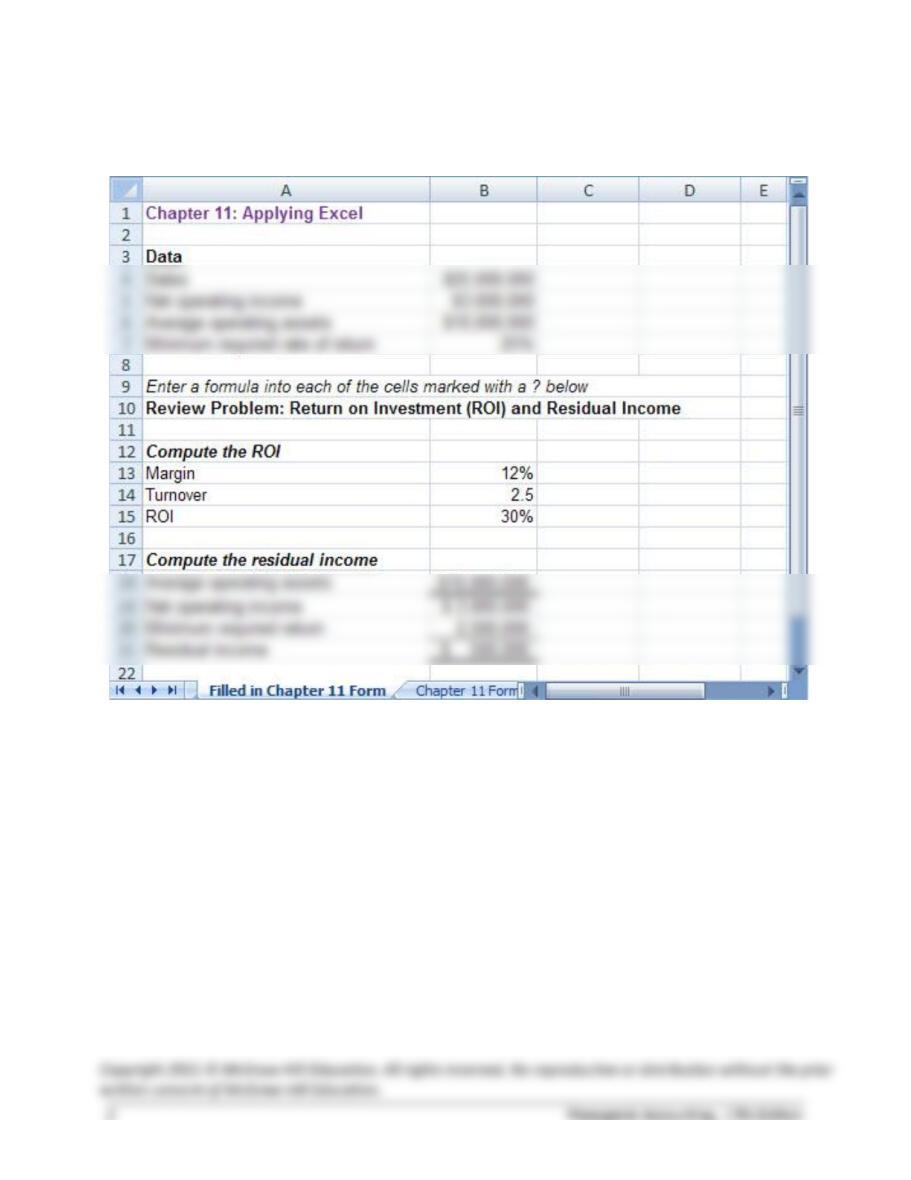
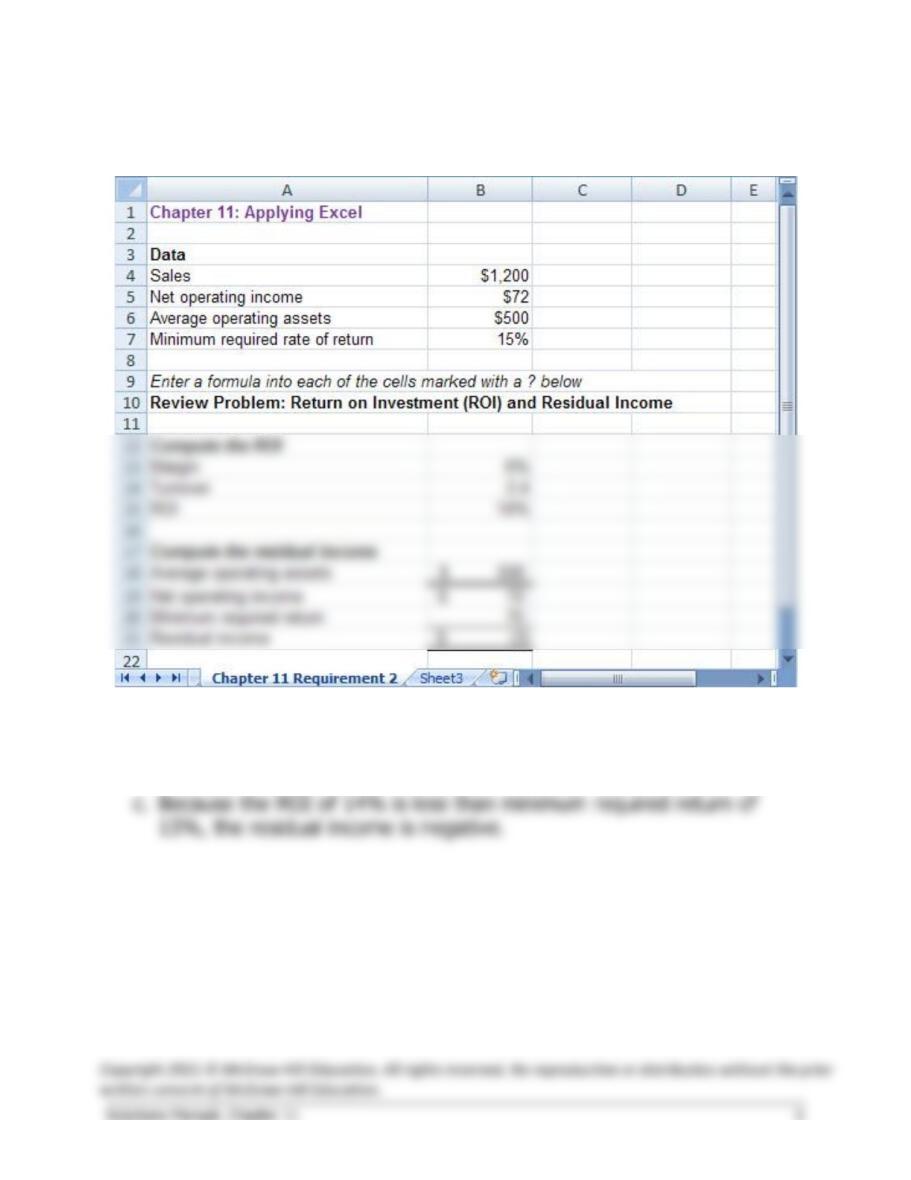
Chapter 11: Applying Excel
The completed worksheet is shown below.
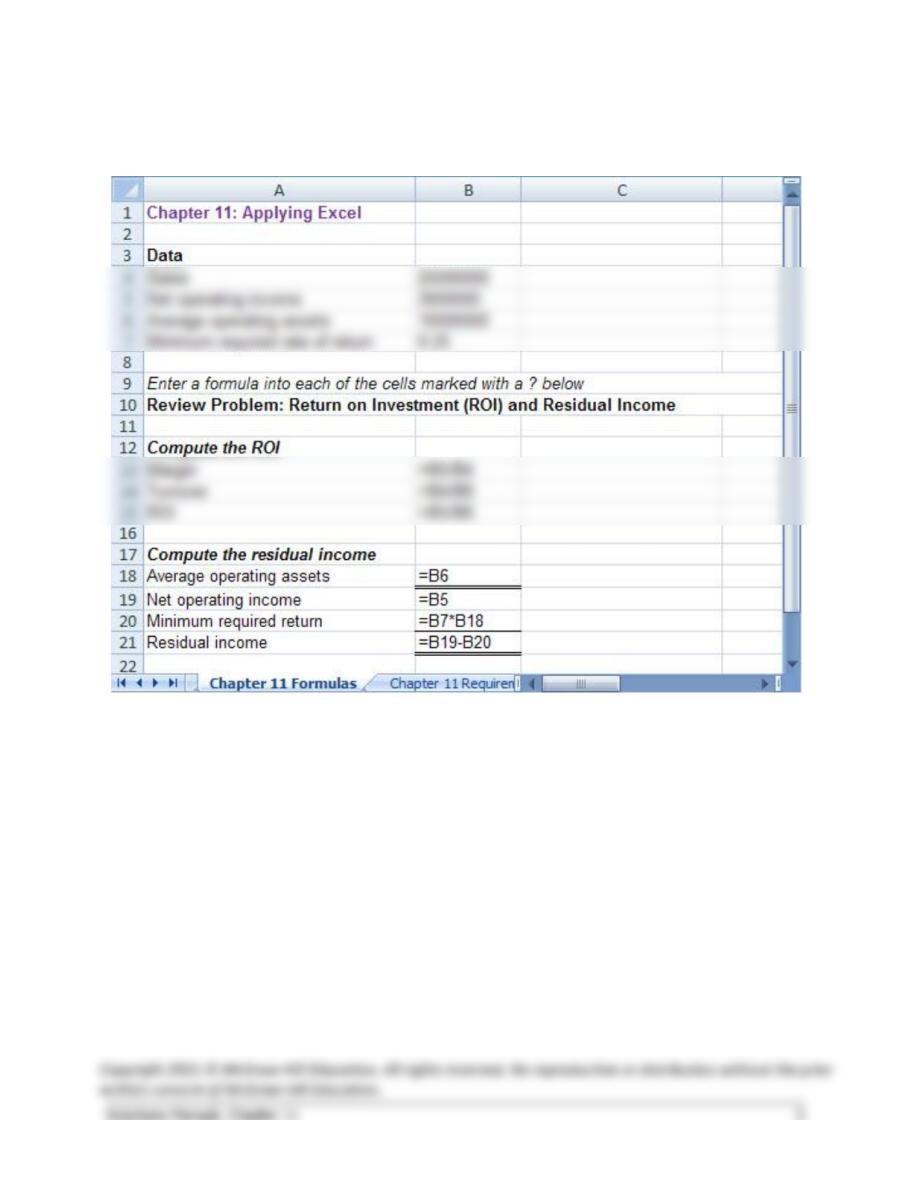
Chapter 11: Applying Excel (continued)
The completed worksheet, with formulas displayed, is shown below.
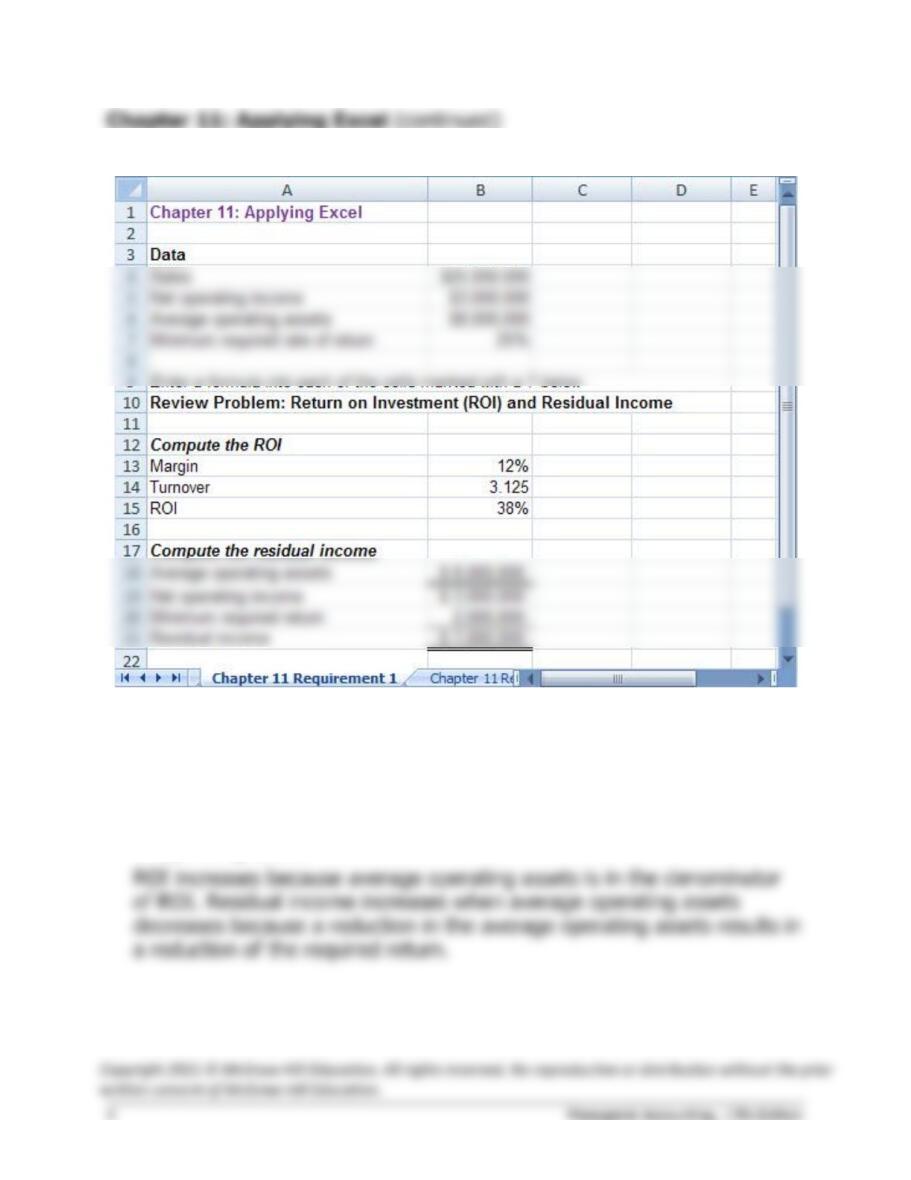
1. With the changes in average operating assets, the result is:
An increase in average operating assets will increase both the ROI and
residual income.
ROI = Net operating income/Average operating assets
Residual income = Net operating income – Required return
Required return = Minimum required rate of return × Average
operating assets
Chapter 11: Applying Excel (continued)
2. With the revised data, the worksheet should look like this:
a. As shown above, the ROI is 14%.
b. As shown above, the residual income is $(3).
The Foundational 15
1. Last year’s margin is:
Net operating income
Margin = Sales
$200,000
= = 20%
$1,000,000
2. Last year’s turnover is:
3. Last year’s return on investment (ROI) is:
ROI = Margin × Turnover
= 20% × 1.6 = 32%
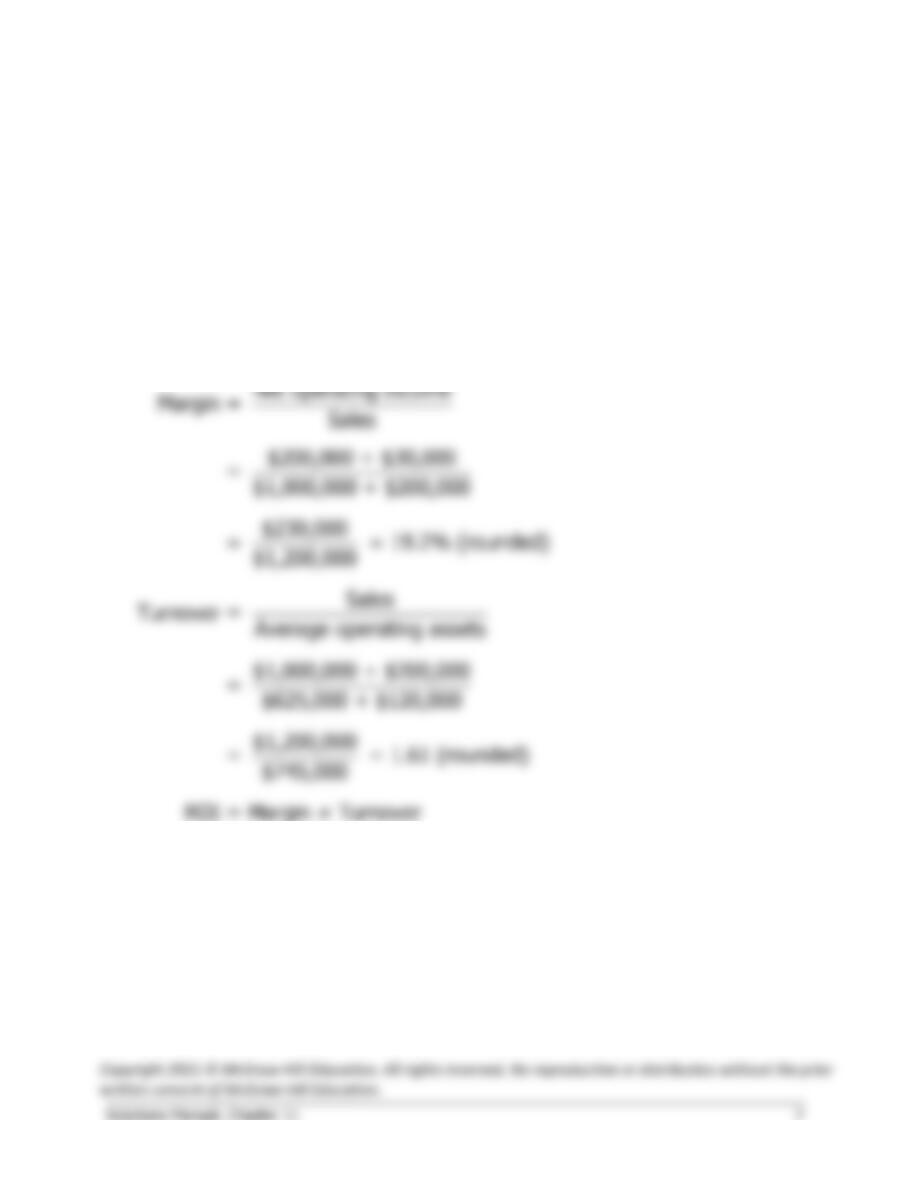
4. The margin for this year’s investment opportunity is:
5. The turnover for this year’s investment opportunity is:
Sales
Turnover = Average operating assets
$200,000
= = 1.67 (rounded)
The Foundational 15 (continued)
6. The ROI for this year’s investment opportunity is:
ROI = Margin × Turnover
= 15% × 1.67 = 25% (rounded)
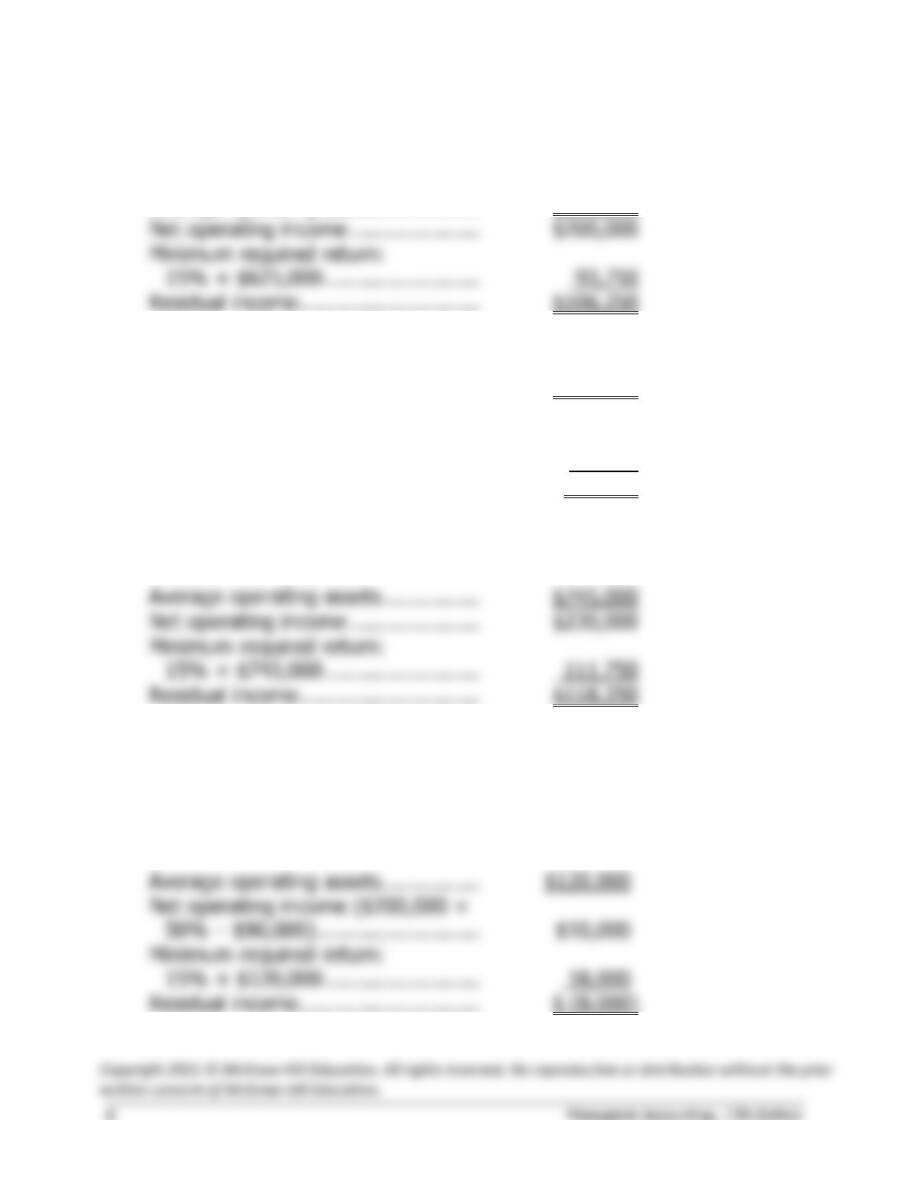
7., 8., and 9.
If the company pursues the investment opportunity, this year’s margin,
turnover, and ROI would be:
= 19.2% × 1.61 = 30.9% (rounded)
10. The CEO would not pursue the investment opportunity because it
lowers her ROI from 32% to 30.9%. The owners of the company
would want the CEO to pursue the investment opportunity because its
ROI of 25% exceeds the company’s minimum required rate of return
of 15%.
The Foundational 15 (continued)
11. Last year’s residual income is:
Average operating assets …………….
$625,000
Net operating income …………………
$200,000
Residual income ………………………..
$106,250
12. The residual income for this year’s investment opportunity is:
Average operating assets …………….
$120,000
Net operating income …………………
$30,000
Minimum required return:
15% × $120,000 …………………….
18,000
Residual income ………………………..
$12,000
13. If the company pursues the investment opportunity, this year’s
residual income will be:
Average operating assets …………….
$745,000
Net operating income …………………
$230,000
Minimum required return:
Residual income ………………………..
$118,250
14. The CEO would pursue the investment opportunity because it would
raise her residual income by $12,000 (= $118,250 – $106,250).
15. The CEO and the company would not want to pursue this investment
opportunity because it does not exceed the minimum required return:
Average operating assets …………….
Net operating income ($200,000 ×
50% – $90,000) ……………………..
Minimum required return:
Residual income ………………………..
$ (8,000)
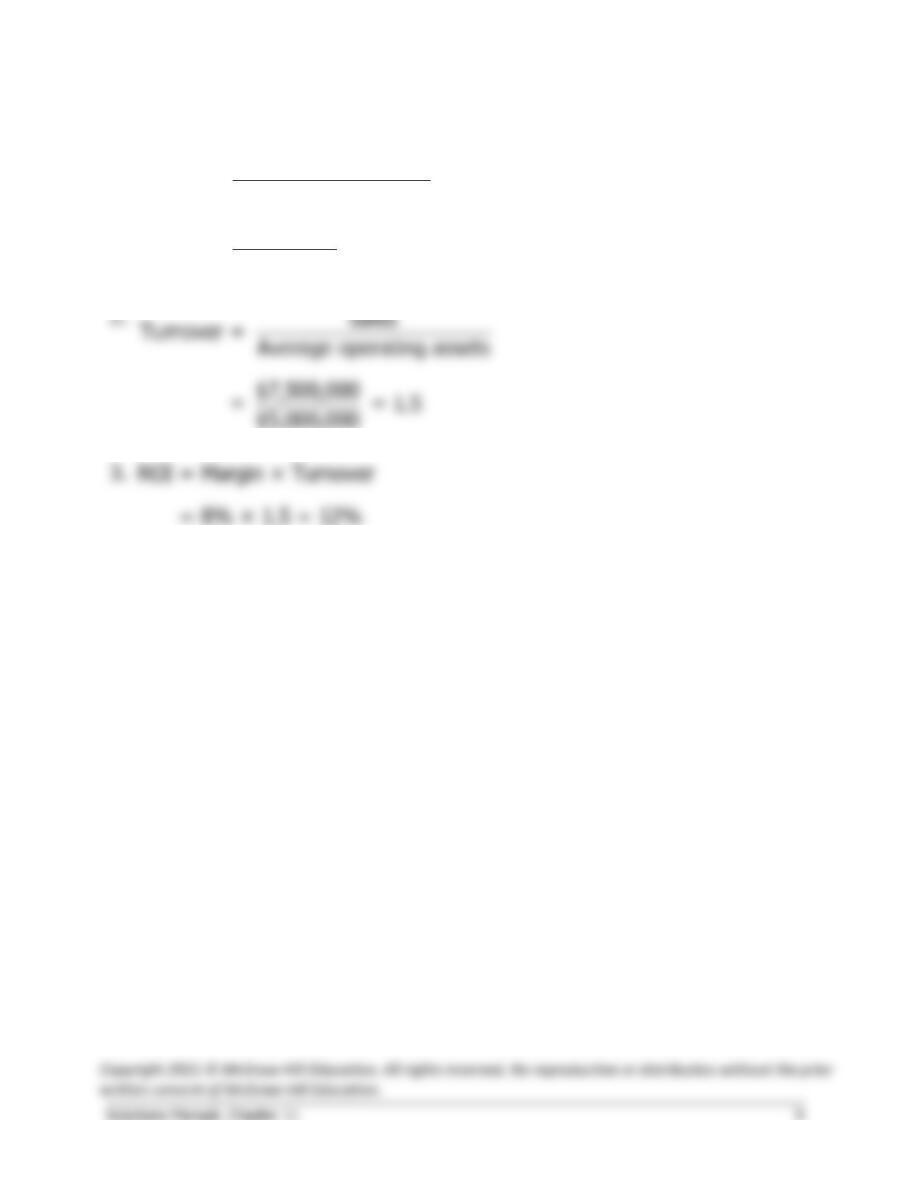
Exercise 11-1 (10 minutes)
1.
Net operating income
Margin = Sales
$600,000
= = 8%
$7,500,000
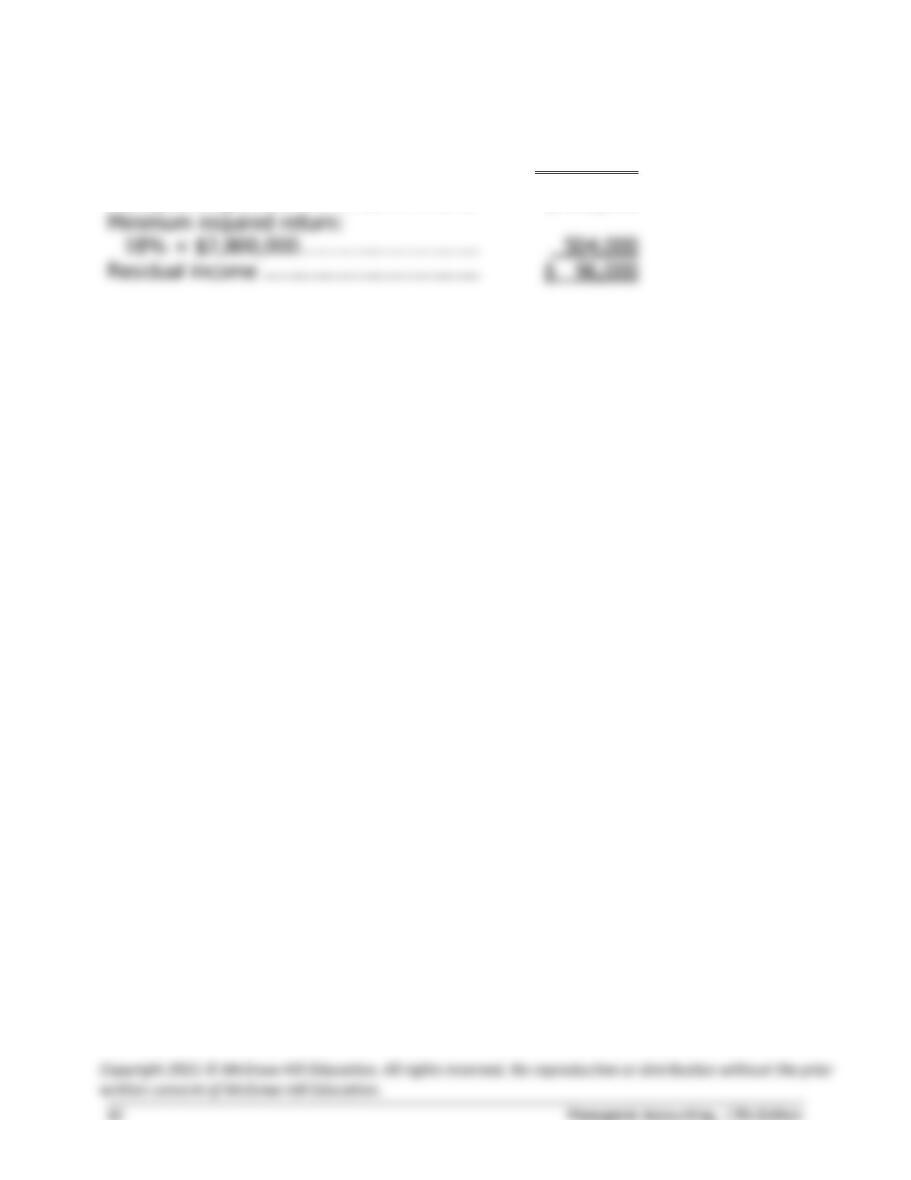
Exercise 11-2 (10 minutes)
Average operating assets ………………….
$2,800,000
Net operating income ……………………….
$ 600,000
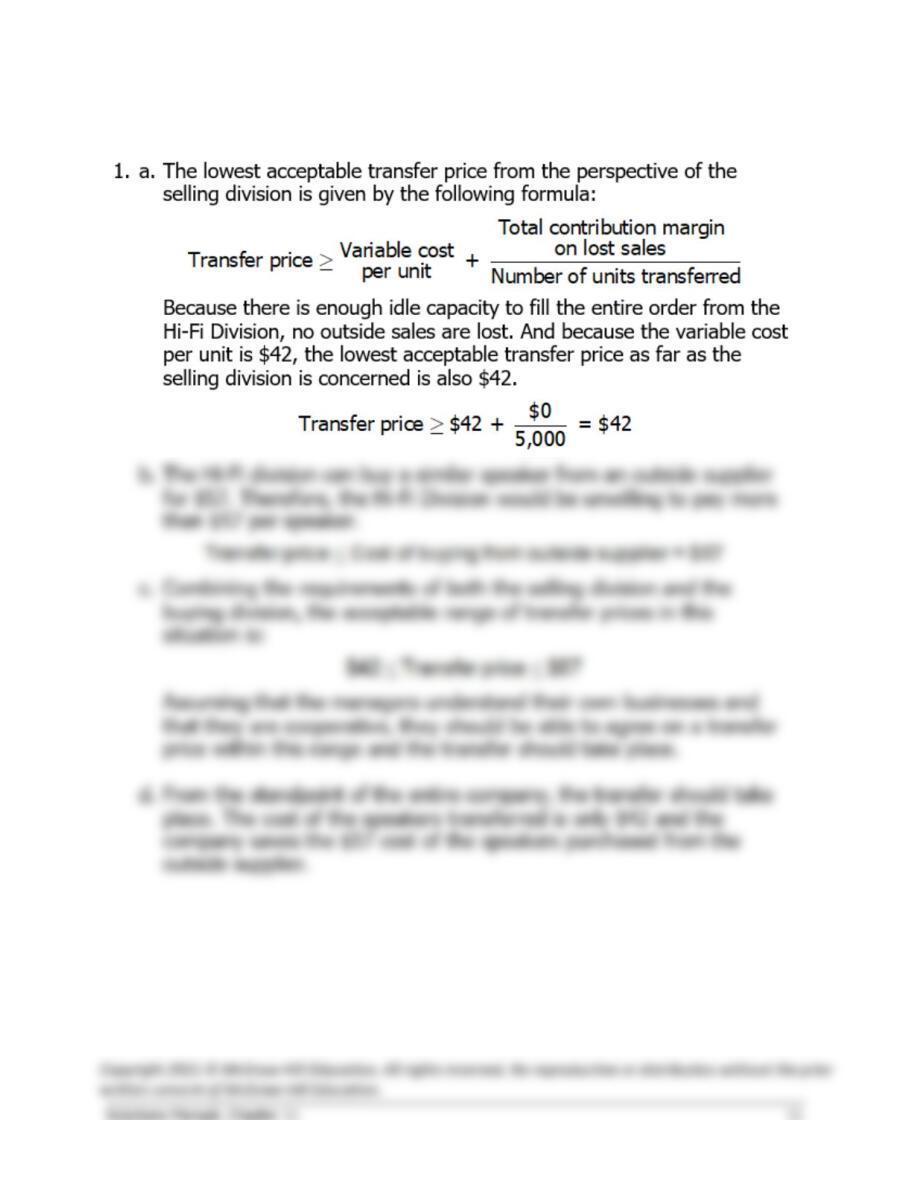
Exercise 11-3 (30 minutes)
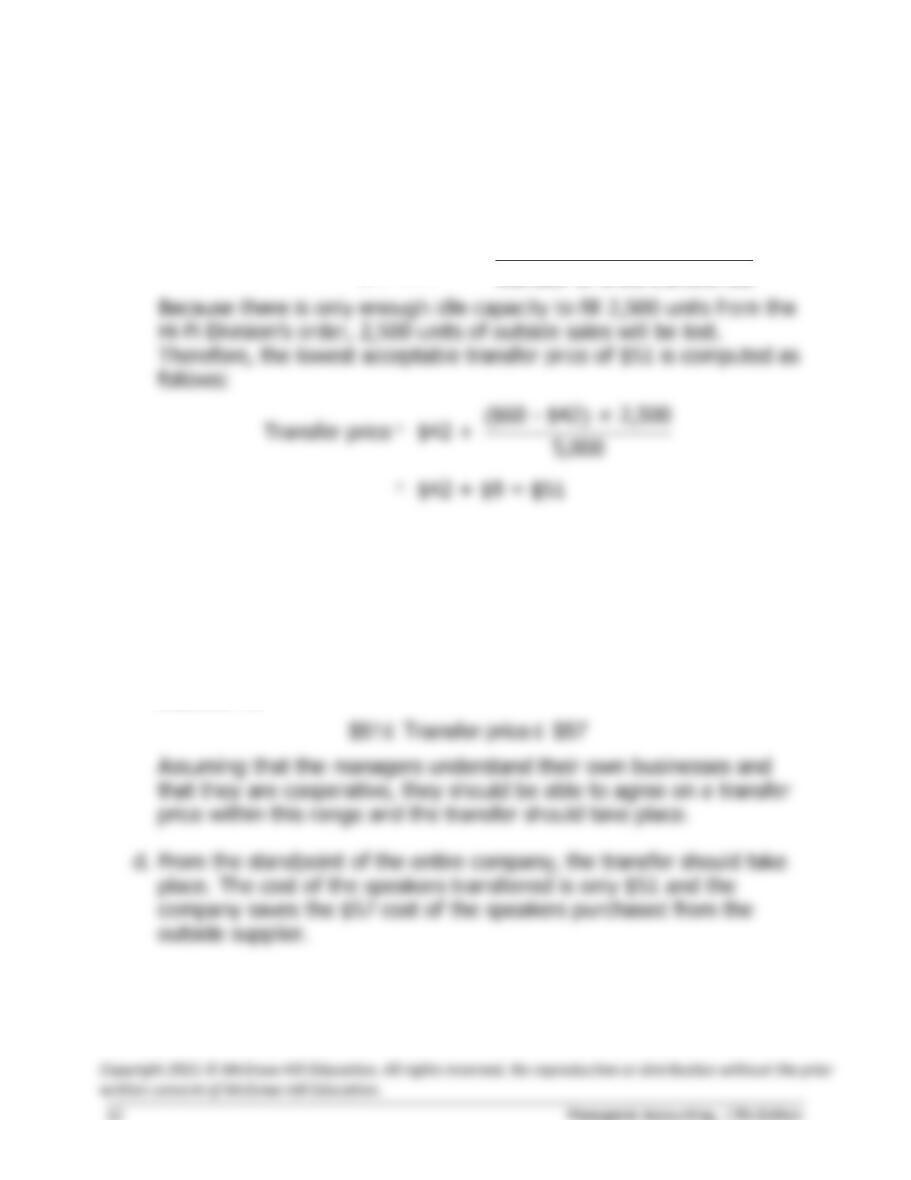
Exercise 11-3 (continued)
2. a. The lowest acceptable transfer price from the perspective of the
selling division is given by the following formula:
Total contribution margin
on lost sales
Variable cost
Transfer price +
per unit Number of units transferred
³
b. The Hi-Fi division can buy a similar speaker from an outside supplier
for $57. Therefore, the Hi-Fi Division would be unwilling to pay more
than $57 per speaker.
£Transfer price Cost of buying from outside supplier = $57
c. Combining the requirements of both the selling division and the
buying division, the acceptable range of transfer prices in this
situation is:
Exercise 11-3 (continued)
3. a. Each of the 5,000 units transferred to the Hi-Fi Division must displace
a sale to an outsider at a price of $60. Therefore, the selling division
would demand a transfer price of at least $60. This can also be
computed using the formula for the lowest acceptable transfer price
c. The requirements of the selling and buying divisions in this instance
are incompatible. The selling division must have a price of at least
$60 whereas the buying division will not pay more than $57. An
agreement to transfer the speakers is extremely unlikely.
Exercise 11-4 (15 minutes)
1. and 2.
Northern
Plant
Southern
Plant
Total
Variable cost charges:
$0.25 per ton × 130,000 tons ………..
$ 32,500
$0.25 per ton × 50,000 tons …………
$ 12,500
$ 45,000
Fixed cost charges:
70% × $300,000 ………………………..
210,000
Total charges ……………………………….
3. Part of the $364,000 in total cost will not be charged to the plants, as
follows:
Variable
Cost
Fixed
Cost
Total
Total actual cost incurred ………………..
$54,000
$310,000
$364,000
Total charges (above) …………………….
45,000
300,000
345,000
Spending variance …………………………
$ 9,000
$ 10,000
$ 19,000
Exercise 11-5 (15 minutes)
Division
Alpha
Bravo
Charlie
Sales (a) ………………………..
$4,000,000
$11,500,000
*
$3,000,000
Net operating income (b) …..
$160,000
$920,000
*
$210,000
*
Average operating assets
*
$1,500,000
Margin (b) ÷ (a) ………………
Turnover (a) ÷ (c) ……………
Exercise 11-6 (20 minutes)
1. ROI computations:
Net operating income Sales
ROI = ×
Sales Average operating assets
2.
Osaka
Yokohama
Average operating assets (a)………………….
$1,000,000
$4,000,000
Net operating income …………………………..
$210,000
$720,000
Minimum required return on average
operating assets: 15% × (a) ……………….
150,000
600,000
Residual income ………………………………….
$ 60,000
$120,000
Exercise 11-7 (20 minutes)
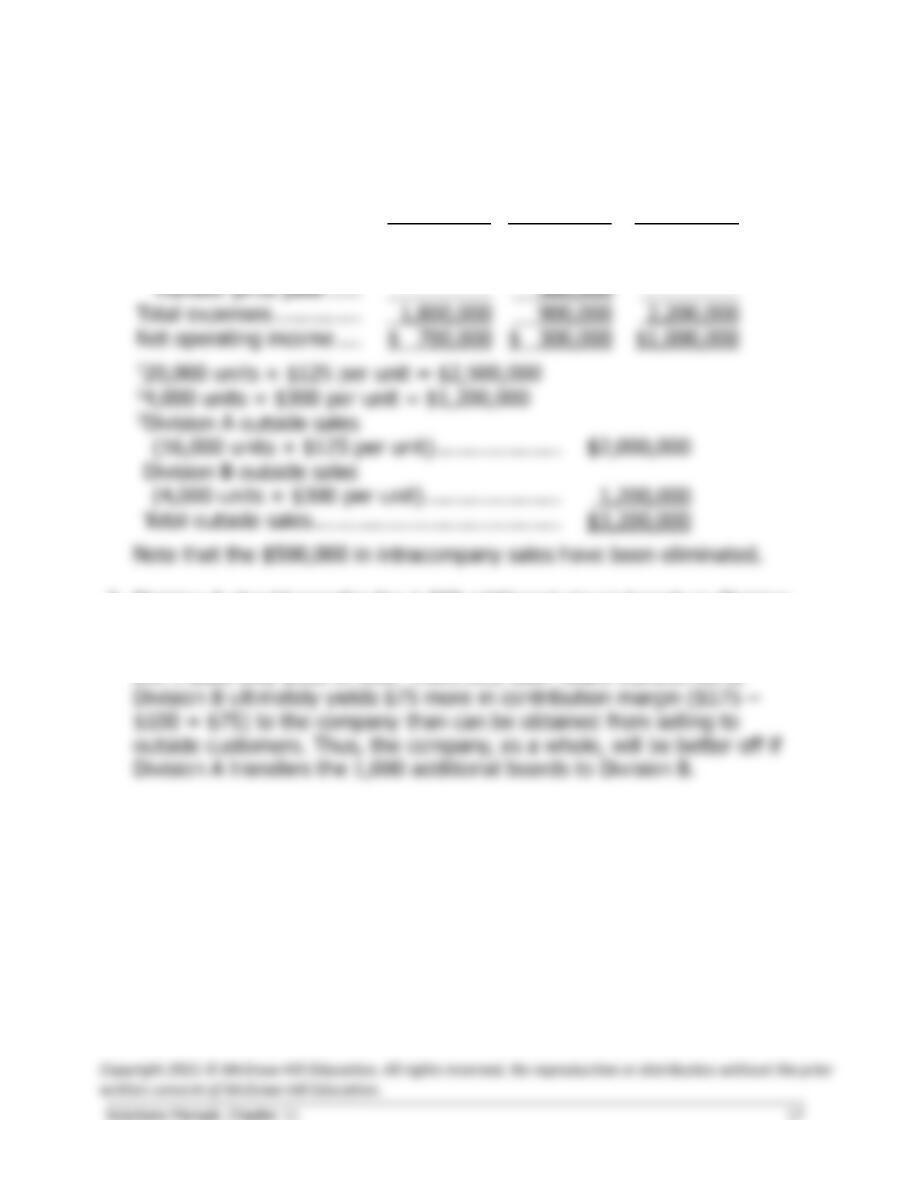
1.
Division A
Division B
Total
Company
Sales ……………………….
$2,500,0001
$1,200,0002
$3,200,0003
Expenses:
Added by the division..
1,800,000
400,000
2,200,000
Total expenses …………..
Net operating income ….
Total outside sales ………………………………….
2. Division A should transfer the 1,000 additional circuit boards to Division
B. Note that Division B’s processing adds $175 to each unit’s selling
price (B’s $300 selling price – A’s $125 selling price = $175 increase),
Exercise 11-8 (15 minutes)
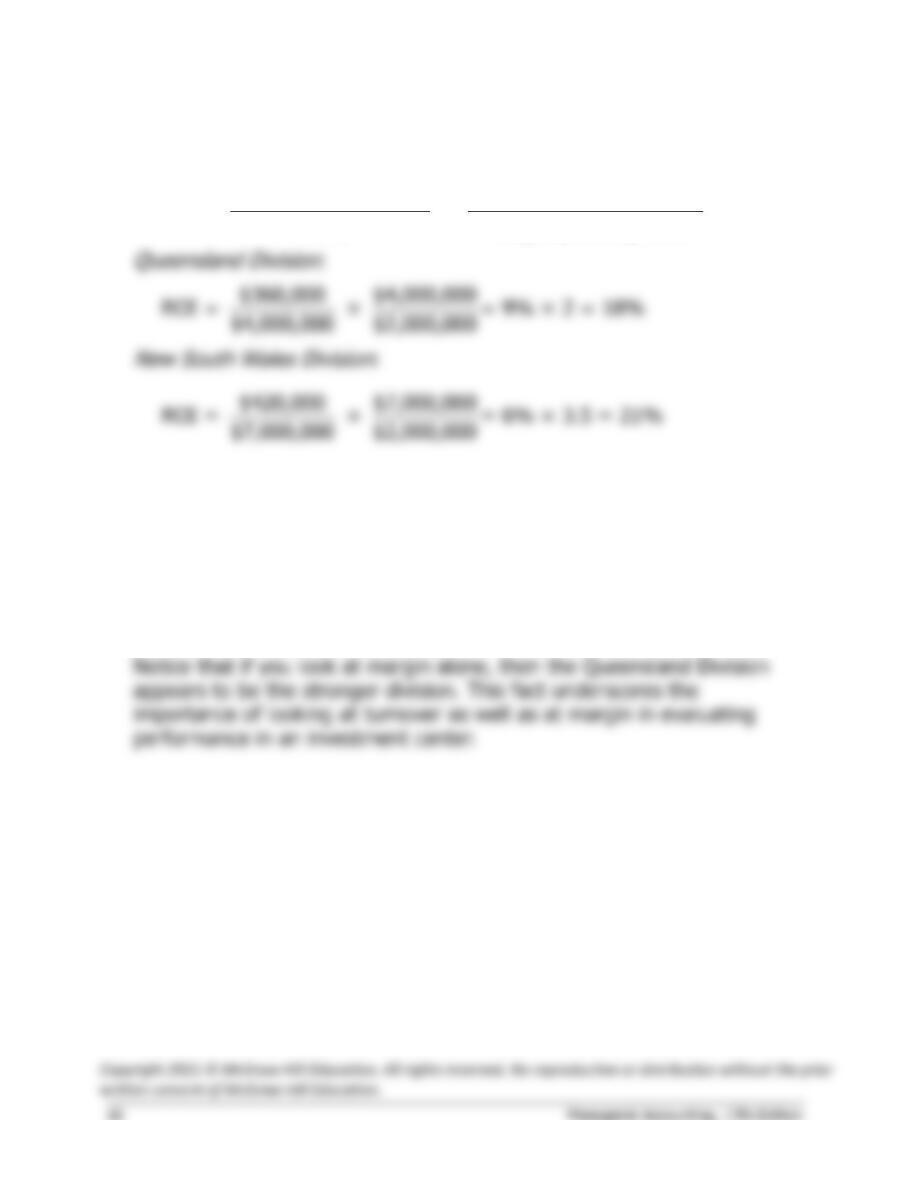
1. ROI computations:
Net operating income Sales
ROI = ×
Sales Average operating assets
2. The manager of the New South Wales Division seems to be doing the
better job. Although the New South Wales Division’s margin is three
percentage points lower than the margin of the Queensland Division, its
turnover is higher (a turnover of 3.5, as compared to a turnover of 2.0
for the Queensland Division). The greater turnover more than offsets
the lower margin, resulting in a 21% ROI, as compared to an 18% ROI
for the other division.
Exercise 11-9 (15 minutes)
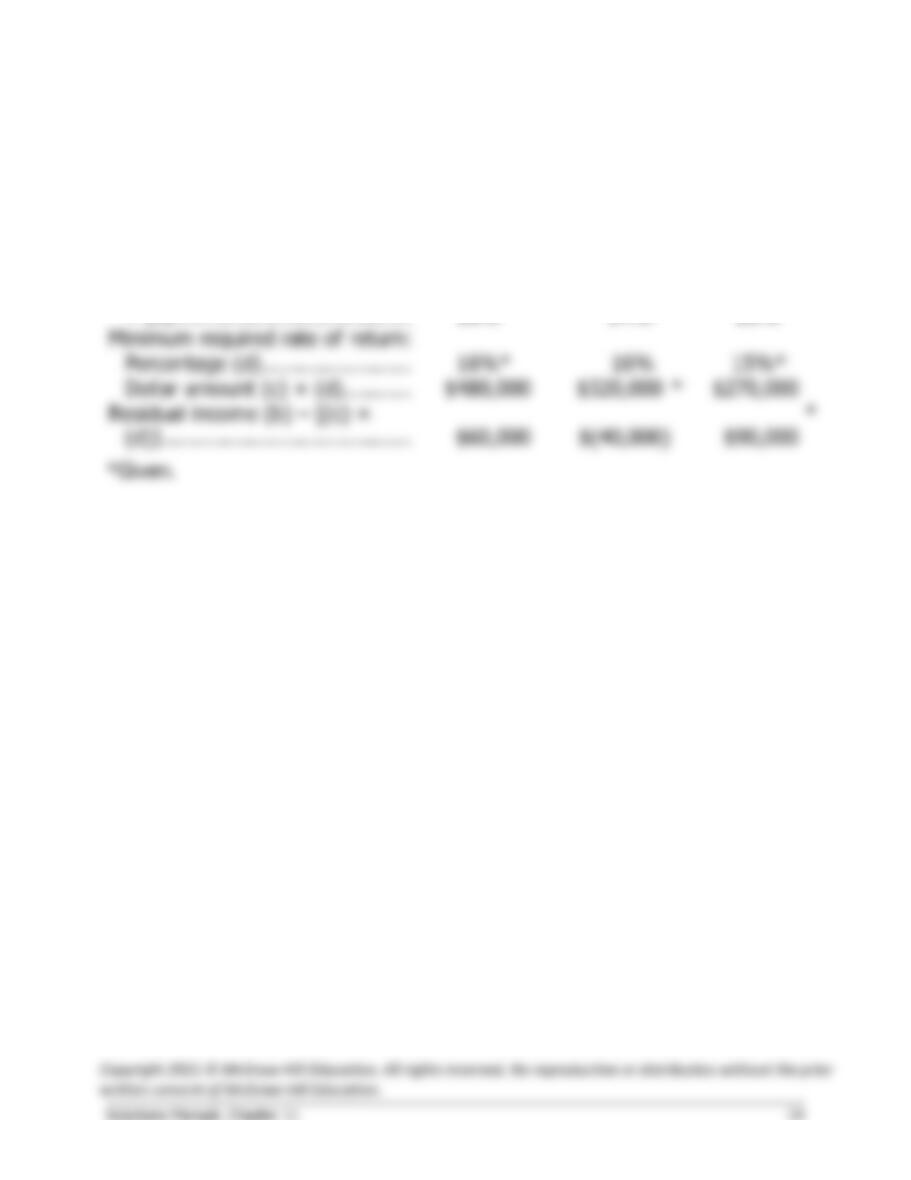
Company A
Company B
Company C
Sales (a) ……………………………..
$9,000,000
*
$7,000,000
*
$4,500,000
*
Net operating income (b) ………..
$540,000
$280,000
*
$360,000
Average operating assets (c) ……
$3,000,000
*
$2,000,000
$1,800,000
*
Return on investment (ROI) (b)
Minimum required rate of return:
*
Residual income (b) – [(c) ×
*
Exercise 11-10 (20 minutes)
1.
Restaurants
Rick’s
Harborside
Imperial
Garden
Ginger
Wok
Total
Percentage of this year’s sales …………………..
32%
50%
18%
100%
Allocation of this year’s fixed administrative
expenses (based on the above percentages)
$640,000
$1,000,000
$360,000
$2,000,000
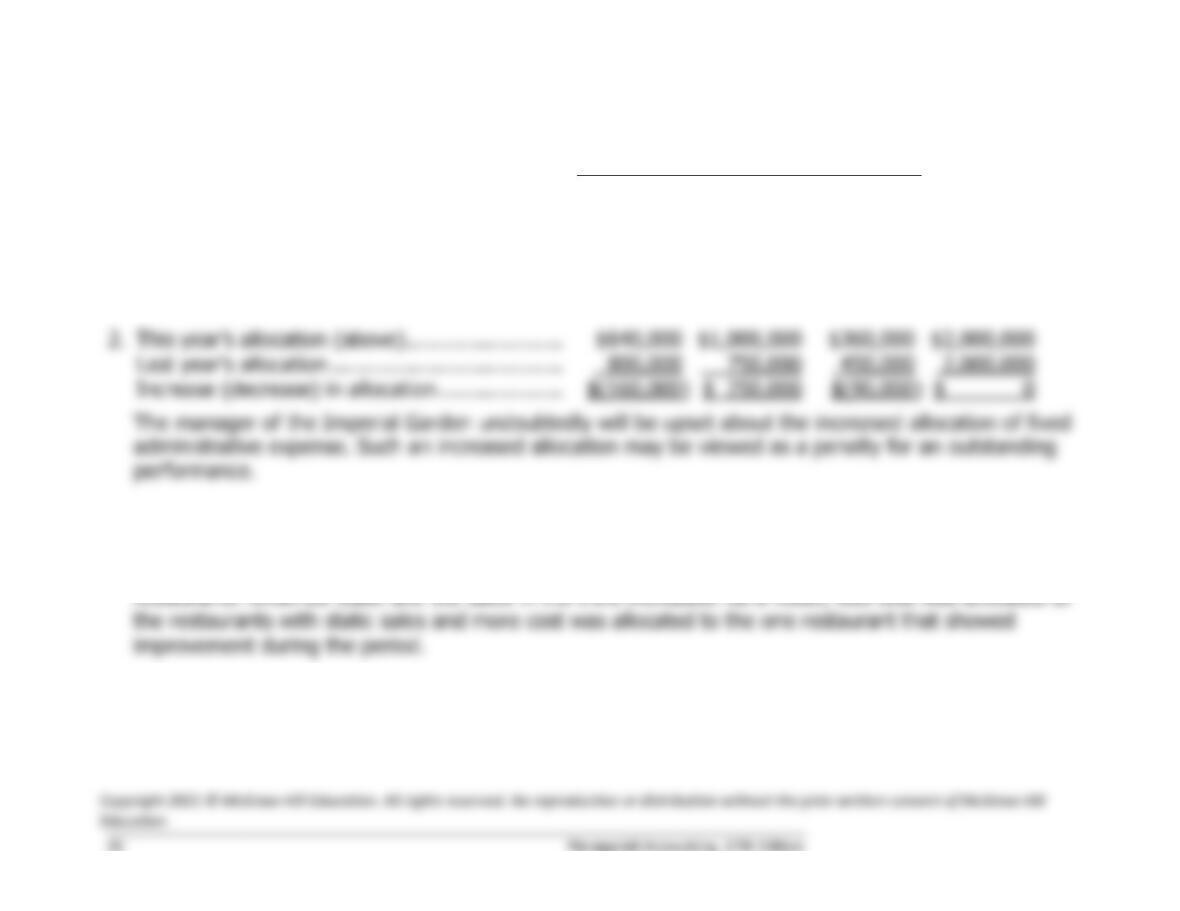
2.
Increase (decrease) in allocation ………………..
3. Sales dollars is not ordinarily a good base for allocating fixed costs. The departments with the
greatest sales will be allocated the greatest amount of cost and the costs allocated to a department
will be affected by the sales in
other
departments. In our illustration above, the sales in two