
11-1
CHAPTER 11
Reporting and Analyzing Stockholders’ Equity
Learning Objectives
1. Identify and discuss the major characteristics of a corporation.
2. Record the issuance of common stock.
3. Explain the accounting for the purchase of treasury stock.
4. Differentiate preferred stock from common stock.
5. Prepare the entries for cash dividends and understand the effect of stock dividends and
stock splits.
6. Identify the items that affect retained earnings.
7. Prepare a comprehensive stockholders’ equity section.
8. Evaluate a corporation’s dividend and earnings performance from a stockholder’s
perspective.
*9. Prepare entries for stock dividends.
11-2
Chapter Outline
Learning Objective 1 – Identify and Discuss the Major Characteristics of a
Corporation
The Corporate Form of Organization—A corporation is a legal entity, created by law,
and has most of the rights and privileges of a person.
▪ Corporations may be classified by purpose and by ownership:
o For the purpose of making a profit (such as Nike or General Motors).
o Or it may be a nonprofit charitable, medical, or educational corporation (such
TEACHING TIP
Ask students to identify corporations operated for a profit (i.e. McDonald’s, Sears, Ford, etc.)
Then ask them to identify corporations with objectives other than profit (i.e. Red Cross,
United Way, Salvation Army, American Heart Association, etc.)
Characteristics Of A Corporation—Several characteristics distinguish corporations
from proprietorships and partnerships.
▪ Separate legal existence:
o An entity separate and distinct from owners.
o Acts under its own name rather than the name of stockholders.
▪ Limited liability of stockholders:
o Creditors ordinarily have recourse only to corporate assets to satisfy their claims.
o Liability of stockholders is normally limited to their investment in the corporation.
▪ Transferable ownership rights:
o Ownership of a corporation is held in shares of capital stock, which are
transferable units.
11-3
▪ Ability to acquire capital:
o It is relatively easy for a corporation to obtain capital through the issuance of
stock.
o Buying stock in a corporation is often attractive to an investor because a
▪ Continuous life:
o The life of a corporation is stated in its charter. It may be perpetual or limited to a
specific number of years.
o If limited, the company can extend the period of existence through renewal of the
charter.
▪ Corporation management:
o Stockholders manage the corporation indirectly through a board of directors,
they elect.
o The board of directors formulates operating policies and selects officers to
execute policy and to perform daily management functions.
o As a result of the Sarbanes-Oxley Act (SOX), the board is now required to
monitor management’s actions more closely.
o The president is the chief executive officer (CEO) and has overall responsibility
▪ Government Regulations:
o State laws prescribe:
• the requirements for issuing stock,
11-4
▪ Additional Taxes:
o Corporations, as separate legal entities, must pay federal and state income
taxes.
▪ Advantages of a corporation:
o Separate legal existence.
o Limited liability of stockholders.
▪ Disadvantages of a corporation:
o Corporation management—separation of ownership and management.
o Government regulations.
o Additional taxes.
▪ Other Forms of Business Organization
o A variety of “hybrid” organizational forms – forms that combine different attributes
of partnerships and corporations – now exist.
TEACHING TIP
Ask students to consider starting a business. Ask them what type organization—sole
proprietorship, partnership, or corporation—they will choose for their hypothetical business.
Why did they choose the type organization they chose? Prompt a discussion of the
advantages and disadvantages of the corporate form of organization.
▪ Forming a corporation—A corporation is formed by grant of a state charter.
o Although a corporation may have operating divisions in a number of states, it is
incorporated in only one state.
o Some states have laws favorable to the corporate form of business organization.
▪ Stockholder rights:
o When chartered, the corporation may begin selling shares of stock of stock.
When a corporation has only one class of stock, it is common stock.
11-5
o Ownership rights are specified in the articles of incorporation or in the by-laws.
o Proof of stock ownership is evidenced by a printed or engraved form known as a
▪ Stockholders have the right to:
o Vote in election of board of directors at the annual meeting and vote on actions
that require stockholder approval.
Learning Objective 2 – Record the Issuance of Common Stock
Stock Issue Considerations:—When a corporation decides to issue stock it must answer
the following questions:
1. How many shares should be authorized for sale?
2. How should the stock be issued?
3. What value should be assigned to the shares?
▪ Authorized Stock—The amount of stock a corporation is authorized to sell is indicated
in the corporate charter.
▪ Issuance of stock—A corporation has the option of issuing common stock directly to
investors or indirectly through an investment banking firm that specializes in bringing
securities to the attention of prospective investors.
o Direct issue is typical in closely held companies.
▪ Par and no-par value stocks:—Par value stock is capital stock that has been
assigned a value per share in the corporate charter.
o Years ago, par value was used to determine the legal capital per share that must
be retained in the business for the protection of corporate creditors. It is the amount
11-6
TEACHING TIP
Stress to students that there is no relationship between par value or stated value and market
value. Pick some corporations in which students would have an interest – Nike, Circuit City,
Starbucks, or Dell. Find the par or stated value of the common stock of these companies.
Take this information along with a current Wall Street Journal, or information from the
Internet, to class. Look at the difference in the par or stated value and the market value. Ask
students when the par value was set. Then ask when the market price was set.
▪ Accounting For Issues Of Common Stock—The stockholders’ equity section of a
corporation’s balance sheet includes paid-in (contributed) capital and retained
earnings (earned capital).
o The distinction between paid-in capital and retained earnings is important from a
legal and an economic point of view.
o Paid-in capital is the amount paid in to the corporation by stockholders in exchange
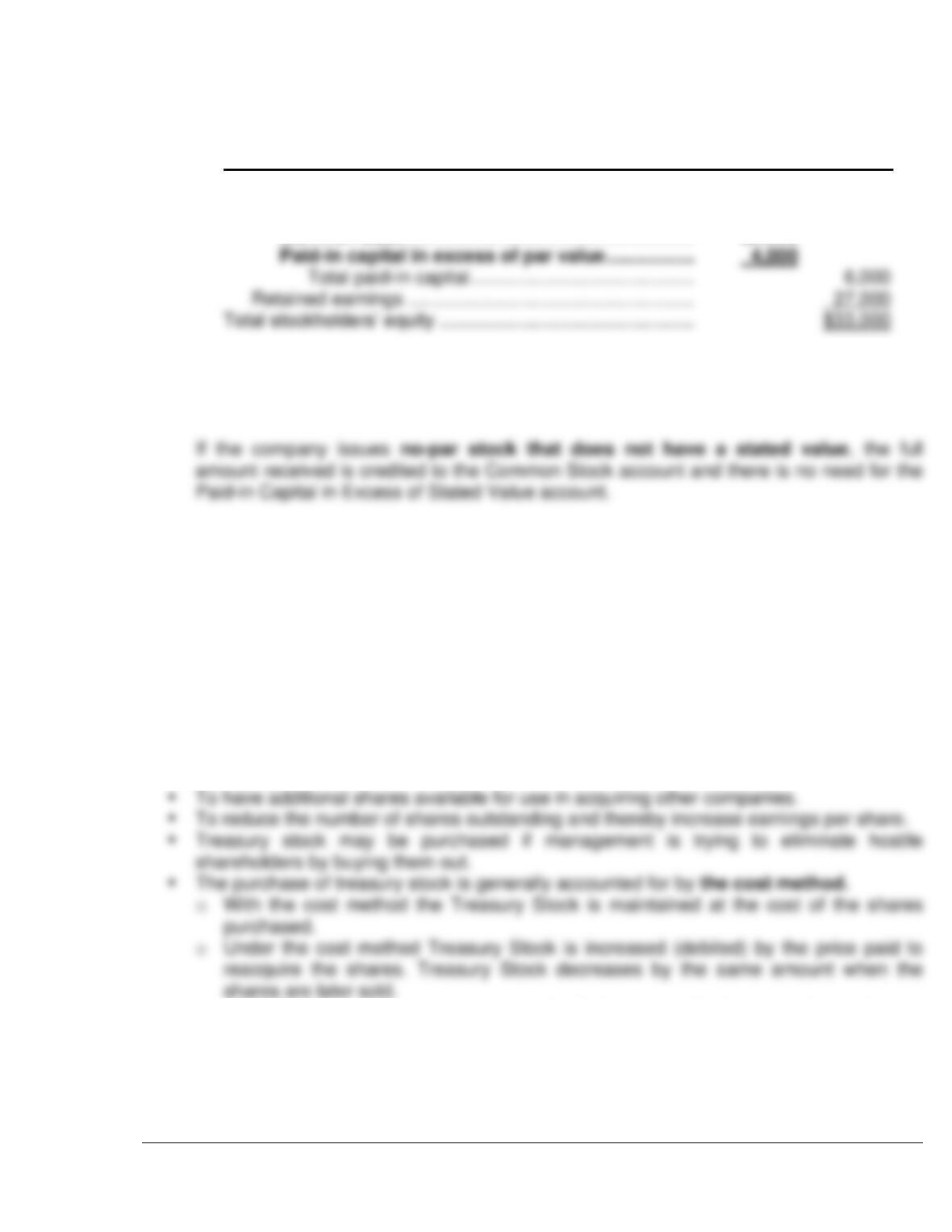
Assume Hydro-Slide, Inc., issues 1,000 shares of $1 par value common stock at par for
cash. The entry to record the transaction is:
Cash …………………………………………………………………………………….. 1,000
If Hydro-Slide, Inc., issues an additional 1,000 shares of the $1 par value common stock for
cash at $5 per share, the entry is:
Cash …………………………………………………………………………………….. 5,000
The total paid-in capital from these two transactions is $6,000.
11-7
Assuming Hydro–Slide, Inc., has retained earnings of $27,000, the stockholders’ equity
section of the balance sheet would be:
HYDRO-SLIDE, INC.
Balance Sheet (partial)
Stockholders’ equity
Paid-in capital
Common stock ………………………………………………. $2,000
If, in the previous example, the stock had been no-par stock with a stated value of $1,
the entries would be the same as those for the par stock except the term “Par Value”
would be replaced with “Stated Value.”
Learning Objective 3 – Explain the Accounting for the Purchase of Treasury Stock
Accounting for Treasury Stock—Treasury stock is a corporation’s own stock that has
been reacquired by the corporation and is being held for future use. A corporation may
acquire treasury stock for various reasons:
▪ To reissue the shares to officers and employees under bonus and stock compensation
plans.
▪ To increase trading of the company’s stock in the securities market with the expectation
of enhancing its market value by signaling that management believes the stock is
underpriced.
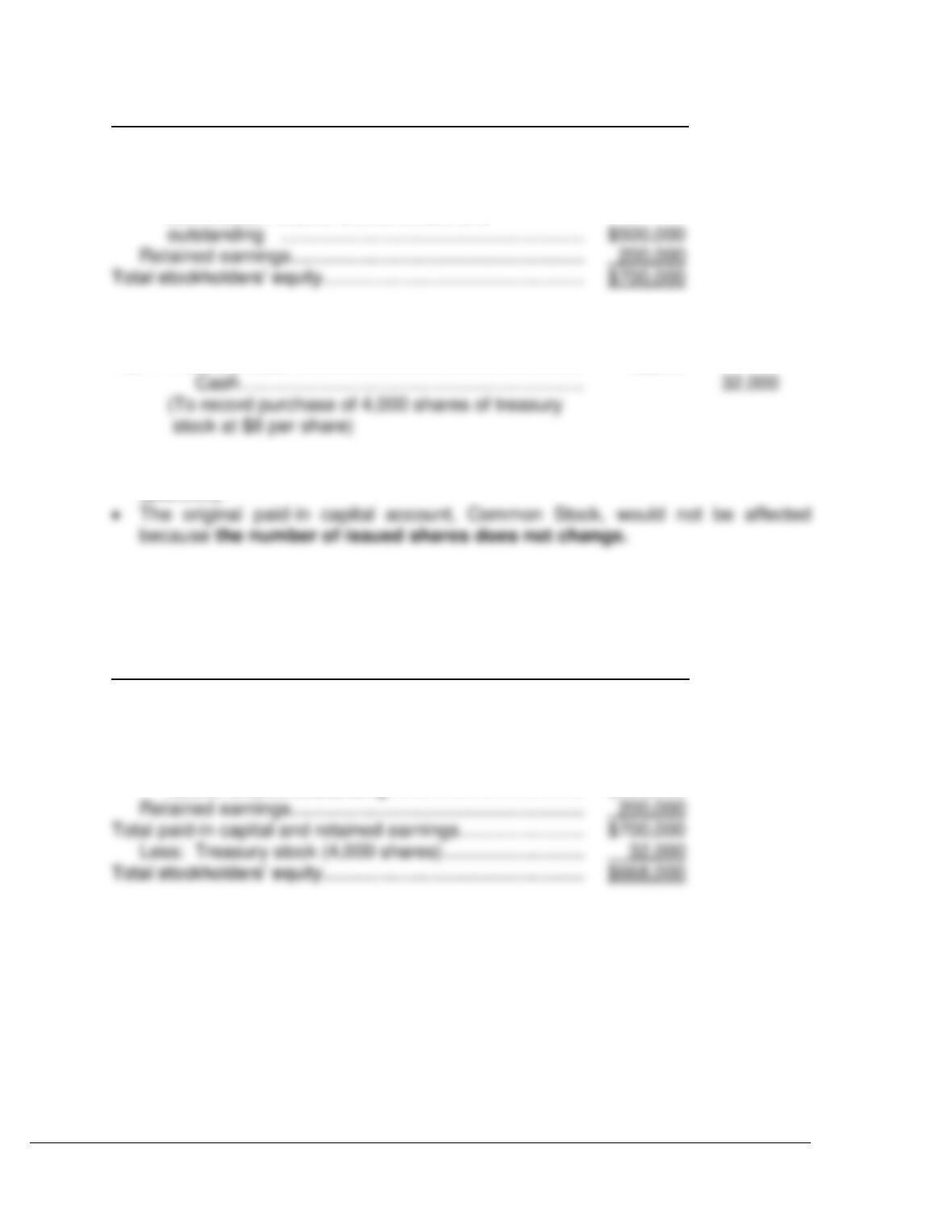
• To illustrate, assume on January 1, 2012, the stockholders’ equity section for
Mead, Inc., has 100,000 shares of $5 par value common stock outstanding (all
issued at par value) and Retained Earnings of $200,000. The stockholders’
equity section of the balance sheet before purchase of treasury stock is shown
as follows:
11-8
MEAD, INC.
Balance Sheet (partial)
Stockholders’ equity
Paid-in capital
Common stock, $5 par value, 400,000 shares
authorized, 100,000 shares issued and
On February 1, 2012, Mead acquires 4,000 shares of its stock at $8 per share. The entry is:
Feb 1. Treasury Stock ………………………………………………. 32,000
• The Treasury Stock account would increase by the cost of the shares purchased
($32,000).
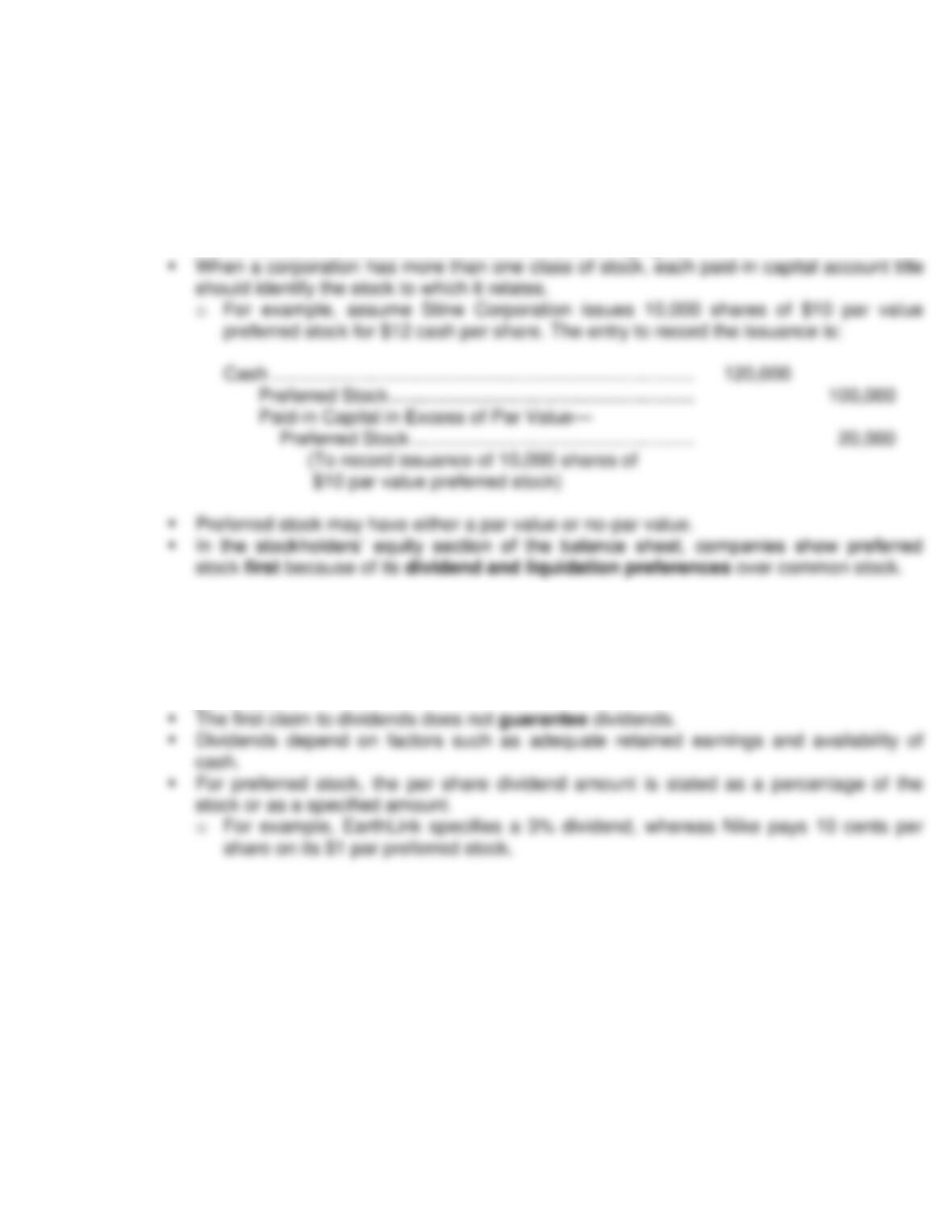
Treasury stock is deducted from total paid-in capital and retained earnings in the
stockholders’ equity section of the balance sheet as follows:
MEAD, INC.
Balance Sheet (partial)
Stockholders’ equity
Paid-in capital
Common stock, $5 par value, 400,000 shares
authorized, 100,000 shares issued and
96,000 shares outstanding ………………………………. $500,000
o Both the number of shares issued (100,000) and the number in the treasury (4,000)
are disclosed. The difference is the number of shares of stock outstanding (96,000).
o The term outstanding stock means the number of shares of issued stock that are
being held by stockholders.
11-9
Learning Objective 4 – Differentiate Preferred Stock from Common Stock
Preferred Stock—Preferred stock has contractual provisions that give it preference or
priority over common stock. Preferred stockholders have a priority in relation to:
(1) dividends
(2) assets in the event of liquidation.
▪ Preferred stockholders sometimes do not have voting rights.
Dividend Preferences—Preferred stockholders have the right to share in the distribution of
corporate income before common stockholders.
▪ If the dividend rate of preferred stock is $5 per share, common shareholders will not
receive any dividends in the current year until preferred stockholders have received $5
per share.
11–10
Cumulative Dividend—Preferred stock contracts often contain a cumulative dividend
feature.
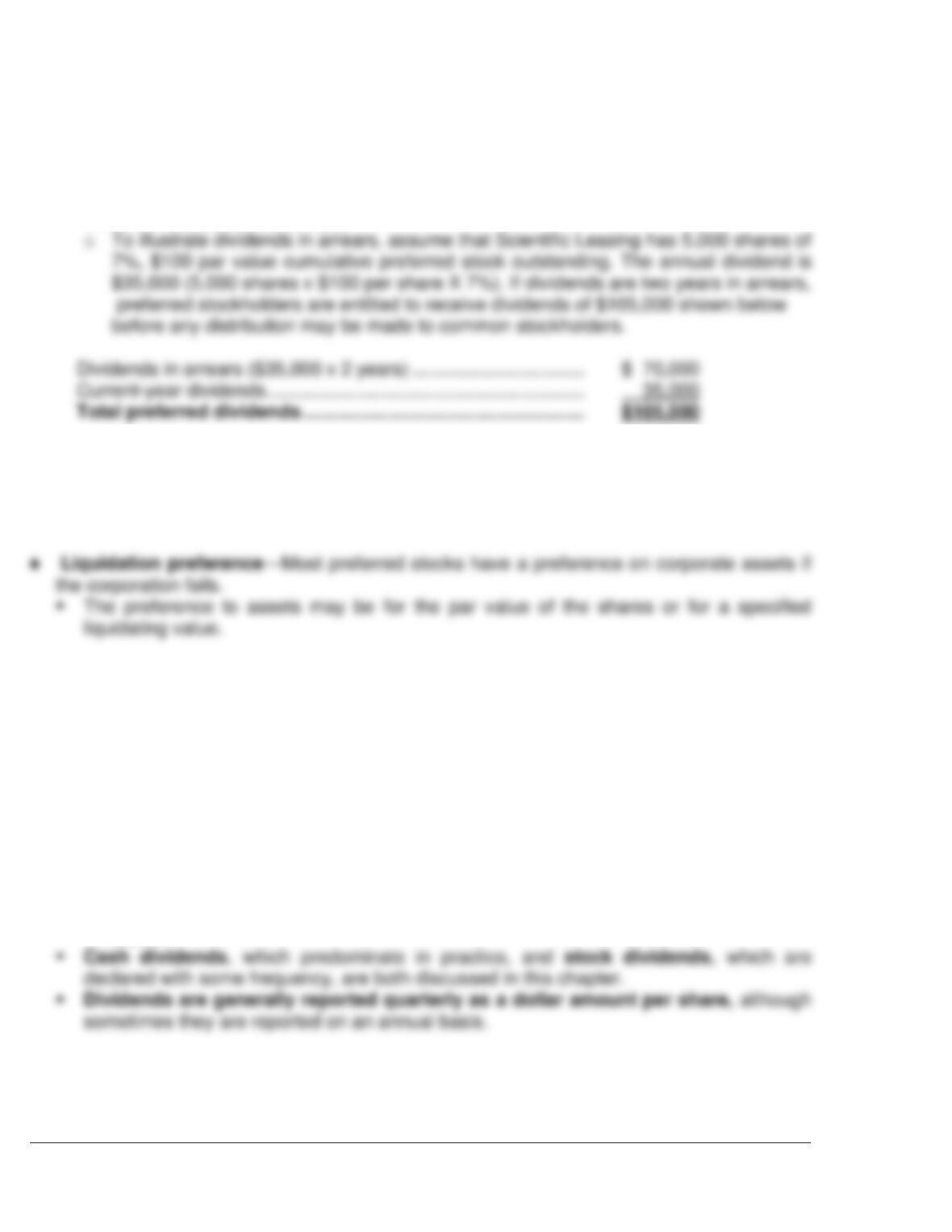
▪ If preferred stock is cumulative, preferred stockholders must be paid both current-year
dividends and any unpaid prior-year dividends before common stockholders receive
dividends.
▪ When preferred stock is cumulative, preferred dividends not declared in a given period
are called dividends in arrears.
▪ Dividends in arrears are not a liability because no obligation exists until the board of
directors declares a dividend.
▪ The amount of dividends in arrears should be disclosed in the notes to the financial
statements.
Learning Objective 5 – Prepare the Entries for Cash Dividends and Understand
the Effect of Stock Dividends and Stock Splits
Dividends—A dividend is a distribution by a corporation to its stockholders on a pro rata
basis. Pro rata means that if you own 10% of the common shares, you will receive 10% of
the dividend.
▪ Dividends can take four forms:
o Cash
o Property
o Scrip (promissory note to pay cash)
o Stock.
11–11
Cash Dividends—A cash dividend is a pro rata (proportional to ownership) distribution of
cash to stockholders.
▪ For a corporation to pay a cash dividend, it must have the following:
o Retained earnings.
• Payment of dividends from retained earnings is legal in all states.
• Companies are frequently constrained by loan agreements to pay dividends only
from retained earnings.
Entries for cash dividends – Three dates are important in connection with dividends:
▪ The declaration date:
o The declaration date is the date the board of directors formally authorizes the cash
dividend and announces it to stockholders.
• Assume that on December 1, 2012, the directors of Media General declare a
$0.50 per share cash dividend on 100,000 shares of $10 par value common
stock. The dividend is $50,000 (100,000 x $0.50), and the entry to record the
declaration is:
Declaration Date
Dec. 1. Cash Dividends ………………………………………………….. 50,000
Dividends Payable ………………………………….. 50,000
(To record declaration of cash dividend)
▪ The record date:
o The record date marks the time when ownership of the outstanding shares is
determined for dividend purposes. It is important in determining the dividend to be paid
to each stockholder but not the total dividend.
11–12
▪ The payment date:
o On the payment date, dividend checks are mailed to the stockholders of record
o The payment of the dividend is recorded.
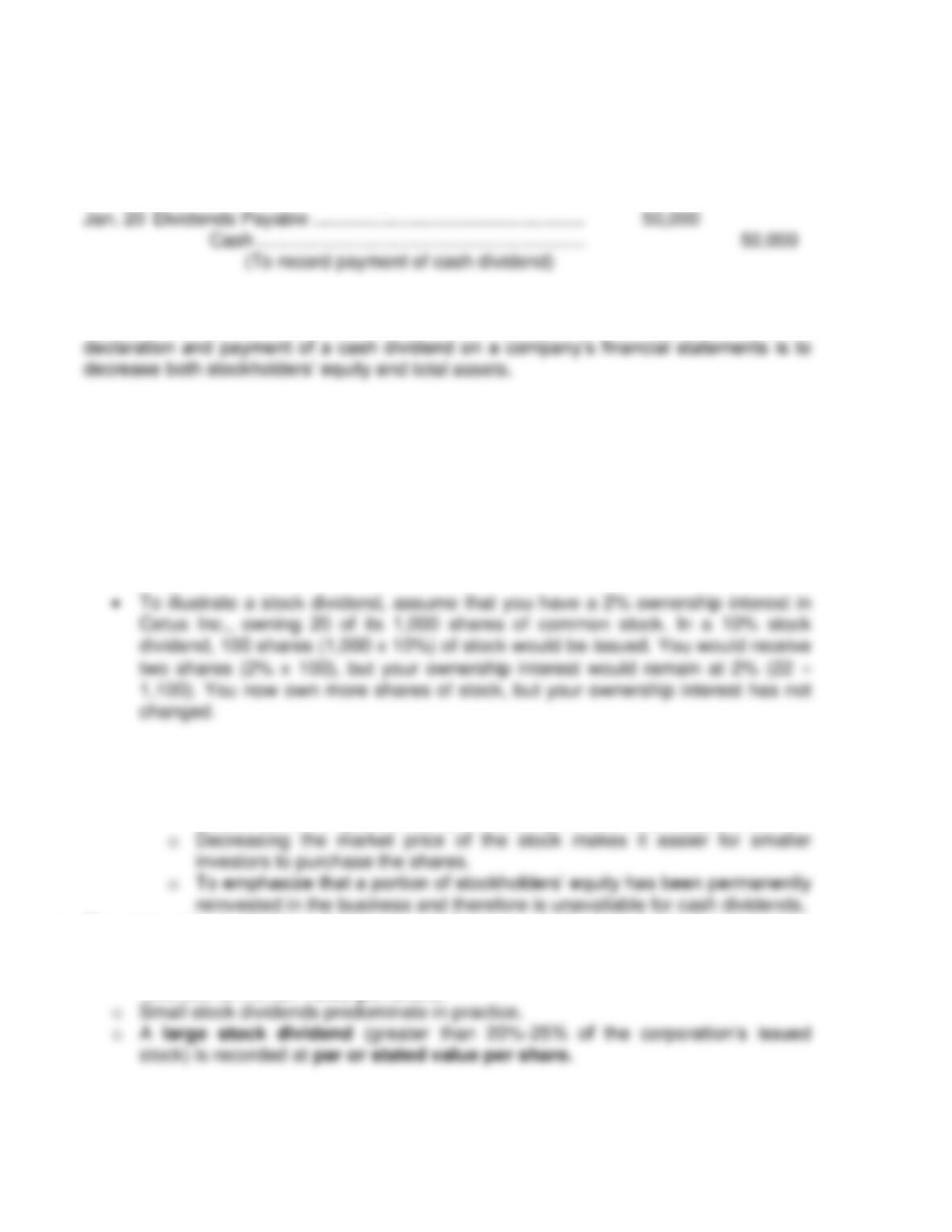
• If January 20 is the payment date for Media General, the entry on that date is:
Payment Date
o Note that the payment of the dividend reduces both current assets and current
liabilities, but it has no effect on stockholders’ equity. The cumulative effect of the
▪ Stock Dividend—A stock dividend is a pro rata distribution of the corporation’s own stock to
stockholders. Whereas a cash dividend is paid in cash, a stock dividend is paid in stock.
o A stock dividend results in a decrease in retained earnings and an increase in
paid-in capital.
o Unlike a cash dividend, a stock dividend does not decrease total stockholders’
equity or total assets.
o Stock dividends are often issued by companies that do not have adequate cash
to issue a cash dividend.
▪ Corporations generally issue stock dividends for one of the following reasons:
o To satisfy stockholders’ dividend expectations without spending cash.
o To increase the marketability of its stock by increasing the number of
shares outstanding and thereby decreasing the market price per share.
▪ The accounting profession distinguishes between a small stock dividend and a large
stock dividend.
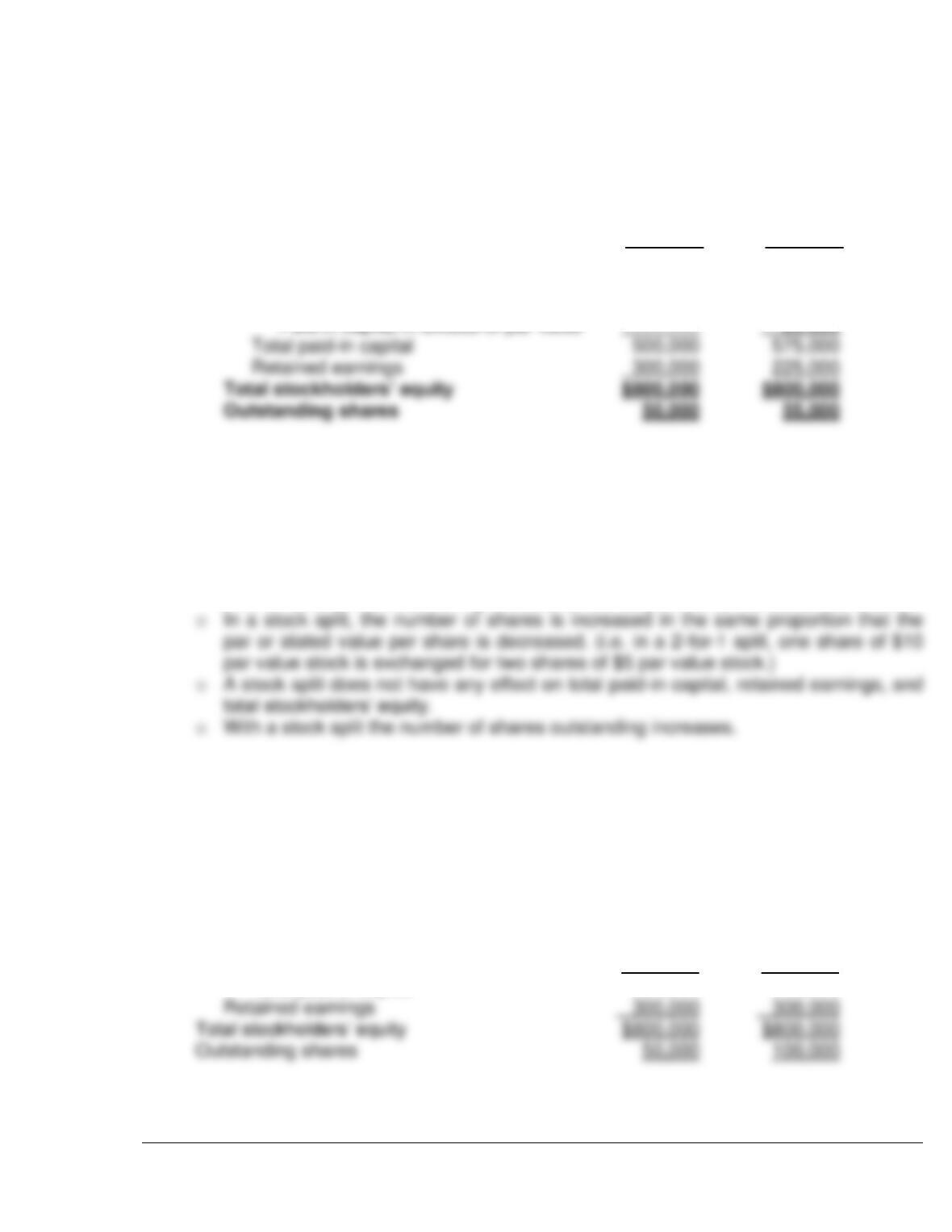
o A small stock dividend (less than 20%-25% of the corporation’s issued stock) is
recorded at the fair value per share.
11–13
▪ Effects of Stock Dividends—Stock dividends change the composition of
stockholders’ equity because they result in a transfer of a portion of retained earnings
to paid-in capital. However total stockholders’ equity remains the same.
o Assume Medland Corp. declares a 10% stock dividend on its $10 par common stock
when 50,000 shares were outstanding. The market price was $15 per share.
Before After
Dividend Dividend
Stockholders’ equity
Paid-in capital
Common stock, $10 par $500,000 $550,000
Total paid-in capital increased by $75,000 and retained earnings decreased by the same
amount. Total stockholders’ equity remains unchanged.
▪ Stock Splits—A stock split, like a stock dividend, involves the issuance of additional shares
of stock to stockholders according to their percentage ownership. However, a stock split results
in a reduction in the par or stated value per share.
o The purpose of stock split is to increase the marketability of the stock by lowering its
market value per share, making it easier for the corporation to issue additional stock.
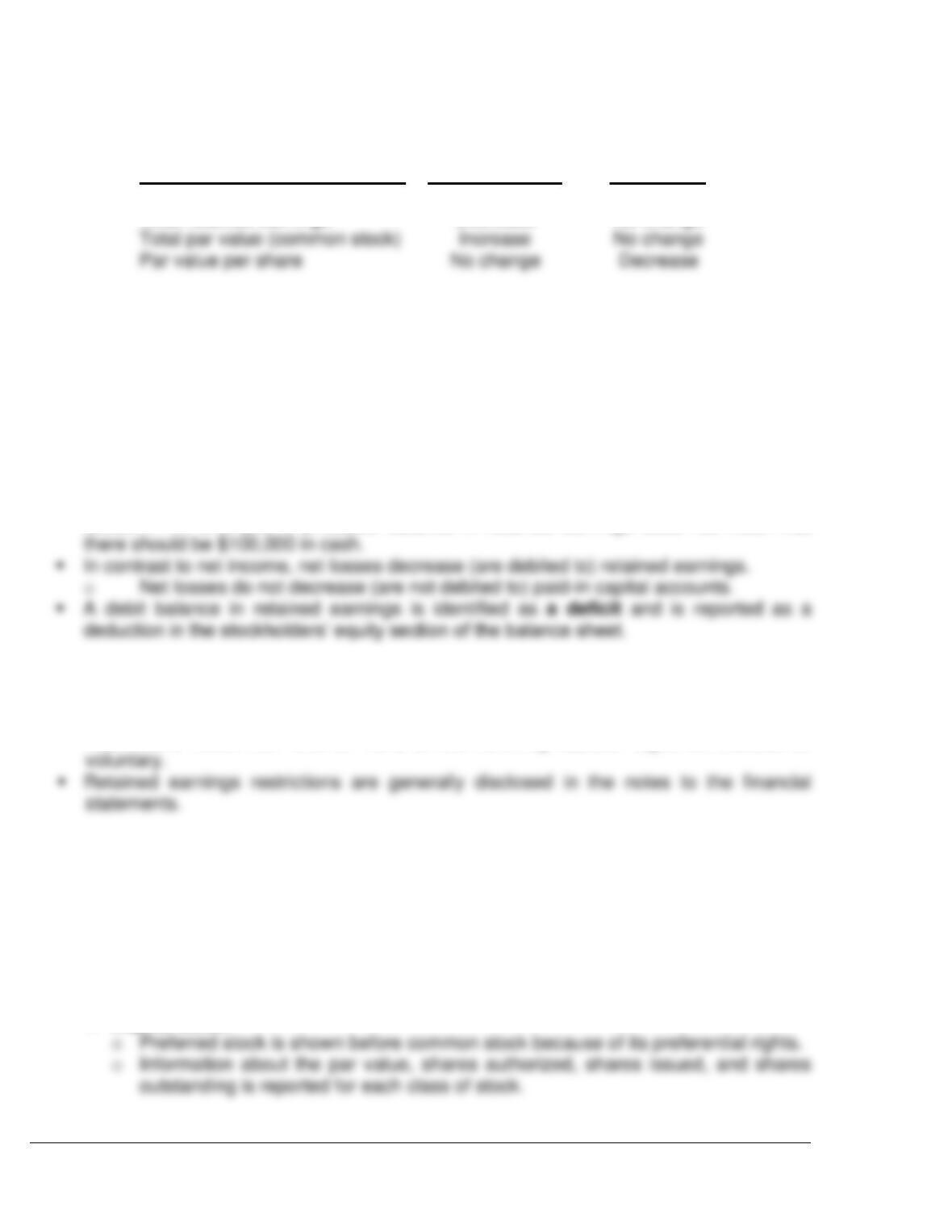
• Assume that instead of issuing a 10% stock dividend Medland splits its 50,000
shares of common stock on a 2-for-1 basis. The effects of Medland’s stock
dividend are shown as follows:
Before After
Stock Split Stock Split
Stockholders’ equity
Paid-in capital
Common stock $500,000 $500,000
Paid-in capital in excess of par value 0 0
Total paid-in capital 500,000 500,000
11–14
o Because a stock split does not affect the balances in any stockholders’ equity accounts,
it is not necessary to journalize a stock split. However, a memorandum entry
explaining the effect of the split is typically made.
o Differences between the effects of stock splits and stock dividends are shown:
Item Stock Dividend Stock Split
Total paid-in capital Increase No change
Total retained earnings Decrease No change
Learning Objective 6 – Identify the Items that Affect Retained Earnings
Retained Earnings—Retained earnings is net income that is retained in the business. The
balance in retained earnings is part of the stockholders’ claim on the total assets of the
corporation.
▪ Retained earnings does not represent a claim on any specific asset.
▪ The amount of retained earnings cannot be associated with the balance of any asset
account. For example, a $100,000 balance in retained earnings does not mean that
Retained Earnings Restrictions—Although the balance in retained earnings is generally
available for dividend declarations, there may be retained earnings restrictions that make
a portion of the balance currently unavailable for dividends.
▪ Restrictions result from one or more of the following causes: legal, contractual, or
Learning Objective 7 – Prepare a Comprehensive Stockholders’ Equity Section
Balance Sheet Presentation—In the stockholders’ equity section of the balance sheet,
companies report paid-in capital and retained earnings and identify the specific sources of
paid-in capital.
▪ Within paid-in capital, two classifications are recognized:
1. Capital stock:
11–15
2. Additional paid-in capital includes the excess of amounts paid in over par or stated
value.
TEACHING TIP
Go through each section of the stockholders’ equity section on Graber’s partial balance
sheet in illustration 11-16.
▪ Sub-classifications within the stockholders equity sections are seldom presented in
published annual reports.
Keeping An Eye on Cash—Information regarding cash inflows and outflows during the
year that resulted from equity transactions is reported in the “Financing Activities” section of
the statement of cash flows.
Learning Objective 8 – Evaluate a Corporation’s Dividend and Earnings Performance
from a Stockholder’s Perspective
Measuring Corporate Performance—Investors are interested in both a company’s
dividend record and its earnings performance. Although those two measures are often
parallel, that is not always the case. Thus, investors should investigate each one separately.
▪ Dividend record – One way that companies reward stock investors for their investment
is to pay them dividends.
▪ The payout ratio measures the percentage of earnings distributed in the form of cash
o However, low dividend payments, or a cut in dividend payments, might signal that a
company has liquidity or solvency problems and is trying to conserve cash by not
paying dividends. Investors and analysts should investigate the reason for low
dividend payments.
TEACHING TIP
Ask students to look at the payout ratios of four companies shown in Illustration 11-19. In
which companies are students more be willing to invest? Why?
▪ Earnings performance – The return on common stockholders’ equity is a widely
used ratio that measures profitability from the common stockholders’ viewpoint.
o This ratio shows how many dollars of net income were earned for each dollar of
common stockholders’ equity.
11–16
Debt versus equity decisions – When obtaining long-term capital, corporate managers
must decide whether to issue bonds or to sell common stock.
▪ Bonds have three primary advantages relative to common stock:
o Stockholder control is not affected. Bondholders do not have voting rights, so
current owners (stockholders) retain full control of the company.
o Tax savings result. Bond interest is deductible for tax purposes; dividends on stock
are not.
o Return on common stockholders’ equity may be higher. Although bond interest
expense reduces net income, return on common stockholders’ equity often is higher
under bond financing because no additional shares of common stock are issued.
▪ The return on common stockholders’ equity is affected by the return on assets ratio and
the amount of leverage a company uses—that is, by the company’ reliance on debt
Learning Objective 9 – Appendix – Prepare Entries for Stock Dividends
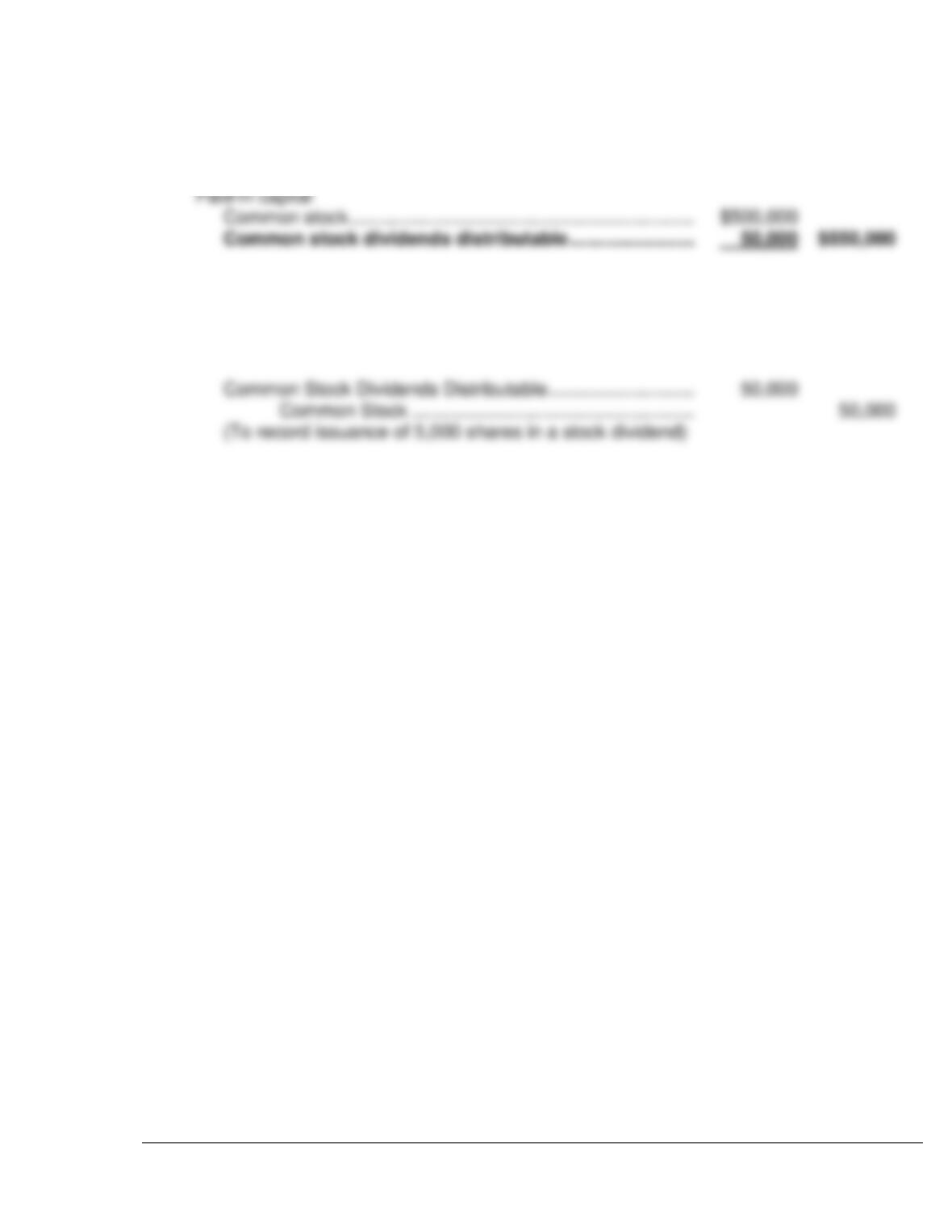
Entries for Stock Dividends—To illustrate the accounting for stock dividends, assume that
Medland Corporation has a balance of $300,000 in retained earnings and declares a 10%
stock dividend on its 50,000 shares of $10 par value common stock. The current fair value
of its stock is $15 per share. The number of shares to be issued is 5,000 (10% x 50,000),
and the total amount to be debited to Retained Earnings is $75,000 (5,000 x $15). The
entry to record this transaction at the declaration date is:
▪ Note that at the declaration date, the account Stock Dividends is increased (debited) for
the fair value of the stock issued: Common Stock Dividends Distributable is increased
(credited) for the par value of the dividend shares; and the excess over par is shown as
an increase (credit) to an additional paid-in capital account.
11–17
MEDLAND CORPORATION
Balance Sheet (partial)
▪ When the dividend shares are issued, Common Stock Dividends Distributable is
decreased and Common Stock is increased as follows: