347
PROBLEMS
P11–1
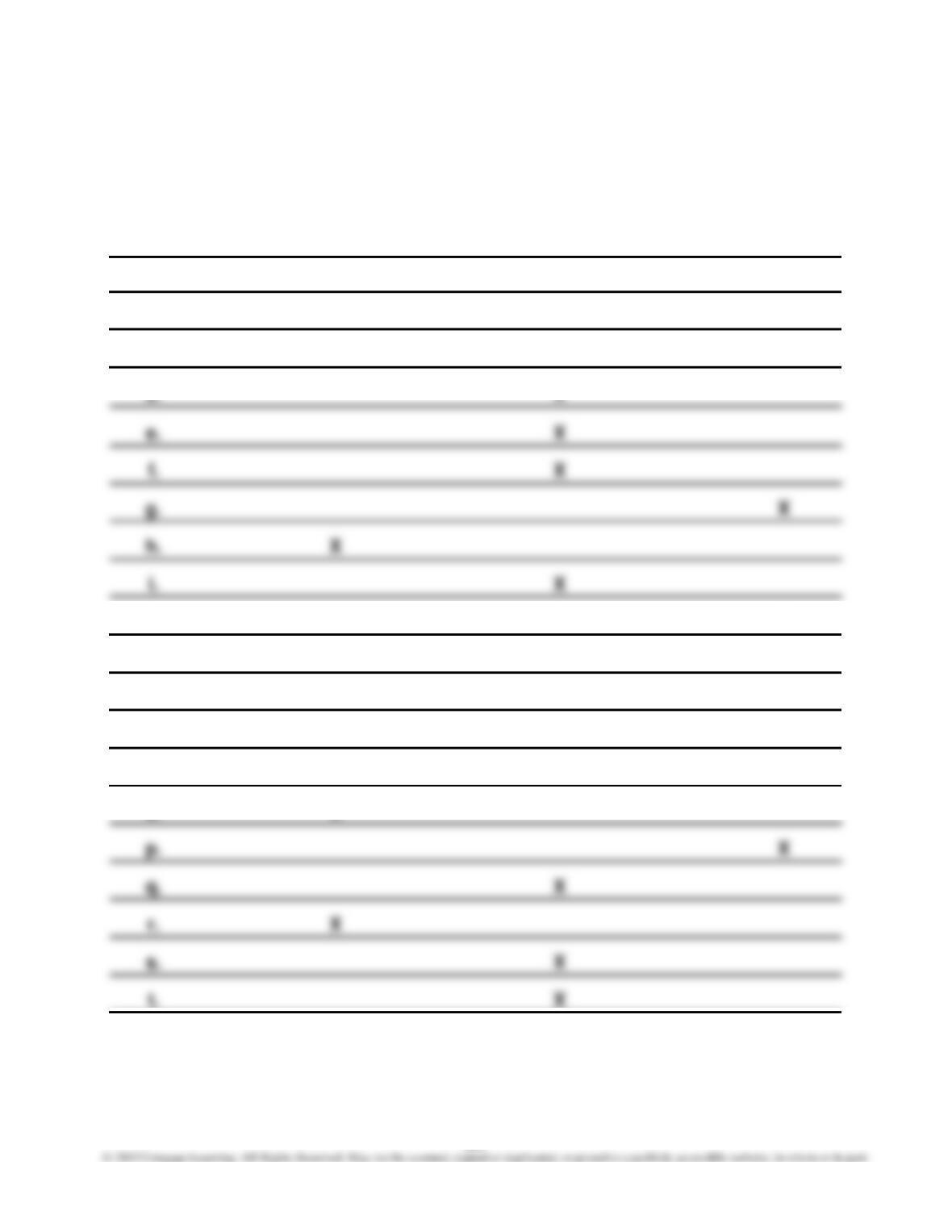
Fixed Variable Mixed
Cost Cost Cost Cost
a. X
b. X
c. X
d. X
j. X
k. X
l. X
m. X
n. X
o. X
348
P11–2
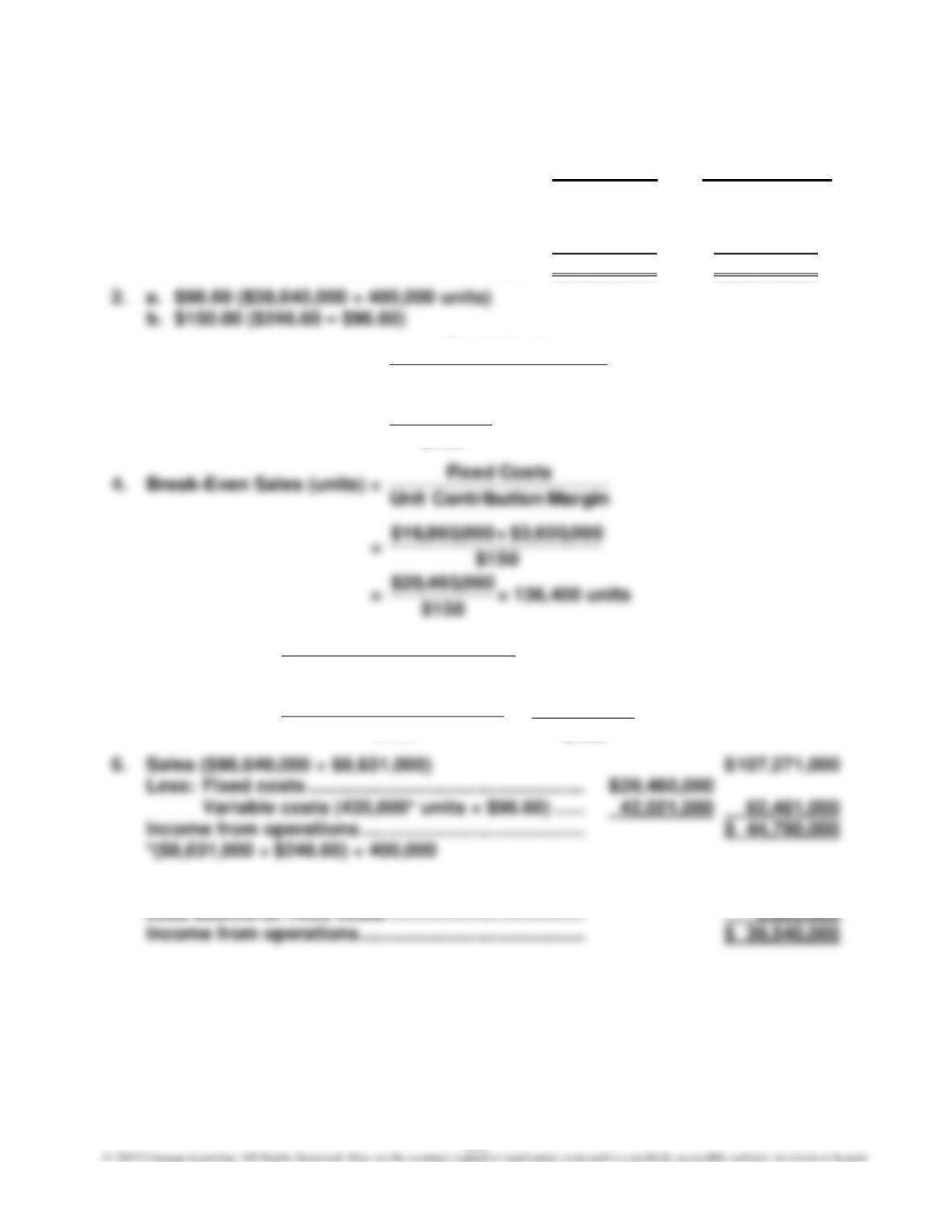
1. Fixed Costs Variable Costs
Cost of goods sold …………………………………. $12,460,000 $ 32,040,000
Selling expenses ……………………………………. 2,000,000 6,000,000
Administrative expenses ………………………… 2,400,000 600,000
Total ………………………………………………………. $ 16,860,000 $ 38,640,000
3. Break-Even Sales (units) =
arginMnontributioCUnit
ostsCFixed
=
150$
000,860,16$
= 112,400 units
5. Sales (units) =
Margin onContributiUnit
ProfitTarget + CostsFixed
=
150$
000,140,43$+000,460,20$
=
150$
000,600,63$
= 424,000 units
7. Present operating income …………………………………. $ 43,140,000
349
P11–2, Concluded
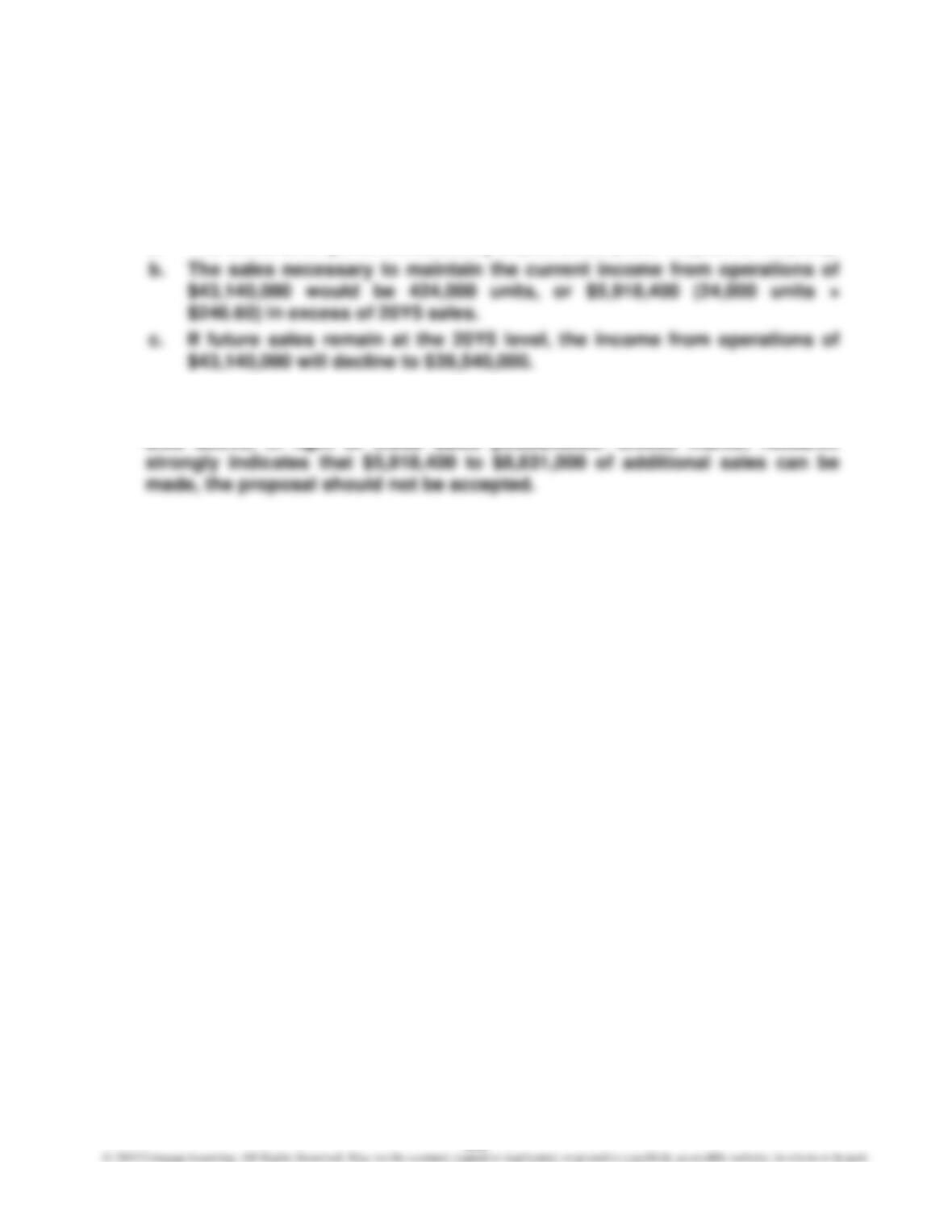
8. In favor of the proposal is the possibility of increasing income from opera-
tions by $1,650,000 from $43,140,000 to $44,790,000. However, there are many
points against the proposal, including:
a. The break-even point increases by 24,000 units (from 112,400 to 136,400).
The company should determine the sales potential if the additional product is
produced and then evaluate the advantages and the disadvantages enumer-
ated above, in light of these sales possibilities. Unless market research
350
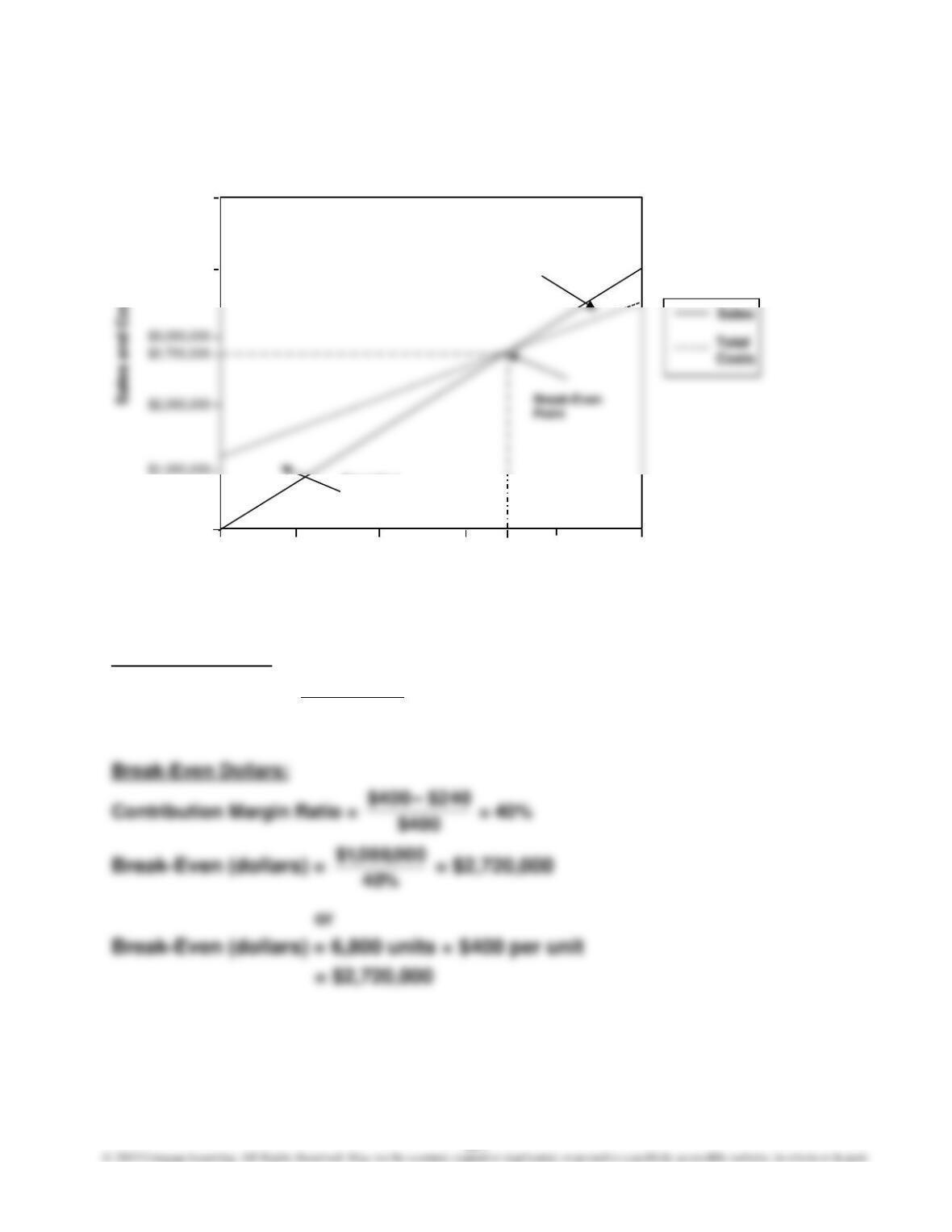
P11–3
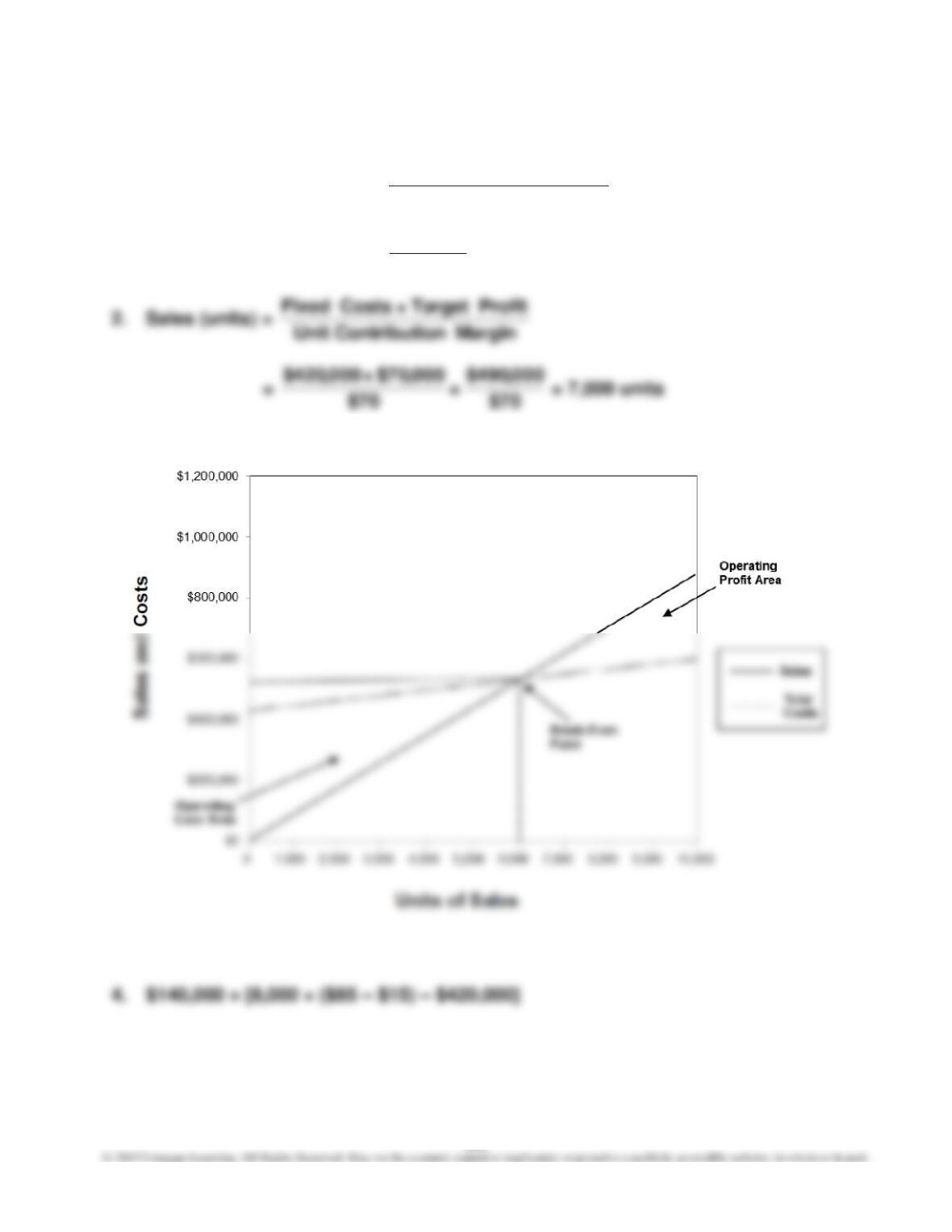
1. Break-Even Sales (units) =
arginMonContributiUnit
CostsFixed
=
70$
000,420$
= 6,000 units
3.
351
P11–4
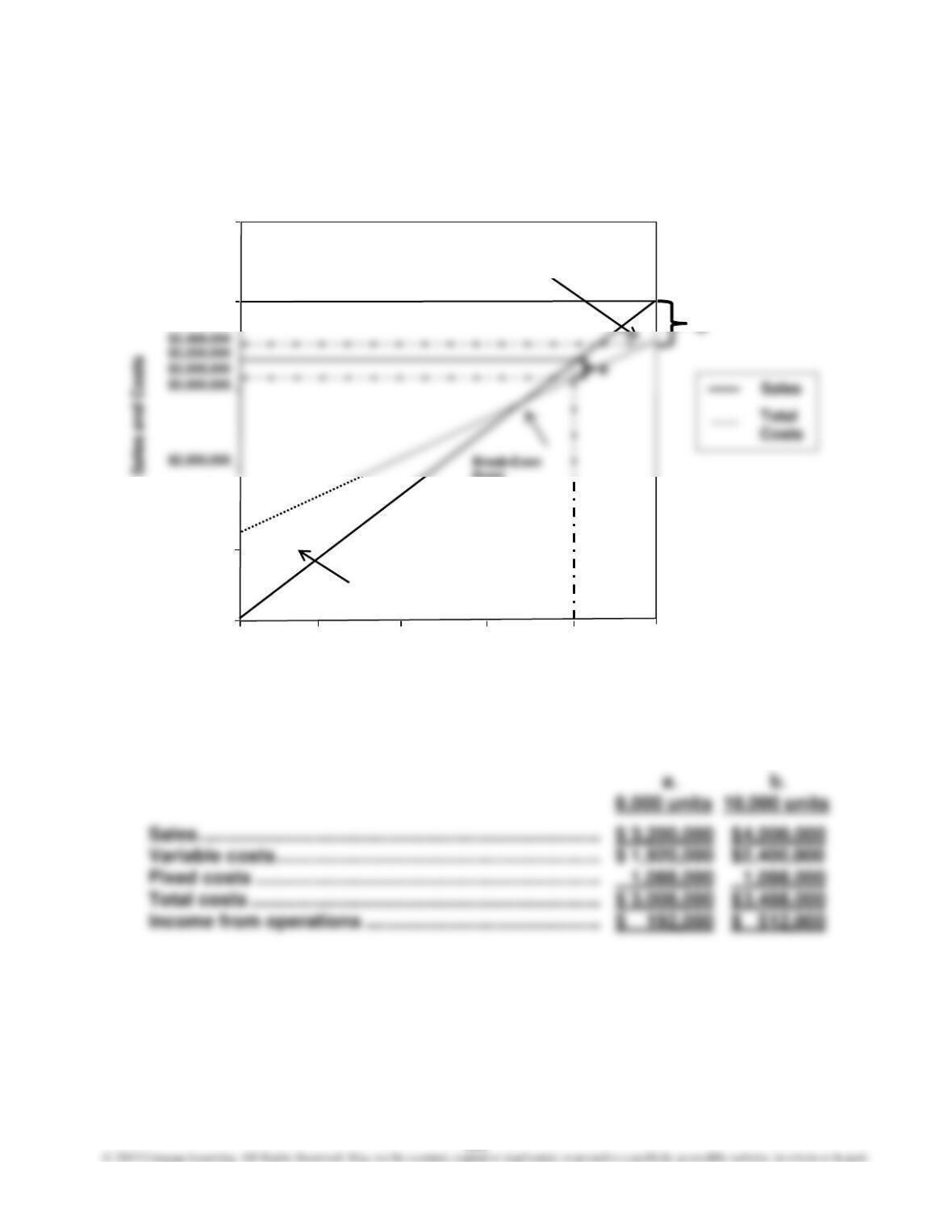
1.
Break-Even Units:
Break-Even (units) =
240$ –– 400$
000,088,1$
= 6,800 units
0 2,000 4,000 6,000 6,800 8,000 10,000
$5,000,000
$4,000,000
$0
Operating
Loss Area
Operating
Profit Area
Units of Sales
352
P11–4, Continued
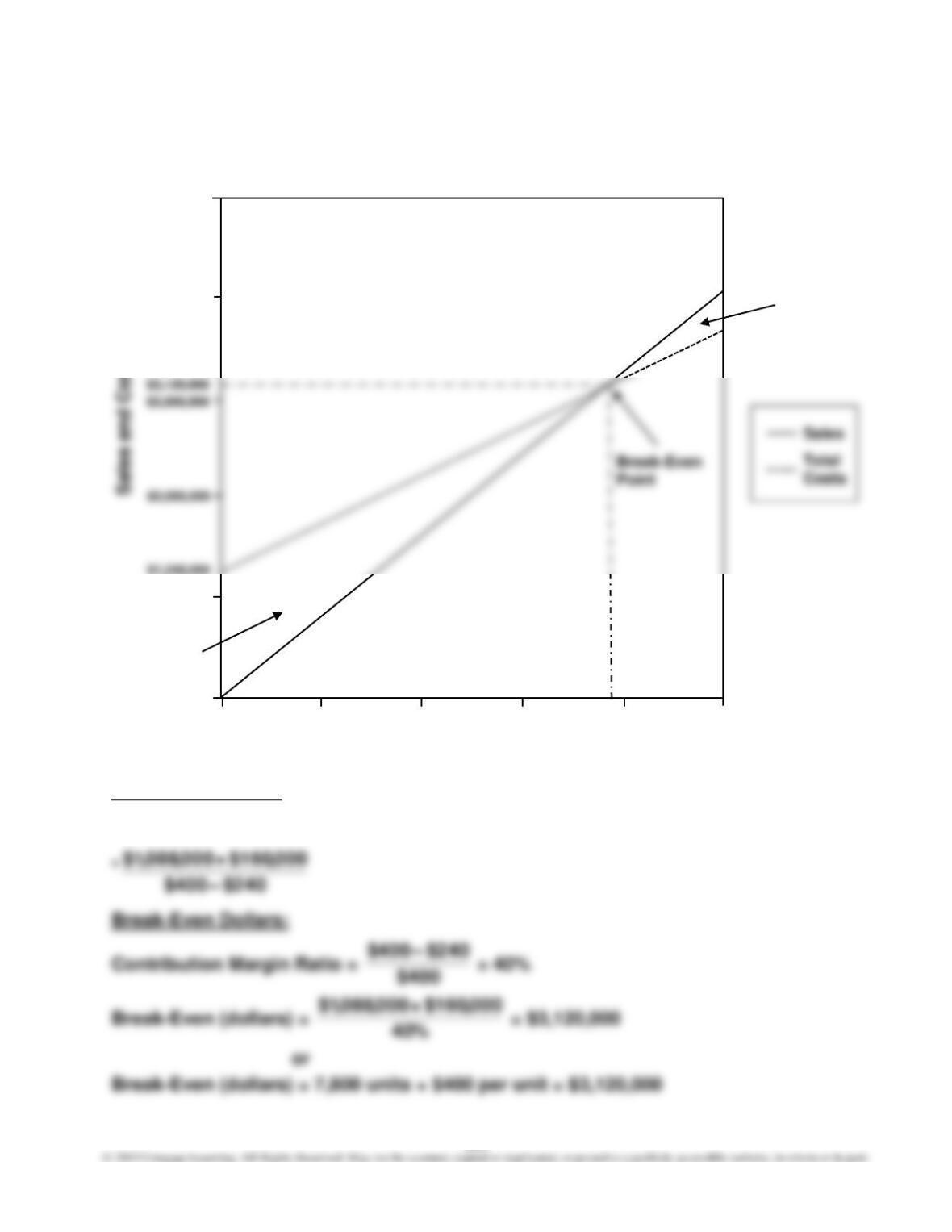
2.
Units sold: $3,200,000 ÷ $400 per unit = 8,000 units
$5,000,000
$4,000,000
$1,000,000
$0
0 2,000 4,000 6,000 8,000 10,000
Units of Sales
Point
Operating
Loss Area
Operating
Profit Area
353
P11–4, Continued
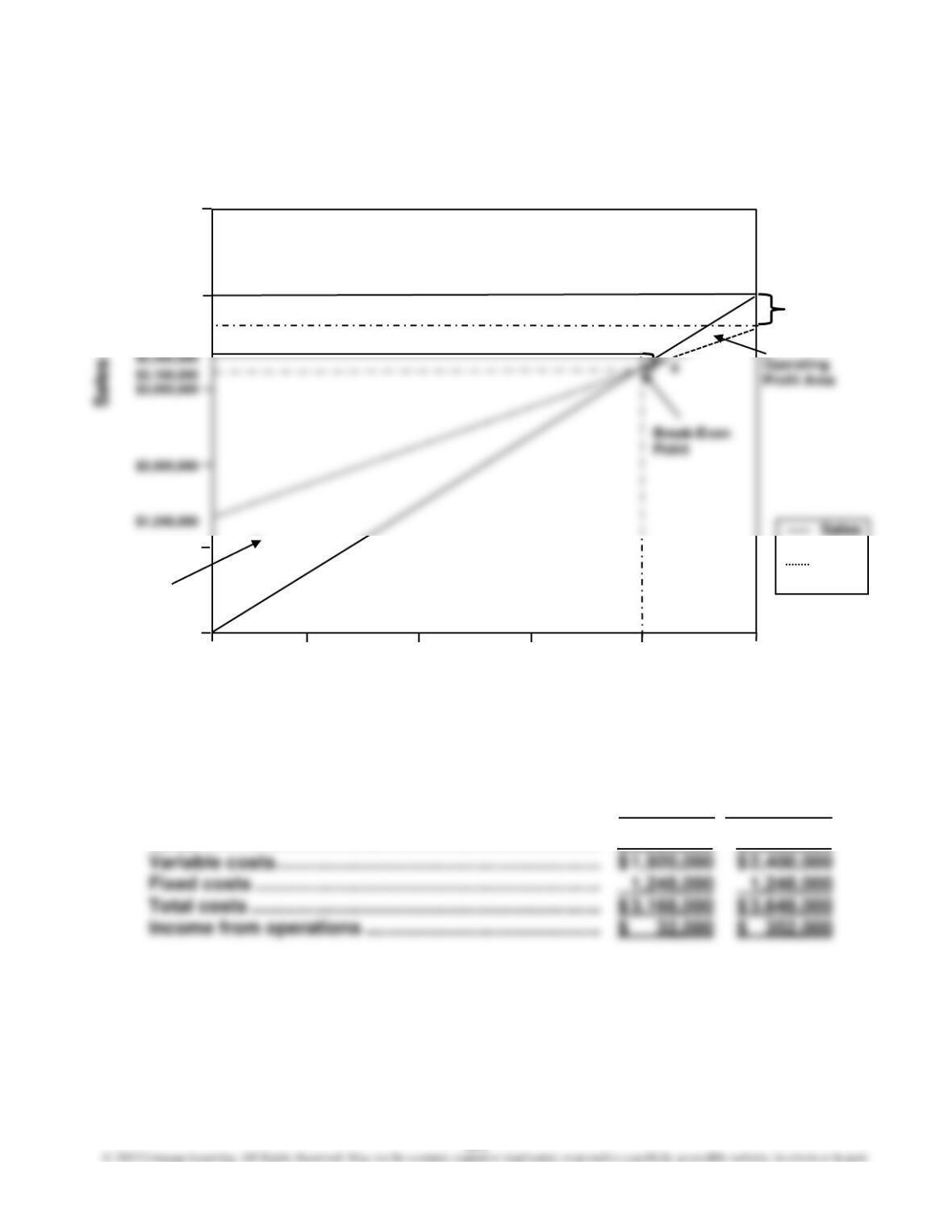
3.
Break-Even (units):
Break-even point: 7,800* units or $3,120,000
$5,000,000
$4,000,000
$1,000,000
$0
0
2,000
4,000
6,000
8,000
10,000
7,800
Units of Sales
Operating
Loss Area
Operating
Profit Area
354
P11–4, Concluded
4.
Break-Even
Point
a. b.
8,000 units 10,000 units
Sales ………………………………………………………………….. $ 3,200,000 $ 4,000,000
Total
Costs
$5,000,000
$4,000,000
$1,000,000
$0
0
2,000
4,000
6,000
10,000
8,000
Units of Sales
Operating
Loss Area
$3,648,000
b
7,800
P11–5
(Overall product is labeled E.)
1. Unit selling price of E [($400 × 80%) + ($800 × 20%)] ……………. $480
2. 7,500 units of E × 80% = 6,000 units of kayaks
7,500 units of E × 20% = 1,500 units of canoes
3. Unit selling price of E [($400 × 20%) + ($800 × 80%)] …………….. $ 720
4. 5,000 units of E × 20% = 1,000 units of kayaks
5,000 units of E × 80% = 4,000 units of canoes
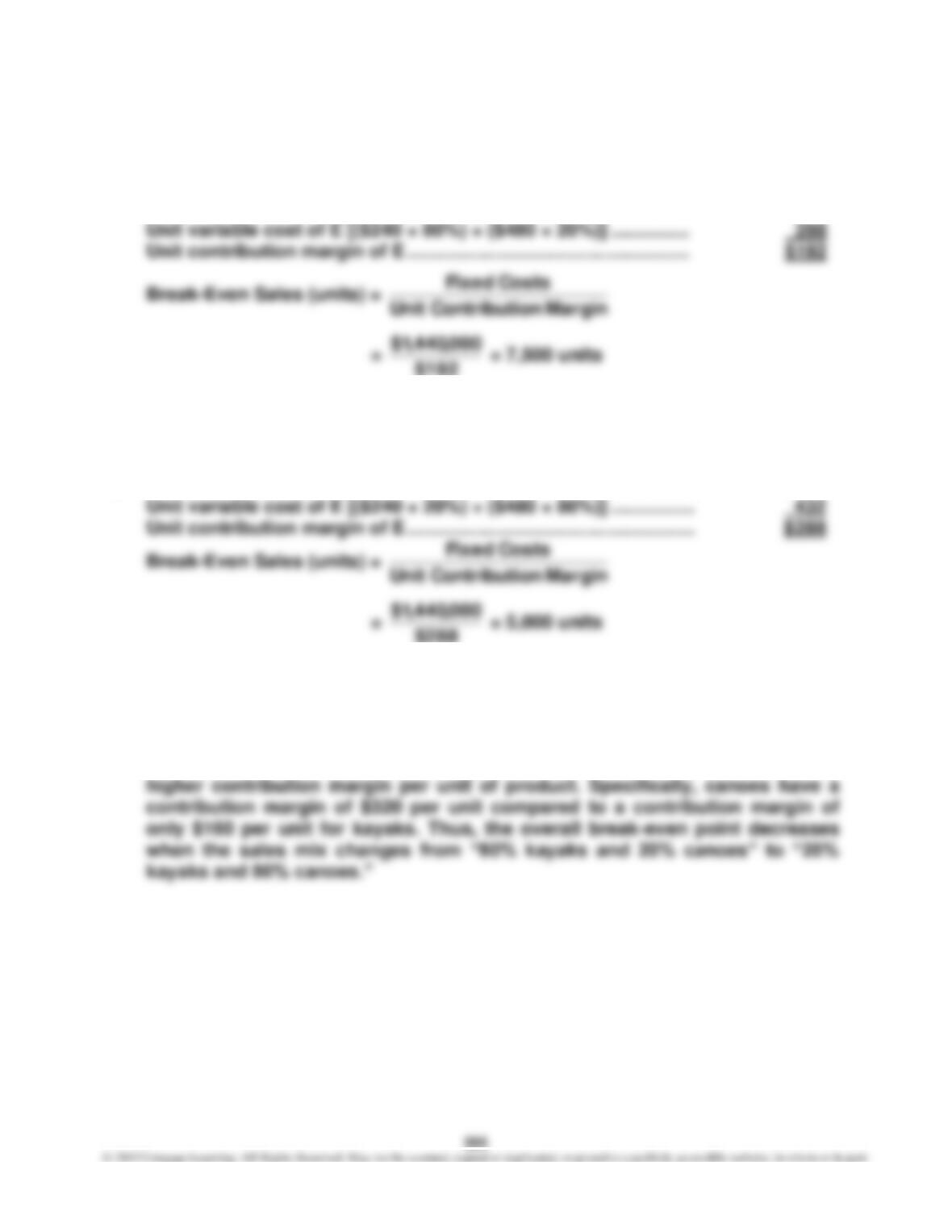
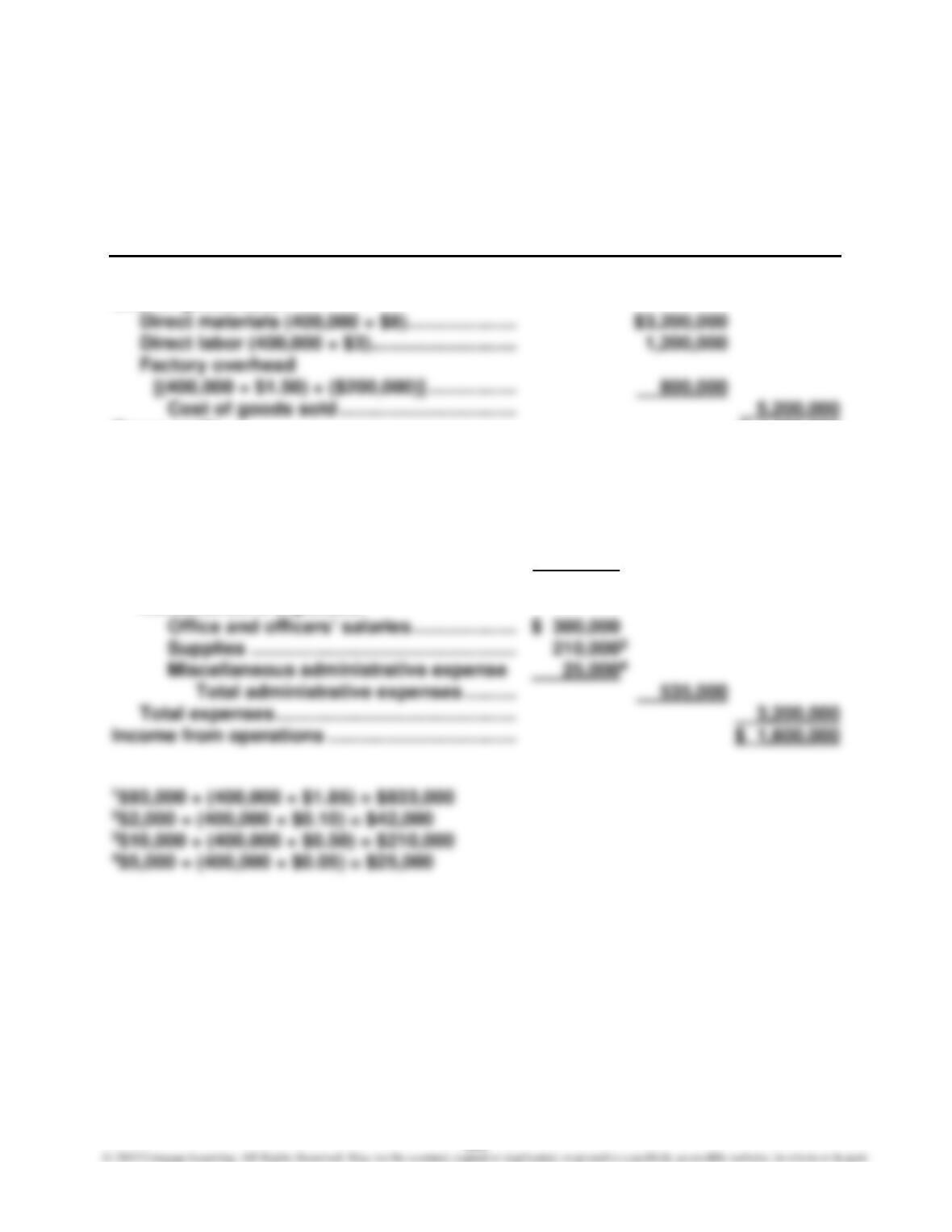
5. The overall enterprise break-even point decreased from 7,500 units to 5,000
units because the sales mix is weighted more toward the product with the
356
P11–6
1.
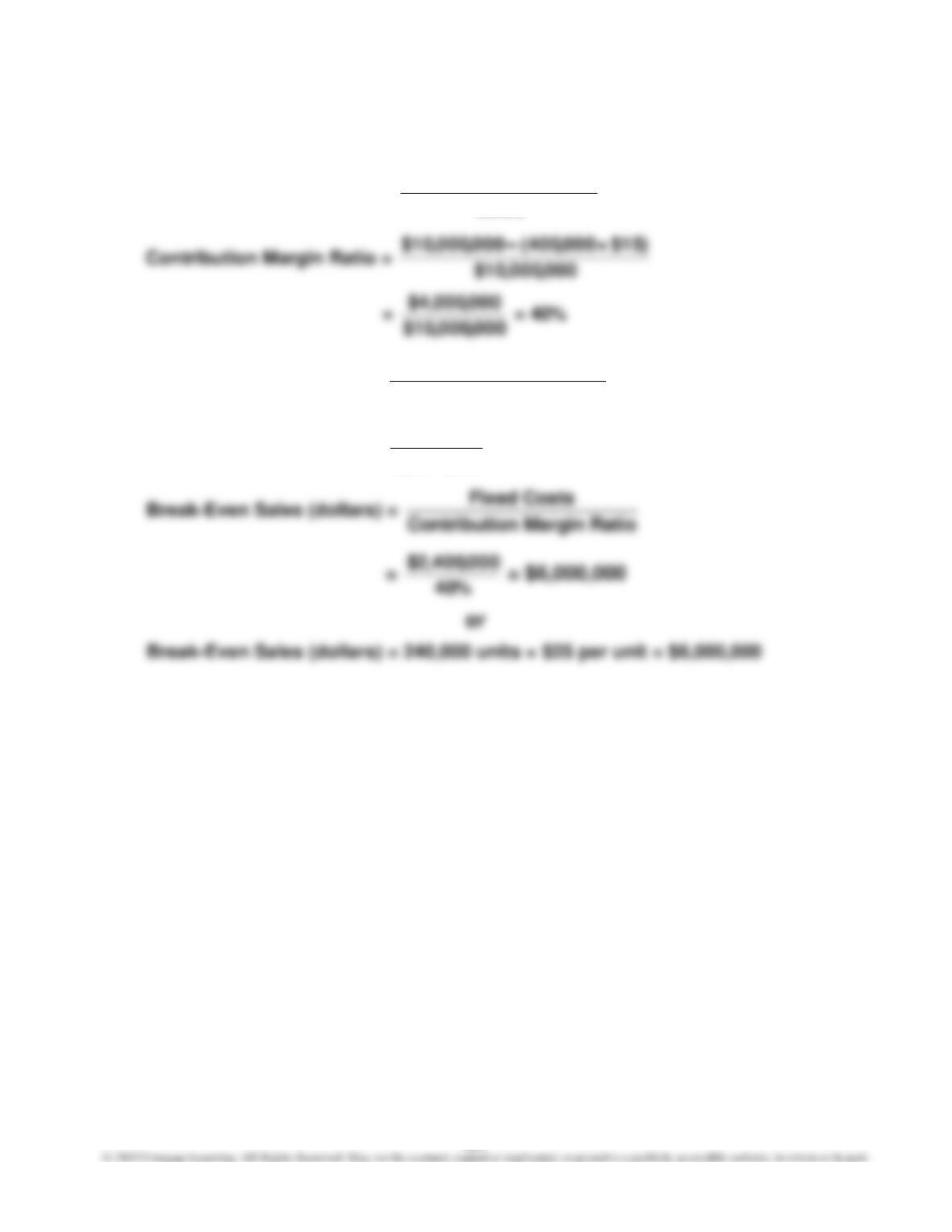
ORGANIC HEALTH CARE PRODUCTS INC.
Estimated Income Statement
For the Year Ended December 31, 20Y8
Sales (400,000 × $25) ………………………………….. $ 10,000,000
Cost of goods sold:
Gross profit ………………………………………………… $ 4,800,000
Expenses:
Selling expenses:
Advertising ……………………………………….. $ 1,450,000
Sales salaries and commissions ………… 833,0001
Travel ……………………………………………….. 340,000
Miscellaneous selling expense ………….. 42,0002
Total selling expenses ………………….. $2,665,000
Administrative expenses:
357
P11–6, Continued
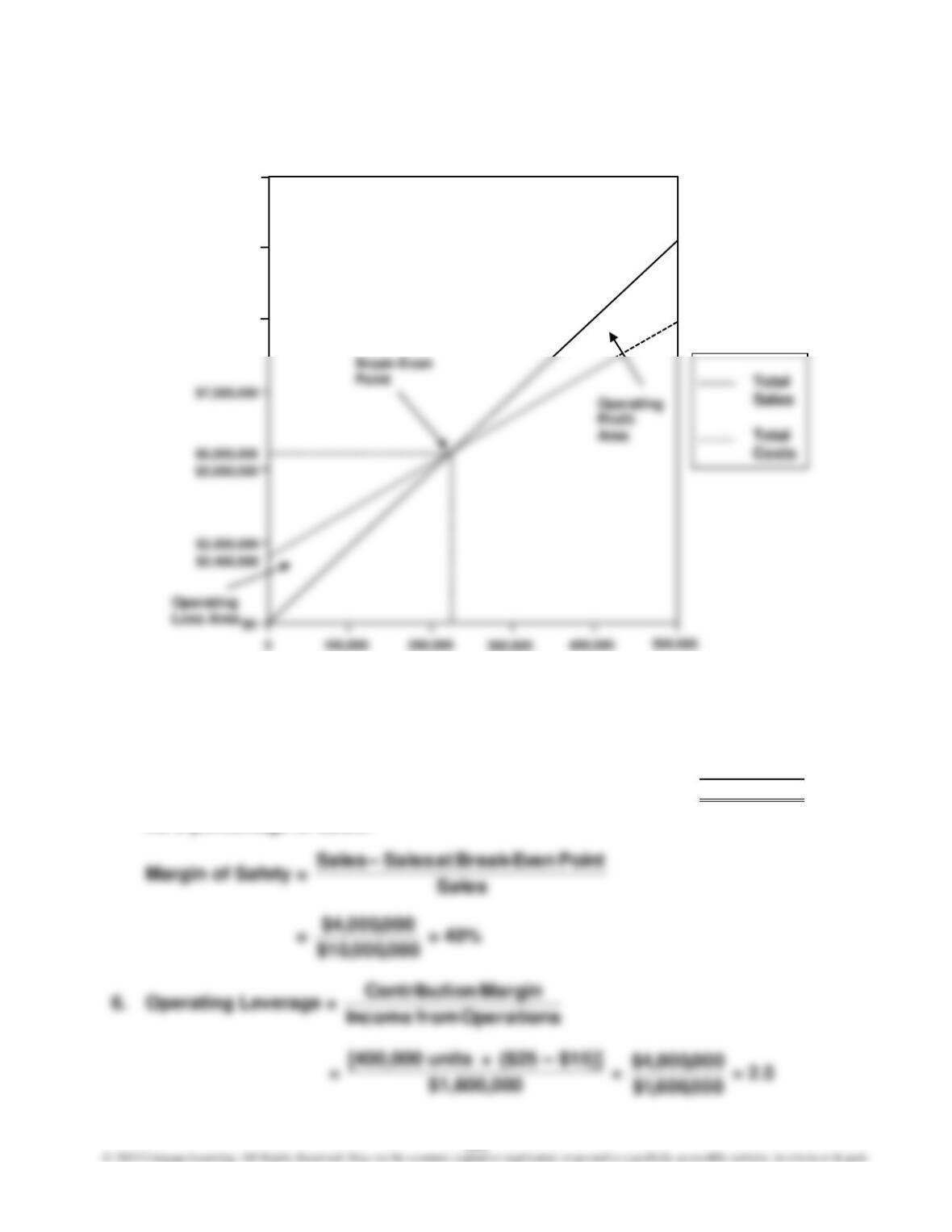
2. Contribution Margin Ratio =
Sales
Costs Variable–– Sales
3. Break-Even Sales (units) =
Margin onContributiUnit
Costs Fixed
=
15$ –– 25$
000,400,2$
= 240,000 units
358
P11–6, Concluded
4.
5. Margin of safety:
In dollars:
Expected sales (400,000 units × $25) …………………………..…… $ 10,000,000
Break-even point (240,000 units × $25) …………………………….. 6,000,000
Margin of safety ……………………………………………………………… $ 4,000,000
As a percentage of sales:
$12,500,000
$10,000,000
$9,900,000
$15,000,000
359
CASES
Case 11–1
In an absolute sense, Phil’s actions are devious. He is clearly attempting to use
the first four-year scenario, which is favorable, as a way to market the partner-
ships. They are really longer-term investments. After the first four years, the risk
increases dramatically. The break-even occupancy becomes much more difficult
to achieve at 92% than it does at 48%. Focusing on the 48% and remaining silent
about the increase to 92% is deceptive. One might argue “let the buyer beware.”
After all, the information is in the fine print. A little spadework would reveal the
longer-term reality of these partnerships. This is not a compelling argument.
360
Case 11–2
The airline industry has a high operating leverage. This means that fixed costs
are a large part of the cost structure. The break-even volume is around 66% of
capacity. When the volume falls below 66%, the industry loses money. As the
percentage increases above 66%, the industry becomes very profitable. There is a
change in passenger volume. However, this is unlikely. The revenue from price
increases would need to increase faster than the lost revenue from lower traffic
volume for a price increase to lower break-even. To raise ticket prices, the airline
would have to minimize the impact on lost volume. This might be possible for fare
increases targeted to business travelers that need to fly anyway. The airline can
economies of scale. For example, an airline could consolidate three flights de-
parting in the morning from Tulsa to Dallas into just two flights departing in the
morning. This would reduce the airline’s costs but would increase the airline pas-
sengers’ inconvenience. This strategy works only if there is little loss in revenue
by going to two flights, meaning that the people bumped from the third flight go
to the other two, rather than a competitor. Alternatively, an airline flying into
LaGuardia and Newark airports in the New York metropolitan area might decide to
fly into only one of the terminals in order to reduce ground-related costs. Again,
this strategy would only be successful if there was little loss in revenue relative
to the cost savings.
Case 11–3
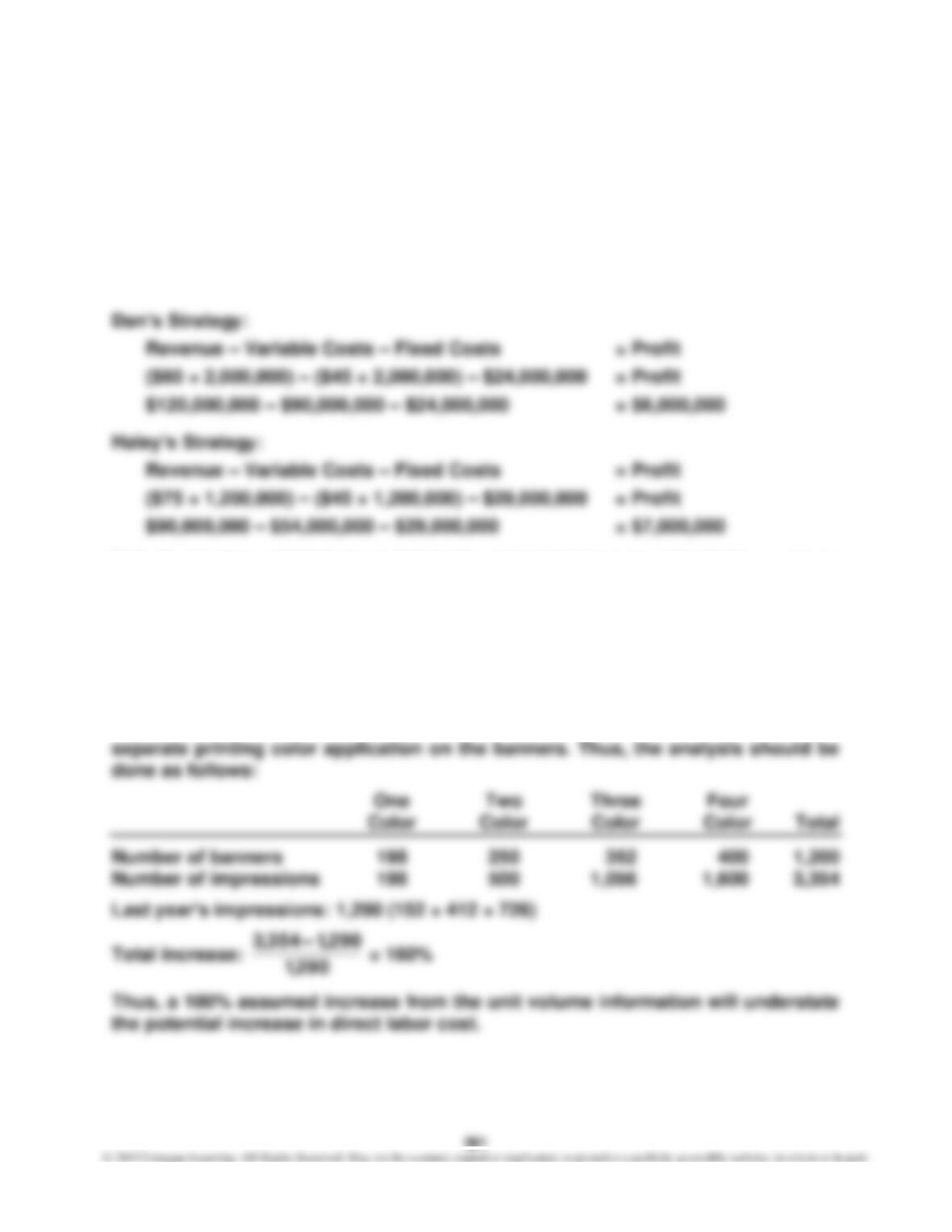
Do-Nothing Strategy:
Revenue – Variable Costs – Fixed Costs = Profit
($75 × 800,000) – ($45 × 800,000) – $24,000,000 = Profit
$60,000,000 – $36,000,000 – $24,000,000 = $0
Thus, 800,000 units is the break-even volume.
Haley’s strategy, which is to maintain the price but increase advertising, appears
superior.
Case 11–4
The direct labor costs are not variable to the increase in unit volume. The unit
volume is the wrong activity base for direct labor costs. The “number of impres-
sions” is a more accurate reflection of the direct labor cost. An impression is a
362
Case 11–5
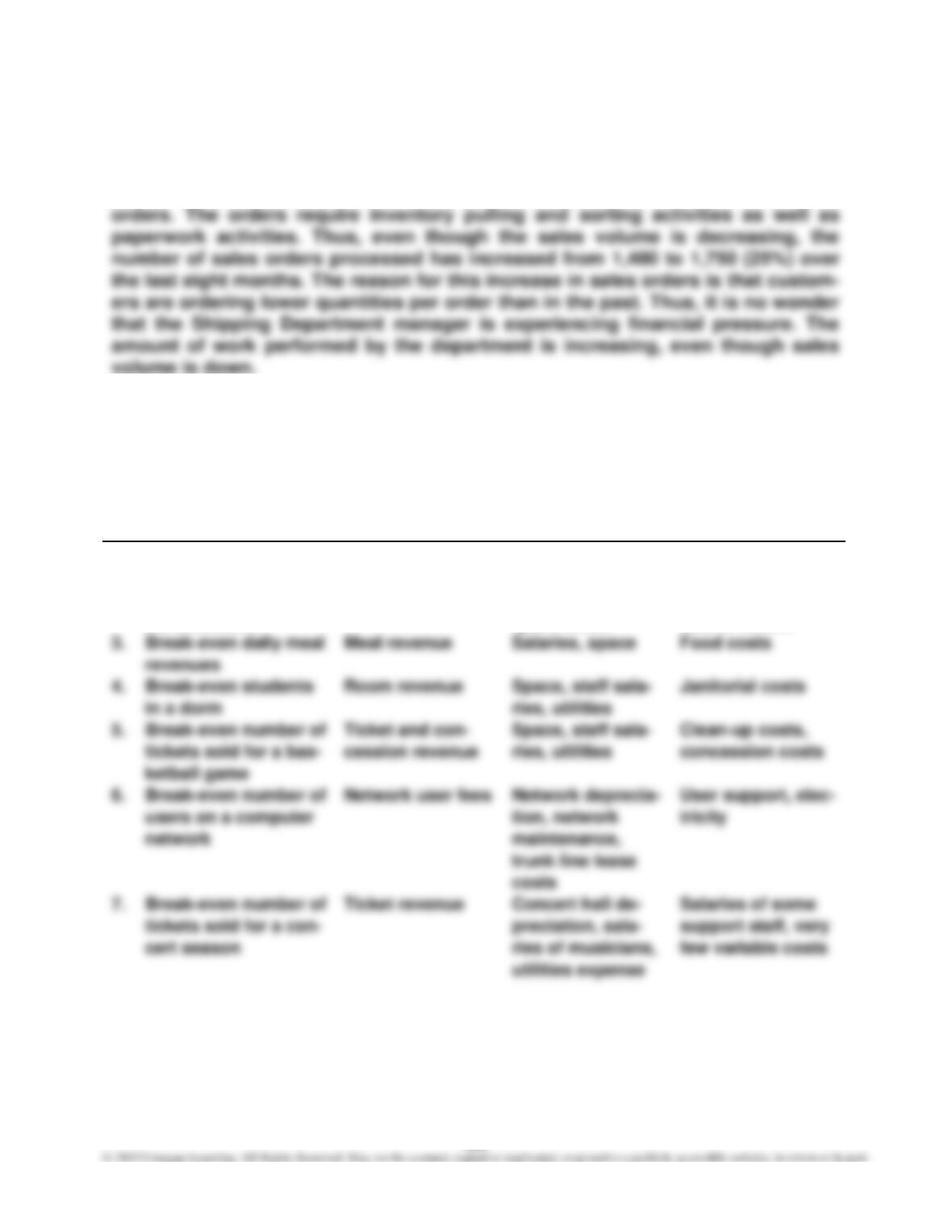
The Shipping Department manager should respond by pointing out that the activi-
ties performed by his department are not related to sales volume but to sales
Case 11–6
There are many possible applications of break-even analysis in a school envi-
ronment. Below are just a few possible ideas.
Break-Even Analysis
Revenue
Fixed Costs
Variable Costs
1.
Break-even number of
students in a class
Student tuition for
a class
Faculty salary,
space costs
Supplies, copying
2.
Break-even sales in
the bookstore
Book sales
Manager’s salary,
space costs
Cashier salaries,
cost of books
4.
Break-even students
in a dorm
Room revenue
Space, staff sala-
ries, utilities
Janitorial costs
utilities expense