
11-33
Analytical Procedures: A Case in the Context of the Pharmaceutical Industry
11-83
Part I – Planning Analytical Procedures
a. In addition to the ratios provided to students, they will likely be creative in suggesting
others. For example, the following might be relevant:
• Trends in inventory by product line, with a focus on potential obsolete inventory when a
competing generic drug has been introduced in a market segment
• Trends in payables for vendors that were significant in prior years, but are no longer
significant
• Changes in cost of goods sold on a percentage basis, quarterly comparisons (this would
b. The following factors will influence data reliability:
• The source of information, i.e., internally generated versus externally obtained. Industry
c. The following expectations seem reasonable:
In terms of inventory ratios:
• Gross margins should increase if PharmaCorp’s company-wide cost reduction initiative
was successful. If it was not, we would expect consistent margins.
• Ending inventory valuation may be slightly higher given that prices of raw material
inventory have increased over historical figures.
In terms of payable ratios:
11-34
• Given the new policy on payment timing of accounts payable, an appropriate
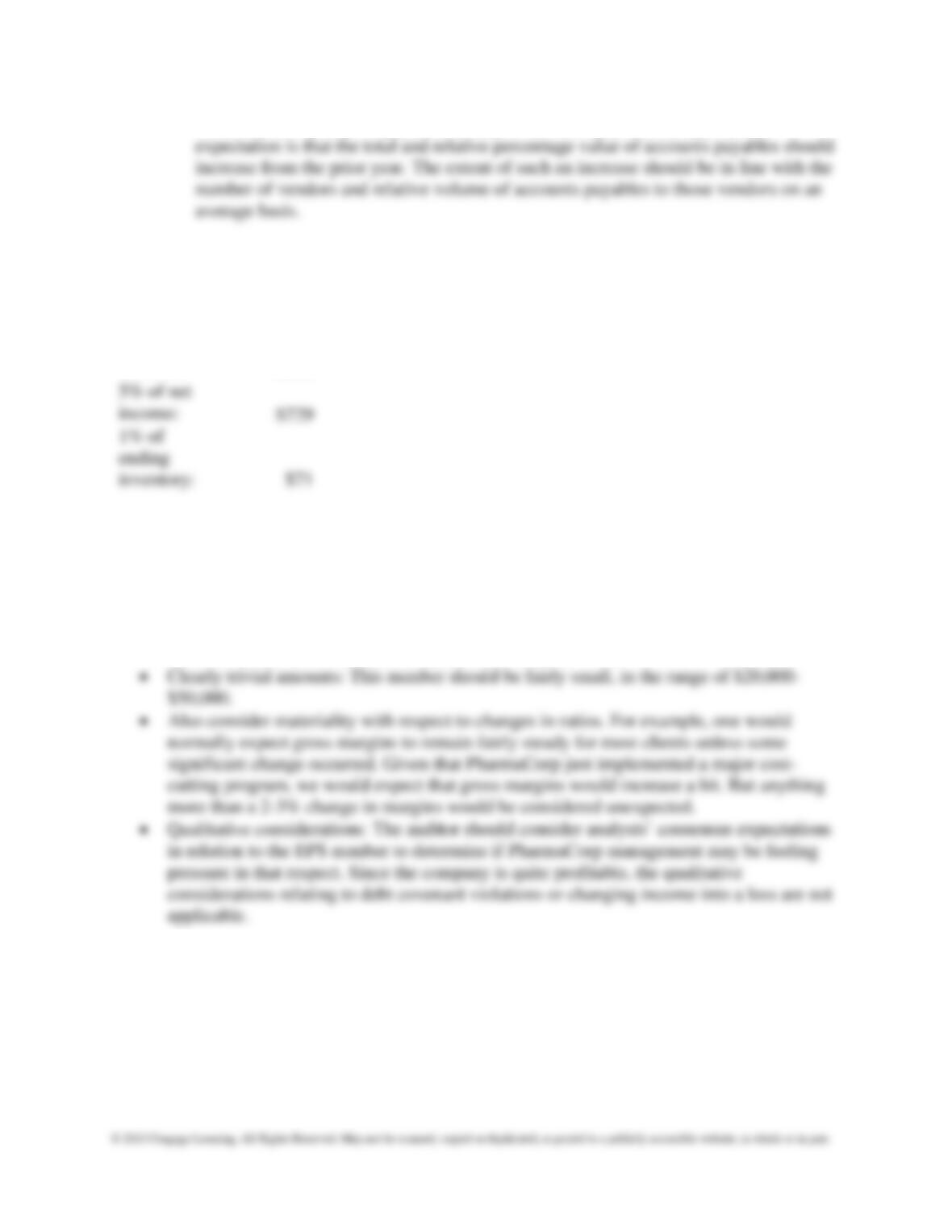
d. Common materiality benchmarks applied to PharmaCorp (in millions):
1% of
assets:
$1,858
1% of
revenue:
$590
5% of net
income:
$729
Student answers will likely vary widely given the judgmental nature of this task. The following
presents one line of possible reasoning.
• Performance materiality: To be conservative, use 1% of revenue, $590 million for
revenue and 1% of A/R, $35 million for inventory.
• Tolerable misstatement: Use ½ of 1% for tolerable misstatement, so about $300 million
for revenue and $17.5 million for accounts receivable.
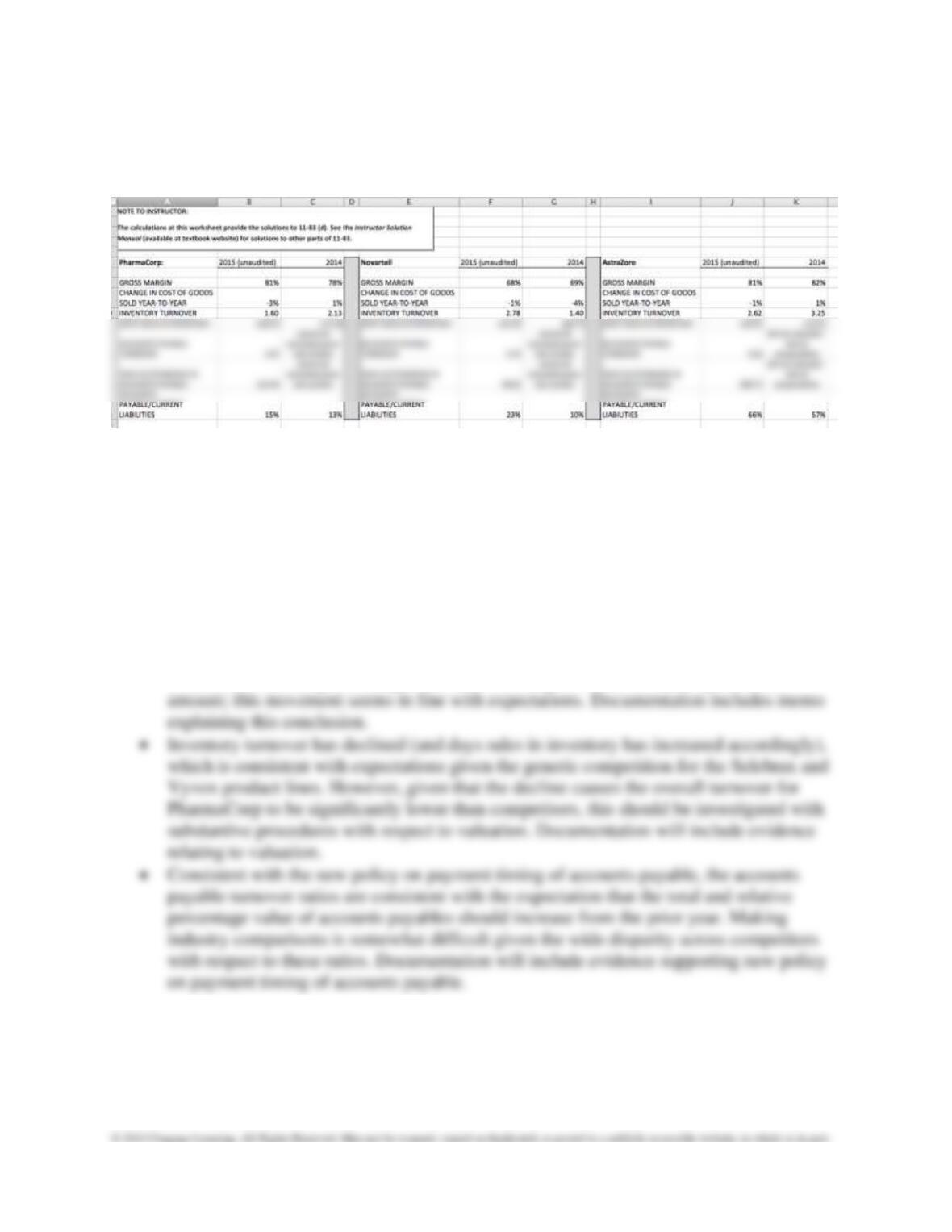
For the computation of the client ratios, see Instructor solution posted to Cengage.com web site,
reproduced below.
11-35
e. Identification of significant unexpected differences:
• Gross margin increased 3% for PharmaCorp and was relatively more stable for its
industry competitors. The gross margin change is unexpected in terms of magnitude, but
consistent with expectations with respect to the cost-cutting initiative. Document
information supporting cost-cutting initiative.
• Consistent with the gross margin increase, cost of goods sold declined by the same
In terms of Step 7, the auditor will want to ensure that the documentation of planning analytical
procedures is proper. As the auditor proceeds through planning analytical procedures,
documentation will be accumulated in the workpapers. Specifically, the auditor will document
the analytical procedures used, the auditor’s expectations, how the level of significant difference

11-36
Part II: Substantive Analytical Procedures
f. Based on the planning analytical procedures, the most important areas to investigate with
substantive audit procedures are the shift in gross margins and the valuation of inventory
(particularly for the Selebrax and Vyvox product lines). While the increase in margins is not
unexpected from a strategic perspective if the cost-cutting initiative was successful, the auditor
Recall that management’s explanations were as follows:
• Lower purchase accounting charges, primarily reflecting fair value adjustments
relating to acquired inventory that was subsequently sold
o Potential substantive analytical procedure: track levels of and changes in
purchase accounting charges by quarter/year/product line
• Lower costs related to new cost reduction and productivity initiatives, as well as
savings generated from ongoing productivity initiatives to streamline the supply
chain network
o Potential substantive analytical procedure: Inquire of management as to
targeted cost reduction initiatives and track levels of and changes in
relevant accounts
• Reduced manufacturing volumes related to products that lost exclusivity in
various markets
o Potential substantive analytical procedure: track production volumes by
the products that lost exclusivity, comparing to prior years/quarters
• The impact of favorable foreign exchange rates of 3%.
11-37
Academic Research Cases
11-84
a. The issue being addressed is the use of Digital Analysis by auditors in the planning stages
of an audit as part of planning analytical procedures. AU 329 requires auditors to use analytical
procedures in planning the extent and type of audit procedures. Analytical procedures are defined
by AU 329 as evaluations of financial information made by a review of reasonable relationships
between among financial and non-financial data. Digital Analysis focuses on digit and number
patterns and is based on Benford’s Law.
Multiple other tests have been performed using Benford’s Law to prove additional theories
related to Digital Analysis. Hill showed that when individuals invent numbers, they do not
conform to Benford’s Law. Other researchers have proven Benford’s Law can be used to
determine rounding issues in data.
b. The results of Digital Analysis performed as a part of this research were quite interesting.
Benford’s Law was used to develop Digital Analysis tests that were used as part of preliminary
analytical procedures in the audit of annual disbursements of an oil company. The results
indicated that Digital Analysis was useful in providing preliminary tests of reasonableness.
c. This issue is important to auditors because it provides a high level means of conducting
preliminary analytical procedures to look for areas of interest that may contain misstatements in
accounts that are being audited. Auditors are frequently faced with large sets of data and it is
11-38
d. Digital Analysis tests were completed. The first four tests were performed on data
retrieved from an oil company. An analysis was performed with the Internal Audit Department.
Data included 28,736 invoices authorized for payment by the accounts payable system. These
tests within this case setting included (1) first digits, (2) second digits, (3) first-two digits, and (4)
number duplication.
Test (1) is a reasonableness test that reviews the first digit of a number to determine if each
number is occurring in the first digit place in a reasonable number of instances. The auditor
would do a visual inspection of the returned data to see if it conforms to Benford’s Law.
e. The student should be aware that the research for this paper was limited to the use of
internal audit and internal company data that could not be released. The use of an external audit
setting was unattainable due to strict client confidentiality provisions and accounting firms not
11-39
11-85
a. The authors examine which audit procedures are perceived to be the most and least
effective for detecting fraud in the stock and warehousing cycle. Additionally, they explore
whether specific auditor traits (i.e., gender, experience level) or firm factors (i.e., firm size) are
associated with differences in perceptions.
b. On a scale of 1-5 (five being most effective), the average rating for all 56 procedures was
3.773. Overall, the audit procedures that were perceived as most effective for detecting fraud
were those associated with direct field work.
• 21 audit procedures (37.5% of the total) were considered “more effective” in detecting
fraud in the inventory and warehousing cycle. The most effective procedure overall was
to recount a sample of client’s counts to make sure the recorded counts are accurate on
the tags (also check descriptions and unit of count such as dozen or gross).
• Nine audit procedures (16.1% of the total) were considered “moderately effective.” The
highest rated “moderately effective” procedure was to trace balances of stock (also
c. The audit procedures deemed as more effective in detecting fraud can be utilized by
auditors in the planning stage in order to have the best chance at detecting fraud early on. This
leaves more time to adapt if fraud is detected, leading to a more effective and efficient audit. The

study suggests that the audit profession should incorporate substantially more field techniques
into their engagements in order to better detect fraud in the stock and warehousing cycle.
Audit teams may want to examine the least effective audit procedures to see if they’re currently
practicing any on this list. If so, they may want to reevaluate their approach and replace those
procedures with ones perceived as moderately or more effective when time is a limiting factor.
d. A self-administered questionnaire was completed by 64 chartered accountants in
Barbados. 57.8% of these respondents came from a small firm, 59% were female, and the entire
group had an average of seven years experience (six of which at their present job).
An audit procedure was deemed:
1. More effective if its mean response exceeded the overall mean by a significant
difference.
e. The small sample size casts doubt on whether or not the results can be generalized to all
auditors in Barbados. Additionally, accountants in Barbados may have culturally different

11-41
Ford and Toyota
11-86
Note to instructor: The solutions based upon the FYE 2012 annual reports for Ford and Toyota
ACL
11-87
This is a good problem to use for class demonstration. ACL icons, commands, and equations in
bold. Field names are in FULL CAPS.
Require
ment
Approach
To
Begin
Open a new project by choosing File, New, Project or click the New Project
icon. Name the project Husky Inventory.
Choose the Husky Inventory 2013 file to import. Name the new table Inventory.
a
Objective: Foot the file and agree to the general ledger.
b
Objective: Identify items not sold or used in the last six months.
Using the Inventory file, choose ANALYZE, Age, age on LASTSALE. Set the
cutoff date to December 31, 2013. Choose to subtotal EXTCOST. Set the Aging
Periods at 0 and 182. (For raw materials, LASTSALE refers to date of last use.)
c. i.
Objective: Check finished goods for NRV less than cost.

11-42
Require
ment
Approach
2. Using the Inventory file, choose DATA, Extract Data, If and either enter
3. Right click on the table and choose Add Columns, Expr… and enter the
4. Create a filter with the expression UNITCOST > NRV. .
5. To get a dollar impact of this, right click on the table and choose Add
6. Adjust the column widths to get all columns on one page and PRINT the
report.
Result: Products FJ311, FJ312, and FJ313 have NRV less than cost by an
extended difference of $939.39.
c. ii.
Objective: Prepare a report of all finished goods with a turnover less than 2.
1. Using the finished goods file from c. i., right click and choose Add Columns,
2. Choose DATA, Extract Data, If and enter the expression INVQTY > 0.
(This is necessary to eliminate dividing by zero in the next step.) Name the
new file Positive FG.
4. Print the list for further investigation.
Results: There are 8 finished good items with a turnover less than 2 with an
extended cost of $884,299.81. Three of these (FM231, FM232, and FT480 make
up $736,141.57 of this total. The three items detected in c. i above that require
writing down to LOCOM (FJ311, FJ312, and FJ313) also have a turnover < 2.
d. i.
Objective: Check raw material for replacement cost less than cost.
1. Using the Inventory file, choose DATA, Extract Data, If and either enter
2. Create a filter with the expression UNITCOST > REPLCOST. .

Require
ment
Approach
Columns, Expr… and enter the expression (UNITCOST – REPLCOST) *
INVQTY. Name the new field WRITEDOWN.
4. PRINT the report.
1. Using the Raw Materials file, right click on the table and choose Add
2. Choose DATA, Extract Data, If and enter the expression INVQTY > 0.
3. Create a filter with the expression TURNOVER < 2. This will list raw
materials that turned less than 2 times during 2013.
4. Print the list for further investigation.
Results: There are 8 raw materials with a turnover less than 2 with an extended
cost of $25,260.30. Six of these were not used in 2013
e.
Report: The report should indicate potential LOCOM problems with FM231, FM
232, and FT480 that have a high value and very slow turnover (see c. ii. above),