
Problem data follows:
Number of rings produced in March 1,500
Standard cost of each ounce of gold 1,000$
Standard quantity of material in ounces 0.50
Cost of gold purchased and used in March 788,480$
Cost of gold purchased per ounce 1,024$
Required
Material price variance
× =
Favorable or unfavorable?
Material quantity variance
× =
Favorable or unfavorable?
What-if?
Consider the following after you have completed the requirements of E11-6.
1. Calculate the two material variances.
Material price variance
× =
Favorable or unfavorable?
Material quantity variance
× =
Favorable or unfavorable?
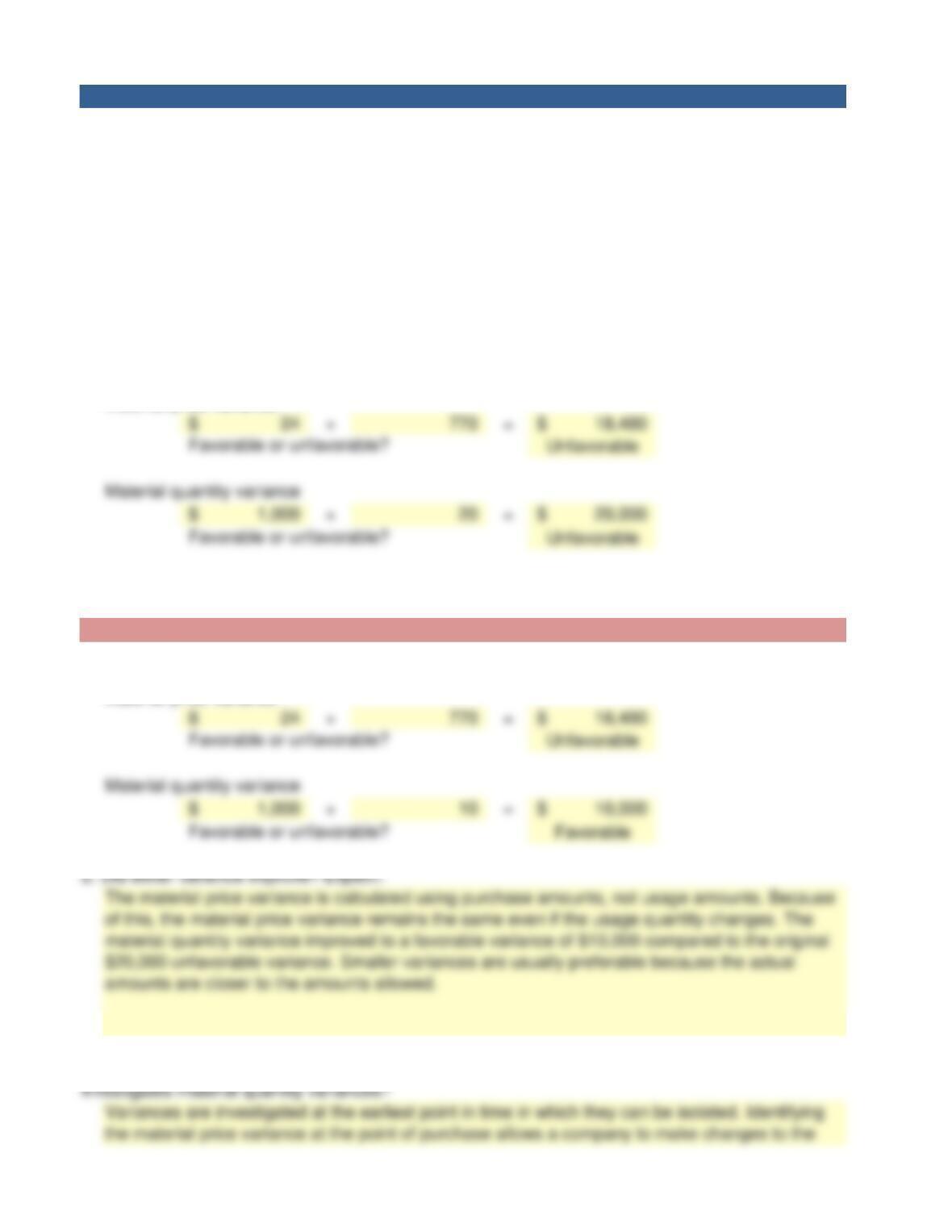
2. Did either variance improve? Explain.
Exercise 11-6 Calculating Material Variances
Determine the material price variance and the material quantity variance for March. Indicate whether
each variance is favorable or unfavorable.
Suppose that the amount of gold purchases remains at $788,480 and the company determines it
actually used 740 ounces instead of 770 ounces of material. There is no beginning inventory of raw
materials.

2. Why might a company want to investigate material price variances at a different point in time than
it investigates material quantity variances?
Number of rings produced in March 1,500
Standard cost of each ounce of gold 1,000$
Standard quantity of material in ounces 0.50
Cost of gold purchased and used in March 788,480$
Cost of gold purchased per ounce 1,024$
Required
Material price variance
What-if?
1. Calculate the two material variances.
Material price variance
Solution: Exercise 11-6 Calculating Material Variances
2. Why might a company want to investigate material price variances at a different point in time as it
materials are used in the production process.
Determine the material price variance and the material quantity variance for March. Indicate whether
each variance is favorable or unfavorable.
Crown Jewelry produces gold rings. Information concerning production for the month of March
follows:

Variances are investigated at the earliest point in time in which they can be isolated. Identifying

Standards and budgeted information:
Gallons of material per can of chemical
1.20
Hours of labor per can of chemical
1.50
Standard cost per gallon of material
$6.00
Standard cost per hour of labor
$9.00
Overhead application rate per can
$7.75
Expected production – cans of chemical
20,000
Expected fixed overhead per year
$55,000
Variable overhead rate per 0.5-gallon can
$5.00
Actual information for 2018:
Cans produced
23,000
Gallons of material purchased
35,000
Cost of material purchased
$250,000
Gallons of material used in production
30,000
Cost of direct labor incurred
$290,000
Average wage rate per hour
$8.25
Actual overhead cost
$220,000
Required
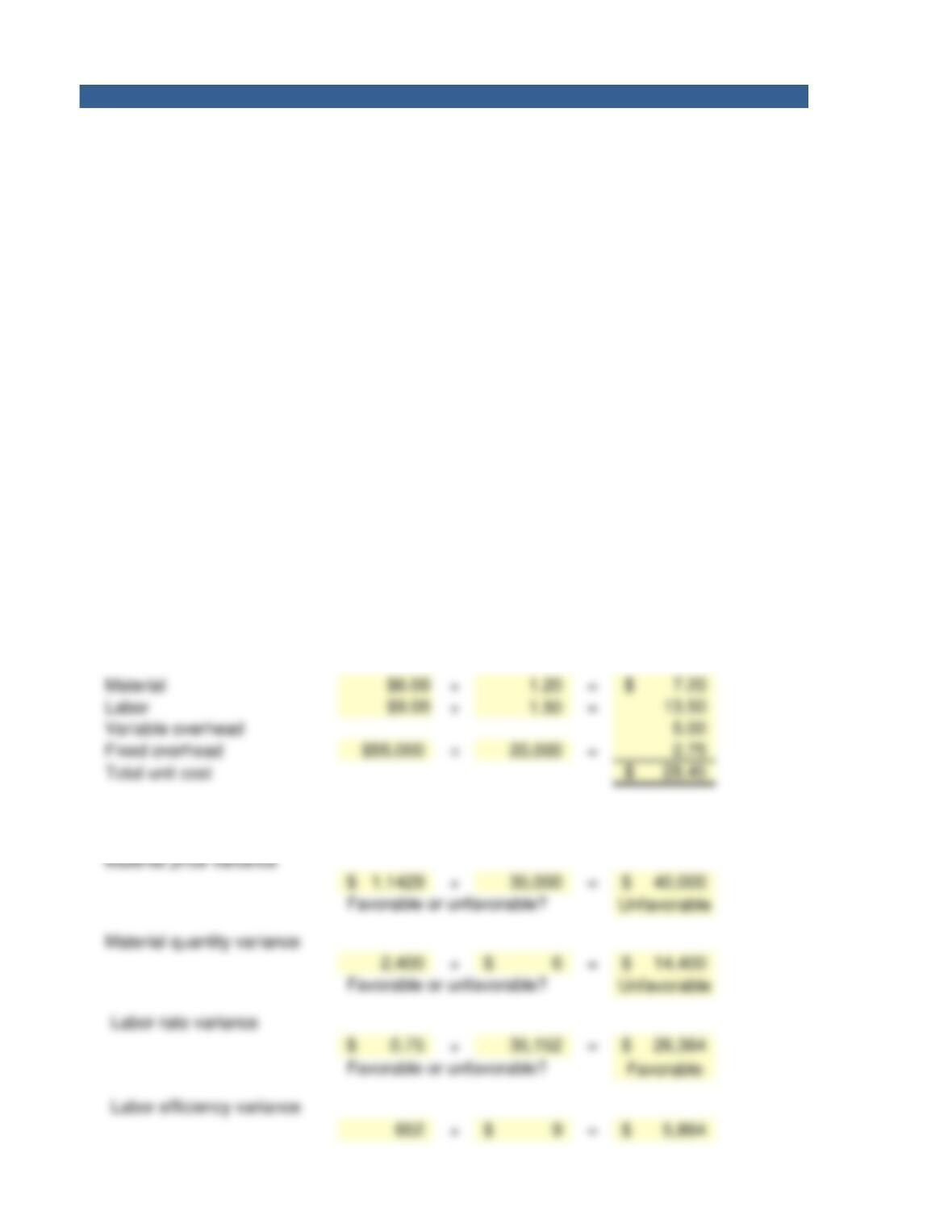
a. Determine the standard cost per unit.
Material × =
Labor × =
Variable overhead
Fixed overhead ÷ =
Total unit cost
b. Calculate the material, labor, and overhead standards.
Material price variance
×=
Favorable or unfavorable?
Material quantity variance
×=
Favorable or unfavorable?
Labor rate variance
×=
Favorable or unfavorable?
Problem 11-5 Comprehensive Variance Problem
Hayes Chemical Company produces a chemical used in dry cleaning. Its accounting system
uses standard costs. Standards for each 0.5-gallon can of chemical and actual data for Hayes
Chemical follow:

Labor efficiency variance
×=
Favorable or unfavorable?
Overhead controllable variance
―=
Favorable or unfavorable?
Overhead volume variance
―=
Favorable or unfavorable?
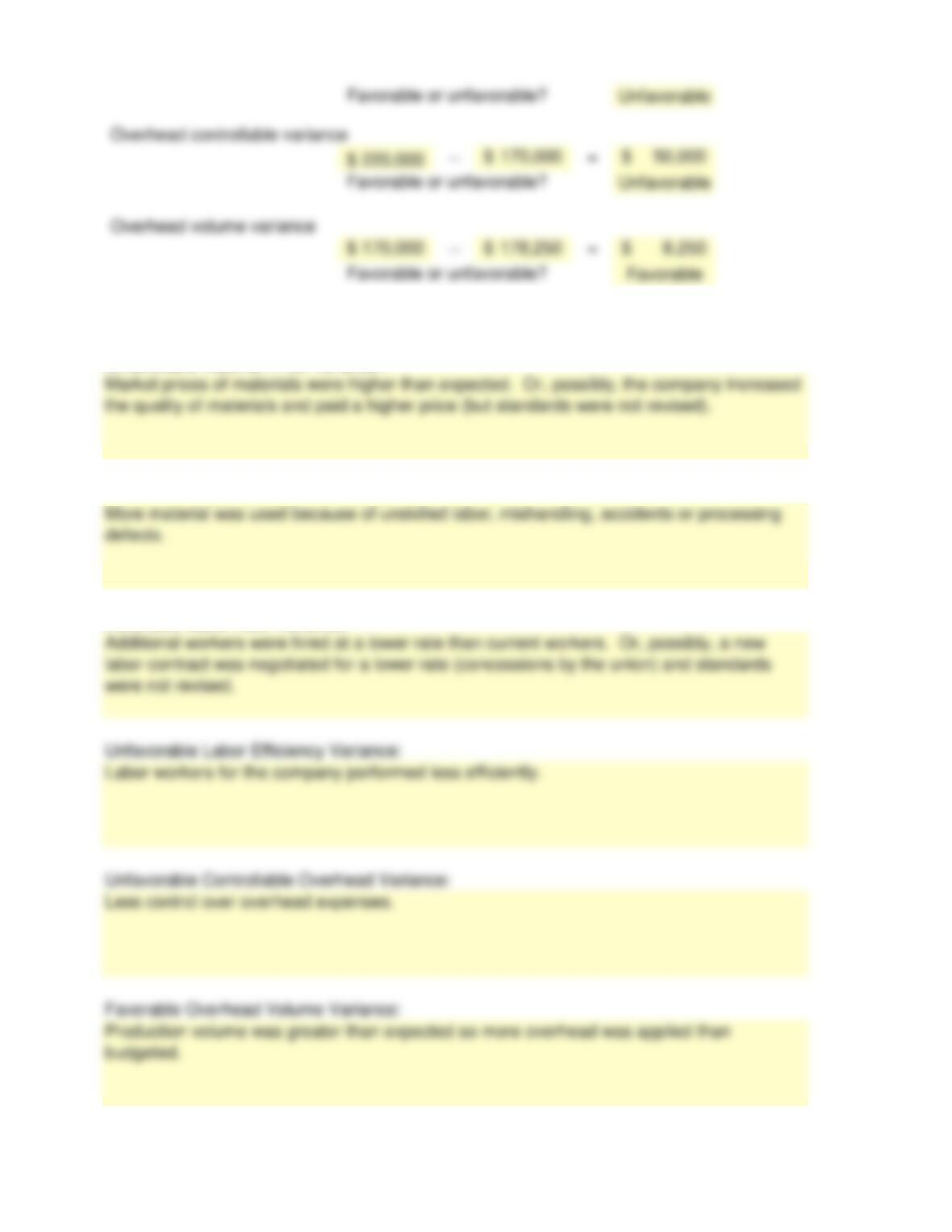
c. List a possible cause for each variance.
Unfavorable Material Price Variance:
Unfavorable Material Quantity Variance:
Favorable Labor Rate Variance:
Unfavorable Labor Efficiency Variance:
Unfavorable Controllable Overhead Variance:
Favorable Overhead Volume Variance:

Standards and budgeted information:
Gallons of material per can of chemical
1.20
Hours of labor per can of chemical
1.50
Standard cost per gallon of material
$6.00
Standard cost per hour of labor
$9.00
Overhead application rate per can
$7.75
Expected production – cans of chemical
20,000
Expected fixed overhead per year
$55,000
Variable overhead rate per 0.5-gallon can
$5.00
Actual information for 2018:
Cans produced
23,000
Gallons of material purchased
35,000
Cost of material purchased
$250,000
Gallons of material used in production
30,000
Cost of direct labor incurred
$290,000
Average wage rate per hour
$8.25
Actual overhead cost
$220,000
Required
a. Determine the standard cost per unit.
b. Calculate the material, labor, and overhead standards.
Solution: Problem 11-5 Comprehensive Variance Problem
Hayes Chemical Company produces a chemical used in dry cleaning. Its accounting system
uses standard costs. Standards for each 0.5-gallon can of chemical and actual data for Hayes
Chemical follow:
c. List a possible cause for each variance.
Unfavorable Material Price Variance:
Unfavorable Material Quantity Variance:
Favorable Labor Rate Variance: