11
Service Department and Joint Cost Allocation
Solutions to Review Questions
11–1.
(2) Additional management costs in selecting allocation methods and allocation
bases;
(2) Relating indirect costs to contracts, jobs, and products;
11–2.
The three methods of allocating service department costs are the (1) direct method, (2)
step method, and (3) reciprocal method.
11–3.
The essential difference is the allocation of costs among service departments. The
direct method makes no inter-service-department allocation, the step method makes a
partial inter-service-department allocation, while the reciprocal solution method fully
recognizes inter-service-department activities. All three methods allocate costs to the
production departments based on the production department’s relative use.
11–5.
The direct method ignores any use of one service department by another.
11–6.
The step method ignores any reciprocal (simultaneous) use of two or more service
departments.
11–7.
Joint cost allocations are usually made to assign a cost to a product after the split-off
point. This is usually done for external reporting, tax, or rate-making purposes or to
satisfy contract requirements. Because the joint costs are common to the outputs, it is
not possible to find a direct way of relating the costs. Rather, the costs are related to
economic benefits on the basis of some measure of relative outputs.
11–8.
Because net realizable values of the output provide a measure of the economic benefit
received from each output from the production process, this method is usually preferred
when it can be implemented. Further, the physical quantities may be difficult to compare
(e.g., weights versus volumes).
11–9.
It could be preferable to use a physical quantities measure if it reflects the economic

11–10.
11–11.
Solutions to Critical Analysis and Discussion Questions
11–12.
Management might believe there are benefits to the use of allocated costs. An
11–13.
Allocating zero costs is another allocation method. It, too, is an arbitrary method.
However, an advantage of not allocating costs is that the time saved reduces the
expenses of cost allocation. A disadvantage is that common costs must be covered
before the company as a whole earns a profit. Cost allocation can make managers
more aware of common costs affecting long-run profitability.
11–14.
As with all cost allocation methods, there is a cost-benefit trade-off to be made. If the
allocations using the reciprocal method are similar to the allocations using the direct or
step method, it may not be worth using the reciprocal method. The costs are not simply
computation costs, which are relatively small. The method has to be documented and
explained so managers believe that the results are useful for decision-making.
11–15.
The concepts of direct and indirect are related to a specific cost object within the
11–16.
The reciprocal method takes into account all of the services rendered among the
service departments. It is preferred (assuming cost-effectiveness) because it results in
an allocation scheme that reflects the total cost of the use of each service.
11–17.
If no service department performs services for any other service department (or if all
service departments render services to producing departments in the same proportions)
then the direct method will give the same answer as any other allocation method.
11–18.
The addition of an employee in one department will increase the allocation base and,
therefore, reduce the allocation to the department that does not add the employee. The
11–19.
Answers will vary. Before deciding to outsource a service department, a company would
want to consider some of the following. (1) Will the quality of service be the same?
Quality includes many things including accuracy, timeliness, and customer service
(where the customers are the other service departments and the production
departments). (2) Will company information (for example, pay data) be secure with an
outside vendor? (3) Will the company lose control over critical services by relying on an
outside vendor?
11–20.
Answers will vary. First, it is useful to consider whether there are any reciprocal
services. Both the Library and Career Development make use of Computer Support, but
11–21.
11–22.
Some managers use fully allocated cost numbers for long-run pricing and other long-run
decisions. Allocated joint costs are used to compute the costs of department and
divisional activities. These costs can be a factor in evaluating managerial performance,
as we discuss in chapter 12. Joint cost allocations often arise as an issue in lawsuits in
which opposing parties have the rights to earnings of joint products.
11–23.
The two situations are similar in that the conceptual treatment of the allocation problem
is the same: the costs cannot be separately identified for each department or product;
therefore, an allocation method must be chosen which reflects to the best possible
extent a matching of the costs incurred with the benefits received. The resulting
allocated costs must be used with care, if at all, in any decision-making context.
11–24.
Examples include timber, livestock, petroleum, real estate development (produces lots),
railroad (many cars on the same train), and many other processing industries.

11–25.
The allocation of joint cost is similar to that of fixed costs in the sense that if I sell less of
one of the products, the cost to be allocated does not change (assuming free disposal).
It is different in the sense that if I produce more of one product, the cost to be allocated
does change.
Solutions to Exercises
11–26. (15 min.) Why Costs Are Allocated—Ethical Issues: Giga-Corp.
a. The president of Stable Division would probably prefer to allocate Personnel costs
on turnover. You could argue that turnover represents the use of Personnel and
Personnel resources.
11–27. (20 min.) Cost Allocation—Direct Method: Caro Manufacturing.
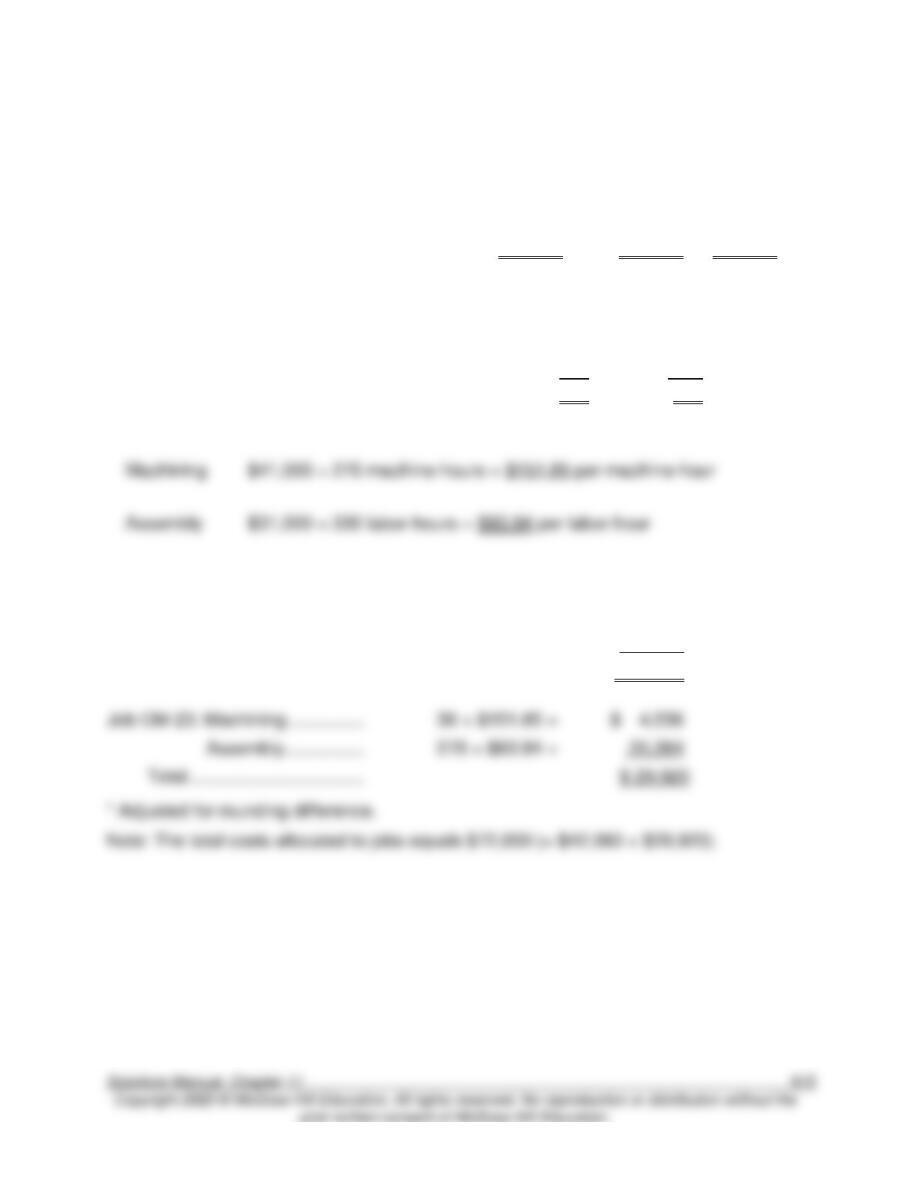
Direct Method:
To
Machining
Assembly
Maintenance ……………………..
$25,000a
$15,000
Cafeteria …………………………..
16,000b
16,000
Total Costs ………………………..
$41,000
$31,000
11–28. (30 min.) Allocating Service Department Costs First to Production
Departments and Then to Jobs: Caro Manufacturing.
Machining
Assembly
Total
Costs allocated to each department
(from Exercise 11.26) …………………
$41,000
$31,000
$72,000
Allocation bases:
Job CM-22: Machine-hours ……..
240
–0–
Labor-hours ………….
–0–
60
Job CM-23: Machine-hours ……..
30
–0–
Labor-hours ………….
–0–
270
Total …………………………………….
270
330
Department rates:
Costs assigned to jobs*:
Job CM-22: Machining ……………
240 × $151.85
=
$ 36,444
Assembly ……………
60 × $93.94
=
5,636
$ 42,080
Job CM-23: Machining ……………
=
11–29. (15 min.) Cost Allocation–Direct Method: University Printers
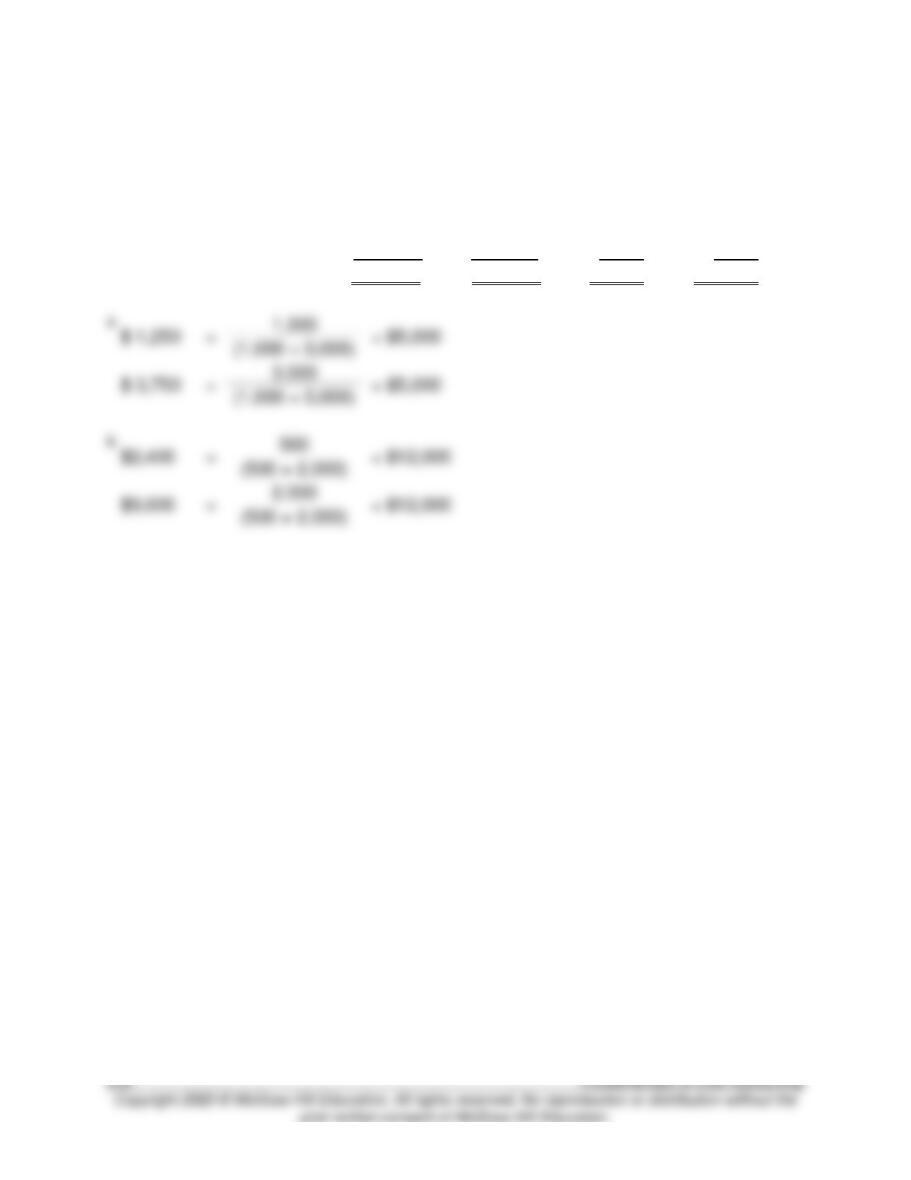
Maintenance
Personnel
Printing
Developing
Service department
costs …………………………
$5,000
$12,000
–0–
–0–
Maintenance allocationa
(5,000)
NA
$1,250
$ 3,750
Personnel allocationb ….
NA
(12,000)
2,400
9,600
Total costs allocated …..
$ –0–
$ –0–
$3,650
$13,350
a
3,000
b

11–30. (25 min.) Cost Allocation—Step Method: Caro Manufacturing.
a. Step Method—Maintenance First:
To
From
Maintenance
Cafeteria
Machining
Assembly
Service department costs
$40,000
$32,000
Maintenancea ……………
(40,000)
8,000
$20,000
$12,000
Cafeteriab …………………
________
(40,000)
20,000
20,000
Total Costs ……………….
$ –0–
$ –0–
$40,000
$32,000
a $8,000 = 20% × $40,000; $20,000 = 50% × $40,000;
$12,000 = 30% × $40,000
b. Step Method—Cafeteria First:
To
From
Cafeteria
Maintenance
Machining
Assembly
Service department costs
$32,000
$40,000
Cafeteriaa …………………
(32,000)
25,600
$ 3,200
$ 3,200
Maintenanceb ……………
________
(65,600)
41,000
24,600
Total Costs ……………….
$ –0–
$ –0–
$44,200
$27,800

11–31. (20 min.) Cost Allocation—Step Method: University Printers
Maintenance
Personnel
Printing
Developing
Service department costs
$ 5,000
$12,000
NA
NA
Maintenancea …………….
(5,000)
1,000
$1,000
$ 3,000
Personnelb ………………..
(13,000)
2,600
10,400
Total costs allocated …..
$ –0–
$ –0–
$3,600
$13,400
a
$1,000
=
1,000
× $5,000
(1,000 + 1,000 + 3,000)
$3,000
=
3,000
× $5,000
(1,000 + 1,000 + 3,000)
(500 + 2,000)
× $13,000
11–32. (30 min.) Cost Allocation—Reciprocal Method: Caro Manufacturing.
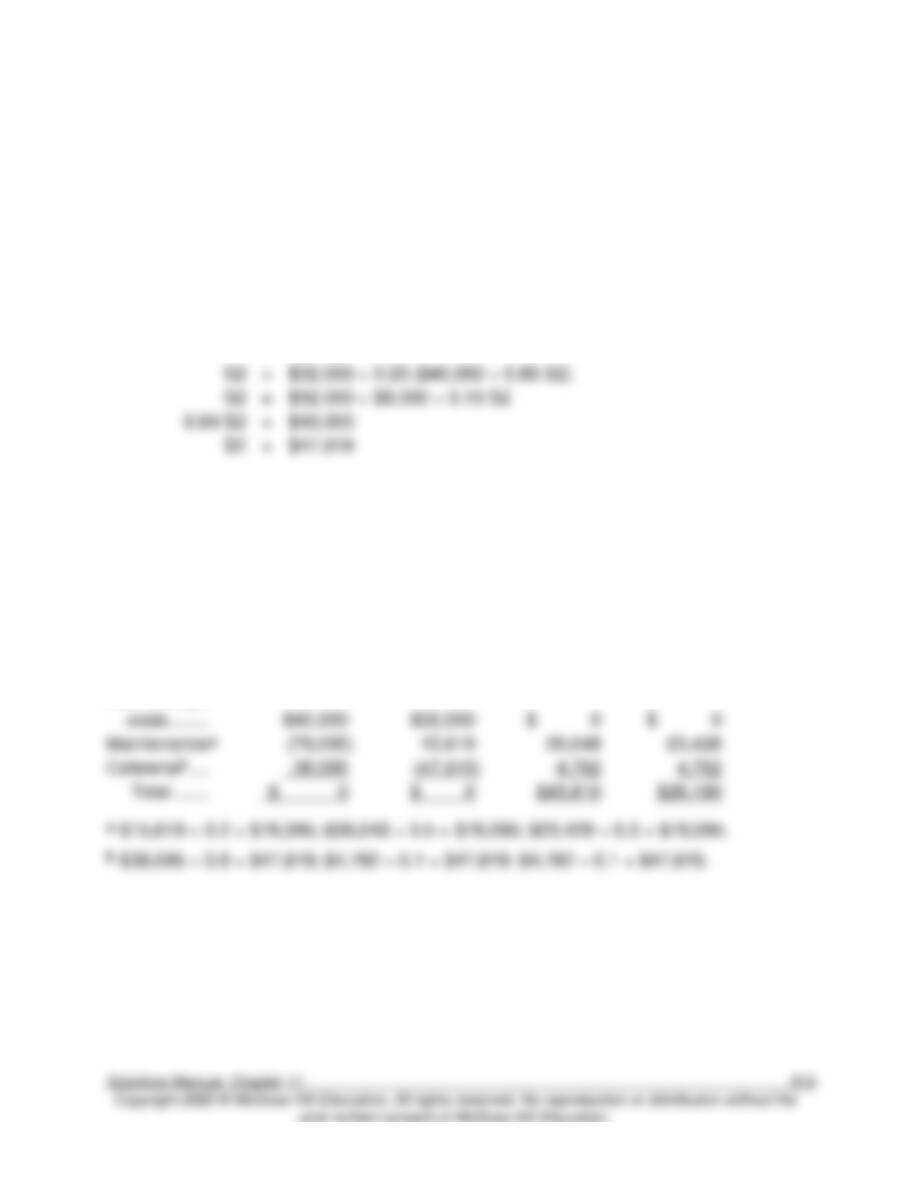
Set up the equations:
Total service
department costs
=
Direct costs of the
service department
+
Cost allocated
to the service
department
S1 (Maintenance)
=
$40,000
+
0.80 S2
S2 (Cafeteria)
=
32,000
+
0.20 S1
Substituting, the first equation into the second yields,
S2
=
S2
=
=
$40,000
S2
=
$47,619
Substituting the value of S2 back into the first equation gives,
S1
=
$40,000 + 0.80 ($47,619)
S1
=
$78,095
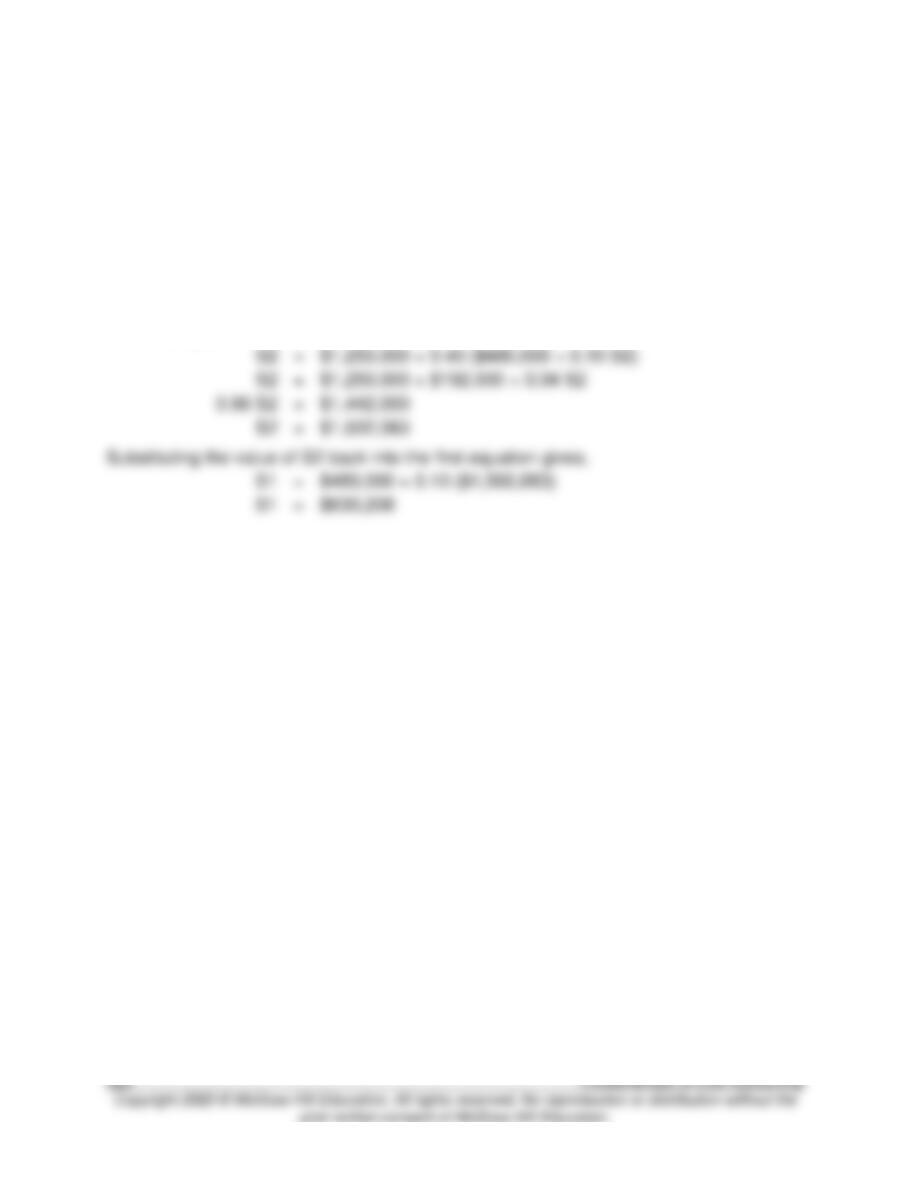
Allocations
Cost Allocation To:
From:
Maintenance
Cafeteria
Machining
Assembly
Service dept.
4,762
4,762
11–33. (30 min.) Cost Allocation—Reciprocal Method, Two Service Departments:
Kim & Co.
Set up the equations:
Total service
department costs
=
Direct costs of
the service
department
+
Cost allocated
to the service
department
S1 (Administration)
=
$480,000
+
0.10 S2
S2 (Factory Support)
=
1,250,000
+
0.40 S1
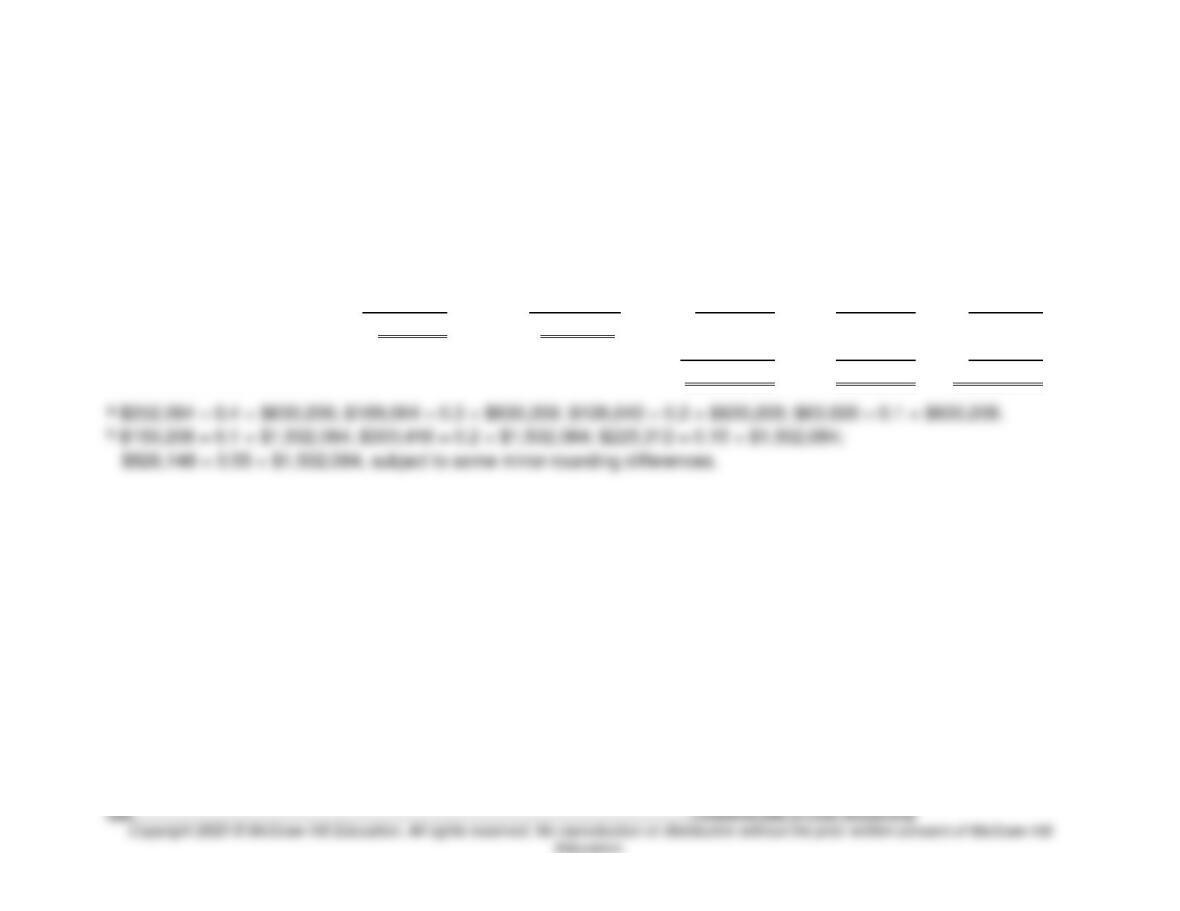
Substituting, the first equation into the second yields,
=
$1,250,000 + 0.40 ($480,000 + 0.10 S2)
=
$1,250,000 + $192,000 + 0.04 S2
=
$1,442,000
=
$1,502,083
=
=
$630,208
11–33 (continued)
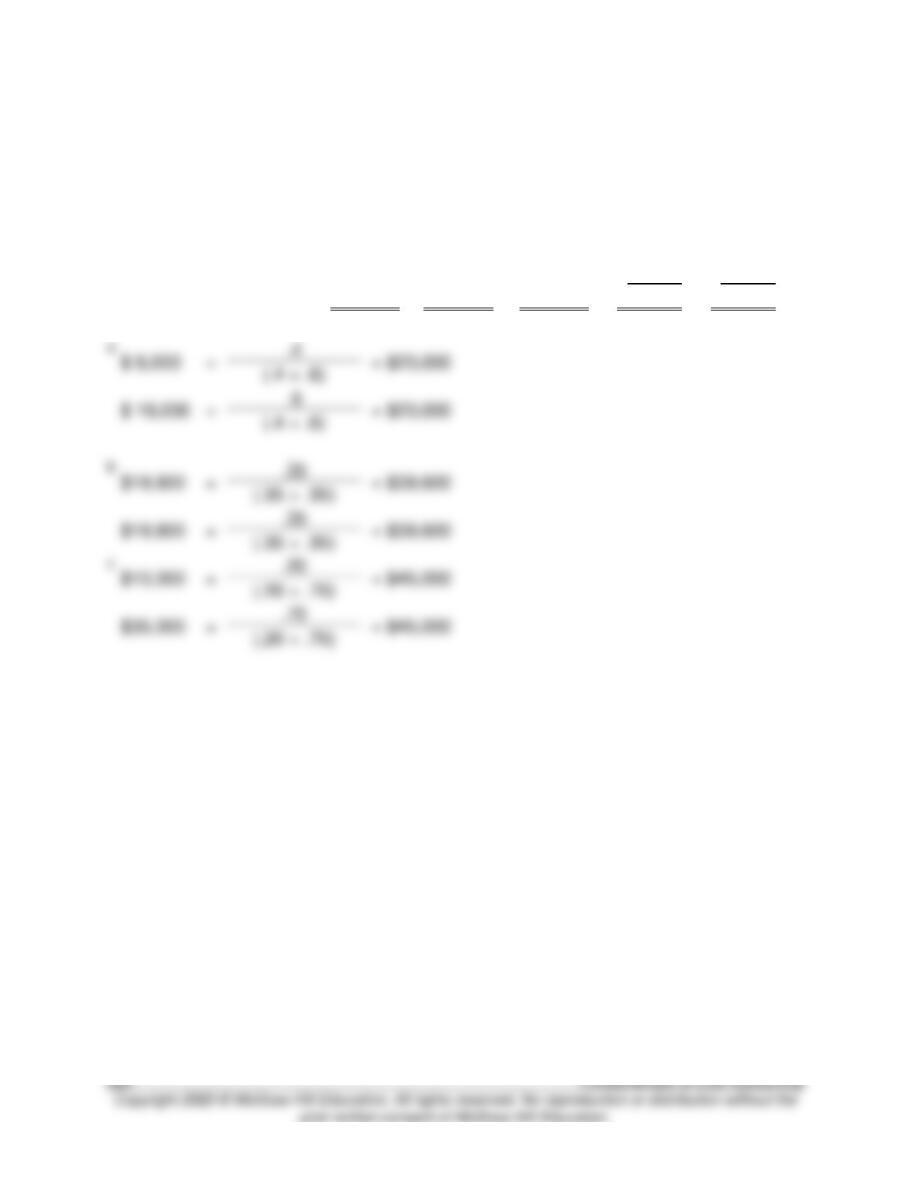
Allocations
Cost Allocation To:
From:
Administration
Factory Support
Fabrication
Assembly
Finishing
Service department costs ..
$480,000
$1,250,000
—
—
—
Administrationa ………………
(630,208)
$252,084
$ 189,064
$ 126,040
$ 63,020
Factory Supportb ……………
150,208
(1,502,084)
300,416
225,312
826,148
Total Allocations ………….
$0
$0
$ 489,480
$ 351,352
$ 889,168
Direct costs …………………..
1,560,000
268,000
238,000
Total costs …………………….
$2,049,480
$ 619,352
$1,127,168

11–34. (35 min.) Cost Allocation—Reciprocal Method: University Printers
Set up the equations:
Total service
department costs
=
Direct costs of
the service
department
+
Cost allocated
to the service
department
S1 (Maintenance)
=
$5,000
+
(1/6) S2
S2 (Personnel)
=
12,000
+
(1/5) S1
Substituting, the first equation into the second yields,
=
=
=
=
$13,448
=
$5,000 + (1/6) ($13,448)
Allocations
Cost Allocation To:
From:
Maintenance
Personnel
Printing
Developin
g
Service department
costs …………………..
$5,000
$12,000
—
—
Maintenancea ………
(7,241)
$1,448
$1,448
$ 4,345
Personnelb ………….
2,241
(13,448)
2,241
8,966
Totalc ……………..
$0
$0
$3,689
$13,311
11–35. (15 min.) Cost Allocation–Direct Method: Bens Corporation
Repairs
HR
IT
P1
P2
Service department
costs …………………………
$20,000
$39,600
$45,000
–0–
–0–
Repairs allocationa ……..
(20,000)
NA
NA
$8,000
$12,000
HR allocationb ……………
NA
(39,600)
NA
19,800
19,800
IT allocationc ……………..
NA
NA
(45,000)
10,000
35,000
Total costs allocated …..
$ –0–
$ –0–
$ –0–
$37,800
$66,800
a
b
c

11–36. (20 min.) Cost Allocation—Step Method: Bens Corporation
Repairs
HR
IT
P1
P2
Service department
costs …………………….
$20,000
$39,600
$45,000
–0–
–0–
HR allocationa ……….
3,960
(39,600)
7,920
$13,860
$13,860
IT allocationb …………
NA
NA
($52,920)
11,760
41,160
Repairs allocationc …
($23,960)
NA
NA
9,584
14,376
Total costs allocated
$ –0–
$ –0–
$ –0–
$35,204
$69,396
a
$3,960
=
0.10
× $39,600
$7,920
=
0.20
× $39,600
$13,860
=
0.35
× $39,600
$13,860
=
0.35
× $39,600
× $23,960
× $23,960
11–37. (35 min.) Cost Allocation—Reciprocal Method: Bens Corporation
Set up the equations:
Total service
department costs
=
Direct costs of
the service
department
+
Cost allocated
to the service
department
S1 (Repairs)
=
$20,000
+
0.10 S2
S2 (HR)
=
$39,600
+
0.10 S3
S3 (IT)
=
$45,000
+
0.20 S2
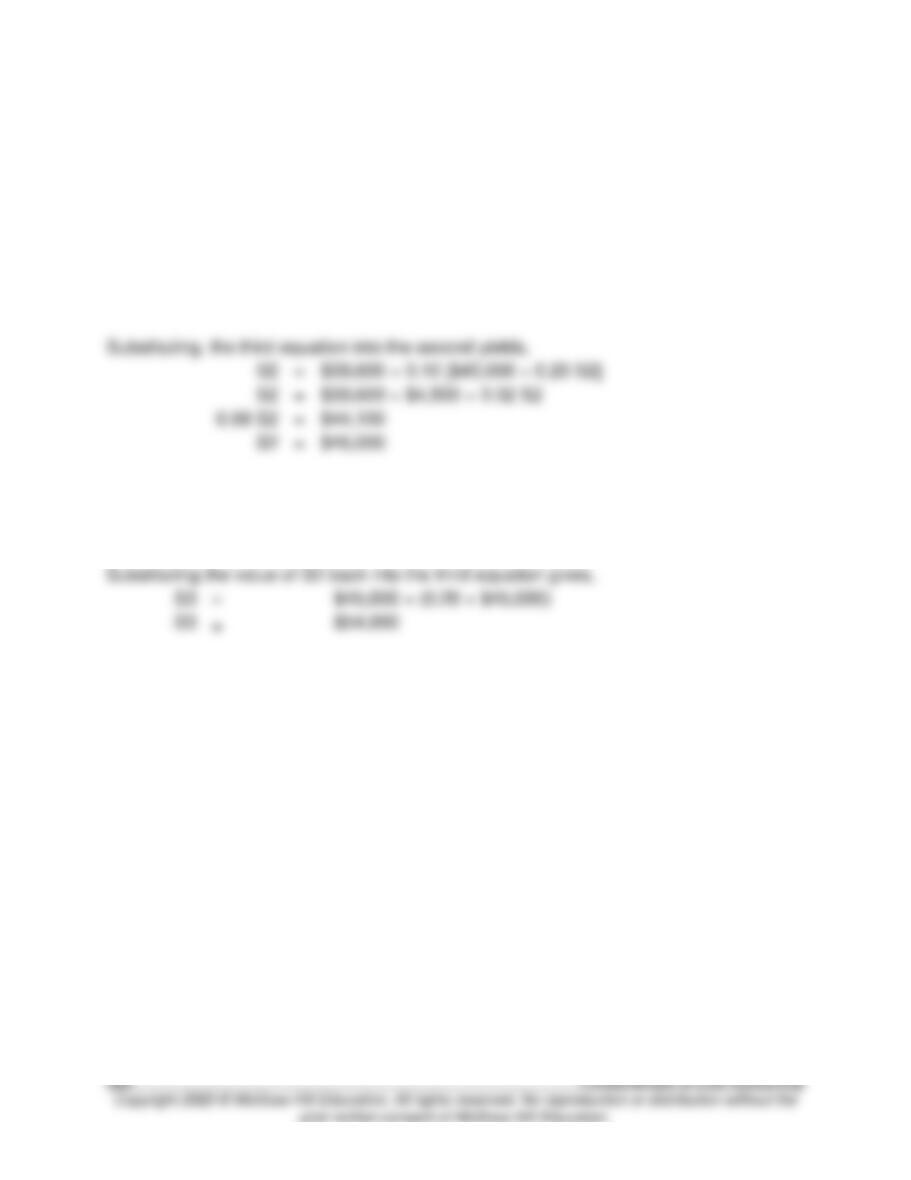
S2
=
$39,600 + 0.10 [$45,000 + 0.20 S2]
=
$39,600 + $4,500 + 0.02 S2
=
$44,100
S2
=
$45,000
Substituting the value of S2 back into the first equation gives,
S1
=
$20,000 + (0.10 × $45,000)
S1
=
$24,500
=
=