11-21
b.
In Step One, the auditor structures the problem, considering the relevant parties to involve in the
decision process, identifying various feasible alternatives, considering how to evaluate the
alternatives, identifying uncertainties or risks, and determining how to structure the problem. To
illustrate these tasks, the audit engagement team should have structured the problem to address
the client’s valuation/obsolescence estimates, and the team’s own independent
valuation/obsolescence estimates. Further, the team should have structured the evidence
gathering in such a way that it would comply with the professional auditing standards.
In Step Two, the auditor assesses the consequences of the potential alternatives. Considerations
at this stage include determining the dimensions on which to evaluate the alternatives and
considering how to weight those dimensions. In this case, the alternatives are that the client’s
inventory is properly valued or that it is not. The dimensions on which to evaluate the
alternatives include valuation estimates and considerations of appropriate auditing substantive
auditing procedures.
11-22
In Step Five, the auditor considers the sensitivity of the conclusions reached in steps two, three,
and four to incorrect assumptions. For example, in this case, the assumptions involve uncertainty
estimates of the valuation of inventory – can it be sold, at what prices can it be sold, etc.? What
are the assumptions that management made and are they reasonable?
In Step Six, the auditor gathers information in an iterative process that affects considerations
about the consequences of potential alternatives and the uncertainties associated with those
judgments. Importantly, the auditor considers the costs and benefits of information acquisition,
knowing that gathering additional evidence requires time, effort, and money. Given that audits
The auditor iterates through steps one through six repeatedly until satisfied that a decision can
prudently be made.
In Step Seven, the auditor needs to make the difficult determination of whether they have
sufficiently analyzed the problem, and whether the risk of making an incorrect decision has been
Fraud Focus: Contemporary and Historical Cases
11-73
a. Schwartzhoff’s primary incentive appears to have been monetary in nature, reflecting the
desire to achieve his bonuses despite the decline in profitability that Dutchmen was experiencing
11-23
know with certainty from the SEC filings what his true rationalization was, so student responses
to this part of the question will vary and might be interesting to discuss in class.
b. Given hindsight knowledge about the deficiencies in controls at Dutchmen, Deloitte
should have conducted an audit that relied minimally on substantive analytics and tests of
c. Substantive analytics that compared cost of goods sold over time and to industry
competitors would have yielded insights that cost of goods was understated and that inventory
11-74
a. Inherent risk factors: plans to make a public offering of stock, weak profitability, weak
market position in relation to large competitors
Control risk factors: lack of competence in the finance department, which implies a weak
b. Why might KPMG audit personnel have lacked professional skepticism? Of course, we can
only speculate. But some possibilities are as follows:
• Ace Hardware was a privately held company, so the litigation risk associated with the
11-75
a. Inherent risk factors: a high technology company in a competitive industry, results of
communication to analysts about margins created significant pressure on management to achieve
those margins
11-24
Fraud risk factors: aside from the pressure on management to achieve margins, there was little
indication of fraud. However, in terms of incentives and rationalization, Periolat may have felt
b. The most important substantive procedure that the auditor would have used to detect the
fraud is a review of manual adjusting entries to inventory-related accounts. Substantive analytics
11-76
a, d
Deficiency
a. Appropriate Audit Action
inventory tags.
1. Extent of observation was
left to the discretion of
There should be a comprehensive plan for the observation of
inventory that considers the risk inherent in the inventory, the
professional skepticism
inventory. Admittedly, it is difficult to request a client to take a
recount of inventory, but the auditor cannot ignore the significant
management may have responded in that way.
2. Errors were made on
observed test counts and
attributed to keypunch errors.
The auditor has taken a sample of evidence as a basis for
determining the overall quality of the inventory. The sample
shows numerous errors which the auditor should project to the
3. Unable to locate purchase
invoices for price tests.
The difficulty in locating evidence as to the price of inventory
indicates either a poor control system over purchasing or the
Deficiency
a. Appropriate Audit Action
clearly not remediating the problem in the current year.
4. Comparative inventory
schedule shows significant
increases from previous
The auditor relied on the notations of the controller for an
explanation for the increases. It is appropriate to solicit input
from the controller for the increases, but the explanations should
receiving during the physical inventory count and at year-end.
5. Pre-numbered purchase
orders and shipping
Year-end cut-off tests are made extremely difficult when the
client does not utilize pre-numbered documents or have an
6. Tags used at Miami
warehouse does not
This is a signal that the client either counted inventory after the
auditor left, the auditor did not observe all inventory, or the client
11-26
7. Invoices were not available
to support price tests.
d. This is an instance in
which the auditor did not
The auditor inappropriately relied on catalogs and price lists.
Neither piece of evidence is persuasive that the inventory was
actually purchased at the price specified. If the auditor cannot
identify an invoice for the particular inventory contained in the
price test, the auditor should classify the item as a 100% error
b. Due to significant time pressures at year-end, or the difficulty of simultaneously
observing inventory at multiple locations, it is not unusual for auditors to be assigned to the
inventory observation who are relatively unfamiliar with the client and the client’s products. At a
minimum, the following information should be communicated to the auditors:
• the overall risk assessment for this client and the particular risks that are associated with
the inventory.
• the nature of the client’s inventory, the type of products, signs of obsolescence that may
be apparent in the products, the types of products that are the `big ticket’ items, and the
overall materiality of inventory at the location being observed.
c. When management integrity is questioned, the auditor has to approach all aspects of the
audit with a high degree of professional skepticism, or the auditor should resign from the audit
engagement. This would imply that the level of tolerable misstatement for observing the client’s
d. See above with part a.
e.
In Step One, the auditor structures the problem, considering the relevant parties to involve in
the decision process, identifying various feasible alternatives, considering how to evaluate the
11-27
with not having the appropriate knowledge or skills to complete the inventory observation task.
Toward that end, the auditor should have identified the risks, primarily that the inventory assets
could be overstated (or even understated) if the measurements were not correct.
In Step Two, the auditor assesses the consequences of the potential alternatives.
Considerations at this stage include determining the dimensions on which to evaluate the
alternatives and considering how to weight those dimensions. In this case, there are two potential
alternatives. One the one hand, the auditor can conduct the inventory observation with her
In Step Three, the auditor assesses the uncertainties in the situation. For example, the auditor
tries to assess the likelihood of various consequences associated with potential alternatives.
Some consequences are more likely than others, and some are more costly than others. In this
case, the primary uncertainty is whether the auditor has the ability to take an inventory
In Step Four, the auditor evaluates the alternatives against some decision rule. For auditors,
decision rules in terms of how to conduct various audit procedures are often articulated in terms
of the professional auditing standards. If the auditor at the inventory observation does not believe
that she can fulfill her professional responsibilities she will need to take steps to ensure that these
responsibilities are fulfilled.
In Step Five, the auditor considers the sensitivity of the conclusions reached in steps two,
three, and four. For example, the auditor should realize that specialized knowledge is likely
In Step Six, the auditor gathers information in an iterative process that affects considerations
about the consequences of potential alternatives and the uncertainties associated with those
judgments. Importantly, the auditor considers the costs and benefits of information acquisition,
11-28
profitability in the audit. In this case, the auditor will want to take steps to help ensure that she
has sufficient evidence to support the existence and valuation assertions related to inventory. The
auditor in this case will certainly wish to speak to her immediate superior to describe the
situation and to get approval on the steps she is taking.
Application Activities
11-77
a.
CEO: Bernard Ebbers. He likely knew of the fraud, and put massive pressure on the CFO and
Controller to make the numbers that the analysts expected. He took huge loans from the
company and had large debts; he lacked detailed oversight of the company and mainly focused
on the acquisition process. He is currently serving a 25 year prison sentence.
CFO: Scott Sullivan. He was the primary driver of the fraud and ordered David Myers to make
the journal entries necessary to perpetrate it. He served 4 years of a 5 year sentence in prison.
Controller: David Myers. He acquiesced to Sullivan’s mandate to make the fraudulent journal
entries. He served 1 year and one day in prison.
b. WorldCom acquired 65 telecommunications companies in six years, leading to lack of
management oversight and difficulties in integrating the companies operationally and financially.
In addition, WorldCom’s stock price rose from just pennies per share to over $60 per share, thus
creating significant pressure on management to continue the upward movement of the stock and
11-29
c. Cynthia Cooper was alerted to unusual accounting entries by a subordinate and began
investigating. She alerted Arthur Andersen audit personnel, but they ignored her and did not
follow up on her allegations. The ethical dilemmas that she faced were as follows:
• By revealing the fraud, the company might go bankrupt.
• By revealing the fraud, she might lose her job or be confronted with physical danger.
d. Arthur Andersen. WorldCom was a massive client for the audit firm overall, and
certainly the most important public company in Mississippi. Like Enron, it appears that
11-78
11-30
11-79
a.
Ratio
Kohl’s
Williams
Sonoma
Dollar General
(COGS/ending
inventory)
2010: 3.74
2009: 3.65
2010: 4.15
2009: 4.29
2010: 5.02
2009: 5.33
(365/inventory
turnover)
2009:100
2009: 85
2009: 68
Gross margin %
2011: 38%
2011: 39%
2011: 32%
payable/current
liabilities
2010: 41%
2009: 50%
2010: 70%
2009: 69%
2010: 70%
2009: 69%
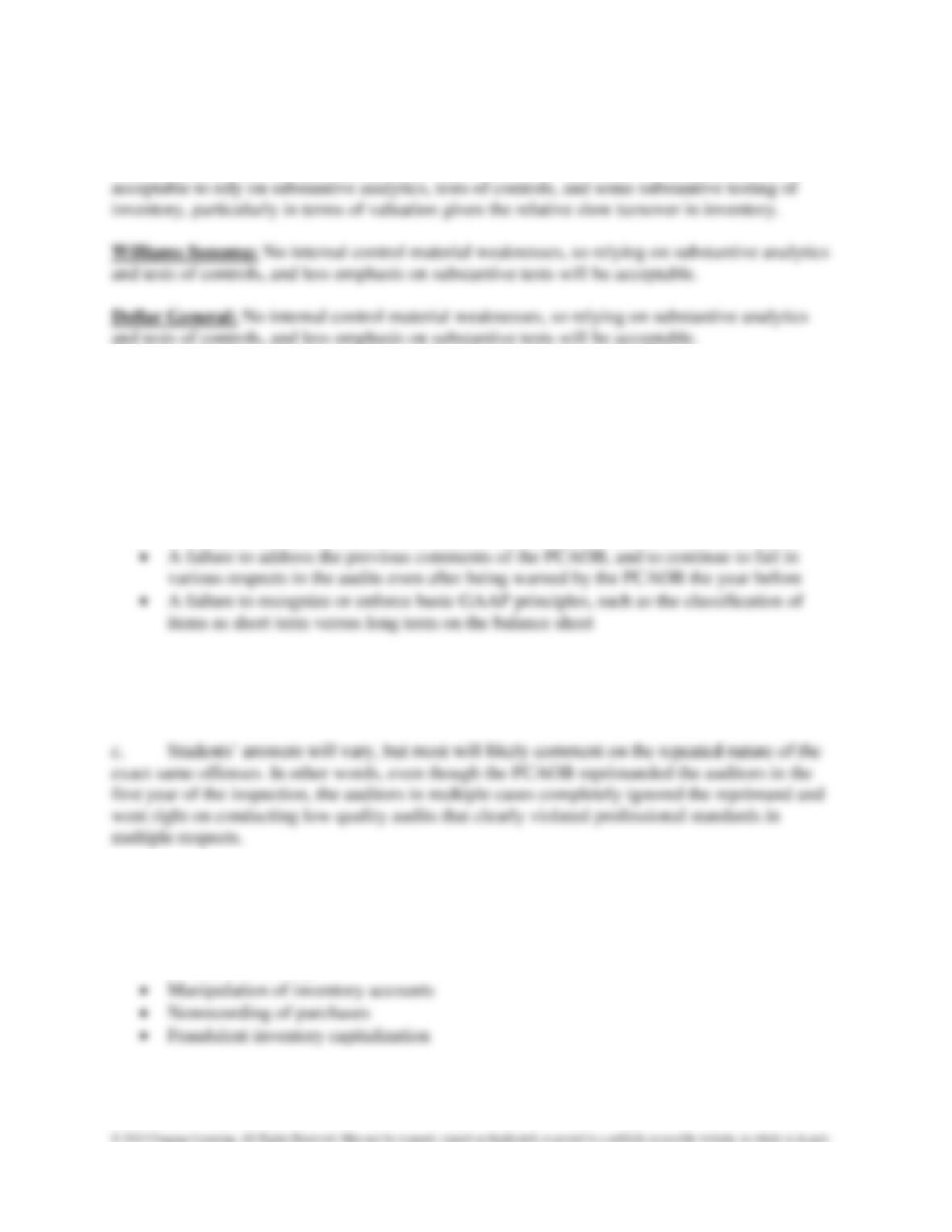
b. Gross margins are similar between Kohl’s and Williams Sonoma. Management attributes
the increase in gross margin for Williams Sonoma between 2009 and 2010 to improved
efficiencies in the supply chain and to a shifting focus more towards internet sales. The margins
of Dollar General are stable, and predictably lower than the two higher-end retailers. Inventory
c.
Kohl’s: 2011. “Based on our assessment, management believes that, as of January 28, 2012, our
internal control over financial reporting was not effective due to the identification of a material
weakness related to our controls over the accounting for leases.” “To remediate the material
weakness described above, we have implemented remedial measures including a review of all of
our leases to correct instances where we were not complying with generally accepted accounting
principles. In addition, we have developed updated procedures to reflect the technical guidance
11-31
While Kohl’s has a material weakness in internal controls, it is in a relatively isolated area and
does not reflect a pervasive weakness, such as the control environment. Therefore, it will be
11-80
a. The following are pervasive problems that were detected by the PCAOB in its
inspections of Ibarra:
• A failure to gather substantive evidence, and to instead rely on management
representations
• A failure to exercise professional skepticism
b. Students’ answers will vary, but most will likely be surprised that the suspension for the
audit firm and for each of the individual auditors is only temporary and that they can reapply in
two years.
11-81
a. The four techniques that companies use to commit inventory fraud are:
• Fictitious inventory
b. Analytical procedures that may indicate inventory fraud include:
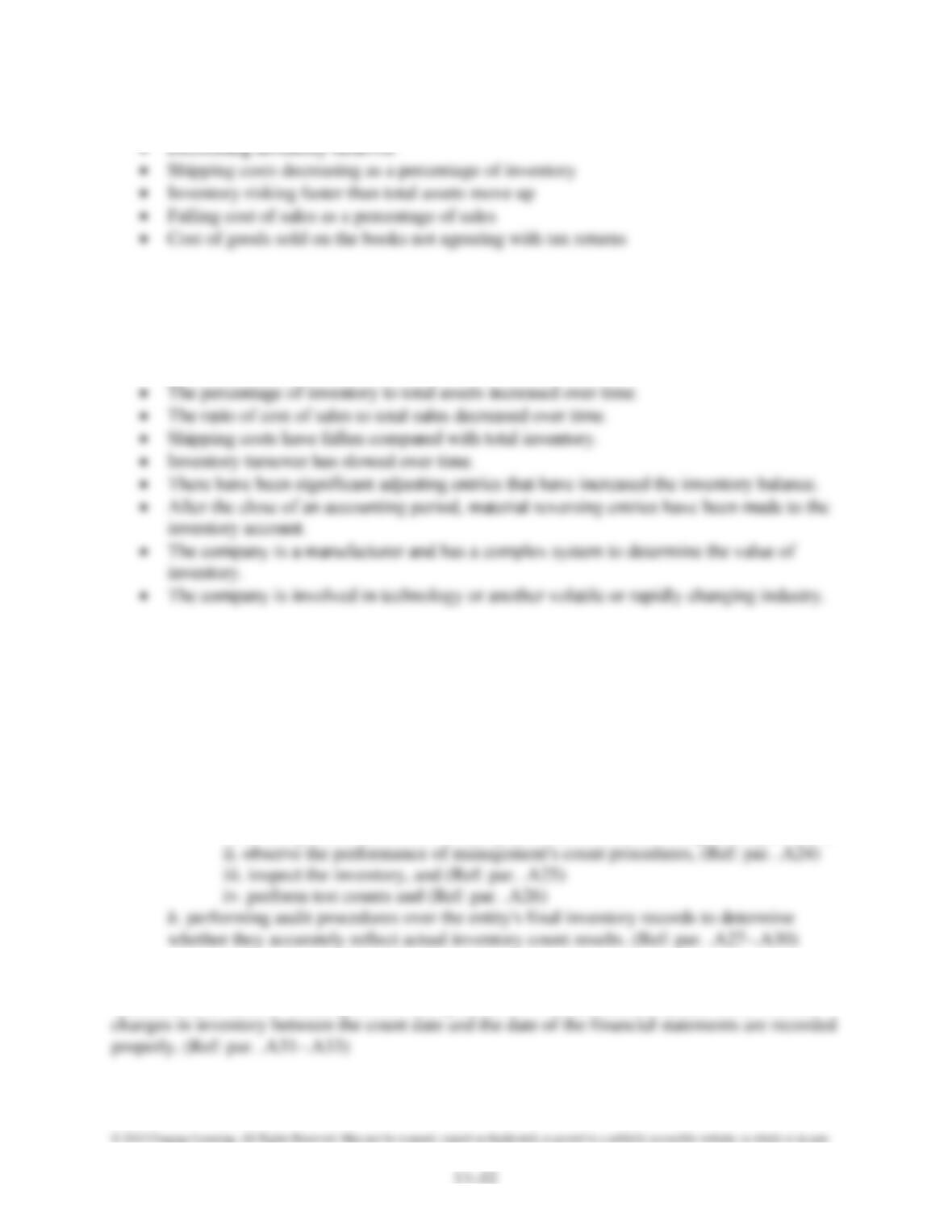
• Inventory increasing faster than sales
c. The most common perpetrators of inventory fraud are employees.
d. The following are indicators of heightened risk for inventory fraud:
• The company is attempting to obtain financing secured by inventory.
• Inventory is a significant balance sheet item.
11-82
a. The number of the standard is AU-C 501.
b. If inventory is material to the financial statements, the auditor should obtain sufficient
appropriate audit evidence regarding the existence and condition of inventory by
a. attending physical inventory counting, unless impracticable, to (Ref: par. .A20–.A22)
i. evaluate management’s instructions and procedures for recording and
controlling the results of the entity’s physical inventory counting, (Ref: par. .A23)
c. If physical inventory counting is conducted at a date other than the date of the financial
statements, the auditor should perform audit procedures to obtain audit evidence about whether