Problem 11-3B (45 minutes)
Part 1
Explanations for each of the journal entries
Jan. 17
Declared a cash dividend of $1 per share of common stock.
($96,000 / 96,000 shares)
Feb. 5
Paid the cash dividend on common stock.
Feb. 28
Declared a 12.5% stock dividend when the market value is $21 per
share. ($120,000 / $10 par = 12,000 shares = 12.5% of 96,000
shares; $252,000 / 12,000 shares = $21 per share)
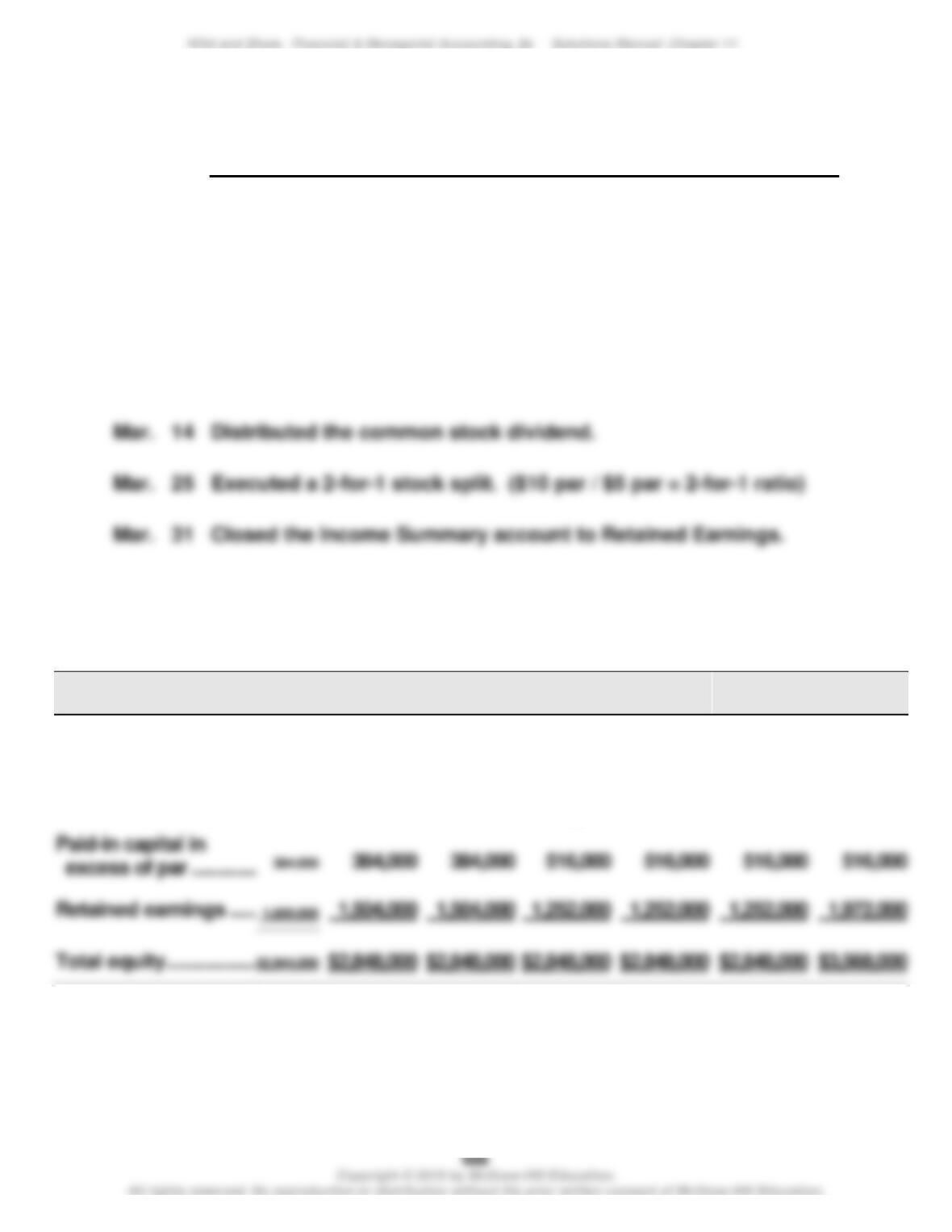
Mar. 14
Mar. 25
Mar. 31
Part 2
Dec. 31
Beg. Bal.
Jan. 17
Feb. 5
Feb. 28
Mar. 14
Mar. 25
Mar. 31
Common stock ………..
$960,000
$ 960,000
$ 960,000
$ 960,000
$1,080,000
$1,080,000
$1,080,000
Common stock
dividend distributable .
0
0
0
120,000
0
0
0
Problem 11-4B (45 minutes)
Part 1
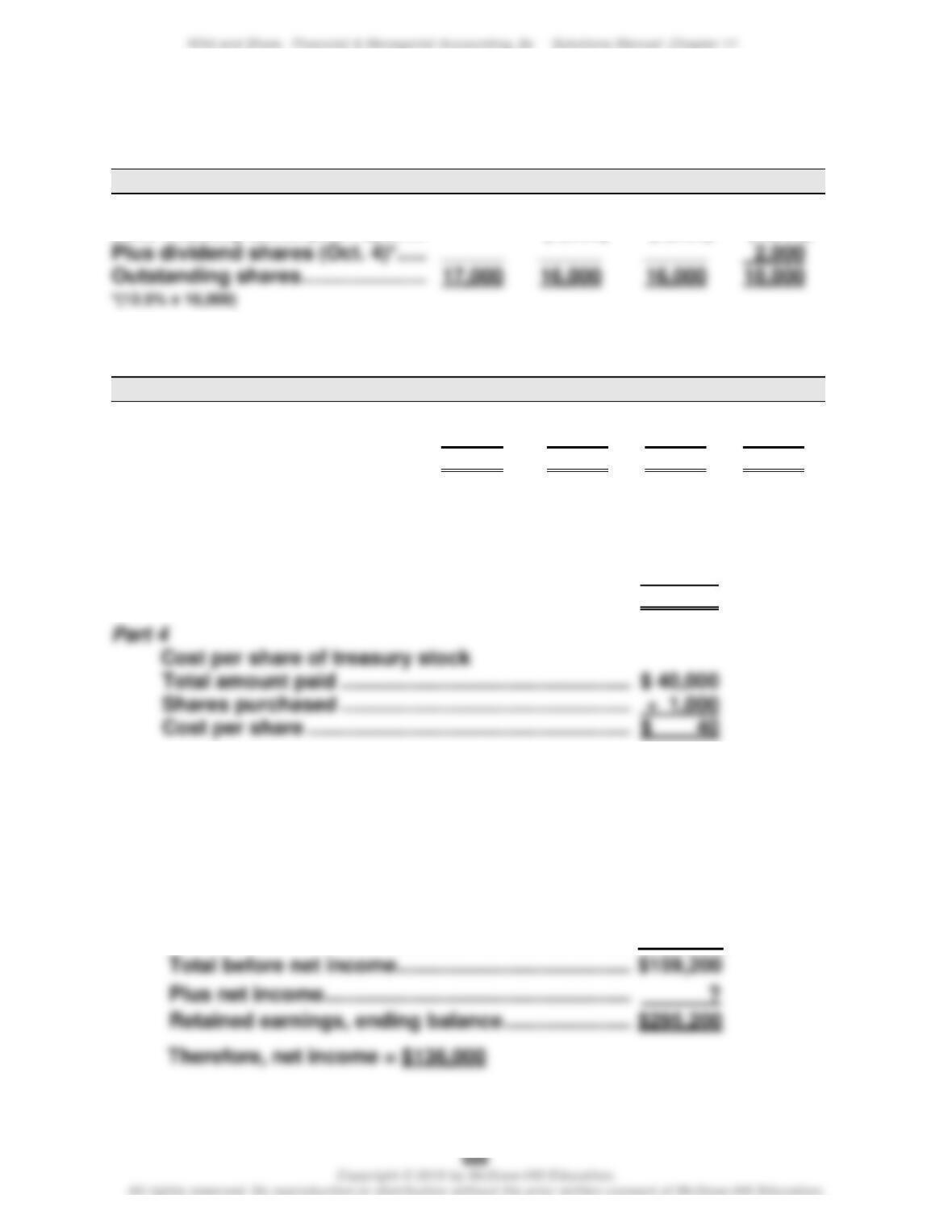
Outstanding common shares
Feb. 15
May 15
Aug. 15
Nov. 15
Beginning balance ………………………
17,000
17,000
17,000
17,000
Less treasury stock (Mar. 2) …………
(1,000)
(1,000)
(1,000)
Outstanding shares ……………………..
17,000
16,000
16,000
18,000
Part 2
Cash dividend amounts
Feb. 15
May 15
Aug. 15
Nov. 15
Outstanding shares ……………………..
17,000
16,000
16,000
18,000
x Dividend per share ……………………
$ 0.40
$ 0.40
$ 0.40
$ 0.40
Total dividend …………………………..
$6,800
$6,400
$6,400
$7,200
Part 3
Capitalization of retained earnings for small stock dividend
Number of shares ……………………………………………………….
2,000
Market value per share ……………………………………………………….
x $42
Total capitalized ……………………………………………………….
$ 84,000
Total amount paid ……………………………………………………….
$ 40,000
Shares purchased ……………………………………………………….
Part 5
Net income
Retained earnings, beginning balance …………………………..
$270,000
Less dividends: Feb. 15 ……………………………………………………….
(6,800)
May 15 ……………………………………………………….
(6,400)
Aug. 15 ……………………………………………………….
(6,400)
Oct. 4 ……………………………………………………….
(84,000)
Nov. 15 ……………………………………………………….
(7,200)
Retained earnings, ending balance …………………………..
$295,200
Problem 11-5B (40 minutes)
1. Computation of stock par values
Preferred: Paid-in amount / Number of shares = $375,000 / 1,500 = $250
Common: Paid-in amount / Number of shares = $900,000 /18,000 = $ 50
2. Book value with no dividends in arrears
Number of outstanding shares …………..
3. Book value with two years’ dividends in arrears
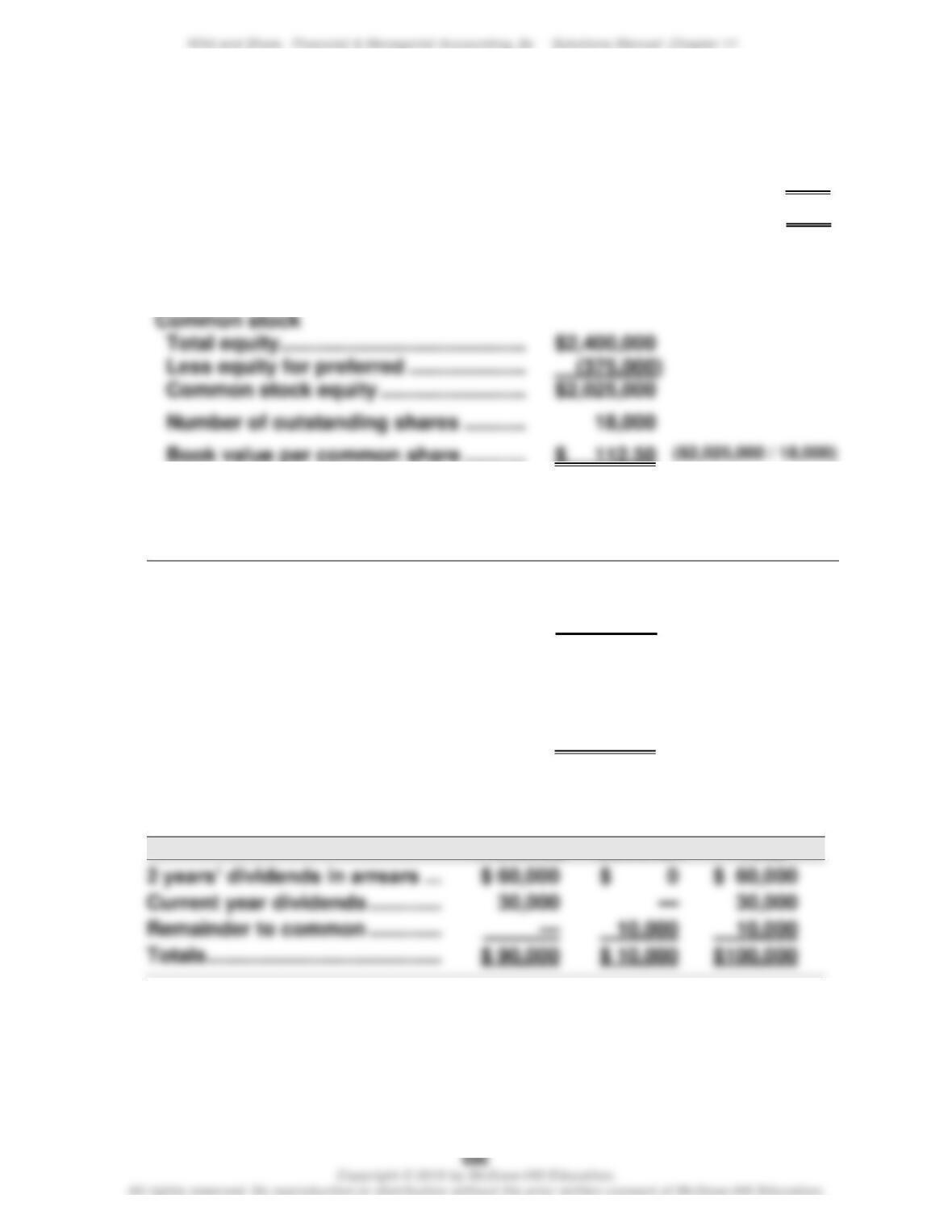
Common stock
Total equity…………………………..……………
$2,400,000
Less preferred stock par value …………..
(375,000)
Less two years’ dividends in arrears* …
Common stock equity ………………………..
*2 years’ dividends = 2 x ($375,000 x 8%) = $60,000
(60,000)
$1,965,000
Number of outstanding shares …………..
18,000
Book value per common share …………..
$ 109.17
($1,965,000 / 18,000) rounded
4. Dividend allocation in total
Preferred
Common
Total
Remainder to common ………….
SERIAL PROBLEM — SP 11
Serial Problem — SP 11, Business Solutions (25 minutes)
1a. Journal entry for issuance of common stock to Cicely
Cash …………………………..………………………………………….
86,000
Common Stock …………………………………………………
86,000
Issuance of common stock.
1b. Journal entry for issuance of preferred stock to Marcello
Cash …………………………..………………………………………….
86,000
Preferred Stock …………………………………………………
86,000
Issuance of $100 par 7% preferred stock.
Cash …………………………..………………………………………….
86,000
Notes Payable …………………………………………………..
86,000
2. Evaluation of the three proposals
a. Cicely’s investment as a common shareholder would mean that
Santana would have a second person who would be an owner.
Santana has been working on her own for about 15 months, and
Serial Problem (concluded)
b. Having a preferred shareholder means that Santana’s Uncle
Marcello will not have the same voting rights as Santana. Marcello
may be expecting regular dividend, however, so Santana should be
prepared to pay $6,020 ($86,000 x 7%) in dividends each year. This
is not a requirement, however, even if the preferred stock is
cumulative.
3. There is no correct answer to the question of which proposal Santana
should adopt. Class discussion may indicate which proposal the class
prefers.
Company Analysis — AA 11-1
(All shares in thousands.)
1. a. 5,126,201 common stock outstanding
b. 5,336,166 common stock outstanding
Note: Apple reports common stock outstanding on its balance sheet.
3. a. $9.27 basic earnings per share
b. $8.35 basic earnings per share
Note: Apple reports EPS at the bottom of its income statement.
5. Increase
Explanation: Buying back outstanding shares generally increases
earnings per share. This is because buying back shares reduces the
weighted-average common shares outstanding, which is the
denominator of the earnings per share formula.
Comparative Analysis — AA 11-2
1. Book value per common share = Equity applicable to common shares
2. Earnings per share = Net income
Weighted-average common shares outstanding
Apple’s earnings per share: $48,351 / 5,217.242 = $ 9.27
Google’s earnings per share: $12,662 / 693.049 = $18.27
3. Dividend yield = Annual cash dividends per share
4. Price-earnings ratio = Market value per share
Earnings per share
Apple’s price-earnings ratio: $ 154.12 / $ 9.27 = 16.63
Google’s price-earnings ratio: $1,046.40 / $18.27 = 57.27
5. Google
Global Analysis — AA 11-3
1. Book value per common share = Equity applicable to common shares
Common shares outstanding
Samsung’s book value per common share = ₩214,371,961 / 119.688
= ₩1,791,090
Note: Equity applicable to common shares includes the total share
premium as Samsung does not provide a break-down of the common share
premium from the preferred share premium.
2. Earnings per share:
3. Increase
Explanation: Buying back outstanding shares generally increases
earnings per share. This is because buying back shares reduces the
weighted-average common shares outstanding, which is the
denominator of the earnings per share formula.
Ethics Challenge — BTN 11-1
During the course of her duties, Harriet has learned information that others
might not know. If she uses this information to trade in New World
Pharmaceuticals’ stock, Harriet may be violating securities laws, so she
should be careful if she buys or sells any New World stock.
It is possible that the new drug will not be as profitable as expected, and
the stock might not increase as much as Harriet expects. Nevertheless,
Harriet might be accused of insider trading in the future if she buys the
stock.
Communicating in Practice — BTN 11-2
There is no set solution to this activity. Solutions will vary based on the
industry and the companies selected.
Taking It to the Net — BTN 11-3
3. In 2016, the financing section of the statement of cash flows shows that
McDonald’s paid $11,171.0 million to purchase treasury stock.
4. In 2016, the financing section of the statement of cash flows shows that
McDonald’s paid common stock cash dividends of $3,058.2 million.
Teamwork in Action — BTN 11–4
1. The team statement should include the following:
a. When a corporation “buys back” its stock (engages in a treasury
2. The team should establish the acquisition entry as follows
Treasury Stock, Common …………………………….
13,400
Cash ……………………………………………………..
13,400
Reacquired 100 shares of $100 par value
common stock at a cost of $134 per share.
Each member should prepare one of the following reissue entries:
a.
Cash …………………………………………………………..
13,400
Treasury Stock, Common ………………………
13,400
Received $134 per share for 100 treasury
shares costing $134 per share.
Cash …………………………………………………………..
15,000
Paid-In Capital, Treasury Stock ………………
Treasury Stock, Common ………………………
13,400
c.
Cash …………………………………………………………..
12,000
Treasury Stock, Common ………………………
13,400
Wild and Shaw, Financial & Managerial Accounting, 8e Solutions Manual: Chapter 11
Teamwork in Action (Continued)
d.
Cash …………………………………………………………..
12,000
Paid-In Capital, Treasury Stock ……………………
1,000
Retained Earnings ……………………………………….
400
Treasury Stock, Common ………………………
13,400
Received $120 per share for 100 treasury
shares costing $134 per share.
Cash …………………………………………………………..
12,000
Retained Earnings ……………………………………….
1,400
Treasury Stock, Common ………………………
13,400
3. When presenting and explaining the above entries to the team, the
following points should be made by the team members:
The similarities in all reissue entries a through e are:
• The net affect of the transaction is to increase assets and equity by
the amount received on reissue.
• Cash (assets) is always increased by the amount received.
• Treasury Stock is always decreased by the full cost regardless of
whether the reissue is at cost, above cost, or below cost.
The differences in reissue entries b through e are:
(b) Reissuing above cost creates additional Paid-In Capital.*
(c) Reissuing below cost reduces existing Paid-In Capital.*
Entrepreneurial Decision — BTN 11-5
1.
Plan A
Plan B
Net income ……………………………………………………..
$ 72,000
$ 72,000
Less preferred dividends ………………………………..
0
(10,000)
Net income for common stockholders …………….
$ 72,000
$ 62,000
Founder’s share of common equity …………………
Founder’s initial equity …………………………………..
$375,000
$375,000
2.
Plan A
Plan B
Net income ……………………………………………………..
$ 16,800
$ 16,800
Less preferred dividends ………………………………..
0
(10,000)
Net income for common stockholders …………….
$ 16,800
$ 6,800
Founder’s share of common equity …………………
Founder’s initial equity …………………………………..
$375,000
$375,000
Founder’s return on equity ……………………………..
3.6%
1.8%
3. The difference between the answers for parts 1 and 2 arises from the
percent of return generated with the assets invested in the corporation.
In part 1, the founder’s return on equity is 15.4% for Plan A, which is
less than the 16.5% for Plan B. However, the return on equity is only
3.6% in part 2 for Plan A, BUT this is more than the 1.8% for Plan B.
These results indicate that the 8% dividend rate on the preferred stock
is advantageous to the founder as long as the rate of return on the

Hitting the Road — BTN 11-6
There is no formal solution for this field activity. Students often find this
assignment interesting as it highlights the relevance of their accounting
studies. Instructors also sometimes assign a particular financial news
show to watch on a certain day for the entire class—this can help
encourage a general class discussion on the topics raised.