BYP 11-2 COMPARATIVE ANALYSIS PROBLEM
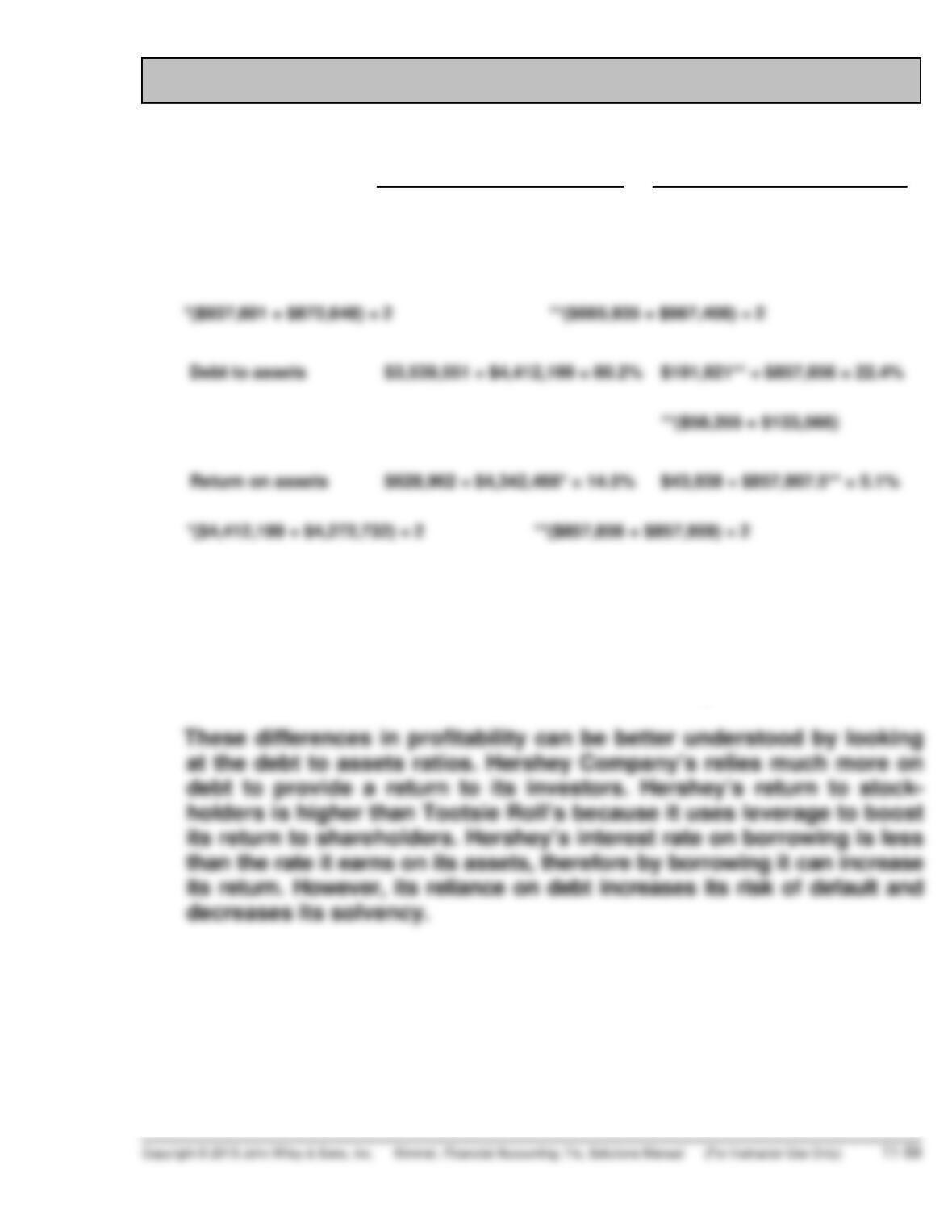
(a) Hershey Company Tootsie Roll
Return on common
stockholders’ equity
$628,962 ÷ $905,124.5* = 69.5% $43,938 ÷ $666,671.5** = 6.6%
(b) Hershey Company’s return on assets, 14.5%, is larger than Tootsie Roll’s
5.1% indicating that it is more profitable. Comparing the return on
common stockholders’ equity indicates that Hershey is significantly more
profitable because its shareholders earned 69.5% on each dollar
invested while Tootsie Roll’s investors earned only 6.6%.
BYP 11-2 (Continued)
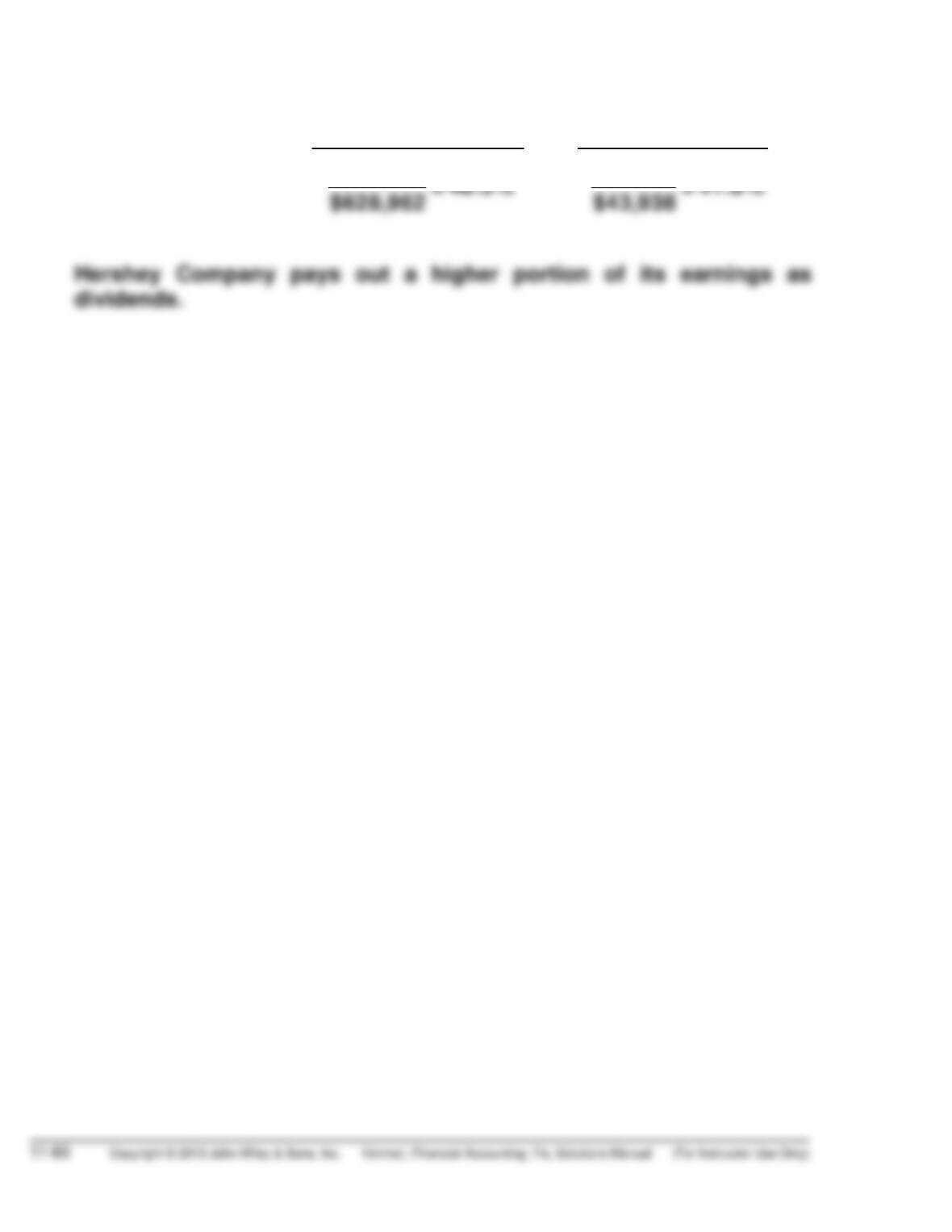
Hershey Company Tootsie Roll
(c) Payout ratio $304,083 = 48.3%
BYP 11-3 RESEARCH CASE
(a) Before it considered paying a dividend or doing a stock buyback the
company paid off near-term debt maturities.
(d) In the past media companies often attracted investors that were
interested in growth. Paying a large dividend will likely attract income-
BYP 11-4 RESEARCH CASE
(a) McDonalds is shifting away from leasing properties toward buying them
because the depressed real estate market has made the purchase of
properties attractive.
(e) McDonalds probably decided not to do this because they were concerned
that the increased leverage would increase the riskiness of the company
by reducing its solvency.
BYP 11-5 INTERPRETING FINANCIAL STATEMENTS
(a) This is a dividend transaction—a property dividend.
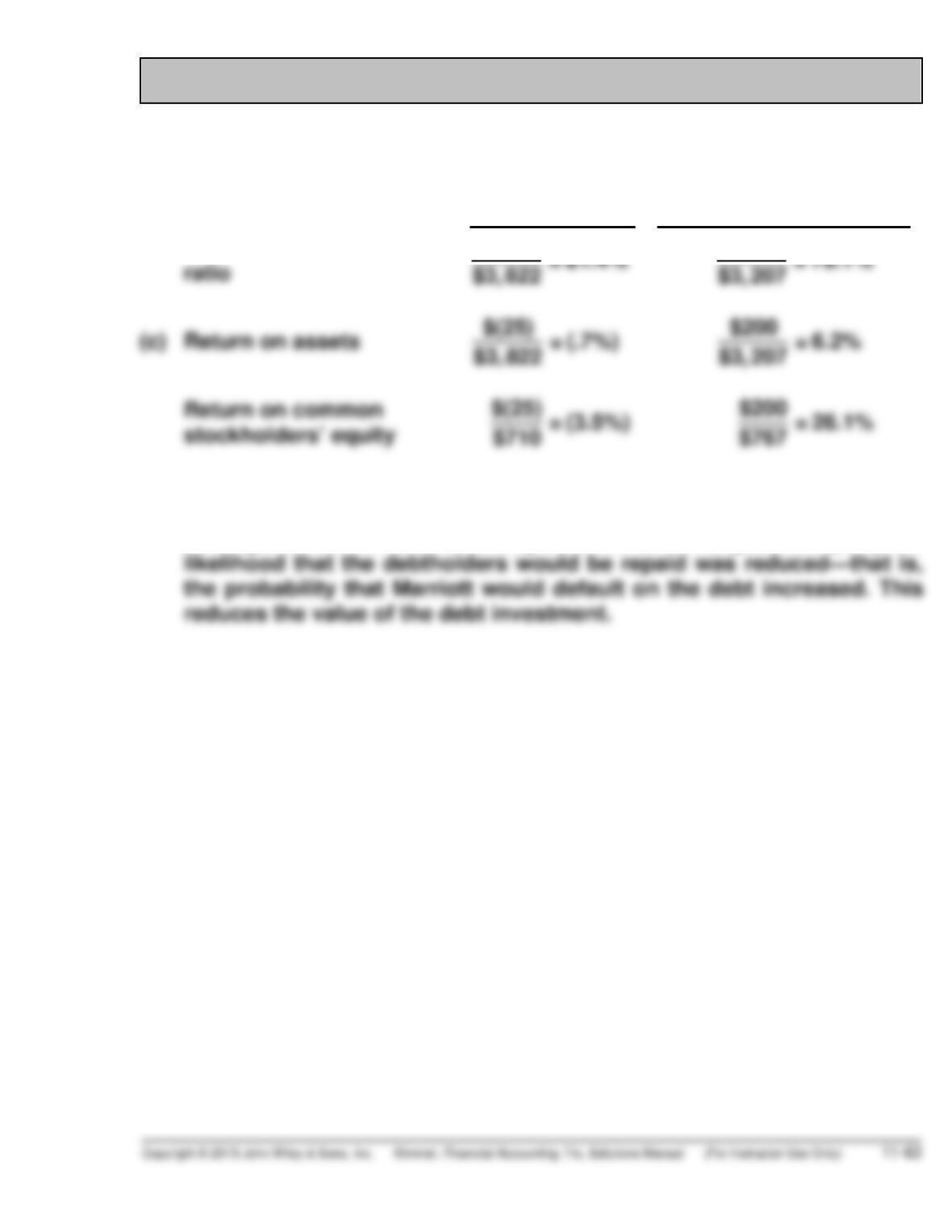
(b) Host Marriott Marriott International
Debt to assets
(d) The debtholders were concerned that by splitting the company and
leaving most of the debt with only one half of the original company the

BYP 11-6 REAL-WORLD FOCUS
Answers will vary depending on the company chosen by the student.
BYP 11-7 DECISION MAKING ACROSS THE ORGANIZATION
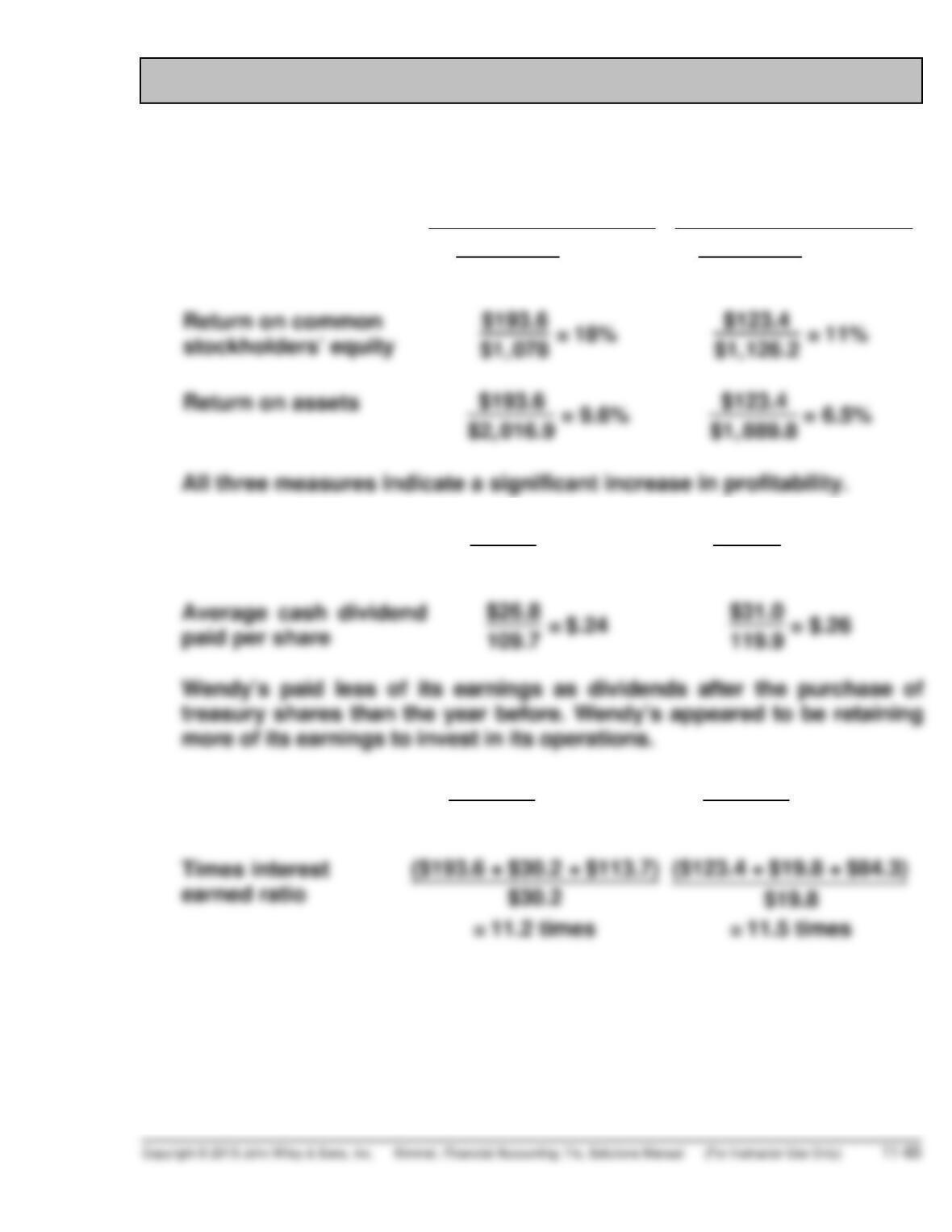
Year ended
A
fter Purchase of
Treasury Stock
Before Purchase of
Treasury Stock
(a) Earnings per share $193.6
–
0
109.7 = $1.76 $123.4
–
0
119.9 = $1.03
(b) Payout ratio $26.8
$193.6 = 13.8% $31.0
$123.4 = 25.1%
(c) Debt to assets ratio $1,046.3
$2,076.0 = 50.4% $769.9
$1,837.9 = 41.9%
BYP 11-7 (Continued)
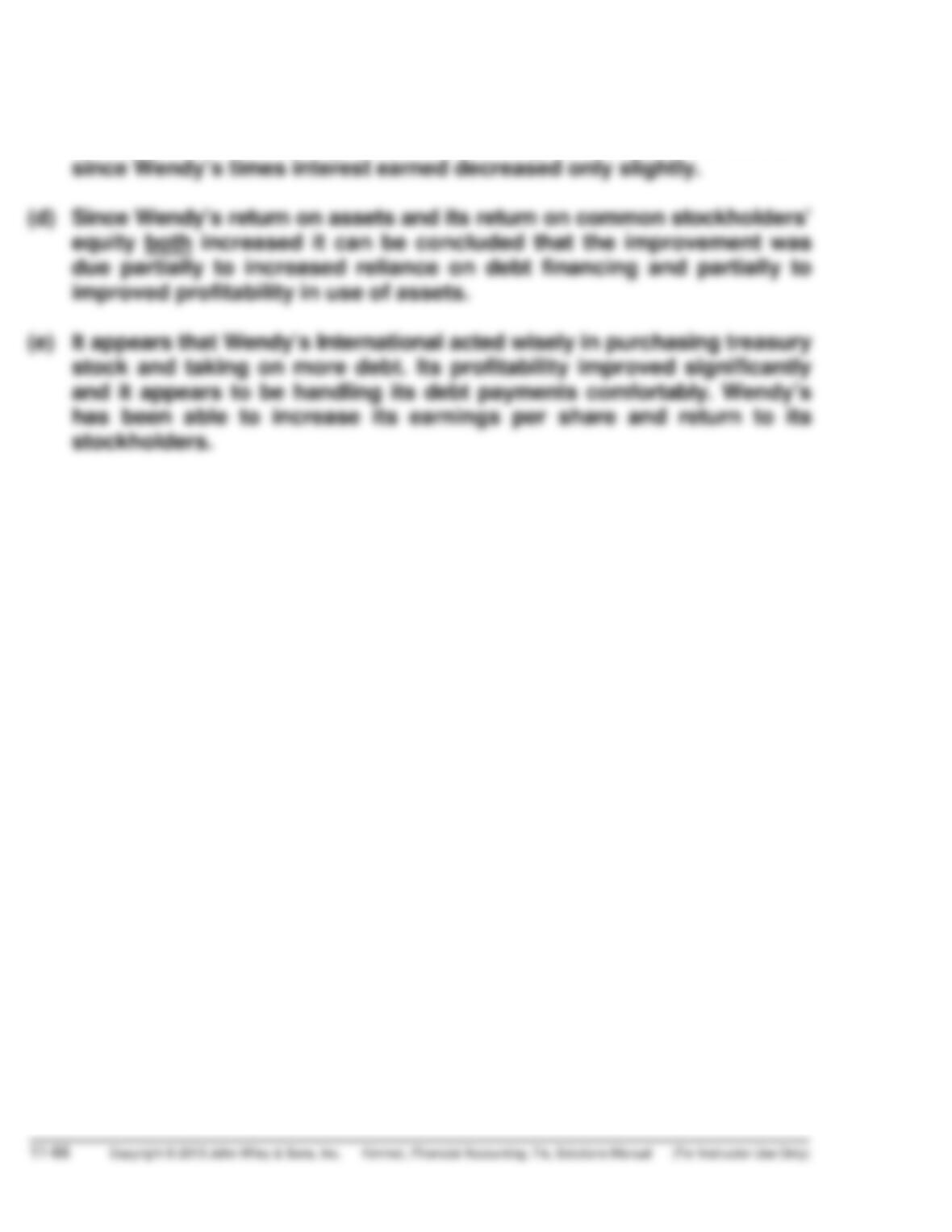
Wendy’s debt to assets ratio increased from 41.9% to 50.4% indicating
a decrease in its solvency. This increase may not be cause for concern
BYP 11-8 COMMUNICATION ACTIVITY
Dear Uncle Ken:
Thanks for your recent letter and for asking me to explain four terms.
Here are my explanations:
(1) Authorized stock is the total amount of stock that a corporation is
given permission to sell as indicated in its charter. If all authorized
(4) Preferred stock is capital stock that has contractual preferences over
BYP 11-9 ETHICS CASE
(a) The stakeholders in this situation are:
The director of Jobe’s R&D division.
The president of Jobe.
(b) The president is risking the environment and everything and everybody in
it that is exposed to this new chemical in order to enhance his company’s
BYP 11-10 ETHICS CASE
(a) The stakeholders in this situation are:
Mr. Sigle, president of Osborn Corporation.
(b) There is nothing unethical in issuing a stock dividend. But the presi-
dent’s order to write a press release convincing the stockholders that
(c) The stock dividend results in a decrease in retained earnings and an
increase of the same amount in paid-in capital with no change in total

BYP 11-11 ALL ABOUT YOU
Student responses will vary depending on the organization chosen by the
student.
BYP 11-12 FASB CODIFICATION ACTIVITY
(a) Stock Dividend: An issuance by a corporation of its own common
shares to its common shareholders without consideration and under
conditions indicating that such action is prompted mainly by a desire
(b) Stock Split: An issuance by a corporation of its own common shares to
its common shareholders without consideration and under conditions
(c) Except for a few instances, the issuance of additional shares of less
than 20 or 25 percent of the number of previously outstanding shares
BYP 11-13 CONSIDERING PEOPLE, PLANET AND PROFIT
(a) The new law allows a company to incorporate under a new charter
which classifies a company as a “benefit company.” A benefit
company’s governing board is allowed to consider social or
(b) The article says that some people say the biggest benefit of the law
would occur when the company is being considered for either a sale
or break-up. Currently, if shareholder value would be maximized by
selling the company or breaking it into pieces, board members can be
(c) Critics of the new law say that it reduces the accountability of the
company to its shareholders. They say that if management makes a
(d) Previously companies could apply for “B Corp” certification. Under
this program, companies are evaluated by a private entity that created
and administers the certification. Companies choose to obtain this
(e) The companies that the article cites as either having adopted benefit
corporation standing, or are considering it are:
Patagonia
Ben and Jerry’s Homemade
IFRS CONCEPTS AND APPLICATION
IFRS 11-1
May 10 Cash (1,000 X $18) ………………………………… 18,000
Share Capital—Ordinary
IFRS 11-2
LUTHER CORPORATION
Partial Statement of Financial Position
December 31, 2014
Equity
Share capital—ordinary,
€10 par value,
5,000 shares issued and 4,500 shares
outstanding ……………………………………………….. €50,000
IFRS 11-3
June 12 Cash ………………………………………………….. 375,000
Share Capital—Ordinary
July 11 Cash (1,000 X $110) ……………………………. 110,000
Share Capital—Preference
Nov. 28 Treasury Shares …………………………………. 80,000
Cash ……………………………………………. 80,000
IFRS 11-4
(a) Santander is issuing shares of its Mexican banking subsidiary to the
public in order to raise capital. It needs the capital because it has had
very high loan-losses on its loans in southern Europe.
(b) The bank feels that the local listings raise awareness of the bank’s
brand when local investors become shareholders. Also, the bank
(d) Many of Santander’s rivals that needed cash infusions have had to
issue shares at deeply discounted prices because their stock price
IFRS 11-5 INTERNATIONAL FINANCIAL REPORTING PROBLEM
(a) Cash ………………………………………………………….. 14
Share Capital—Ordinary …………………….. 0
(c) Share capital Common stock
Share premium Paid-in capital in excess of par value