
Continuing Cookie Chronicle 1
Continuing Cookie Chronicle
(Note: This is a continuation of the Cookie Chronicle from Chapters 1 through
10.)
CCC11
Part 1 Because Natalie has been so successful with Cookie Creations and
Curtis has been just as successful with his coffee shop, they both conclude that
they could benefit from each other’s business expertise. Curtis and Natalie next
evaluate the different types of business organization, and because of the
advantage of limited personal liability, decide to form a new corporation.
Curtis has operated his coffee shop for 2 years. He buys coffee, muffins, and
cookies from a local supplier. Natalie’s business consists of giving cookie-making
classes and selling fine European mixers. The plan is for Natalie to use the
premises Curtis currently rents as a location for her cookie-making classes and
demonstrations of the mixers that she sells. Natalie will also hire, train, and
supervise staff hired to bake cookies and muffins sold in the coffee shop. By
offering her classes on the premises, Natalie will save on travel, and the coffee
shop will provide one central location for selling the mixers. Combining forces will
also allow Natalie and Curtis to pool their resources and buy a few more assets
to run their new business venture.
The current market values of the assets of both businesses are as follows.
Description
Curtis’
Coffee
Cookie Creations
Cash
$ 7,500
$12,000
Accounts
receivable
100
500
Merchandise
inventory
450
1,130
Equipment
2,500
1,000
$10,550
$14,630
Curtis and Natalie meet with a lawyer and form their corporation, called
Cookie & Coffee Creations Inc., on November 1, 2015. The new corporation is
authorized to issue 50,000 shares of $1 par common stock and 10,000 shares of
no par, $6 cumulative preferred stock.
The assets held by each business will be transferred into the corporation at
current market value of $1 per share. Curtis will receive 10,550 common shares,
and Natalie will receive 14,630 common shares in the corporation.
Natalie and Curtis are very excited about this new business venture. They
come to you with the following questions.
1. Curtis’ dad and Natalie’s grandmother are interested in investing $5,000
each in the new business venture. Curtis and Natalie are considering
issuing them preferred shares. What would be the advantage of issuing
them preferred stock instead of common?
2. What would be the advantages and disadvantages of issuing cumulative
preferred?
3. “Our lawyer sent us a bill for $750. When we talked the bill over with her,
she said she would be willing to receive common stock in our corporation
instead of cash. We would be happy to issue her stock, but we’re worried
about accounting for this transaction. Can we do this? If so, how do we
determine how many shares to give her?”
Instructions
(a) Answer Natalie and Curtis’ questions.
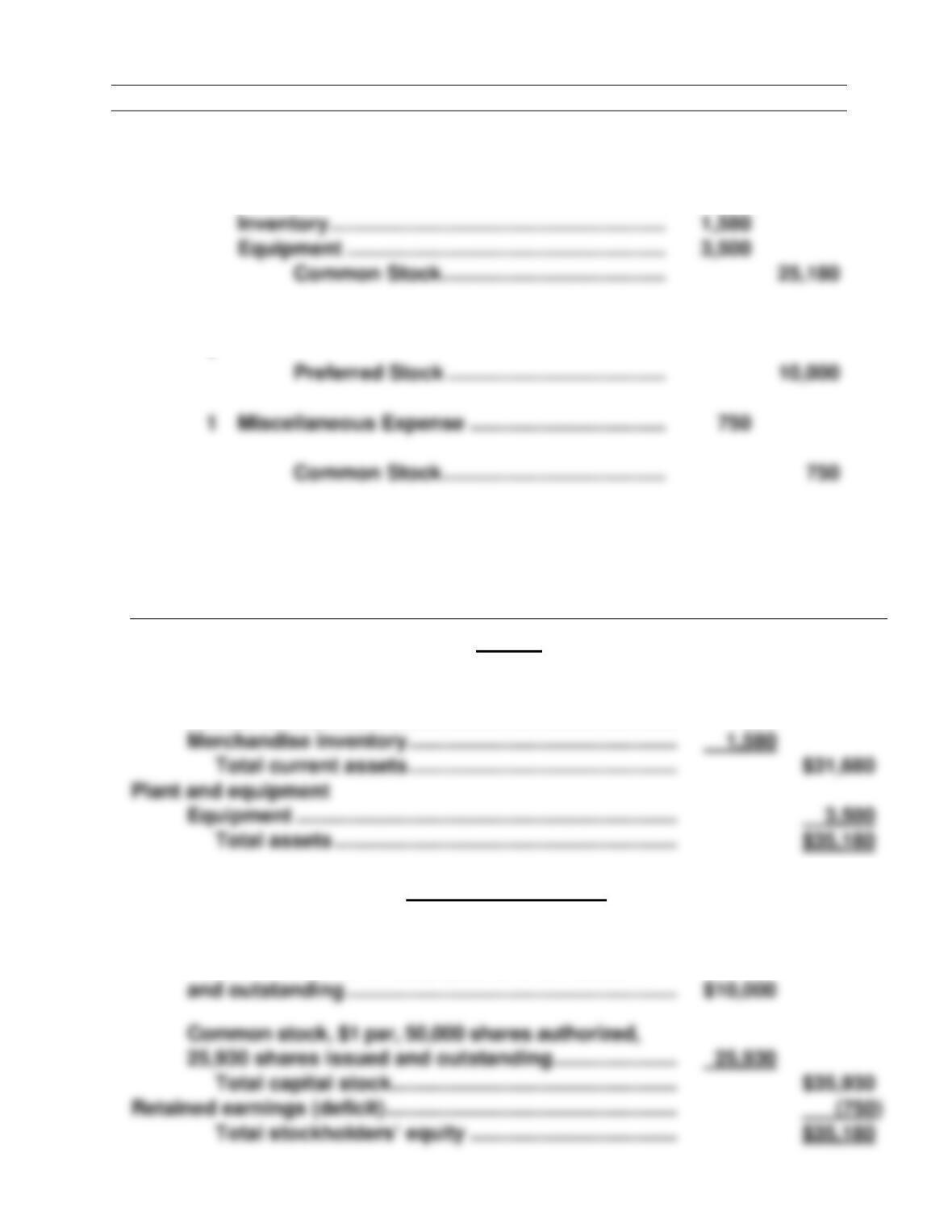
(b) Prepare the journal entries required on November 1, 2015, the date when
Natalie and Curtis transfer the assets of their respective businesses into
Cookie & Coffee Creations Inc.
(c) Assume that Cookie & Coffee Creations Inc. issues 1,000 $6 cumulative
preferred shares to Curtis’ Dad and the same number to Natalie’s
grandmother, in both cases for $5,000. Also assume that Cookie & Coffee
Creations Inc. issues 750 common shares to its lawyer. Prepare the
journal entries required for each of these transactions that also occurred
on November 1.
(d) Prepare the opening balance sheet for Cookie & Coffee Creations Inc. as
of November 1, 2015, including the journal entries in (b) and (c) above.
Part 2 After establishing their company’s fiscal year-end to be October 31,
Natalie and Curtis began operating Cookie & Coffee Creations Inc. on November
1, 2015. The company had the following selected transactions during its first
fiscal year of operations.
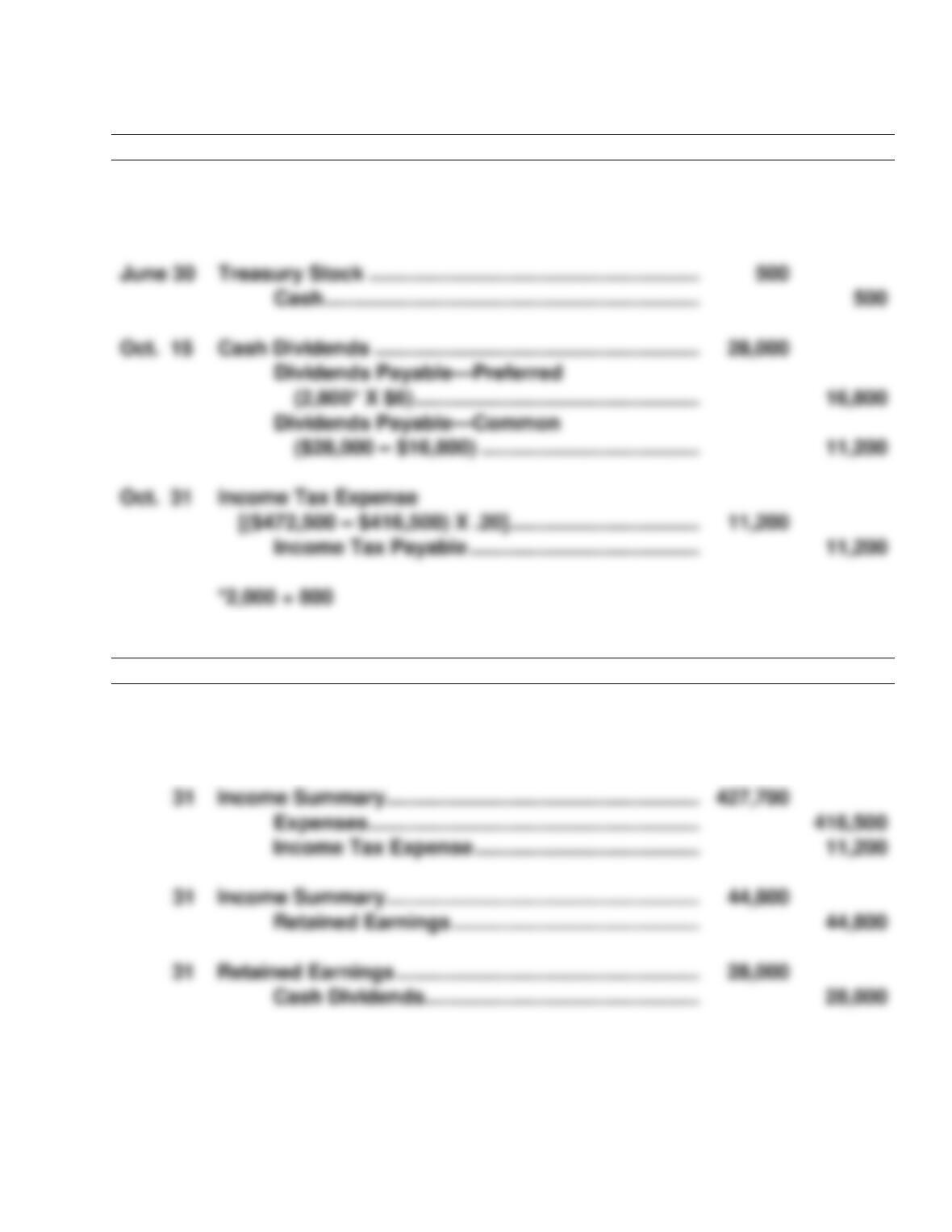
Jan. 1 Issued an additional 800 preferred shares to Natalie’s brother for
$4,000 cash.
June. 30 Repurchased 750 shares issued to the lawyer, for $500 cash. The
lawyer had decided to retire and wanted to liquidate all of her assets.
Oct. 15 The company had a very successful first year of operations and as a
result declared dividends of $28,000, payable November 15, 2016.
(Indicate the amounts payable to the preferred stockholders and to the
common stockholders.)
Oct. 31 The company earned revenues of $472,500 and incurred expenses of
$416,500 (including the $750 legal expense from November 1 but
excluding income tax). Record income tax expense, assuming the
company has a 20% income tax rate.
Instructions
(a) Prepare the journal entries to record each of the above transactions.
(b) Prepare all of the closing entries required on October 31, 2016.
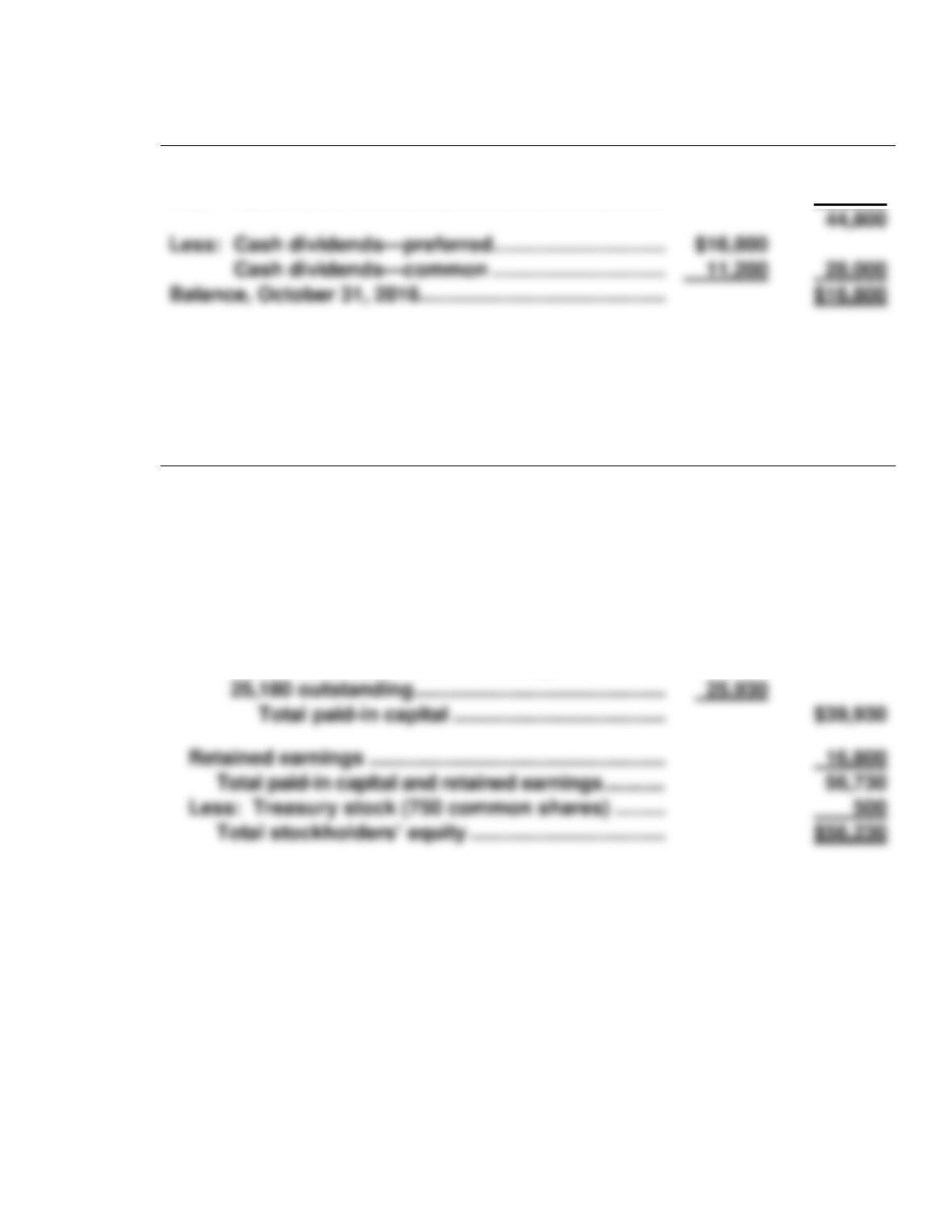
(c) Prepare the retained earnings statement for the year ended October 31,
2016.
(d) Prepare the stockholders’ equity section of the balance sheet as of
October 31, 2016.
(d) Tot. stockholders’ equity $56,230
Part 1
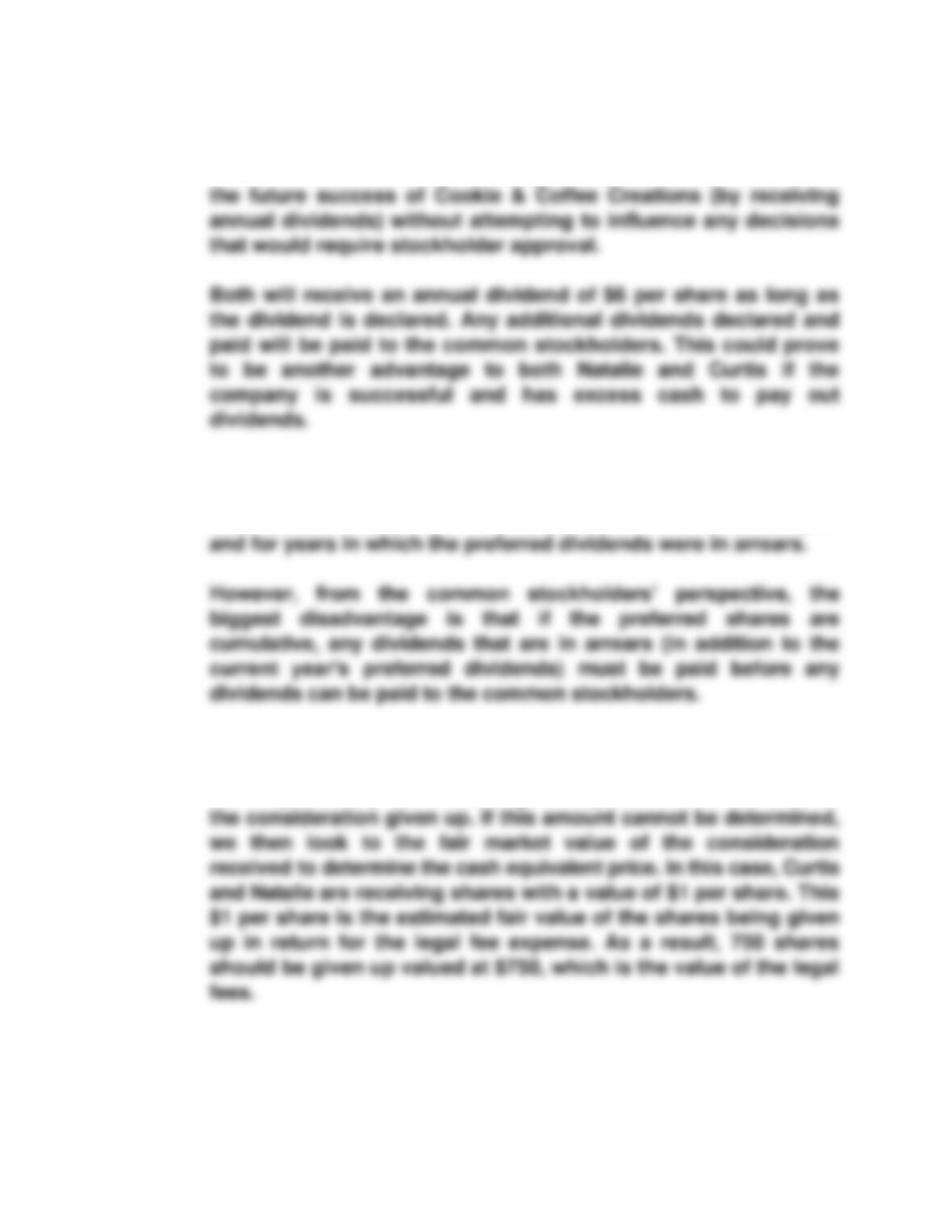
(a) 1. One of the major advantages of issuing preferred stock is that
the preferred stockholder does not have voting rights. In this
case, Curtis’ dad and Natalie’s grandmother can participate in
2. The advantages of offering your family cumulative preferred
stock is that when dividends were declared, the preferred
stockholders would receive dividends both for the current year
3. It is possible to pay for the $750 legal bill by issuing common stock.
However, the cost principle still applies. Cost must equal the
cash equivalent price which is generally the fair market value of
General Journal
Date
Account Titles
Debit
Credit
(b)
2015
Nov.
1
Cash ………………………………………………………………..
19,500
Accounts Receivable ………………………………………..
600
Equipment ……………………………………………………….
Common Stock………………………………………..
(c)
Nov.
1
Cash ………………………………………………………………..
10,000
Preferred Stock ……………………………………….
Miscellaneous Expense ……………………………………
Common Stock………………………………………..
(d) COOKIE & COFFEE CREATIONS INC.
Balance Sheet
November 1, 2015
Assets
Current assets
Cash ……………………………………………………………………
$29,500
Accounts receivable …………………………………………….
600
Merchandise inventory …………………………………………
Equipment …………………………………………………………..
Stockholders’ Equity
Capital stock
Preferred stock, no-par value, $6, cumulative,
10,000 shares authorized, 2,000 shares issued
$10,000
Common stock, $1 par, 50,000 shares authorized,
25,930 shares issued and outstanding ………………….
Retained earnings (deficit) …………………………………………….
Part 2
(a) General Journal
Date
Account Titles
Debit
Credit
2016
Jan. 1
Cash ……………………………………………………………………
4,000
Preferred Stock …………………………………………..
4,000
June 30
Treasury Stock ……………………………………………………
Cash Dividends …………………………………………………..
(2,800* X $6) …………………………………………….
($28,000 – $16,800) ………………………………….
[($472,500 – $416,500) X .20]……………………………..
Income Tax Payable ……………………………………
*2,000 + 800
(b) General Journal
Date
Account Titles
Debit
Credit
2016
Oct. 31
Revenues …………………………………………………………….
472,500
Income Summary ………………………………………..
472,500
Income Summary …………………………………………………
427,700
Expenses ……………………………………………………
416,500
Income Tax Expense …………………………………..
Income Summary …………………………………………………
Retained Earnings ………………………………………
Retained Earnings ……………………………………………….
Cash Dividends …………………………………………..
(c) COOKIE & COFFEE CREATIONS INC.
Retained Earnings Statement
For the Year Ended October 31, 2016
Balance, November 1, 2015 …………………………………….
$ –
Add: Net income ………………………………………………….
44,800
Cash dividends—common …………………………..
28,000
Balance, October 31, 2016 ………………………………………
(d) COOKIE & COFFEE CREATIONS INC.
Partial Balance Sheet
October 31, 2016
Stockholders’ equity
Paid-in capital
Capital stock
Preferred stock, no-par value, $6,
cumulative, 10,000 authorized,
2,800 shares issued and outstanding ……………
$14,000
Common stock, $1 par, 50,000 shares
authorized, 25,930 shares issued, and
25,180 outstanding ……………………………………….
Total paid-in capital ………………………………………..
Retained earnings ……………………………………………………..
Total paid-in capital and retained earnings ………………….
Less: Treasury stock (750 common shares) ………………
Total stockholders’ equity ……………………………………..