Exercise 11.18 (Concluded)
2. Basic: $228,000/45,000 = $5.07* per unit
Advanced: $720,000/24,000 = $30 per unit
3. JIT manufacturing should result in more efficient production, and thus, costs
would be reduced. For example, the multidisciplinary nature of cells would
CPA-TYPE EXERCISES
Exercise 11.19
b. As with products, whenever there is customer diversity, activities will not be
Exercise 11.20
b. A low-price supplier is not necessarily the low-cost supplier. Suppliers can
Exercise 11.21
c. The key is selecting a driver that is the best measure of consumption. Order
Exercise 11.22
a. The cost per defective component is $20 ($3,000,000/150,000). Thus, the cost
Exercise 11.23
d. The second stage assigns activity costs to cost objects. Since customers are
the cost object, the only correct answer is d.
PROBLEMS
Problem 11.24
1. Cost per labor hour = ($5,000,000 + $7,500,000*)/250,000
2. Cost per hour = ($6,600,000 + $6,000,000*)/200,000 = $63.00 per hour
3. The design changes increased non-unit-based overhead activities, while de-
creasing unit-based costs. This is suggested by the fact that engineering
change orders triggered a number of overhead-related activities such as
changes in setup, inspection, and purchasing activities. Thus, so-called fixed
overhead increased by $1,600,000. Reduction in labor content may have come
Problem 11.24 (Concluded)
4. The cost of producing decreases by $250,000 for the rejected design:
Unit-level activities:
Setups:
Receiving:
Purchasing demand change = (75 – 100) = (25)
Decrease in steps = 25/20 = 1 (rounded down to nearest whole unit)
Decrease in variable activity cost = $2,000 × (25) = $(50,000)
Problem 11.25
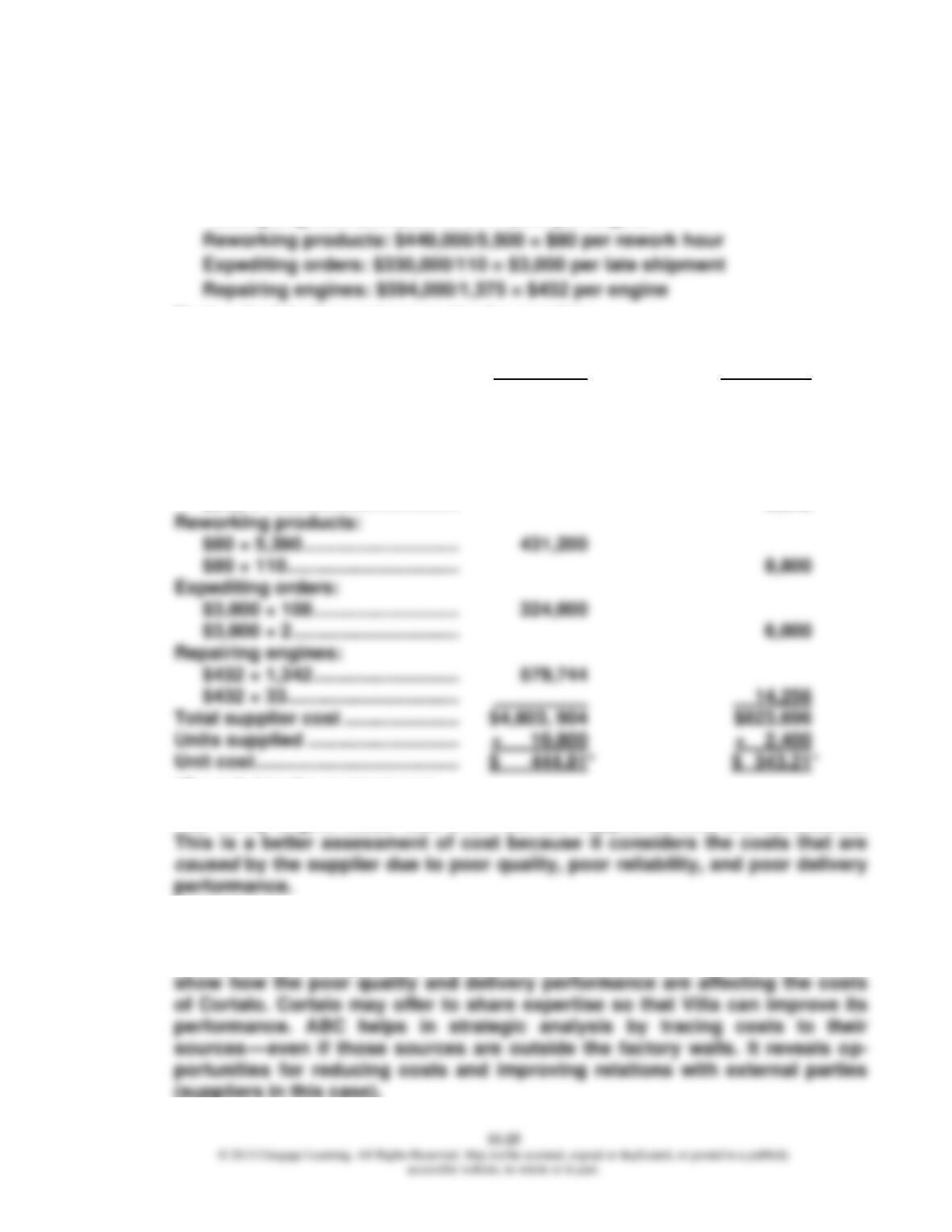
1. Supplier cost:
First, calculate the activity rates for assigning costs to suppliers:
Testing engines: $264,000/1,100 = $240 per engine
Next, calculate the cost per engine by supplier:
Supplier cost:
Villa Verity
Purchase cost:
$297 × 10,800 …………………….. $ 3,207,600
$330 × 2,400 ………………………. $792,000
Testing engines:
$240 × 1,089 ………………………. 261,360
$240 × 11 …………………………... 2,640
*Rounded to the nearest cent.
The Verity engine costs less when the full supplier effects are considered.
2. Given that Cortalo needs both suppliers, it seems sensible to first shift more
business to the true low-cost supplier and then take actions to help improve
behavior of Villa engines. Cortalo could share the ABC analysis with Villa and
Problem 11.26
1. Following GAAP is fine for external financial reporting; however, for internal
reporting it may not be a good practice. By expensing order-filling costs,
2. The total product consists of all benefits—both tangible and intangible—that
a customer receives. One of the benefits is the order-filling service provided
by Moss. Thus, it can be argued that these costs should be product costs,
and not assigning them to products undercosts all products. There are more
small orders than large (70,000 orders average 600 units), and these small or-
ders consume more of the order-filling resources. They should, therefore,
receive more of the order-filling costs. Furthermore, since segmenting prod-
ucts is equivalent to segmenting customers, we obtain insight as to how
much it is costing to service different customer categories.
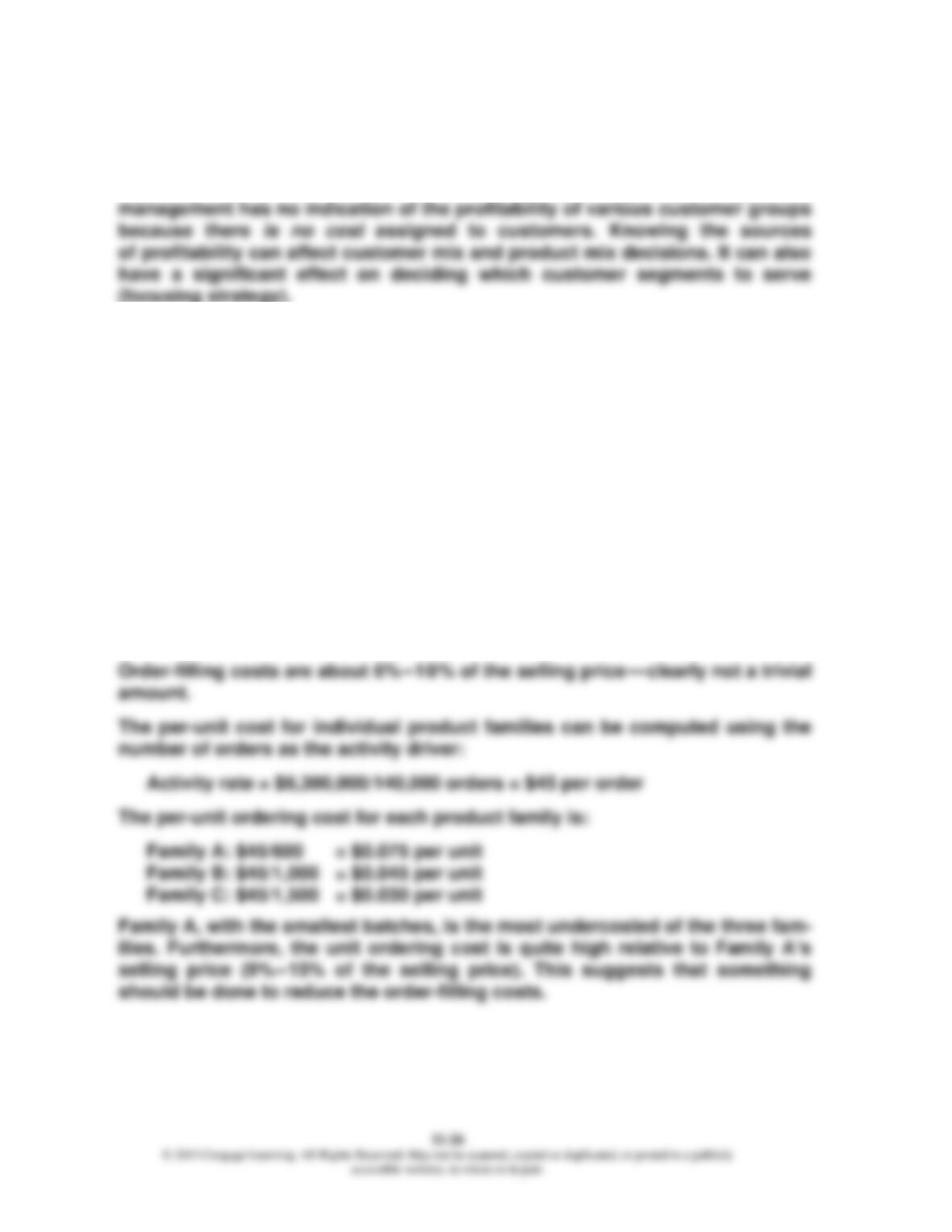
The average order-filling cost per unit produced is:
$6,300,000/126,000,000 units = $0.05/unit
Note: Each product has 42 million units (e.g., 600 × 70,000 for A); thus, there
are 126,000,000 units in total.
Problem 11.26 (Concluded)
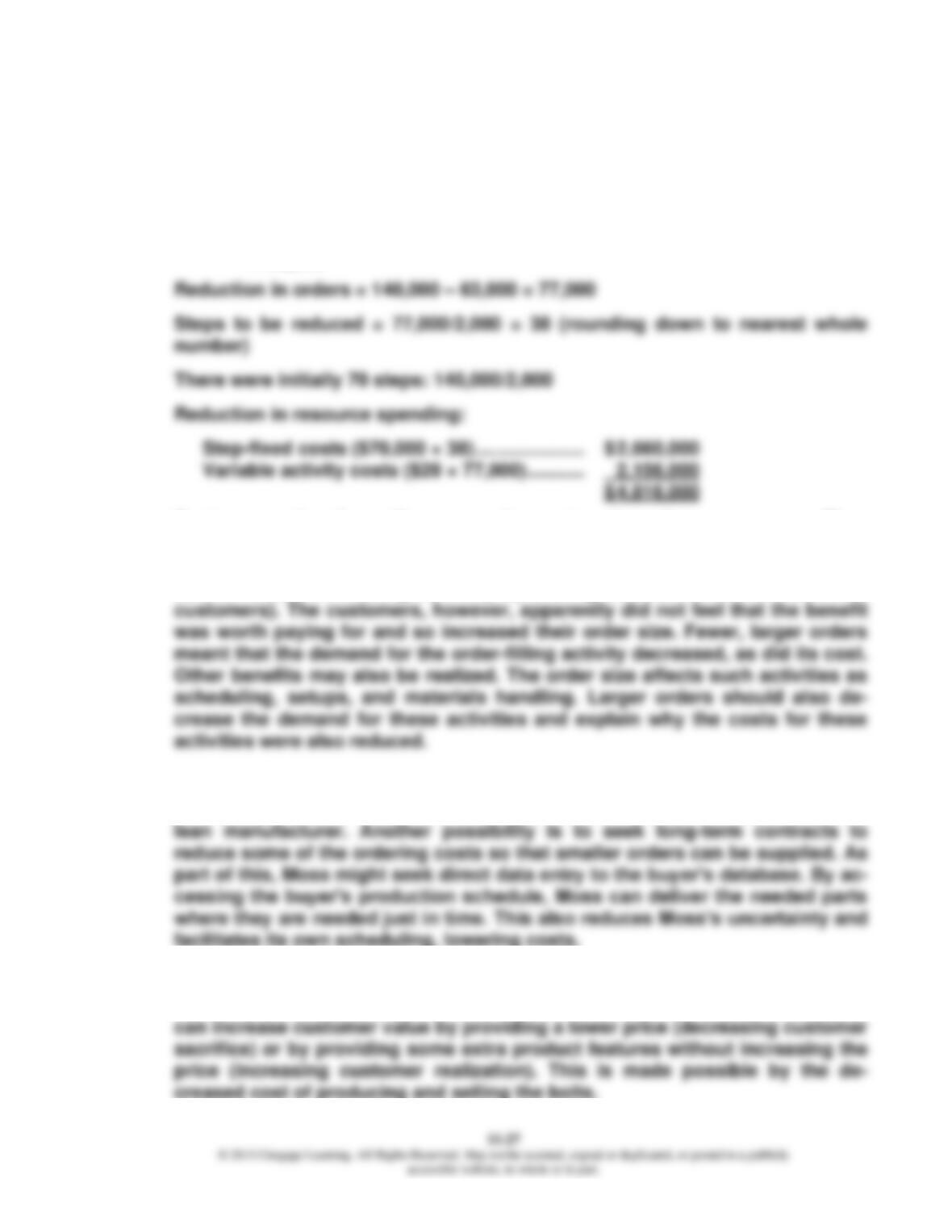
3. With the pricing incentive feature, the average order size has been increased
to 2,000 units for all three product families. The number of orders now pro–
cessed can be calculated as follows:
Orders = [(600 × 70,000) + (1,000 × 42,000) + (1,500 × 28,000)]/2,000
= 63,000
Customers placed smaller, more frequent orders than necessary. They
received a benefit without being charged for it. By charging for the benefit
and allowing customers to decide whether it was worth the cost, Moss was
able to reduce its costs (potentially by shifting the cost of the service to the
4. If Moss is to be a JIT supplier, then it should enjoy some of the benefits. One
possibility is to seek help from the buyer so that Moss can become more of a
5. Competitive advantage is created by providing the same customer value for
less cost or better value for the same or less cost. By reducing the cost, Moss
Problem 11.27
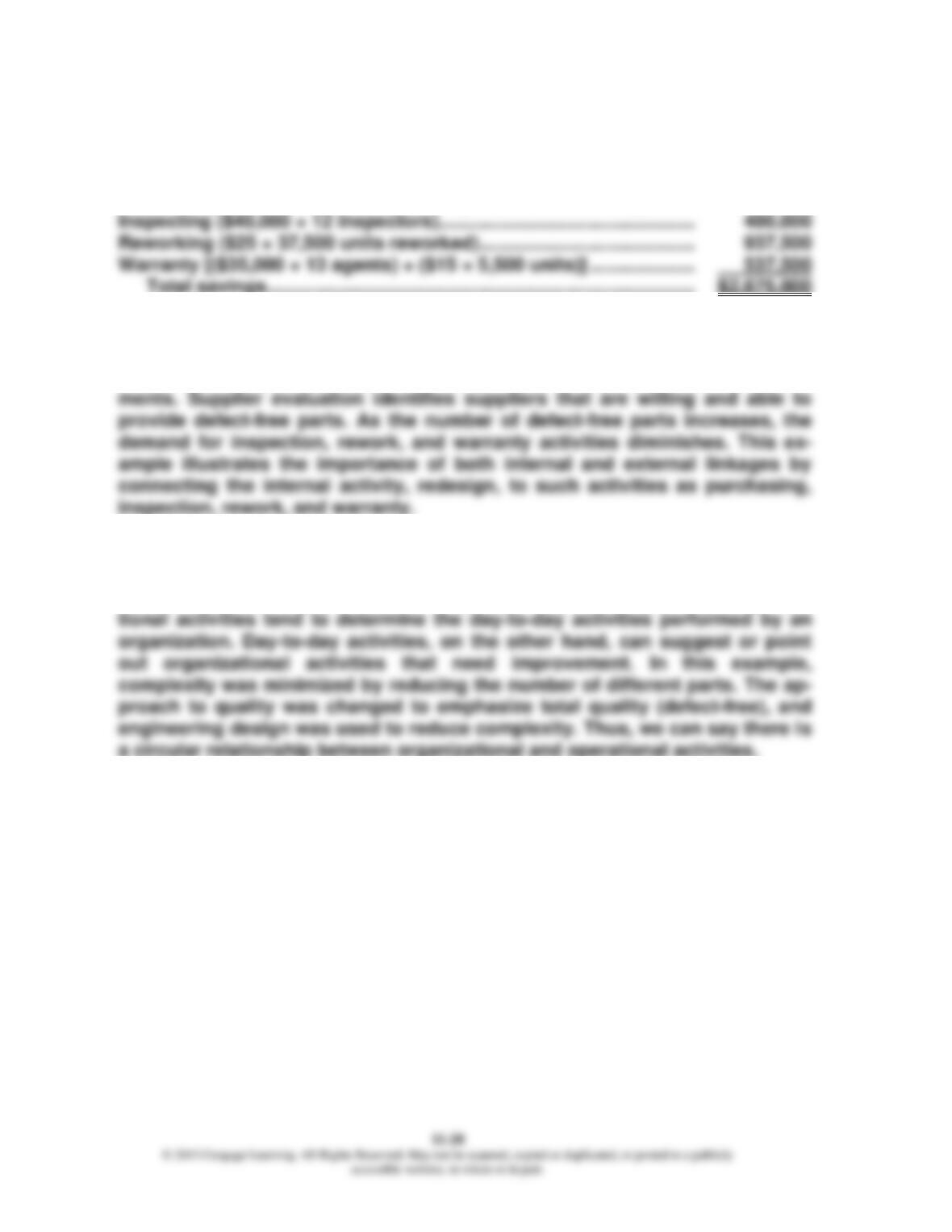
1. Savings:
Purchasing [($30 × 1,500 part types) + ($45,000 × 15 clerks)] ……… $ 720,000
2. The redesign reduces the number of different parts by creating products that
use interchangeable parts. This reduces the demand for purchasing activity
and, at the same time, makes it easier to implement quality-related improve-
3. The operational activities include designing, evaluating suppliers, inspecting,
purchasing, rework, and warranty. Related organizational activities include
complexity, providing quality, and designing and producing quality. Organiza-
©
a
ac
cc
ce
es
ss
si
ib
bl
le
e
w
we
eb
bs
si
it
te
e,
,
i
in
n
w
wh
ho
ol
le
e
o
or
r
i
in
n
p
pa
ar
rt
t.
.
Problem 11.28
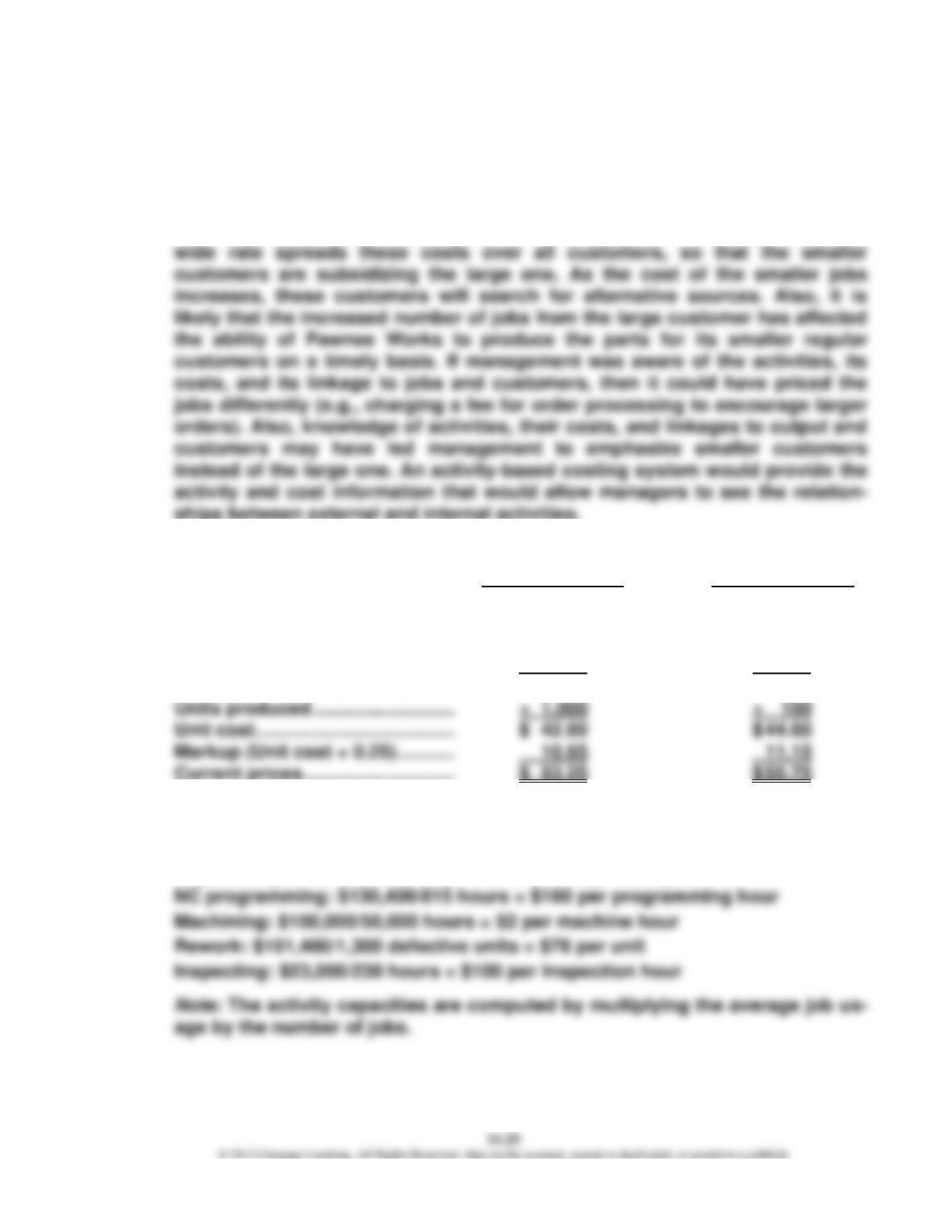
1. Pawnee Works is losing money because it is unaware of the activities gener-
ated by each customer. The large customer places small, specialized orders,
requiring high-precision machined parts. The frequent orders and specialized
nature of the parts increase activities and activity-caused costs. The plant-
2. Traditional pricing:
Small Customer Large Customer
Prime costs …………………………... $ 14,000 $ 1,600
Overhead:
$14.30 × 2,000 …………………… 28,600
$14.30 × 200 ……………………… 2,860
Total cost ……………………………… $ 42,600 $ 4,460
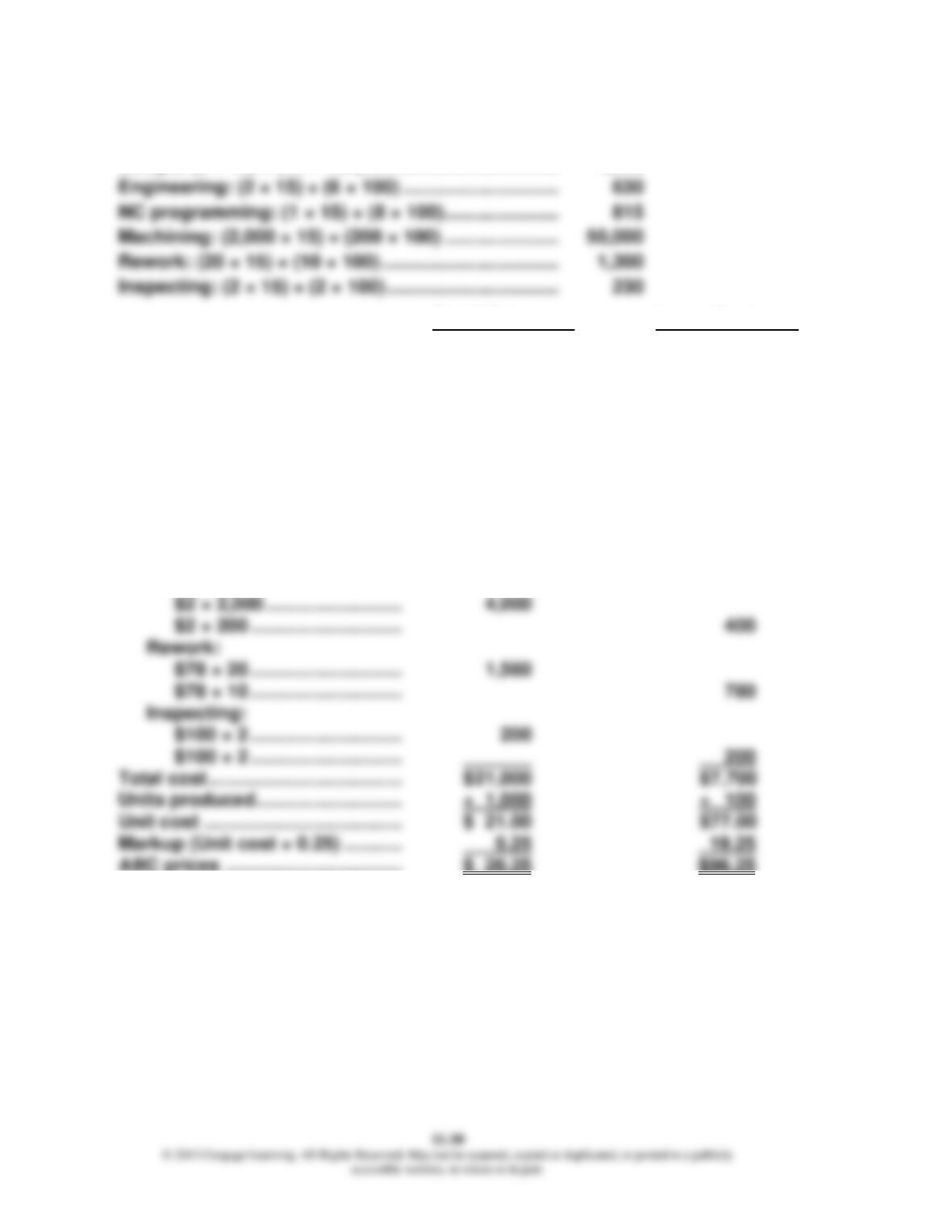
3. Pool rates:
Setups: $209,000/1,045 hours = $200 per setup hour
Engineering: $151,200/630 hours = $240 per engineering hour
Problem 11.28 (Continued)
Setups: (3 × 15) + (10 × 100) ………………………………. 1,045
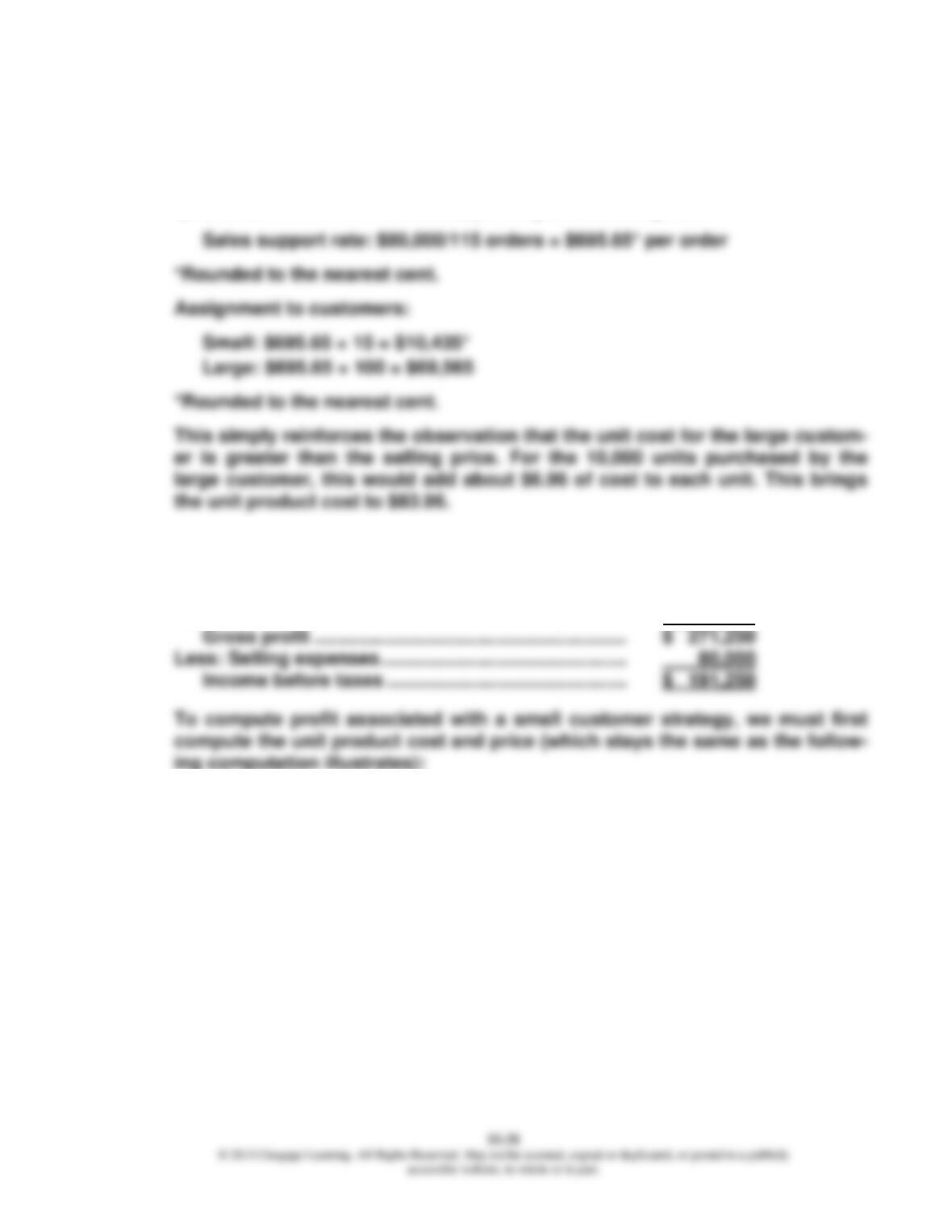
Small Customer Large Customer
Prime costs ……………………………. $ 14,000 $1,600
Overhead:
Setups:
$200 × 3 ……………………….. 600
$200 × 10 ……………………… 2,000
Engineering:
$240 × 2 ……………………….. 480
$240 × 6 ……………………….. 1,440
NC programming:
$160 × 1 ……………………….. 160
$160 × 8 ……………………….. 1,280
Machining:
Problem 11.28 (Continued)
If the sales support is traced to individual products, Pawnee will discover that
the major share of this cost is being caused by the large customer. The activi-
ty driver is the number of orders, yielding the following rate:
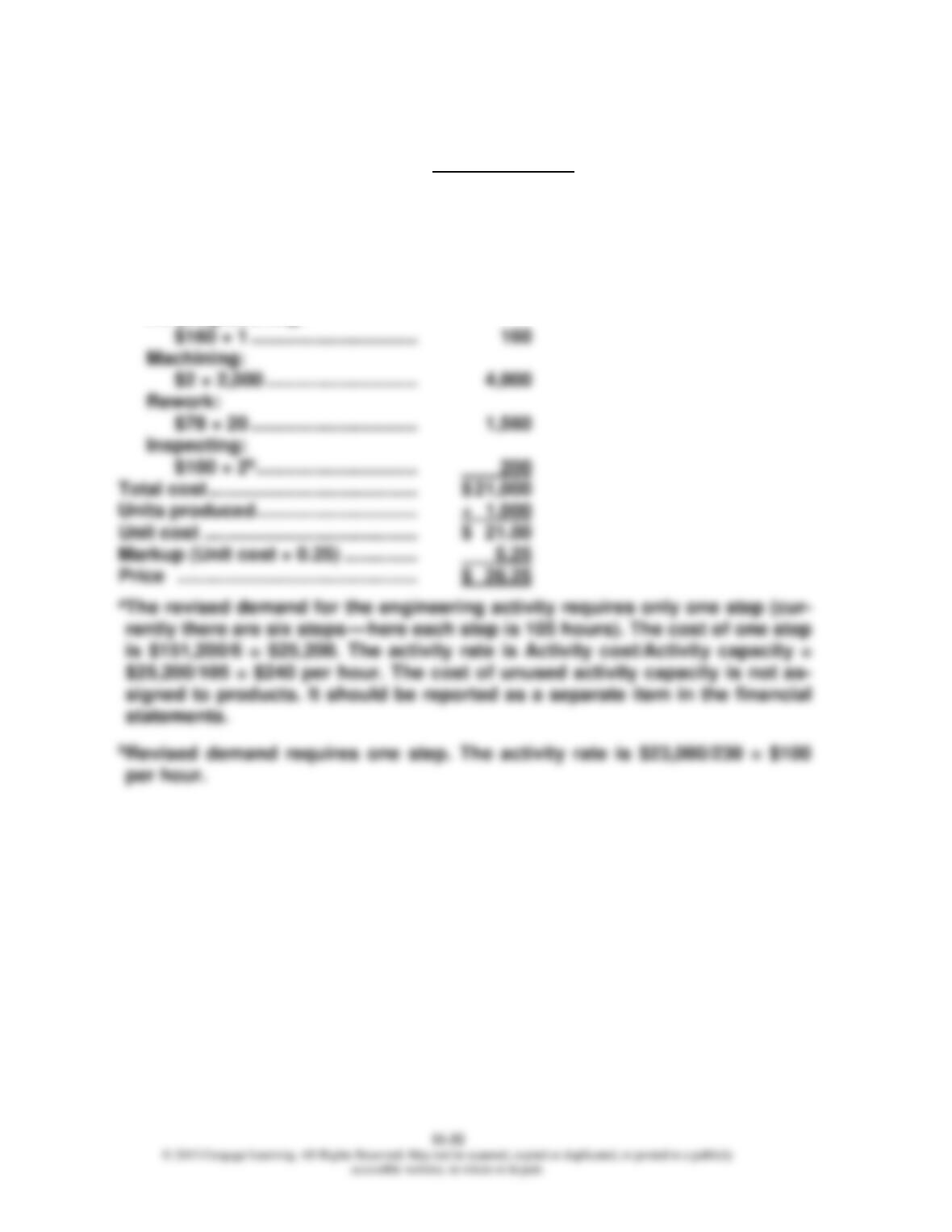
4. Current profit:
Sales [($53.25 × 15,000) + ($55.75 × 10,000)] …………. $1,356,250
COGS [($42.60 × 15,000) + ($44.60 × 10,000)]………… 1,085,000
Problem 11.28 (Continued)
Small Customer
Prime costs ………………………………. $ 14,000
Overhead:
Setups:
$200 × 3 ………………………….. 600
Engineering:
$240 × 2a …………………………. 480
NC programming:
Problem 11.28 (Concluded)
Income statement, small customer strategy:
Sales ($26.25 × 25,000) ………………………………… $ 656,250
Less: COGS ($21 × 25,000) …………………………... 525,000
5. Pawnee Works operates in a small segment of the industrial value chain. Fur-
thermore, it has very little seller power—especially relative to the Fortune 500
company. The president expressed concern about raising prices because he
was afraid that he would lose the large customer’s business—but even so,
the company cannot afford to continue selling at the same price. It is only a