
CHAPTER 11
Standard Costs and Balanced Scorecard
ASSIGNMENT CLASSIFICATION TABLE
Learning Objectives
Questions
Brief
Exercises
Do It!
Exercises
A
Problems
1. Describe standard costs.
1, 2, 3, 4, 5,
6, 7, 8, 9
1, 2, 3
1
1, 2, 3, 4, 17
2. Determine direct materials
variances.
10
4
2
5, 6, 7, 8, 9,
13, 14, 21
1A, 2A, 3A,
4A, 5A, 6A
3. Determine direct labor and
total manufacturing overhead
variances.
11, 12
5, 6
3
4, 6, 7, 8, 9,
10, 11, 12,
13, 21
1A, 2A, 3A,
4A, 5A, 6A
4. Prepare variance reports and
balanced scorecards.
13, 14, 15,
16, 17, 18
7
4
10, 14, 15,
16, 17, 18,
19
2A, 3A, 5A,
6A
*5. Identify the features of a
standard cost accounting
system.
19
8, 9
20, 21, 22
6A
*6. Compute overhead
controllable and volume
variance.
20, 21, 22,
23
10, 11
23, 24, 25
7A, 8A, 9A,
10A

ASSIGNMENT CHARACTERISTICS TABLE
Problem
Number
Description
Difficulty
Level
Time
Allotted (min.)
1A
Compute variances.
Simple
20–30
2A
Compute variances, and prepare income statement.
Simple
30–40
3A
Compute and identify significant variances.
Moderate
20–30
4A
Answer questions about variances.
Complex
30–0
5A
Compute variances, prepare an income statement, and
explain unfavorable variances.
Moderate
30–40
*6A
Journalize and post standard cost entries, and prepare
income statement.
Moderate
40–50
*7A
Compute overhead controllable and volume variances.
Simple
10–15
*8A
Compute overhead controllable and volume variances.
Simple
10–15
*9A
Compute overhead controllable and volume variances.
Moderate
10–15
*10A
Compute overhead controllable and volume variances.
Moderate
10–15
BYP11-9
Q11-5 E11-17
DI11-1 E11–17
ANSWERS TO QUESTIONS
1. (a) This is incorrect. Standard costs are predetermined unit costs.
(b) Agree. Examples of governmental regulations that establish standards for a business are
2. (a) Standards and budgets are similar in that both are predetermined costs and both contribute
significantly to management planning and control. The two terms differ in that a standard is
a unit amount and a budget is a total amount.
(b) There are important accounting differences between budgets and standards. Except in the
application of manufacturing overhead to jobs and processes, budget data are not journalized
3. In addition to facilitating management planning, standard costs offer the following advantages to
an organization:
(1) They promote greater economy by making employees more “cost–conscious.”
(2) They may be useful in setting selling prices.
(3) They contribute to management control by providing a basis for evaluating cost control.
(4) They are useful in highlighting variances in “management by exception.”
(5) They simplify the costing of inventories and reduce clerical costs.
4. The management accountant provides input to the setting of standards through the accumulation
of historical cost data and knowledge of the behavior of costs in response to changes in activity
levels. Management has the responsibility for setting the standards.
5. Ideal standards represent optimum levels of performance under perfect operating conditions. Normal
standards represent efficient levels of performance that are attainable under expected operating
conditions.
6. (a) The direct materials price standard should be based on the purchasing department’s best
estimate of the cost of raw materials and an amount for related costs such as receiving,
7. Agree. The direct labor quantity standard should include allowances for rest periods, cleanup,
machine setup, and machine downtime.
8. With standard costs, the predetermined overhead rate is determined by dividing budgeted overhead
costs by an expected standard activity index.
Questions Chapter 11 (Continued)
10. (a) (1) actual price. (2) standard price.
(b) (3) actual quantity. (4) standard price.
(c) (5) standard price. (6) standard quantity.
11. (1) – (3) = total labor variance; (1) – (2) = labor price variance; and (2) – (3) = labor quantity
14. The purchasing department would be responsible for an unfavorable materials price variance
when it paid more than the standard price for the materials. The purchasing department would
also be responsible for an unfavorable materials quantity variance if it purchased materials of
inferior quality which caused an excess use of materials.
15. The four perspectives of the balanced scorecard are: financial, customer, internal process, and
learning and growth. The financial perspective employs financial measures of performance used
by most firms. The customer perspective evaluates the company from the viewpoint of those
16. Kerry James is not correct. The balanced scorecard does not replace financial measures, it
instead integrates both financial and nonfinancial measures. In fact, financial measures are very
critical to the balanced scorecard, since they represent the final “destination” of all the company’s
efforts.
17. The possibilities for nonfinancial measures are limitless. Some that were mentioned in the chapter
were: capacity utilization of plants, average age of key assets, impact of strikes, brand-loyalty statistics,
market profile of customer-end products, number of new products, employee stock ownership
18. (a) Variances are reported in income statements for management below gross profit which is
reported at standard costs. Each variance is identified and the total variance is shown.
(b) Standard costs may be used in costing inventories when there is no significant difference
between actual costs and standard costs. When there are significant differences, actual costs
must be reported.
Questions Chapter 11 (Continued)
*19. (a) A standard cost accounting system is a double-entry system of accounting in which
standard costs are used in making entries and standard cost variances are formally
*20. Overhead controllable variance = actual overhead costs ($248,000) – overhead budgeted. Overhead
budgeted is based on standard hours allowed as follows: variable costs (27,000 X $5 = $135,000) +
fixed costs (28,000 X $4 = $112,000) = total overhead budgeted ($247,000). Thus, the controllable
variance is $1,000 unfavorable.
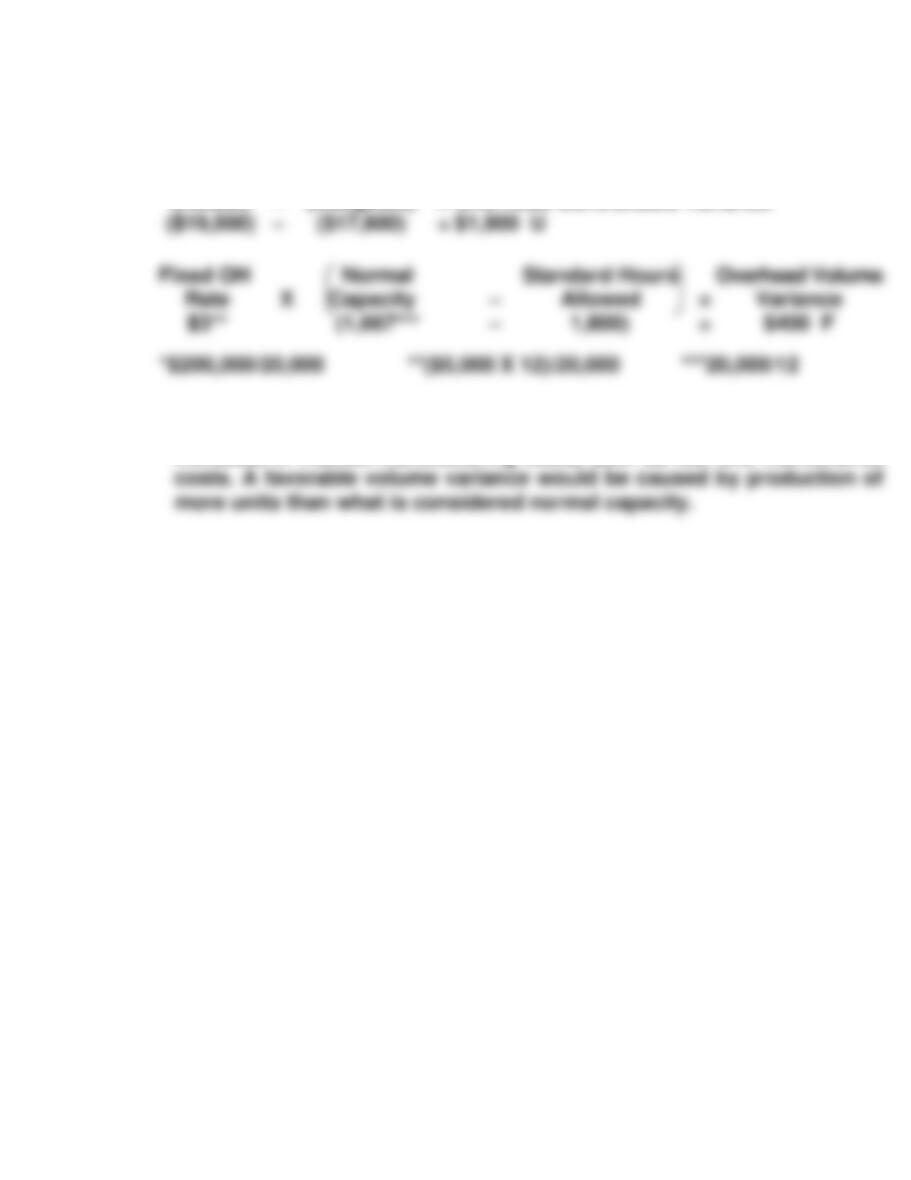
*21. The purpose of computing the overhead volume variance is to determine whether plant facilities were
*22. Fixed costs remain the same at every level of activity within the relevant range. Since the prede-
termined overhead rate is based on normal capacity, it follows that if standard hours allowed are less
than standard hours at normal capacity, fixed overhead costs will be underapplied. The reverse is true
when production exceeds normal capacity.
*23. John should include the following points about overhead variances:
(1) Standard hours allowed are used in each of the variances.
SOLUTIONS TO BRIEF EXERCISES
BRIEF EXERCISE 11-1
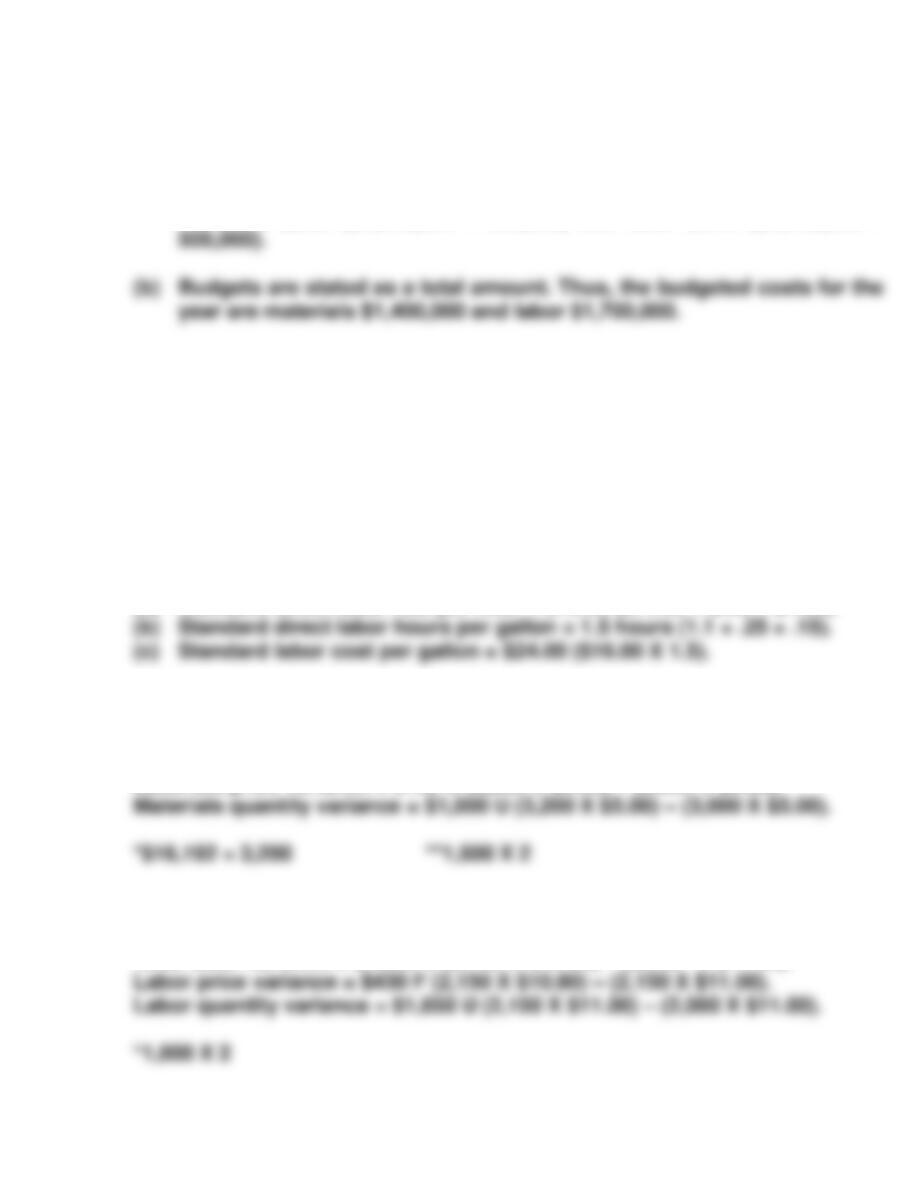
(a) Standards are stated as a per unit amount. Thus, the standards are
materials $2.80 ($1,400,000 ÷ 500,000) and labor $3.40 ($1,700,000 ÷
BRIEF EXERCISE 11-2
(a) Standard direct materials price per gallon = $2.60 ($2.30 + $.20 + $.10).
(b) Standard direct materials quantity per gallon = 4 pounds (3.6 + .4).
(c) Standard materials cost per gallon = $10.40 ($2.60 X 4).
BRIEF EXERCISE 11-3
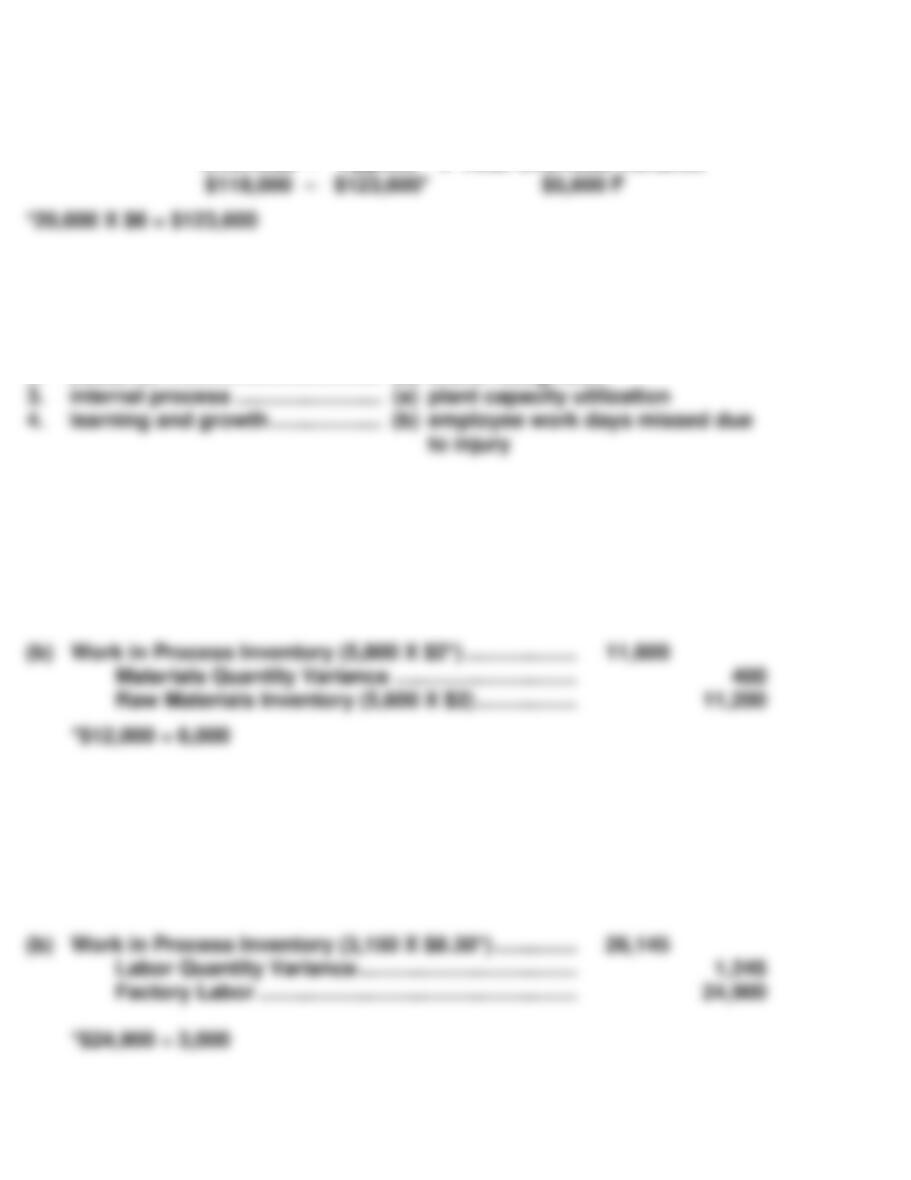
(a) Standard direct labor rate per hour = $16.00 ($14.00 + $.80 + $1.20).
BRIEF EXERCISE 11-4
Total materials variance = $1,192 U (3,200 X $5.06*) – (3,000** X $5.00).
Materials price variance = $192 U (3,200 X $5.06) – (3,200 X $5.00).
BRIEF EXERCISE 11-5
Total labor variance = $1,220 U (2,150 X $10.80) – (2,000* X $11.00).
BRIEF EXERCISE 11-6
The formula is:
Actual
Overhead
–
Overhead
Applied
=
Total Overhead Variance
BRIEF EXERCISE 11-7
internal process …………………….
plant capacity utilization
1.
2.
financial ………………………………..
customer ……………………………….
(c)
(d)
return on assets
brand recognition
*BRIEF EXERCISE 11-8
(a) Raw Materials Inventory ……………………………………… 12,000
Materials Price Variance ………………………………. 500
Accounts Payable ……………………………………….. 11,500
*BRIEF EXERCISE 11-9
(a) Factory Labor …………………………………………………….. 24,900
Labor Price Variance …………………………..……….. 900
Factory Wages Payable ……………………………….. 24,000
*BRIEF EXERCISE 11-10
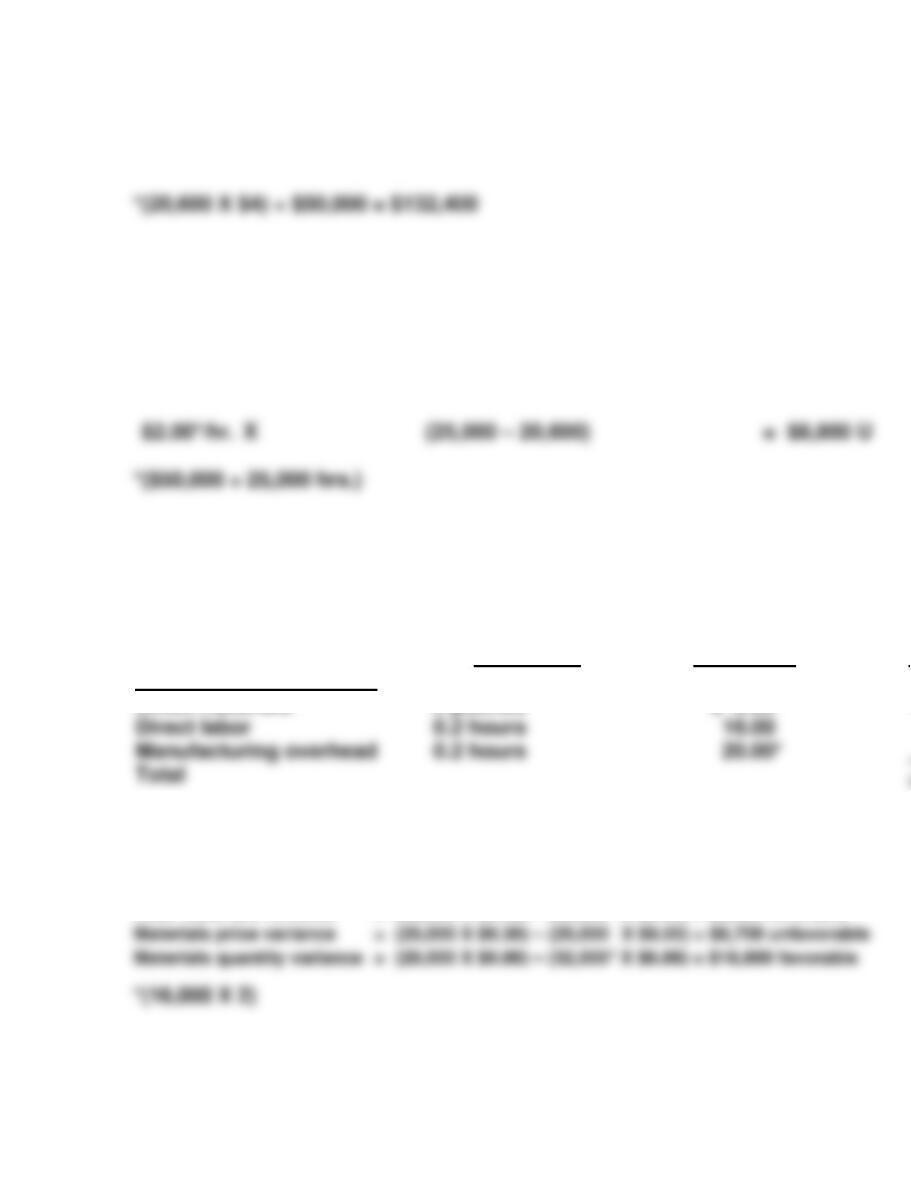
The formula is:
Actual Overhead
$118,000
–
–
Overhead
Budgeted
*$132,400*
=
Overhead
Controllable Variance
$14,400 F
*BRIEF EXERCISE 11-11
The formula is:
Fixed
Overhead
Rate
X
(Normal Capacity Hours – Standard Hours Allowed)
=
Overhead
Volume
Variance
(25,000 – 20,600)
SOLUTIONS FOR DO IT! REVIEW EXERCISES
DO IT! 11-1
Manufacturing Cost
Element
Standard Quantity
X
Standard Price
=
Standard Cost
Direct materials
2 pounds
$ 5.00
$10.00
Direct labor
Manufacturing overhead
Total
DO IT! 11-2
The variances are:
Total materials variance = (29,000 X $6.30) – (32,000* X $6.00) = $9,300 favorable
DO IT! 11-3
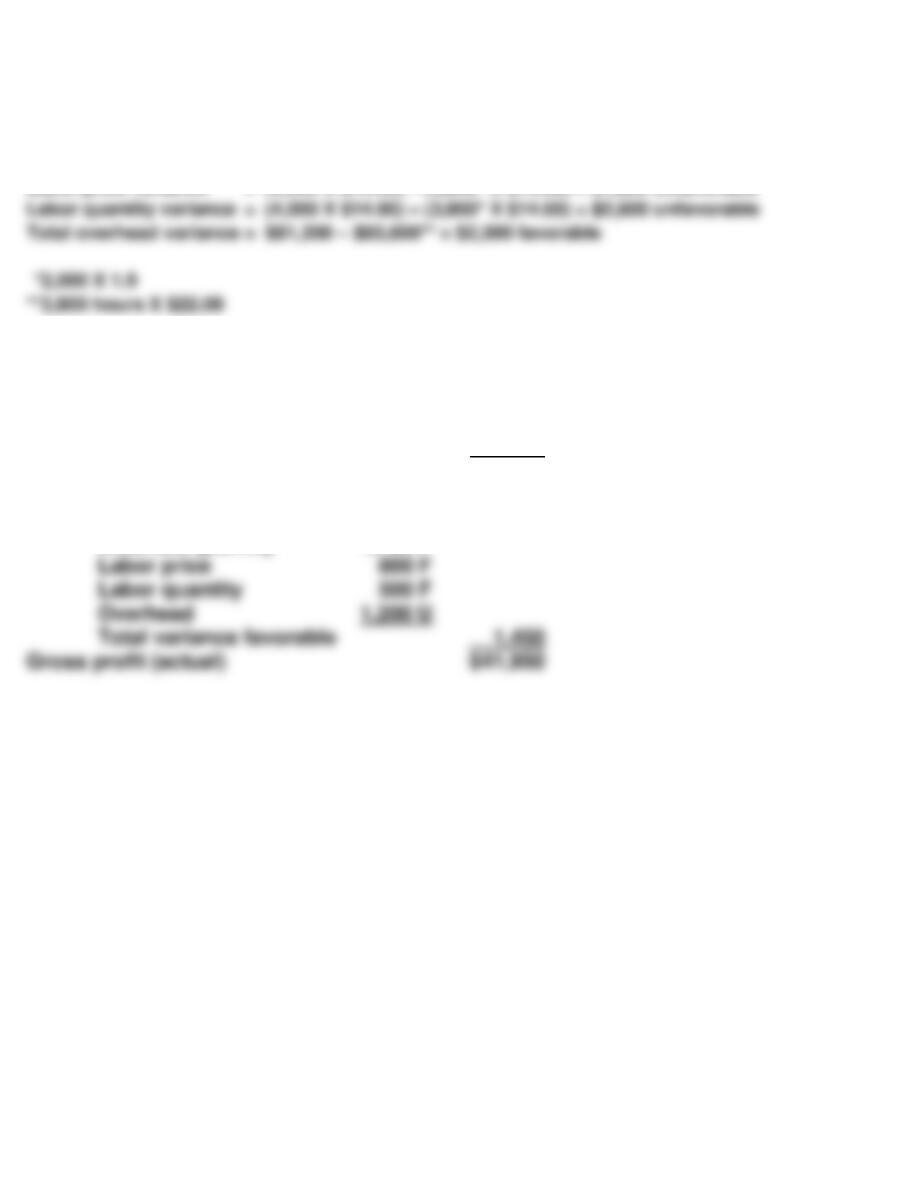
The variances are:
Total labor variance = (4,000 X $14.30) – (3,800* X $14.00) = $4,000 unfavorable
Labor price variance = (4,000 X $14.30) – (4,000 X $14.00) = $1,200 unfavorable
DO IT! 11-4
Sales revenue $92,100
Cost of goods sold (at standard) 51,600
Standard gross profit 40,500
Variances
Materials price $350 U
Materials quantity 1,700 F
SOLUTIONS TO EXERCISES
EXERCISE 11-1
(a) Direct materials: (2,000 X 3) X $5 = $30,000
(b) Direct materials: 3 X $5 = $15.00
(c) The advantages of standard costs which are carefully established and
prudently used are:
1. Management planning is facilitated.
2. Greater economy is promoted by making employees more cost–
conscious.
EXERCISE 11-2
Ingredient
Amount
Per
Gallon
Standard
Waste
Standard
Usage
Standard
Price
Standard
Cost Per
Gallon
Water (2,600 ÷ 50)
Grape concentrate
Sugar (54 ÷ 50)
Lemons (60 ÷ 50)
60* oz.
1.08 lb.
1.2
4%
10%
25%
(a)
(b)
(c)
62.5 oz.
1.20 lb.
1.6
$.06
.30
.60
$3.75
.36
.96
(a) .96X = 60 ounces; or X = (60 ounces)/.96.
EXERCISE 11-3
Direct materials
Cost per pound [($5 – (2% X $5)) + $0.25] $5.15
Pounds per unit (4.5 + 0.5) X 5 $25.75
Direct labor
EXERCISE 11-4
(a)
Actual service time
Setup and downtime
1.0 hours
0.2 hours
(b)
Hourly wage rate
Payroll taxes ($12 X 10%)
$12.00
1.20
(d)
Direct labor quantity variance
=
(1.60 hours X $16.20) – (1.50 hours X $16.20)
EXERCISE 11-5
(a) Total materials variance:
( AQ X AP )
(29,000 X $4.70)
–
( SQ X SP )
(28,200* X $5.00)
$4,700 F
Materials quantity variance:
(29,000 X $5.00)
$4,000 U
( AQ X SP )
–
( SQ X SP )
(b) Total materials variance:
(28,000 X $5.15)
(28,200 X $5.00)
$3,200 U
( AQ X AP )
–
( SQ X SP )
Materials price variance:
(28,000 X $5.00)
–
( SQ X SP )
( AQ X AP )
(28,000 X $5.15)
–
( AQ X SP )
(28,000 X $5.00)
$4,200 U
(29,000 X $4.70)
( AQ X SP )
(29,000 X $5.00)
EXERCISE 11-6
(a) Total labor variance:
( AH X AR )
(40,600 X $12.15)
–
( SH X SR )
(40,000* X $12.00)
(b) Labor price variance:
(40,600 X $12.15)
–
(40,600 X $12.00)
=
$6,090 U
( AH X AR )
–
( AH X SR )
Labor quantity variance:
( AH X SR )
(40,600 X $12.00)
$487,200
–
–
( SH X SR )
(40,000 X $12.00)
$480,000
=
$7,200 U
(c) Labor price variance:
$493,290
–
$497,350
=
( AH X SR )
(40,600 X $12.25)
–
–
( SH X SR )
=
$4,900 F
( AH X AR )
–
( AH X SR )
EXERCISE 11-7
Total materials variance:
( AQ X AP )
(1,900 X $2.65*)
$5,035
–
–
( SQ X SP )
(1,840** X $2.50)
$4,600
=
$435 U
Materials price variance:
–
=
( AQ X AP )
–
( AQ X SP )
$493,290
–
$480,000
=
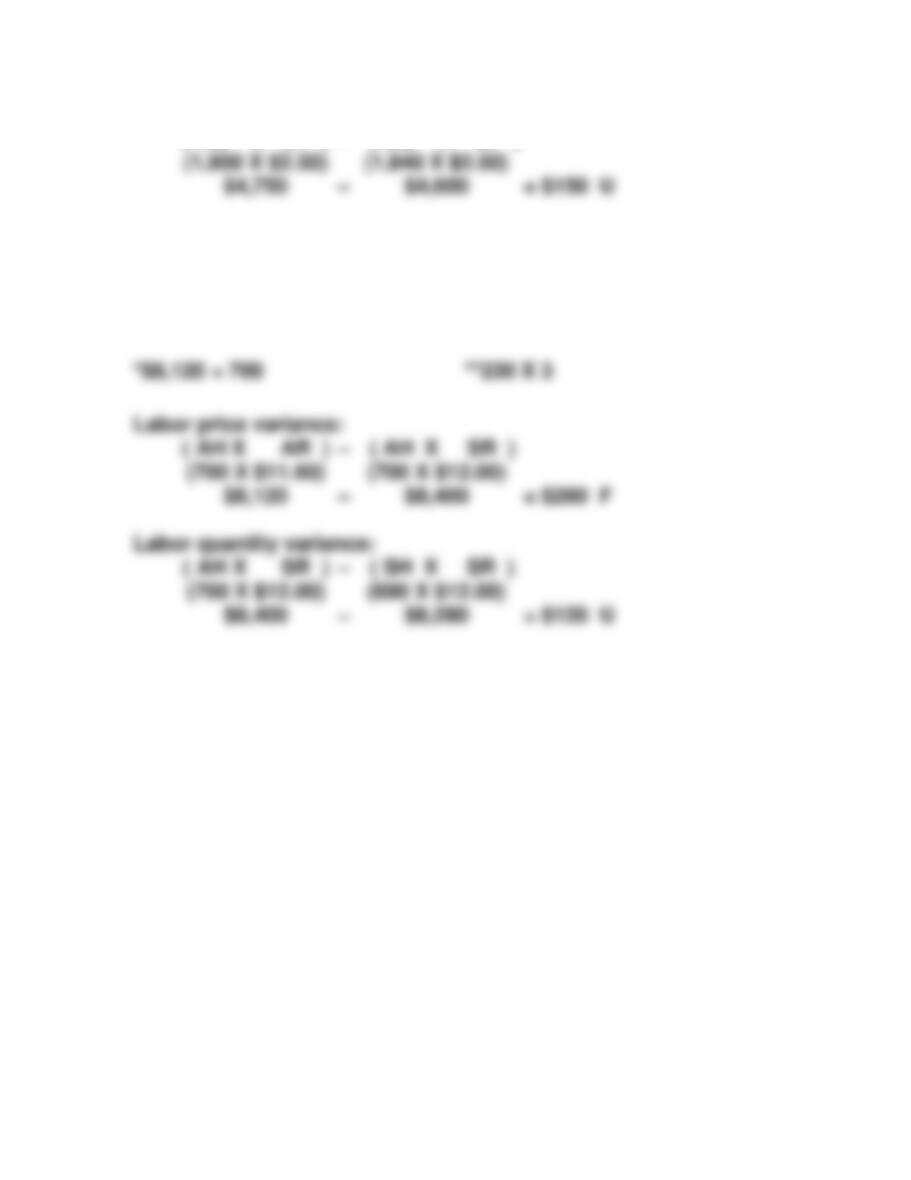
EXERCISE 11-7 (Continued)
Materials quantity variance:
( AQ X SP )
–
( SQ X SP )
Total labor variance:
( AH X AR )
(700 X $11.60*)
$8,120
–
–
( SH X SR )
(690** X $12.00)
$8,280
=
$160 F
–
( AH X SR )
$4,600
=
$150 U
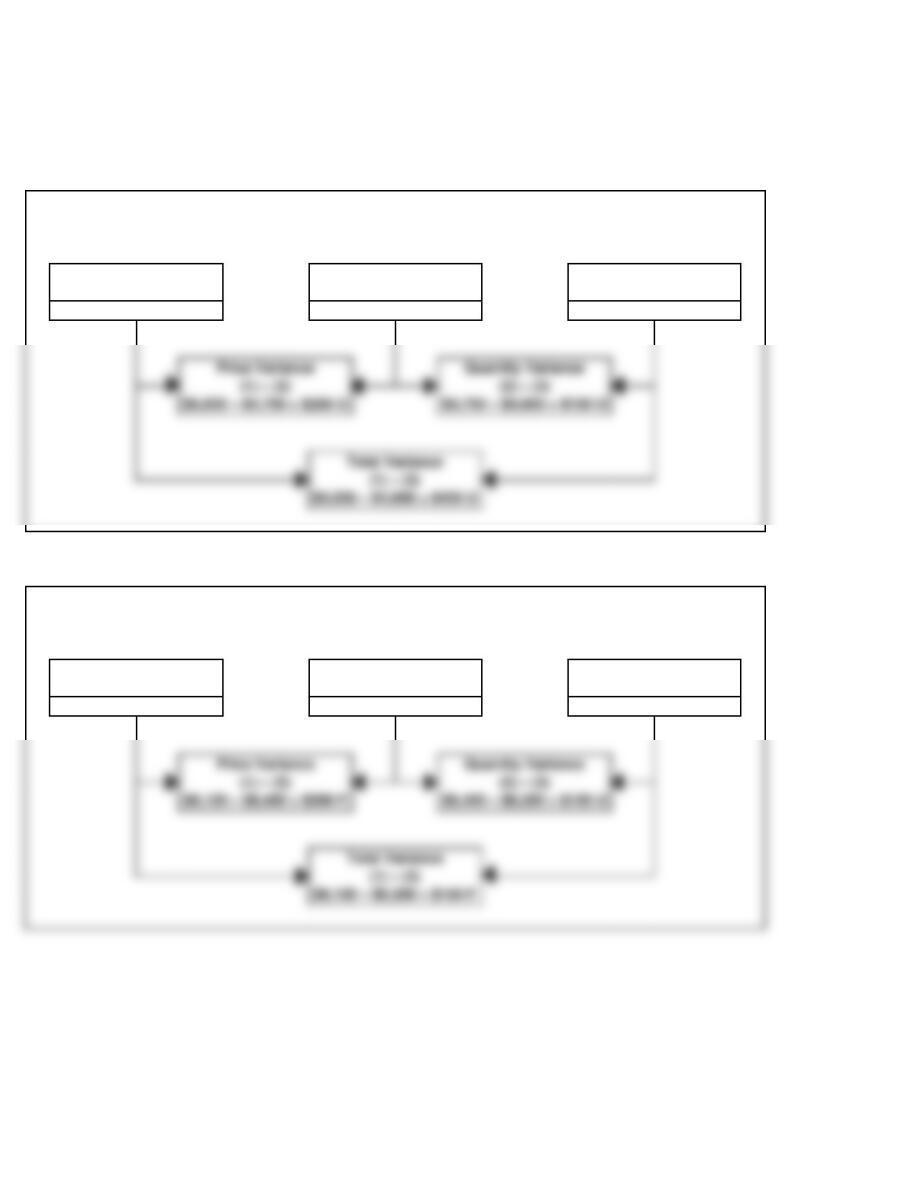
EXERCISE 11-7 (Continued)
(Not Required)
Materials Variance Matrix
(1)
(2)
(3)
Actual Quantity
X Actual Price
Actual Quantity
X Standard Price
Standard Quantity
X Standard Price
1,900 X $2.65 = $5,035
1,900 X $2.50 = $4,750
1,840 X $2.50 = $4,600
Labor Variance Matrix
(1)
(2)
(3)
Actual Hours
X Actual Rate
Actual Hours
X Standard Rate
Standard Hours
X Standard Rate
700 X $11.60 = $8,120
700 X $12.00 = $8,400
690 X $12.00 = $8,280
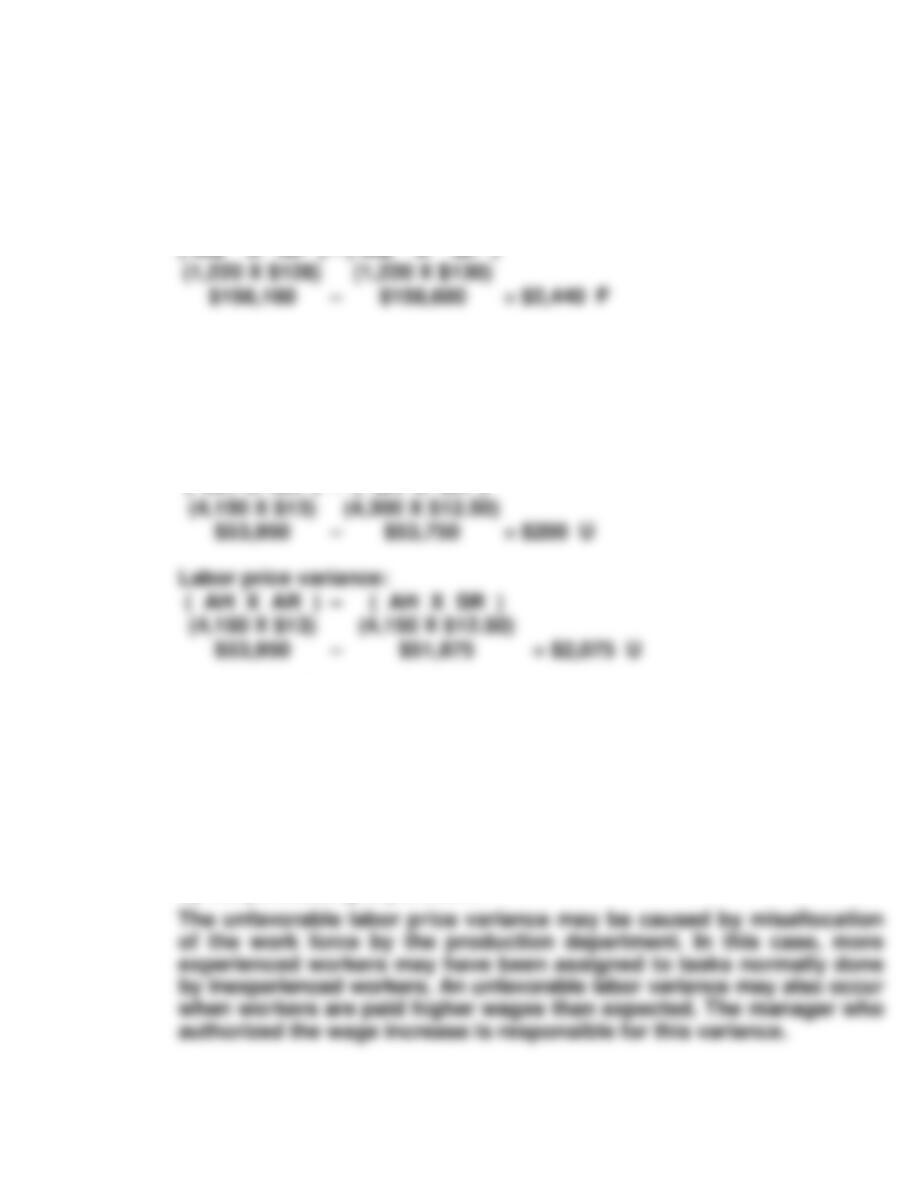
EXERCISE 11-8
(a) Total materials variance:
( AQ X AP )
(1,220 X $128)
$156,160
–
–
( SQ X SP )
(1,200 X $130)
$156,000
=
$160 U
Materials price variance:
( AQ X AP )
(1,220 X $128)
–
–
( AQ X SP )
(1,220 X $130)
$158,600
=
$2,440 F
Materials quantity variance:
( AQ X SP )
(1,220 X $130)
$158,600
–
–
( SQ X SP )
(1,200 X $130)
$156,000
=
$2,600 U
Total labor variance:
–
=
$200 U
–
=
$2,075 U
( AH X AR )
–
( SH X SR )
Labor quantity variance:
( AH X SR )
(4,150 X $12.50)
$51,875
–
–
( SH X SR )
(4,300 X $12.50)
$53,750
=
$1,875 F
(b) The unfavorable materials quantity variance may be caused by the
carelessness or inefficiency of production workers. Alternatively, the
excess quantities may be caused by inferior quality materials acquired
by the purchasing department.
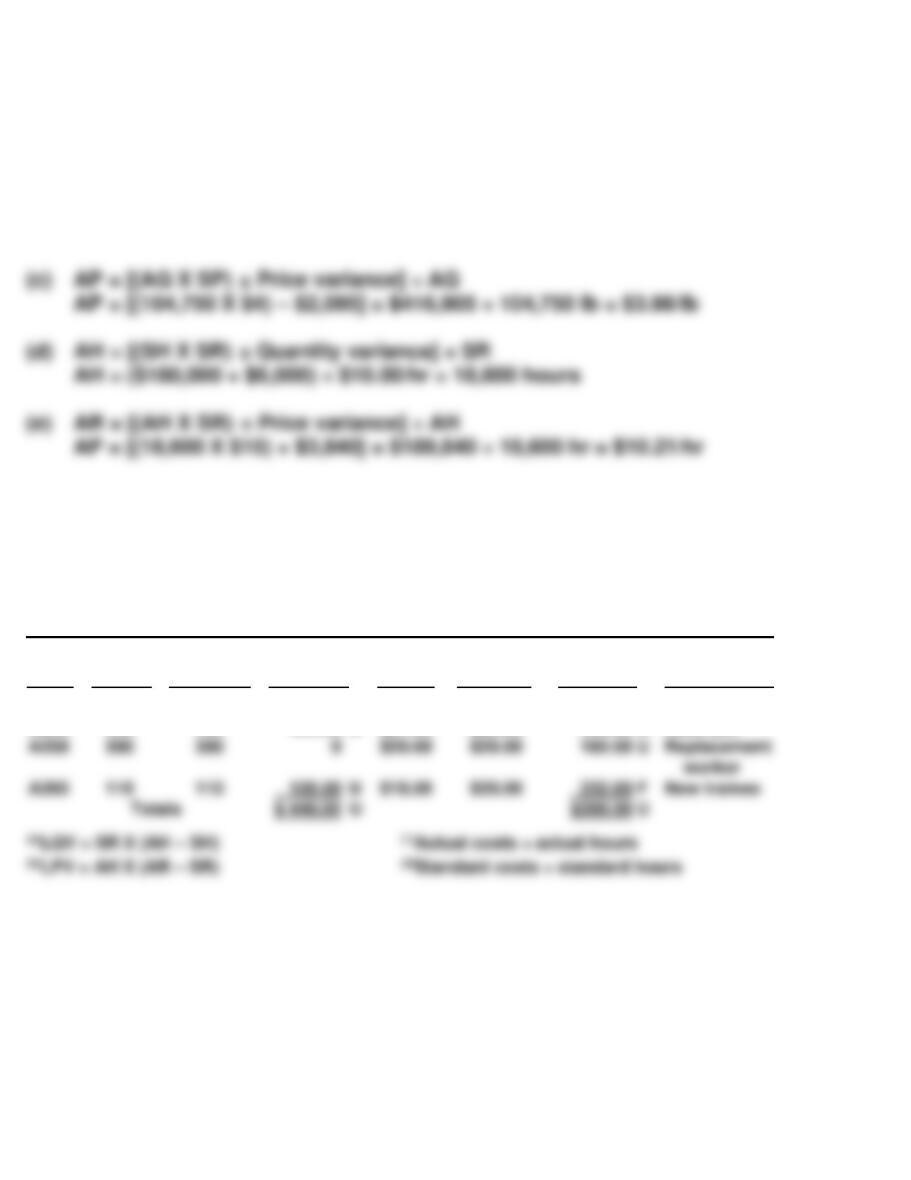
EXERCISE 11-9
(a) Number of units = Total standard cost ÷ Standard cost per unit
Number of units = $410,000 ÷ $20.00 (5 lb X $4 per lb) = 20,500
(b) AQ = [(SQ X SP)
±
Quantity variance] ÷ SP
AQ = ($410,000 + $9,000) ÷ $4.00 per lb = 104,750 pounds
EXERCISE 11-10
TOBY TOOL & DIE COMPANY
Direct Labor Variance Report
For the Month Ended March 31, 2017
Job
No.
Actual
Hours
Standard
Hours
Quantity
Variance
(a)
Actual
Rate
(1)
Standard
Rate
(2)
Price
Variance
(b)
Explanation
$18.00
worker
A257
A258
221
450
225
430
$ 80.00
400.00
F
U
$20.00
$21.00
$20.00
$20.00
$ 0
450.00
U
Repeat job
Rush job
±
±
±
EXERCISE 11-11
Total overhead variance:
Actual Overhead
–
Overhead Applied
EXERCISE 11-12
(a)
Overhead Budget
(at normal capacity)
÷
Direct Labor Hours
(at normal capacity)
=
Predetermined
Overhead Rate
Variable
$250,000
100,000
$2.50
Fixed
600,000
100,000
$6.00
(b)
X
=
(c)
=
$856,000
=
EXERCISE 11-13
(a)
(AQ X AP)
( $10,200)
–
–
( SQ X SP)
(2,100* X $5)
=
=
Total Materials Variance
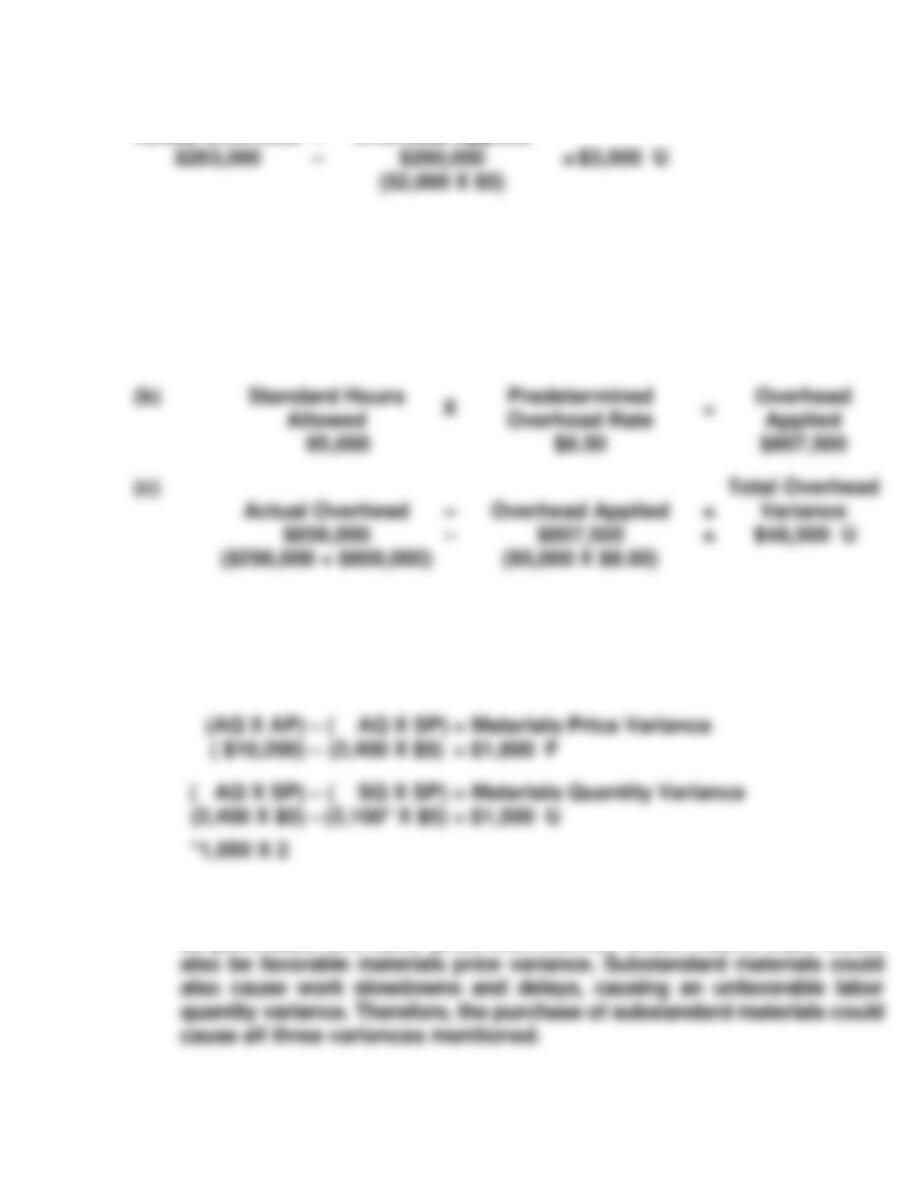
$300 F
(AQ X AP)
( $10,200)
–
–
( AQ X SP)
=
=
Materials Price Variance
(2,400 X $5)
–
–
( SQ X SP)
(2,100* X $5)
=
=
Materials Quantity Variance
(b) One possible cause of an unfavorable materials quantity variance is
the purchase of substandard materials. Such materials would normally
be purchased at a lower price than normal, which means there would
–
=
$3,000 U
EXERCISE 11-14
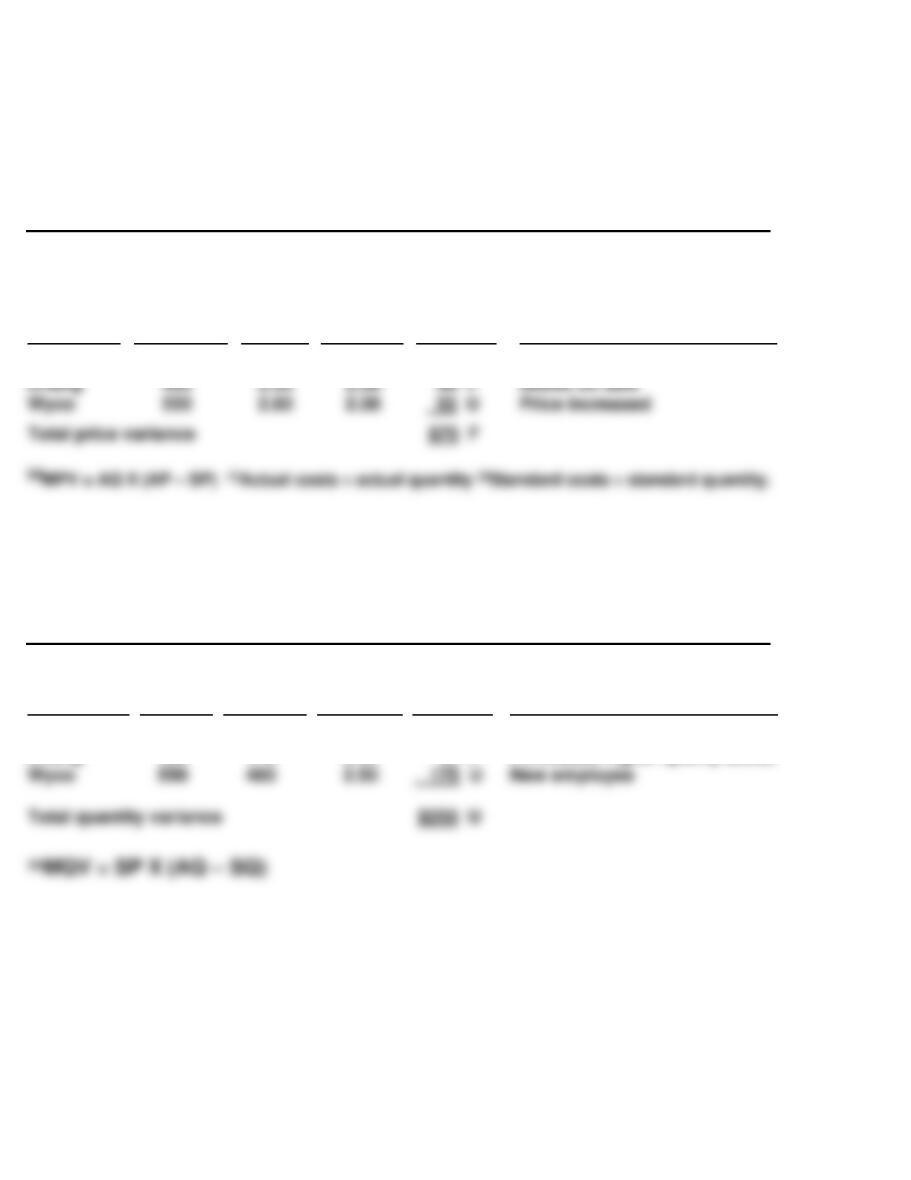
(a) PICARD LANDSCAPING
Variance Report – Purchasing Department
For the Current Month
Project
Actual
Pounds
Purchased
(1)
Actual
Price
Per
Pound
(2)
Standard
Price
Price
Variance
(a)
Explanation
Remington
500
$2.40
$2.50
$50 F
Purchased poor-quality seeds
(b) PICARD LANDSCAPING
Variance Report – Production Department
For the Current Month
Project
Actual
Pounds
Standard
Pounds
Standard
Price Per
Pound
Quantity
Variance
(b)
Explanation
Remington
Chang
500
400
460
410
$2.50
2.50
$100 U
25 F
Purchased poor-quality seeds
Purchased higher-quality seeds
EXERCISE 11-15
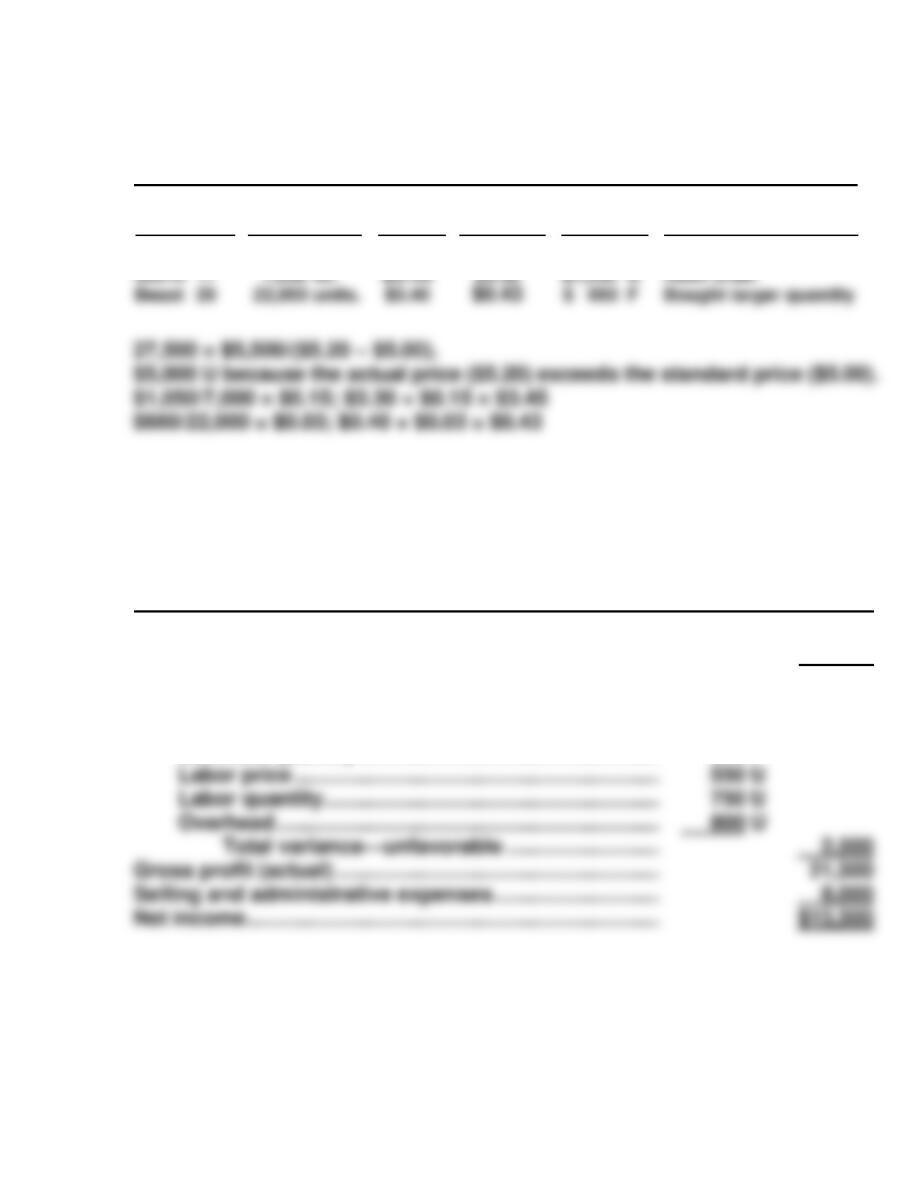
URBAN CORPORATION
Variance Report – Purchasing Department
For Week Ended January 9, 2017
Type of
Materials
Quantity
Purchased
Actual
Price
Standard
Price
Price
Variance
Explanation
Rogue 11
27,500 lbs.
$5.20
$5.00
$5,500 U
Price increase
EXERCISE 11-16
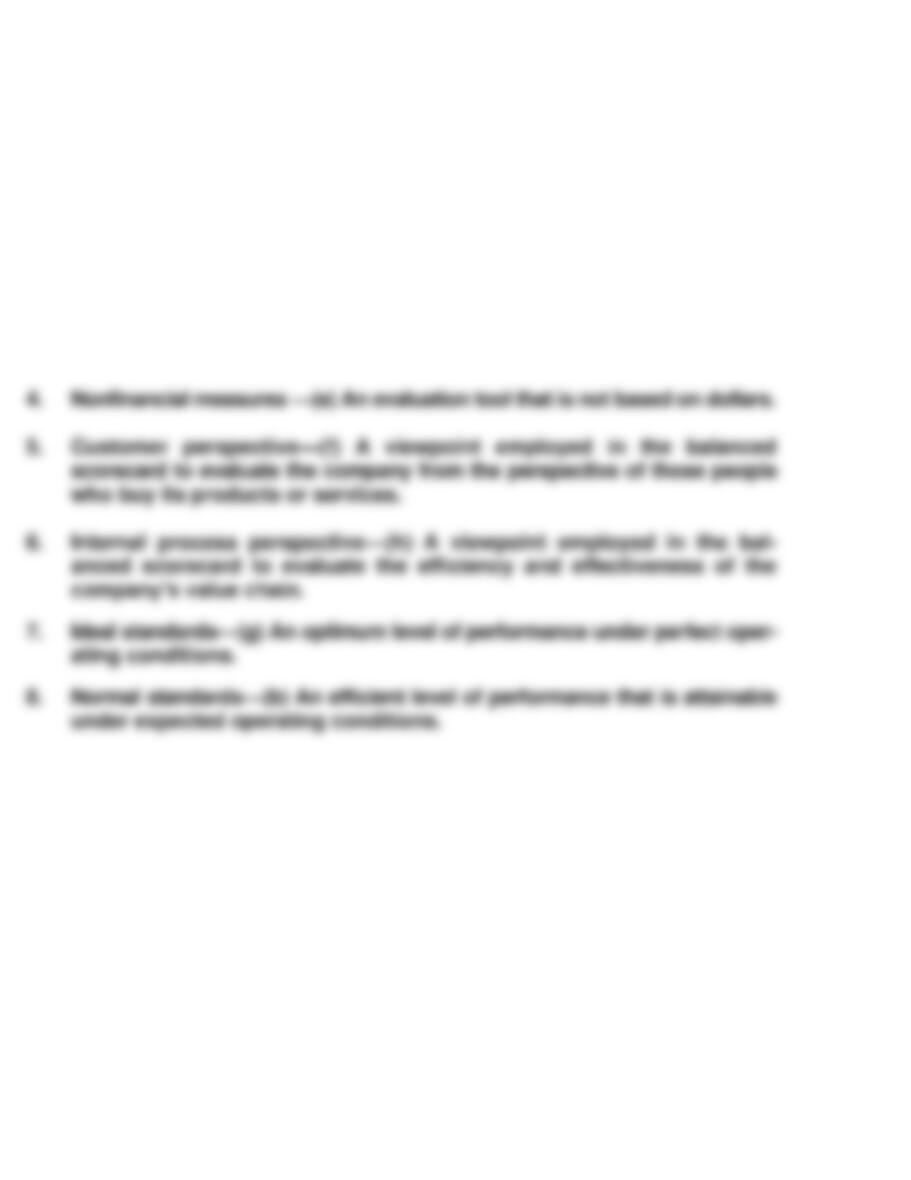
FISK COMPANY
Income Statement
For the Month Ended January 31, 2017
Sales revenue (8,000 X $8) ……………………………………… $64,000
Cost of goods sold (8,000 X $5) ……………………………… 40,000
Gross profit (at standard) ………………………………………. 24,000
Variances
Materials price ……………………………………………….. $1,200 U
Materials quantity …………………………………………… 800 F
EXERCISE 11-17
1. Balanced scorecard—(c) An approach that incorporates financial and
nonfinancial measures in an integrated system that links performance
measurement and a company’s strategic goals.
2. Variance—(a) The difference between total actual costs and total stan-
dard costs.
3. Learning and growth perspective—(d) A viewpoint employed in the
balanced scorecard to evaluate how well a company develops and retains
its employees.
EXERCISE 11-18
1. Customer perspective.
2. Learning and growth perspective.
3. Financial perspective.
4. Customer perspective.
5. Learning and growth perspective.
6. Internal process perspective.
EXERCISE 11-19
1.
Learning and growth perspective.
2.
Financial perspective.
3.
Customer perspective.
4.
Internal process perspective.
5.
Learning and growth perspective.
6.
Customer perspective.
*EXERCISE 11-20
1. Raw Materials Inventory (18,000 X $4.40) ……………. 79,200
Materials Price Variance (18,000 X $.10) ……………… 1,800
Accounts Payable (18,000 X $4.50) ………………. 81,000
2. Work in Process Inventory (17,500 X $4.40) ………… 77,000
Materials Quantity Variance (500 X $4.40) …………… 2,200
*EXERCISE 11-21
(a) $136,000 ($138,000 – $2,000).
(b) $139,000 ($136,000 + $3,000).
*EXERCISE 11-22
Raw Materials Inventory (1,900 X $2.50) ……………………… 4,750
Materials Price Variance (1,900 X $0.15) ……………………… 285
Accounts Payable (1,900 X $2.65) ………………………… 5,035
Work in Process Inventory (1,840* X $2.50) …………………. 4,600
*230 X 3
*EXERCISE 11-23
(a)
Item
Amount
Hours
Rate
Fixed overhead …………………………………
Variable overhead ……………………………..
$34,650
16,500
$2.10
(b) Total overhead variance:
Actual Overhead
–
Overhead Applied
Overhead controllable variance:
Actual Overhead
$55,500
–
–
Overhead Budgeted
$53,820
[(16,200 X $2.10) + $19,800]
=
$1,680 U
EXERCISE 11-23 (Continued)
*EXERCISE 11-24
(a)
1.
Total actual overhead cost
=
Overhead
Budgeted +
Overhead
Controllable
Variance
=
($18,000 + $12,600) + $1,200
=
$31,800
2.
Actual variable overhead cost
=
Actual Overhead – Fixed Overhead
=
$31,800 – $12,600
=
$19,200
(b)
Number of loans processed
=
Standard hours allowed ÷
Standard hours per application
=
2,000 ÷ 2
=
1,000 loans processed
3.
=
2,000 hours X $9 = $18,000
4.
=
2,000 hours X $6 = $12,000
=
EXERCISE 11-25
(a)
(Actual)
($19,500)
–
–
(Applied)
(1,800 X $10*)
=
=
Total Overhead Variance
$1,500 U
(Actual)
–
(Budgeted)
=
Overhead Controllable Variance
(b) The cause of an unfavorable controllable variance could be higher than
expected use of indirect materials, indirect labor, and factory supplies, or
increases in indirect manufacturing costs, such as fuel and maintenance
–
=
$1,900 U
=
SOLUTIONS TO PROBLEMS
PROBLEM 11-1A
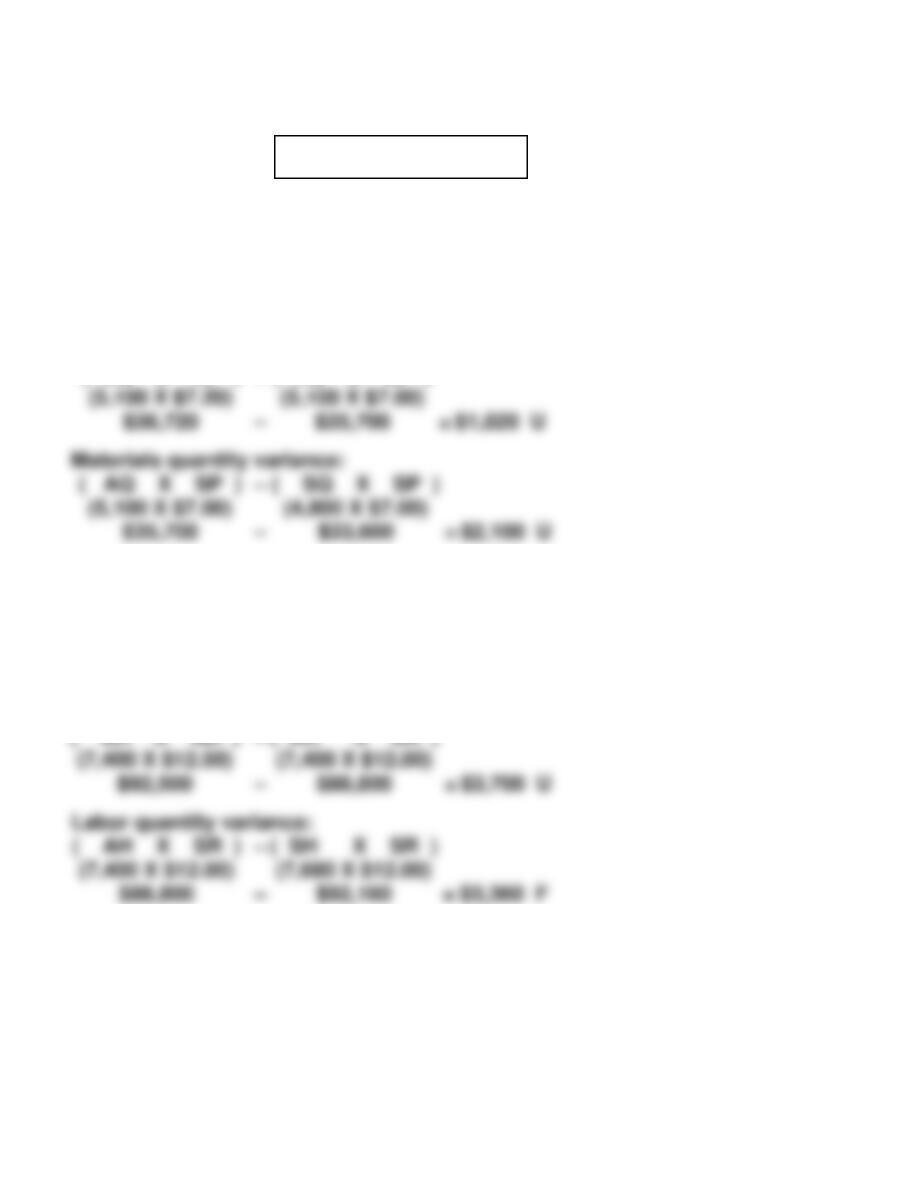
(a) Total materials variance:
( AQ X AP )
(5,100 X $7.20)
$36,720
–
–
( SQ X SP )
(4,800 X $7.00)
$33,600
=
$3,120 U
Materials price variance:
( AQ X AP )
–
( AQ X SP )
Total labor variance:
( AH X AR )
(7,400 X $12.50)
$92,500
–
–
( SH X SR )
(7,680* X $12.00)
$92,160
=
$340 U
*4,800 X 1.6
Labor price variance:
( AH X AR )
$92,500
–
–
( AH X SR )
=
$92,160
(b) Total overhead variance:
Actual
Overhead
($59,700 + $21,000)
$80,700
–
–
Overhead
Applied
(7,680 X $10.00)
$76,800
=
$3,900 U
–
=
–
PROBLEM 11-2A
(a) 1. Total materials variance:
( AQ X AP )
(10,600 X $2.25)
$23,850
–
–
( SQ X SP )
(10,000 X $2.10)
$21,000
=
$2,850 U
Materials price variance:
( AQ X AP )
(10,600 X $2.25)
$23,850
–
–
( AQ X SP )
(10,600 X $2.10)
$22,260
=
$1,590 U
(b) Total overhead variance:
Actual
Overhead
$189,500
–
–
Overhead
Applied
$193,500
(45,000* X $4.30)
=
$4,000 F
*15,000 X 3
( AQ X SP )
(10,600 X $2.10)
–
–
( SQ X SP )
(10,000 X $2.10)
$21,000
=
$1,260 U
–
–
=
(14,400 X $8.40)
–
–
(14,400 X $8.00)
=
(14,400 X $8.00)
–
–
(15,000 X $8.00)
=
PROBLEM 11-2A (Continued)
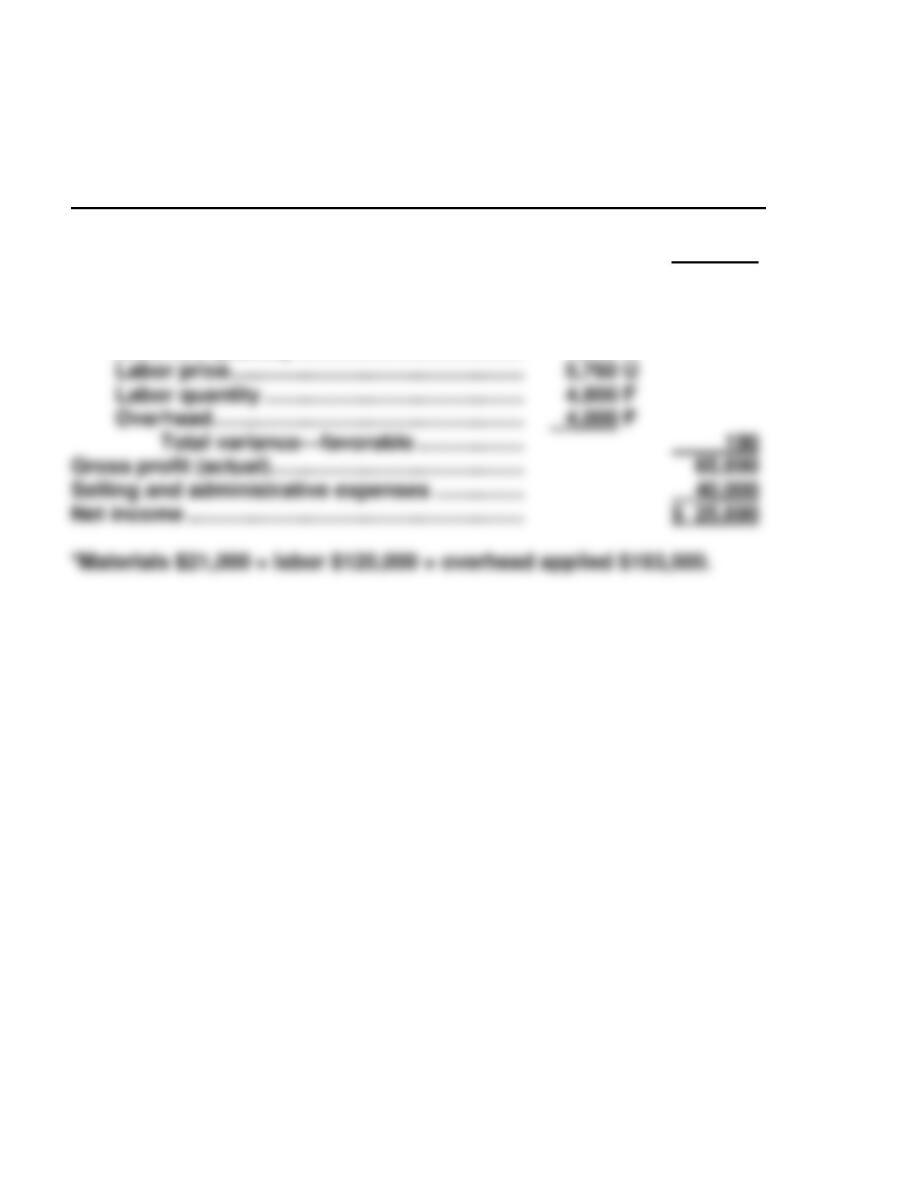
(c) AYALA CORPORATION
Income Statement
For the Month Ended June 30, 2017
Sales revenue …………………………………………….. $400,000
Cost of goods sold (at standard) …………………. 334,500*
Gross profit (at standard) ……………………………. 65,500
Variances
Materials price …………………………………….. $ 1,590 U
Materials quantity ………………………………… 1,260 U
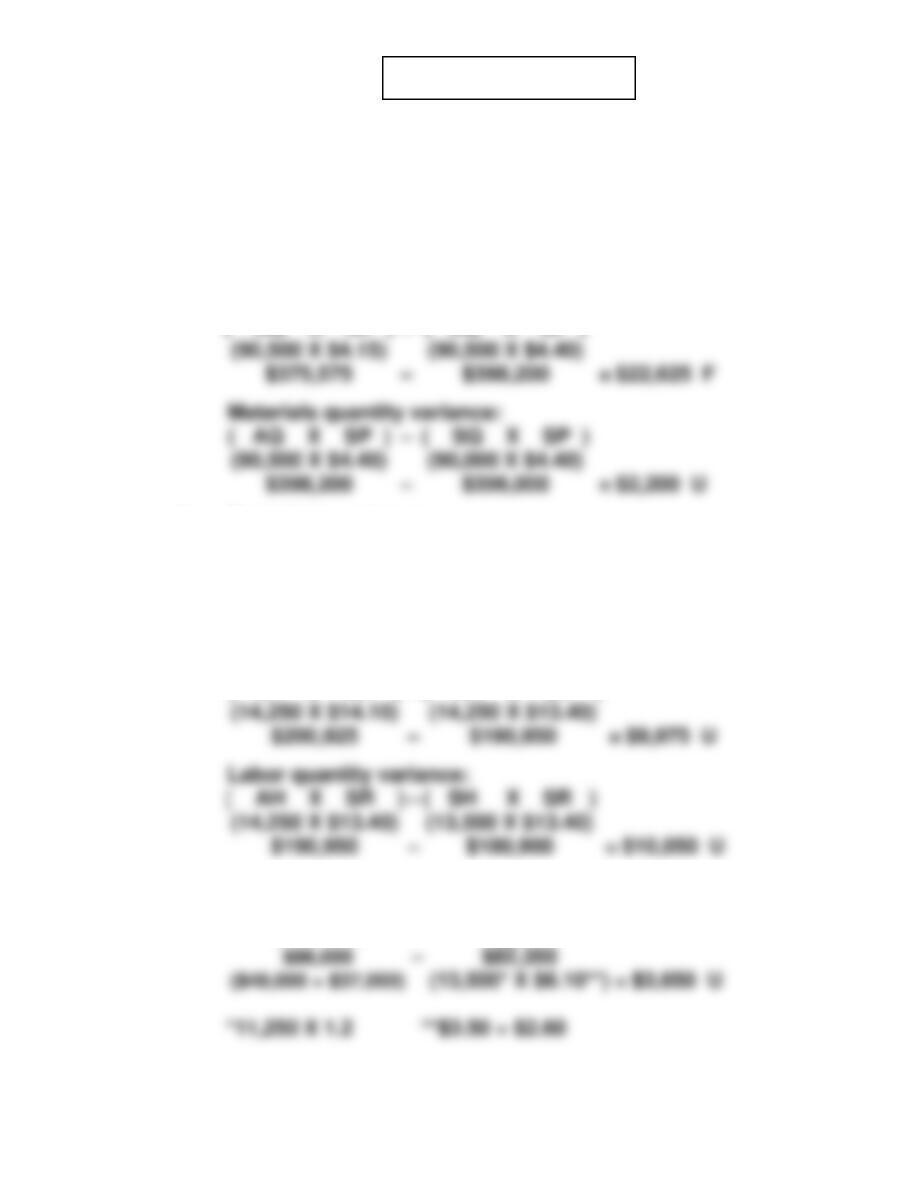
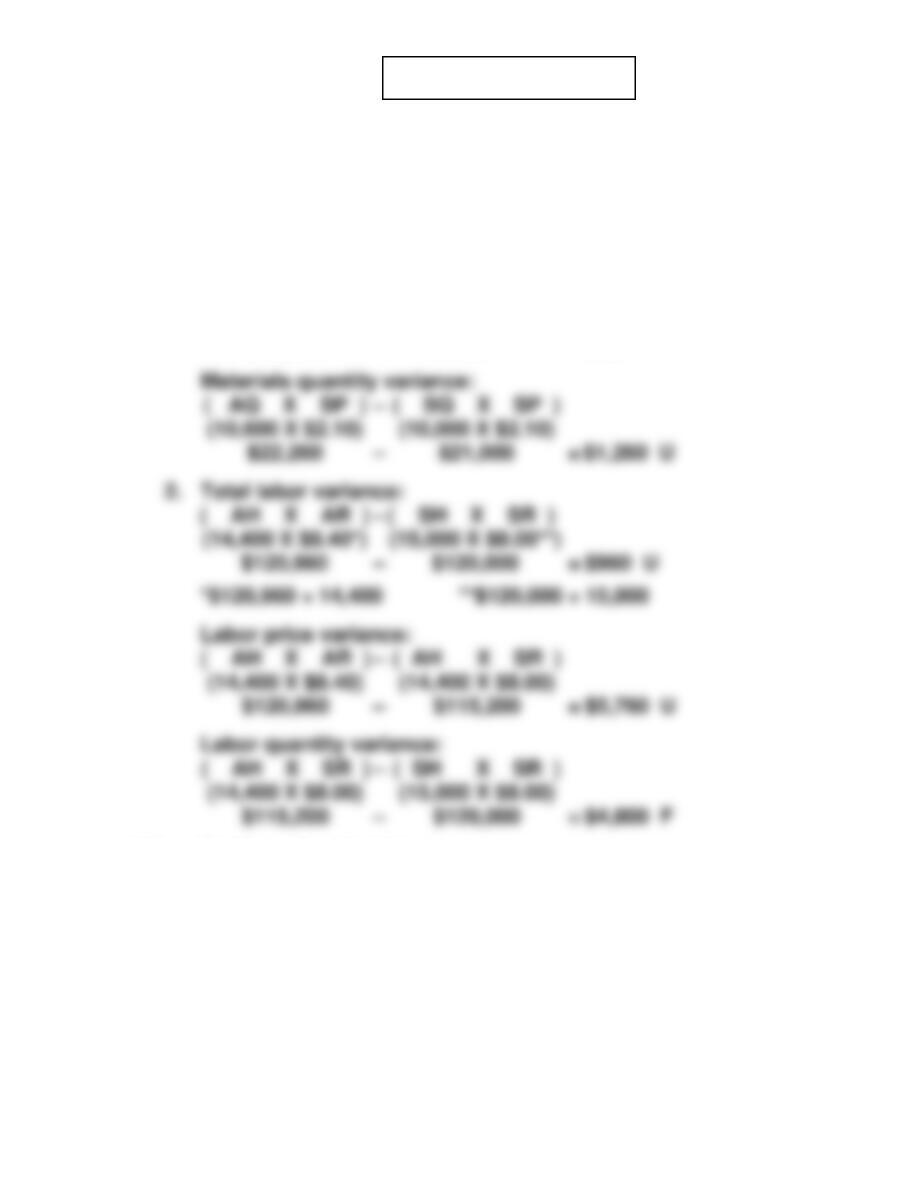
PROBLEM 11-3A
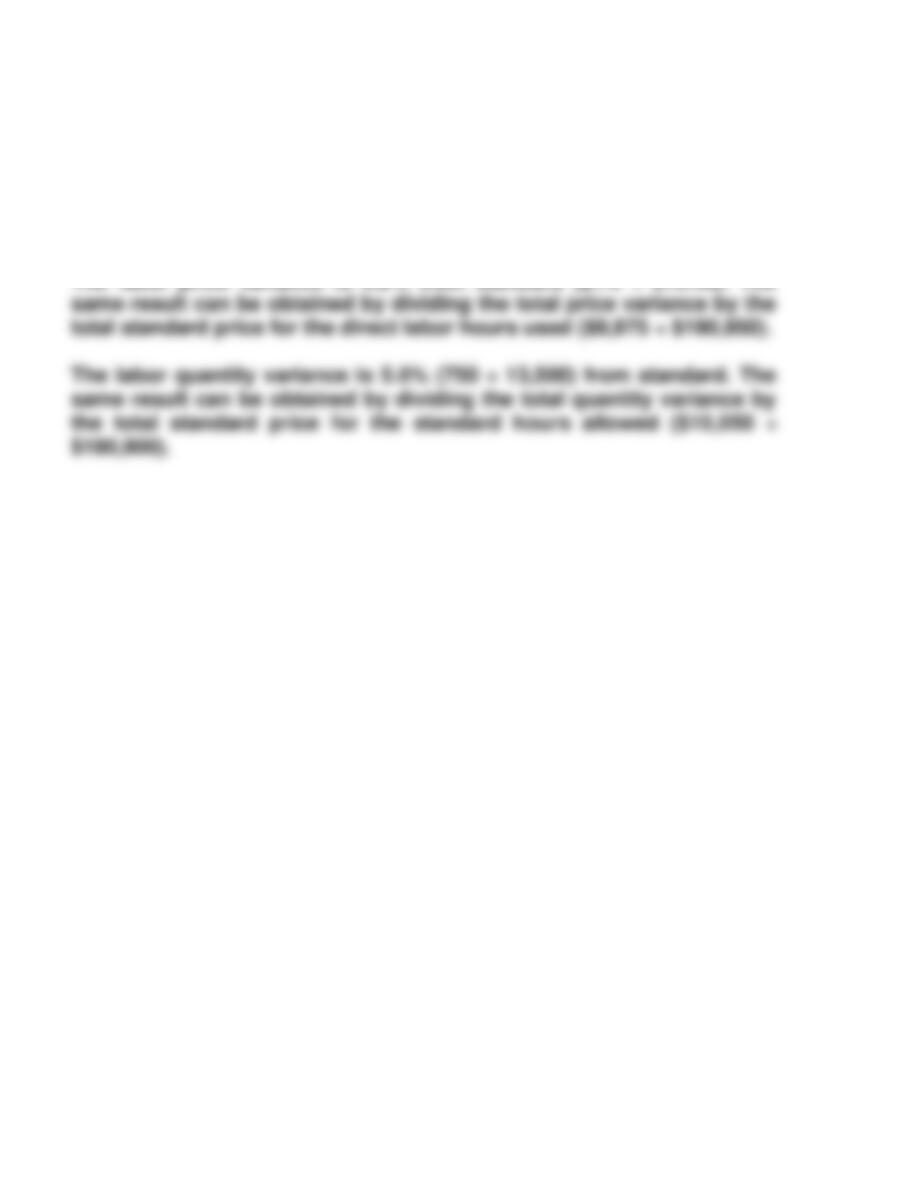
(a) 1. Total materials variance:
( AQ X AP )
(90,500 X $4.15)
$375,575
–
–
( SQ X SP )
(90,000* X $4.40)
$396,000
=
$20,425 F
*11,250 X 8
Materials price variance:
( AQ X AP )
–
( AQ X SP )
2. Total labor variance:
( AH X AR )
(14,250 X $14.10)
$200,925
–
–
( SH X SR )
(13,500* X $13.40)
$180,900
=
$20,025 U
*11,250 X 1.2
Labor price variance:
(14,250 X $13.40)
–
(13,500 X $13.40)
( AH X AR )
–
( AH X SR )
(b) Total overhead variance:
Actual
Overhead
–
Overhead
Applied
–
PROBLEM 11-3A (Continued)
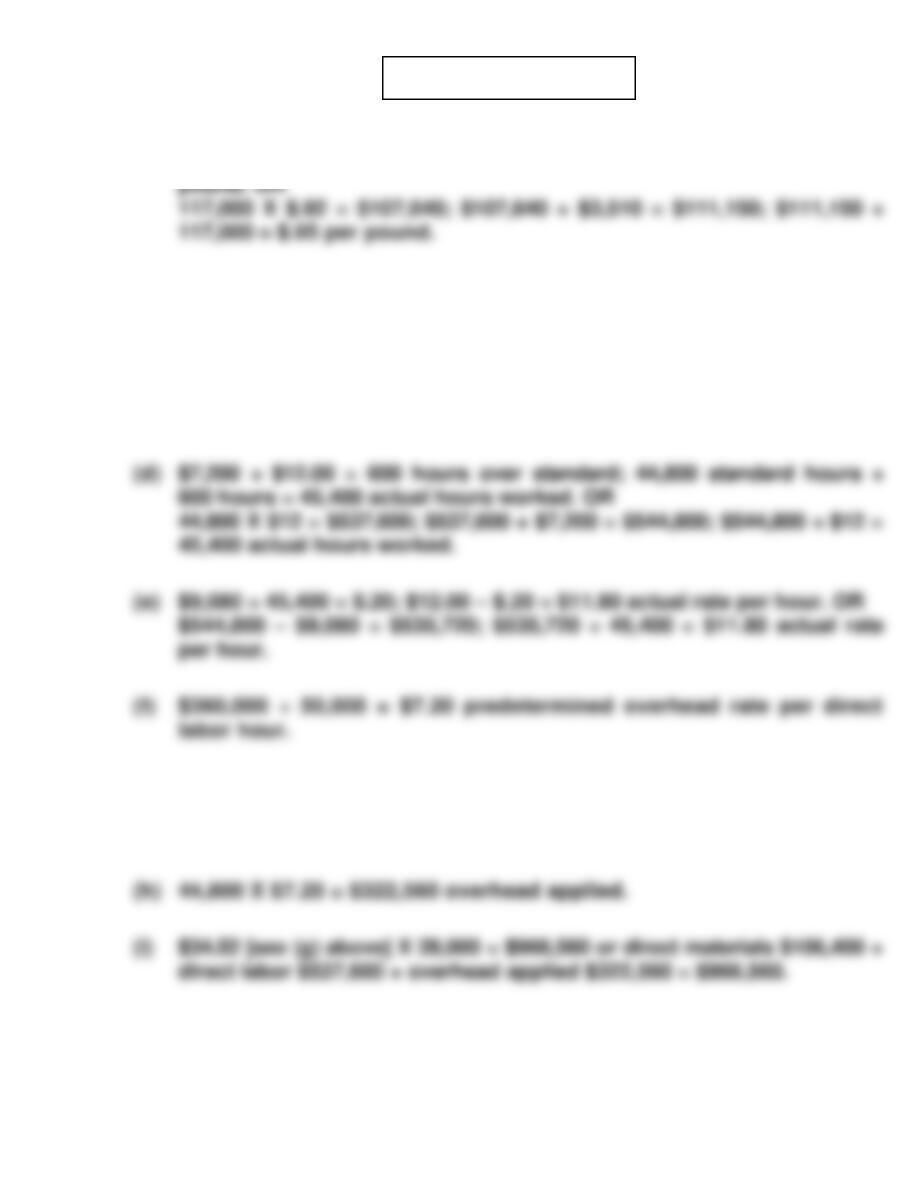
(c) The materials price variance is more than 4% from standard. The actual
price for materials of $4.15 is $.25 below the standard price of $4.40 or
5.7% ($.25 ÷ $4.40). The same result can be obtained by dividing the
total price variance by the total standard price for the quantities purchased
($22,625 ÷ $398,200).
PROBLEM 11-4A
(a) $3,510 ÷ 117,000 = $.03; $.92 + $.03 = $.95 standard materials price per
(b) $4,750 ÷ $.95 = 5,000 pounds; 117,000 – 5,000 = 112,000 standard
quantity for 28,000 units or 4.0 pounds (112,000 ÷ 28,000) per unit. OR
$111,150 – $4,750 = $106,400; $106,400 ÷ $.95 = 112,000; 112,000 ÷
28,000 = 4.0 pounds per unit.
(c) Standard hours allowed are 44,800 (28,000 X 1.6).
(g) Direct materials 4.0 pounds X $.95 = $3.80; direct labor 1.6 X $12.00 =
$19.20; manufacturing overhead 1.6 X $7.20 = $11.52. $3.80 + $19.20 +
$11.52 = $34.52 standard cost per unit.
PROBLEM 11-5A
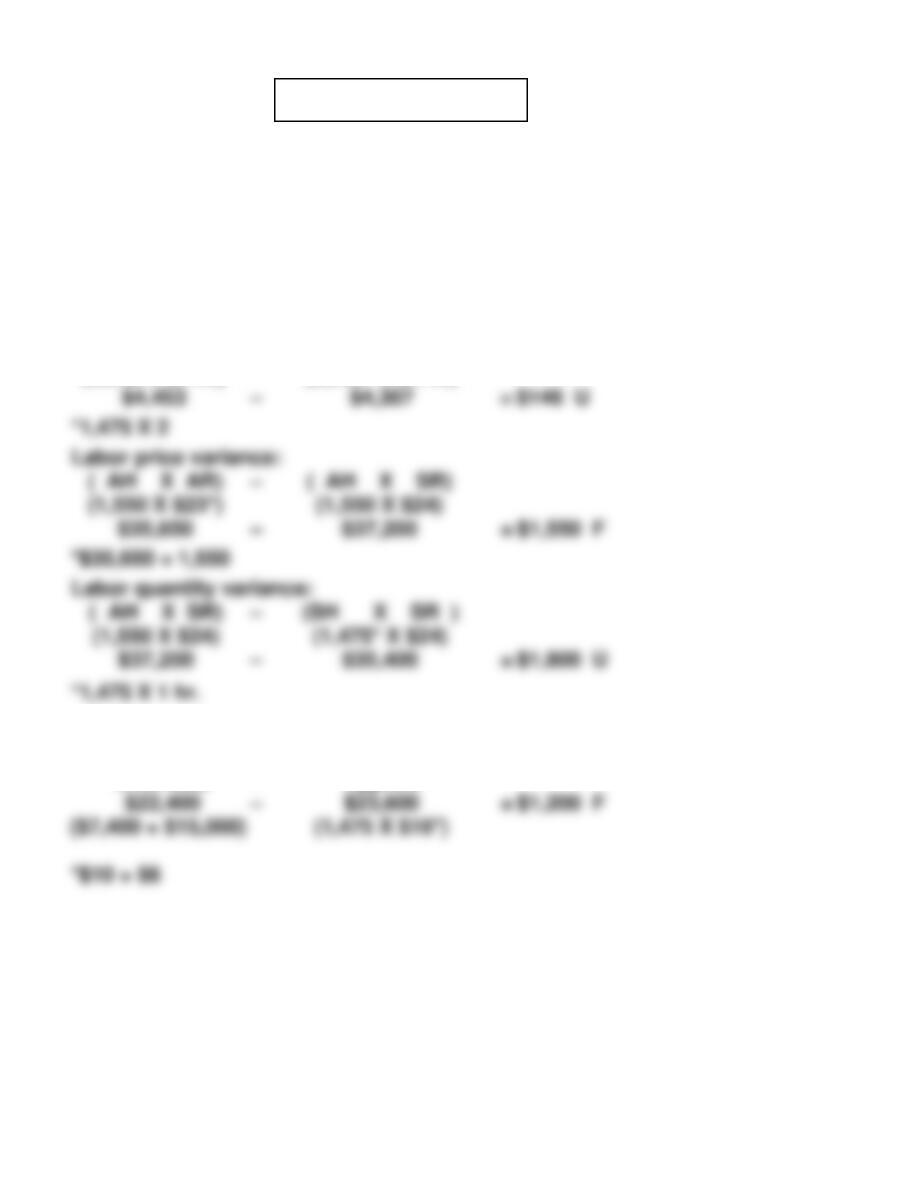
(a) Materials price variance:
( AQ X AP )
(3,050 X $1.40*)
$4,270
–
–
( AQ X SP )
(3,050 X $1.46)
$4,453
=
$183 F
*$4,270 ÷ 3,050
Materials quantity variance:
( AQ X SP )
(3,050 X $1.46)
–
( SQ X SP )
(2,950* X $1.46)
(b) Total Overhead variance:
Actual
Overhead
–
Overhead
Applied
–
=
$146 U
–
PROBLEM 11-5A (Continued)
(c) HART LABS, INC.
Income Statement
For the Month Ended November 30, 2017
Service revenue ……………………………………………… $75,000
Cost of service provided (at standard)
(1,475 X $42.92) …………………………………………… 63,307
Gross profit (at standard) ………………………………… 11,693
Variances
(d) The unfavorable materials quantity variance could be caused by poor
quality materials or inexperienced workers or faulty test procedures.
*PROBLEM 11-6A
(a) 1. Raw Materials Inventory (6,200 X $1.00) ………… 6,200
2. Work in Process Inventory (5,700* X $1) ……….. 5,700
Materials Quantity Variance
3. Factory Labor (2,000 X $8) ……………………………. 16,000
Labor Price Variance
[2,000 X ($8.00 – $7.80)] ……………………… 400
Factory Wages Payable (2,000 X $7.80) ….. 15,600
4. Work in Process Inventory
(1,900 X $8.00) …………………………………………. 15,200
Labor Quantity Variance
[(2,000 – 1,900) X $8.00] ……………………………. 800
Factory Labor ………………………………………. 16,000
8. Accounts Receivable …………………………………… 65,000
Sales Revenue ……………………………………… 65,000
Cost of Goods Sold …………………………………….. 44,650
Finished Goods Inventory ……………………. 44,650
*PROBLEM 11-6A (Continued)
(b)
Raw Materials Inventory
Materials Price Variance
Work in Process Inventory
(1) 6,200
(2) 6,200
(1) 310
(2) 5,700
(4) 15,200
(6) 23,750
(7) 44,650
(c) Overhead Variance ($25,000 – $23,750) …………… 1,250
Manufacturing Overhead …………………………. 1,250
(d) JORGENSEN CORPORATION
Income Statement
For the Month Ended January 31, 2017
Sales revenue ……………………………………………….. $65,000
Cost of goods sold (at standard)
(1,900 X $23.50) ………………………………………….. 44,650
Gross profit (at standard) ……………………………….. 20,350
(8) 44,650
*PROBLEM 11-7A
Overhead controllable variance:
Actual
Overhead
Overhead volume variance:
Fixed
Normal
Standard
*PROBLEM 11-8A
Overhead controllable variance:
Actual
Overhead
–
Overhead
Budgeted
Overhead volume variance:
Fixed
Normal
Standard
*PROBLEM 11-9A
Overhead controllable variance:
Actual
Overhead
–
Overhead
Budgeted
Overhead volume variance:
Fixed
Overhead
X
Normal
Capacity
–
Standard
Hours
*PROBLEM 11-10A
Overhead controllable variance:
Actual
Overhead
–
Overhead
Budgeted
Overhead volume variance:
Fixed
Overhead
X
Normal
Capacity
–
Standard
Hours
CD11 CURRENT DESIGNS
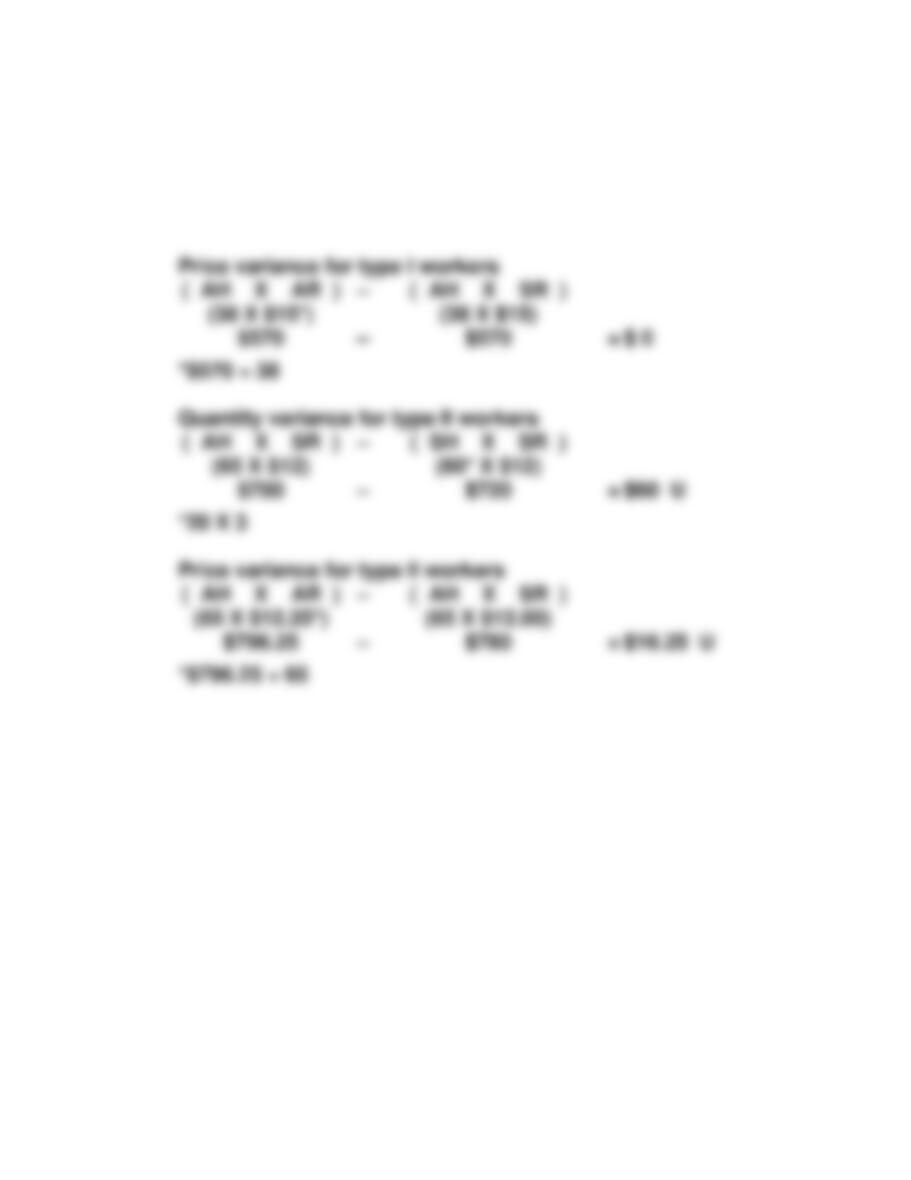
(a) Quantity variance for polyethylene powder Unfavorable
Price variance for polyethylene powder Unfavorable
Quantity variance for finishing kits NEI = Not enough information
(b) Quantity variance for polyethylene powder
$1,800
–
$1,620
=
$180 U
( AQ X SP )
–
( SQ X SP )
Price variance for polyethylene powder
( AQ X AP )
(1,200 X $1.70*)
$2,040
–
–
( AQ X SP )
(1,200 X $1.50)
$1,800
=
$240 U
( AQ X SP )
$3,400
–
–
( SQ X SP )
$3,400
=
*$2,040 ÷ 1,200
CD11 (Continued)
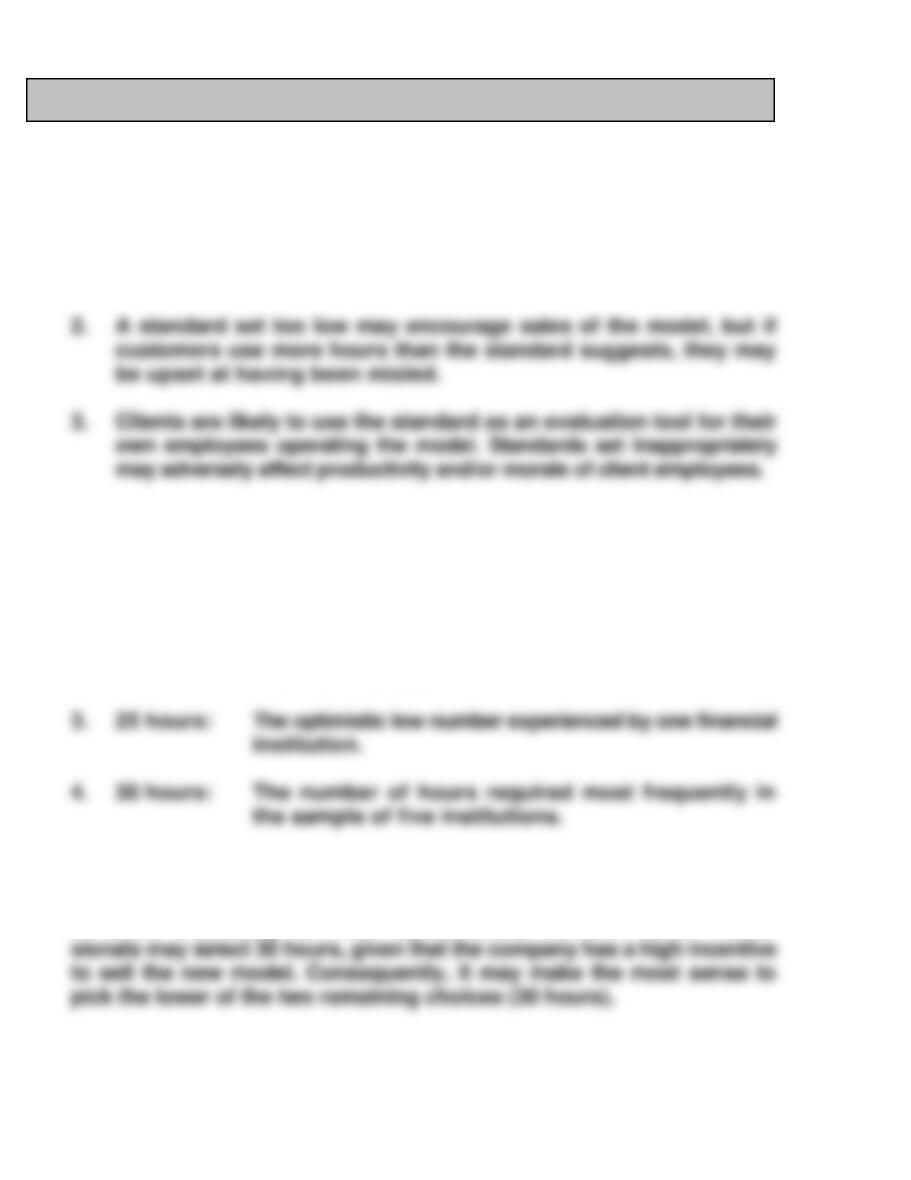
Quantity variance for type I workers
( AH X SR )
(38 X $15)
$570
–
–
( SH X SR )
(40* X $15)
$600
=
$30 F
*20 X 2
$570
–
–
( AH X SR )
$570
=
( AH X SR )
(65 X $12)
$780
–
–
( SH X SR )
(60* X $12)
$720
=
$60 U
–
$780
=
BYP 11-1 DECISION-MAKING ACROSS THE ORGANIZATION
(a) When setting a standard for computer/labor hours usage, Milton Profes–
sionals should consider the following factors:
1. A standard set conservatively high may discourage clients from
purchasing the model.
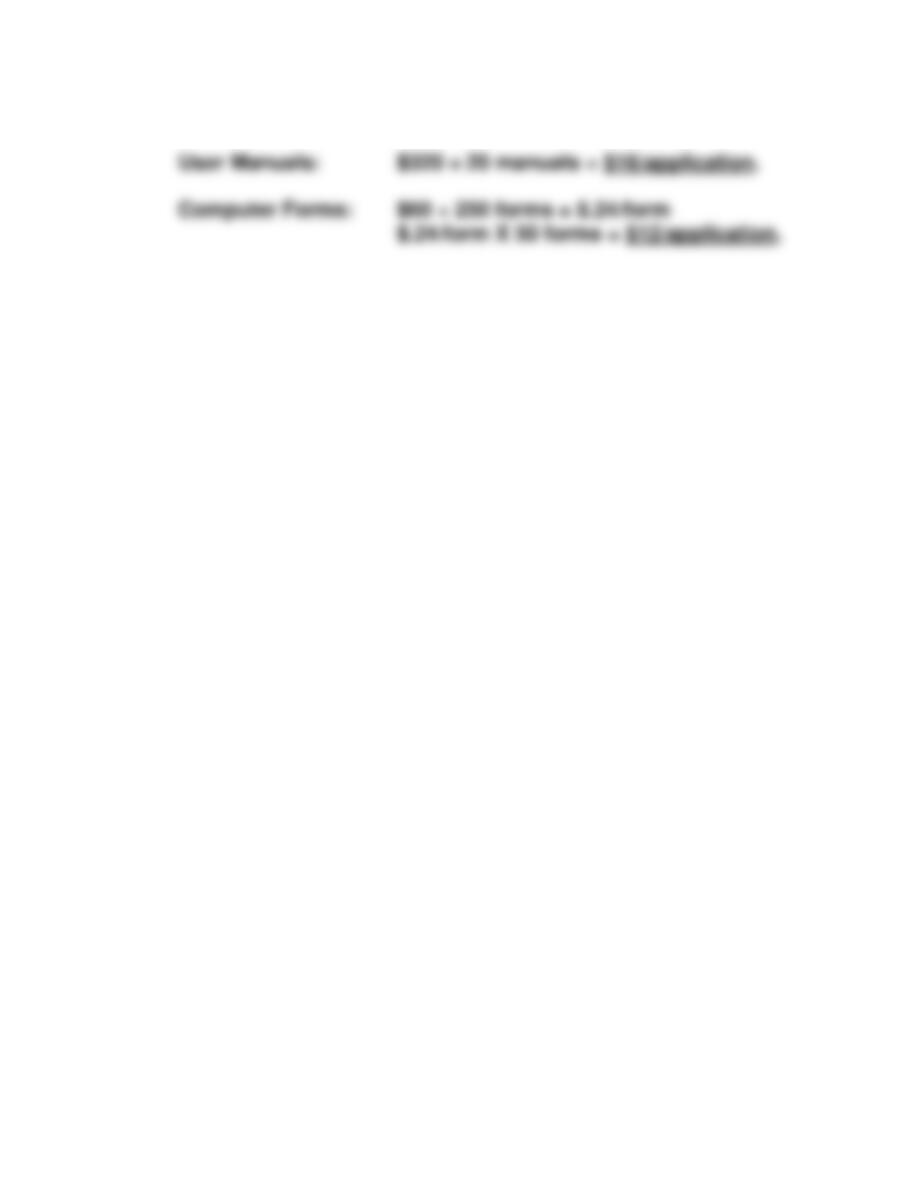
(b) Logical alternatives for the standard include:
1. 34 hours: The average number of hours used for one application
by all five financial institutions.
2. 45 hours: The conservatively high number experienced by one
financial institution.
(c) In light of earlier factors listed, the second and third choices for the
standard should be eliminated (i.e., 45 and 25 hours). The average
34 hours is probably the most representative. However, Milton Profes–
BYP 11-1 (Continued)
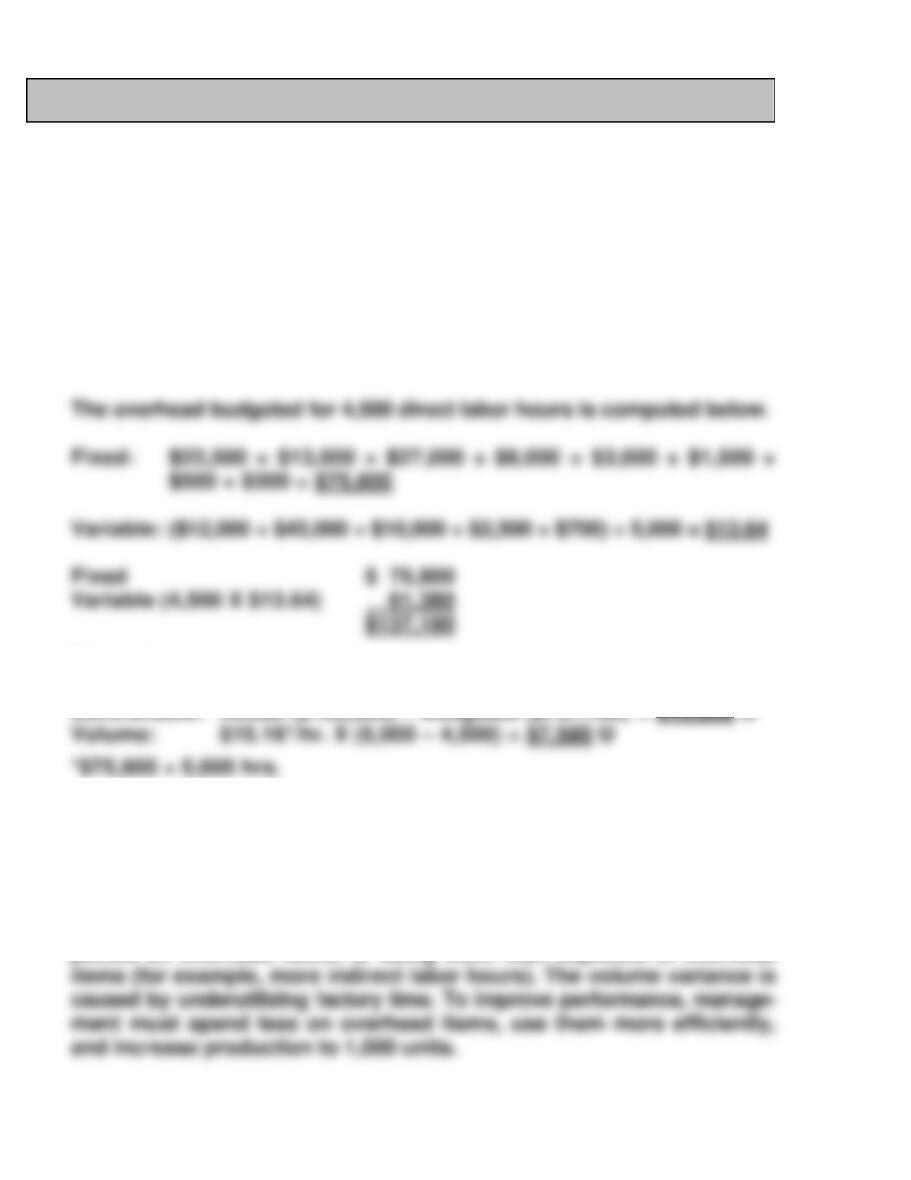
(d) Standard material cost for one model application:
BYP 11-2 MANAGERIAL ANALYSIS
(a) The overhead application rate is $144,000 divided by 5,000 hours, or
$28.80 per direct labor hour.
(b) The standard direct labor hours are used to apply overhead to production,
so the calculation is $28.80 X 4,500, or $129,600.
(c)
Actual Overhead
$150,000
–
Overhead Applied
$129,600
=
=
Total Overhead Variance
$20,400 U
The variances are:
(d) Both variances appear significant. The controllable variance is 9.3% of
budgeted overhead ($12,820 ÷ $137,180), and the volume variance is
5.8% of applied overhead ($7,580 ÷ $129,600).
(e) The controllable variance is caused by either spending more than ex–
pected on overhead items, or using more than expected of overhead
BYP 11-3 REAL-WORLD FOCUS
(a) Glassmaster is using standard costs because management states that
a factor that contributed to improved margins (profit) was a favorable
materials price variance.
(b) The materials price variance experienced should not lead to changes
BYP 11-4 REAL-WORLD FOCUS
(a) The objectives for each perspective are:
Financial: Increase profitability, lower costs, increase revenue
Customer: Flight is on-time, lowest prices, more customers
Internal: Improve turnaround time.
Learning: Ground crew alignment.
BYP 11-5 REAL-WORLD FOCUS
(a) The normal industry standard for plants to be considered operating at
100% capacity is two shifts working about 250 days a year.
(b) A government task force urged the company to try to operate at 120%
capacity by traditional standards.
(c) It is argued that assembly lines need too much scheduled maintenance
and restocking. This is normally done during the period that the
company is proposing to run a third shift. For example, the paint shop
BYP 11-6 COMMUNICATION ACTIVITY
To: Professor Standard
From: I. M. Smart
Subject: Setting Standard Costs
This memorandum covers two points as follows:
(a) The comparative advantages and disadvantages of ideal versus normal
standards.
Ideal standards represent optimum levels of performance under perfect
operating conditions. In contrast, normal standards represent efficient
levels of performance that are attainable under expected operating
conditions.
(b) Factors to be considered in setting standards for direct materials, direct
labor, and manufacturing overhead.
1. Direct materials. The direct materials price standard is the cost per
unit of direct materials that should be incurred. This standard should
be based on the purchasing department’s best estimate of the cost
of raw materials. The price standard should include allowances for
related costs such as receiving, storing and handling.
BYP 11-6 (Continued)
The direct materials quantity standard is the quantity of direct
materials that should be used per unit of finished goods. This
standard is a physical measure and it should include allowances
for unavoidable waste and normal spoilage.
BYP 11-7 ETHICS CASE
(a) Bill and his fellow painters in the painting department will benefit from
Bill’s slow action. The company and its customers are harmed. The
company will incur higher costs on the product and therefore will have
to set a higher selling price or suffer a smaller gross profit. Customers
will have to pay a greater price for the product or stockholders will
obtain less benefit from their investment.
BYP 11-8 ALL ABOUT YOU
(a) The panel made recommendations regarding a number of areas of
concern in higher education. For example, it suggested that new
approaches should be used to control costs, and it stated that the cost
of tuition should grow no faster than median family income. It made
recommendations to strengthen the Pell Grant program, which is the
core of the federal financial aid program. It also recommended that
public universities should use standardized tests to measure student
learning.
(b) As discussed in the chapter, standards provide a mechanism for evalu–
ating performance and, if used properly, can be used as a motivational
BYP 11-9 CONSIDERING YOUR COSTS AND BENEFITS
Discussion Guide: The practice of medicine holds an unusual place in
society. On the one hand, it provides a critical, life-sustaining service. We
expect and demand the highest-quality service. We measure its success in
terms of health improvement and lives saved. On the other hand, it is a
business, and like other businesses, it must operate profitably. Some
healthcare providers characterize this delicate balance as “The Business of
Caring.” How should we balance providing quality health-care and