5. ROI (1) encourages managers to pay attention to the relationships among sales, expenses, and
investment;
(2) encourages cost efficiency; and
(3) discourages excessive investment in operating assets.
Increased profitability can be achieved (all else being equal) by increasing revenues,
decreasing expenses, or lowering investment.
6. Residual income is equal to operating income minus the minimum rate of return multiplied by
the average operating assets. EVA (economic value added) requires the company to calculate its
actual cost of capital and use it as the minimum rate of return in the residual income calculation.
In addition, EVA always uses after-tax income.
A
9. One policy is a market price where the transfer price equals the price at which the product would
sell in a competitive market outside of the organization. A second policy is a cost-based price
where the transfer price equals some measure of the product’s cost plus a markup above cost.
A
third policy is a negotiated price where the transfer price equals an amount that is negotiated
between the buyer and seller of the product.
11
DISCUSSION QUESTIONS
PERFORMANCE EVALUATION
AND DECENTRALIZATION
CHAPTER 11 Performance Evaluation and Decentralization
11. The four perspectives of the Balanced Scorecard are financial, customer, internal business
process, and learning and growth. The financial perspective describes the economic
consequences of actions taken in the other three perspectives. The customer perspective
defines the customer and market segments in which the business unit will compete. The
internal business process perspective describes the internal processes needed to provide
value for customers and owners. The learning and growth (infrastructure) perspective defines
the capabilities that an organization needs to create long-term growth and improvement.
11-1. a
11-5. b
11-6. c
11-9. b
11-10. a
MULTIPLE-CHOICE QUESTIONS
CHAPTER 11 Performance Evaluation and Decentralization
BE 11-13
=
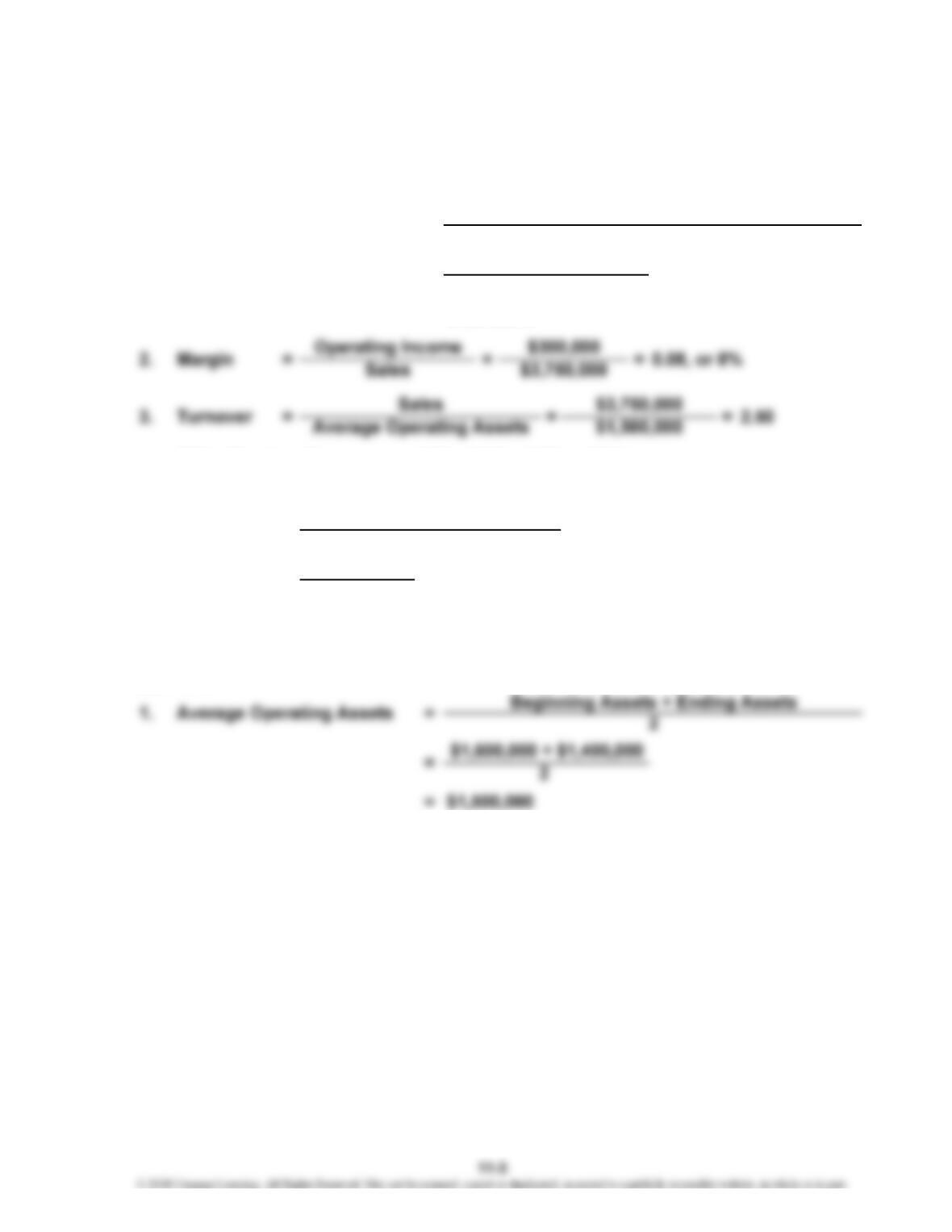
4. ROI = Margin × Turnover = 0.08 × 2.50 = 0.20, or 20%
Alternatively,
Average Operating Assets
= 0.20, or 20%
BE 11-14
2. = Operating Income – (Minimum Rate of Return ×
A
verage Operating Assets)
= $300,000 – (0.05 × $1,500,000)
= $300,000 – $75,000
=
=
$1,500,000
$1,600,000 + $1,400,000
2
BRIEF EXERCISES: SET A
=
=
ROI
=Average Operating Assets
1. Beginning Assets + Ending Assets
2
Residual Income
$225,000
$300,000
$1,500,000
Operating Income
CHAPTER 11 Performance Evaluation and Decentralization
BE 11-15
BE 11-16
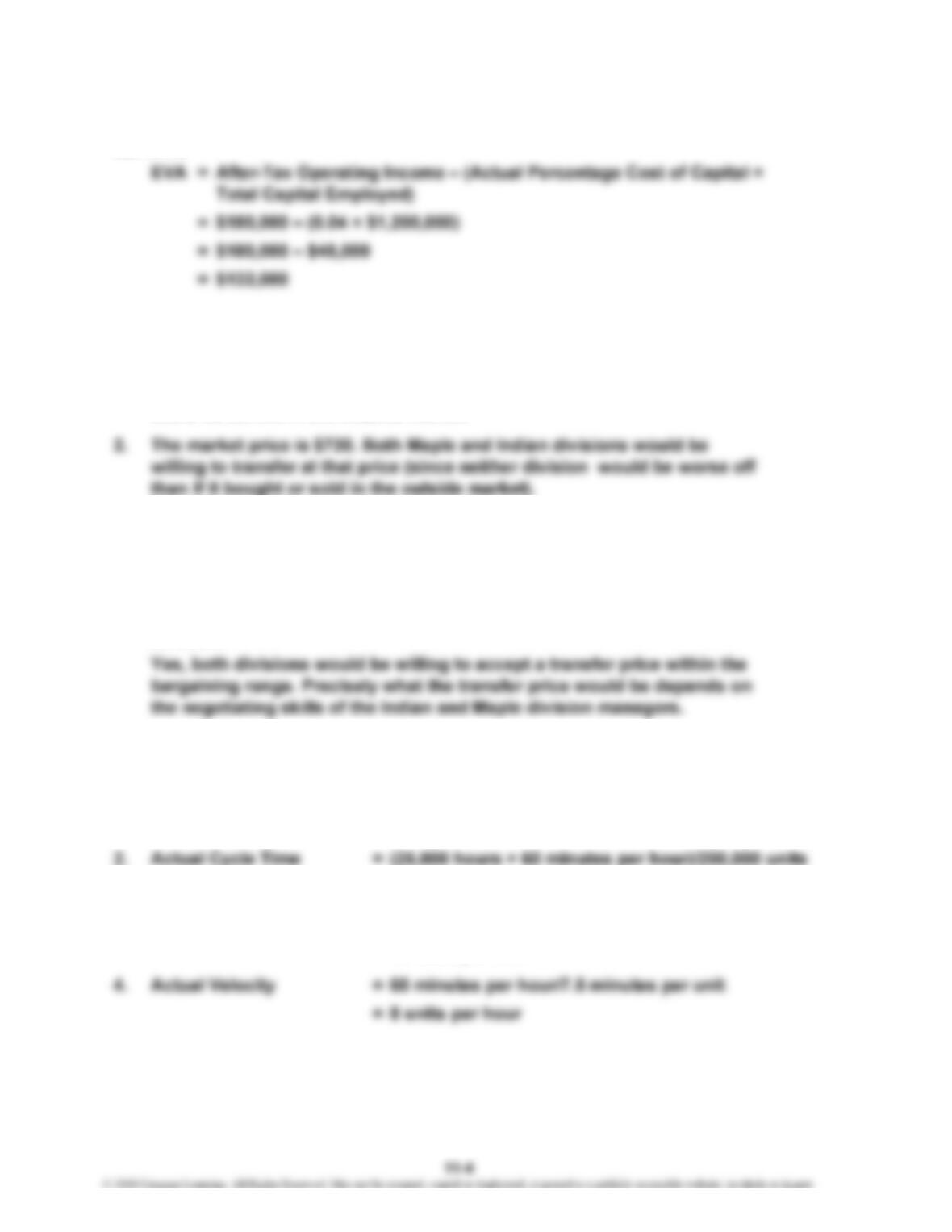
1. The full cost transfer price is $540. Maple Division would be delighted
with that price, but Indian Division would refuse to transfer since $720
could be earned in the outside market.
3. Minimum Transfer Price = $720 – $120 = $600
This price is set by Indian Division, the selling division.
Maximum Transfer Price = $720.
This price is the market price and is set by Maple Division, the buying
division.
BE 11-17 (Appendix)
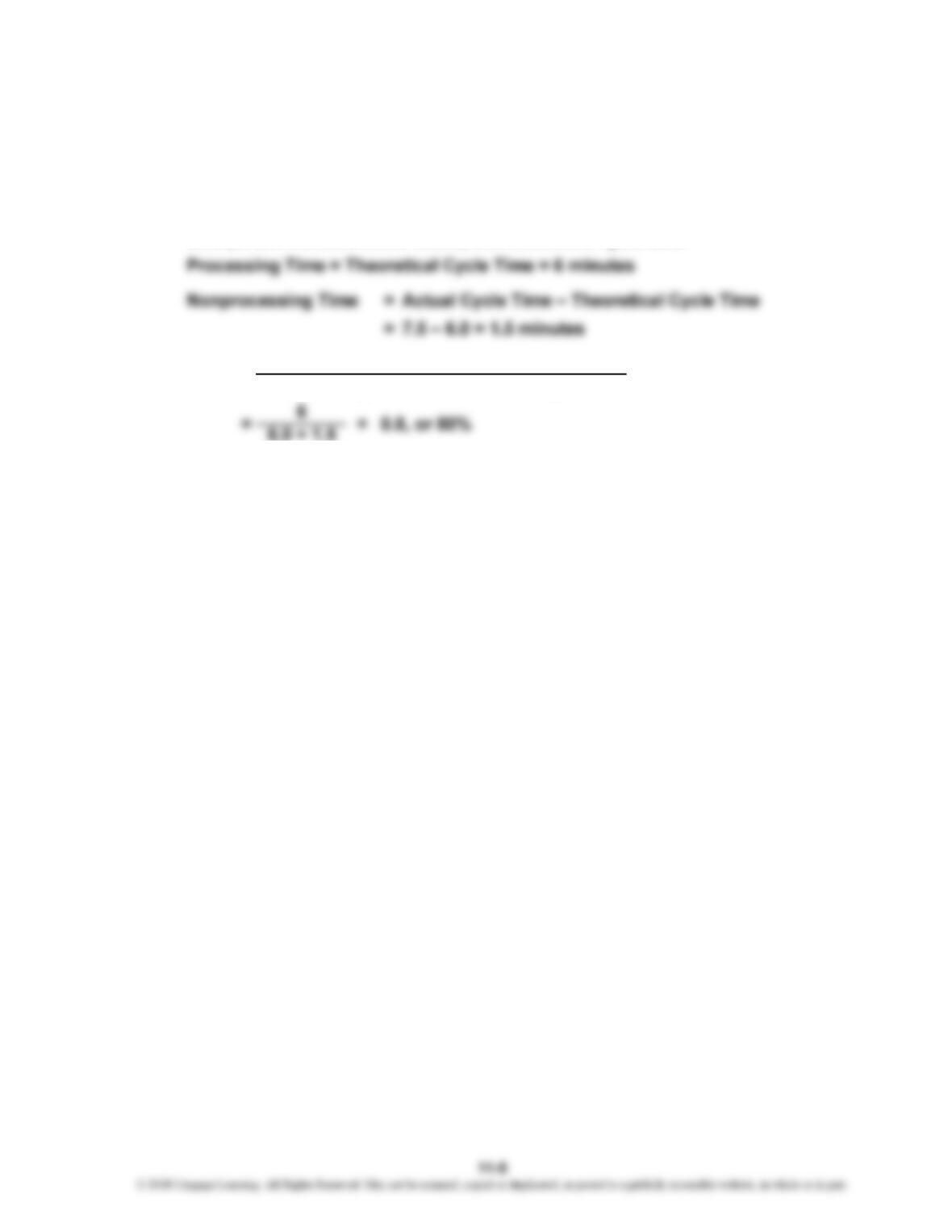
1. Theoretical Cycle Time = (25,000 hours × 60 minutes per hour)/250,000 units
= 6 minutes per unit
= 7.5 minutes per unit
3. Theoretical Velocity = 60 minutes per hour/6 minutes per unit
= 10 units per hou
r
CHAPTER 11 Performance Evaluation and Decentralization
BE 11-18 (Appendix)
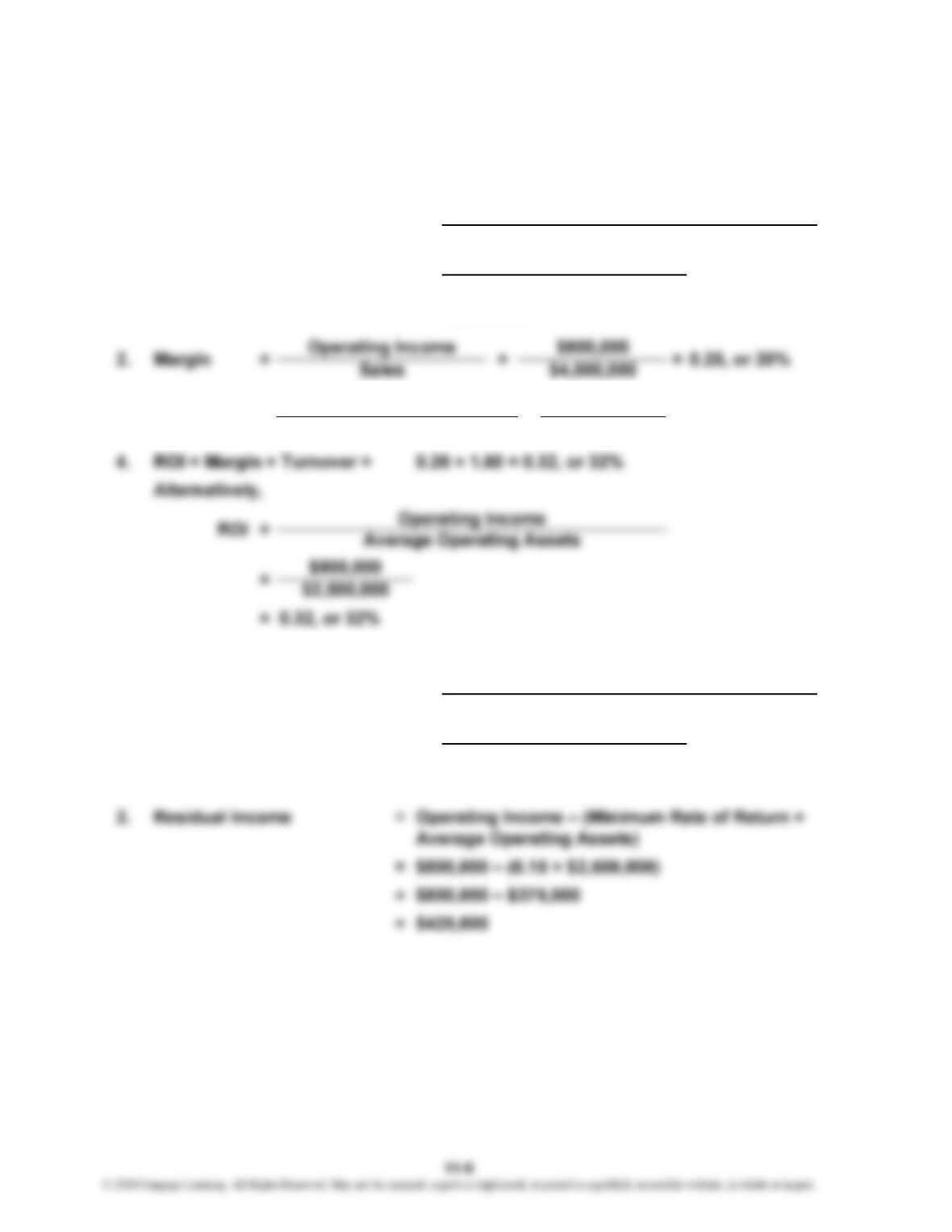
1. Processing time is equal to theoretical cycle time. That is, if everything goes
smoothly and there is no wasted time, it takes 6 minutes to produce one unit.
Nonprocessing time, therefore, must be the difference between actual cycle
time (which includes some waste) and theoretical cycle time.
MCE2. =
Processing Time
Processing Time + Nonprocessing Time
CHAPTER 11 Performance Evaluation and Decentralization
BE 11-19
=
$4,000,000
$2,500,000
BE 11-20
=
BRIEF EXERCISES: SET B
1. Average Operating Assets = Beginning Assets + Ending Assets
2
=$2,700,000 + $2,300,000
2
$2,500,000
3. Turnover = Sales = 1.60
=
Average Operating Assets
1. Average Operating Assets = Beginning Assets + Ending Assets
2
2
$2,500,000
=$2,700,000 + $2,300,000
CHAPTER 11 Performance Evaluation and Decentralization
BE 11-21
EVA = After-Tax Operating Income – (Actual Percentage Cost of Capital ×
Total Capital Employed)
BE 11-22
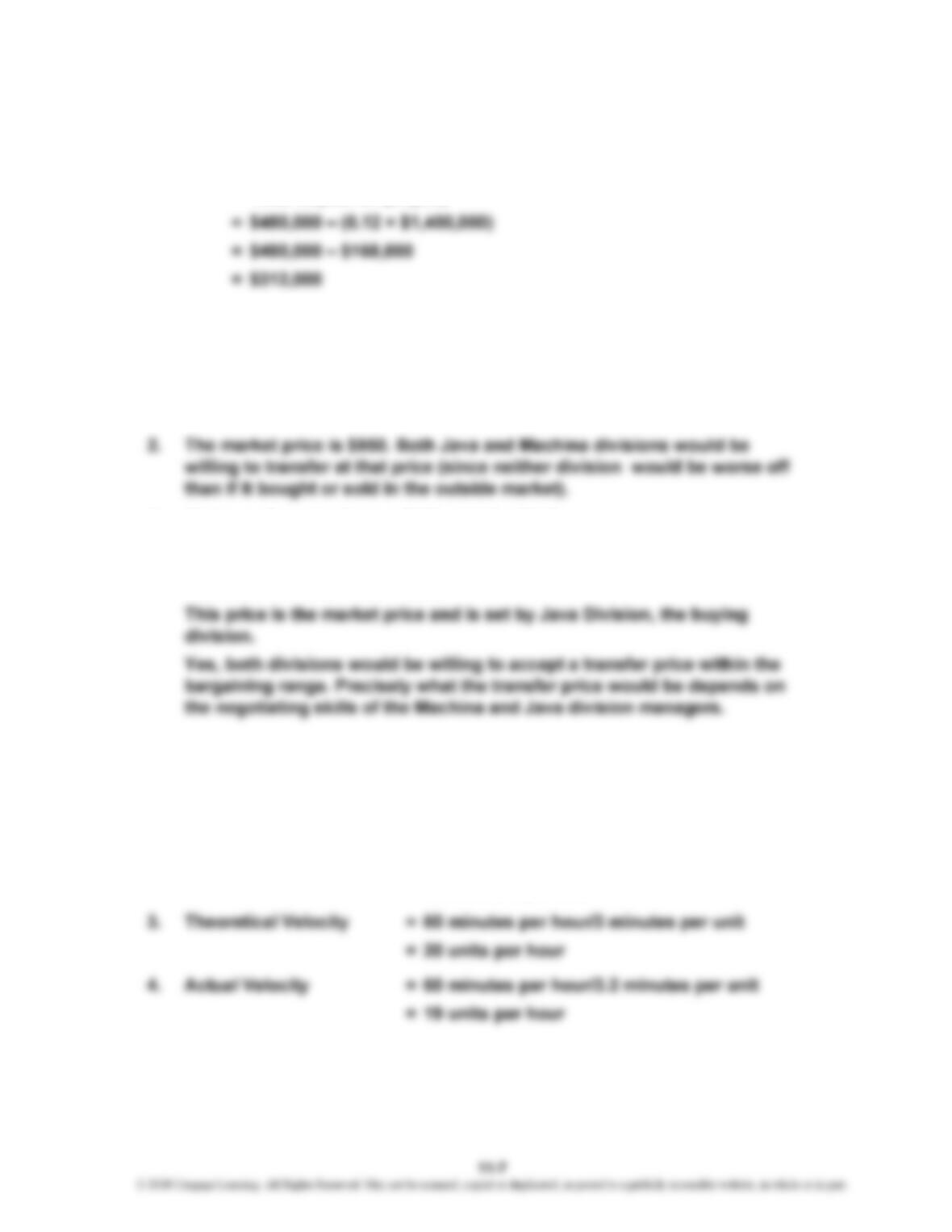
1. The full cost transfer price is $475. Java Division would be delighted
with that price, but Machina Division would refuse to transfer since $950
could be earned in the outside market.
3. Minimum Transfer Price = $950 – $135 = $815
This price is set by Machina Division, the selling division.
Maximum Transfer Price = $950.
BE 11-23 (Appendix)
1. Theoretical Cycle Time = (20,000 hours × 60 minutes per hour)/400,000 units
= 3 minutes per unit
2. Actual Cycle Time = (20,000 hours × 60 minutes per hour)/375,000 units
= 3.2 minutes per unit
CHAPTER 11 Performance Evaluation and Decentralization
BE 11-24 (Appendix)
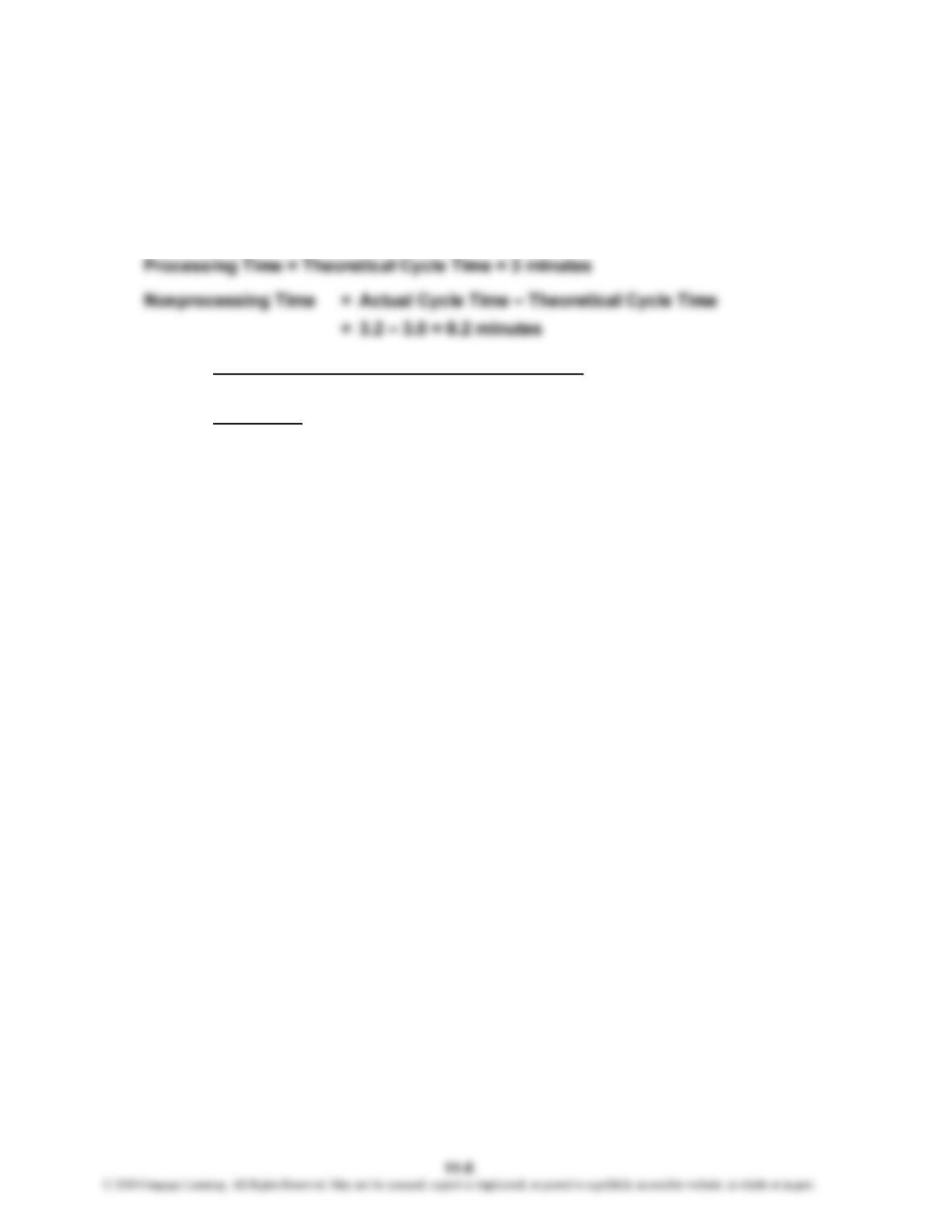
1. Processing time is equal to theoretical cycle time. That is, if everything goes
smoothly and there is no wasted time, it takes 3 minutes to produce one unit.
Nonprocessing time, therefore, must be the difference between actual cycle
time (which includes some waste) and theoretical cycle time.
3
3.0 + 0.2
2. MCE = Processing Time
Processing Time + Nonprocessing Time
= = 0.94, or 94%
CHAPTER 11 Performance Evaluation and Decentralization
E 11-25
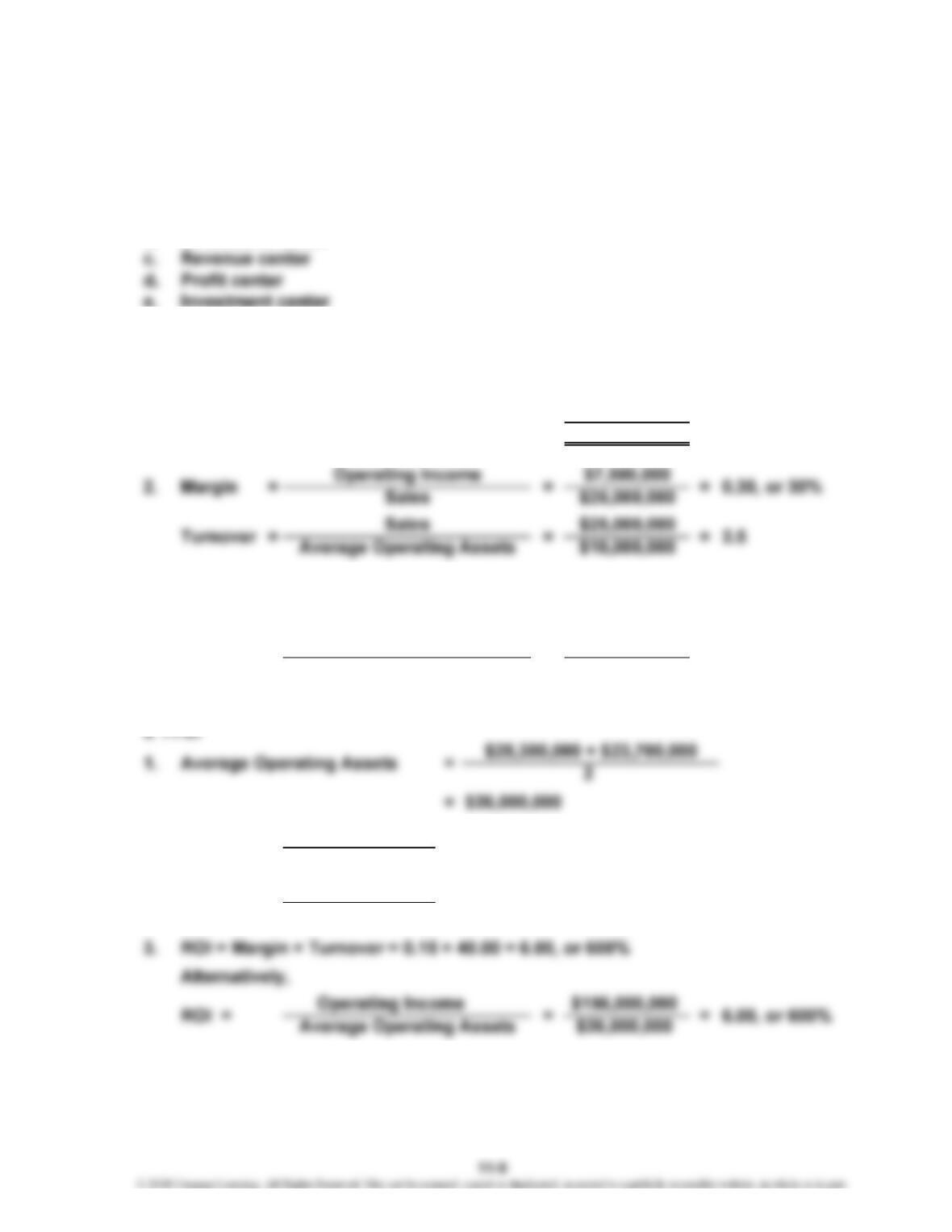
a. Cost center
b. Investment cente
r
e. Investment cente
r
E 11-26
1. Sales $25,000,000
Less expenses 17,500,000
Operating income $ 7,500,000
3. ROI = Margin × Turnover = 0.30 × 2.5 = 0.75, or 75%
Alternatively,
$7,500,000
$10,000,000
$156,000,000
$1,040,000,000
$1,040,000,000
$26,000,000
4. ROI measures a company’s ability to generate income relative to its
investment in assets. The greater the ROI, the more efficiently the company
is generating income from its assets.
ROI
=
=
2.
Turnover
Average Operating Assets =
= 0.75, or 75%
Operating Income
EXERCISES
=Margin
= 40.00
0.15, or 15%
=
CHAPTER 11 Performance Evaluation and Decentralization
E 11-27 (Concluded)
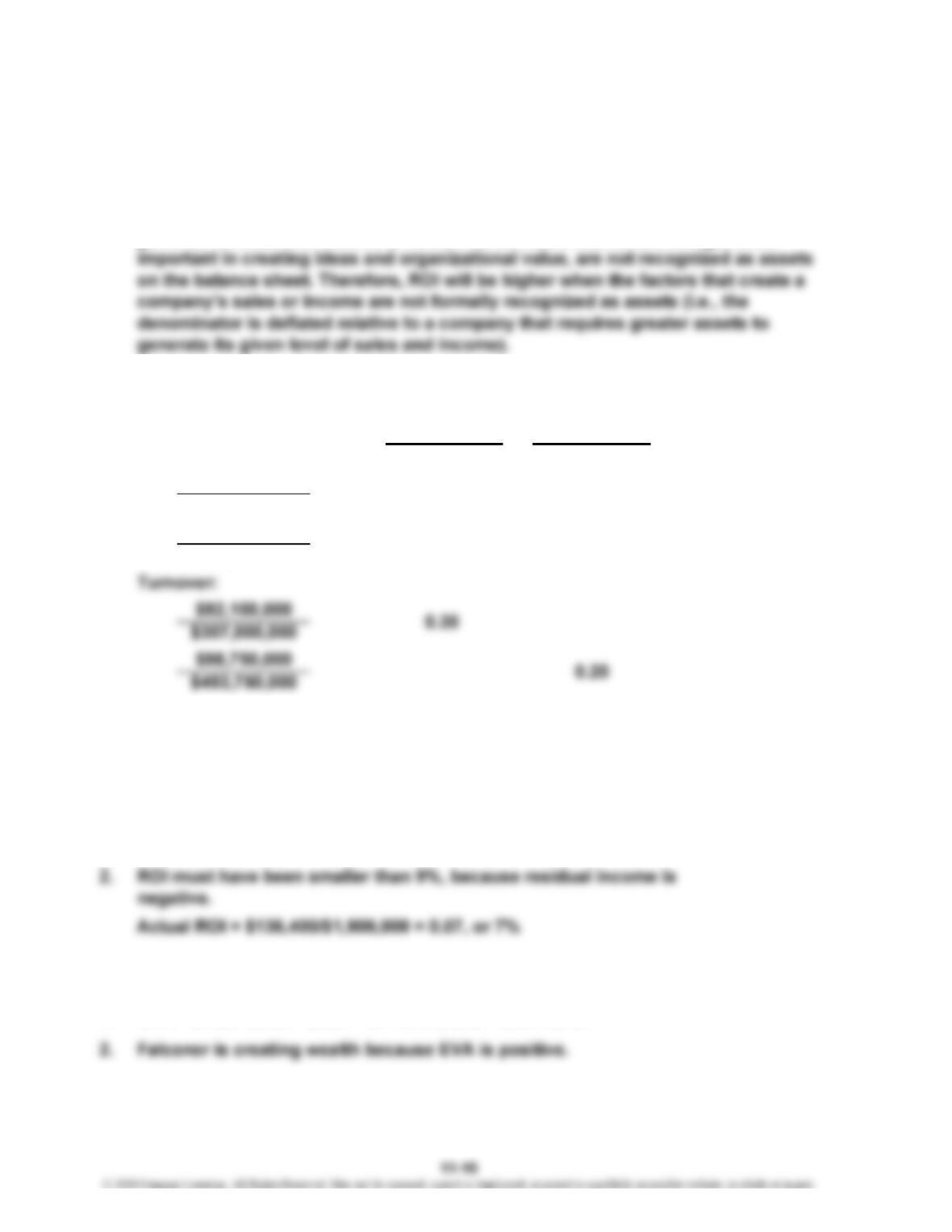
5. Elway Company might be a service organization with relatively few physical assets
required to generate its sales revenue and income. For example, for many service
organizations, and some manufacturers, one of the most important factors that
generate revenue and income is human talent. However, human beings, while
E 11-28
1. Year 1 Year 2
Margin:
2. ROI Year 1 = 0.10 × 0.30 = 0.03, or 3%, or $9,210,000/$307,000,000
ROI Year 2 = 0.08 × 0.20 = 0.02, or 2%, or $790,000/$493,750,000
E 11-29
1. Residual Income = $136,400 – (0.09 × $1,900,000) = –$34,600
E 11-30
1. EVA = $12,375,400 – (0.09 × $111,754,000) = $2,317,540
0.10, or 10%
0.08, or 8%
$9,210,000
$92,100,000
$7,900,000
$98,750,000
E 11-31
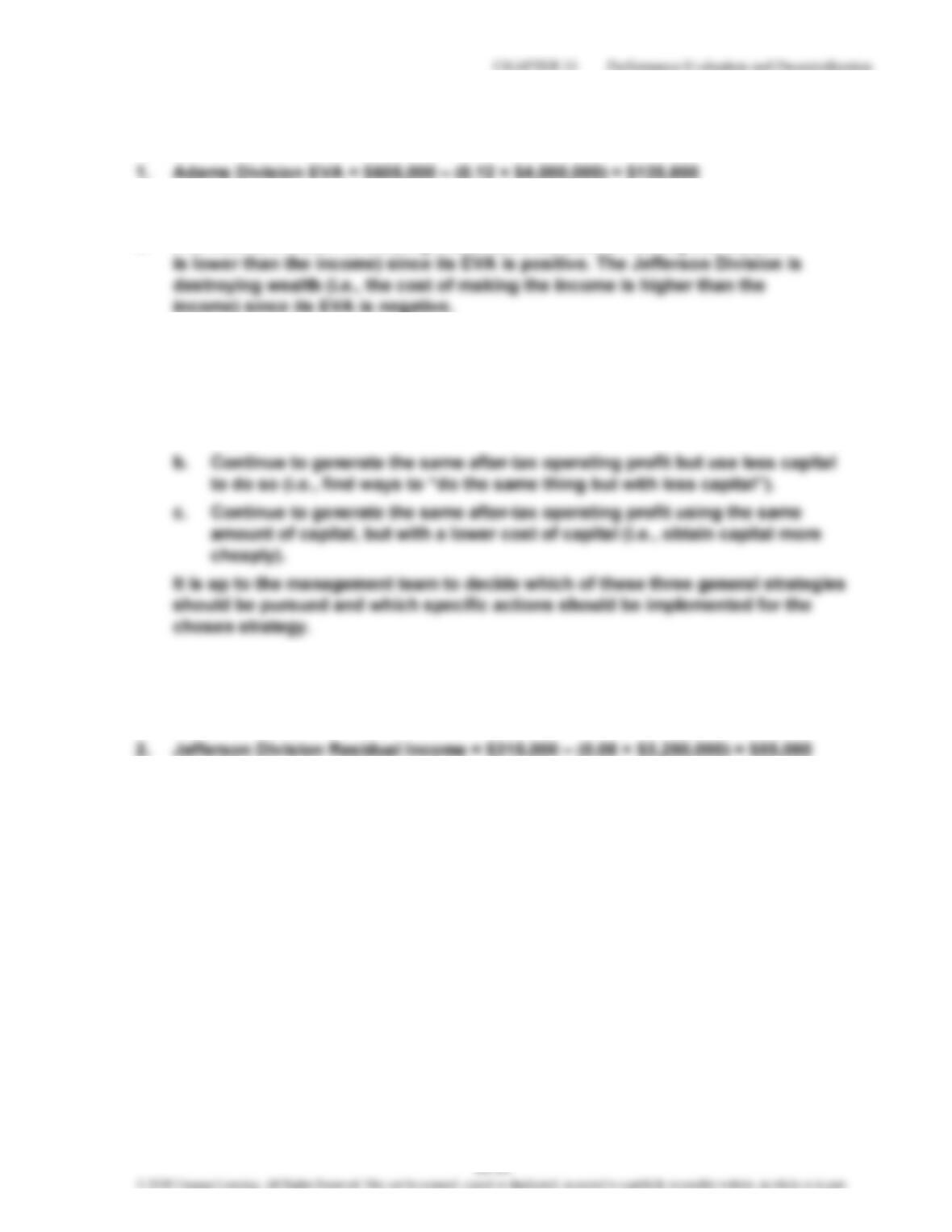
2. Jefferson Division EVA = $315,000 – (0.12 × $3,250,000) = ($75,000)
3. The Adams Division is creating wealth (i.e., the cost of making the income
4. Washington’s management can increase Jefferson Division’s EVA by doing any
of the following items:
a. Increase the after-tax operating profit that is generated from using the same
amount of invested capital (i.e., find ways to “do more with the same level of
capital”).
E 11-32
1. Adams Division Residual Income = $605,000 – (0.08 × $4,000,000) = $285,000
CHAPTER 11 Performance Evaluation and Decentralization
E 11-33
1. The maximum transfer price is set by the buying division, in this case, the Motel
Division. The minimum transfer price is set by the selling division, in this case,
the Furniture Division.
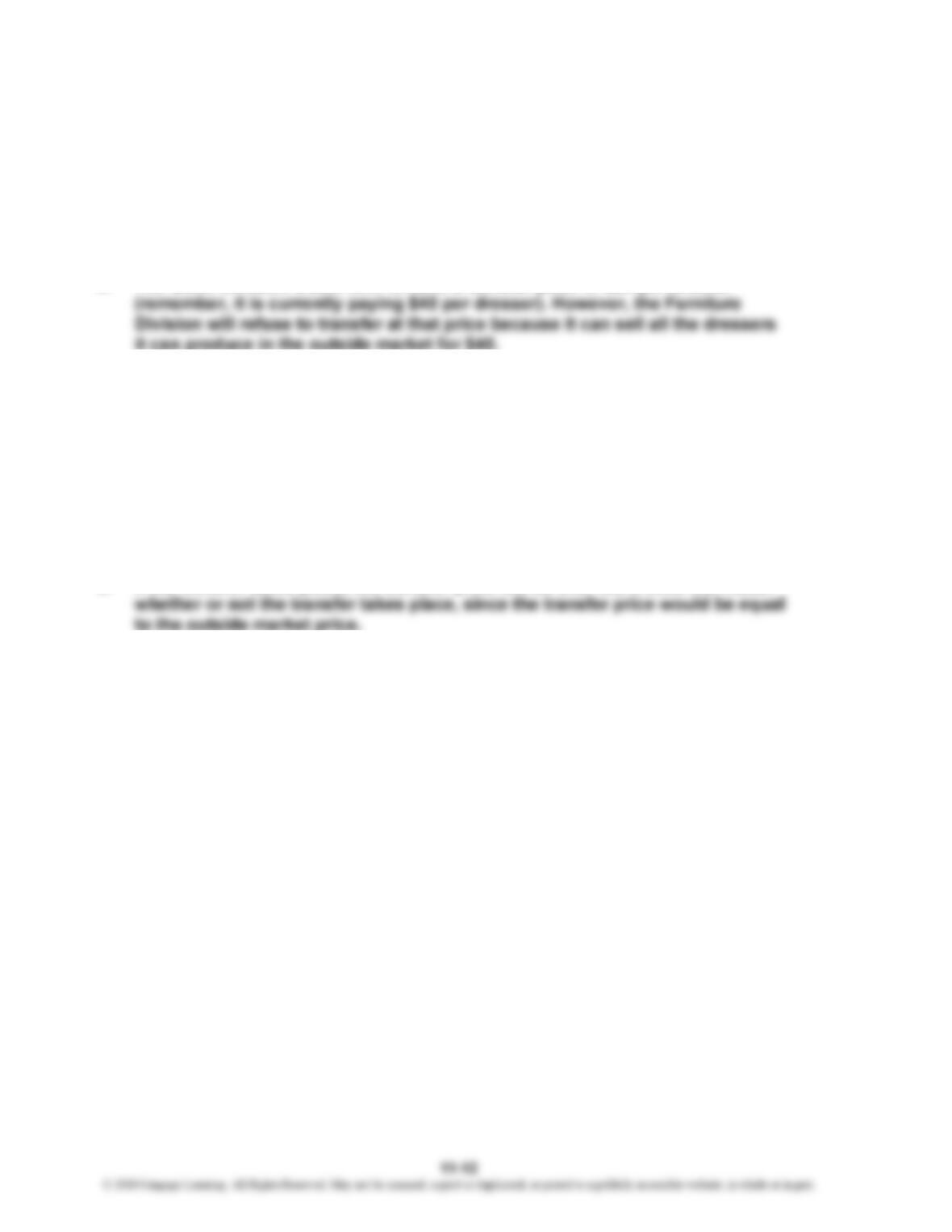
2. Full Cost Transfer Price = $29
3. The Motel Division would love to have a transfer price of $29 per dresser
E 11-34
1. The maximum transfer price, set by the Motel Division, is $40. Remember,
the Motel Division would not pay any more than $40 because that is the
price it currently pays to outside suppliers.
2. The minimum transfer price, set by the Furniture Division, is $40. Remember
that this division is operating at capacity and can sell all that it makes to outside
buyers for $40.
3. If the transfer takes place, the transfer price will be $40. No, it does not matter