CHAPTER 11 Performance Evaluation and Decentralization
E 11-35
1. The maximum transfer price, set by the Motel Division, is $40. maximum transfer price 40
2. The minimum transfer price, set by the Furniture Division, is $14. In this case, only minimum transfer price 14
variable costs of $14 per dresser are relevant because the Furniture Division has variable cost 14
excess capacity.
3. Benefit to Furniture Division:
Revenue ($35 × 10,000) $350,000 35 × 10,000 = 350,000
Less: Variable cost ($14 × 10,000) 140,000 14 × 10,000 = 140,000
Benefit
$210,000
Benefit
E 11-36 (Appendix)
1. Theoretical Cycle Time = (10,000 hours × 60 minutes per hour)/50,000 units 10,000 × 60 / 50,000 = 12
= 12 minutes per unit
2. Actual Cycle Time = (10,000 hours × 60 minutes per hour)/40,000 units 10,000 × 60 / 40,000 = 15
= 15 minutes per unit
E 11-37 (Appendix)
1. Theoretical Cycle Time = (30,000 hours × 60 minutes per hour)/90,000 units 30,000 × 60 / 90,000 = 20
= 20 minutes per unit
2. Actual Cycle Time = (30,000 hours × 60 minutes per hour)/75,000 units 30,000 × 60 / 75,000 = 24
= 24 minutes per unit
CHAPTER 11 Performance Evaluation and Decentralization
E 11-38 (Appendix)
1. Processing Time = Theoretical Cycle Time = 9 minutes per unit theoretical cycle time 9.0
Nonprocessing Time
=Actual Cycle Time – Theoretical Cycle Time
E 11-39 (Appendix)
1. Processing Time = Theoretical Cycle Time = 10 minutes per unit
Nonprocessing Time
=Actual Cycle Time – Theoretical Cycle Time
=16 minutes – 10 minutes = 6 minutes per unit 16 – 10 = 6

CHAPTER 11 Performance Evaluation and Decentralization
P 11-40
1. a. ROI of Division without Radio = $725,000/$3,625,000 = 0.20, or 20% 725,000 / 3,625,000
=
20%
b. ROI of the Radio Project = $640,000/$4,000,000 = 0.16, or 16% 640,000 / 4,000,000
=
16%
+
2. a. Residual Income of Division without Radio = $725,000 – (0.12 × $3,625,000) 725,000 – 12%
×
3,625,000
=
290,000
= $290,000
b. Residual Income of the Radio Project = $640,000 – (0.12 × $4,000,000) 640,000 – 12%
×
4,000,000
=
160,000
= $160,000
c. Residual Income of Division with Radio = $1,365,000 – (0.12 × $7,625,000) 725,000
+
640,000 – 12%
×
3,625,000 +
= $450,000 4,000,000
=
450,000
PROBLEMS

CHAPTER 11 Performance Evaluation and Decentralization
P 11-41
$1,200,000 1,200,000
$15,000,000 15,000,000
$1,200,000 1,200,000
$10,000,000 10,000,000
$10,000,000 10,000,000
$15,000,000 15,000,000
The ROI increased because expenses decreased and assets turned over at a
higher rate (sales increased).
3. Operating assets: $15,000,000 × 0.80 = $12,000,000 15,000,000 × 80% = 12,000,000
$945,000 945,000
$12,000,000 12,000,000
$9,000,000 9,000,000
Margin:
10.5%
=
=
0.75
Turnover:
=
0.75
=
10.50%
$1,200,000 1,200,000
$12,000,000 12,000,000
$1,200,000 1,200,000
$10,000,000 10,000,000
$10,000,000 10,000,000
0.83
Turnover:
=
=
0.83
0.12, or 12%
0.10, or 10%
4.
=
=
ROI:
Margin:
ROI:
Margin:
Turnover:
2.
7.88%
ROI:
=
=
=
=
0.08, or 8%
0.12, or 12%
0.67
=
10.00%
=
12.00%
=
0.08
=
0.12
=
0.67
=
7.88%
CHAPTER 11 Performance Evaluation and Decentralization
P 11-42
1. Air Conditioner ROI = $90,000/$750,000 = 0.12, or 12% 90,000 /750,000 = 12%
Turbocharger ROI = $82,080/$540,000 = 0.15, or 15% 82,080 /540,000 = 15%
2. With Air With With Both Neither average assets 28,900,000
0.15
3. The manager will choose the turbocharger, but not the air conditioner. 0.15
4. a. = $4,425,000 – (0.14 × $29,650,000) 4,425,000 – 14% × 29,650,000 = 274,000
= $274,000
b. Residual Income with Turbocharger = $4,417,080 – (0.14 × $29,440,000) 4,417,080 – 14% × 29,440,000 = 295,480
= $295,480
c. Residual Income with Both = $4,507,080 – (0.14 × $30,190,000) 4,507,080 – 14% × 30,190,000 = 280,480
= $280,480
d. Residual Income with Neither = $4,335,000 – (0.14 × $28,900,000) 4,335,000 – 14% × 28,900,000 = 289,000
= $289,000
While the residual income is positive in all four cases, the manager will choose the
turbocharger, but not the air conditioner, since the residual income is highest for
that alternative.
5. a. Residual Income with Air Conditioner = $4,425,000 – (0.10 × $29,650,000) 4,425,000 – 10% × 29,650,000 = 1,460,000
= $1,460,000
b. Residual Income with Turbocharger = $4,417,080 – (0.10 × $29,440,000) 4,417,080 – 10% × 29,440,000 = 1,473,080
= $1,473,080
c. Residual Income with Both = $4,507,080 – (0.10 × $30,190,000) 4,507,080 – 10% × 30,190,000 = 1,488,080
= $1,488,080
d. Residual Income with Neither = $4,335,000 – (0.10 × $28,900,000) 4,335,000 – 10% × 28,900,000 = 1,445,000
= $1,445,000
The manager will choose to invest in both the air conditioner and the turbocharger
In this case, the minimum required return on investment, 10%, is lower than the
ROIs of both projects. Therefore, both projects are profitable, and the highest
residual income is earned by investing in both.
Residual Income with Air Conditioner
CHAPTER 11 Performance Evaluation and Decentralization
P 11-43
1. $310,000/$3,000,000 = 0.1033, or 10.33% 310,000 /3,000,000 = 0.1033
310,000
3,450,000
3,450,000
3,000,000
ROI = 1.15 × 0.0899 = 0.1034, or 10.34% 1.15 × 0.09 = 0.1034
310,000 + 57,500
3.
0.105, or 10.5%
=
500,000
=
10.5%
=
310,000 + 57,500
3,450,000 + 575,000
3,450,000 + 575,000
3,000,000 + 500,000
The margin has increased, and the turnover ratio has stayed the same.
Margin:
Turnover:
2.
$310,000
$3,450,000
$3,450,000
$3,000,000
=
=
0.0899, or 8.99%
1.15
0.0913, or 9.13%
$3,450,000 + $575,000
=
1.15
1.15
=
$310,000 + $57,500
=
9.13%
Margin:
=
4.
Turnover:
$3,450,000 + $575,000
$3,000,000 + $500,000
=
=
0.0899
1.15
CHAPTER 11 Performance Evaluation and Decentralization
P 11-44
1. Lorne should not reduce the price charged to Rosario if he can sell all he produces. maximum price 75
It does not matter whether the two divisions trade internally or not.
2. The minimum price is $53, and the maximum is $75. Yes, Lorne should consider the 63 – 10 = 53
transfer, since his income will increase by $59,500 [3,500 × ($70 – $53)]. 3,500 × 70 – 53 = 59,500
3. The transfer price would be $75.60 ($63 × 1.2). No, the transfer would not occur, 63 × 1.20 = 75.60
since the transfer price is higher than the outside price that Rosario could get.
Y34 sales 40,000 × 6.5 = 260,000
P 11-45 SC67 sales 40,000 × 42.0 = 1,680,000
1. Model SC67 Company Y34 variable exp. 40,000 × 6.5 – 2.5 = 160,000 Y34 SC67
Sales………………………………………………………………………………………………………..
$260,000 $1,680,000 $1,940,000 SC67 variable exp. 40,000 × 38.0 – 15.0 = 920,000 unit price 6.5 42
Variable expenses…………………………………………………………………………………………………..
160,000 920,000 1,080,000 direct materials 2.5 12.5
Contribution margin…………………………………………………………………………………………………..
$100,000 $ 760,000 $ 860,000 direct labor 0.5 3.0
2. The transfer price should be the market price of $12. This is the minimum price for variable overhead 1.0 1.0
the Components Division and the maximum price for the PSF Division. fixed overhead 2.5 15
total unit cost 6.5
3. Unless the PSF Division is able to increase the price of Model SC67, the manager market price 12
will discontinue production and will not purchase any of the components. (The units 40,000
cost of producing the scanner will increase from $38 to $43.50 ($38 – $6.50 + $12.00), 38
a cost greater than the current selling price of $42.)
4. All 40,000 units of Component Y34 will be sold externally at the market price of $12
per unit.
5.
Sales…………………………………………………………………………………………………………………………….
Variable expenses…………………………………………………………………………………………………………………………….
Contribution margin…………………………………………………………………………………………………..
The contribution margin decreases by $540,000. Cam made the wrong decision. 860,000 – 320,000 = 540,000
Component Y34
CHAPTER 11 Performance Evaluation and Decentralization
P 11-46
1. Minimum: $26 31 – 5 = 26 saving in selling & distn. cost 5
Maximum: $31 31 price charged to outside customers 31
In terms of full cost-plus markup,
$28.50 = $20.00 + (Markup Percentage × Full Cost) 28.50 = 20.00 + ?
Markup = $28.50 – $20.00 = $8.50 28.50 – 20.00 = 8.50
Markup Percentage = $8.50/$20.00 = 0.425, or 42.5% 8.50 / 20.00 = 0.425
=
28.50
2
$28.50
3. New minimum: $27 32 – 5 = 27
New maximum: $32 32
27 + 32
or full cost plus 47.5% [($29.50 – $20.00)/$20.00] 29.50 – 20.00 / 20.00 = 47.5%
4. The two divisions would renegotiate because the buying division would probably
be able to buy the necessary part at a lower price from another supplier. The
Auxiliary Components Division might have to reduce its price.
=
29.50
$27 + $32
2
2
=
$29.50
CHAPTER 11 Performance Evaluation and Decentralization
P 11-47 (Appendix)
$2,700,000 2,700,000
600,000 600,000
= $4.50 per minute
Theoretical Conversion Cost per Unit = $4.50 × 30 4.5 × 30 = 135
=$135
3. An incentive exists to reduce product cost by reducing cycle time. For example,
current cycle time is 40 minutes per unit. If cycle time could be reduced to 30 30
minutes per unit, conversion costs would be reduced from $180 per unit to $135
P 11-48 (Appendix)
1. a. Customer
b. Internal business process
c. Financial
d. Financial
e. Learning and growth
2. Answers will vary.
Financial—contribution margin by product
Customer—number of complaints
Internal business process—number of accidents per month
Learning and growth—hours of continuing education provided per month
=
1.
=
4.50
=
Theoretical Rate
CHAPTER 11 Performance Evaluation and Decentralization
P 11-49 (Appendix)
1,000 repairs 1,000
500 hours 500
=
Theoretical Cycle Time
=
30 + 4 + 10 + 6
=
1.20
= 1.20 repairs per hour
Actual Velocity
1.
= 2 per hour
MCE
=
=
=
Theoretical Velocity
= 0.60, or 60%
Productivity Time
Total Time
30 + 4 + 10 + 6
2.
=
2
0.60
30
=
30
CHAPTER 11 Performance Evaluation and Decentralization
Case 11-50
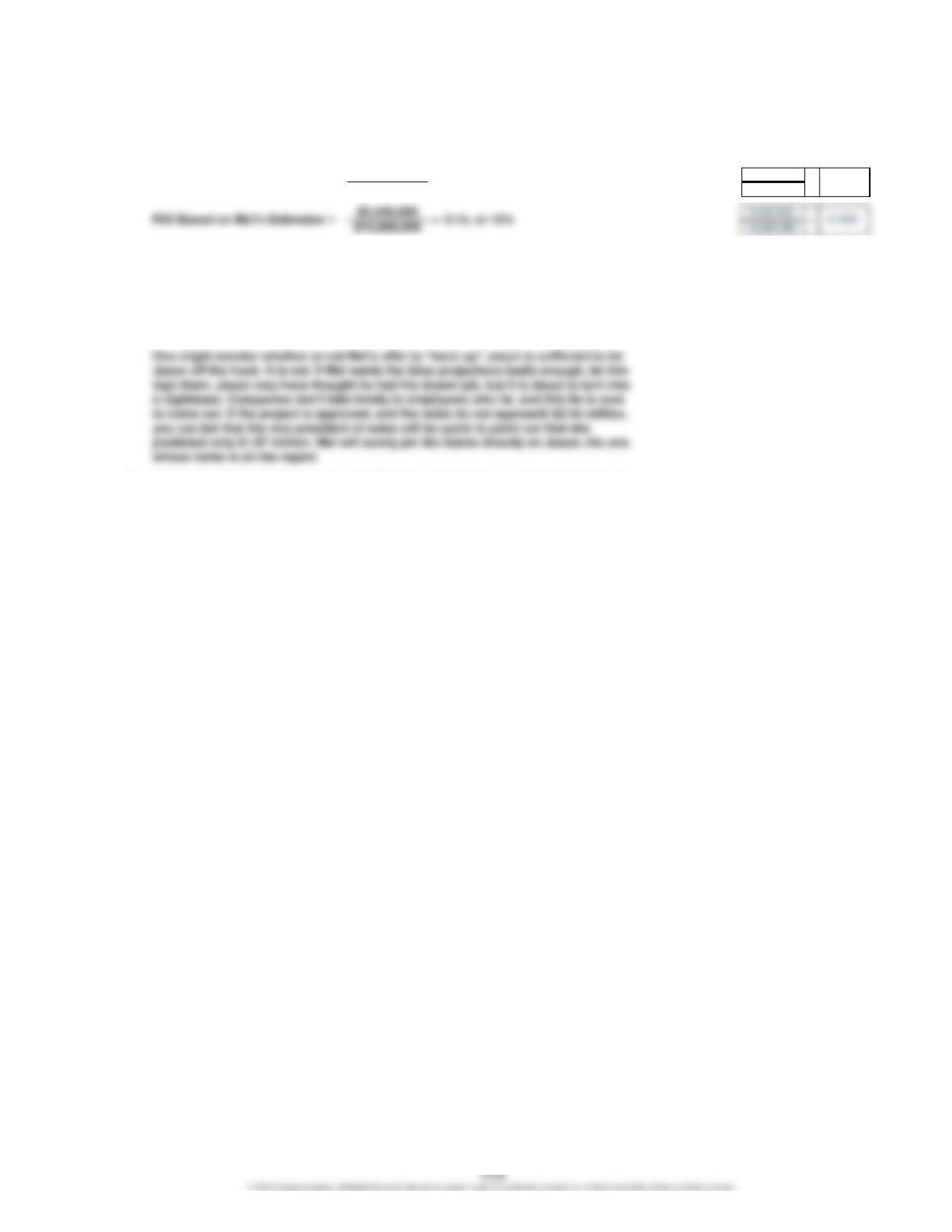
$1,870,000 1,870,000
$15,600,000 15,600,000
$2,340,000 2,340,000
$15,600,000 15,600,000
=
0.1500
=
0.15, or 15%
2. Jason is definitely facing an ethical dilemma. While it is true that the sales and
expense projections are estimates, they are the best ones available to him. If
he uses a sales revenue projection from the top end of the range, he will be
deliberately basing the ROI estimate on a highly unlikely sales figure. Sales
and expense projections are not fantasy figures. They are supposed to be
management’s best estimate of what will actually happen. If Jason prepares
the report in accordance with Mel’s desires, he will be knowingly fabricating data.
One might wonder whether or not Mel’s offer to “back up” Jason is sufficient to let
Jason off the hook. It is not. If Mel wants the false projections badly enough, let him
a nightmare. Companies don’t take kindly to employees who lie, and this lie is sure
you can bet that the vice president of sales will be quick to point out that she
predicted only $1.87 million. Mel will surely pin the blame directly on Jason, the one
whose name is on the report.
3. Jason should prepare the report using the figures he thinks are most descriptive of
the project’s potential. He should feel free to include information about the predicted
range of sales and to point out any other information that reflects favorably on the
project. If Mel continues to pressure Jason, then Jason might consider looking for
another job.
CASE
=
0.1199
1.
ROI Based on Initial Estimates =
=
0.1199, or 11.99%