
Auditing: A Risk Based Approach to Conducting a Quality Audit, 10e
Solutions for Chapter 11
True/False Questions
11-2 T
11-4 T
11-6 T
11-8 F
11-10 T
11-12 T
11-14 T
11-16 T
Multiple-Choice Questions
11-18 D
11-20 A
11-22 C
11-24 E
11-26 A
11-28 D
11-30 D
11-32 E
11-2
Review and Short Case Questions
11-33
2. Purchase of goods and services
4. Approval of items for payment
11-34
An automated purchasing system is a networked software system linking to vendors whose
offerings and prices have been preapproved by appropriate management. An automated
purchasing system can perform the following beneficial tasks:
• Apply preloaded specifications and materials lists to the system to start the process
11-35
2. A
4. B
11-36
2. B
4. E
11-37
Inventory is a complex accounting and auditing area because of the following:
• A great variety (diversity) of items exists in inventory.
• Inventory accounts typically experience a high volume of activity.
11-3
• Inventory often exists at multiple locations with some locations being remote from the
company’s headquarters.
11-38
a. Management has an incentive to bring the amounts in the allowance for doubtful
accounts back into income this year in order to offset the loss from the write-down in inventory.
b. The difficulty in this setting is that management is not maintaining a standard of reporting
the financial status of the company in a representationally faithful manner. In contrast to this
argument, some management teams will counter that by smoothing the income numbers they are
actually helping shareholders because stock valuations may be more favorable for income
streams that are more predictable.
c.
• Identify the ethical issue(s).
The auditor’s ethical difficulty is that there is little verifiable evidence to suggest that the
allowance for doubtful accounts should be maintained at the current, high level. Yet, the
auditor realizes that the reason management is pulling that adjustment back into income
this year is simply to offset the loss on the write-down of inventory. Further, the auditor
believes that the client’s write-down of inventory is not sufficient.
• Determine the most important rights.
Shareholders of the company because they are the most numerous and stand to lose most
directly from the problems. Further, they are not in any way at fault, unlike the members of
the audit committee, board, or individual auditors.
11-4
• Develop alternative courses of action.
In this case setting there are a number of options for the auditor to consider.
Option one: allow management to reduce the allowance for doubtful accounts at
approximately the amount they desire. Obtain evidence supporting that reduction,
including patterns of collectibility from customers and analyses of industry norms in this
regard.
Option one: likely consequences are unknown, although it does appear that a reduction
in the allowance account may be an action that would result in financial statements that
present an accurate picture of the company.
Option two: likely consequences are unknown; it is not possible to determine if
management will resist this alternative. However, a write-down of the inventory may be
of the conceptual framework, such as reliability, to convince management teams that
reporting truthfully is more important than reporting income streams that are highly
predictable.
• Assess the possible consequences, including an estimation of the greatest good for the
greatest number.
The greatest good for the greatest number likely accrues to the actions associated with
options one and two. These actions will likely result in the financial statements presenting
• Decide on the appropriate course of action.
11-39
Examples of common fraud schemes in the acquisition and payment cycle include:
2. Inventory shrinkage, which is a reduction in inventory presumed to be due to physical loss
or theft
4. Employees recording fictitious inventory or inappropriately recording higher values for
existing inventory by creating false records for items that do not exist (for example,
inflated inventory count sheets, and bogus receiving reports or purchase orders)
7. Executives misusing travel and entertainment accounts and charging them as company
expense
11-6
11-40
Nature of the Fraud
Motivation for the
Fraud
How the Fraud Was
Perpetrated
WorldCom
Overstatement of
assets and income
To meet earnings
expectations; to show
that the managers
Managers debited
fixed assets rather
than expenses.
Phar-Mor
Overstatement of
ending inventory
minor-league
basketball team
To cover up misuse of
company money that
Inflation of inventory
costs.
11-41
a. The auditor is responsible for identifying material fraud. Although the amount of the
fraud may be material to the head bookkeeper, it is most likely not material to the financial
statements as a whole. The auditor is also responsible for maintaining a skeptical audit approach
when control risk is assessed as high. It would appear that the lack of segregation of duties
within the bookkeeping function would lead to a high control risk assessment.
b. Deficiencies evident in the client’s internal control include:
• inadequate segregation of duties with the bookkeeper able to vouch items for payment
and records the disbursement.
c. Substantive audit procedures that would be effective in uncovering the fraud include:
• examination of support for large checks that have not cleared the bank within a month of
year-end.
11-7
• investigation of increases in expenses in particular accounts. This is not likely to be very
effective since Morgan has carried on the fraud for a number of years so that comparison
with previous years would not likely show an unusual increase.
11-42
a. The receiving department electronically scans bar codes on the goods received to record
quantity and visually inspects for quality. (3)
b. Computer-generated purchase orders are reviewed by the purchasing department. (1)
c. Management approves contracts with suppliers. (2)
d. Management reviews payments and compares them to data such as production budgets. (5)
l. The receiving department prepares prenumbered receiving documents to record all receipts.
(3)
m. A three-way match is made between the invoice, the purchase order, and the receiving report.
(1)
o. Supporting documentation is canceled on payment to avoid duplicate payments. (4)
11-43
a. Deficiencies and inefficiencies are:
• Everyone is authorized to issue and file the purchase orders, but there is no ultimate
responsibility.
11-8
b. The process could be improved in the following ways:
• The department head should specify responsibility for the filing of the purchase
orders and those specified should be held accountable for the reliability of the files.
• The shipper’s invoice should be sent directly to filing personnel who should match the
shipper’s invoice and the purchase order. If matched, the shipper’s invoice should be
forwarded to the controller.
c. Incompatible functions (authorization, physical custody, and record keeping) need
to be segregated to minimize error and the possibility of an employee stealing an asset and
When these functions are automated, purchase orders are automatically generated by inventory
control system based on certain parameters. Those parameters should only be set or changed by
someone independent of the receiving and payment functions using appropriate access
d. Control risk should be set high (maximum) because receiving personnel have access to
the purchase order, the goods ordered, and the vendor’s invoice. Because of the high level of
control risk, the auditor should have a heightened level of professional skepticism. The controller
receives only the vendor’s invoice signed by receiving personnel who could steal the goods and
have the company pay for them.
11-9
11-44
The auditor can use cross-sectional analysis to help identify potential inventory misstatements
for a multi-location retail client by calculating inventory per square feet of store space and
11-45
Analytical procedures are effective in reviewing the trends in account balances by comparison
with previous years or other current independent data. Analyzing common-sized income
statements by comparing current year relationships of expenses to net sales with prior years and
industry information may help identify accounts that need special audit attention.
Examples of effective use of analytical procedures of specific expense accounts include:
• comparison of factory supplies expense with production data e.g., cost of goods sold or
• comparison of sales commission expense with sales
11-46
Panel A of Exhibit 11.7 shows that because of differences in risk, the box of evidence to be filled
for testing the existence of inventory at the low-risk client is smaller than that at a high risk
11-10
11-47
Deloitte’s auditors made the following errors in substantive analytical procedures for inventory
accounts:
They only observed physical inventory at one-half of one percent of the issuer’s locations (only
three locations) during the first half of the year, and used those results to develop an expectation
11-48
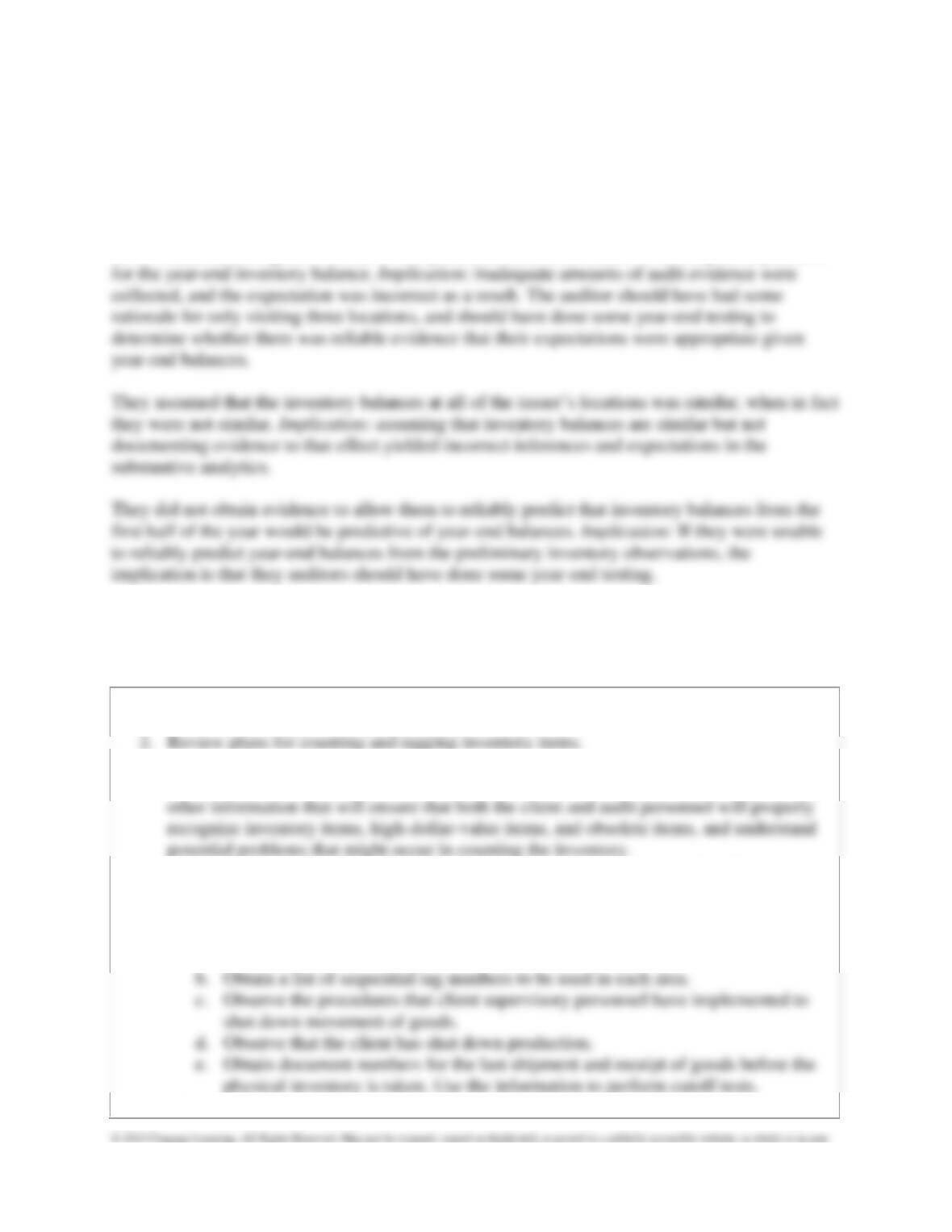
Procedures for Observing a Physical Inventory Count
1. Meet with client personnel to discuss the procedures, timing, location, and personnel
involved in taking the annual physical inventory.
3. Review the inventory-taking procedures with all audit firm personnel. Familiarize them
with the nature of the client’s inventory, potential problems with the inventory, and any
4. Determine whether specialists are needed to test or assist in correctly identifying
inventory items.
5. Upon arriving at each site:
a. Meet with client personnel, obtain a map of the area, and obtain a schedule of
inventory counts to be made for each area.
6. Observe the counting of inventory and note the following on inventory count working
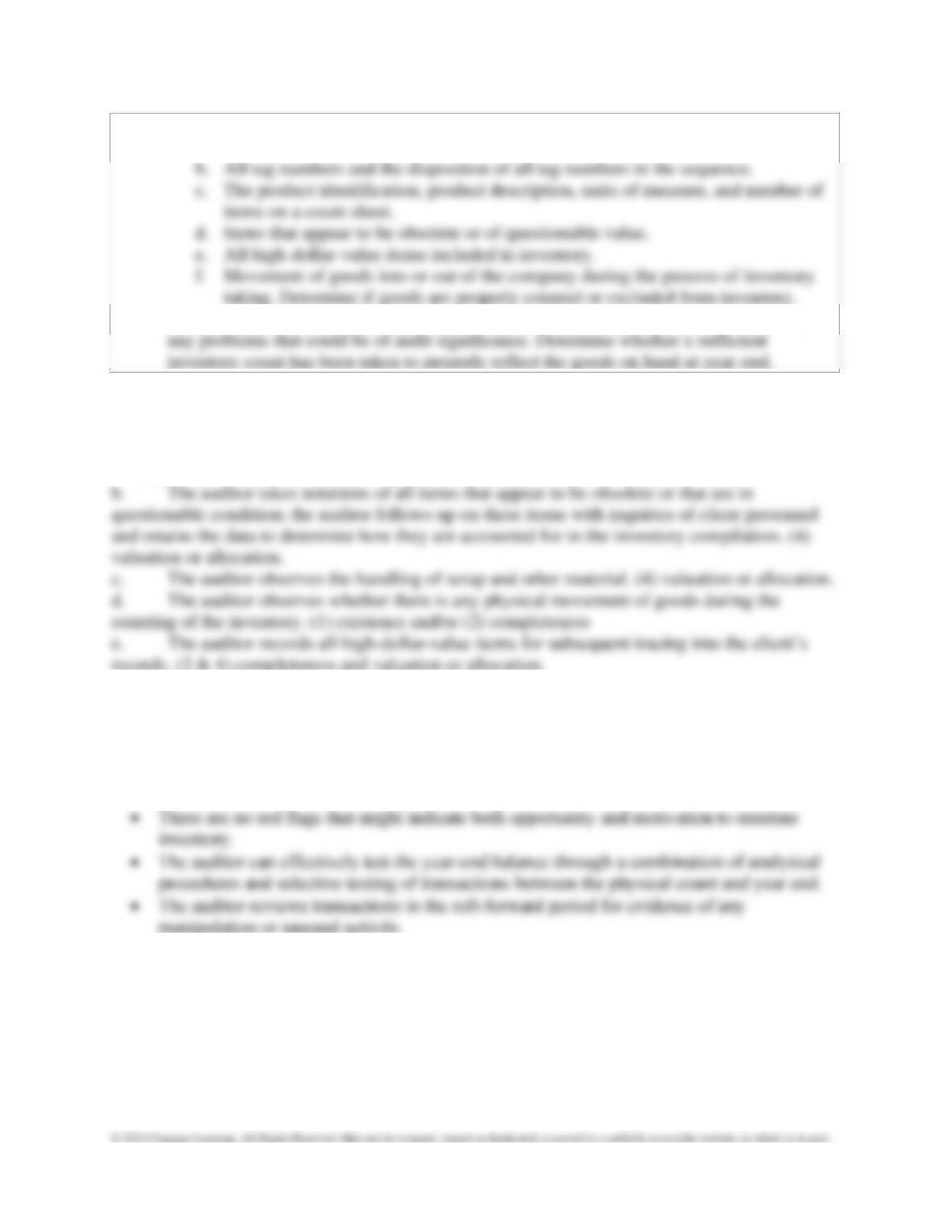
11-11
papers:
a. The first and last tag number used in the section.
7. Document conclusion as to the quality of the client’s inventory-taking process, noting
11-49
a. The auditor makes test counts of selected items and records the test counts for subsequent
tracing into the client’s inventory compilation. (2) completeness.
11-50
It is acceptable to have the client take inventory before year end provided that:
• Internal control is effective.
11-51
Examples of corroborating evidence include:
• Noting potential obsolete inventory when observing the client’s physical inventory
• Calculating inventory turnover, number of days’ sales in inventory, date of last sale or
purchase, and other similar analytic techniques to identify potential obsolescence
11-12
• Calculating net realizable value for products by referring to current selling prices, cost of
disposal, and sales commissions
• Monitoring trade journals and the Internet for information regarding the introduction of
11-52
The following are fraud-related substantive procedures for inventory and cost of goods sold:
• Observe all inventory locations simultaneously.
11-53
The following are examples of fraud in inventory accounts:
• Empty boxes or hollow squares in stacked goods
• Mislabeled boxes containing scrap, obsolete items, or lower-value materials
• Arranging for false confirmations of inventory held by others
• Including inventory receipts for which corresponding payables had not been recorded
• Overstating the stage of completion of work-in-process
11-54
2. Review the client’s financial statement disclosures of accounts payable and expense
accounts such as travel and entertainment. (e)
4. Examine a sample of cash disbursements made after the end of the year to determine
whether the disbursements are for goods and services applicable to the previous year. (b)
6. Perform analytical review of related expense accounts, for example, travel and
entertainment or legal expenses. (b)
8. Agree monthly statements and confirmations from major vendors with the accounts
payable list. (b)
11-55
By examining cash disbursements after year end, the auditor sees payments that were made on
account. The question, then, is one of timing. The auditor needs to determine whether those
payments were for items purchased in the fiscal year being audited or the following fiscal year.
11-14
11-56
a. The unusual thing about the journal entry is that an expense is credited and a reserve
account is debited; usually expenses are debited and reserves are credited.
b. Yes, management would likely have had some explanation to provide an inquisitive
11-57
The information is used in performing year-end cut-off tests. All shipping or receiving
documents with higher numbers should be recorded in the next period and all receipts or
11-58
The major question associated with the increased automation of production is whether direct
11-59
The auditor should not comply with the client’s request. Auditors should not inform
11-15
professional skepticism. However, on some audits providing this information to the client may
be necessary for planning purposes. In those situations, the auditor may also choose to conduct a
surprise count at one or two locations.
11-60
11-61
Audit procedures that might be used to identify obsolete or slow-moving goods include:
• review industry trade journals to gain knowledge of new product introductions
and the relationship of the new products to existing products.
• calculate inventory turn-over on a product-line or individual product basis.
11-62
GAS can be used to help identify potentially obsolete inventory by:
• Aging the inventory items.
11-16
11-63
An auditor makes a number of test counts and other observations during the observation of the
client’s physical inventory. The objectives of the auditor’s counts and observations are to:
• verify that all goods were correctly counted, identified, and recorded.
11-64
A number of financial disclosures are required for inventory:
• inventory valuation method used (FIFO, LIFO, moving average) and the percentage of
inventory valued under each method
11-65
The two primary alternatives for gaining assurance about the correctness of a client’s perpetual
inventory system include:
• taking a random sample of perpetual inventory records and verifying the correctness of
11-66
Audit Procedure
a. Audit Objective / Management
Assertion
b. Type of Test
11-17
Audit Procedure
a. Audit Objective / Management
Assertion
b. Type of Test
payable file.
accounts payable liability.)
procedure.
2. Access to purchase agent
2. Determine the adequacy of controls
2. Test of the
followed.
3. Examine all items not
matched by automated
3. Determine the accuracy of recording
and support for payments. Assess
3. Both a substantive
test and a test of
payments.
be for charge-backs or for defective
of the accounts payable account.
substantive evidence
4. Review debits to accounts
payable for other than
4. The debits represent adjustments made
to the vendor account. The debits could
4. Primarily a test
that provides both
5. Use GAS to list receipts
that are not matched to
purchase orders.
the open items. Determine if the
purchasing agent had approved the
receipt of the goods without the purchase
the shipment and the vendor invoice.)
evidence.
5. Determine the adequacy of control
procedures by examining items that are in
`limbo’ in the system. Determine the
5. Primarily a test of
the operation of
controls. Provides
evidence on additional write-downs
evidence to be used
6. Database report of write-
downs by product line and by
6. Provides evidence of write-downs by
purchasing agent which may reflect on
6. Primarily a test of
control operations,
11-18
Audit Procedure
a. Audit Objective / Management
Assertion
b. Type of Test
7. Analysis of scrap by
product line.
7. Analysis provides evidence on the
adequacy of standard costs. The analysis
7. Both a test of
operation of controls
inventory.
8. Report of sales and
inventory data on a monthly
8. Determine seasonal relationship
between sales and inventory levels.
8. Primarily a
substantive audit
11-67
a. The major purpose served by observing the physical inventory count is to test the
existence assertion. In addition, the actual observation can provide the auditor with insight on the
extent of damaged goods, obsolete goods, movement of goods, returned goods, and so forth that
cannot be obtained without actually getting out into the factory, store, or distribution center and
observing the goods. This insight will help the auditor in testing the valuation assertion.
b. Items that should be noted by the auditor on the inventory observation workpaper
include:
• the starting tag number, voided tags, missing tag numbers, and the last tag number
used for each geographic area or location where inventory is observed.
• the adequacy of the physical counting process, including the quality of supervision
c. If the client takes a complete physical inventory, the auditor will have an opportunity to
view the entire inventory and to make judgments about the completeness of the counting, the
condition of the inventory, the general lay-out of the warehouse, etc. as a basis to identify goods
and determine potential obsolescence.
11-19
11-68
A high risk client has been identified. Given the situation, there is management motivation to
understate expenses and accounts payable. Further, the control environment is poor and the
auditor may not want to place much reliance on the internal controls. Accordingly, the auditor
will take a primarily substantive approach towards the audit, with great reliance on tests of
11-69
a. The accounts payable assertions are the same as the assertions used in testing all account
balances. The major difference is on emphasis: the work on accounts payable usually focuses on
potential understatement of the liability account, which suggests a focus on the completeness
assertion.
b. Mincin is not required to use accounts payable confirmations. Many auditors prefer not to
use accounts payable confirmations because they believe they can obtain convincing evidence by
examining vendor monthly statements, payments made subsequent to year-end, and examining
open accounts payable files. However, those procedures may be less effective when:
• the company does not have adequate control procedures to ensure that all items will
be identified or paid on a timely basis.
c. Sampling based on large dollar amounts is particularly good at identifying account
overstatements, such as accounts receivable overstatements. However, the primary emphasis on
11-70
The legal expense account is reviewed in detail because the billings by law firms may contain
11-71
Travel and entertainment expense may contain costs that are of a personal nature rather than
11-72
a. The PCAOB was concerned because Grant Thornton clearly did not perform sufficient
appropriate substantive procedures related to aspects of the client’s inventory accounts. While it
is appropriate to use substantive analytical procedures as the primary approach for testing some
accounts, it appears that the PCAOB’s concerns were that the auditors’ performance of these
procedures was inadequate. When analytical procedures are performed as a substantive