11-26 (20 min.) Choosing customers.
Rodeo Printers operates a printing press with a monthly capacity of 4,000 machine-hours. Rodeo
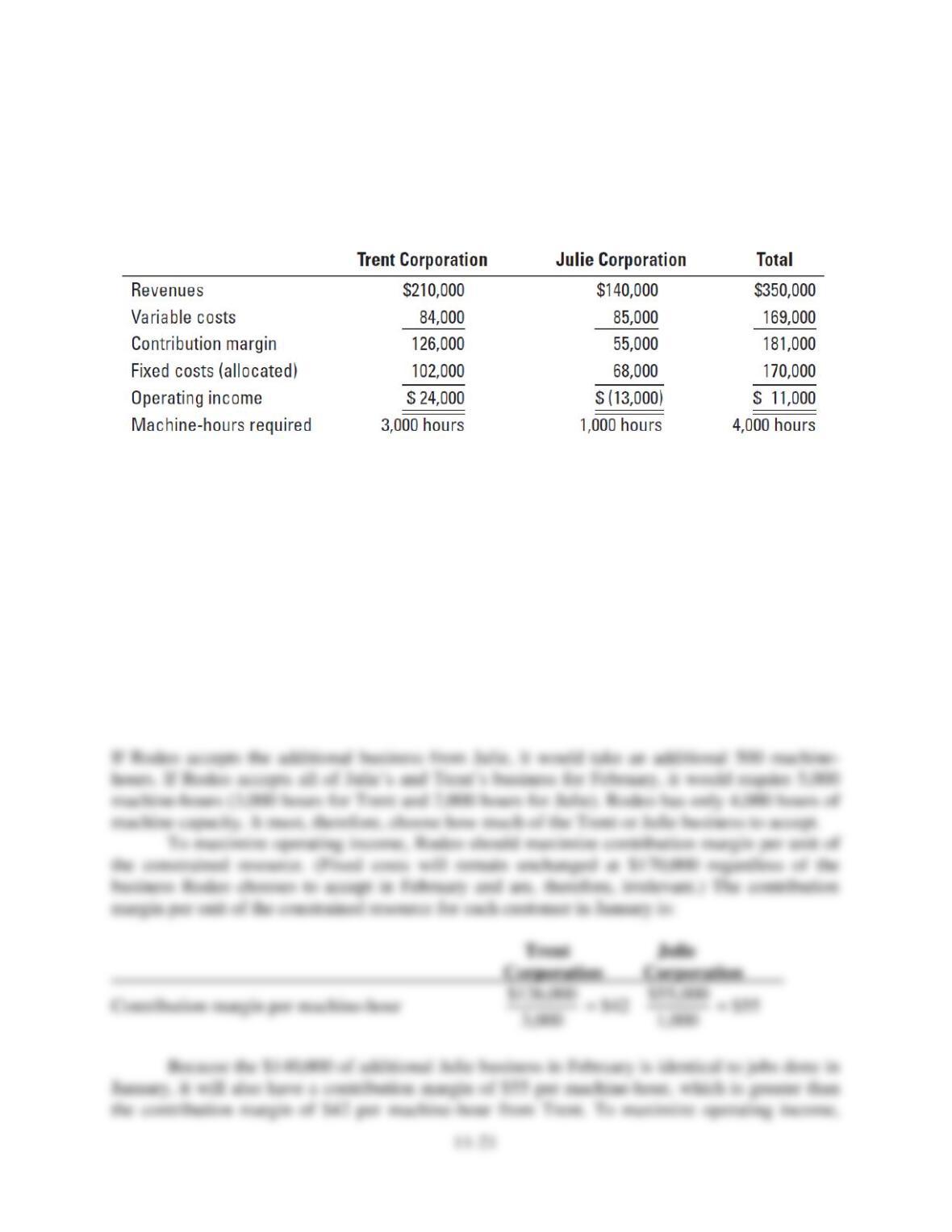
has two main customers: Trent Corporation and Julie Corporation. Data on each customer for
January are:
Julie Corporation indicates that it wants Rodeo to do an additional $140,000 worth of printing
jobs during February. These jobs are identical to the existing business Rodeo did for Julie in
January in terms of variable costs and machine-hours required. Rodeo anticipates that the
business from Trent Corporation in February will be the same as that in January. Rodeo can
choose to accept as much of the Trent and Julie business for February as its capacity allows.
Assume that total machine-hours and fixed costs for February will be the same as in January.
Required:
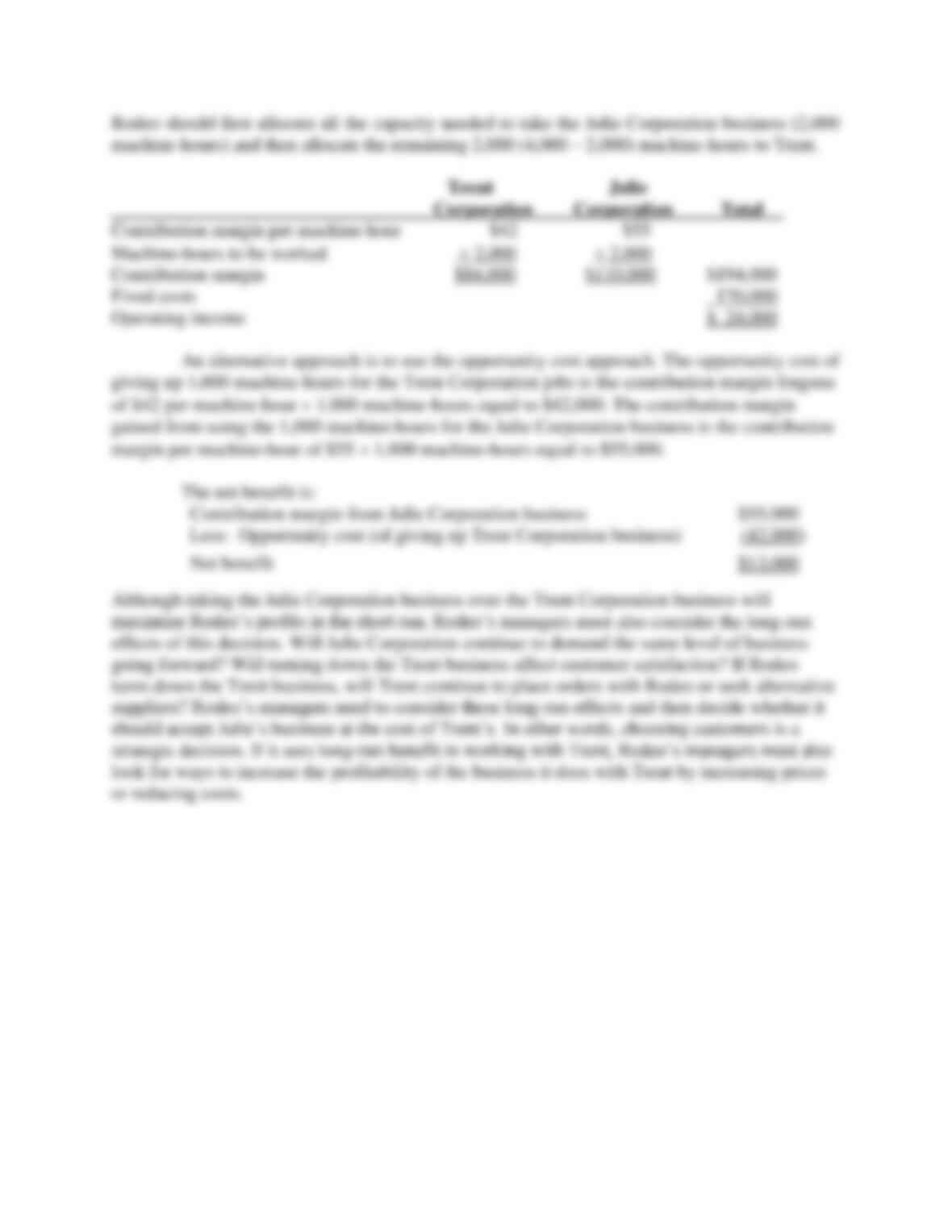
What action should Rodeo take to maximize its operating income? Show your calculations. What
other factors should Rodeo consider before making a decision?
SOLUTION
11-22
11-27 (20 min.) Relevance of equipment costs.
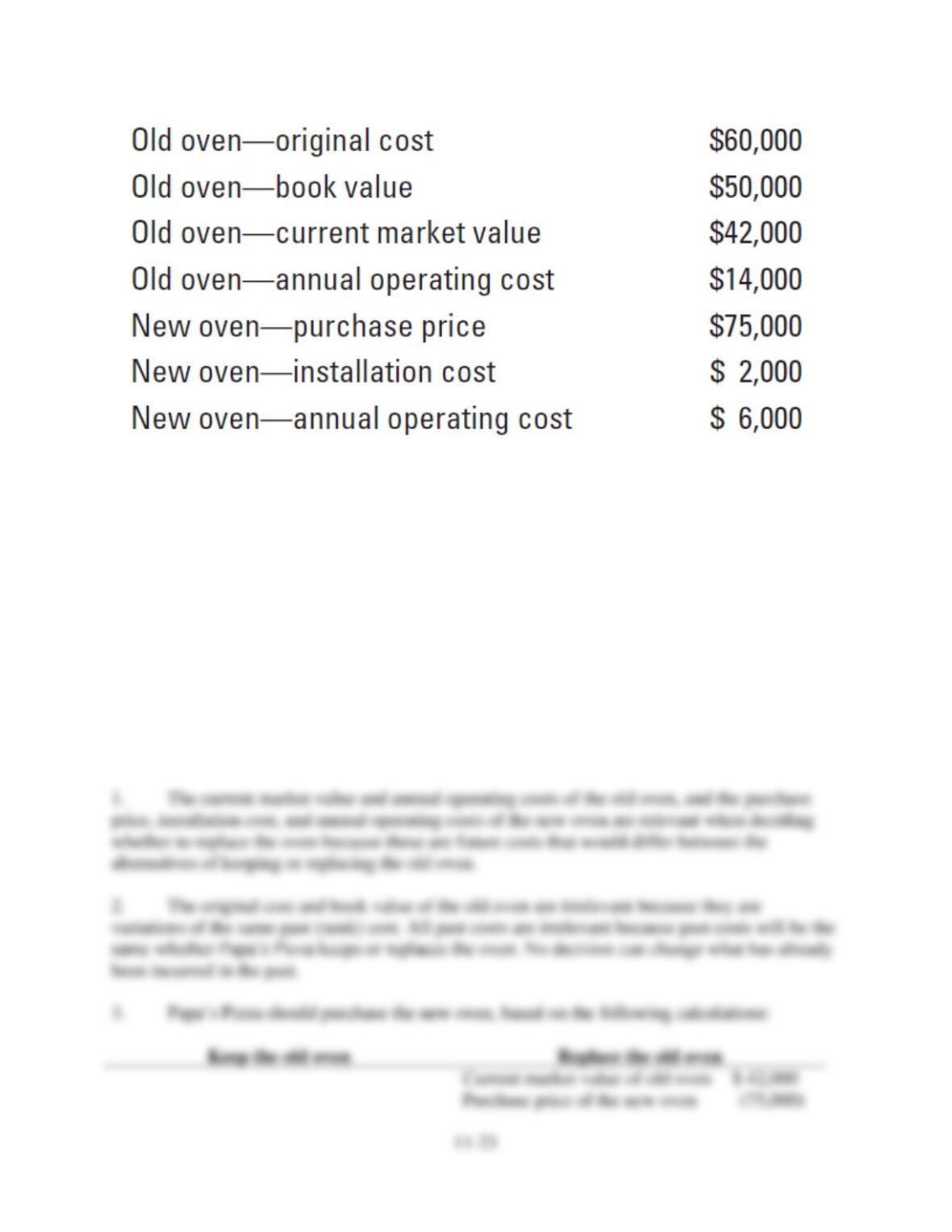
Papa’s Pizza is considering replacement of its pizza oven with a new, more energy-efficient
model. Information related to the old and new pizza ovens follows:
The old oven had been purchased a year ago. Papa’s Pizza estimates that either oven has a
remaining useful life of five years. At the end of five years, either oven would have a zero
salvage value. Ignore the effect of income taxes and the time value of money.
Required:
1. Which of the costs and benefits above are relevant to the decision to replace the oven?
2. What information is irrelevant? Why is it irrelevant?
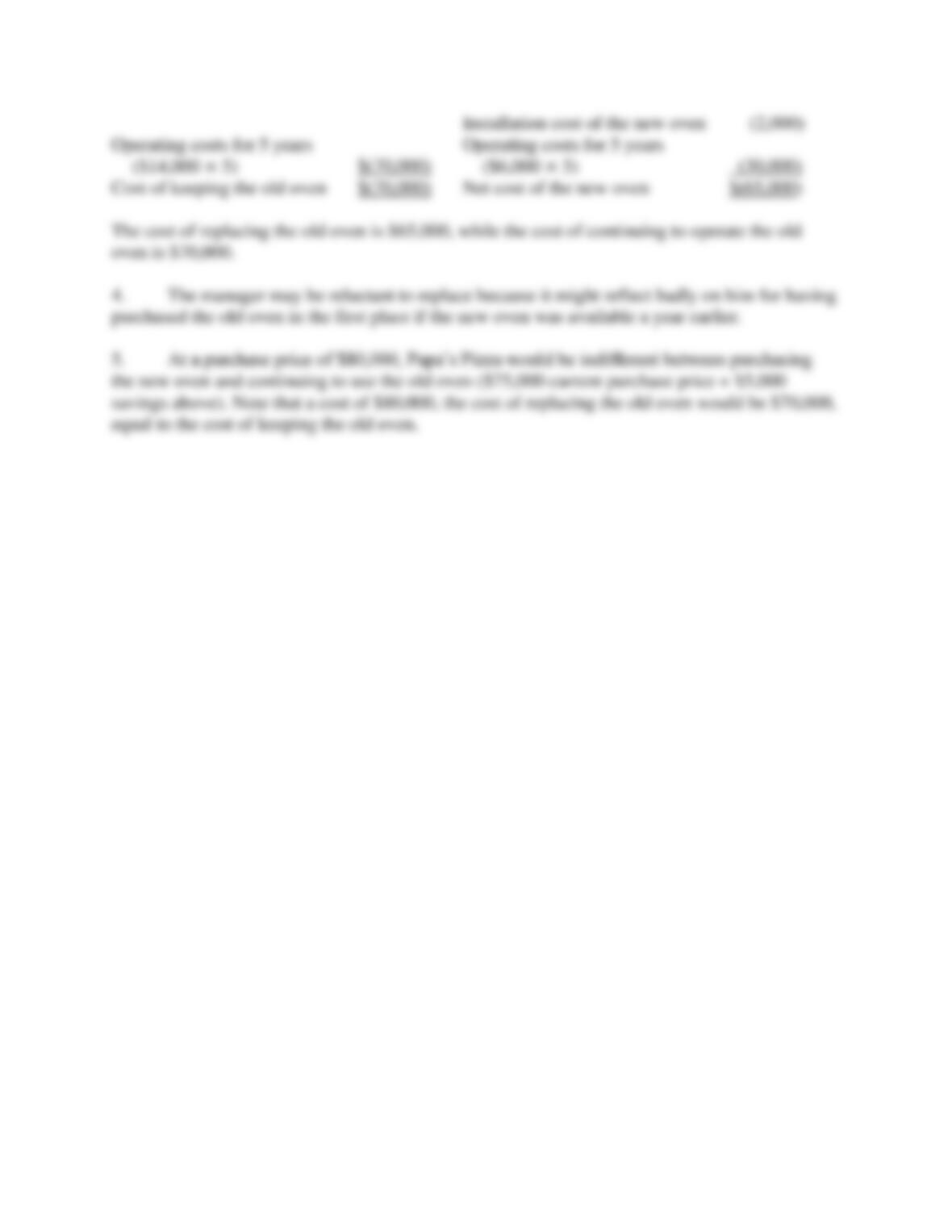
3. Should Papa’s Pizza purchase the new oven? Provide support for your answer.
4. Is there any conflict between the decision model and the incentives of the manager who has
purchased the “old” oven and is considering replacing it a year later?
5. At what purchase price would Papa’s Pizza be indifferent between purchasing the new oven
and continuing to use the old oven?
SOLUTION
11-24
11-25
11-28 (30 min.) Equipment upgrade versus replacement.
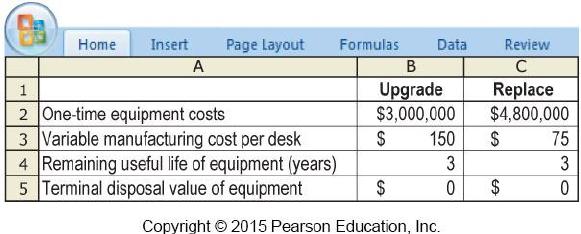
(A. Spero, adapted) The TechGuide Company produces and sells 7,500 modular computer desks
per year at a selling price of $750 each. Its current production equipment, purchased for
$1,800,000 and with a five-year useful life, is only two years old. It has a terminal disposal value
of $0 and is depreciated on a straight-line basis. The equipment has a current disposal price of
$450,000. However, the emergence of a new molding technology has led TechGuide to consider
either upgrading or replacing the production equipment. The following table presents data for the
two alternatives:
All equipment costs will continue to be depreciated on a straight-line basis. For simplicity,
ignore income taxes and the time value of money.
Required:
1. Should TechGuide upgrade its production line or replace it? Show your calculations.
2. Now suppose the one-time equipment cost to replace the production equipment is somewhat
negotiable. All other data are as given previously. What is the maximum one-time equipment
cost that TechGuide would be willing to pay to replace rather than upgrade the old
equipment?
3. Assume that the capital expenditures to replace and upgrade the production equipment are as
given in the original exercise, but that the production and sales quantity is not known. For
what production and sales quantity would TechGuide (i) upgrade the equipment or (ii)
replace the equipment?
4. Assume that all data are as given in the original exercise. Dan Doria is TechGuide’s
manager, and his bonus is based on operating income. Because he is likely to relocate after
about a year, his current bonus is his primary concern. Which alternative would Doria
choose? Explain.
SOLUTION
11-27
11-29 (20 min.) Special Order3
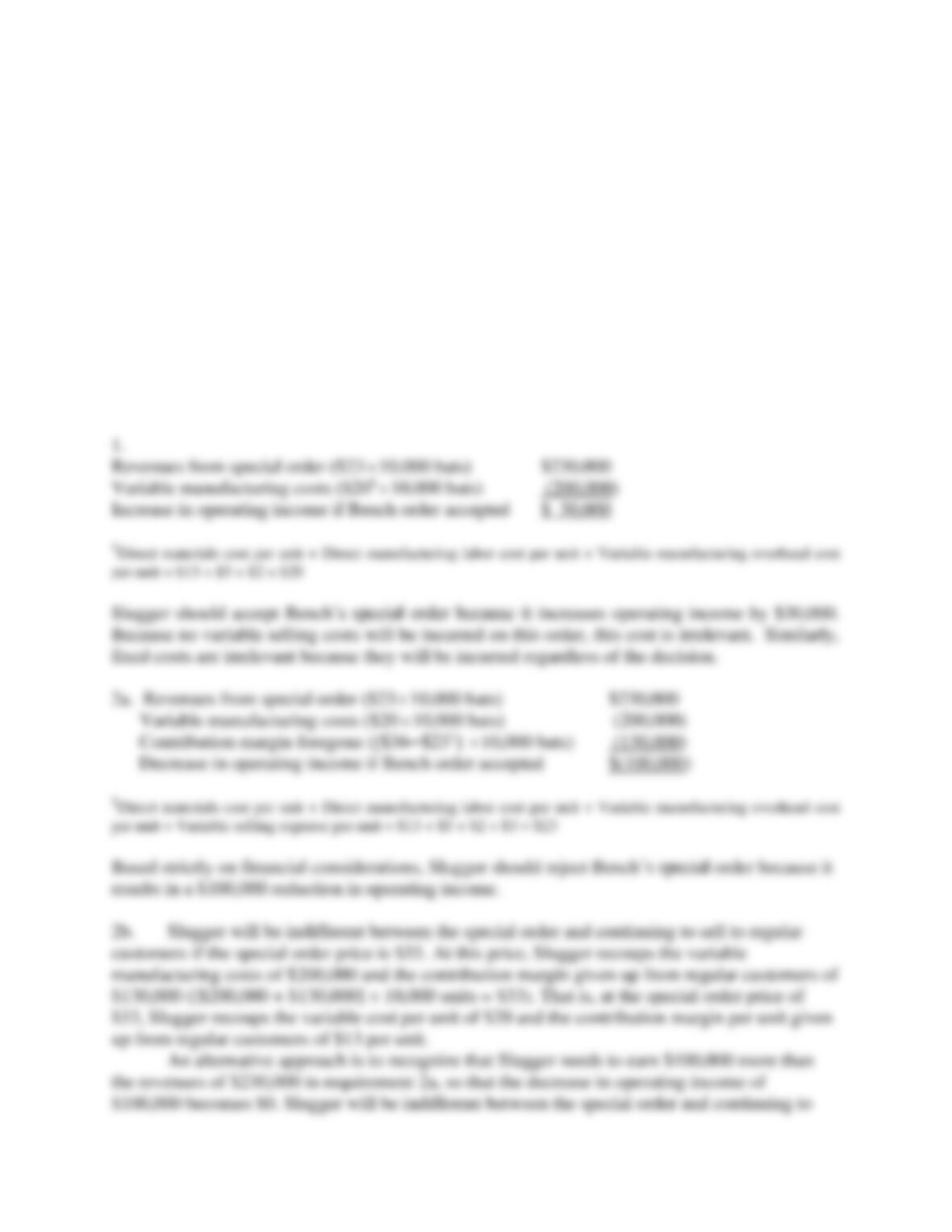
Slugger Corporation produces baseball bats for kids that it sells for $36 each. At capacity, the
company can produce 50,000 bats a year. The costs of producing and selling 50,000 bats are as
follows:
Required:
11-28
1. Suppose Slugger is currently producing and selling 40,000 bats. At this level of production
and sales, its fixed costs are the same as given in the preceding table. Bench Corporation
wants to place a one-time special order for 10,000 bats at $23 each. Slugger will incur no
variable selling costs for this special order. Should Slugger accept this one-time special
order? Show your calculations.
2. Now suppose Slugger is currently producing and selling 50,000 bats. If Slugger accepts
Bench’s offer it will have to sell 10,000 fewer bats to its regular customers. (a) On financial
considerations alone, should Slugger accept this one-time special order? Show your
calculations. (b) On financial considerations alone, at what price would Slugger be
indifferent between accepting the special order and continuing to sell to its regular customers
at $36 per bat. (c) What other factors should Slugger consider in deciding whether to accept
the one-time special order?
SOLUTION
11-30 (15-20 min.) Short-run pricing, capacity constraints.
Ohio Acres Dairy, maker of specialty cheeses, produces a soft cheese from the milk of Holstein
cows raised on a special corn-based diet. One kilogram of soft cheese, which has a contribution
margin of $8, requires 4 liters of milk. A well-known gourmet restaurant has asked Ohio Acres
to produce 2,000 kilograms of a hard cheese from the same milk of Holstein cows. Knowing that
the dairy has sufficient unused capacity, Elise Princiotti, owner of Ohio Acres, calculates the
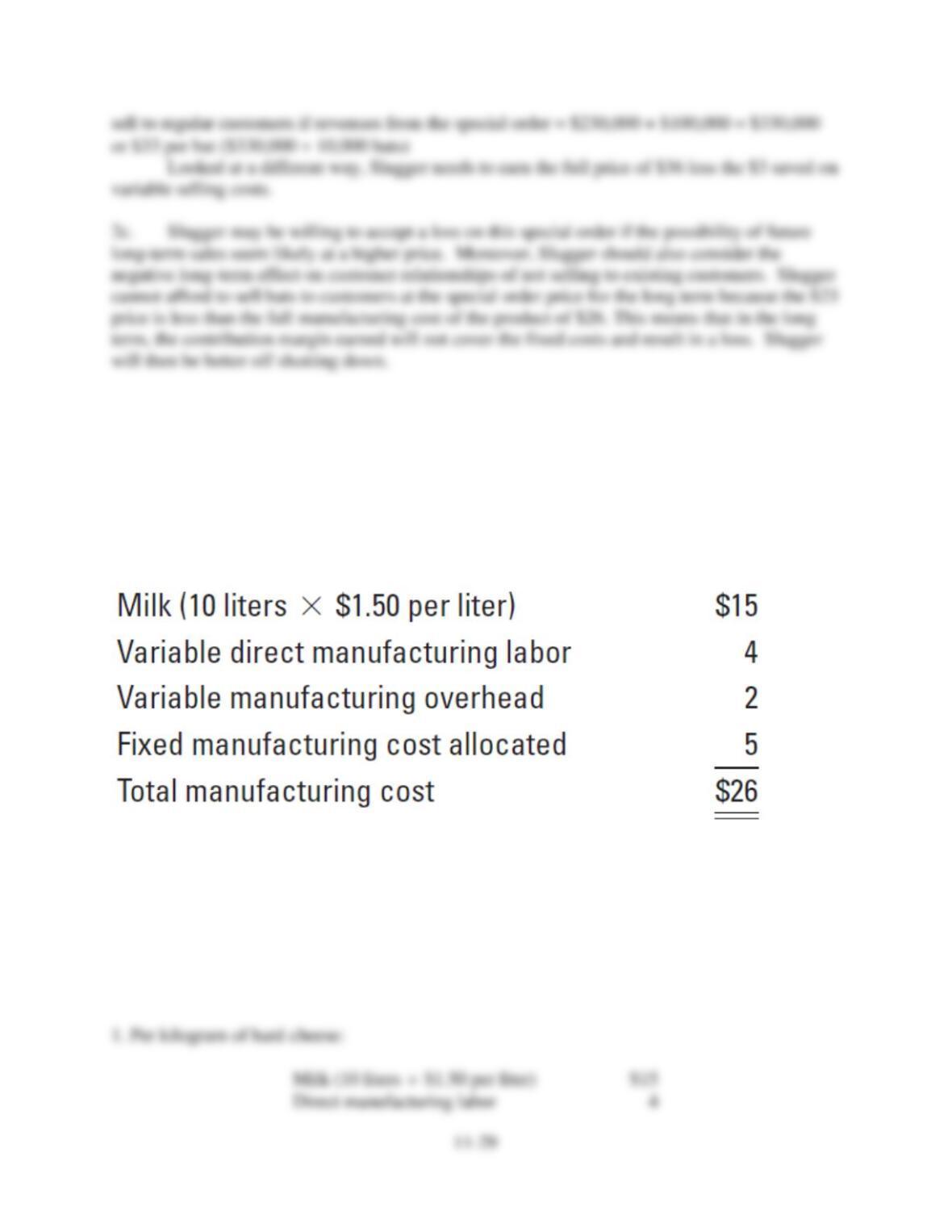
costs of making one kilogram of the desired hard cheese:
Required:
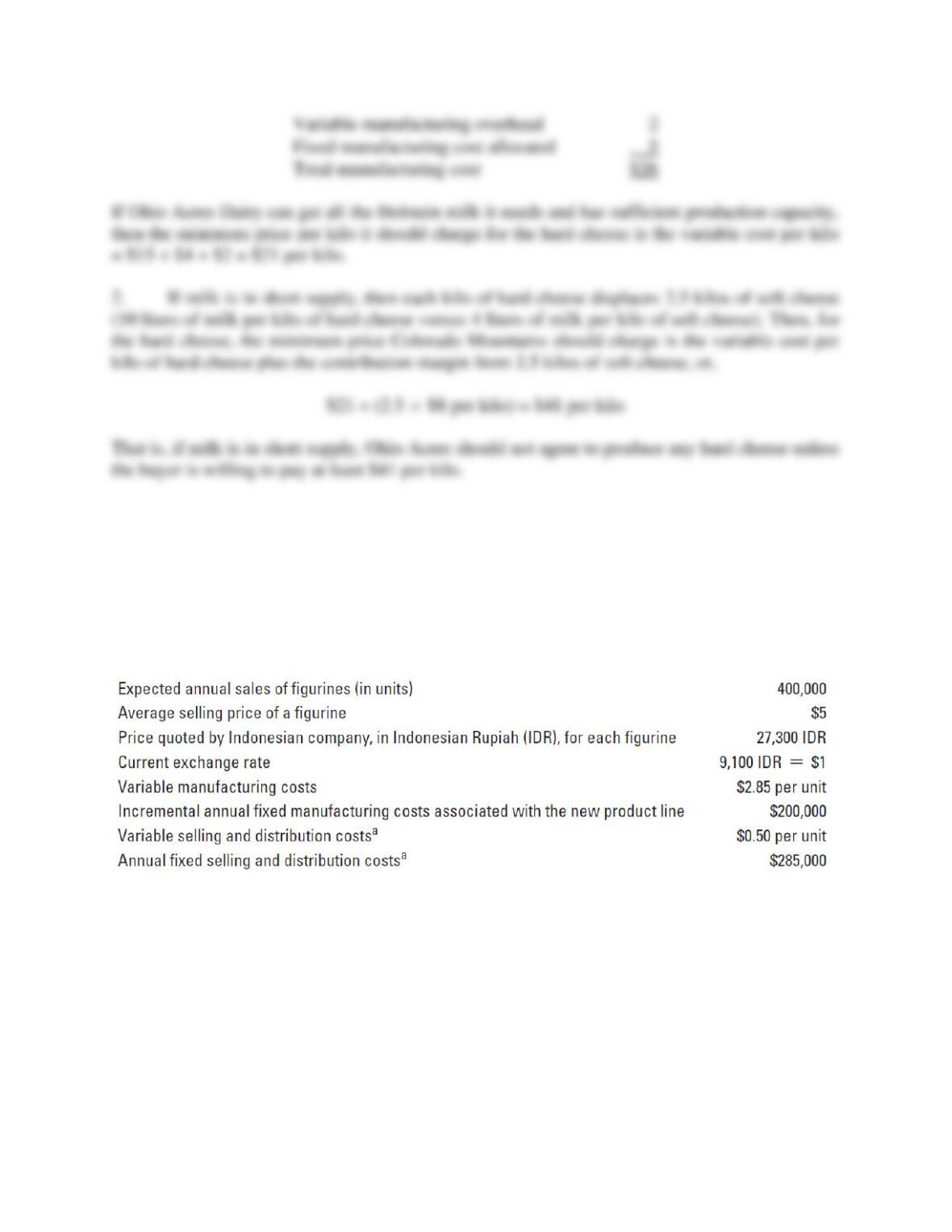
1. Suppose Ohio Acres can acquire all the Holstein milk that it needs. What is the minimum
price per kilogram the company should charge for the hard cheese?
2. Now suppose that the Holstein milk is in short supply. Every kilogram of hard cheese Ohio
Acres produces will reduce the quantity of soft cheese that it can make and sell. What is the
minimum price per kilogram the company should charge to produce the hard cheese?
SOLUTION
11-30
11-31 (20 min.) International outsourcing.
Cuddly Critters, Inc., manufactures plush toys in a facility in Cleveland, Ohio. Recently, the
company designed a group of collectible resin figurines to go with the plush toy line.
Management is trying to decide whether to manufacture the figurines themselves in existing
space in the Cleveland facility or to accept an offer from a manufacturing company in Indonesia.
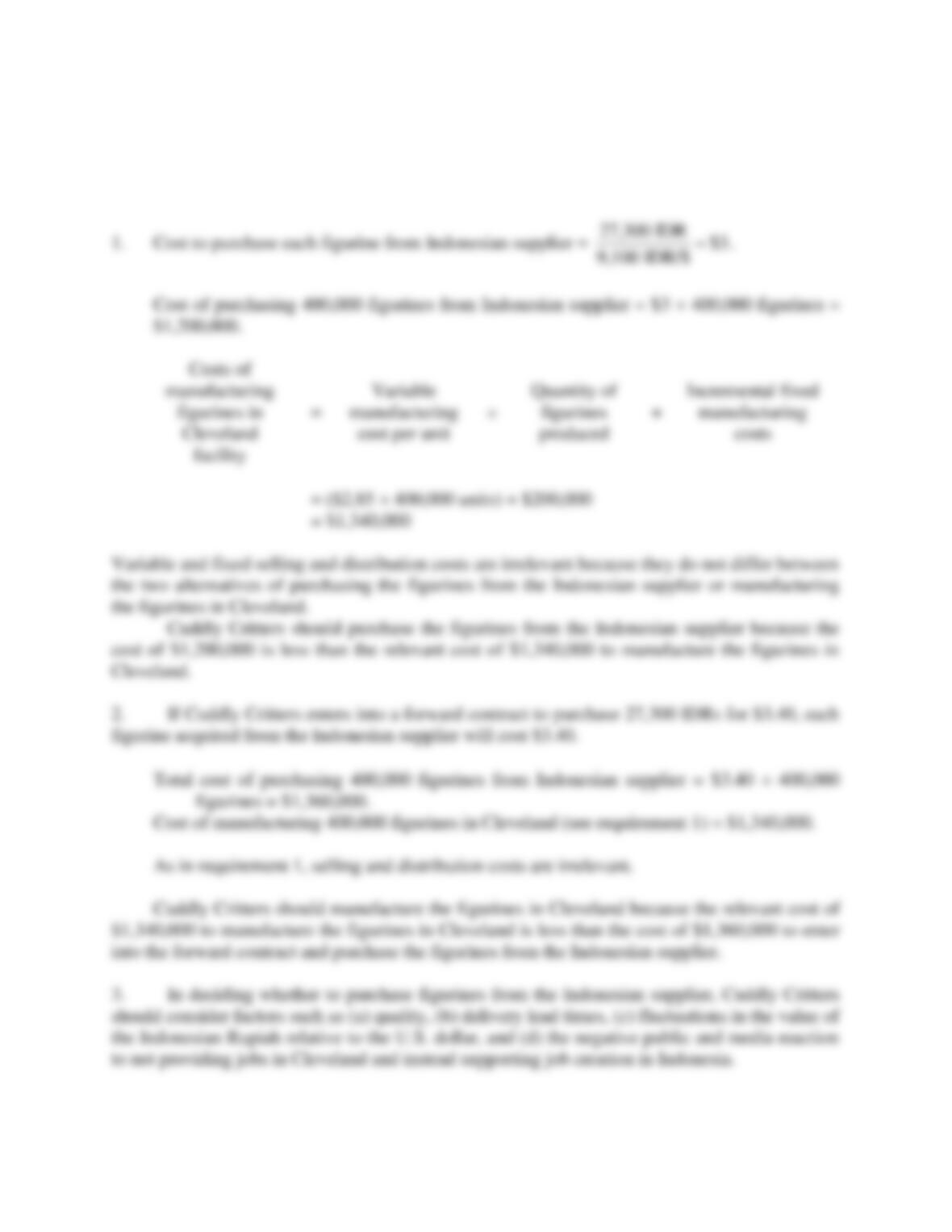
Data concerning the decision are:
a Selling and distribution costs are the same regardless of whether the figurines are manufactured
in Cleveland or imported.
Required:
1. Should Cuddly Critters manufacture the 400,000 figurines in the Cleveland facility or
purchase them from the Indonesian supplier? Explain.
2. Cuddly Critters believes that the U.S. dollar may weaken in the coming months against the
Indonesian rupiah and does not want to face any currency risk. Assume that Cuddly Critters
can enter into a forward contract today to purchase 27,300 IDRs for $3.40. Should Cuddly
Critters manufacture the 400,000 figurines in the Cleveland facility or purchase them from
the Indonesian supplier? Explain.
11-31
3. What are some of the qualitative factors that Cuddly Critters should consider when deciding
whether to outsource the figurine manufacturing to Indonesia?
SOLUTION
11-32
11-32 (30 min.) Relevant costs, opportunity costs.
Gavin Martin, the general manager of Oregano Software, must decide when to release the new
version of Oregano’s spreadsheet package, Easyspread 2.0. Development of Easyspread 2.0 is
complete; however, the diskettes, compact discs, and user manuals have not yet been produced.
The product can be shipped starting July 1, 2014.
The major problem is that Oregano has overstocked the previous version of its spreadsheet
package, Easyspread 1.0. Martin knows that once Easyspread 2.0 is introduced, Oregano will not
be able to sell any more units of Easyspread 1.0. Rather than just throwing away the inventory of
Easyspread 1.0, Martin is wondering if it might be better to continue to sell Easyspread 1.0 for
the next three months and introduce Easyspread 2.0 on October 1, 2014, when the inventory of
Easyspread 1.0 will be sold out.
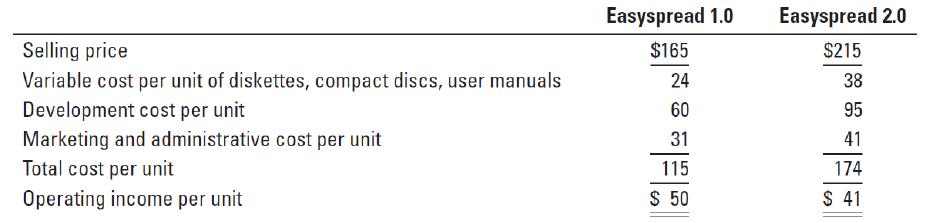
The following information is available:
Development cost per unit for each product equals the total costs of developing the software
product divided by the anticipated unit sales over the life of the product. Marketing and
administrative costs are fixed costs in 2014, incurred to support all marketing and administrative
activities of Oregano Software. Marketing and administrative costs are allocated to products on
the basis of the budgeted revenues of each product. The preceding unit costs assume Easyspread
2.0 will be introduced on October 1, 2014.
Required:
1. On the basis of financial considerations alone, should Martin introduce Easyspread 2.0 on
July 1, 2014, or wait until October 1, 2014? Show your calculations, clearly identifying
relevant and irrelevant revenues and costs.
2. What other factors might Gavin Martin consider in making a decision?
11-33
SOLUTION
11-34
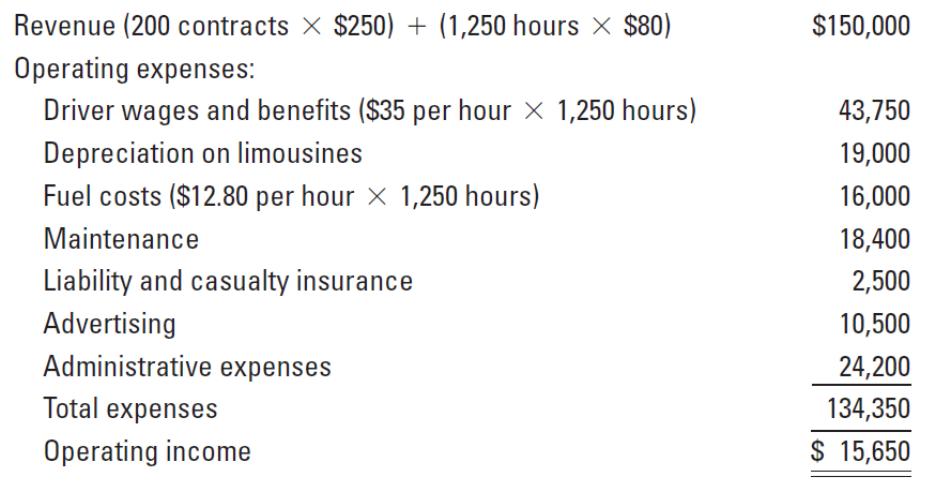
11-33 (30 min.) Opportunity costs and relevant costs
Jason Wu operates Exclusive Limousines, a fleet of 10 limousines used for weddings, proms,
and business events in Washington, D.C. Wu charges customers a flat fee of $250 per car taken
on contract plus an hourly fee of $80. His income statement for May follows:
All expenses are fixed, with the exception of driver wages and benefits and fuel costs, which
are both variable per hour. During May, the company’s limousines were fully booked. In June,
Wu expects that Exclusive Limousines will be operating near capacity. Shelly Worthington, a
prominent Washington socialite, has asked Wu to bid on a large charity event she is hosting in
late June. The limousine company she had hired has canceled at the last minute, and she needs
the service of five limousines for four hours each. She will only hire Exclusive Limousines if
they take the entire job. Wu checks his schedule and finds that he only has three limousines
available that day.
Required:
1. If Wu accepts the contract with Worthington, he would either have to (a) cancel two prom
contracts each for 1 car for 6 hours or (b) cancel one business event for three cars contracted
for two hours each. What are the relevant opportunity costs of accepting the Worthington
contract in each case? Which contract should he cancel?
2. Wu would like to win the bid on the Worthington job because of the potential for lucrative
future business. Assume that Wu cancels the contract in part 1 with the lowest opportunity
cost, and assume that the three currently available cars would go unrented if the company
does not win the bid. What is the lowest amount he should bid on the Worthington job?
3. Another limousine company has offered to rent Exclusive Limousines two additional cars for
$300 each per day. Wu would still need to pay for fuel and driver wages on these cars for the
Worthington job. Should Wu rent the two cars to avoid canceling either of the other two
contracts?
11-35
SOLUTION
11-34 (20 min.) Opportunity costs.
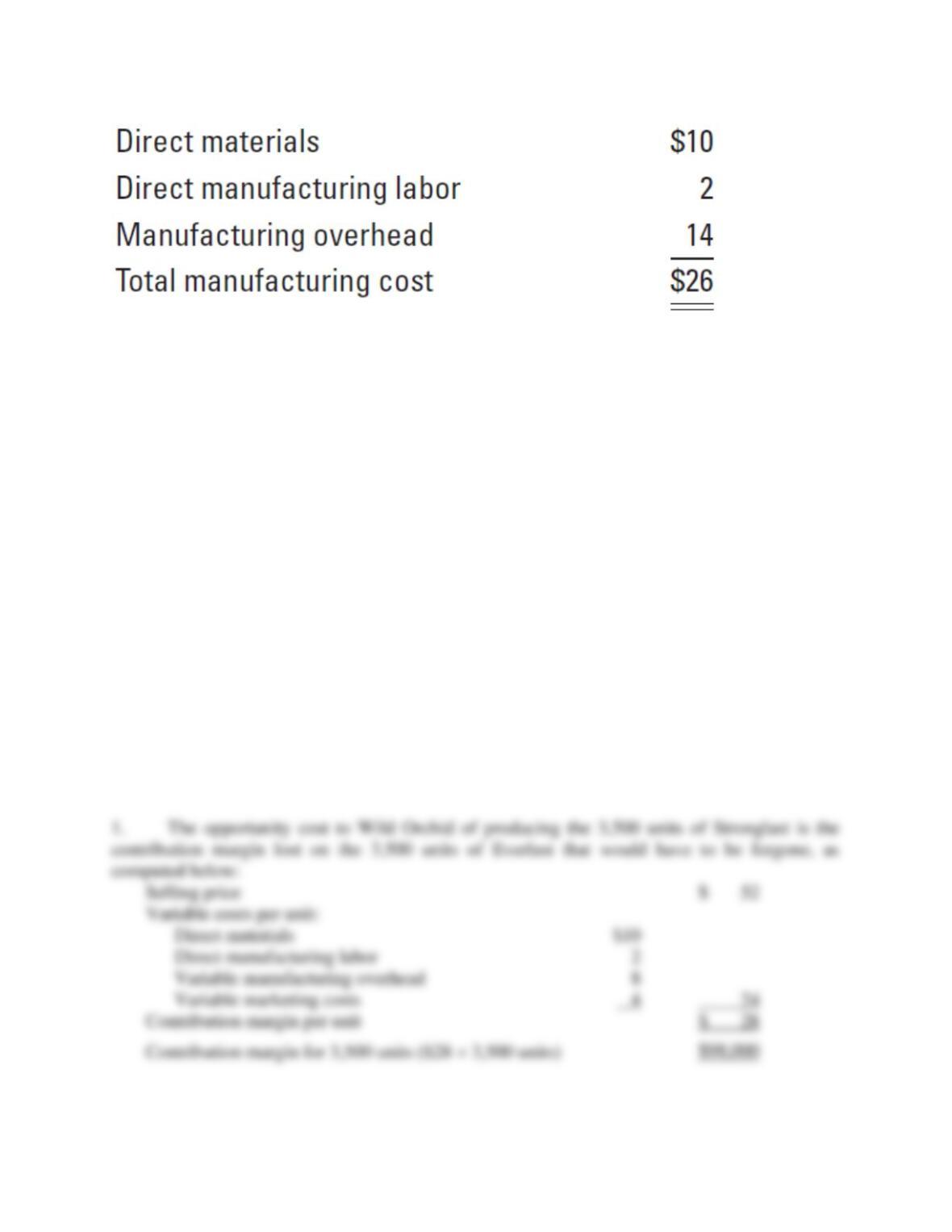
(H. Schaefer, adapted) The Wild Orchid Corporation is working at full production capacity
producing 13,000 units of a unique product, Everlast. Manufacturing cost per unit for Everlast is:
11-36
Manufacturing overhead cost per unit is based on variable cost per unit of $8 and fixed costs of
$78,000 (at full capacity of 13,000 units). Marketing cost per unit, all variable, is $4, and the
selling price is $52.
A customer, the Apex Company, has asked Wild Orchid to produce 3,500 units of Stronglast,
a modification of Everlast. Stronglast would require the same manufacturing processes as
Everlast. Apex has offered to pay Wild Orchid $40 for a unit of Stronglast and share half of the
marketing cost per unit.
Required:
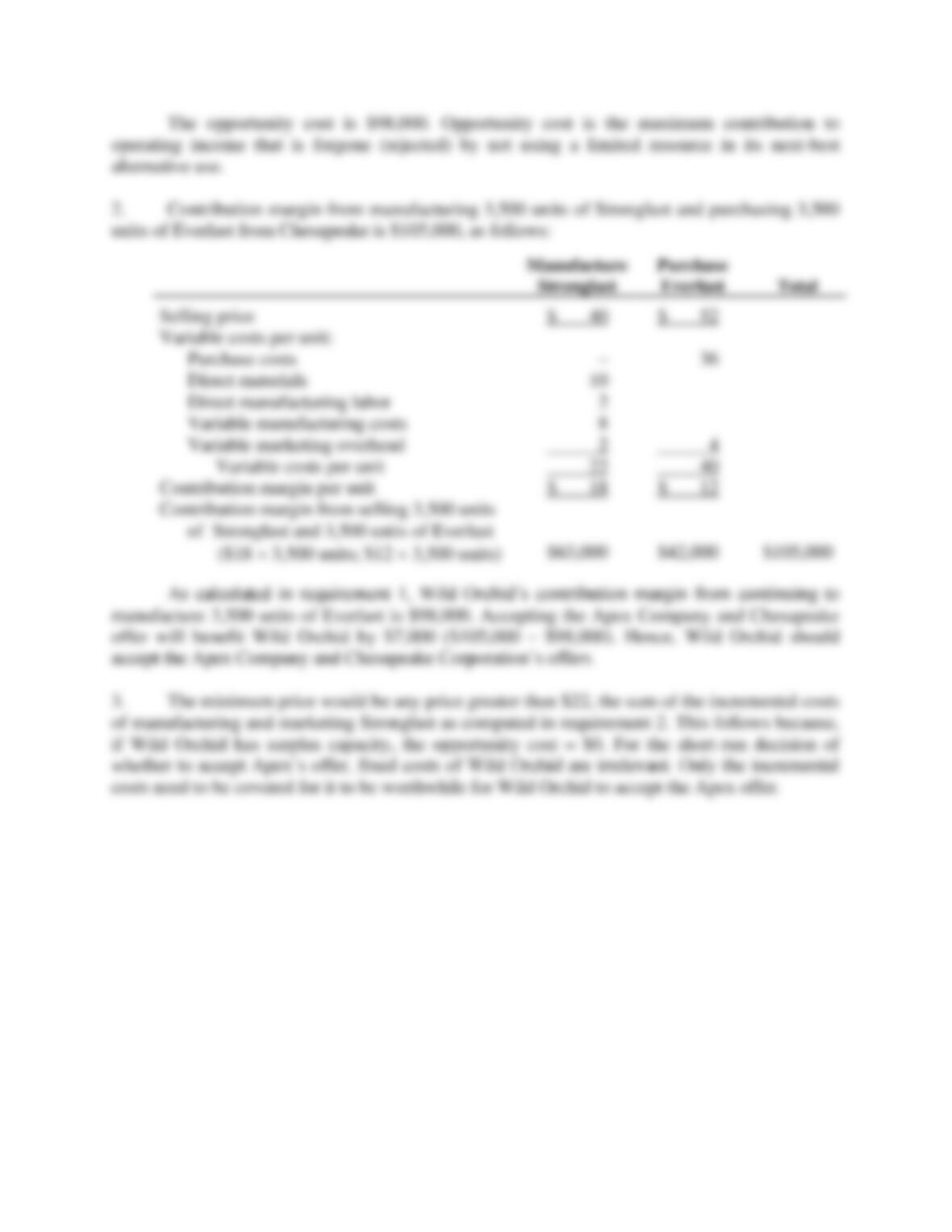
1. What is the opportunity cost to Wild Orchid of producing the 3,500 units of Stronglast?
(Assume that no overtime is worked.)
2. The Chesapeake Corporation has offered to produce 3,500 units of Everlast for Wild Orchid
so that Wild Orchid may accept the Apex offer. That is, if Wild Orchid accepts the
Chesapeake offer, Wild Orchid would manufacture 9,500 units of Everlast and 3,500 units of
Stronglast and purchase 3,500 units of Everlast from Chesapeake. Chesapeake would charge
Wild Orchid $36 per unit to manufacture Everlast. On the basis of financial considerations
alone, should Wild Orchid accept the Chesapeake offer? Show your calculations.
3. Suppose Wild Orchid had been working at less than full capacity, producing 9,500 units of
Everlast, at the time the Apex offer was made. Calculate the minimum price Wild Orchid
should accept for Stronglast under these conditions. (Ignore the previous $40 selling price.)
SOLUTION
11-37
11-35 (30–40 min.) Make or buy, unknown level of volume.
(A. Atkinson, adapted) Denver Engineering manufactures small engines that it sells to
manufacturers who install them in products such as lawn mowers. The company currently
manufactures all the parts used in these engines but is considering a proposal from an external
supplier who wishes to supply the starter assemblies used in these engines.
The starter assemblies are currently manufactured in Division 3 of Denver Engineering. The
costs relating to the starter assemblies for the past 12 months were as follows:
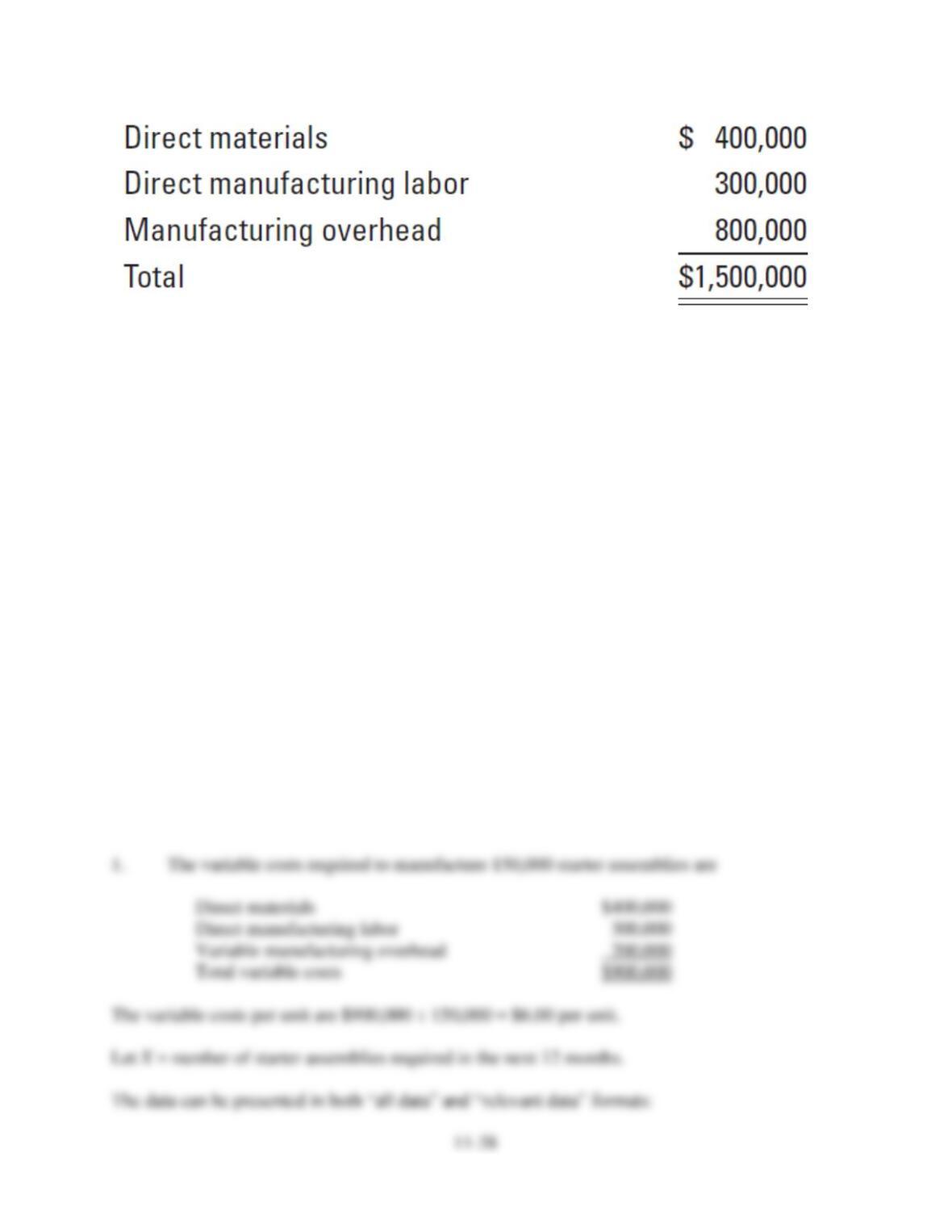
Over the past year, Division 3 manufactured 150,000 starter assemblies. The average cost for
each starter assembly is $10($1,500,000 ÷ 150,000).
Further analysis of manufacturing overhead revealed the following information. Of the total
manufacturing overhead, only 25% is considered variable. Of the fixed portion, $300,000 is an
allocation of general overhead that will remain unchanged for the company as a whole if
production of the starter assemblies is discontinued. A further $200,000 of the fixed overhead is
avoidable if production of the starter assemblies is discontinued. The balance of the current fixed
overhead, $100,000, is the division manager’s salary. If Denver Engineering discontinues
production of the starter assemblies, the manager of Division 3 will be transferred to Division 2
at the same salary. This move will allow the company to save the $80,000 salary that would
otherwise be paid to attract an outsider to this position.
Required:
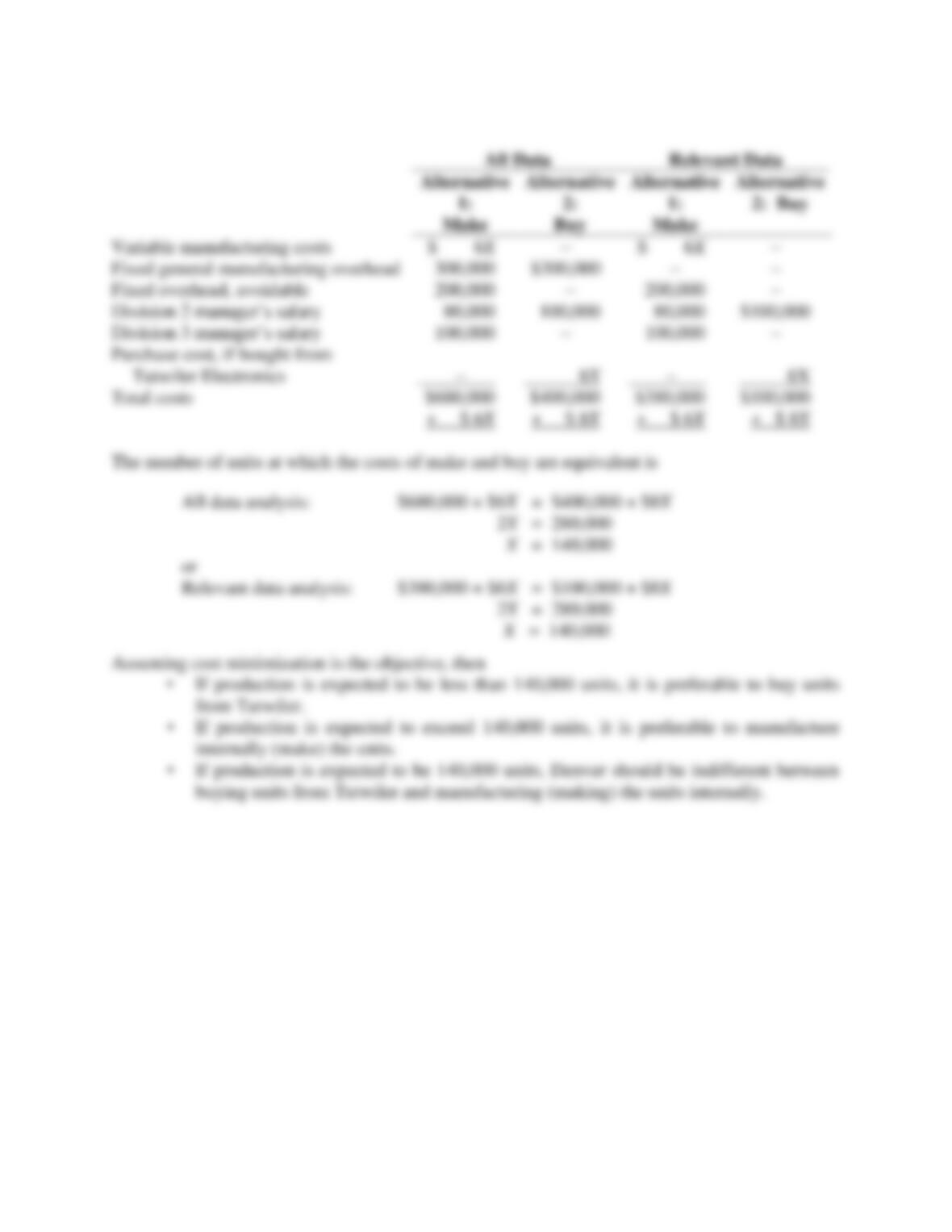
1. Tutwiler Electronics, a reliable supplier, has offered to supply starter-assembly units at $8
per unit. Because this price is less than the current average cost of $10 per unit, the vice
president of manufacturing is eager to accept this offer. On the basis of financial
considerations alone, should Denver Engineering accept the outside offer? Show your
calculations. (Hint: Production output in the coming year may be different from production
output in the past year.)
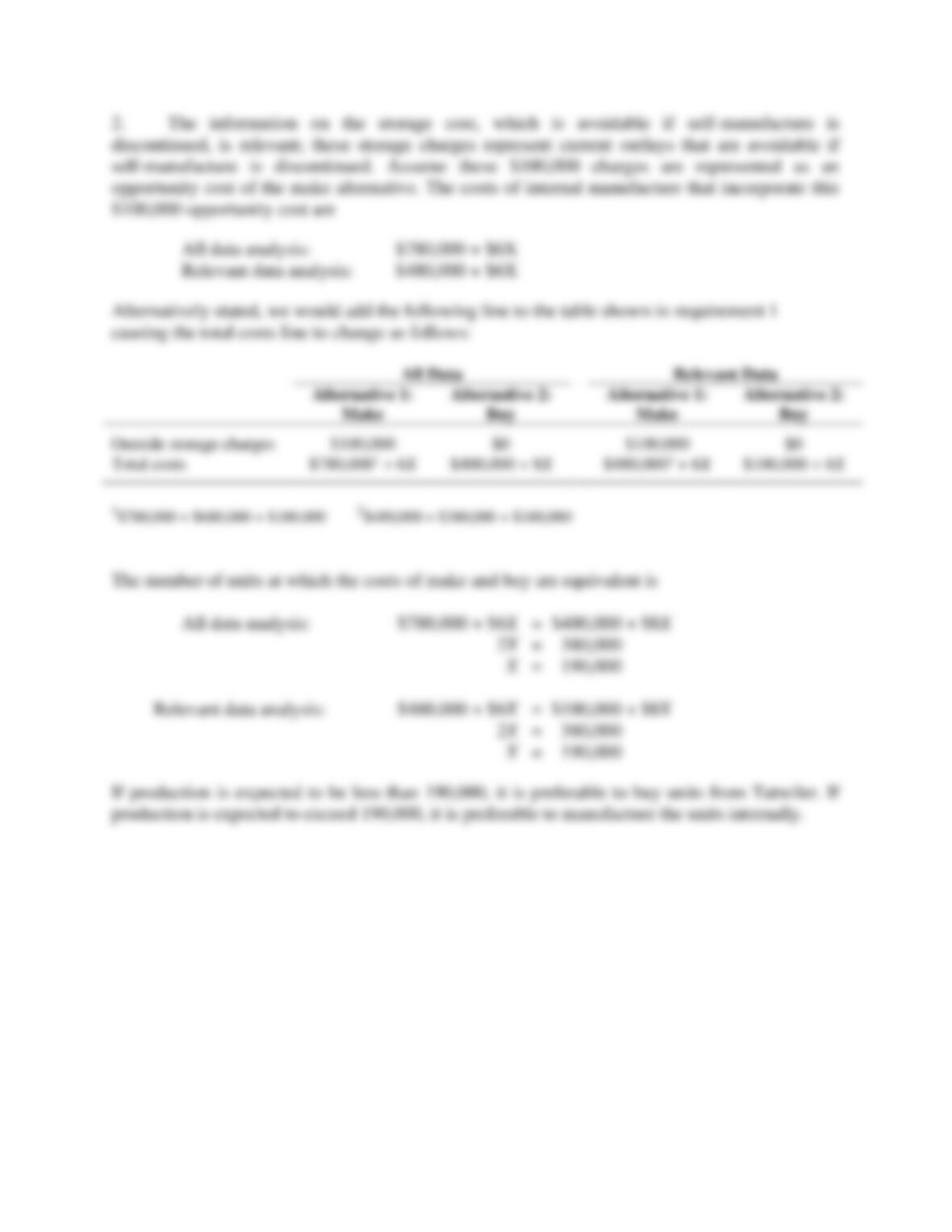
2. How, if at all, would your response to requirement 1 change if the company could use the
vacated plant space for storage and, in so doing, avoid $100,000 of outside storage charges
currently incurred? Why is this information relevant or irrelevant?
SOLUTION
11-39
11-40