CHAPTER 25 (FIN MAN); CHAPTER 11 (MAN)
DIFFERENTIAL ANALYSIS AND PRODUCT PRICING
DISCUSSION QUESTIONS
1. a. Differential revenue is the amount of increase or decrease in revenue expected from a particular
course of action compared with an alternative.
b. Differential cost is the amount of increase or decrease in cost expected from a particular course
of action compared with an alternative.
c. Differential profit (loss) is the difference between differential revenue and differential cost.
3. If there is demand for the premium-grade product, the differential revenue (premium less commodity)
may exceed the differential cost to process the product to premium grade.
4. A company should only accept business at a special price if the lower price will not contaminate the
regular pricing for other customers or induce other customers to demand the special price. In
addition, the company must be careful not to violate the Robinson-Patman Act, which prohibits
uncompetitive price differences across different markets for the same product within the United
States. Lastly, the company must consider the longer-term ramifications of offering discount
business to a customer that may wish to order in the future.
7. In the long run, the normal selling price must be set high enough to cover all costs (both fixed and variable)
and provide a reasonable amount for profit.
8. In setting prices, managers should also consider such factors as the prices of competing products and
the general economic conditions of the marketplace.
10. The proper measure of product value in a bottlenecked process is the contribution margin per bottleneck
hour.
CHAPTER 25 (FIN MAN); CHAPTER 11 (MAN) Differential Analysis and Product Pricing
BASIC EXERCISES
BE 25–1 (FIN MAN); BE 11–1 (MAN)
Differential Analysis
Lease (Alt. 1) or Sell (Alt. 2) Equipment
August 7
Lease
Equipment
(Alternative 1)
Sell
Equipment
(Alternative 2)
Differential
Effects
(Alternative 2)
Revenues
$320,000
$300,000
$(20,000)
* $300,000 × 4%
Plymouth Company should sell the equipment.
BE 25–2 (FIN MAN); BE 11–2 (MAN)
Differential Analysis
Continue (Alt. 1) or Discontinue (Alt. 2) Product Tango
February 13
Continue
Product Tango
(Alternative 1)
Discontinue
Product Tango
(Alternative 2)
Differential
Effects
(Alternative 2)
Revenues
$1,150,000
$ 0
$(1,150,000)
Costs:
Product Tango should be continued.
CHAPTER 25 (FIN MAN); CHAPTER 11 (MAN) Differential Analysis and Product Pricing
BE 25–3 (FIN MAN); BE 11–3 (MAN)
Differential Analysis
Make (Alt. 1) or Buy (Alt. 2) Bottles
January 25
Make
Bottles
(Alternative 1)
Buy
Bottles
(Alternative 2)
Differential
Effects
(Alternative 2)
Unit costs:
BE 25–4 (FIN MAN); BE 11–4 (MAN)
Differential Analysis
Continue (Alt. 1) or Replace (Alt. 2) Old Machine
April 11
Continue
with Old
Machine
(Alternative 1)
Replace
Old
Machine
(Alternative 2)
Differential
Effects
(Alternative 2)
Revenues:
Proceeds from sale of old machine
$ 0
$ 50,500
$ 50,500
Direct labor (5 years)
$(61,500)
CHAPTER 25 (FIN MAN); CHAPTER 11 (MAN) Differential Analysis and Product Pricing
BE 25–5 (FIN MAN); BE 11–5 (MAN)
Differential Analysis
Sell Product J19 (Alt. 1) or Process Further into Product R33 (Alt. 2)
April 30
Sell
Product J19
(Alternative 1)
Process
Further into
Product R33
(Alternative 2)
Differential
Effects
(Alternative 2)
Revenues, per unit
$ 18
$ 24
$ 6
Costs, per unit
Profit (loss), per unit
The company should sell Product J19 without further processing.
BE 25–6 (FIN MAN); BE 11–6 (MAN)
Differential Analysis
Reject (Alt. 1) or Accept (Alt. 2) Order
March 16
Reject
Order
(Alternative 1)
Accept
Order
(Alternative 2)
Differential
Effects
(Alternative 2)
Revenues, per unit
$0.00
$ 7.20
$ 7.20
Costs:
(5.00)
(1.08)*
Profit (loss), per unit
$0.00
$ 1.12
CHAPTER 25 (FIN MAN); CHAPTER 11 (MAN) Differential Analysis and Product Pricing
BE 25–7 (FIN MAN); BE 11–7 (MAN)
Desired Profit + Selling and Admin. Exp.
Markup Percentage on Product Cost : Total Product Cost
$58 + $70 = 80%
$160 *
* $230 – $70
BE 25–8 (FIN MAN); BE 11–8 (MAN)
Product K
Product L
Unit contribution margin …………………………………………………
$120
$100
CHAPTER 25 (FIN MAN); CHAPTER 11 (MAN) Differential Analysis and Product Pricing
EXERCISES
Ex. 25–1 (FIN MAN); Ex. 11–1 (MAN)
a.
Differential Analysis
Lease (Alt. 1) or Sell (Alt. 2) Machinery
January 15
Lease
Machinery
(Alternative 1)
Sell
Machinery
(Alternative 2)
Differential
Effects
(Alternative 2)
Revenues
Costs
b. Lease the machinery. The net gain from leasing is $6,400.
Ex. 25–2 (FIN MAN); Ex. 11–2 (MAN)
Note to Instructors: This differential analysis is a “lease or buy” decision, which is from
the user perspective. The “lease or sell” decision is from the perspective of the
equipment owner. Thus, the analysis is similar to the text examples but must be set up
from the user’s, rather than the owner’s, perspective.
Differential Analysis
Lease (Alt. 1) or Buy (Alt. 2) Equipment
March 15
Lease
Equipment
(Alternative 1)
Buy
Equipment
(Alternative 2)
Differential
Effects
(Alternative 2)
Costs:
The company should buy the equipment.
CHAPTER 25 (FIN MAN); CHAPTER 11 (MAN) Differential Analysis and Product Pricing
Ex. 25–3 (FIN MAN); Ex. 11–3 (MAN)
a.
Differential Analysis
Continue (Alt. 1) or Discontinue (Alt. 2) Mango Cola
February 29
Continue
Mango Cola
(Alternative 1)
Discontinue
Mango Cola
(Alternative 2)
Differential
Effects
(Alternative 2)
Revenues
$15,000,000
$ 0
$(15,000,000)
Costs:
Variable cost of goods sold
(7,560,000)1
0
7,560,000
Variable operating expenses
(6,000,000)2
0
6,000,000
CHAPTER 25 (FIN MAN); CHAPTER 11 (MAN) Differential Analysis and Product Pricing
Ex. 25–4 (FIN MAN); Ex. 11–4 (MAN)
a.
Differential Analysis
Continue (Alt. 1) or Discontinue (Alt. 2) Mufflers
October 31
Continue
Mufflers
(Alternative 1)
Discontinue
Mufflers
(Alternative 2)
Differential
Effects
(Alternative 2)
Revenues
$ 45,000
$ 0
$(45,000)
Costs:
Variable cost of goods sold
(21,600)1
0
21,600
Variable selling and admin.
0
17,500
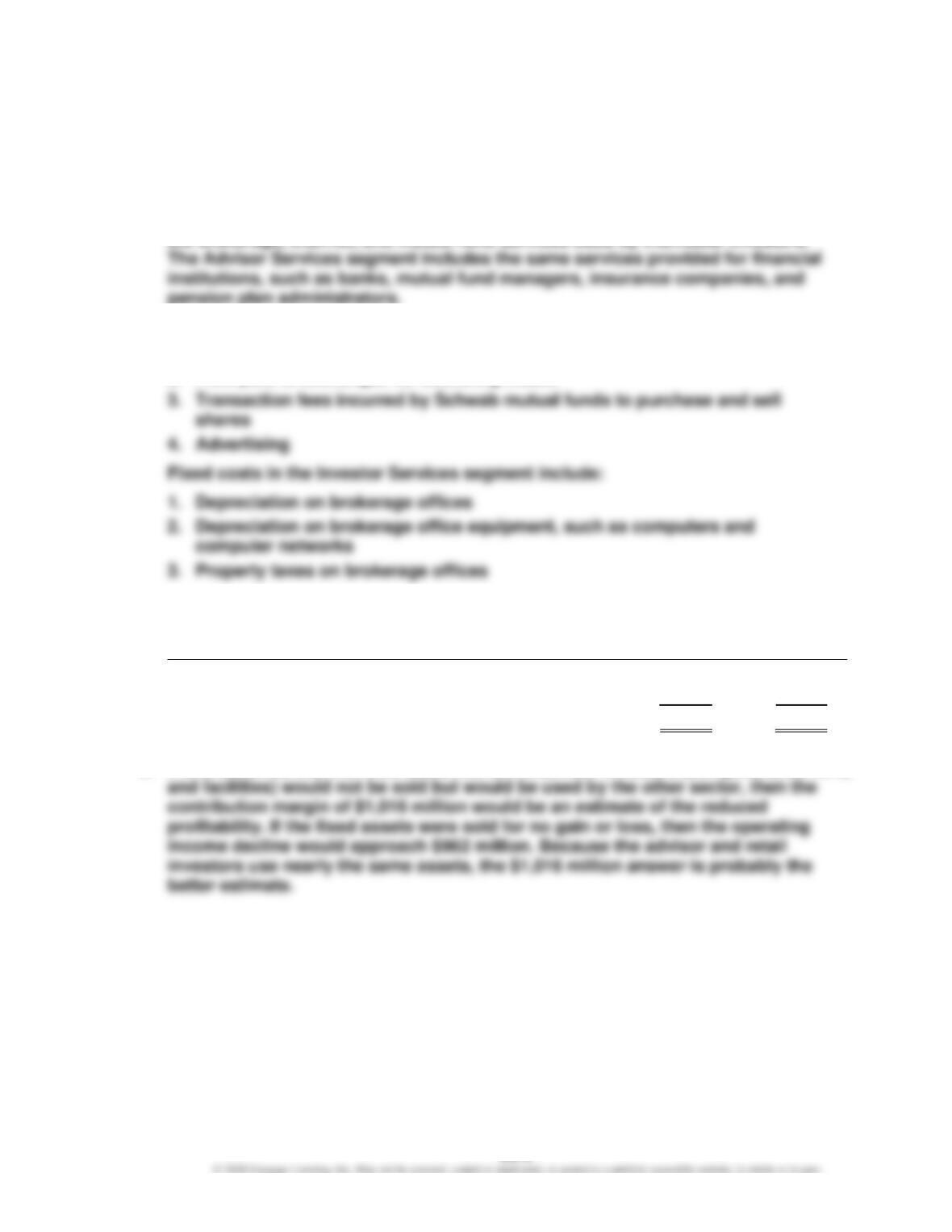
Fixed costs
(12,900)3
CHAPTER 25 (FIN MAN); CHAPTER 11 (MAN) Differential Analysis and Product Pricing
Ex. 25–5 (FIN MAN); Ex. 11–5 (MAN)
Note to Instructors: Many students may be unfamiliar with the financial services industry.
This exercise provides an opportunity to introduce students to some basic terms and
concepts used within the industry.
a. The Investor Services segment serves the retail customer, you and me. These are
pension plan administrators.
b. Variable costs in the Investor Services segment include:
1. Commissions to brokers
2. Fees paid to exchanges for executing trades
c.
Investor
Services
(in millions)
Advisor
Services
(in millions)
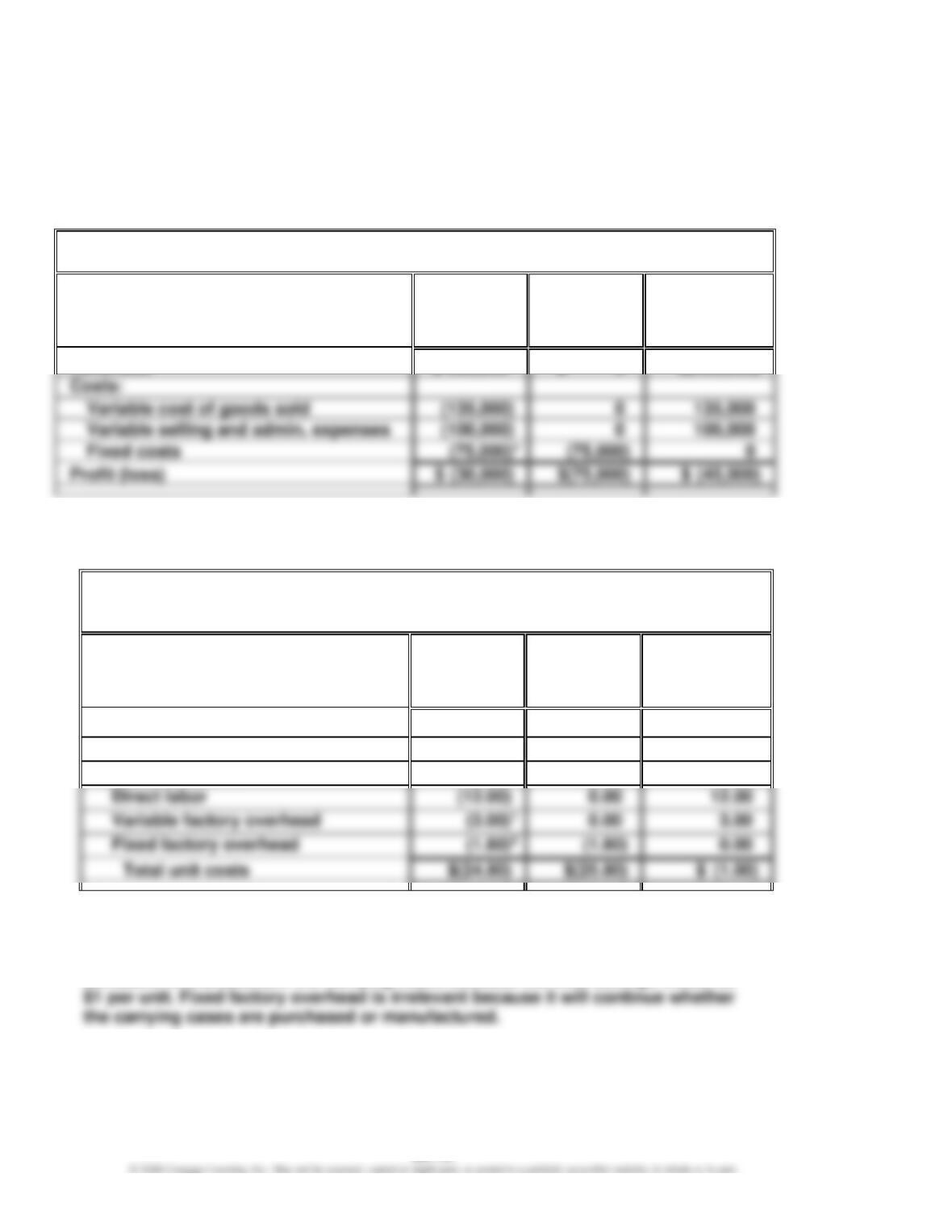
Operating income ……………………………………………….
$2,031
$ 962
Depreciation ……………………………………………………….
180
54
Estimated contribution margin …………………………….
$2,211
$1,016
d. If one assumes that the fixed costs that serve advisor investors (computers, servers,
CHAPTER 25 (FIN MAN); CHAPTER 11 (MAN) Differential Analysis and Product Pricing
Ex. 25–6 (FIN MAN); Ex. 11–6 (MAN)
The flaw in the decision is the failure to focus on the differential revenues and costs, which
indicate that operating income would be reduced by $45,000 if Children’s Shoes were
discontinued. This differential income from sales of Children’s Shoes can be determined
from the following differential analysis:
Differential Analysis
Continue (Alt. 1) or Discontinue (Alt. 2) Children’s Shoes
Continue
Children’s
Shoes
(Alternative 1)
Discontinue
Children’s
Shoes
(Alternative 2)
Differential
Effects
(Alternative 2)
* $45,000 + $30,000
Ex. 25–7 (FIN MAN); Ex. 11–7 (MAN)
a.
Differential Analysis
Make (Alt. 1) or Buy (Alt. 2) Carrying Case
April 30
Make
Carrying
Case
(Alternative 1)
Buy
Carrying
Case
(Alternative 2)
Differential
Effects
(Alternative 2)
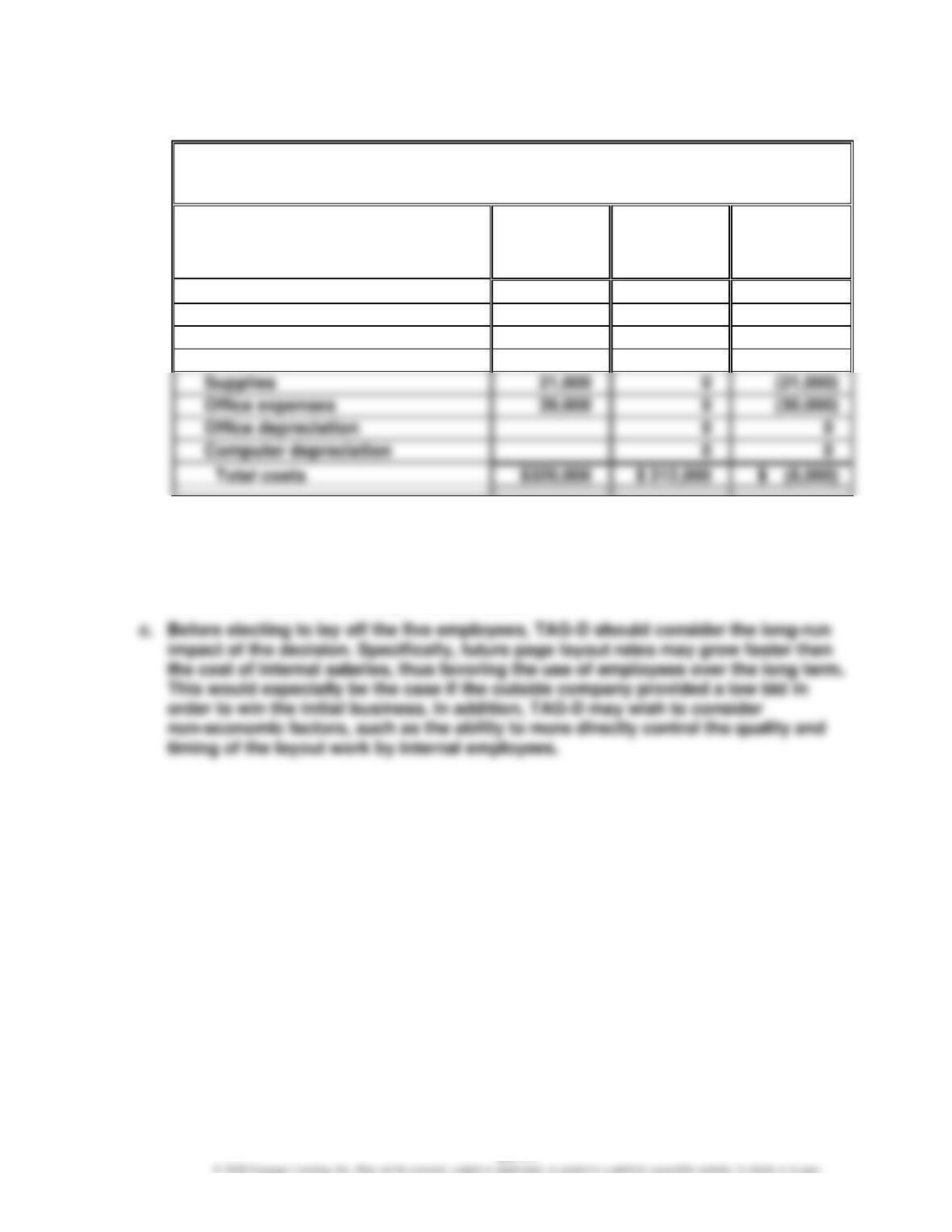
Unit costs:
Purchase price
$ 0.00
$(24.00)
$(24.00)
Direct materials
(8.00)
0.00
8.00
Direct labor
0.00
Variable factory overhead
0.00
3.00
1 $12.00 × 25%
2 $4.80 – $3.00
b. Assuming there were no better alternative uses for the spare capacity, it would be
advisable to manufacture the carrying cases because the cost savings would be
CHAPTER 25 (FIN MAN); CHAPTER 11 (MAN) Differential Analysis and Product Pricing
Ex. 25–8 (FIN MAN); Ex. 11–8 (MAN)
a.
Differential Analysis
Lay Out Pages Internally (Alt. 1) or Purchase Layout Services (Alt. 2)
February 22
Lay Out
Pages
Internally
(Alternative 1)
Purchase
Layout
Services
(Alternative 2)
Differential
Effects
(Alternative 2)
Costs:
Purchase price of layout work
$ 0
$312,000*
$ 312,000
Salaries
224,000
0
(224,000)
Benefits
36,000
0
(36,000)
Supplies
21,000
0
(21,000)
Office expenses
39,000
0
(39,000)
Office depreciation
0
Computer depreciation
0
* 24,000 pages × $13 per page
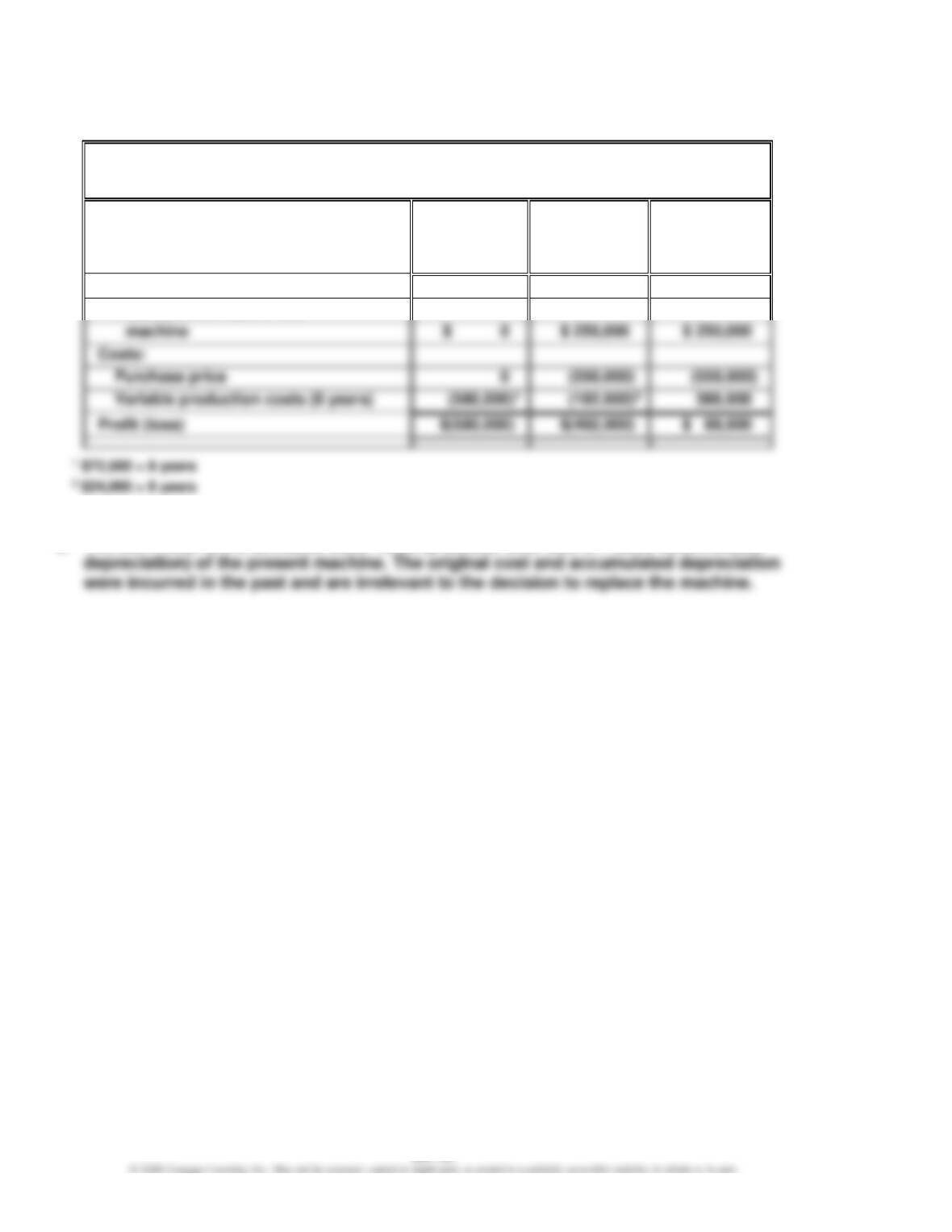
b. The benefit from using an outside service is shown to be $8,000 greater than
performing the layout work internally. The fixed costs (depreciation expenses) in
the budget are irrelevant to the decision. Thus, the work should be purchased
from the outside on a strictly financial basis.
CHAPTER 25 (FIN MAN); CHAPTER 11 (MAN) Differential Analysis and Product Pricing
Ex. 25–9 (FIN MAN); Ex. 11–9 (MAN)
a.
Differential Analysis
Continue with (Alt. 1) or Replace (Alt. 2) Old Machine
May 29
Continue
with Old
Machine
(Alternative 1)
Replace
Old
Machine
(Alternative2)
Differential
Effects
(Alternative 2)
Revenues:
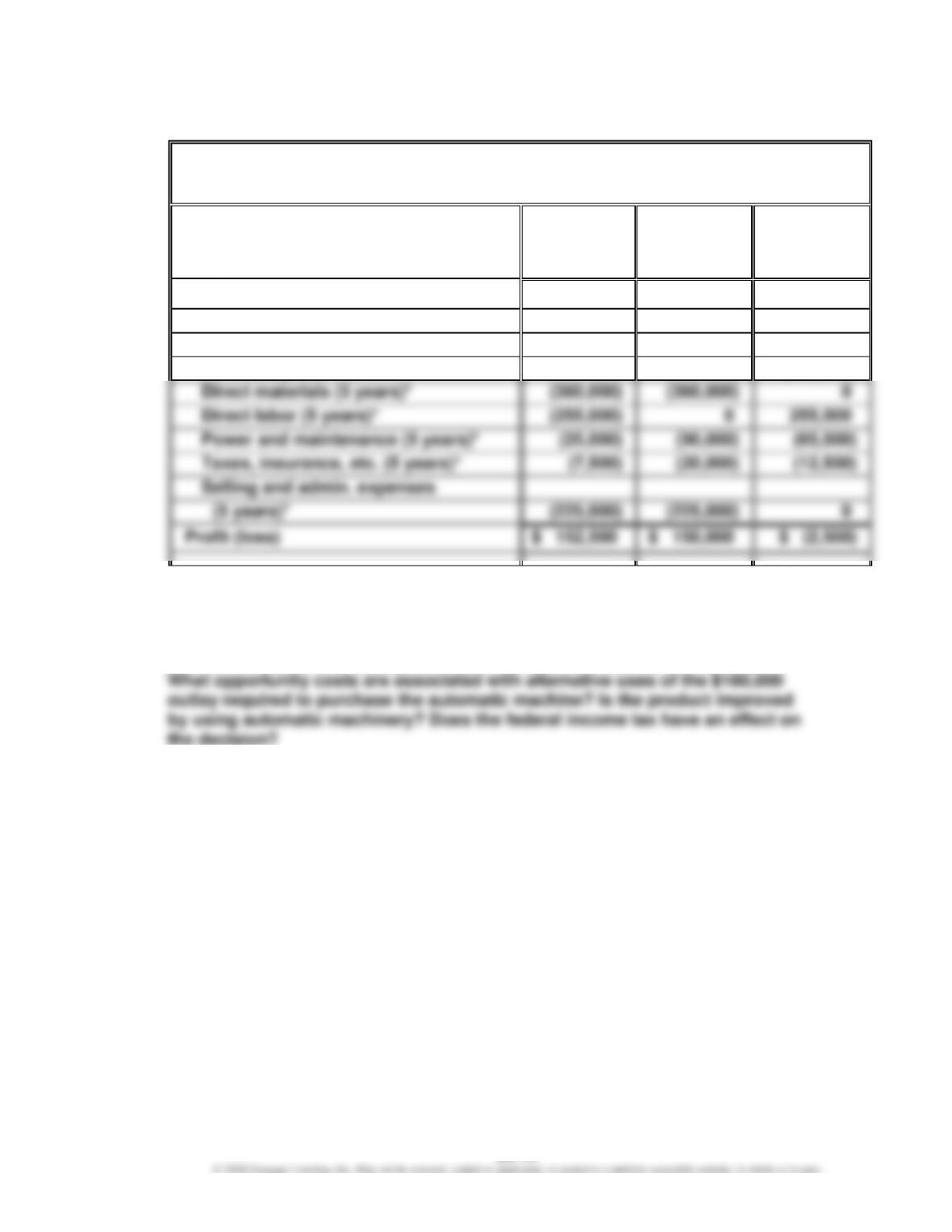
$ 250,000
Costs:
Variable production costs (8 years)
Proceeds from sale of old
The company should replace the old machine.
CHAPTER 25 (FIN MAN); CHAPTER 11 (MAN) Differential Analysis and Product Pricing
Ex. 25–10 (FIN MAN); Ex. 11–10 (MAN)
a.
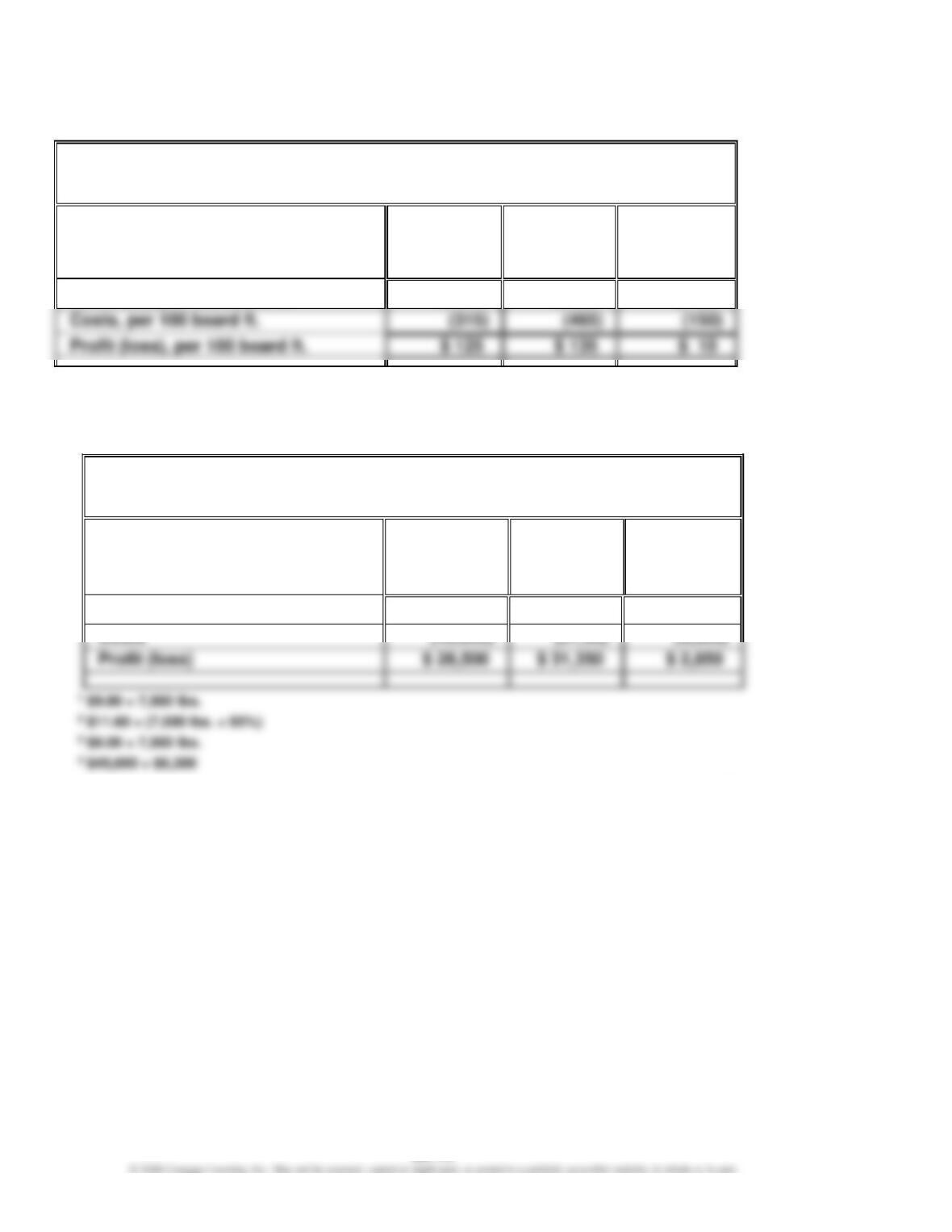
Differential Analysis
Continue with (Alt. 1) or Replace (Alt. 2) Old Machine
May 4
Continue
with Old
Machine
(Alternative 1)
Replace Old
Machine
(Alternative 2)
Differential
Effects
(Alternative 2)
Revenues:
Sales (5 years)*
$1,025,000
$1,025,000
$ 0
Costs:
Purchase price
0
(180,000)
(180,000)
Direct materials (5 years)*
Direct labor (5 years)*
Power and maintenance (5 years)*
Selling and admin. expenses
(225,000)
* Each annual revenue and cost is multiplied by five years.
b. The proposal should not be accepted.
c. In addition to the factors given, consideration should be given to such factors
as: Do both present and proposed operations provide the same capacity?
CHAPTER 25 (FIN MAN); CHAPTER 11 (MAN) Differential Analysis and Product Pricing
Ex. 25–11 (FIN MAN); Ex. 11–11 (MAN)
Differential Analysis
Sell Rough-Cut (Alt. 1) or Process Further into Finished-Cut (Alt. 2)
March 15
Sell
Rough-Cut
(Alternative 1)
Process
Further into
Finished-Cut
(Alternative 2)
Differential
Effects
(Alternative 2)
Revenues, per 100 board ft.
$ 440
$ 600
$ 160
Calgary Lumber Company should process further and sell finished-cut lumber.
Ex. 25–12 (FIN MAN); Ex. 11–12 (MAN)
a
Differential Analysis
Sell Regular (Alt. 1) or Process Further into Decaf (Alt. 2)
December 11
Sell
Regular
(Alternative 1)
Process
Further into
Decaf
(Alternative 2)
Differential
Effects
(Alternative 2)
Revenues
$ 73,5001
$ 82,6502
$ 9,150
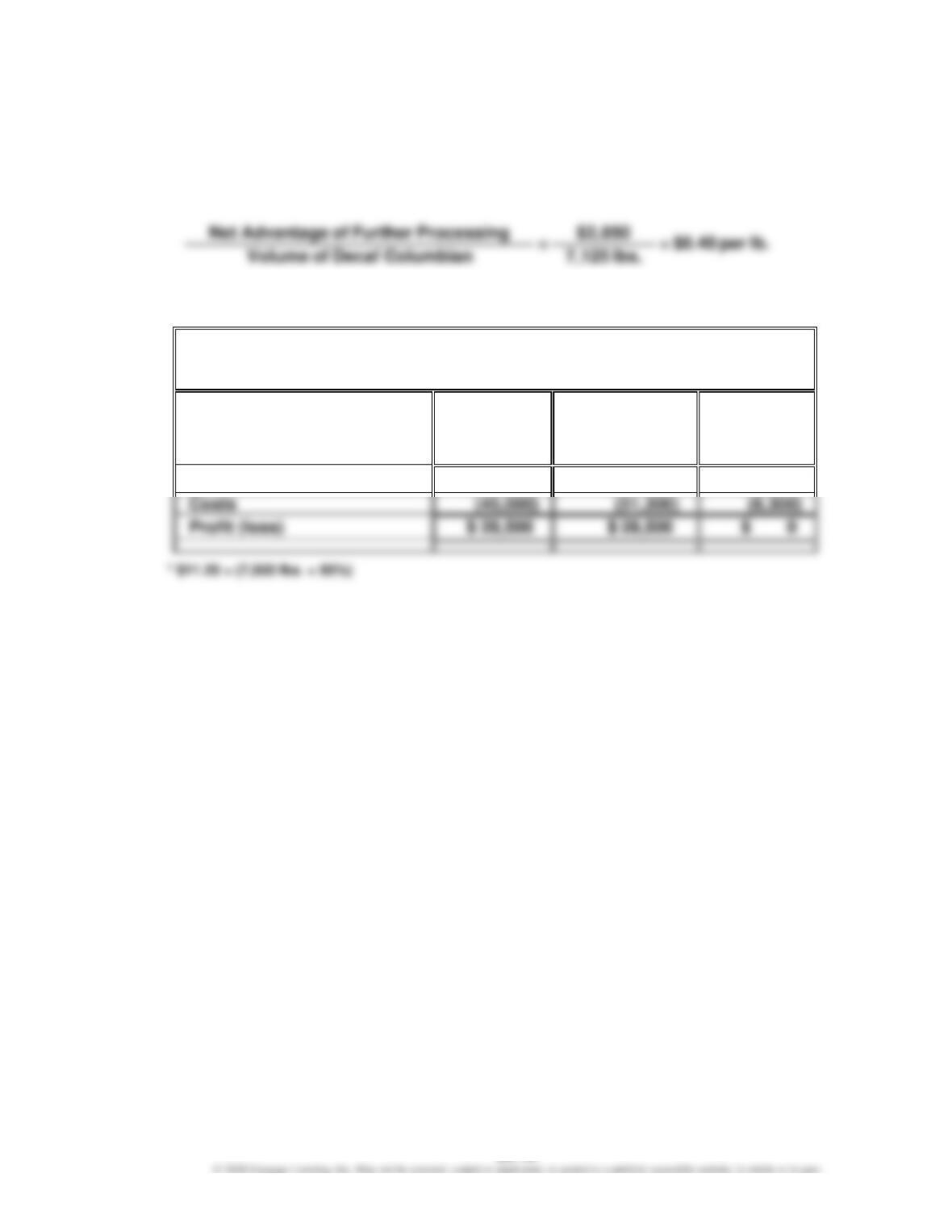
b. The differential revenue from processing further to Decaf Columbian is $2,850. Thus,
Dakota Coffee Company should process further to Decaf Columbian.
CHAPTER 25 (FIN MAN); CHAPTER 11 (MAN) Differential Analysis and Product Pricing
Ex. 25–12 (FIN MAN); Ex. 11–12 (MAN) (Concluded)
c. The price of Decaf Columbian would need to decrease from $11.60 to $11.20 per
pound in order for the differential analysis to yield neither an advantage nor a
disadvantage (indifference). This is determined as follows:
The price of Decaf Columbian would need to be $0.40 lower, or $11.20, to yield no net
differential profit or loss. This is verified by the following differential analysis:
Differential Analysis
Sell Regular (Alt. 1) or Process Further into Decaf (Alt. 2)
December 11
Sell
Regular
(Alternative 1)
Process
Further into
Decaf
(Alternative 2)
Differential
Effects
(Alternative 2)
Revenues
$ 73,500
$ 79,800*
$ 6,300
Costs
CHAPTER 25 (FIN MAN); CHAPTER 11 (MAN) Differential Analysis and Product Pricing
Ex. 25–13 (FIN MAN); Ex. 11–13 (MAN)
a.
Differential Analysis
Reject (Alt. 1) or Accept (Alt. 2) Order
November 12
Reject
Order
(Alternative 1)
Accept
Order
(Alternative 2)
Differential
Effects
(Alternative 2)
Revenues
$0
$ 576,0001
$ 576,000
Costs:
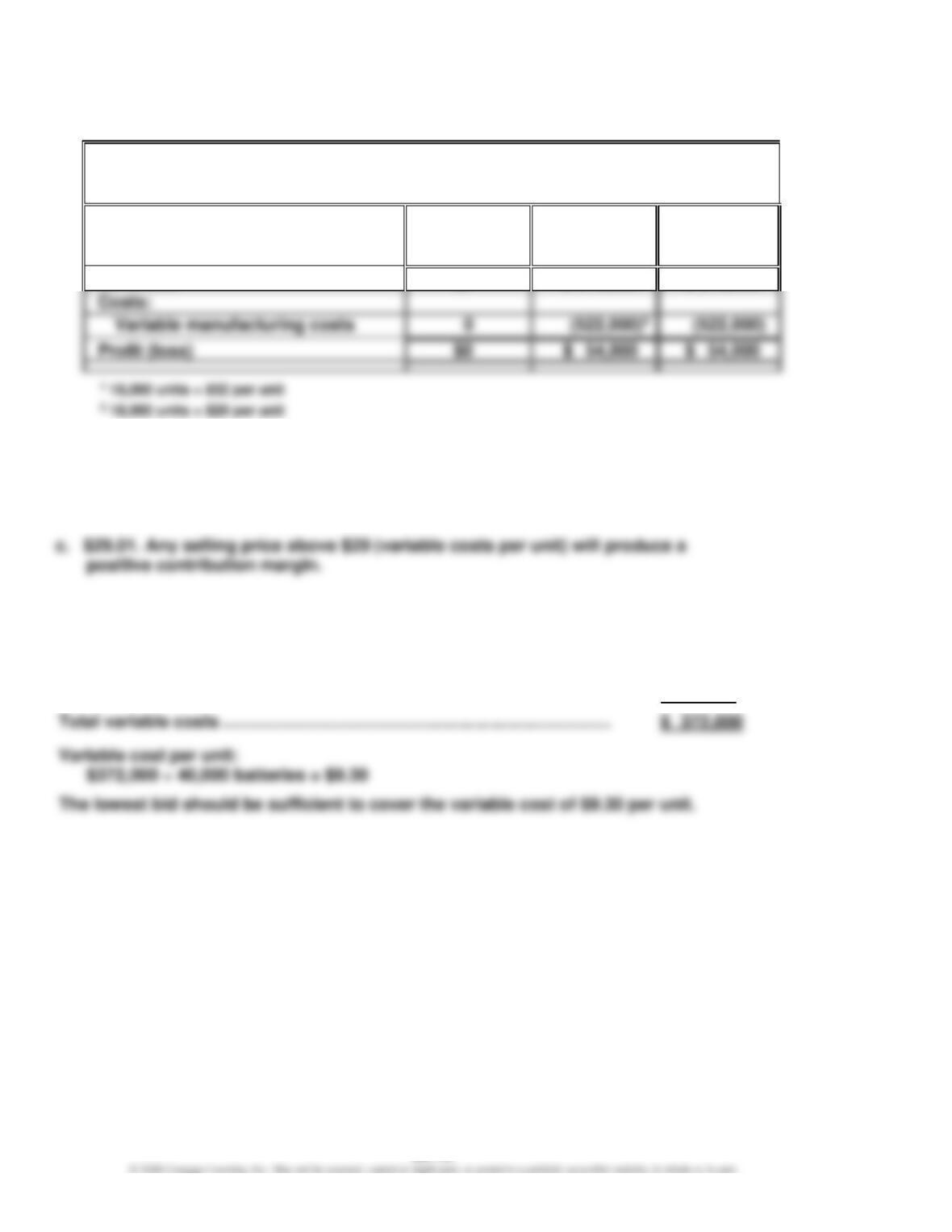
b. The additional units can be sold for $32 each, and because unused capacity is
available, the only costs that would be added if this additional production were
accepted are the variable costs of $29 per unit. The differential revenue is therefore
$32 per unit, and the differential cost is $29 per unit. Thus, the net profit is $3 per unit
× 18,000 units, or $54,000.
Ex. 25–14 (FIN MAN); Ex. 11–14 (MAN)
Total costs …………………………..………………………………………………………
$ 522,000
Fixed costs ………………………………………………………………………………….
(150,000)
Variable cost per unit:
CHAPTER 25 (FIN MAN); CHAPTER 11 (MAN) Differential Analysis and Product Pricing
Ex. 25–15 (FIN MAN); Ex. 11–15 (MAN)
a.
Differential Analysis
Reject (Alt. 1) or Accept (Alt. 2) Order
July 31
Reject
Order
(Alternative 1)
Accept
Order
(Alternative 2)
Differential
Effects
(Alternative 2)
Revenues
$0
$15,000,0001
$15,000,000
Costs:
Direct materials
0
(7,500,000)2
(7,500,000)
Variable factory overhead
0
(2,100,000)4
(2,100,000)
Variable selling and admin.
0
Shipping costs
0
Certification costs
0
Direct labor
0
(2,000,000)3
(2,000,000)
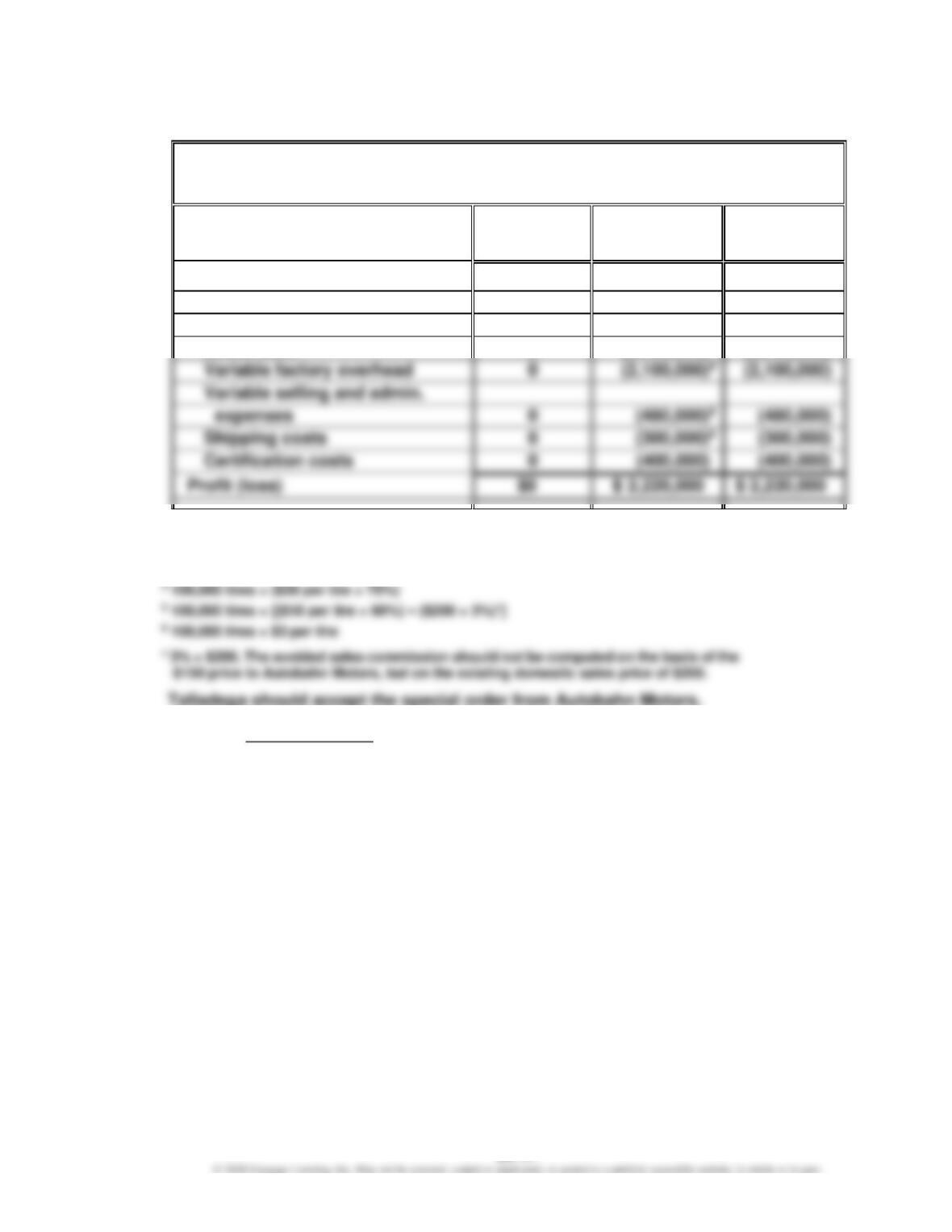
1 100,000 tires × $150 per tire
2 100,000 tires × $75 per tire
3 100,000 tires × $20 per tire
Talladega should accept the special order from Autobahn Motors.
b.
$2,220,000
$150 – = $150.00 – $22.20 = $127.80
100,000
This is the price at which the differential profit would be zero.
CHAPTER 25 (FIN MAN); CHAPTER 11 (MAN) Differential Analysis and Product Pricing
Ex. 25–16 (FIN MAN); Ex. 11–16 (MAN)
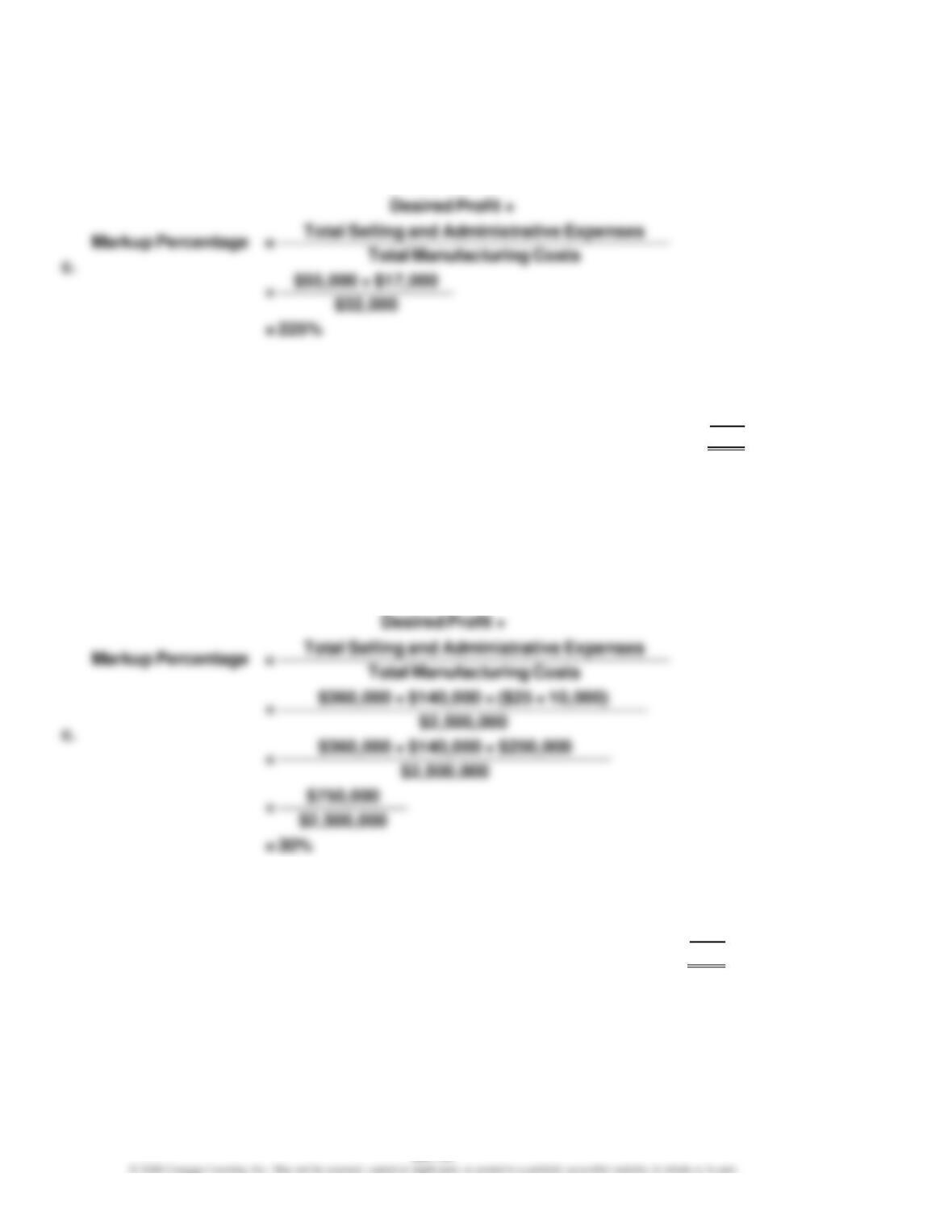
a. Desired profit = $250,000 × 22% = $55,000
b. Cost amount (product cost) per unit: $32,000 ÷ 800 units = $40
d.
Cost amount (product cost) per unit ………………………………………………….
$ 40
Markup ($40 × 225%) …………………………………………………………………………
90
Selling price ……………………………………………………………………………………..
$130
Ex. 25–17 (FIN MAN); Ex. 11–17 (MAN)
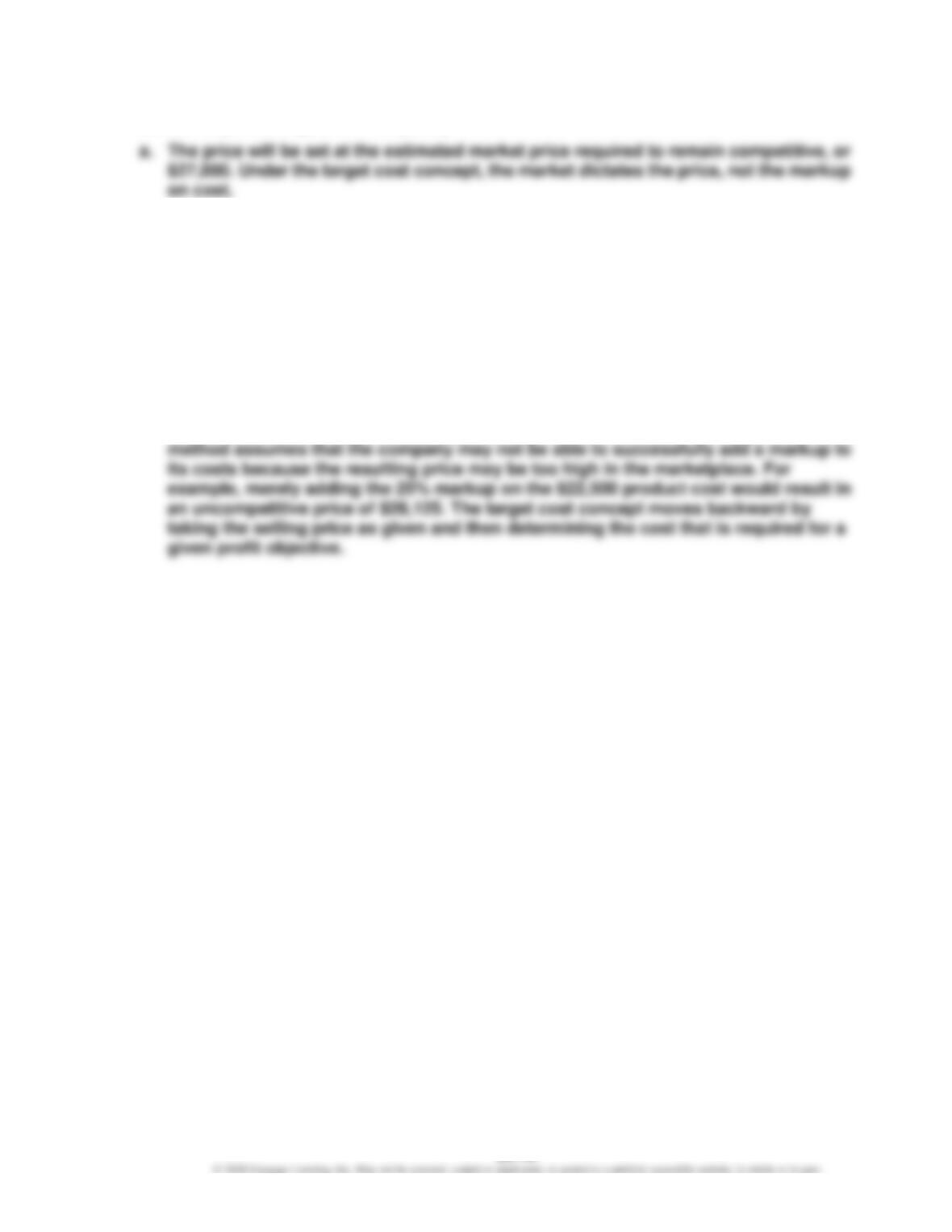
a. Desired profit = $1,200,000 × 30% = $360,000
b. Cost amount (product cost) per unit: $2,500,000* ÷ 10,000 units = $250
* ($215 manufacturing variable cost per unit × 10,000 units) + $350,000 manufacturing fixed
cost
d.
Cost amount per unit ……………………………………………………………………….
$250
Markup ($250 × 30%) …………………………..……………………………………………
75
Selling price …………………………………………………………………………………….
$325
CHAPTER 25 (FIN MAN); CHAPTER 11 (MAN) Differential Analysis and Product Pricing
Ex. 25–18 (FIN MAN); Ex. 11–18 (MAN)
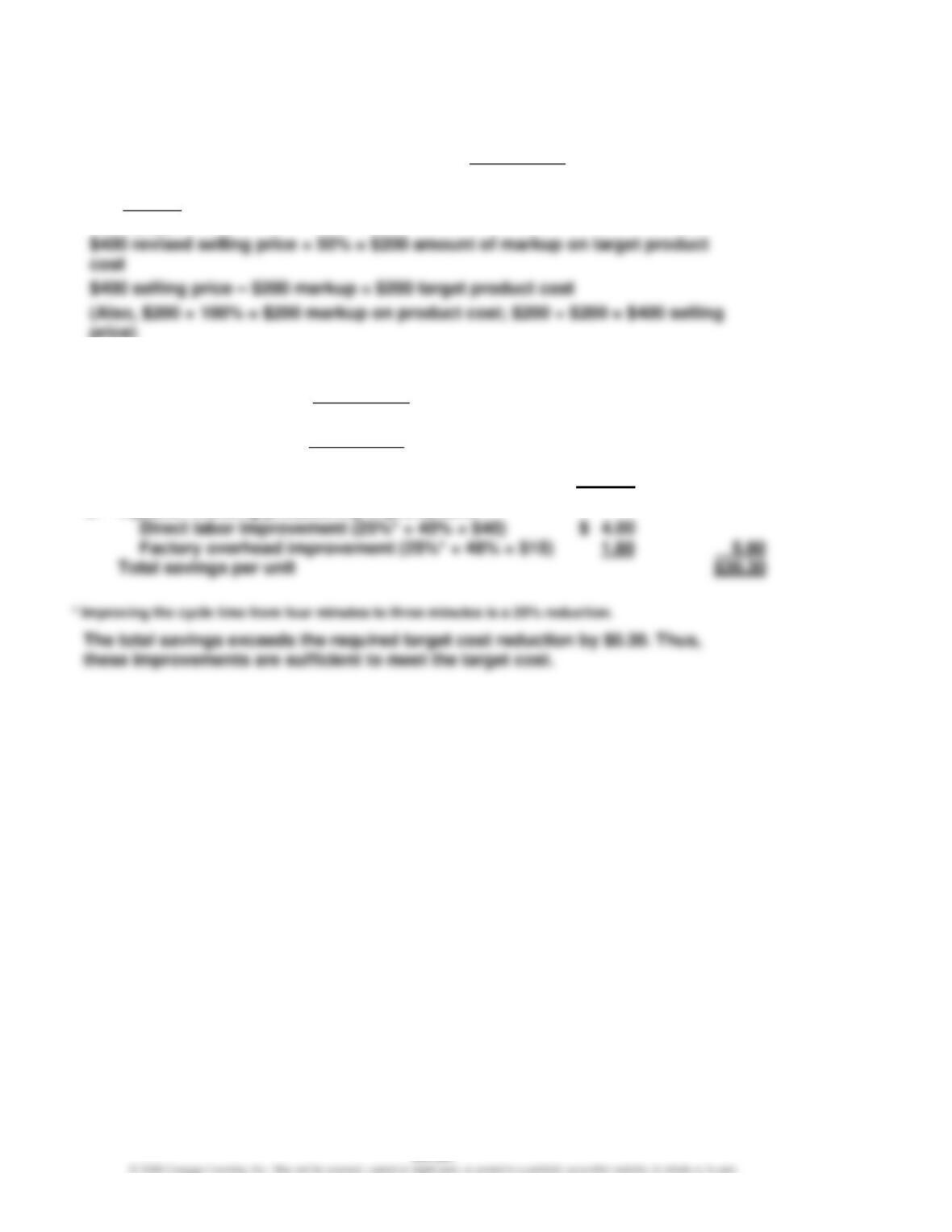
b. The required profit margin of 20% of the estimated $27,000 selling price implies a
$21,600 target product cost as follows:
Target Product Cost
=
$27,000 – ($27,000 × 20%)
=
$27,000 – $5,400
=
$21,600
Because the estimated manufacturing cost of $22,500 exceeds the target cost of
$21,600, Toyota must reduce $900 from its total costs in order to maintain
competitive pricing within its profit objectives.
Note to Instructors: Target costing provides pressure to keep costs competitive. The
CHAPTER 25 (FIN MAN); CHAPTER 11 (MAN) Differential Analysis and Product Pricing
Ex. 25–19 (FIN MAN); Ex. 11–19 (MAN)
a.
$460 – $230
Historical markup percentage on product cost : = 100%
$230
or,
$230 = 50% of selling price
$460
price)
b. Required cost reduction: $230 – $200 = $30
c. 1. Direct labor reduction:
$30 × 15 min. =
60 min.
$ 7.50
2. Additional inspection:
$30 × 6 min. =
60 min.
$ (3.00)
Direct material reduction: 20.00 17.00
3. Injection molding productivity improvement: