Chapter 11 – Auditing of Government and Not-for-Profit Organizations
11-1
CHAPTER 11: AUDITING OF GOVERNMENT AND NOT-FOR-
PROFIT ORGANIZATIONS
OUTLINE
Number
Topic
Type/Task
Status
(re: 18/e)
Questions:
11-1
Definition of audit, standard setters
Define, explain
Same
11-2
GAGAS audit services
Define
Same
11-3
GAGAS versus GAAS
Explain
11-8
11-4
Opinion units
Explain
Same
11-5
GAAP hierarchy
Explain
Same
11-6
Single Audit guidance
Explain
Revised
11-7
Use of auditing standards
Compare
New
11-8
Supplementary information
Explain
New
11-9
Independence under GAGAS
Remember
Same
11-10
Single Audit
Explain
Same
Cases:
11-11
Audit engagement
Apply
Revised
11-12
Audit considerations
Apply
Same
11-13
Research Case⎯Performance Audit
Apply
Same
11-14
Research Case⎯Single Audit
Apply
Same
11-15
Auditing a federal program
Apply
Revised
11-16
Auditor selection and independence
Apply
Same
11-17
NFP audit requirements
Analyze
New
Exercises/Problems:
11-18
Examine the CAFR
Understand
Revised
11-19
Various
Understand
Items 2, 3, 10
new. Items 1,
5, 11 revised.
11-20
GAGAS
Apply
New
11-21
Nonaudit services
Evaluate
Revised
11-22
Single audit
Apply
Revised
11-23
Single audit
Apply
Same
11-24
GAAS versus GAGAS standards
Understand
Revised
11-25
Audit report
Analyze
Revised
Chapter 11 – Auditing of Government and Not-for-Profit Organizations
CHAPTER 11: AUDITING OF GOVERNMENT AND NOT-FOR-
PROFIT ORGANIZATIONS
Answers to Questions
11-1. An audit involves an independent review of information or processes by an external party
for the purpose of evaluating the validity and reliability of information or assessing a
program or process. The purpose of a financial audit is to express an opinion or provide
assurance for users of the financial statements that the statements have been prepared in
conformity with accounting and financial reporting standards established by authoritative
bodies.
General Problem Information: Definition of audit, standard setters
Learning Objective: 11-1
Topic: Financial Audits by Independent CPAs
Bloom’s Taxonomy: Define, Explain
Accreditation Skills tag: AACSB: Communication, AICPA: FN Reporting
Level of Difficulty: Easy
11-2. Government Auditing Standards define three major types of services performed by
auditors: financial audits, attestation engagements, and performance audits. Financial
audits provide an auditor’s opinion that financial statements present fairly an entity’s
financial position, changes in financial position, and where applicable, cash flows in
conformity with generally accepted accounting principles, and informs users that they can
rely on that information. Attestation engagements are examinations, reviews, or agreed-
upon procedures on subject matter that provide various levels of assurance on financial or
General Problem Information: GAGAS audit services
Learning Objective: 11-2
Topic: Government Auditing Standards
Bloom’s Taxonomy: Define
11-3
11-3. GAGAS is the acronym for generally accepted government auditing standards (also
referred to as GAS), the standards set forth by the Comptroller General in Government
Auditing Standards. GAAS is the acronym for generally accepted auditing standards
established by the AICPA. As covered in this chapter, GAAS enable an auditor to express
an opinion on the financial statements. GAGAS cover not only financial audits, but also
cover attestation engagements and performance audits (e.g., operational audits to assess
the efficiency and effectiveness of an organization). In effect, GAGAS are broader than
GAAS and generally encompass and expand on the AICPA’s generally accepted auditing
standards. GAGAS are required to be used for a single audit engagement but may also be
required by contract or law to be used for a financial statement audit.
General Problem Information: GAGAS versus GAAS
Learning Objective: 11-2
11-4. An opinion unit is related to the financial reporting structure of governments. Opinion
units include governmental activities, business-type activities, aggregate discretely
presented component units, each major governmental and enterprise fund, and the
aggregate remaining funds. Auditors need to be familiar with the number of client
opinion units since the auditor is required to opine on each unit. Because an opinion is
needed on each unit, GAAS requires that materiality determinations be made for each
opinion unit. The number of opinion units affects the complexity, time, and cost of an
audit.
Accreditation Skills tag: AACSB: Communication, AICPA: FN Reporting
Level of Difficulty: Medium
11-5. Referring to Illustration 11-1, state and local governments and federal government entity
financial reporting is governed by officially established accounting principles, including
statements issued by the Governmental Accounting Standards Board (GASB) and the
Federal Accounting Standards Advisory Board (FASAB), respectively. The FASAB also
considers interpretations as Category (a) principles. Authoritative standards for
nongovernment entities are set by the Financial Accounting Standards Board (FASB) and
Chapter 11 – Auditing of Government and Not-for-Profit Organizations
11-4
Ch. 11, Answers, Question 11-5 (Cont’d)
Learning Objective: 11-1
Topic: The Audit Process
11-6. An auditor performing a single audit should be familiar with the unique purpose served
by each of these resources. OMB Uniform Administrative Requirements, Cost Principles,
and Audit Requirements for Federal Awards (Uniform Guidance) provides information
and guidance for federal fund recipients and auditors regarding compliance with single
audit requirements set forth in the Single Audit Act of 1984 (P.L. 98-502), as amended by
Single Audit Act Amendments of 1996 (P.L. 104-156). An audit staff member would be
most interested in subpart E, which covers scope of audit, audit reporting, audit findings,
audit working papers, major program determination, criteria for federal program risk, and
criteria for a low-risk auditee. While OMB Uniform Guidance is generic for all single
audits, the Compliance Supplement provides specific audit requirements and suggested
auditing procedures for each individual federal program. The Government Auditing
11-7. Auditors of public for-profit organizations refer to auditing standards issued by the Public
Company Accounting Oversight Board (PCAOB), while auditors of private for-profit
organizations refer to generally accepted auditing standards (GAAS) issued by the
Auditing Standards Board of the AICPA. Auditors of not-for-profit entities and
governments would use either GAAS or generally accepted government auditing
General Problem Information: Use of auditing standards
Learning Objective: 11-1
Topic: Generally Accepted Auditing Standards
Bloom’s Taxonomy: Compare
Accreditation Skills tag: AACSB: Communication, AICPA: FN Reporting
Level of Difficulty: Hard
Chapter 11 – Auditing of Government and Not-for-Profit Organizations
11-5
11-8. It depends. Required supplementary information (RSI), such as the MD&A and
budgetary comparison schedules, are outside the scope of the financial statement audit
but are considered by the GASB to be essential to the financial report. Auditors apply
certain limited procedures in connection with RSI and issue an opinion on whether the
RSI is fairly presented in relation to the basic financial statements. Other items within
government financial statements that are outside the scope of the financial statement audit
can be deemed either supplemental information, for which an in relation to opinion may
be issued, or other information, for which no opinion is issued. AU-C Sections 720, 725,
and 730 cover auditor responsibilities regarding supplementary information that is
included in a document containing audited financial statements.
General Problem Information: Supplementary information
Learning Objective: 11-2
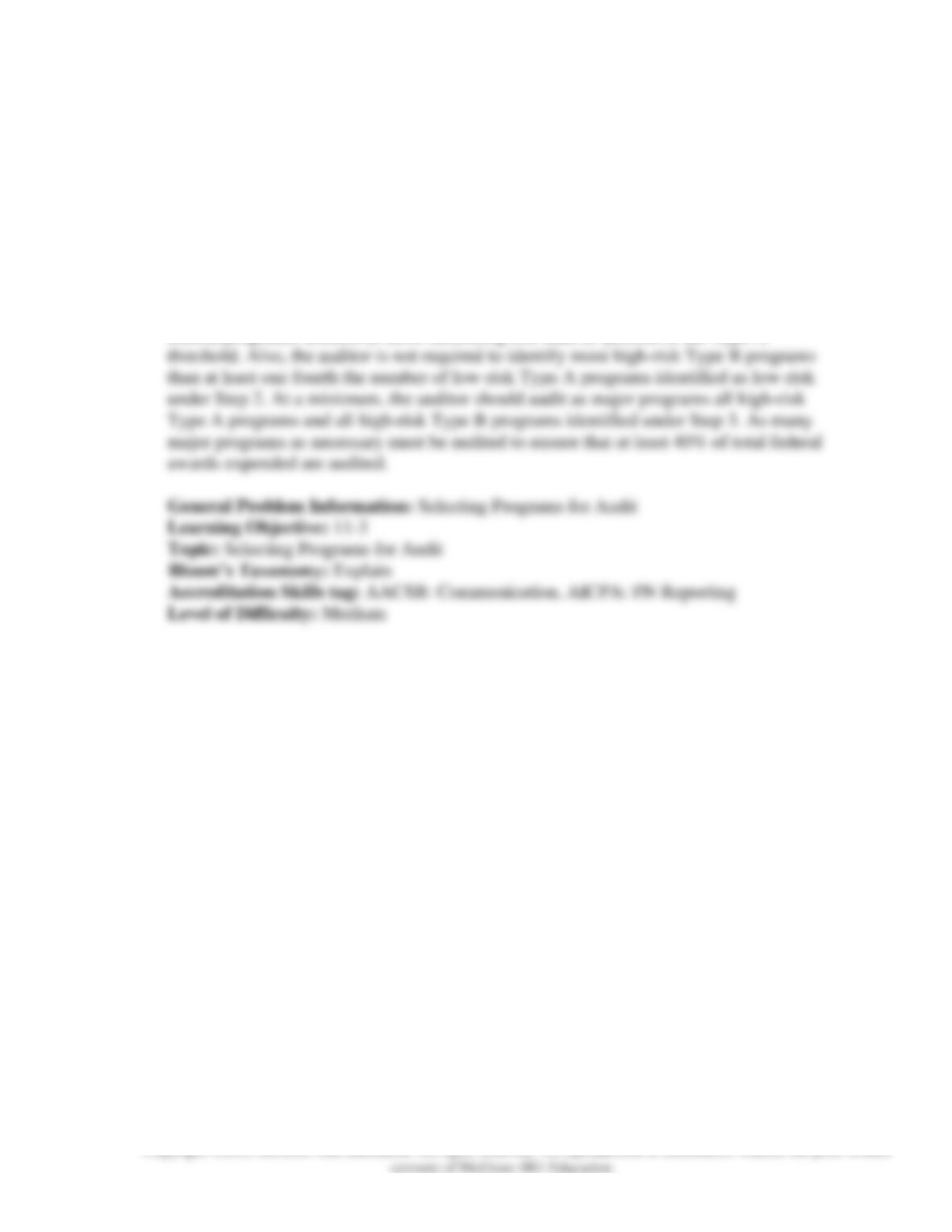
11-9. Government Auditing Standards, par. 3.81 identifies the following prohibited nonaudit
activities considered management responsibilities that impair independence if performed
by an independent auditor:
a. setting policies and strategic direction for the audited entity;
b. directing and accepting responsibility for the actions of the audited
entity’s employees in the performance of their routine, recurring
f. accepting responsibility for the management of an audited entity’s
project;
g. accepting responsibility for designing, implementing, or maintaining
internal control;
h. providing services that are intended to be used as management’s
primary basis for making decisions that are significant to the subject
matter of the audit;
General Problem Information: Independence under GAGAS
Learning Objective: 11-2
Topic: Ethics and Independence
Bloom’s Taxonomy: Remember
Accreditation Skills tag: AACSB: Communication, AICPA: FN Reporting
Chapter 11 – Auditing of Government and Not-for-Profit Organizations
11-6
Ch. 11, Answers, Question 11-9 (Cont’d)
Level of Difficulty: Easy
11-10. When performing a single audit, federal awards programs are classified by risk. In Step 1,
the larger (per the sliding scale presented in Chapter 11) federal programs are identified
as Type A. All other programs are identified as Type B programs. In Step 2, any low-risk
Type A programs are identified. This involves auditor judgment after fully considering
the factors discussed in Chapter 11. In Step 3, Type B programs are risk assessed;
however, the auditor is not expected to perform risk assessments on relatively small
Chapter 11 – Auditing of Government and Not-for-Profit Organizations
11-7
Solutions to Cases
11-11. This case addresses the issue of properly defining an audit engagement. In particular,
students must assess whether a financial audit is sufficient, or whether an organization
has expended sufficient federal awards to also require a single audit. It also provides an
opportunity to discuss the process of accepting a new audit engagement, specifically the
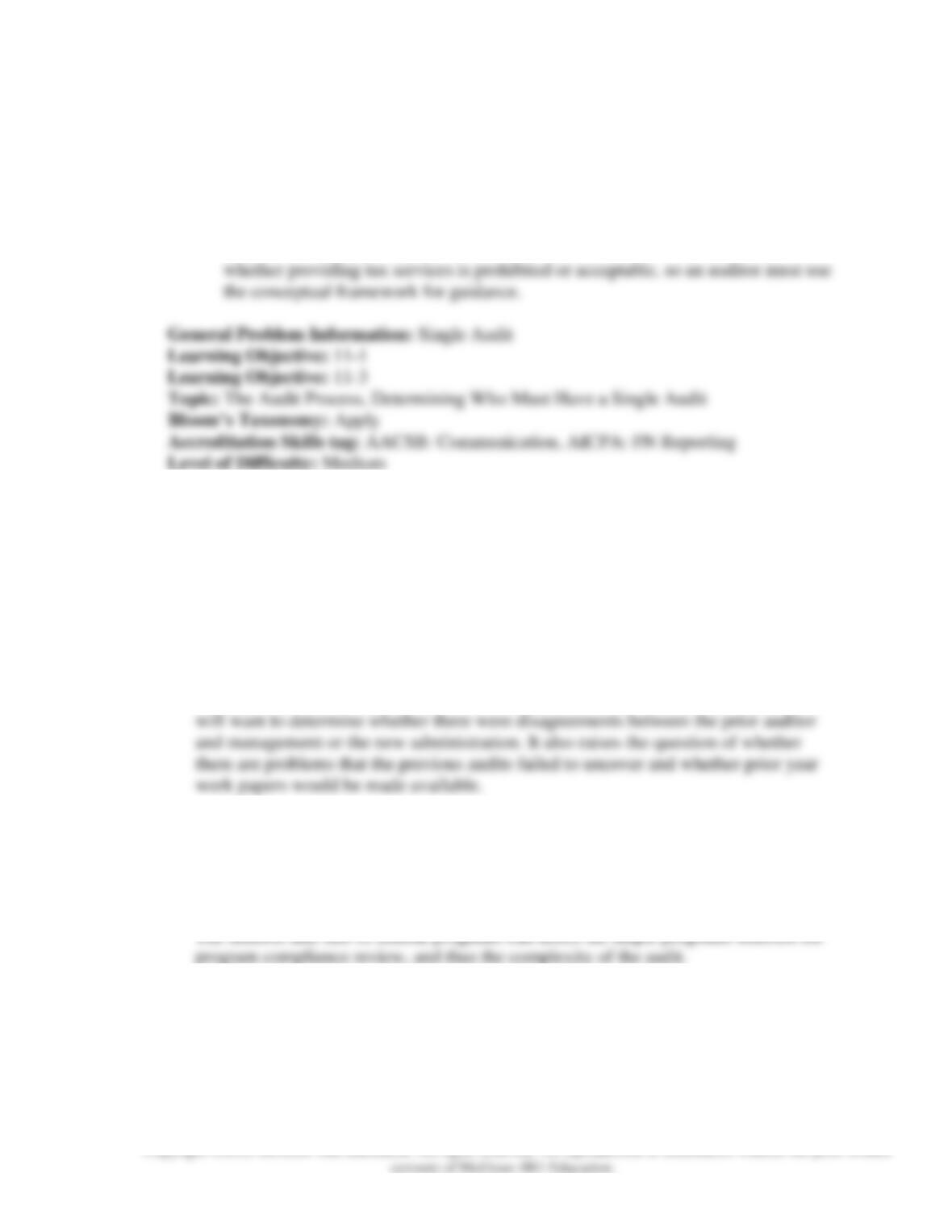
a. Analysis of expenditures of federal awards shows that Lake View Mental Health
Affiliates expended more than $750,000 in federal awards and therefore is
required to have a single audit. Total expenditures of federal awards are
determined as follows:
Item Federal Awards Expended
2. Private gifts – 0 – (not applicable)
4. Pass through funds from County 300,000
5. Counseling services 400,000 (maximum)
Total $775,000
b. Based upon the conclusion in part a and the information provided in the
background, one could conclude that Mr. Wise would be unwise to accept this
engagement for $10,000 – the going rate for a financial audit. A single audit
conducted in accordance with GAGAS and OMB Uniform Guidance requires
considerably more audit planning, audit work, and audit reporting than a financial
statement audit conducted in accordance with GAAS. Also, as Mr. Wise notes in
the case, an auditor should not accept an engagement at a given price before
evaluating the extent of work that will be required.
Personnel of a newly formed not-for-profit might not be familiar with single audit
requirements, so it is Mr. Wise’s professional responsibility to communicate to
Lake View’s management and audit committee (or, if no audit committee, to the
governing board) that an audit in accordance with GAAS does not meet the legal
and regulatory requirements established by the federal government for recipients
who expend $750,000 or more in federal awards.
Chapter 11 – Auditing of Government and Not-for-Profit Organizations
11-8
Ch. 11, Solutions, Case 11–11 (Cont’d)
c. Maybe. Mr. Wise would be required to reference the GAGAS conceptual
framework for independence shown in Illustration 11-5. While the task of
preparing routine tax filings was previously listed in the GAO’s Government
Auditing Standards on independence as an example of a service that would not
impair the independence of an auditor, in the current standards it is not clear
11-12. There is a great deal more information you will want before making your bid; however,
some of the factors affecting price that you might have on your list include:
1. Number of major programs and component units. The larger the number of major
programs, the more opinion units on which you will need to determine materiality and
opine. An auditor should also consider whether the downtown development district is
a component unit of the city for reporting purposes.
2. Predecessor auditor. When a prior auditor chooses not to pursue an audit engagement,
it may indicate that there is an element of audit risk involved. An incoming auditor
3. The amount of aid received from the federal government. If the city expends over
$750,000 in federal funds, it is subject to a single audit, increasing the complexity of
the audit.
4. The number of federal programs and the amount of funds expended by each program.
5. Specifics of the former wastewater employee lawsuit and allegations of improper
payments. These issues involve internal controls at the facility, potential illegal acts,
and contingent liabilities to the city. Each of these areas impacts audit planning and
fieldwork.
Chapter 11 – Auditing of Government and Not-for-Profit Organizations
11-9
Ch. 11, Solutions, Case 11–12 (Cont’d)
6. In addition to the new administration and the lawsuit, other potential risk factors
exist. The new controller is a CPA with government audit experience, which may
help mitigate some risk. However, the controller is new to the culture and
environment of the city government. Item 4 indicates that other risk factors could
11-13. The objective of this case is to familiarize students with the nature of performance audits.
Instructors may choose to specify an Oregon audit for review, such as the biennial one
related to financial condition review of counties, or have students search for performance
audits within their state or local governments rather than using the Oregon website.
Instructors may also want to specify an expected length for the required memo or provide
a grading rubric.
Answers to parts a-c will vary with the performance report selected. Suggested answers
are provided for the 2020 performance audit of Travel Oregon
a. Title: Travel Oregon Should Strengthen Controls over Contracting and Improve
Accountability of Compensation to Inform Decision Makers; Issued: February 2020;
Conducted by: Secretary of State’s Audit Division
Ch. 11, Solutions, Case 11–13 (Cont’d)
Chapter 11 – Auditing of Government and Not-for-Profit Organizations
11–10
c. Yes, Travel Oregon submitted a response at the end of the report. The CEO agreed
with all recommendations and provided a target date to complete implementation
activities.
General Problem Information: Performance Audits
Learning Objective: 11-2
Accreditation Skills tag: AACSB: Communication, AICPA: FN Reporting
Level of Difficulty: Medium
11-14. The objectives of this case are to familiarize students with government audit resources
available on the Internet and to illustrate the process for selecting major programs for
audit using the risk-based approach. The following answers were obtained from the 2019
Compliance Supplement; note that programs can change annually.
a. The Department of Health and Human Services sponsors the Child Care and
Development Block Grant (CFDA 93.575); the Maternal, Infant, and Early Childhood
Home Visiting Program (CFDA 93.870); and Head Start (CFDA 93.600). The
National School Lunch Program (CFDA 10.555), School Breakfast Program (CFDA
10.553), and the Special Milk Program for Children (CFDA 10.556) are sponsored by
the Department of Agriculture. The Special Education—Grants for Infants and
Families (CFDA 84.181) is under the Department of Education.
c. Total expenditures are $1,581,261; therefore, the criterion for selecting a major Type
A program would be $750,000 in federal funds expended. Head Start is the only
program that meets this requirement. The Special Education grant at $25,000 falls
below the threshold for assessment (25% of $750,000 = $187,500) and would be
exempt from consideration based on its size. (The Department of Agriculture
programs are below the threshold individually, but they should be considered together
since they form a cluster.)
Chapter 11 – Auditing of Government and Not-for-Profit Organizations
11–11
Ch. 11, Solutions, Case 11–14 (Cont’d)
e. This is a difficult question. Notice that the only way the 40 percent coverage rule can
be met is by auditing the Head Start program. One single audit problem that OMB
and GAO have identified in the past relates to the same programs always being
audited. This presents one situation where the auditor may continue to audit a low-
risk program just to meet single audit requirements. The auditor should analyze the
auditee to determine if the auditee would qualify as a low-risk auditee. If the auditee
is low-risk the auditor need audit only 20 percent of federal funds expended. The
General Problem Information: Single audit and major programs
Learning Objective: 11-3
Topic: Single Audit Requirements
Bloom’s Taxonomy: Apply
Accreditation Skills tag: AACSB: Knowledge Application, AICPA: Critical Thinking
Level of Difficulty: Hard
11-15. Although this case requires limited analysis, it is a useful exercise to give students a feel
for the resources auditors use to test for compliance in performing single audits. The
following answers were obtained from the 2019 Compliance Supplement; note that
programs can change annually.
a. The Catalog of Federal Domestic Assistance (CFDA) number for this program is
10.516.
b. According to the Compliance Supplement, the Rural Health and Safety program
addresses the health and well-being of rural America through supporting the
c. Based on the matrix provided in Part 2 of the August 2019 draft of the Compliance
Supplement, the description of compliance requirements in Part 3 of the Compliance
Supplement, and the more detailed compliance requirements in Part 4, the following
generic compliance requirements are applicable to the program. (Note: These are
assigned the same identifying letters as shown in the Compliance Supplement.)
Chapter 11 – Auditing of Government and Not-for-Profit Organizations
11–12
Ch. 11, Solutions, Case 11–15, c. (Cont’d)
A. Activities Allowed or Unallowed
F. Equipment/Real Property Management
L. Reporting
M. Subrecipient Monitoring
d. The following answers are found under Activities Allowed or Unallowed.
1. Yes. This workshop appears to relate to a topic applicable to timber harvesters. It
2. It appears as though the cost of a picnic would be entertainment and not allowable.
Meals for a person “not in travel status” are not allowable. Furthermore,
3. No. Both general purpose equipment and renovation of extension space are not
allowable.
General Problem Information: Auditing a federal program
Learning Objective: 11-3
Topic: Compliance Audits
Level of Difficulty: Medium
11-16.
a. The seven threats found in GAGAS Section 3.30 are as follows:
a. Self-interest threat – the threat that a financial or other interest will
inappropriately influence an auditor’s judgment or behavior.
b. Self-review threat – the threat that an auditor will not appropriately
evaluate the results of a previous judgment made or service
performed by the auditor, or the audit organization, on which the
auditor will rely when forming a judgment significant to an audit.
Chapter 11 – Auditing of Government and Not-for-Profit Organizations
11–13
Ch. 11, Solutions, Case 11–16, a. (Cont’d)
e. Undue influence threat – the threat that external influences or
pressures will impact an auditor or audit organization’s ability to
make independent and objective judgments.
f. Management participation threat – the threat that results from an
auditor’s taking on the role of management or otherwise
performing management functions on behalf of the entity
undergoing an audit or attestation engagement.
Three of the seven threats could apply to this situation. Since the accounting firm put
the accounting system in place, the auditor could be in a position of reviewing or
evaluating his/her own work or set of controls (self-review threat). If the new auditor
is familiar enough with the accounting system to have the ability to override controls,
management participation threat could be a problem. Finally, if the personnel that
implemented the accounting system change spent a great deal of time in the city
offices, familiarity threat could also prove to be an issue.
b. A request for proposals for government audit services should describe accounting-
related characteristics of the government entity and detail the scope of audit services
being requested, as well as the specific qualifications desired of audit firms
responding to the RFP. An RFP should be widely dispersed to qualified audit firms
and advertised in local business and professional periodicals.
The government seeking an audit should also be described in the RFP. Summary
financial data (e.g., total revenues, number of funds, component units) and accounting
function staff characteristics should be disclosed. Prospective auditors will also be
interested in the availability of prior financial reports and records, including journal
entries, as well as management letters issued and pension plan information.
Engagement specifics, such as the timing of the audit, work schedules, estimated
hours, prior year audit fees, and due date are also important.
Chapter 11 – Auditing of Government and Not-for-Profit Organizations
11–14
Ch. 11, Solutions, Case 11–16, b. (Cont’d)
The government entity should also specify the required qualifications of the auditing
firm, in terms of experience, staff size, licensing and training, and independence.
References from other government audit clients and results of peer reviews might be
requested. If available, evaluation criteria should be provided within the RFP.
General Problem Information: Auditor selection and independence
Learning Objective: 11-2
Learning Objective: 11-4
Topic: Ethics and Independence, Special Topics Related to Audits of Governments and
Not-for-Profits
Bloom’s Taxonomy: Apply
Accreditation Skills tag: AACSB: Knowledge Application, AICPA: Critical Thinking
Level of Difficulty: Hard
11-17. Vermont does not have an audit requirement for NFPs, but Massachusetts and New
Hampshire have differing requirements:
Massachusetts – a public charity with gross annual support and revenue over $200,000
must file an audited financial statement prepared by an independent CPA together with
its annual report; however, if gross annual support and revenue is not more than
$500,000, only a review is required.
Each student’s memo will differ but should note that the anticipated level of revenue may
dictate when an audit is required. If revenues will be below $200,000, then a review
would be required in Massachusetts, but there are no requirements in Vermont or New
Hampshire. Revenues of $500,000 or more will require an audit or submission of
financial statements. If an audit is desired by potential donors, this research may impact
the decision regarding state registration; however, other factors, such as where
fundraising events will be held, may also be important.
Chapter 11 – Auditing of Government and Not-for-Profit Organizations
11–15
Ch. 11, Solutions, Case 11–17 (Cont’d)
General Problem Information: NFP audit requirements
Learning Objective: 11-1
Topic: Audit Requirements for NFPs
Solutions to Exercises and Problems
11-18. Each student should have a different government annual report and so will have different
answers to questions in this exercise. Some time spent in class to allow students to report
on their own answers and to get an idea of the range of the answers of other students is
useful.
General Problem Information: Examine the CAFR
Learning Objective: 11-1
11-19. 1. d. 6. c. 11. a.
3. b. 8. a. 13. c.
5. a. 10. b.
General Problem Information: Various
Learning Objective: 11-1
Topic: Various Chapter Topics
Bloom’s Taxonomy: Understand
Accreditation Skills tag: AACSB: Communication, AICPA: FN Reporting
Level of Difficulty: Medium
11-20. 1. BO 6. BO
3. BO 8. BO
5. GO
Chapter 11 – Auditing of Government and Not-for-Profit Organizations
11–16
Ch. 11, Solutions, Exercise 11–20 (Cont’d)
General Problem Information: Generally accepted government auditing standards
(GAGAS)
2. P 6. A
4. P 8. P
General Problem Information: Allowable Nonaudit Services
Learning Objective: 11-2
Topic: Governmental Auditing Standards
Bloom’s Taxonomy: Apply
Accreditation Skills tag: AACSB: Knowledge Application, AICPA: Critical Thinking
Level of Difficulty: Medium
11-22.
a. Total federal awards expended for the year are $12,394,000. Using the sliding scale for
determining the threshold for a Type A program (found in Chapter 11), it can be
determined that the threshold is $750,000, since it is larger than 3% ($12,394,000 × .03 =
$371,820). Those programs that would be classified as Type A because they exceed the
threshold would be Programs 2, 3, 4, 5, and 7. The Type B programs would be Programs
1, 6, 8, 9, and 10, since all programs not meeting Type A criteria are classified as Type B.
Some Type B programs are too small to be assessed. Programs 1, 8, and 10 are below the
25% assessment threshold (25% of $750,000 = $187,500). Of the remaining Type B
programs, the auditor is not required to identify more high-risk Type B programs than at
least one fourth the number of low-risk Type A programs identified as low-risk. Given
two low-risk Type A programs (Programs 4 and 5), only one Type B program need be
Chapter 11 – Auditing of Government and Not-for-Profit Organizations
11–17
Ch. 11, Solutions, Exercise 11–22 (Cont’d)
c. Programs 2, 3, and 7 would be audited as Type A programs in the current year, totaling
$4,360,000. In addition, any Type B program identified as high-risk must be audited.
Given that only two Type A programs were identified as low-risk, normally identifying
one high-risk Type B program would suffice; however, since the county is not a low-risk
auditee, a minimum of 40% of expended amounts or $4,957,600 ($12,394,000 × .40)
General Problem Information: Single audit
Learning Objective: 11-3
Topic: Selecting Programs for Audit
Bloom’s Taxonomy: Apply
Accreditation Skills tag: AACSB: Knowledge Application, AICPA: Critical Thinking
Level of Difficulty: Hard
11-23.
a. Total federal awards expended for the year are $26,675,000. Using the sliding scale for
determining the threshold for a Type A program (found in this chapter), it can be
determined that the threshold is $800,250 ($26,675,000 × .03 = $800,250). Those
programs that would be classified as Type A because they exceed the threshold would be
Programs 3, 4, 5, 6, and 8. The Type B programs would be Programs 1, 2, 7, 9, and 10,
since all programs not meeting Type A criteria are classified as Type B. Program 9 will
not be risk-assessed, as it is less than 25% of the Type A threshold (.25 × $800,250 =
$200,062.50).
Chapter 11 – Auditing of Government and Not-for-Profit Organizations
11–18
Ch. 11, Solutions, Exercise 11–23, b. (Cont’d)
The 40% coverage rule requires that $10,670,000 be audited ($26,675,000 × .40).
Auditing Programs 5, 6, 8, and 2 provides coverage of $10,175,000, so at least one more
program must be selected for audit. Following audit firm policy, it is likely that Program
10 would be selected.
11-24. 1. GAGAS 6. GAAS
3. GAAS 8. GAAS
5. GAGAS 10. GAGAS
General Problem Information: GAAS versus GAGAS standards
Learning Objective: 11-2
Topic: Government Auditing Standards
Bloom’s Taxonomy: Understand
Accreditation Skills tag: AACSB: Communication, AICPA: FN Reporting
Level of Difficulty: Medium
11-25. The document appears more like a letter than an audit report. Some of the changes that
would need to be made to bring the Tom and Jerry audit report into conformance with
current audit standards include:
• A title that includes the word independent.
• If there are sections of the financial report that are not audited, the auditor should
distinguish between required supplementary and supplementary information that
receives an “in-relation-to” opinion and other information that is not opined upon.
Chapter 11 – Auditing of Government and Not-for-Profit Organizations
11–19
Ch. 11, Solutions, Exercise 11–25 (Cont’d)
• A section with the heading “Basis for Opinion.” This section should note whether the
audit was a GAAS or GAGAS audit. (Reference to the documentation of
independence suggests that it may have been a GAGAS audit.)
• When applicable, a section subtitled “Report on Other Legal and Regulatory
Requirements.”
• Removal of the “Other Matters” section and its contents.
Note: The most current government audit report was not available at the time the
textbook went to press. More specific requirements may be found in updated government
audit reports available under Quick Links – Illustrative Audit Reports on the AICPA’s
Governmental Audit Quality Center website at
https://www.aicpa.org/interestareas/governmentalauditquality.html.
General Problem Information: Audit Report
Learning Objective: 11-1
Topic: Format of the Audit Report