
11-58. (continued)
Costs allocated from the electric department S2 + S3 = $108 + $333 = $441.
If electricity generation causes the costs allocated to it, then the company would
compare $441,000 internal cost to $480,000 from the outside utility.
c. If the company could realize $174,000 from the sale of the steam, then the relevant
costs would be:
Forgone steam sales ……………………….
$174,000a
Equipment maintenance …………………..
27,000b
Direct costs …………………………………….
330,000
$531,000
11–59. (30 min.) (Appendix) Cost Allocations—Reciprocal Method (Computer
Required): Steamco.
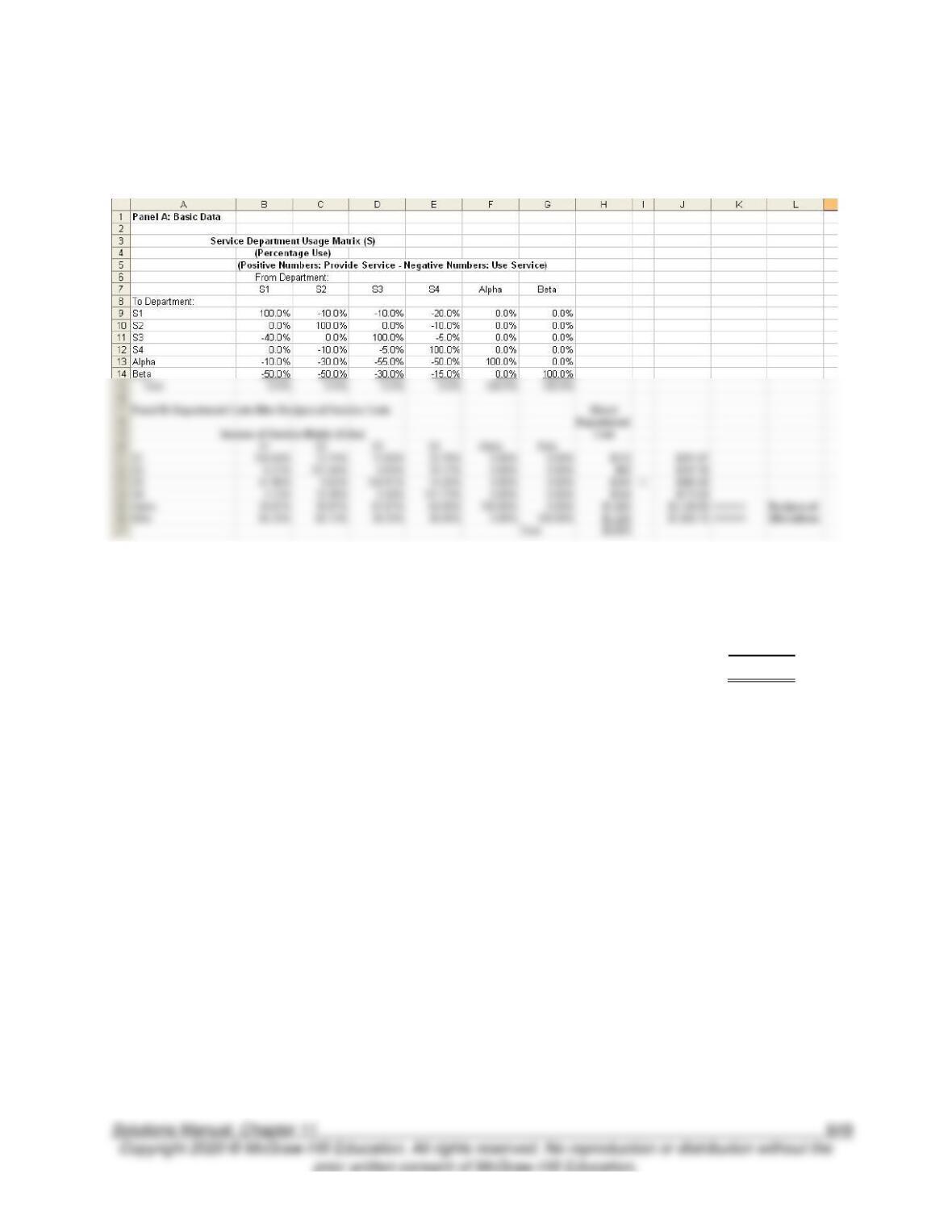
The total costs of the two producing departments include their direct costs. The
allocated costs, therefore, are:
Alpha ……………………………………….
($2,148.85 – $1,800.00)
=
$348.85
Beta ……………………………………….
($1,655.15 – $1,320.00)
=
335.15
Total service department costs ……
$684.00
11–60. (30 min.) Cost Allocation— Step Method, Reciprocal Method: Great
Eastern Credit Union.
a. The key to this problem is to recognize that Administration provides no service to
either of the other two service departments and that Processing only provides
services to Administration and not to Maintenance. Therefore, there are no
reciprocal services between Administration and the other service departments or
between Processing and Administration.
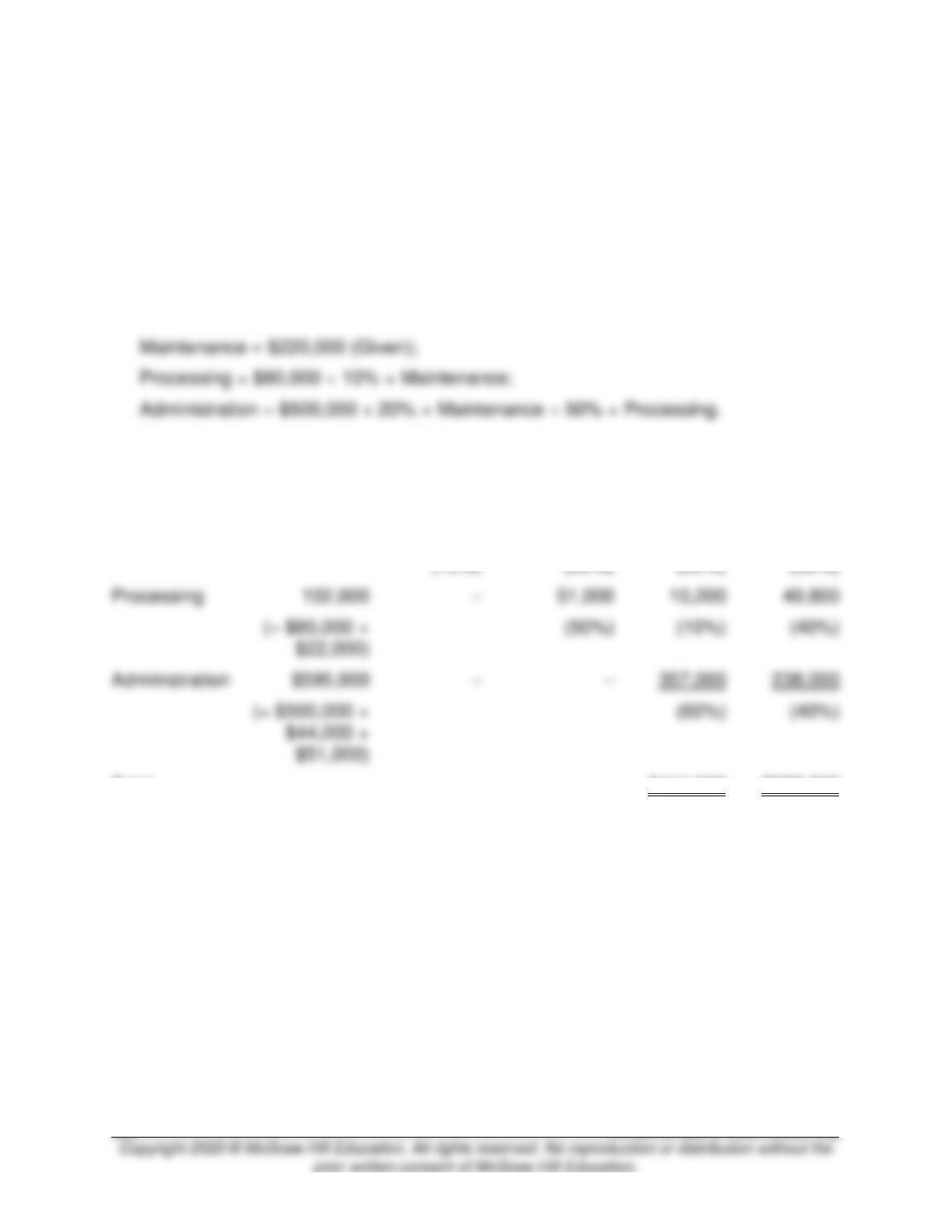
The cost equations can be written as follows:
Allocating costs in the order specified:
Allocated to:
Costs
Processing
Adminstration
Branches
Electronic
Maintenance
$220,000
$22,000
$44,000
$44,000
$110,000
Total
$411,200
$388,800
b. This is exactly the same as you would get using the step method because of the
pattern of usage.
11–61. (50 min.) Direct, Step, and Reciprocal Methods: Comparisons: Gipps
Business College.
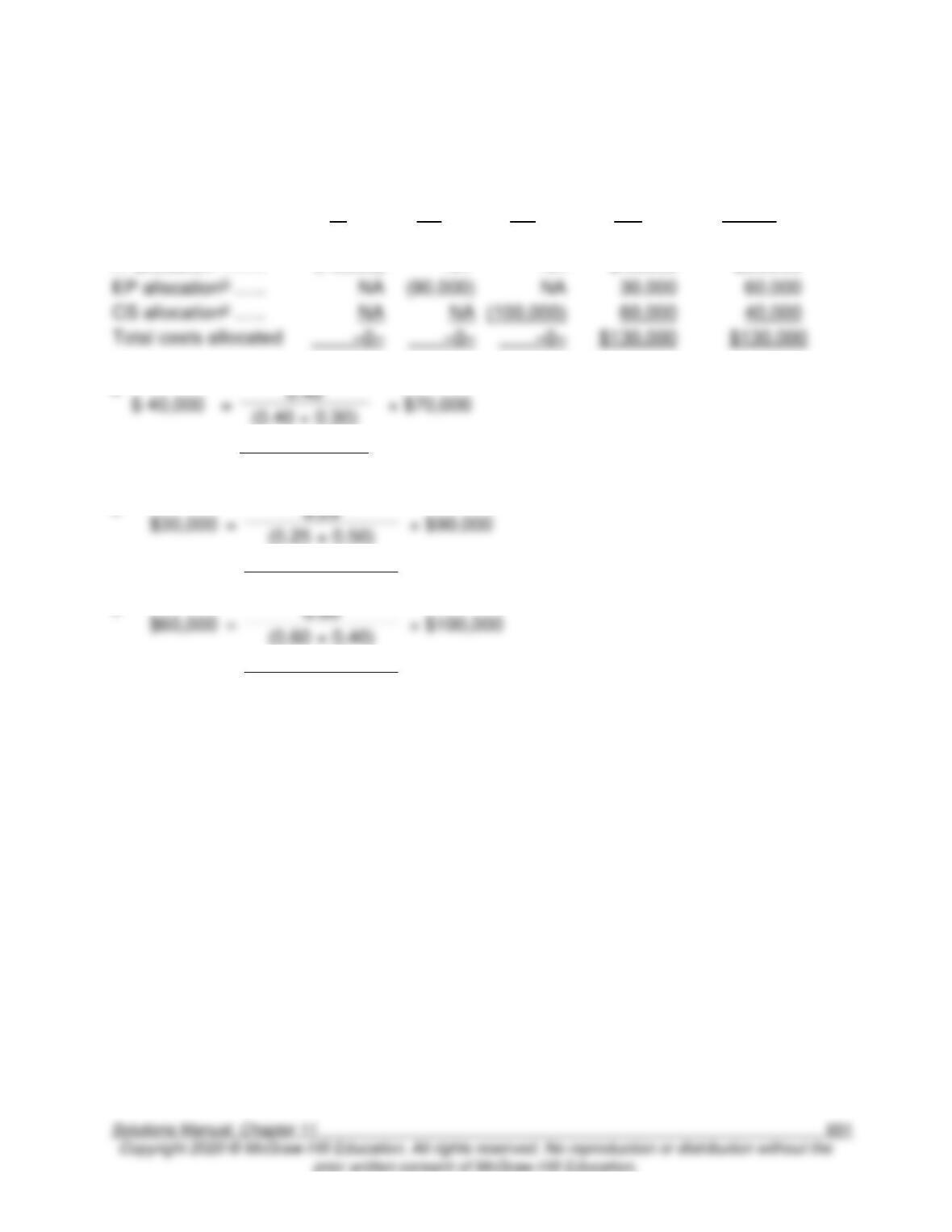
a(1). Direct Method:
IT
EP
CS
UG
GRAD
Department costs .
$70,000
$90,000
$100,000
-0-
-0-
NA
60,000
a
=
0.40
× $70,000
$30,000
=
0.30
× $70,000
(0.40 + 0.30)
b
=
0.25
× $90,000
(0.25 + 0.50)
$60,000
=
0.50
× $90,000
(0.25 + 0.50)
c
$60,000
=
× $100,000
(0.60 + 0.40)
$40,000
=
0.40
× $100,000
(0.60 + 0.40)
11–61. (continued)
a(2). Step Method:
IT
EP
CS
UG
GRAD
Department costs .
$70,000
$90,000
$100,000
-0-
-0-
IT allocationa ……..
(70,000)
7,000
14,000
$28,000
$21,000
EP allocationb ……
NA
(97,000)
24,250
24,250
48,500
CS allocationc ……
NA
NA
(138,250)
82,950
55,300
Total costs allocated
–0–
–0–
–0–
$135,200
$124,800
a
$7,000
=
0.10
×
$70,000
$14,000
=
0.20
×
$70,000
$28,000
=
0.40
×
$70,000
$21,000
=
0.30
×
$70,000
$24,250
=
0.25
×
($90,000 + $7,000)
$24,250
=
0.25
×
($90,000 + $7,000)
$48,500
=
0.50
×
($90,000 + $7,000)
$55,300
=
0.40
×
($100,000 + $14,000 + $24,250)
11–61. (continued)
a(3). Reciprocal Method:
Set up the equations:
Total service
department costs
=
Direct costs of
the service
department
+
Cost Allocated
to the Service
Department
Cost Allocated
to the Service
Department
IT
=
$70,000
EP
=
90,000
+
0.10 IT
CS
=
100,000
+
0.20 IT
+
0.25 EP
=
=
$100,000 + (0.20 × $70,000) + (0.25 × $97,000)
=
$138,250
Allocations
IT
EP
CS
UG
GRAD
Department costs .
$70,000
$90,000
$100,000
-0-
-0-
IT allocationa ……..
(70,000)
7,000
14,000
$28,000
$21,000
EP allocationb ……
NA
(97,000)
24,250
24,250
48,500
CS allocationc ……
NA
NA
(138,250)
82,950
55,300
Total costs allocated
–0–
–0–
–0–
$135,200
$124,800
a
$7,000
=
0.10
×
$70,000
$14,000
=
0.20
×
$70,000
$28,000
=
0.40
×
$70,000
$21,000
=
0.30
×
$70,000
$24,250
=
0.25
×
$97,000
$24,250
=
0.25
×
$97,000
$48,500
=
0.50
×
$97,000
$82,950
=
0.60
×
$138,250
$55,300
=
0.40
×
$138,250
11–61. (continued)
b.
The reciprocal method might provide the best allocation method because it recognizes
the reciprocal use of one service department by another. However, given this usage
pattern, the step method—starting with IT first, followed by EP, and then CS—will
provide identical allocations. This is because the step method does not allocate costs to
service departments whose costs have already been allocated. However, with this
sequence, there are no costs to allocate to previous departments. This is where the
step method gets its name. We can “step down” or “step through” each department and
allocate costs of any of the service departments to all departments that use the service.
This is exactly what the reciprocal (or simultaneous) method is designed to do.
c.
Step Method: CS First, then EP, and then IT.
b
$30,000
=
0.25
× $90,000
(0.25 + 0.50)
$60,000
=
0.50
× $90,000
(0.25 + 0.50)
c
$40,000
=
× $70,000
(0.40 + 0.30)
$30,000
=
0.30
× $70,000
(0.40 + 0.30)
11–61. (continued)
d.
Using the step method with the sequence chosen in requirement c leads to the same
result as the direct method. The reason, again, is the pattern of usage. With this
sequence, the only departments that use a given service department are the
11–62. (35 min.) Cost Allocation— Step Method and Reciprocal Method: Midland
Resources.
The key to this problem is to write out the equations expressing the usage:
Administration = $171,000 + 0.50 × Engineering + 0.20 × Maintenance
Engineering = $36,000 + 0.20 × Administration
Maintenance = $45,000 + 0.10 × Administration
Substituting the equations for Engineering and Maintenance into the equation for
Administration yields:
Allocated to:
Costs
Fabrication
Assembly
Engineering
$81,000
$8,100
(10%)
$32,400
(40%)
Maintenance
Total
11–63. (35 min.) Allocate Service Department Costs: State Financial Corp.
a. $175,000
$175,000
=
210
×
$300,000
(210 + 150)
b. $87,500
$87,500
=
350,000
×
$200,000
(450,000 + 350,000)
=
×
11–64. (45 min.) Allocate Service Department Costs—Ethical Issues: FSP.
a. Direct Method:
Member
Department
Commercial
Department
Total
Accounting …………….
$8,000a
$8,000a
$16,000
Computer Services ….
12,320b
49,280c
61,600
Total …………………..
$20,320
$57,280
$77,600
a
$8,000
=
.40
×
$16,000
(.40 + .40)
b
=
.10
×
(.10 + .40)
c
.40
×
$61,600
(.10 + .40)
b. This is clearly unethical and likely fraudulent.
c. The answer to this question depends, at least in part, on the reason for the change.
If there is evidence that the support from accounting is related to the wages of the
employees, for example, if the accounting staff has more paperwork because of the
higher wages, then this request is not unethical. If it is done simply to shift cost to the
one department, it seems to be unethical.
d. Step Method:
Computer
Services
Accounting
Member
Department
Commercial
Department
Before allocation …….
$61,600
$16,000
$ –0–
$ –0–
Computer Services …
(61,600)
30,800a
$6,160b
$24,640c
Accounting …………….
______
(46,800)
23,400d
23,400d
Total …………………
$ –0–
$ –0–
$29,560
$48,040
a
$30,800
=
.50
×
$61,600
(.50 + .10 + .40)
b
$6,160
=
.10
×
$61,600
(.50+ .10 + .40)
c
$24,640
=
.40
×
$61,600
(.50 + .10 + .40)
d
$23,400
=
($16,000 + $30,800)
11–64. (continued)
e. Reciprocal Method:
Set up the equations:
Total service
department costs
=
Direct costs of
the service
department
+
Cost Allocated
to the Service
Department
S1 (Accounting)
=
$16,000
+
0.50 S2
S2 (Computer Services)
=
61,600
+
0.20 S1
Substituting, the first equation into the second yields,
=
61,600 + 0.20 ($16,000 + 0.50 S2)
=
61,600 + 3,200 + 0.10 S2
=
=
=
=
Allocations
From:
Accounting
Computer
Service
Member
Commercial
Costs ………………..
$16,000
$61,600
Accountinga ……….
(52,000)
$10,400
20,800
20,800
Computer Serviceb
36,000
(72,000)
7,200
28,800
Total …………….
$0
$0
$28,000
$49,600
11–65. (45 min.) Reciprocal Cost Allocation – Outsourcing a Service Department:
BluStar Company.
a. To determine the avoidable cost, first determine the variable cost (including the
variable cost of the services no longer needed by the other service department).
This is done by using the equations we set up to solve the reciprocal cost allocation
problem.
Set up the equations:
Total service
department costs
=
Direct costs of
the service
=
+
0.20 S2
=
+
0.10 S1
=
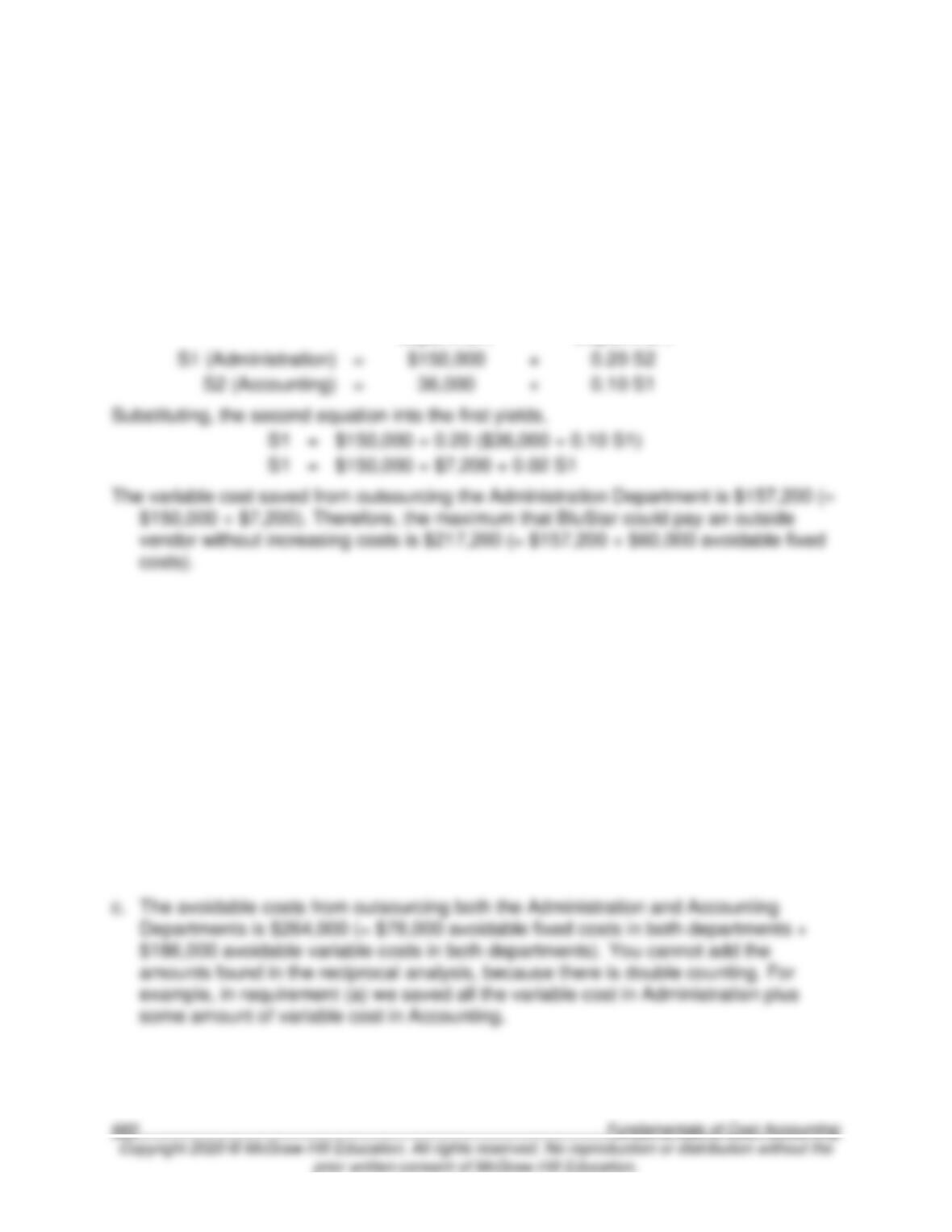
$150,000 + 0.20 ($36,000 + 0.10 S1)
S1
=
$150,000 + $7,200 + 0.02 S1
+
Cost Allocated
to the Service
b. Using the same approach, the avoidable cost from outsourcing Accounting is
$69,000 (= $36,000 + $15,000 + $18,000 avoidable fixed costs).
Total service
department costs
=
Direct costs of
the service
department
+
Cost Allocated
to the Service
Department
S1 (Administration)
=
$150,000
+
0.20 S2
S2 (Accounting)
=
36,000
+
0.10 S1
Substituting, the first equation into the second yields,
S2
=
$36,000 + 0.10 ($150,000 + 0.20 S2)
S2
=
$36,000 + $15,000 + 0.02 S2
11–66. (45 min.) Reciprocal Cost Allocation – Outsourcing a Service Department:
Great Eastern Credit Union.
To determine the avoidable cost, first determine the variable cost (including the
variable cost of reciprocal services for the Processing department). This is done by
seting up the equations for the reciprocal method using only variable costs. As
discussed in the solution to Problem 11-60, this can be done as with the step
method, substituting variable costs for total costs. Once the variable costs are
determined, we can add the avoidable fixed costs to estimate the total avoidable
cost.
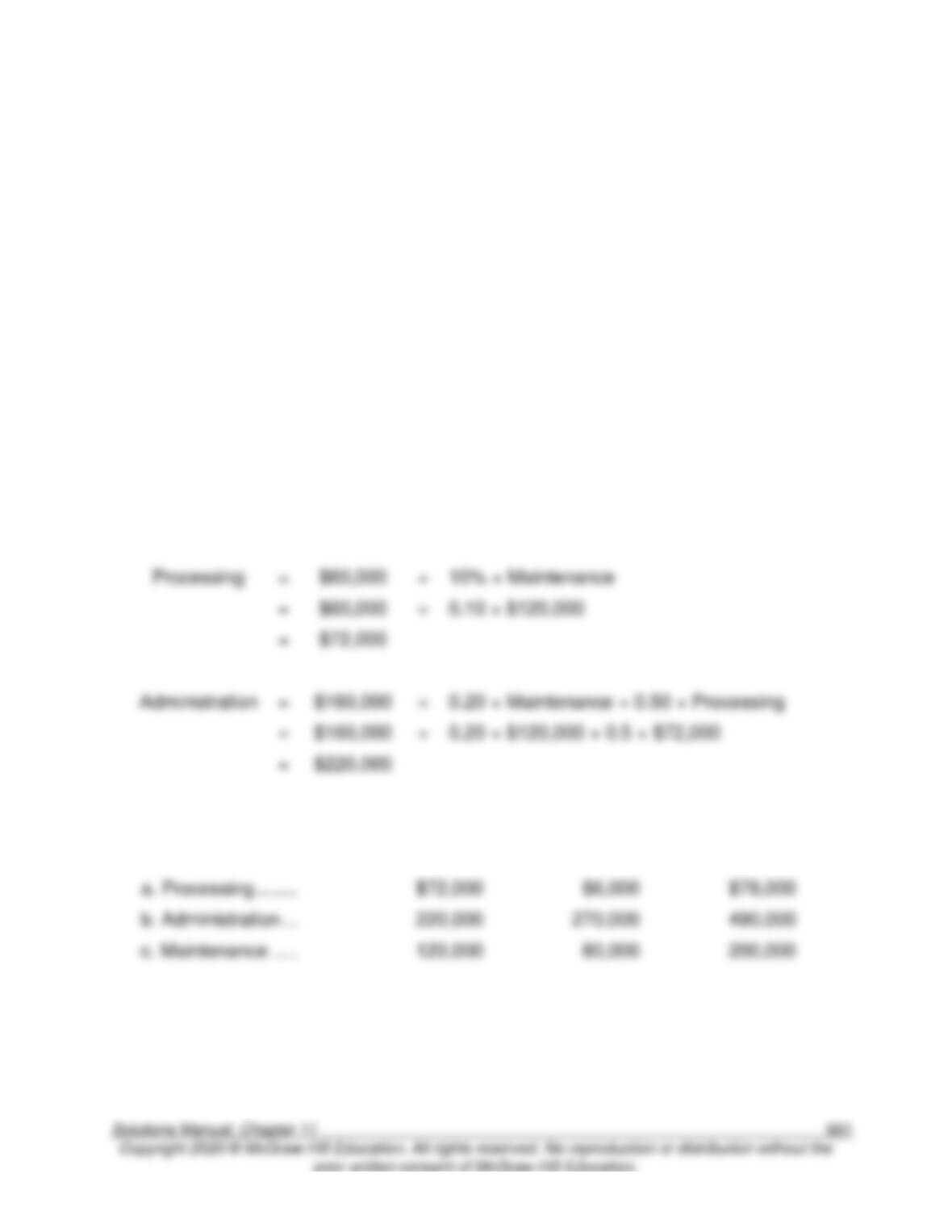
The cost equations can be written as follows (using variable costs only):
Maintenance = $120,000
Processing = $60,000 + 10% × Maintenance;
Administration = $160,000 + 20% × Maintenance + 50% × Processing
Maintenance
=
$120,000
=
+
10% × Maintenance
=
+
=
Administration
=
$160,000
+
0.20 × Maintenance + 0.50 × Processing
=
$160,000
+
0.20 × $120,000 + 0.5 × $72,000
=
$220,000
Department
Avoidable
Variable Costs
Avoidable
Fixed Costs
Total
Avoidable Costs
a. Processing ……..
b. Administration …
c. Maintenance …..
11–67. (15 min.) Reciprocal Cost Allocation – Outsourcing a Service Department:
Great Eastern Credit Union.
a. (2). Less than the sum of the savings calculated in Problem 11-59 (a) and (b). The
sum of the two double counts some of the savings from eliminating each department
separately.
11–68. (45 min.) Net Realizable Value of Joint Products: Davenport Company.
a. $375,000
Since there is no further processing for Beta-1 after split-off, the net realizable value
is simply the sales value of all units produced.
Price per unit
=
$225,000
= $1.25
180,000 units sold
Units produced = 300,000 units (= 180,000 sold + 120,000 in ending inventory).
Total net realizable value = $375,000 (= 300,000 units × $1.25)
b. $1,050,000.