11-41
11-36 (30 min.) Make versus buy, activity-based costing, opportunity costs.
The Lexington Company produces gas grills. This year’s expected production is 20,000 units.
Currently, Lexington makes the side burners for its grills. Each grill includes two side burners.
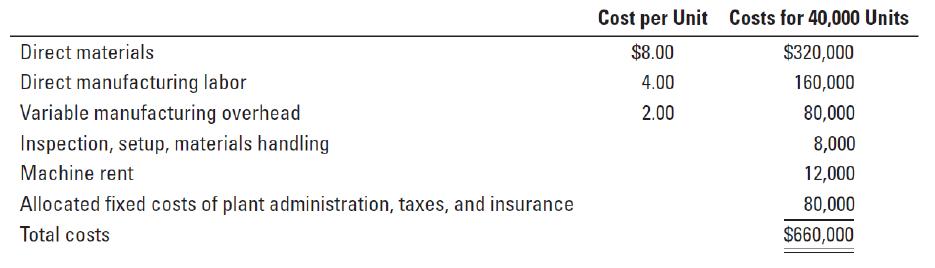
Lexington’s management accountant reports the following costs for making the 40,000 burners:
Lexington has received an offer from an outside vendor to supply any number of burners
Lexington requires at $14.80 per burner. The following additional information is available:
a. Inspection, setup, and materials-handling costs vary with the number of batches in which the
burners are produced. Lexington produces burners in batch sizes of 1,000 units. Lexington
will produce the 40,000 units in 40 batches.
b. Lexington rents the machine it uses to make the burners. If Lexington buys all of its burners
from the outside vendor, it does not need to pay rent on this machine.
Required:
1. Assume that if Lexington purchases the burners from the outside vendor, the facility where
the burners are currently made will remain idle. On the basis of financial considerations
alone, should Lexington accept the outside vendor’s offer at the anticipated volume of 40,000
burners? Show your calculations.
2. For this question, assume that if the burners are purchased outside, the facilities where the
burners are currently made will be used to upgrade the grills by adding a rotisserie
attachment. (Note: Each grill contains two burners and one rotisserie attachment.) As a
consequence, the selling price of grills will be raised by $48. The variable cost per unit of the
upgrade would be $38, and additional tooling costs of $160,000 per year would be incurred.
On the basis of financial considerations alone, should Lexington make or buy the burners,
assuming that 20,000 grills are produced (and sold)? Show your calculations.
3. The sales manager at Lexington is concerned that the estimate of 20,000 grills may be high
and believes that only 16,000 grills will be sold. Production will be cut back, freeing up work
space. This space can be used to add the rotisserie attachments whether Lexington buys the
burners or makes them in-house. At this lower output, Lexington will produce the burners in
32 batches of 1,000 units each. On the basis of financial considerations alone, should
Lexington purchase the burners from the outside vendor? Show your calculations.
SOLUTION
11-43
11-37 (25 min.) Product mix, constrained resource.
Wechsler Company produces three products: A110, B382, and C657. All three products use the
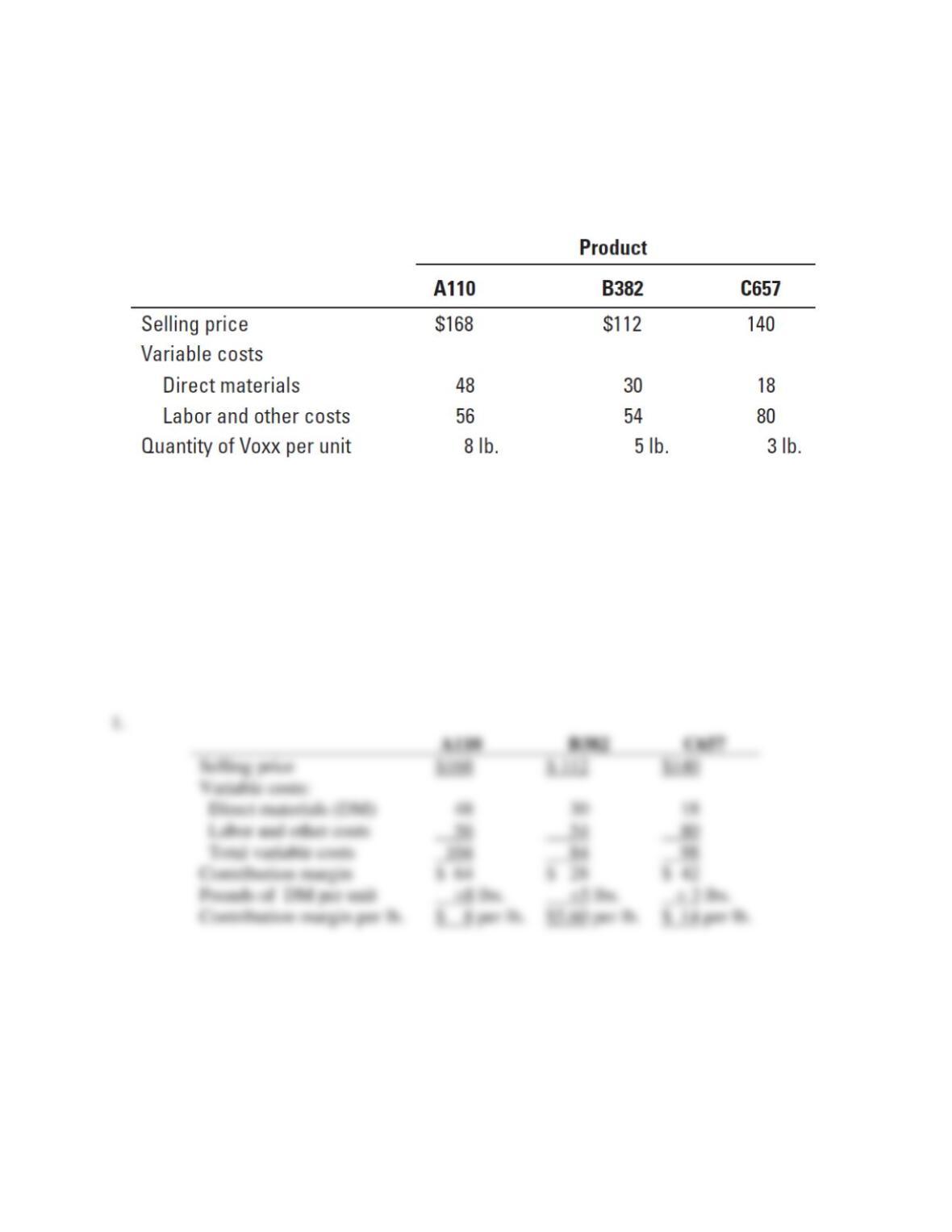
same direct material, Voxx. Unit data for the three products are:
The demand for the products far exceeds the direct materials available to produce the products.
Voxx costs $6 per pound, and a maximum of 5,000 pounds is available each month. Wechsler
must produce a minimum of 200 units of each product.
Required:
1. How many units of product A110, B382, and C657 should Wechsler produce?
2. What is the maximum amount Wechsler would be willing to pay for another 1,200 pounds of
Voxx?
SOLUTION
11-44
11-38 (30–40 min.) Product mix, relevant costs.
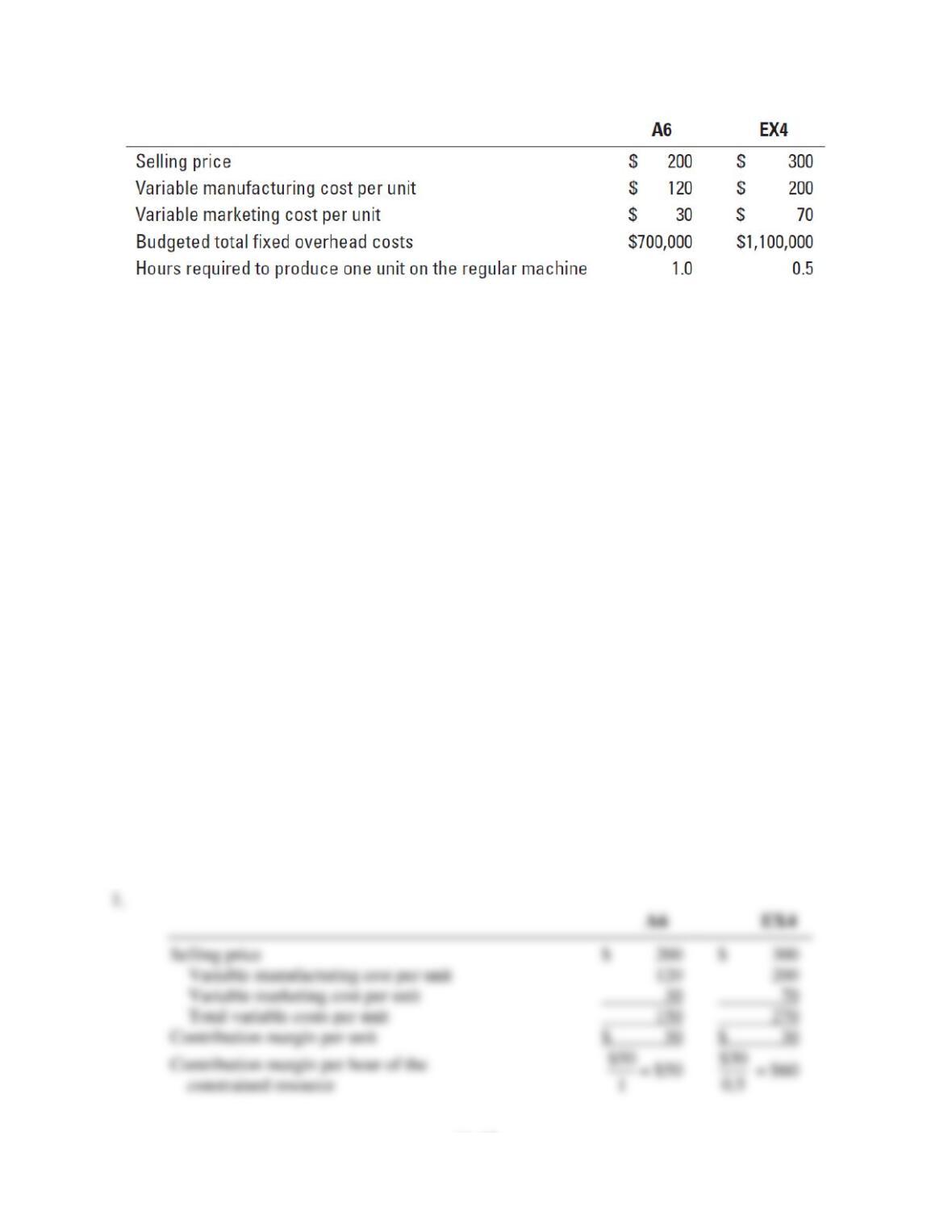
(N. Melumad, adapted) Gormley Precision Tools makes cutting tools for metalworking
operations. It makes two types of tools: A6, a regular cutting tool, and EX4, a high-precision
cutting tool. A6 is manufactured on a regular machine, but EX4 must be manufactured on both
the regular machine and a high-precision machine. The following information is available:
11-45
Additional information includes the following:
a. Gormley faces a capacity constraint on the regular machine of 50,000 hours per year.
b. The capacity of the high-precision machine is not a constraint.
c. Of the $1,100,000 budgeted fixed overhead costs of EX4, $600,000 are lease payments for
the high-precision machine. This cost is charged entirely to EX4 because Gormley uses the
machine exclusively to produce EX4. The company can cancel the lease agreement for the
high-precision machine at any time without penalties.
d. All other overhead costs are fixed and cannot be changed.
Required:
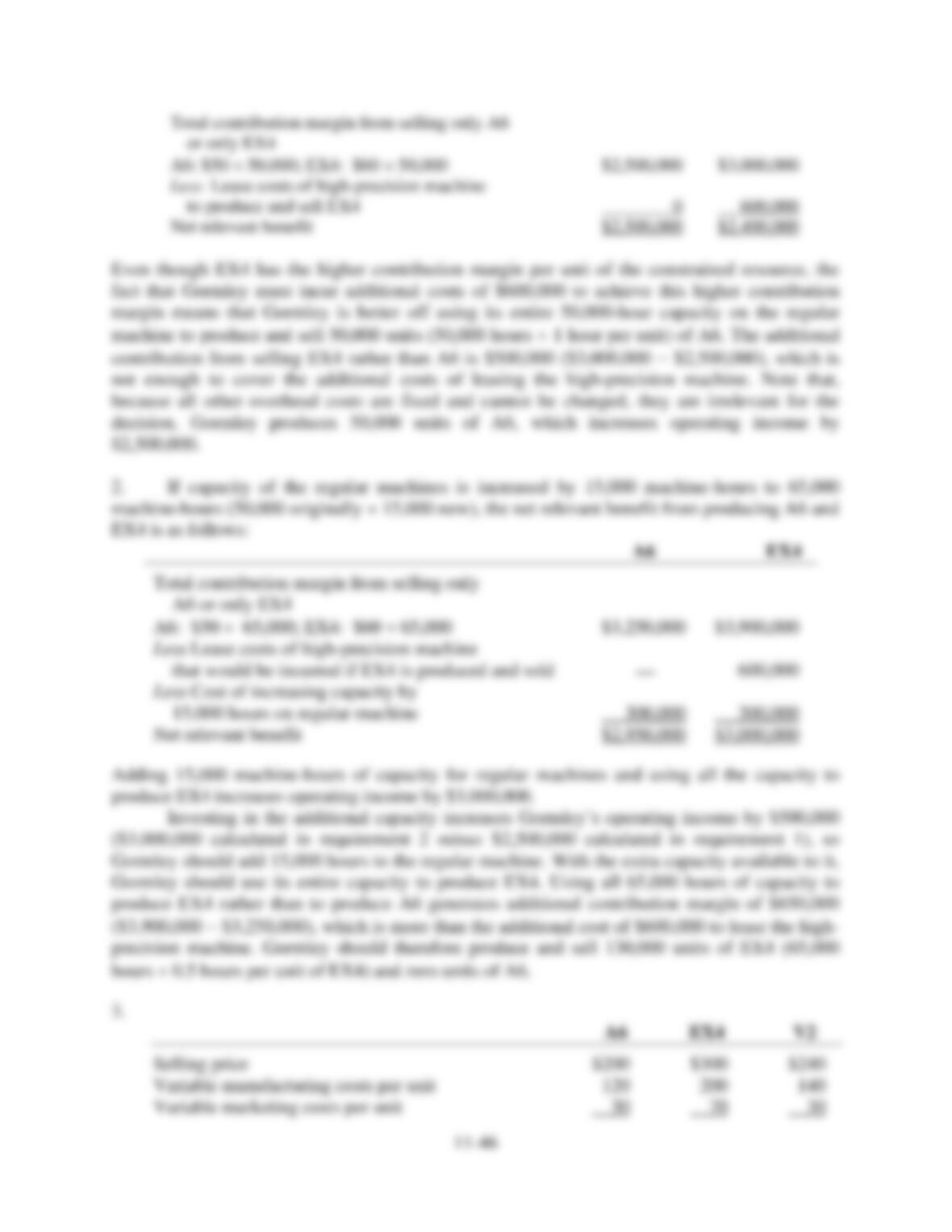
1. What product mix—that is, how many units of A6 and EX4—will maximize Gormley’s
operating income? Show your calculations.
2. Suppose Gormley can increase the annual capacity of its regular machines by 15,000
machine-hours at a cost of $300,000. Should Gormley increase the capacity of the regular
machines by 15,000 machine-hours? By how much will Gormley’s operating income
increase or decrease? Show your calculations.
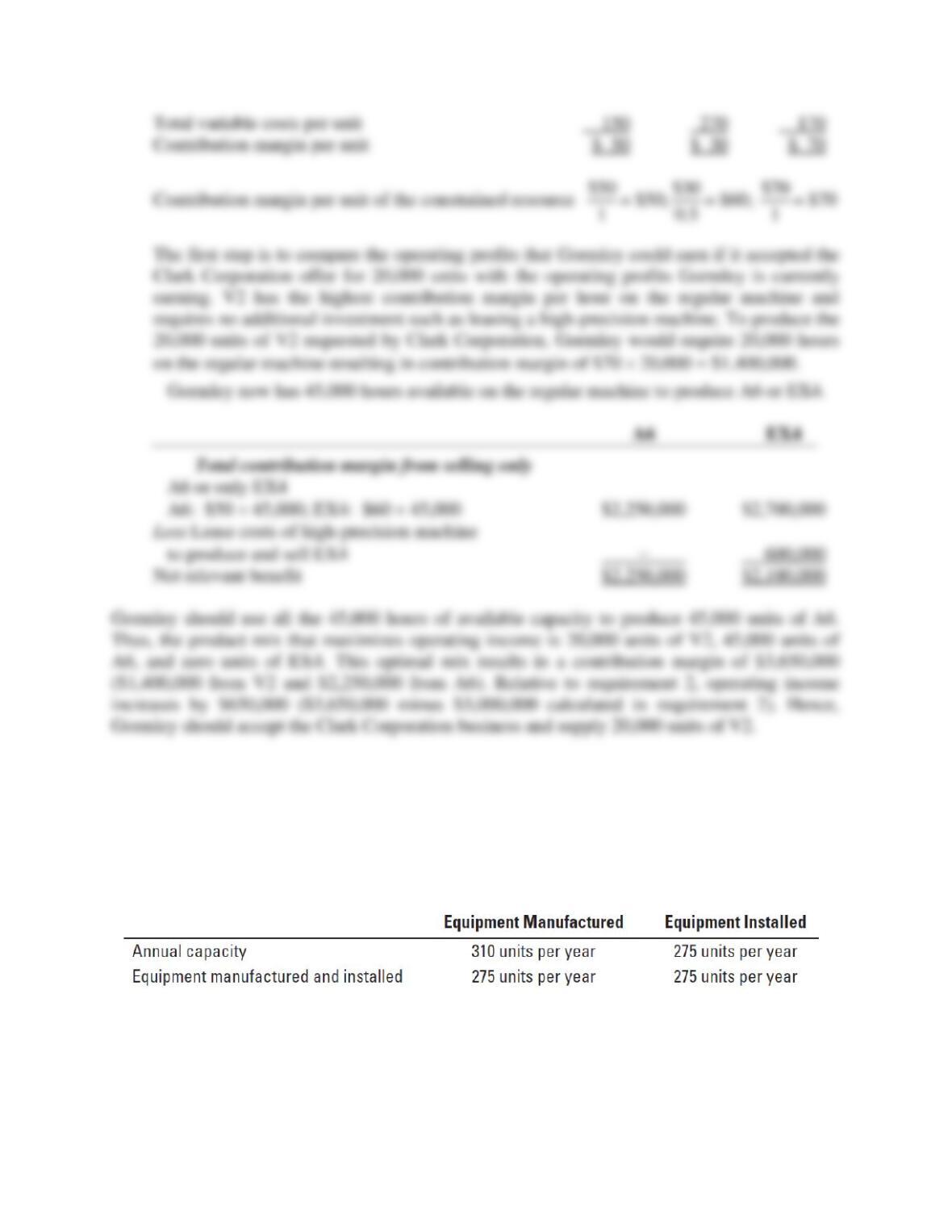
3. Suppose that the capacity of the regular machines has been increased to 65,000 hours.
Gormley has been approached by Clark Corporation to supply 20,000 units of another cutting
tool, V2, for $240 per unit. Gormley must either accept the order for all 20,000 units or reject
it totally. V2 is exactly like A6 except that its variable manufacturing cost is $140 per unit.
(It takes 1 hour to produce one unit of V2 on the regular machine, and variable marketing
cost equals $30 per unit.) What product mix should Gormley choose to maximize operating
income? Show your calculations.
SOLUTION
11-47
11-39 (20 min.) Theory of constraints, throughput contribution, relevant costs.
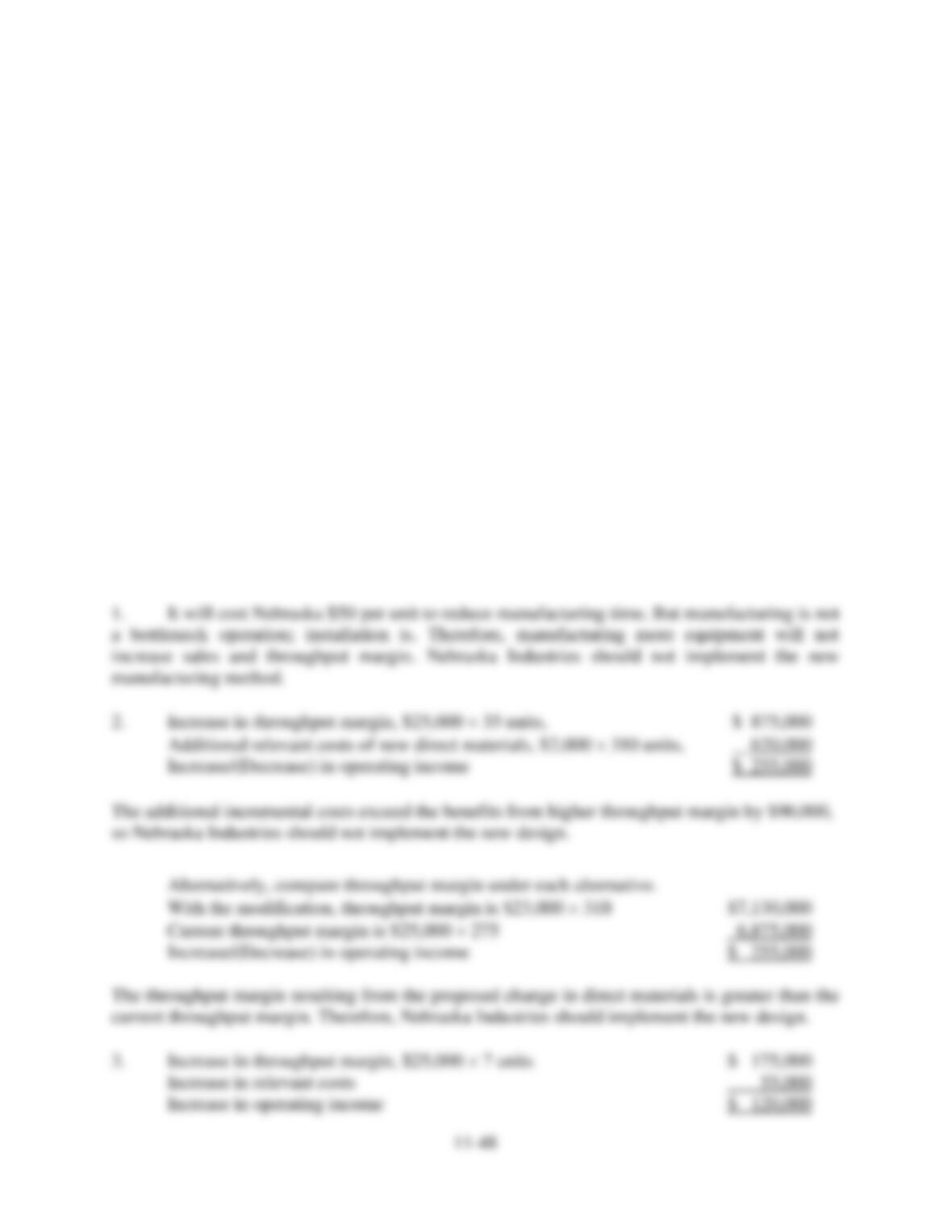
Nebraska Industries manufactures electronic testing equipment. Nebraska also installs the
equipment at customers’ sites and ensures that it functions smoothly. Additional information on
the manufacturing and installation departments is as follows (capacities are expressed in terms of
the number of units of electronic testing equipment):
Nebraska manufactures only 275 units per year because the installation department has only
enough capacity to install 275 units. The equipment sells for $45,000 per unit (installed) and has
direct material costs of $20,000. All costs other than direct material costs are fixed. The
following requirements refer only to the preceding data. There is no connection between the
requirements.
Required:
1. Nebraska’s engineers have found a way to reduce equipment manufacturing time. The new
method would cost an additional $50 per unit and would allow Nebraska to manufacture 20
additional units a year. Should Nebraska implement the new method? Show your
calculations.
2. Nebraska’s designers have proposed a change in direct materials that would increase direct
material costs by $2,000 per unit. This change would enable Nebraska to install 310 units of
equipment each year. If Nebraska makes the change, it will implement the new design on all
equipment sold. Should Nebraska use the new design? Show your calculations.
3. A new installation technique has been developed that will enable Nebraska’s engineers to
install 7 additional units of equipment a year. The new method will increase installation costs
by $55,000 each year. Should Nebraska implement the new technique? Show your
calculations.
4. Nebraska is considering how to motivate workers to improve their productivity (output per
hour). One proposal is to evaluate and compensate workers in the manufacturing and
installation departments on the basis of their productivities. Do you think the new proposal is
a good idea? Explain briefly.
SOLUTION
11-49
11-40 (30-35 min.) Theory of constraints, contribution margin, sensitivity analysis.
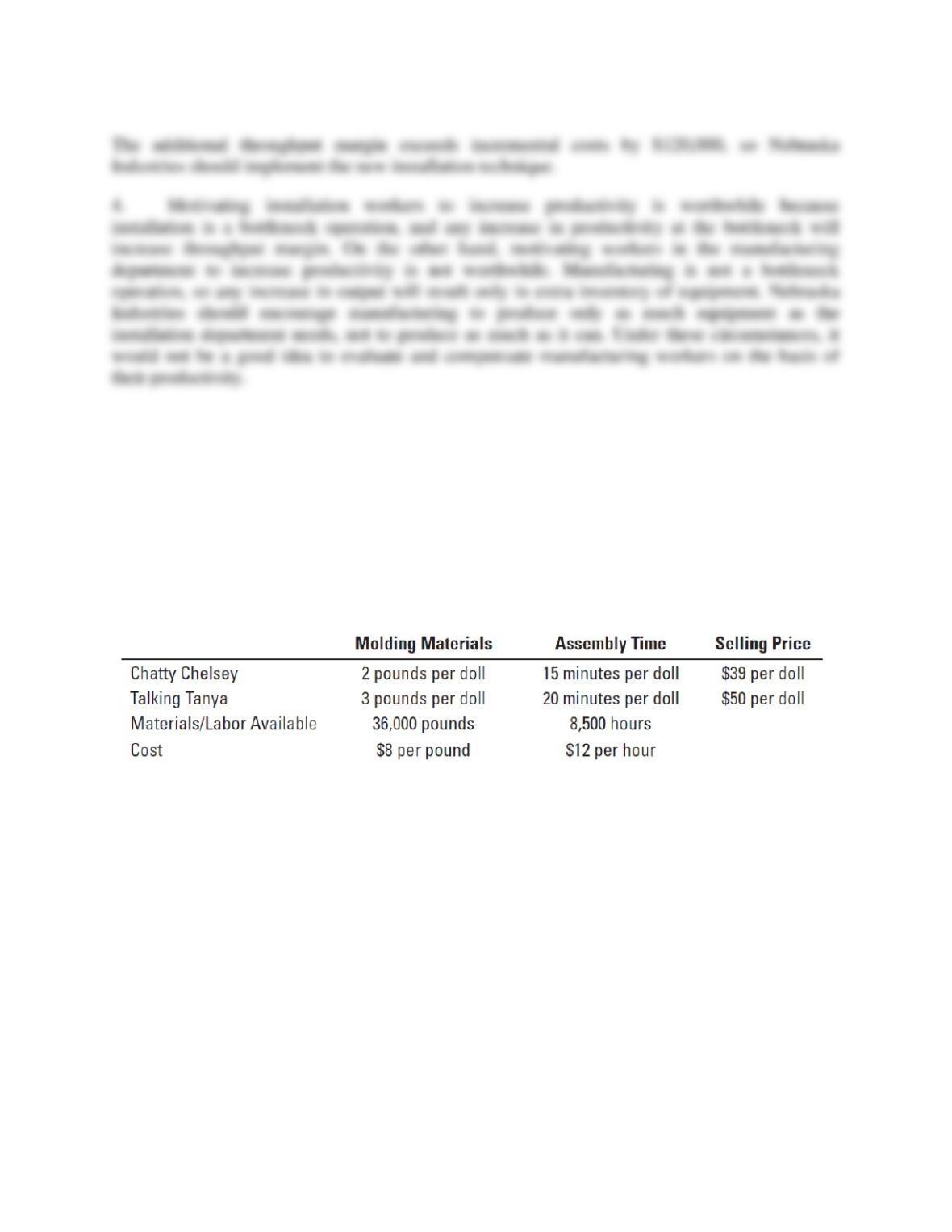
Talking Toys (TT) produces dolls in two processes: molding and assembly. TT is currently
producing two models: Chatty Chelsey and Talking Tanya. Production in the molding
department is limited by the amount of materials available. Production in the assembly
department is limited by the amount of trained labor available. The only variable costs are
materials in the molding department and labor in the assembly department. Following are the
requirements and limitations by doll model and department:
The following requirements refer only to the preceding data. There is no connection between the
requirements.
Required:
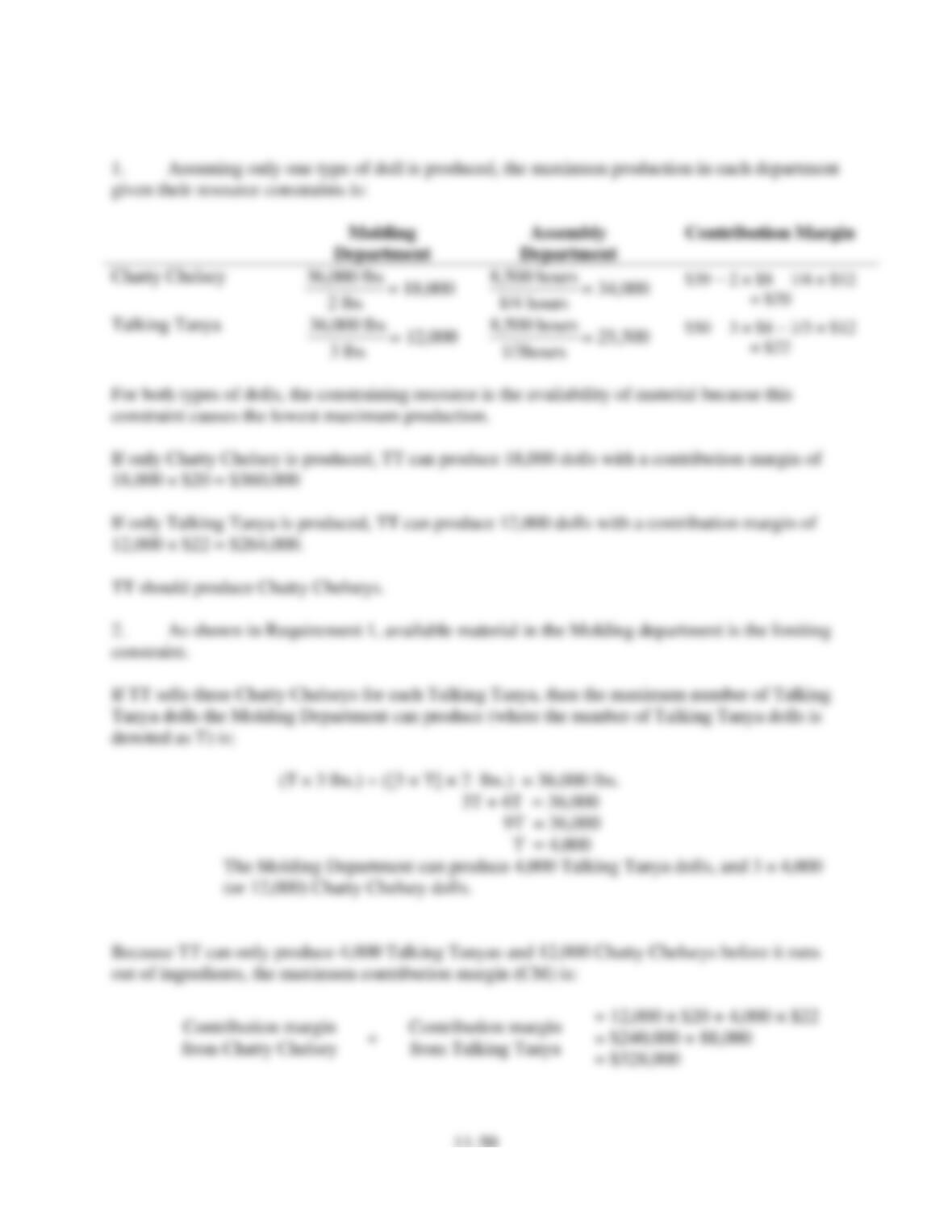
1. If there were enough demand for either doll, which doll would TT produce? How many of
these dolls would it make and sell?
2. If TT sells three Chatty Chelseys for each Talking Tanya, how many dolls of each type
would it produce and sell? What would be the total contribution margin?
3. If TT sells three Chatty Chelseys for each Talking Tanya, how much would production and
contribution margin increase if the molding department could buy 900 more pounds of
materials for $8 per pound?
4. If TT sells three Chatty Chelseys for each Talking Tanya, how much would production and
contribution margin increase if the assembly department could get 65 more labor hours at
$12 per hour?
11-50
SOLUTION
11-51
11-41 (25 min.) Closing down divisions.
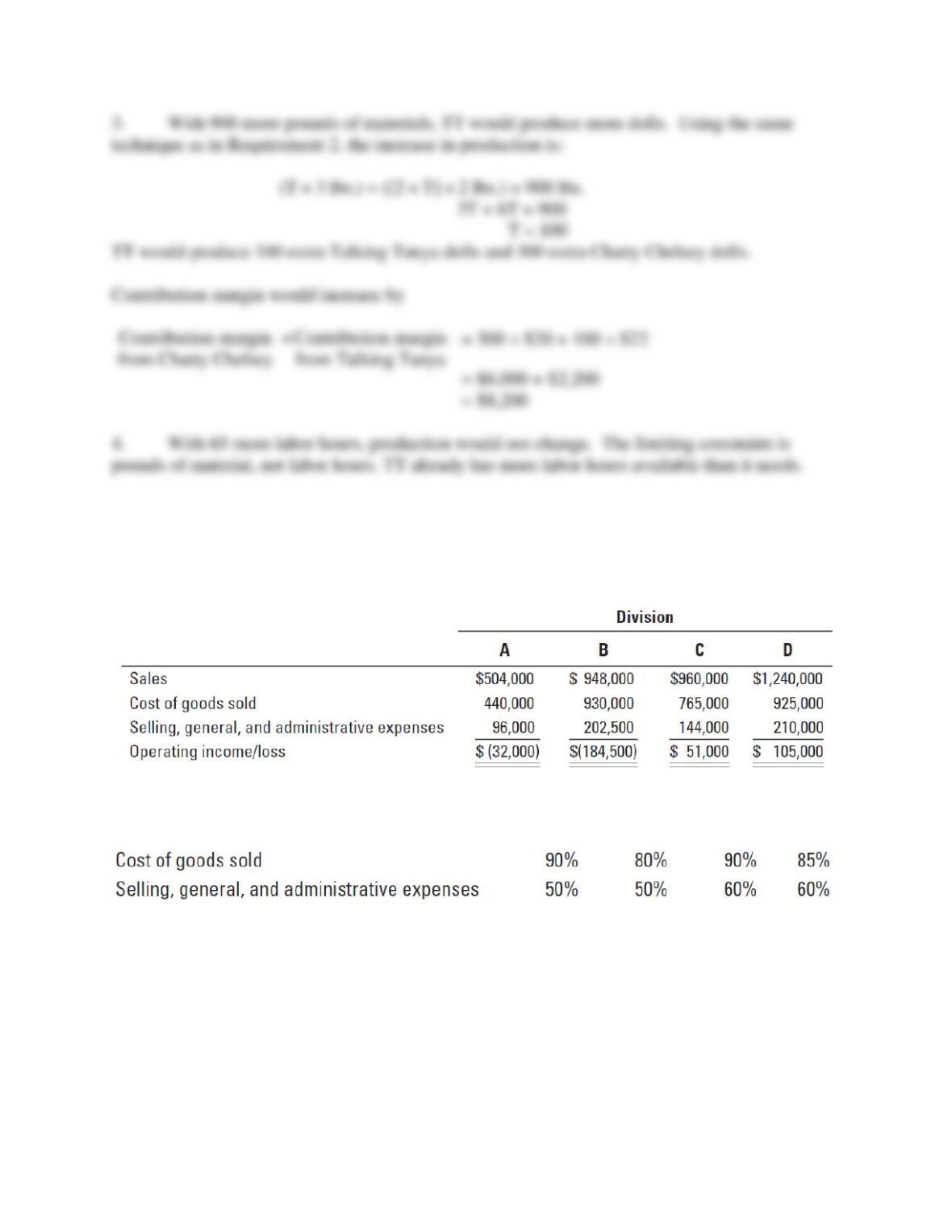
Ainsley Corporation has four operating divisions. The budgeted revenues and expenses for each
division for 2014 follows:
Further analysis of costs reveals the following percentages of variable costs in each division:
Closing down any division would result in savings of 40% of the fixed costs of that division.
Top management is very concerned about the unprofitable divisions (A and B) and is
considering closing them for the year.
Required:
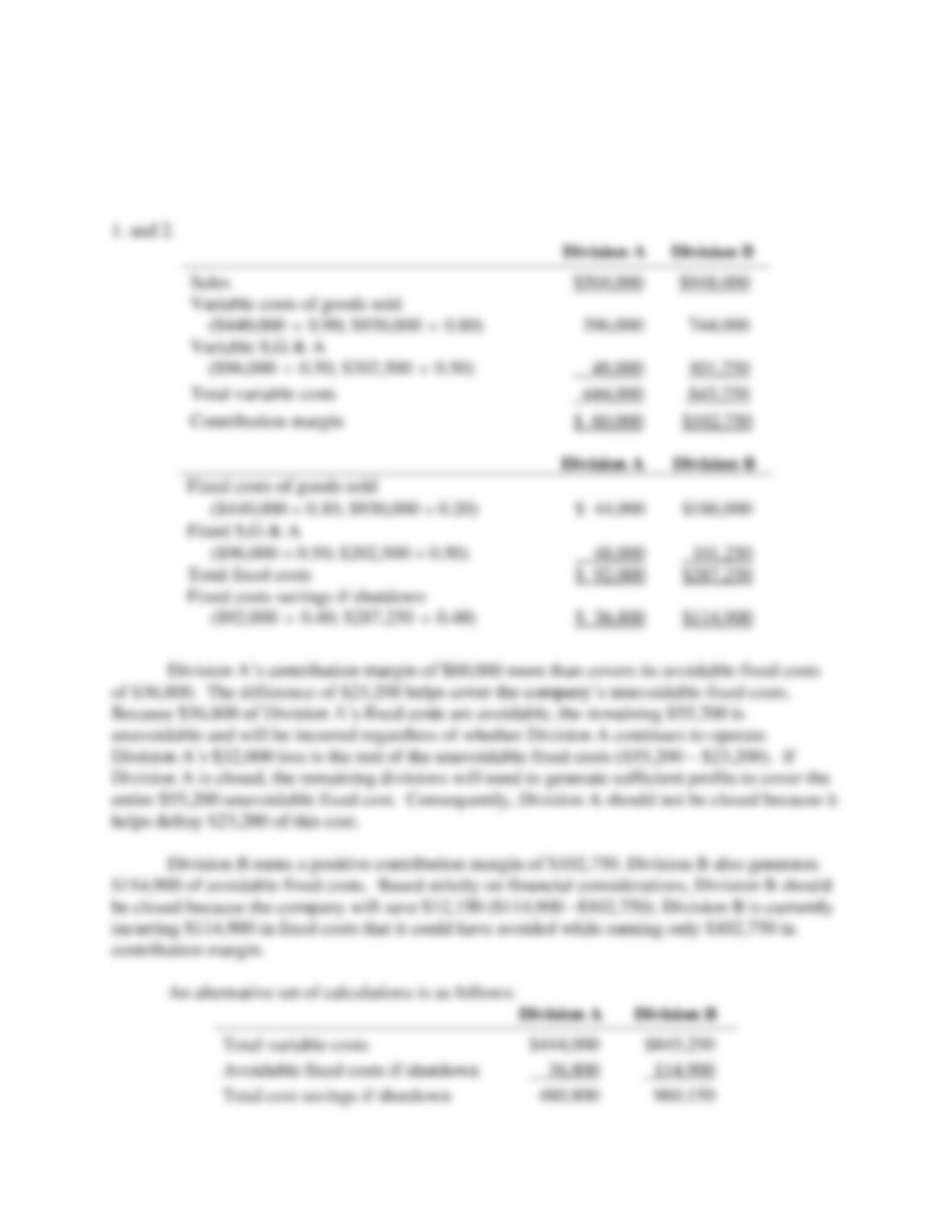
1. Calculate the increase or decrease in operating income if Ainsley closes division A.
2. Calculate the increase or decrease in operating income if Ainsley closes division B.
11-52
3. What other factors should the top management of Ainsley consider before making a
decision?
SOLUTION