11–37 (continued)
Allocation
Repairs
HR
IT
P1
P2
Service department
costs …………………………
$20,000
$39,600
$45,000
–0–
–0–
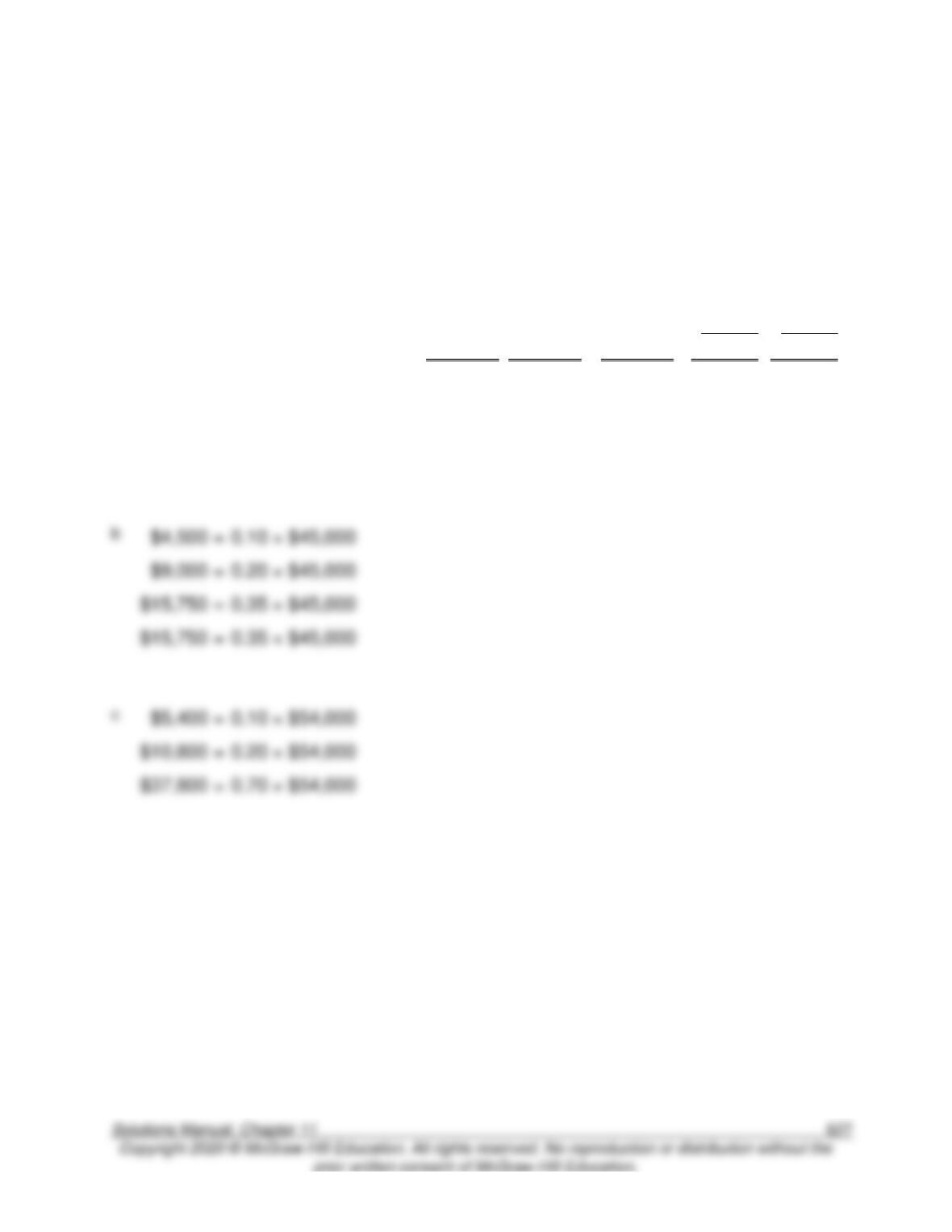
Repairs allocationa ……..
(24,500)
NA
NA
$9,800
$14,700
HR allocationb ……………
4,500
(45,000)
9,000
15,750
15,750
IT allocationc ……………..
NA
5,400
(54,000)
10,800
37,800
Total costs allocated……
$ –0–
$ –0–
$ –0–
$36,350
$68,250
a
$9,800
=
0.40
× $24,500
$14,700
=
0.60
× $24,500
b
$4,500
=
0.10
× $45,000
$9,000
=
0.20
× $45,000
$15,750
=
0.35
× $45,000
c
$5,400
=
0.10
× $54,000
$10,800
=
0.20
× $54,000
11–38. (15 min.) Evaluate Cost Allocation Methods: University Printers
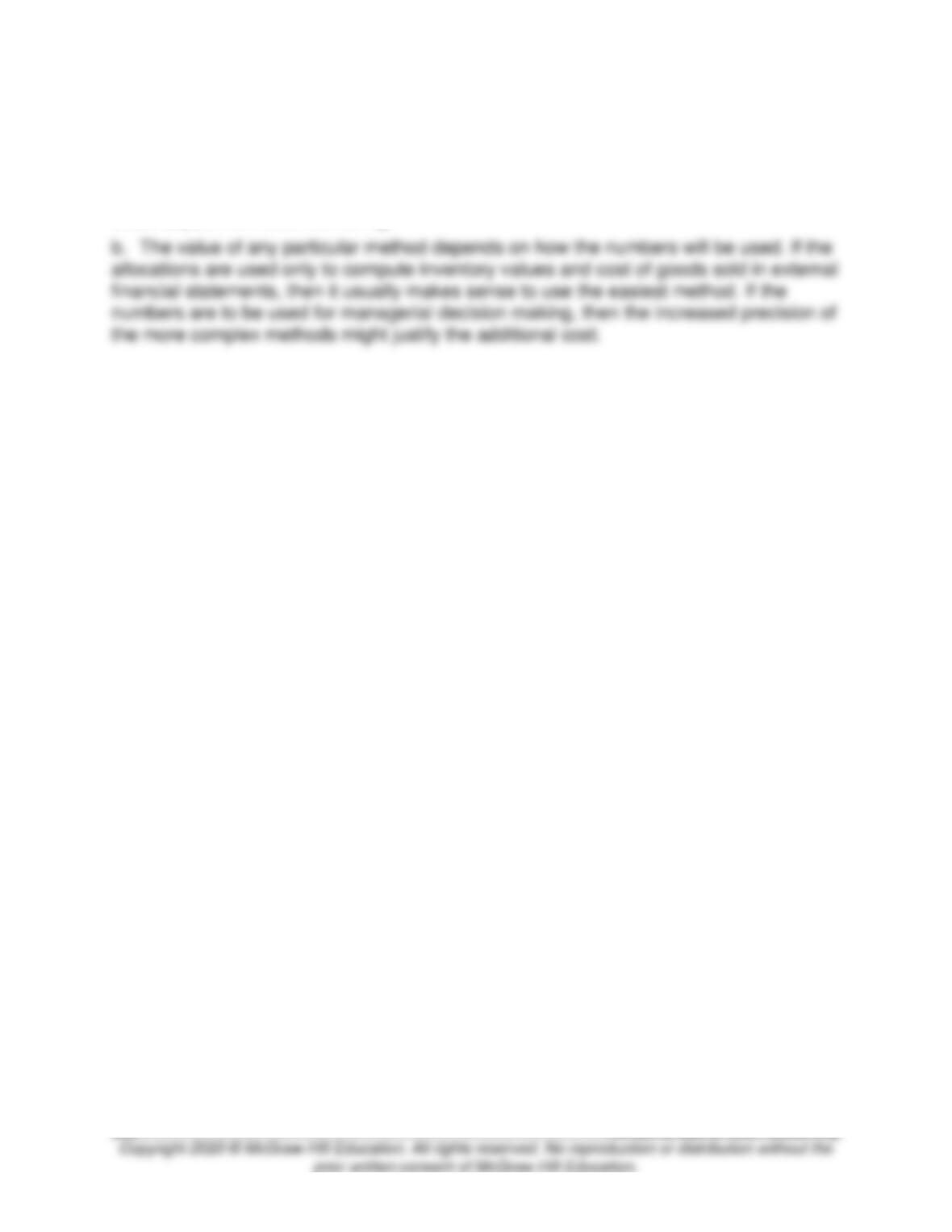
a. The answer to this question depends on the cost and benefits of each method. The
reciprocal method takes into account the fact that each service department uses the
services of the other. While the difference in costs is small, there is a gain of increasing
cross-department cost monitoring.
11–39. (15 min.) Reciprocal Cost Allocation – Outsourcing a Service Department:
Caro Manufacturing
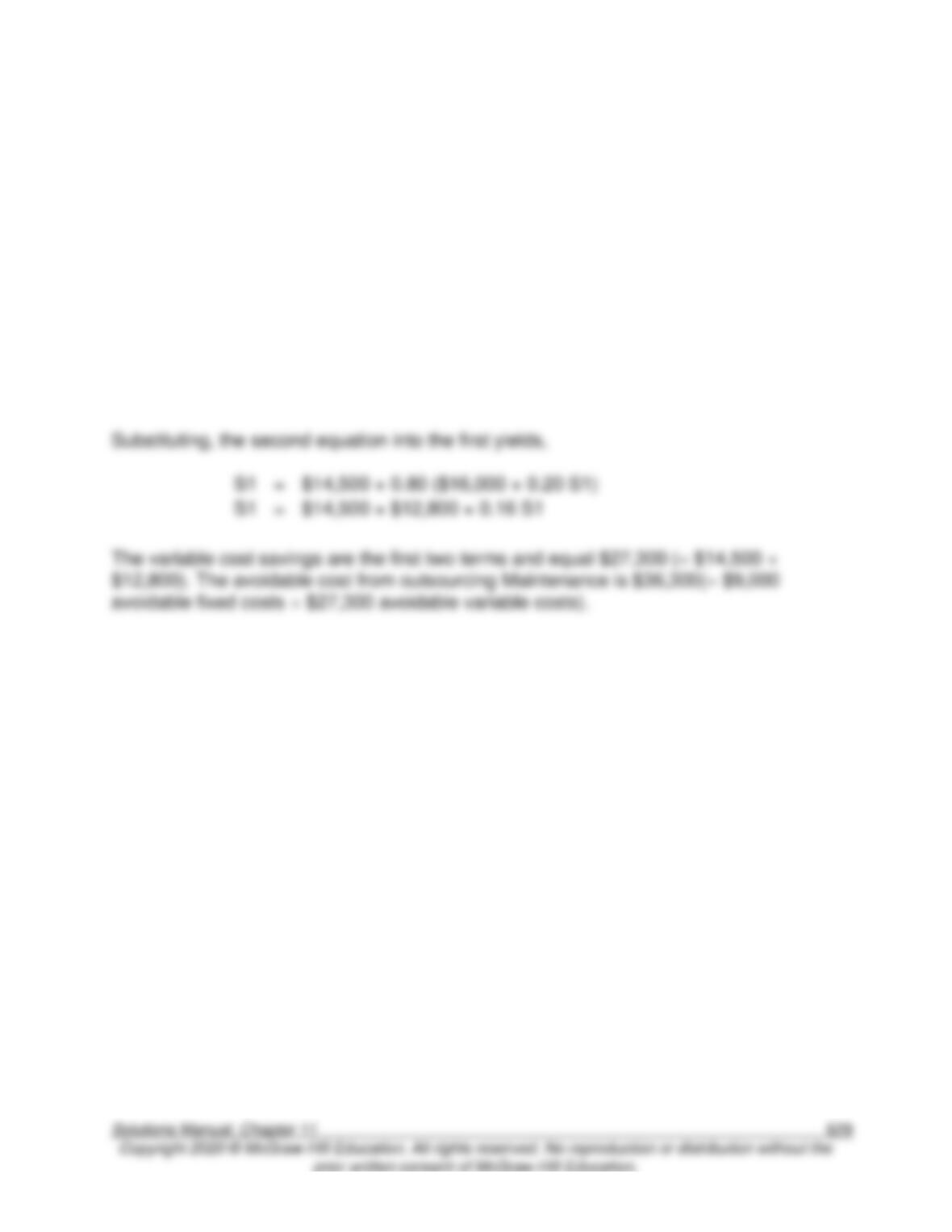
To determine the avoidable cost, first determine the variable cost (including the
variable cost of reciprocal services for the maintenance department). This can be
done by setting up the equations for the reciprocal method using only variable costs.
Set up the equations:
Total service
department costs
=
Direct costs of the
service department
+
Cost allocated
to the service
department
S1 (Maintenance)
=
$14,500
+
0.80 S2
S2 (Cafeteria)
=
16,000
+
0.20 S1
=
$14,500 + 0.80 ($16,000 + 0.20 S1)
=
$14,500 + $12,800 + 0.16 S1
11–40. (15 min.) Reciprocal Cost Allocation – Outsourcing a Service
Department: University Printers.
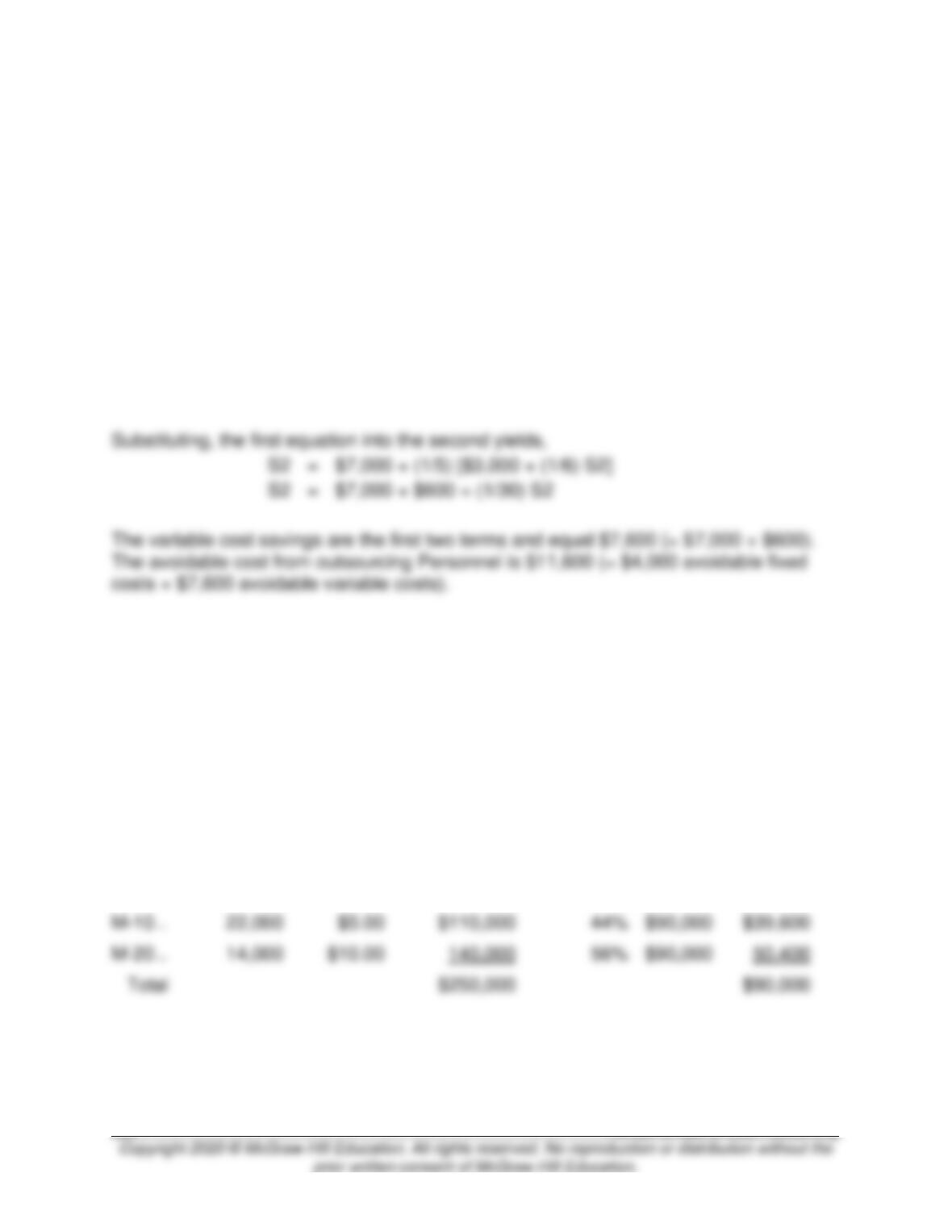
To determine the avoidable cost, first determine the variable cost (including the
variable cost of reciprocal services for the maintenance department). This can be
done by setting up the equations for the reciprocal method using only variable costs.
Set up the equations:
Total service
department costs
=
Direct costs of
the service
department
+
Cost allocated
to the service
department
S1 (Maintenance)
=
$3,000
+
(1/6) S2
S2 (Personnel)
=
7,000
+
(1/5) S1
=
$7,000 + (1/5) [$3,000 + (1/6) S2]
=
$7,000 + $600 + (1/30) S2
11–41. (15 min.) Net Realizable Value Method: Oak View Chemicals.
b. $39,600.
The by-product costs are irrelevant, because they are treated as other income.
The net realizable values of the two main products at split-off and the allocation of joint
cost can be computed as follows:
Product
Phys. Qty.
Sales
Price at
Split-off
Net
Realizable
Value
Percentage
of NRV
Joint
Cost
Allocation
22,000
14,000
11–42. (15 min.) Sell or Process Further: Oak View Chemicals.
b. M-20.
The allocation method and the treatment of by-product costs is irrelevant to this
decision.
11–43. (15 min.) Net Realizable Value Method: Euclid Corporation.
Total joint costs are $432,000 (based on the $144,000 materials plus $288,000
conversion). These costs are allocated as follows:
To Output P-11:
$640,000
×
$432,000
=
$345,600
($640,000 + $160,000)
11–44. (20 min.) Estimated Net Realizable Value Method: Blasto, Inc.
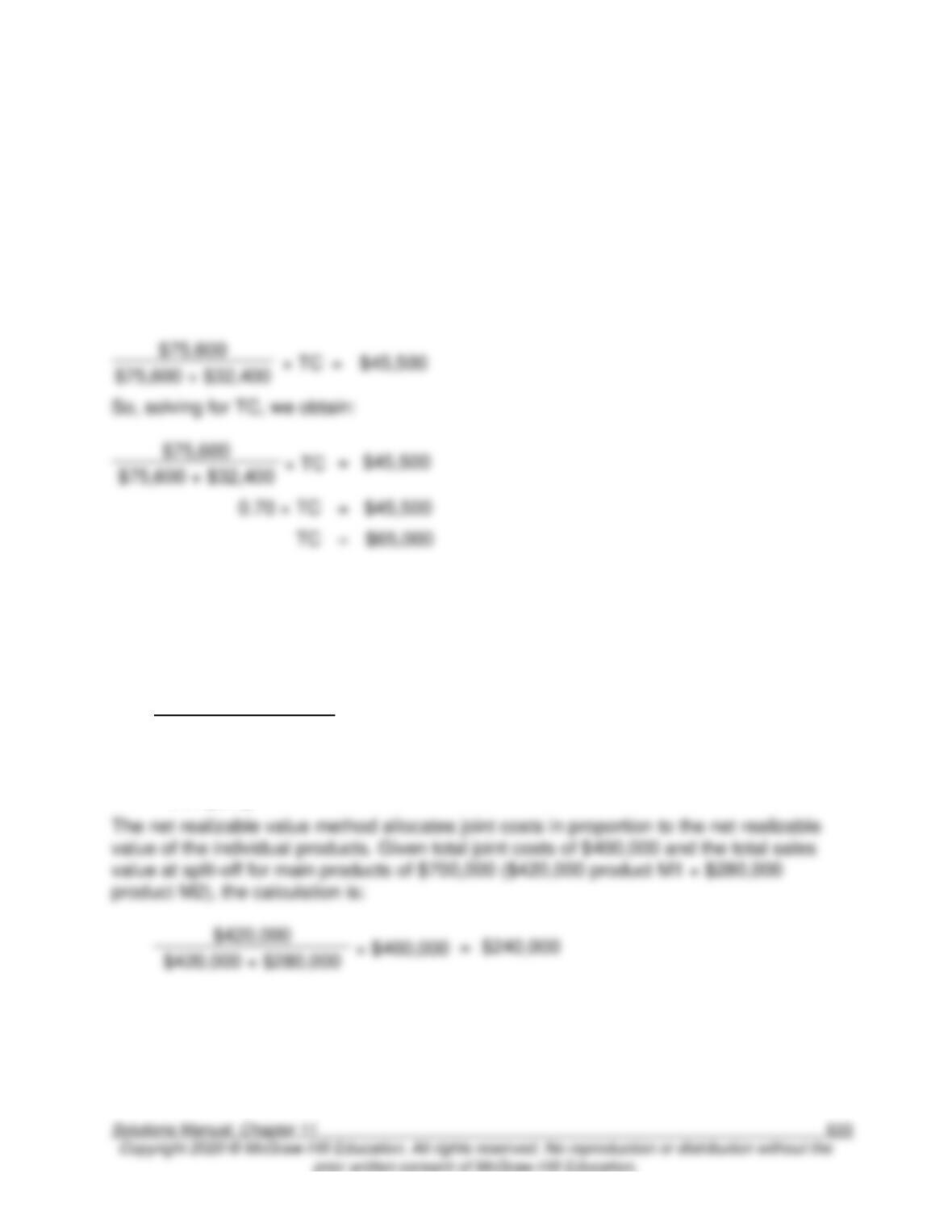
Although not required, the process may be diagrammed as follows:
The diagram can be used to help organize the solution, which follows:
Lead
Copper
Manganese
Total
Selling price ………………….
$40,000
$80,000
$60,000
$180,000
Additional processing ……..
(12,000)
(10,000)
(18,000)
(40,000)
Approximate sales value at
split-off …………………………
$28,000
$70,000
$42,000
$140,000
% of total sales values at
split-offa ………………………..
20%
50%
30%
100%
Cost Allocation:
$30,000
11–45. (20 min.) Net Realizable Value Method To Solve For Unknowns: GG
Products, Inc.
Since the sales value of each product at the split-off point is available, the appropriate
basis for allocation using the net realizable value method is $108,000 (which is $75,600
+ $32,400).
Let TC equal the unknown total costs. The allocation of $45,500 to tips must have been
the result of the allocation equation:
=
11–46. (10 min.) Net Realizable Value Method: Bixel Components.
The net realizable value method allocates joint costs in proportion to the net realizable
value of the individual products. Given total joint costs of $250,000 and total sales value
at split-off of $450,000 ($292,500 product A1 + $157,500 product A2), the calculation is:
$292,500
× $250,000
=
$162,500
$292,500 + $157,500
11–47. (10 min.) Net Realizable Value Method with By-Products: Butterfly
Company.
× $400,000
$240,000
11–48. (15 min.) Net Realizable Value Method: Deming & Sons.
The net realizable value method is a cost allocation method that allocates joint costs in
proportion to the net realizable value of the individual products. The calculation is:
Net Realizable
Value at
Split-Off
($000)
Allocation
Joint Costs
Allocated
W-10 ………….
$ 336
(336 ÷ 960)
×
$384,000
$134,400
W-20 ………….
288
(288 ÷ 960)
×
384,000
115,200
W-30 ………….
192
(192 ÷ 960)
×
384,000
W-40 ………….
(144 ÷ 960)
×
11–49. (15 min.) Physical Quantities Method: Deming & Sons.
The physical units method is a cost allocation method that allocates joint costs in
proportion to the units produced of the individual products. The calculation is:
Production
(units)
Allocation
Joint Costs
Allocated
W-10 ………….
56,000
(56 ÷ 160)
×
$384,000
$134,400
W-20 ………….
40,000
(40 ÷ 160)
×
384,000
96,000
W-30 ………….
32,000
(32 ÷ 160)
×
384,000
W-40 ………….
(32 ÷ 160)
×
11–50. (15 min.) Sell or Process Further: Deming & Sons.
Product W-10. The sales value at split-off is $336,000. If processed further, the sales
value is $30,000 more, but you incur an additional $36,000 in processing costs. The
11–51. (20 min.) Physical Quantities Method: Kyle Company.
a.
Total units of KA ………………
=
84,000
units
Total units produced …………
=
168,000
units
Joint product costs ……………
=
$189,000
Amount allocated from joint costs:
b.
Net realizable value of KB at split-off ……..
=
$210,000
Total net realizable value at split-off ………
=
600,000
Joint product costs ………………………………
=
189,000
Amount allocated from joint costs:
Additional processing costs ………………..
11–52. (20 min.) Physical Quantities Method; Sell or Process Further: Kyle
Company.
a.
When KC can no longer be sold and must be disposed of, the disposal costs become
part of the joint cost of production for KA and KB. Using the physical units method,
the allocated costs are:
Total units of KA ………………
=
84,000
units
Total units produced …………
=
144,000
Units (= 84,000 + 60,000)
Joint product costs ……………
=
$360,000
(= $189,000 + $171,000)
Amount allocated from joint costs to KA:
Similarly,
11–53. (20 min.) Physical Quantities Method With By-Product: Trans-Pacific
Lumber
The net realizable value of the sawdust ($20,000) is deducted from the total processing
costs ($350,000) to obtain the net processing costs to be allocated ($330,000).
The allocation computations are:
To Grade-A Lumber:
Solutions to Problems
11–54. (50 min.) Step Method With Three Service Departments: Model, Inc.
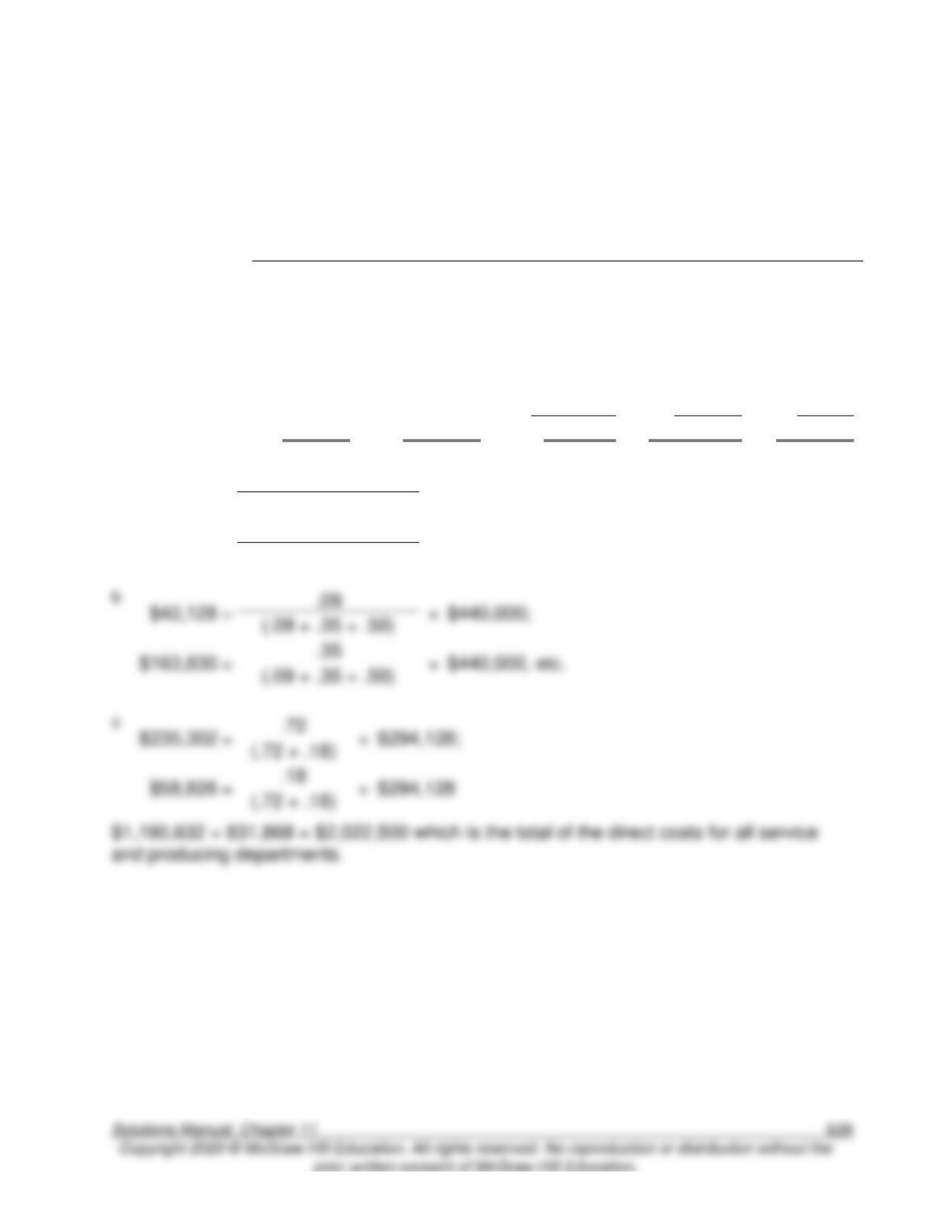
a. To facilitate the solution, reduce the different allocation bases to proportions used by
departments other than the same department.
Proportion Used By
Administration
Accounting
Maintenance
Molding
Painting
Building Area ……
—a
.06b
.04b
.72
.18
Employees ………
.09c
—a
.06c
.35
.50
Equipment Value
.01d
.20d
—a
.52d
.27
11–54. (continued)
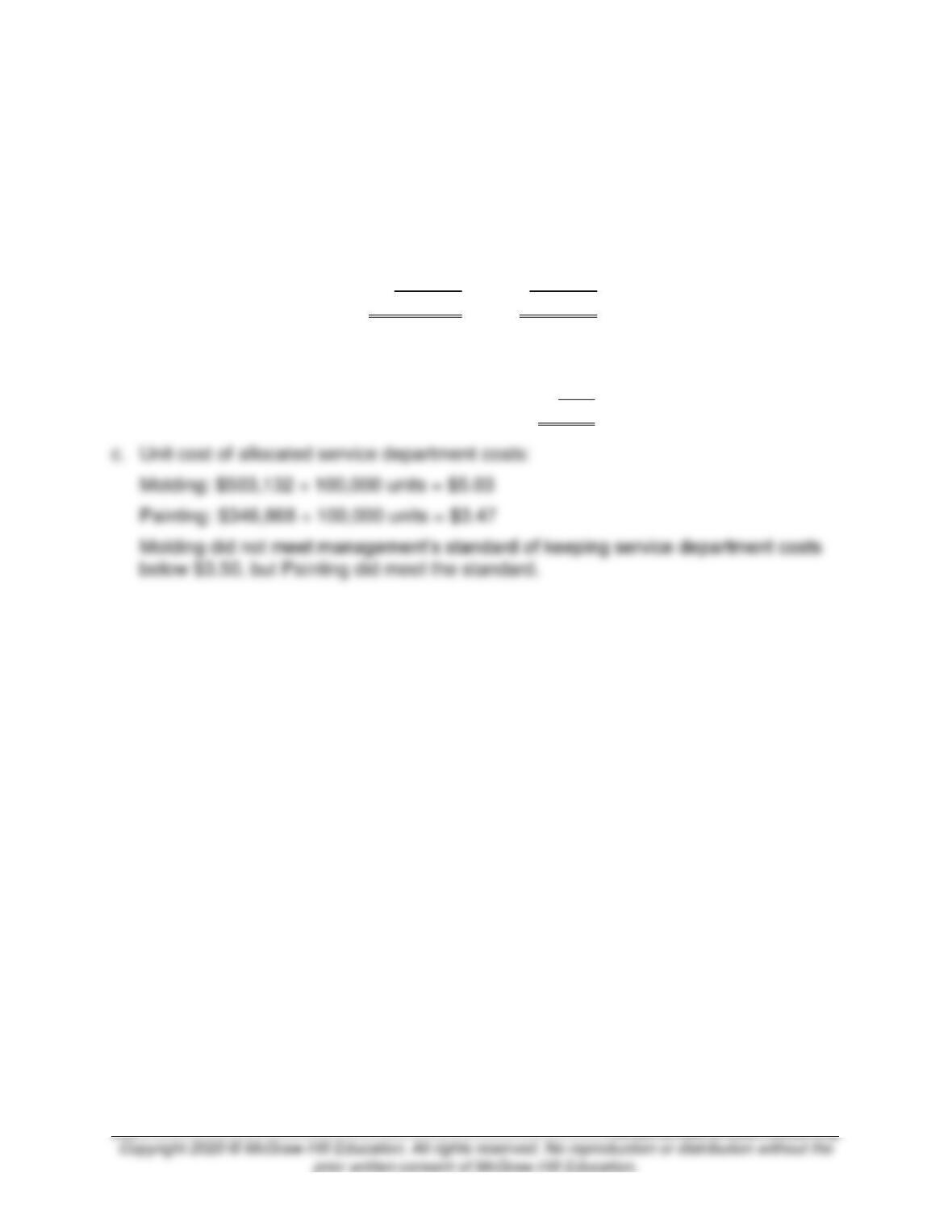
Model, Inc.
Step Method
To
Maintenance
Accounting
Administration
Molding
Painting
Direct Costs .
$200,000
$400,000
$250,000
$687,500
$485,000
FROM
Maintenancea
(200,000)
40,000
2,000
104,000
54,000
Accountingb ..
(440,000)
42,128
163,830
234,042
Administrationc
_________
_______
(294,128)
235,302
58,826
Totals ….
–0–
–0–
–0–
$1,190,632
$831,868
a
$40,000
=
.20
×
$200,000;
(.01 + .20 + .52 + .27)
$2,000
=
.01
×
$200,000, etc.
(.01 + .20 + .52 + .27)
$42,128
=
.09
×
=
.35
×
$440,000, etc.
=
×
$294,128;
(.72 + .18)
$58,826
=
×
$294,128
(.72 + .18)
11–54. (continued)
b.
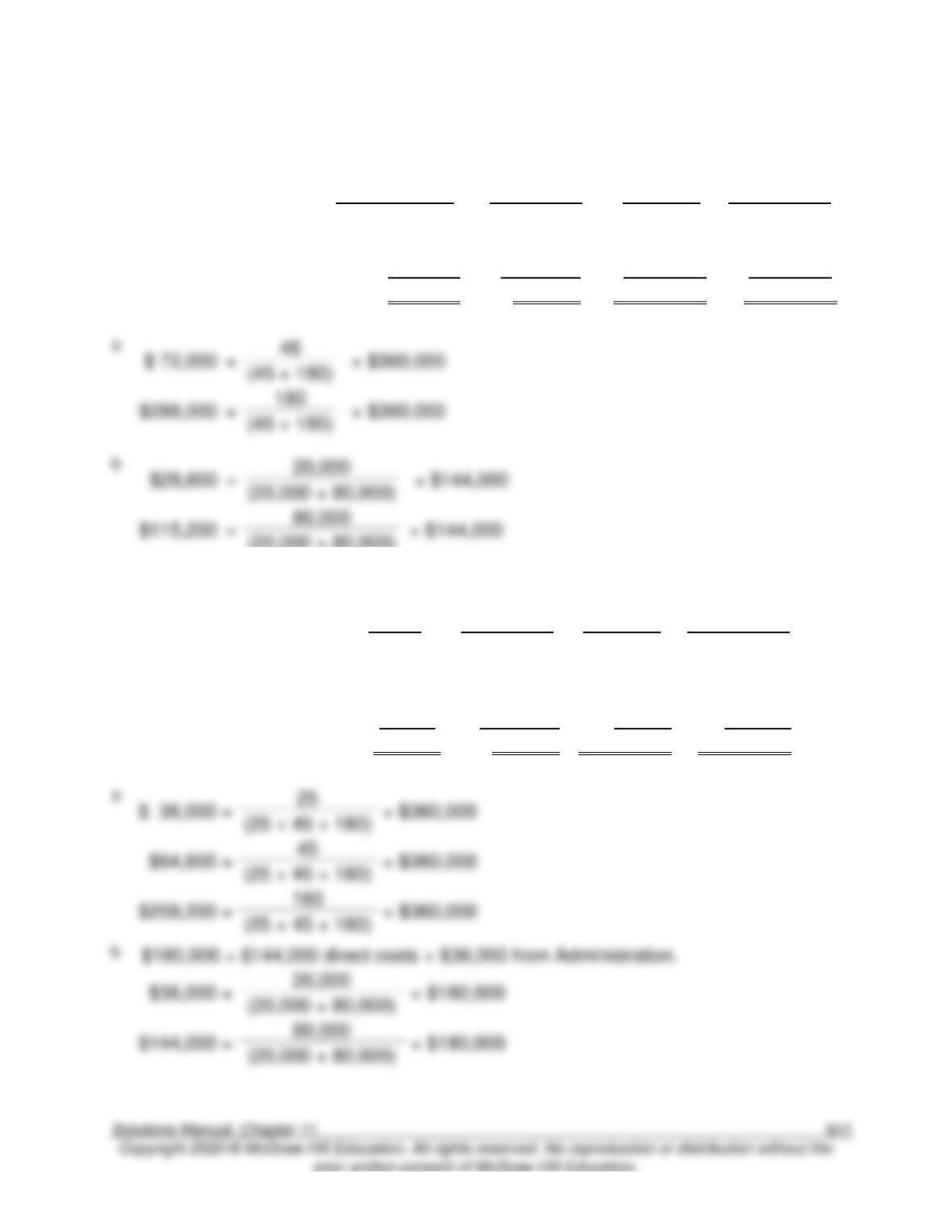
Molding
Painting
Direct materials ………….
$237,500
$210,000
Direct labor ……………….
337,500
200,000
Overhead (direct) ……….
112,500
75,000
Overhead (allocated) ….
503,132
346,868
Totals ……………………
$1,190,632
$831,868
Unit cost:
Molding:
$1,190,632 ÷ 100,000 units
=
$11.91
Painting:
$831,868 ÷ 100,000 units
=
8.32
Total …………………………………………..
$20.23
11–55. (40 min.) Comparison of Allocation Methods: BluStar Company.
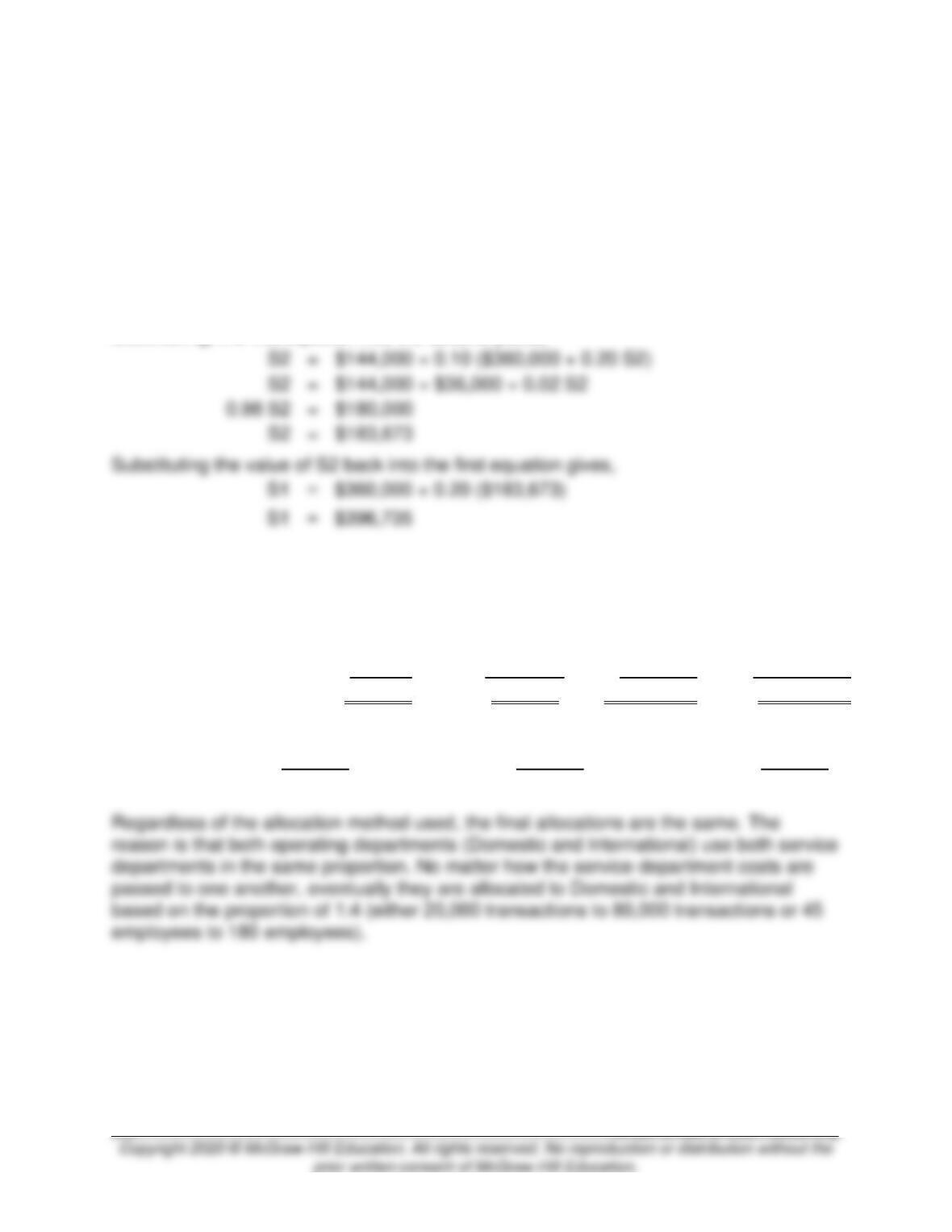
a. Direct Method:
Administration
Accounting
Domestic
International
Department costs ……….
$360,000
$144,000
$936,000
$3,600,000
Administration allocationa
(360,000)
NA
72,000
288,000
Accounting allocationb …
NA
(144,000)
28,800
115,200
Total costs allocated …..
–0–
–0–
$1,036,800
$4,003,200
a
(45 + 180)
(45 + 180)
b
(20,000 + 80,000)
(20,000 + 80,000)
b. Step Method—Administration First:
To
From
Admin
Accounting
Domestic
International
Department costs ……..
$360,000
$144,000
$936,000
$3,600,000
Administration
allocationa ……………….
(360,000)
36,000
64,800
259,200
Accounting allocationb
(180,000)
36,000
144,000
Total Costs………………
–0–
–0–
$1,036,800
$4,003,200
a
45
(25 + 45 + 180)
(25 + 45 + 180)
(20,000 + 80,000)
11–55. (continued)
c. Reciprocal Method:
Set up the equations:
Total service
department costs
=
Direct costs of
the service
department
+
Cost Allocated
to the Service
Department
S1 (Administration)
=
$360,000
+
0.20 S2
S2 (Accounting)
=
144,000
+
0.10 S1
Substituting, the first equation into the second yields,
=
$144,000 + 0.10 ($360,000 + 0.20 S2)
=
=
$183,673
Allocations:
Administration
Accounting
Domestic
International
Costs ………………..
$360,000
$144,000
$936,000
$3,600,000
Administrationa …..
(396,735)
39,674
71,412
285,649
Accountingb ……….
36,735
(183,674)
29,388
117,551
Total …………….
$ 0
$ 0
$1,036,800
$4,003,200
a $39,674 = 0.10 × $396,735; $71,412 = 0.18 × $396,735; $285,649 = 0.72 × $396,735.
b $36,735 = 0.20 × $183,673; $29,388 = 0.16 × $183,673; $117,551 = 0.64 × $183,673.
d.
11–56. (40 min.) Solve For Unknowns: Frank’s Foods.
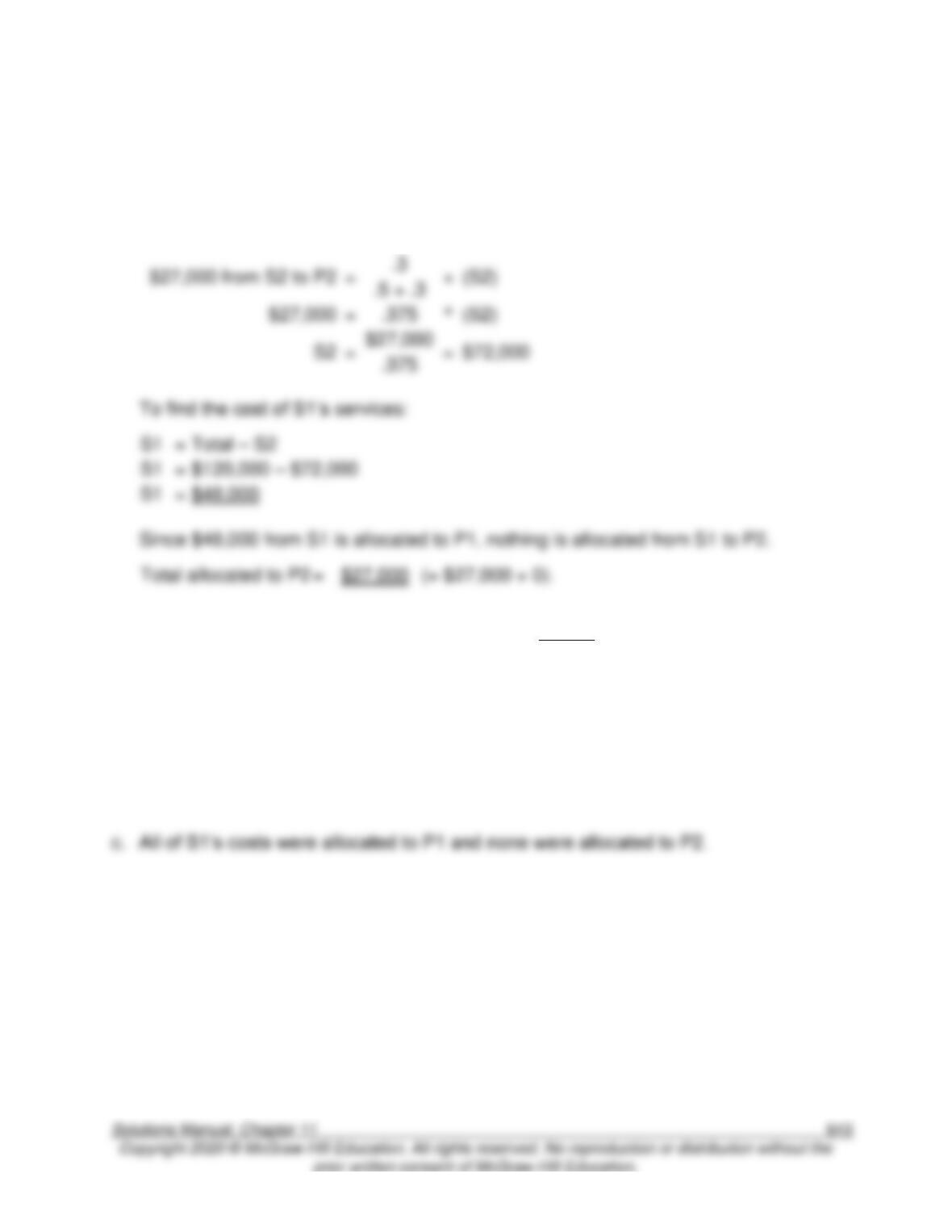
a. Since the direct method is used, Operations Support’s (S2’s) costs are allocated
only to P1 and P2, not to S1.
To find the cost of S2’s services:
S1
=
b.
Amount allocated from S2 to P1
=
$45,000
= (
.5
×
$72,000
)
.5 + .3
From
To
P1
P2
S1 …………
$48,000
–0–
S2 …………
$45,000
$27,000
11–57. (40 min.) Solve For Unknowns: RT Renovations.
a. $250,000.
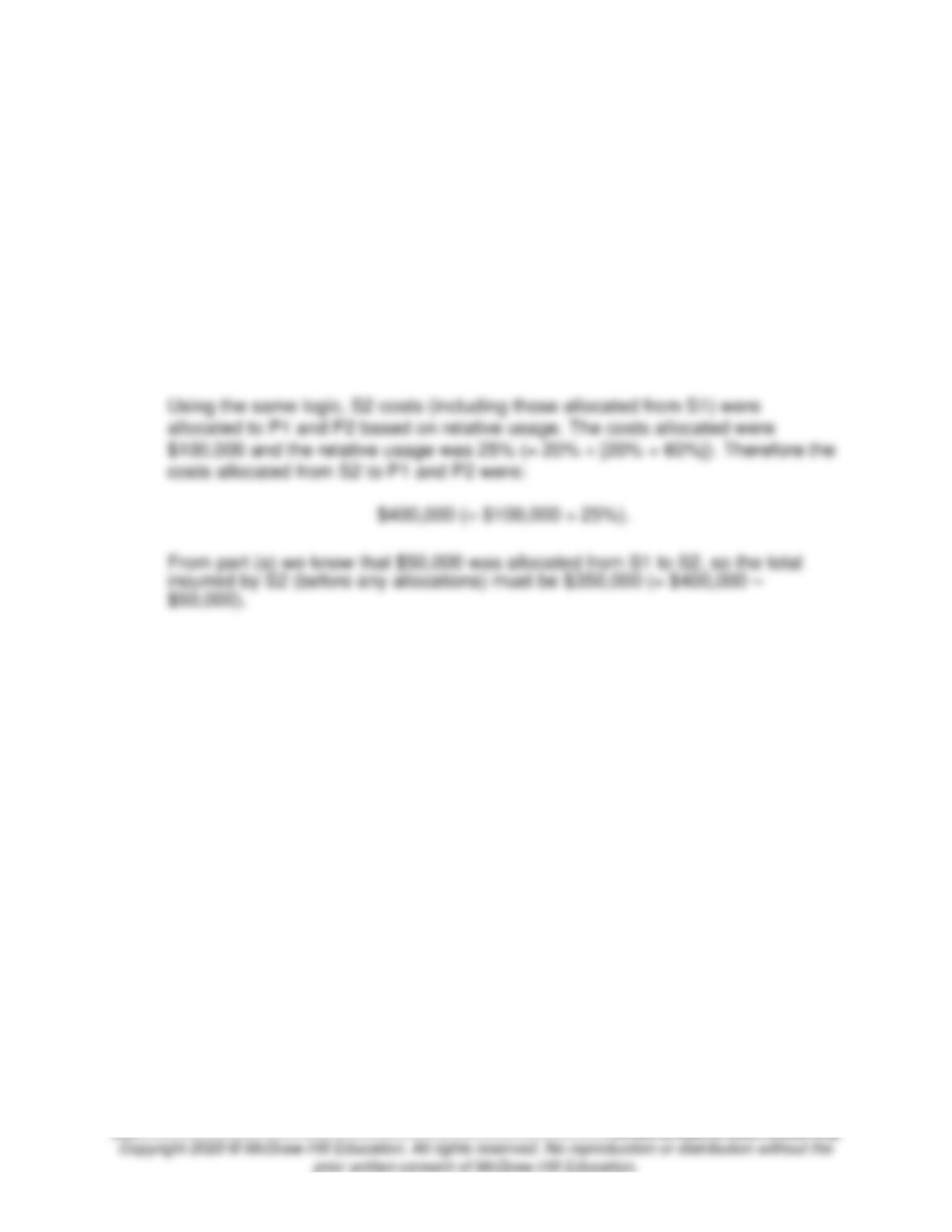
The company uses the step method allocating from S1 to the other three
departments first. The costs allocated from S1 to S2 in November were $50,000
and S2 used 20% of S1’s services. This implies that S1 costs were:
$250,000 (= $50,000 ÷ 20%).
b. $350,000.

11–58. (60 min.) Cost Allocation—Step Method With Analysis And Decision
Making: Steamco Corporation.
a. The company considered only the direct costs of the electric generating plant. It did
not include the costs of the steam plant or other indirect costs.
11–58. (continued)
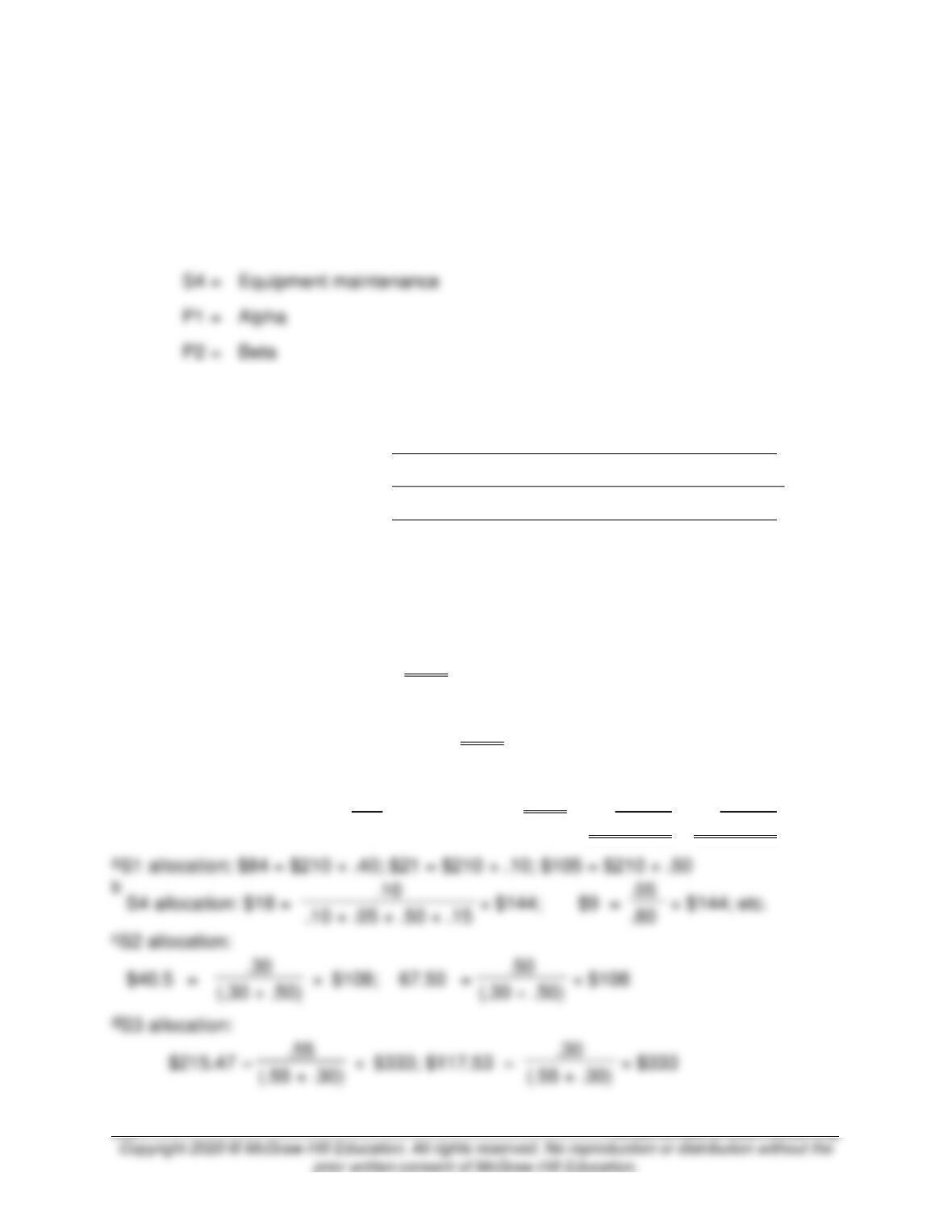
b.
Let:
S1
=
Steam generation
S2
=
Electric generating—fixed
S3
=
Electric generating—variable
P1
=
Alpha
P2
=
Beta
Allocation:
To Department:
(Direct Costs Shown Below Department)
S4
S2
S3
P1
P2
$144
$90
$240
$1,800.00
$1,320.00
Amount to
From department:
be allocated
Steam generation
(S1)a
$ 210
84
21.00
105.00
Equipment
maintenance (S4)b
144
(144)
18
9
90.00
27.00
Electric
generating—fixed
(S2)c
108
(108)
0
40.50
67.50
Electric
generating—
variable (S3)d
333
(333)
215.47
117.53
Total
$0
$0
$0
$0
$2,166.97
$1,637.03
.05
.50