
Chapter 11
Financial Risk Management
Discussion Questions
1. Market risk refers to the risk of loss due to unexpected changes in the prices of currencies, interest
rates, commodities, and equities. It is not confined to price changes. Market risk also includes
2. An FX risk management program includes the following processes:
a. Forecasting the expected movement in the relation between the yuan and your domestic currency.
3. Translation exposure measures the impact of exchange rate changes on the domestic currency
equivalents of a firm’s foreign currency assets and liabilities. It is primarily concerned with currency
restatement. Transaction exposure measures the cash flow impact of fluctuating currency values on
the settlement of commercial transactions denominated in foreign currencies. Transaction exposure is
concerned with a currency conversion (exchange) process. Economic exposure attempts to measure
the impact of changing exchange rates on the future revenues, costs, and sales volume of a
multinational entity. It is concerned with the temporal effects of exchange rate changes.
Although FAS No. 52 attempts to mitigate concern with translation gains and losses (accounting
exposure), it does not totally eliminate it. Companies choosing the U.S. dollar as their functional
currency will still use the temporal translation method and report translation gains and losses in
4. The chapter lists 10 specific methods to reduce a firm’s exposure to foreign exchange risk in a
devaluation-prone country. These techniques, and possible cost-benefit trade-offs, are summarized in
the following table.
Methods Trade-Offs
a. Minimize cash balances in a. Reduced exposure versus

c. Accelerate the collection c. Reduced exposure versus
of local currency receivables possible reduction in sales
f. Invest local currency cash f. Reduced exposure versus
balances in inventories and higher transaction costs
g. Invest in strong currency g. Reduced exposure versus
foreign assets higher transaction costs
i. Invoice exports in hard i. Reduced exposure versus
currencies possible reduction in
sales abroad
j. Currency swaps j. Reduced translation
5. A multicurrency transaction exposure report differs from a multicurrency translation exposure report
in a number of ways. First, the transactions exposure report has a cash flow orientation instead of a
6. Student responses should proceed along the following lines. Pele Corporation, a Brazilian firm, has
borrowed a certain sum of British pounds at 9 percent and is worried that the pound will appreciate
7. A futures contract is a commitment to purchase or deliver a specified quantity of a financial
instrument or foreign currency at a future date at a price set when the contract is made. It differs from
a forward contract in several respects. A futures contract is standardized in terms of size and delivery
8. Fair value hedges are hedges of a firm’s foreign currency assets and liabilities and firm foreign
currency commitments. Cash flow hedges are hedges of forecasted transactions such as a future sale
9. In theory, the term highly effective means that gains or losses on hedging instruments should exactly
offset gains or losses on the item being hedged. In practice, it means that gains or losses on the
10. The notion of an opportunity cost refers to the return associated with your next best opportunity. In
the area of FX risk management, it entails comparing a given risk management strategy with an
Exercises
1. Students usually gloss over diagrams without thinking them through. This exercise forces them to
think through each step of the diagram and allows them to better internalize the risk management
cycle. Responses might follow the following pattern: Step 1 involves operationalizing a firm’s
strategies into quantifiable objectives and then identifying developments both external and internal
2. Foreign exchange risk: a devaluation of the foreign currency in which an account receivable was
denominated would cause the domestic currency cash flows to decrease. This would cause current
assets to decrease. Alternatively, a revaluation of the foreign currency would cause the account
3. The purpose of this exercise is to force students to look at managerial accounting issues from the
user’s perspective. Students may suggest additional information sources with respect to inflation
differentials, balance of trade and balance of payments statistics, international monetary reserves,
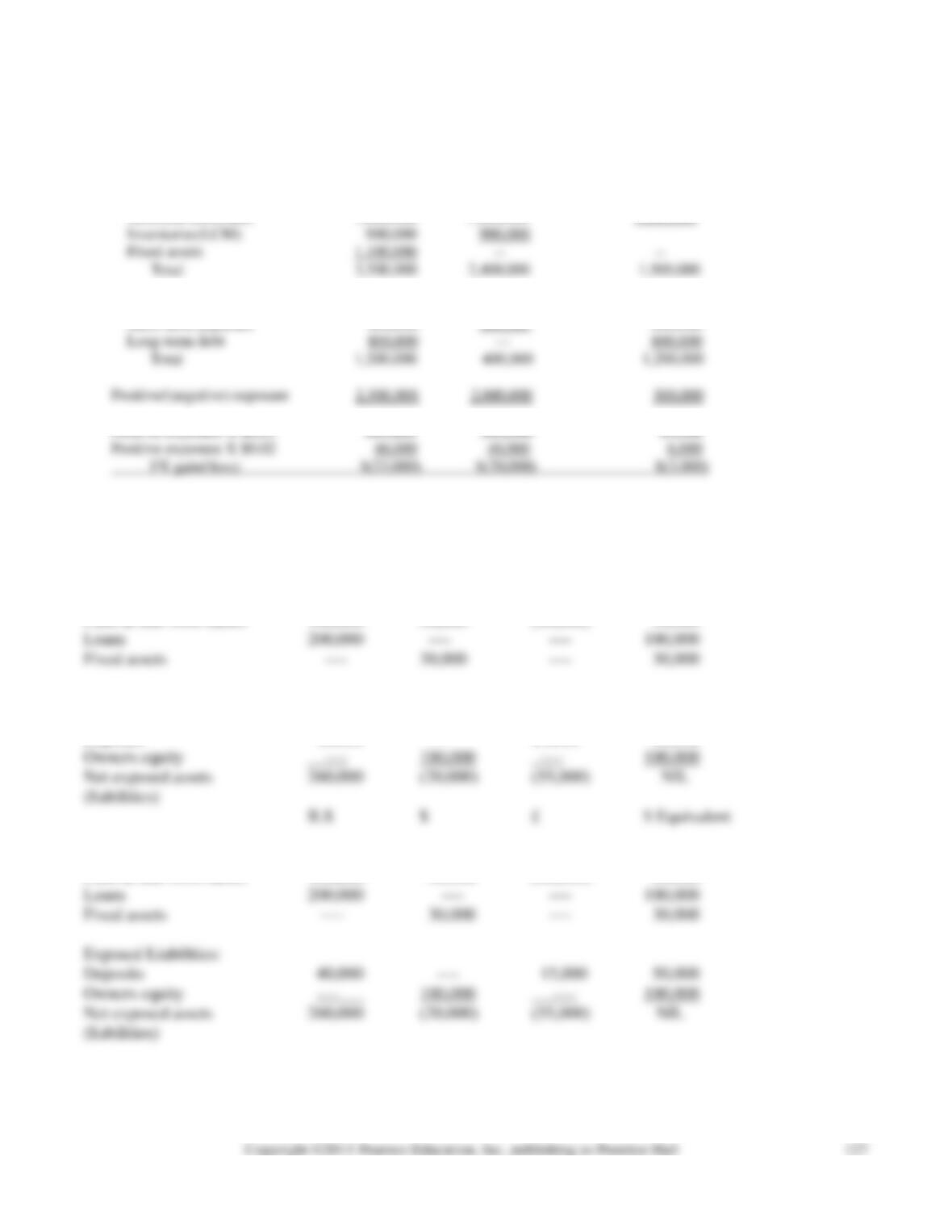
4. Current rate Current/Noncurrent Monetary/nonmonetary
Exposed assets(PHP):
Cash 500,000 500,000 500,000
Accounts receivable 1,000,000 1,000,000 1,000,000
Exposed liabilities:
Short-term payables 400,000 400,000 400,000
5.
ILS $ £ $ Equivalent
Exposed Assets:
Cash & due from banks 100,000 50,000 (40,000) 20,000
Exposed Liabilities:
Deposits 40,000 —- 15,000 50,000
Exposed Assets:
Cash & due from banks 100,000 50,000 (40,000) 20,000
6.

Trial Balance Before
ILS $ £ $ Equivalent
Cash & due from banks 100,000 50,000 (40,000) 20,000
Trial Balance After
(£/$/ILS = 1/2/8)
ILS $ £ $ Equivalent
Cash & due from banks 100,000 50,000 (40,000) (5,000)
7. If the U.S. dollar is the functional currency, the translation gain upon consolidation is aggregated with
the transaction loss on the foreign currency borrowing and disclosed as one line item in the
consolidated income statement. This figure is determined as follows:
Translation gain = Positive exposure X change in exchange rate
= NZD3,000,000 x $.10
If the New Zealand dollar is the functional currency, the translation gain upon consolidation bypasses

8.
4/1 CD (¥30,000,000 ÷ ¥100) $300,000
7/1 CD (¥30,000,000 ÷ [¥100 – ¥90]) $ 33,333
7/1 Cash (¥30,000,000 ÷ ¥90) $333,333
Interest income (¥30,000,000 X .08 X ¼) ÷ ¥90] $ 6,667
9. a. Journal entries:

6/30 Premium expense 1,111
9/1 CHF Contract receivable 3,333
9/1 $ Contract payable 153,333
b. If the premium on the forward contract is considered an operating expense, and the conditions for
hedge treatment are met, i.e., management designates the forward contract as a hedge, documents
its risk management objective and strategy, identifies the hedging instrument, the item being
hedged and the risk exposure, and that the forward is effective both prospectively and
retrospectively in hedging the risk, the gain on the forward can be offset against the loss on the
payable as follows:
Amount paid to settle the account payable on the purchase $153,333

10. Journal entries:
The call option is intended to hedge an uncertain cash flow. Accordingly, gains or losses on the
hedging instrument would be disclosed in comprehensive income and reclassified into earnings in the
period the sale actually takes place.
June 1 Premium expense $28,125
Case 11-1 Exposure Identification
The following list is by no means exhaustive and students will identify risks beyond those deemed financial. This
is to be encouraged as this captures the essence of accounting as an information service.
Page No. Value Driver Market risk
324 Consolidated statements Foreign exchange
326 PP&E Foreign exchange
Interest rate

Equity price
Foreign exchange
Commodity price
366 Inventories Foreign exchange
Interest rate
Commodity price
366 Trading securities Equity price
Interest rate
Foreign exchange
378 Employee benefits Interest rate
Equity price
384 Borrowings Interest rate
Foreign exchange
388 Trade payables Interest rate

Students who scan Pirelli’s entire annual report may note the following, and more.
17 Capital stock Equity prices
30 Liabilities Interest rate
40 Capital stock Equity price
47 Sales Foreign exchange
47 Sales by geographic area Foreign exchange
48 Operating expenses Foreign exchange
For a discussion on the firms risk management activities, see the discussion on risk and uncertainties, pp. 41–45,
and financial risk management policies, pp. 336–340.
Case 11-2 Value At Risk: What Are Our Options?
Students should be asked to play the role of the consultant, and will find it to be a contentious issue. Suggested
remedies that have merit are:
1. The FASB should permit deferral accounting for rolling options which would take the derivative gain
2. Another tack would be to adhere to generally accepted accounting principles and record the gain or
3. Another option that students might suggest is to revert back to the earlier U.S. practice of keeping the
option off balance sheet and providing supplementary disclosure of mark-to-market accounting. This