CHAPTER 25 (FIN MAN); CHAPTER 11 (MAN) Differential Analysis and Product Pricing
Ex. 25–20 (FIN MAN); Ex. 11–20 (MAN)
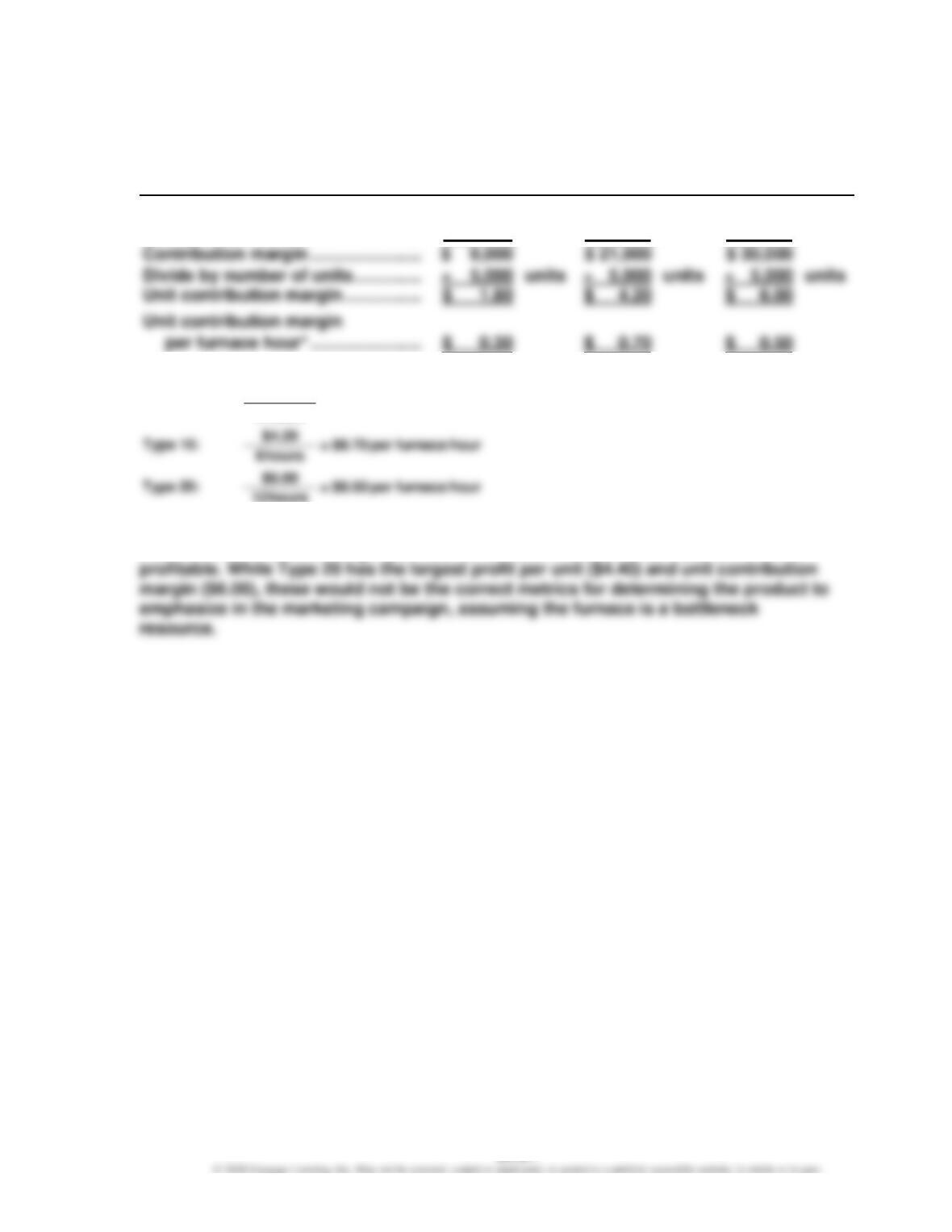
Determine the contribution margin per furnace hour as follows:
Type 5
Type 10
Type 20
Revenues ………………………………….
$ 43,000
$ 49,000
$ 56,500
Variable cost ……………………………..
(34,000)
(28,000)
(26,500)
Contribution margin …………………..
$ 21,000
$ 30,000
Unit contribution margin …………….
$ 4.20
$ 6.00
Unit contribution margin
$ 0.70
$ 0.50
* Calculated as follows:
Type 5:
$1.80 = $0.30 per furnace hour
6hours
$4.20 = $0.70 per furnace hour
6hours
$6.00 = $0.50 per furnace hour
12hours
Emphasize Type 10. In a production-constrained environment, Type 10 generates the
most unit contribution margin per hour of furnace resource and, thus, is the most
CHAPTER 25 (FIN MAN); CHAPTER 11 (MAN) Differential Analysis and Product Pricing
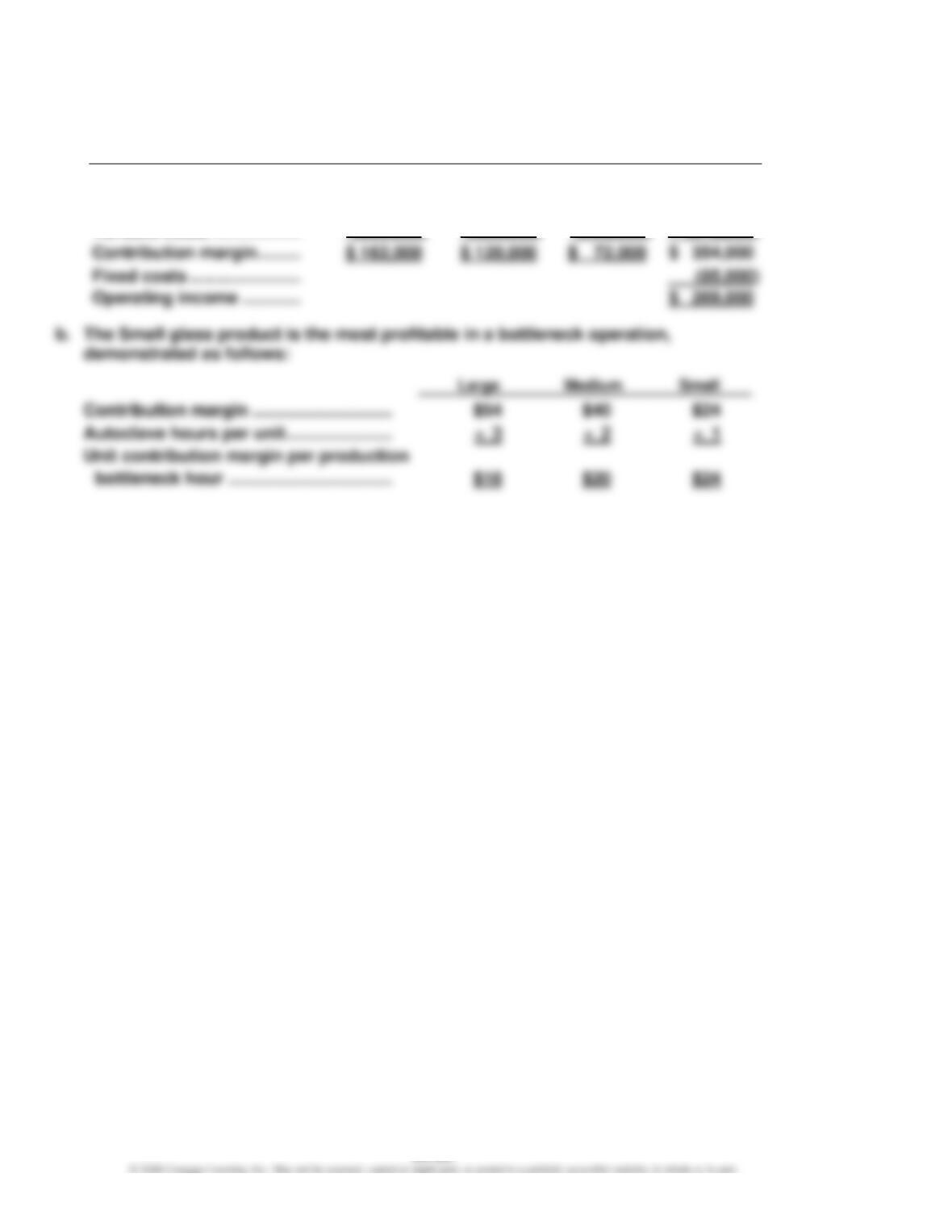
Ex. 25–21 (FIN MAN); Ex. 11–21 (MAN)
a.
Large
Medium
Small
Total
Units produced ……………..
3,000
3,000
3,000
Revenues ……………………..
$ 552,000
$ 480,000
$ 300,000
$1,332,000
CHAPTER 25 (FIN MAN); CHAPTER 11 (MAN) Differential Analysis and Product Pricing
Appendix Ex. 25–22 (FIN MAN); Appendix Ex. 11–22 (MAN)
a.
Total costs:
Variable ($240 × 10,000 units) …………………………………………………
$2,400,000
Fixed ($350,000 + $140,000)…………………………………………………….
490,000
Total ……………………………………………………………………………………
$2,890,000
Cost amount per unit: $2,890,000 ÷ 10,000 units = $289
Appendix Ex. 25–23 (FIN MAN); Appendix Ex. 11–23 (MAN)
a.
Total variable costs: ($240 × 10,000 units) ………………………………………
$2,400,000
Cost amount per unit:: $2,400,000 ÷ 10,000 units = $240
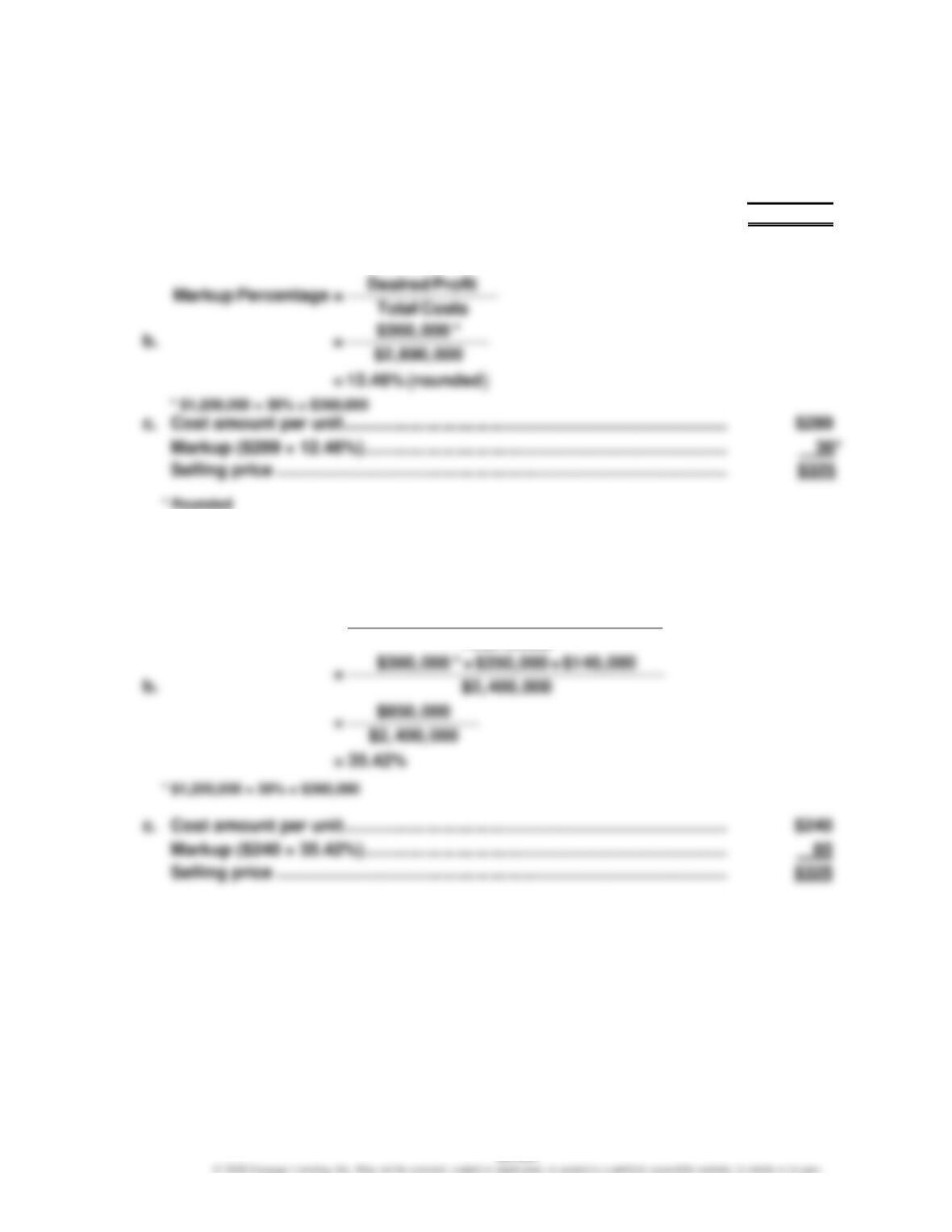
Desired Profit + Total Fixed Costs
Markup Percentage = Total Costs
CHAPTER 25 (FIN MAN); CHAPTER 11 (MAN) Differential Analysis and Product Pricing
PROBLEMS
Prob. 25–1A (FIN MAN); Prob. 11–1A (MAN)
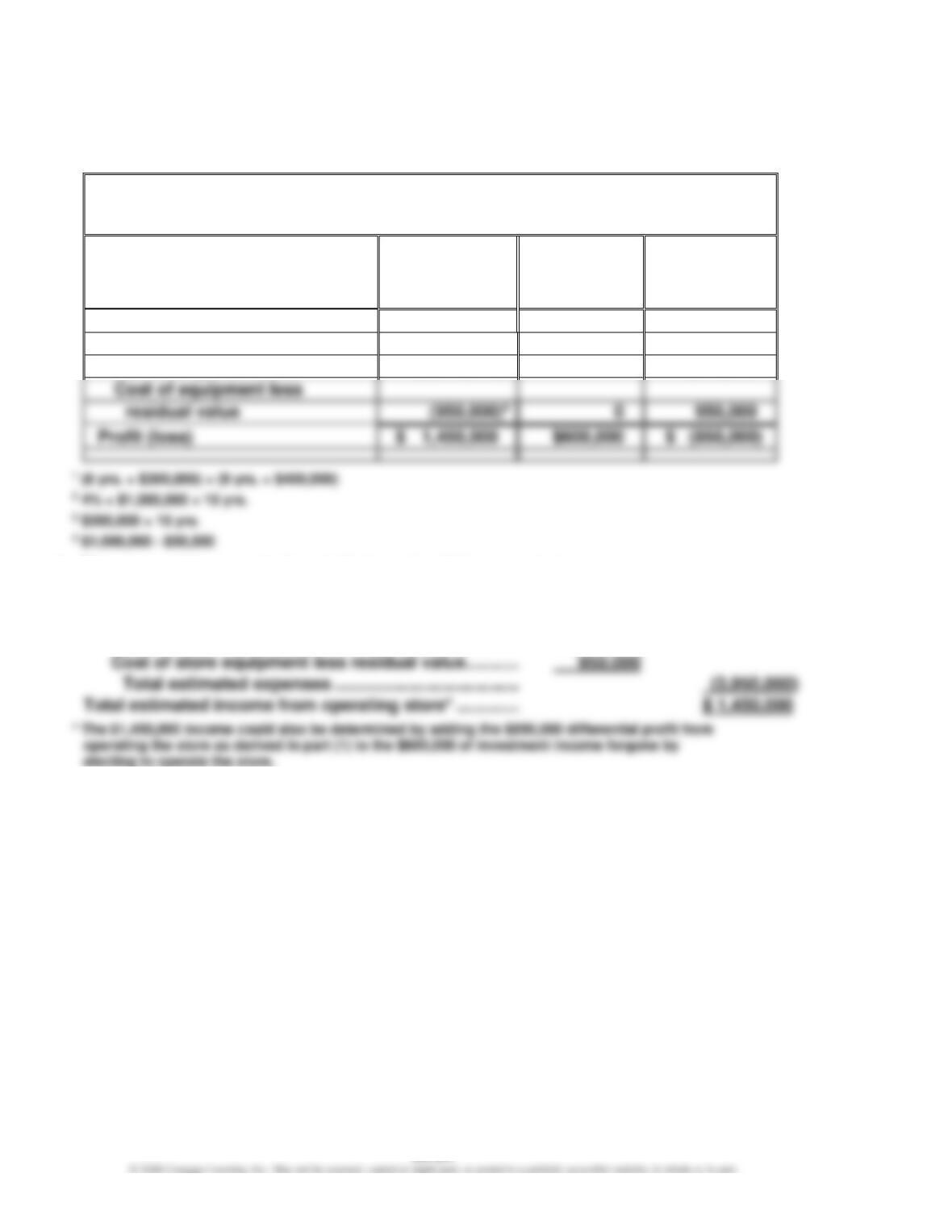
1.
Differential Analysis
Operate Retail Store (Alt. 1) or Invest in Bonds (Alt. 2)
August 1
Operate
Retail
Store
(Alternative 1)
Invest in
Bonds
(Alternative 2)
Differential
Effects
(Alternative 2)
Revenues
$ 5,400,0001
$600,0002
$(4,800,000)
Costs:
Costs to operate store
(3,000,000)3
0
3,000,000
Cost of equipment less
0
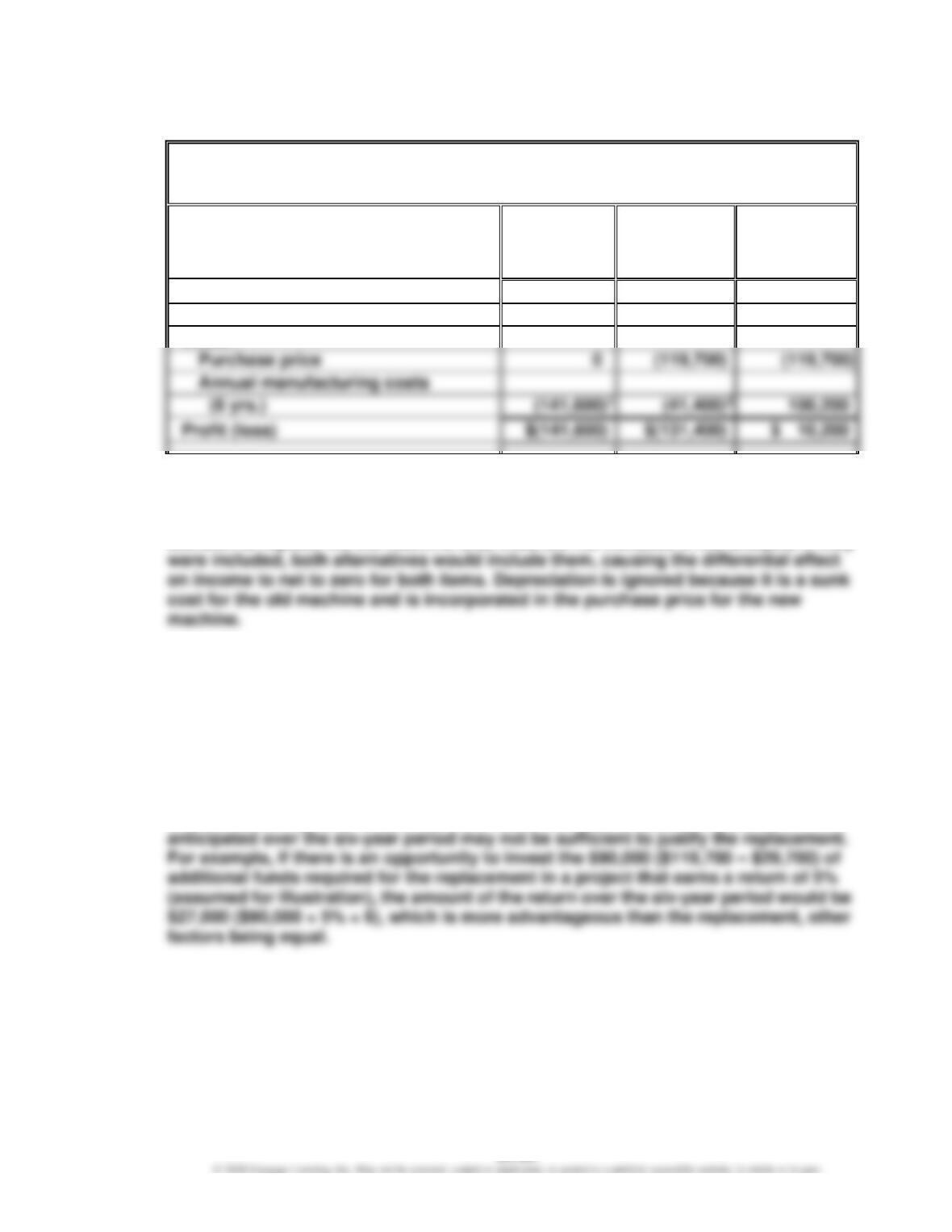
2. The proposal to operate the retail store should be accepted.
3.
Total estimated revenue from operating store ………….
$ 5,400,000
Total estimated expenses to operate store:
Costs to operate store, excluding depreciation ……
$3,000,000
Cost of store equipment less residual value ………..
(3,950,000)
Total estimated income from operating store* ………….
CHAPTER 25 (FIN MAN); CHAPTER 11 (MAN) Differential Analysis and Product Pricing
Prob. 25–2A (FIN MAN); Prob. 11–2A (MAN)
1.
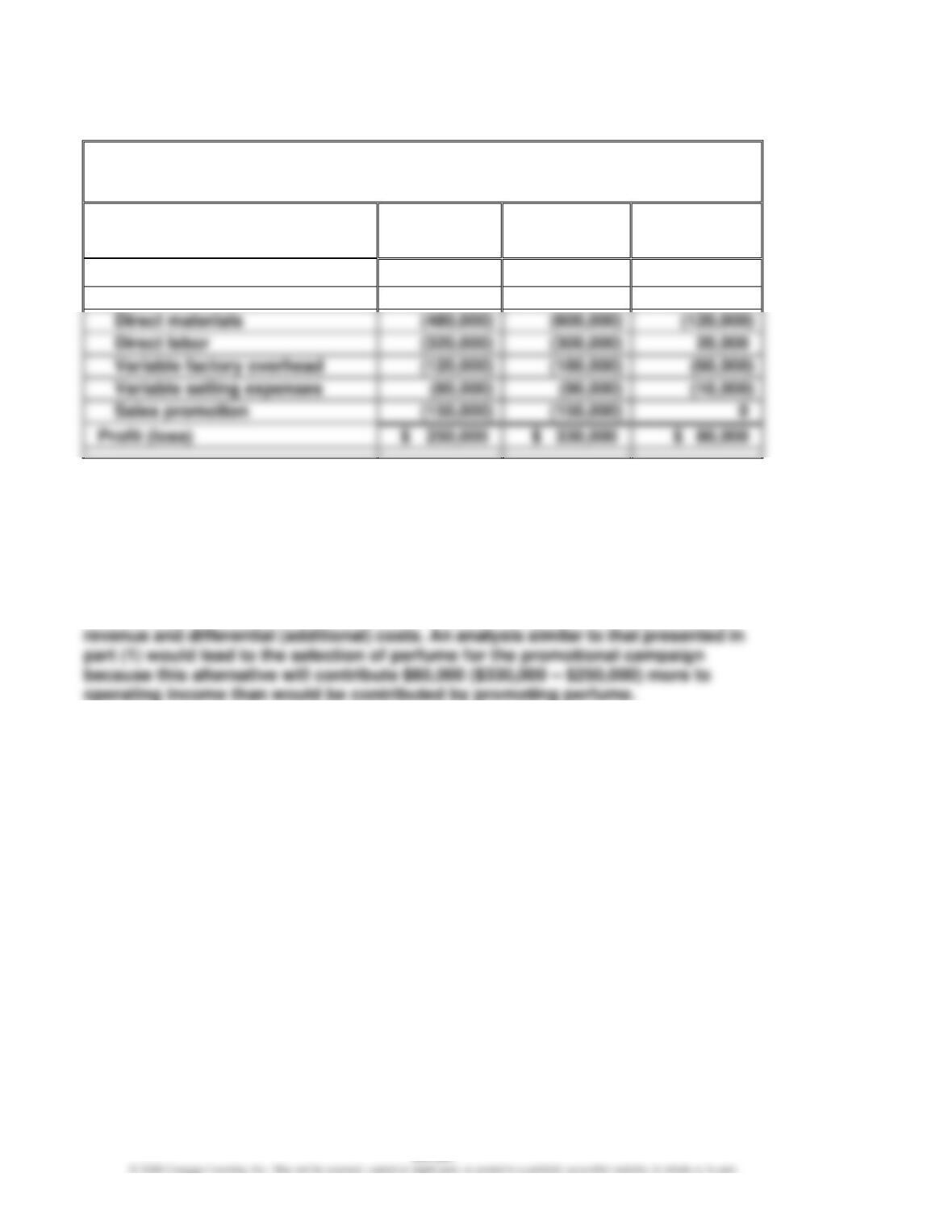
Differential Analysis
Continue with (Alt. 1) or Replace (Alt. 2) Old Machine
April 30
Continue
with Old
Machine
(Alternative 1)
Replace
Old
Machine
(Alternative 2)
Differential
Effects
(Alternative 2)
Revenues:
Proceeds from sale of old machine
$ 0
$ 29,700
$ 29,700
Purchase price
Annual manufacturing costs
$ 10,200
Costs:
1 $23,600 × 6 years
2 $6,900 × 6 years
Note: Revenues and nonmanufacturing operating expenses are not affected by the
Lexigraphic Printing Company should replace the old machine with the new machine.
2. Other factors to be considered include:
a. Are there any improvements in the quality of work turned out by the new machine?
b. What effect does the federal income tax have on the decision?
c. What opportunities are available for the use of the $90,000 of funds ($119,700 less
$29,700 proceeds from the old machine) that are required to purchase the new
machine?
After considering such factors as those listed above, the net cost reduction
CHAPTER 25 (FIN MAN); CHAPTER 11 (MAN) Differential Analysis and Product Pricing
Prob. 25–3A (FIN MAN); Prob. 11–3A (MAN)
1.
Differential Analysis
Promote Moisturizer (Alt. 1) or Promote Perfume (Alt. 2)
November 2
Promote
Moisturizer
(Alternative 1)
Promote
Perfume
(Alternative 2)
Differential
Effects
(Alternative 2)
Revenues
$1,400,0001
$1,650,0002
$ 250,000
Costs:*
1 40,000 units × $35
2 30,000 units × $55
* Costs, except sales promotion, are the costs per unit multiplied by the increase in unit volume
for each cosmetic. Fixed costs are not relevant to the decision, so are not included.
Kanakee Cosmetics should promote perfume.
2. The sales manager’s tentative decision should be opposed. The sales manager
erroneously considered the full unit costs instead of the differential (additional)
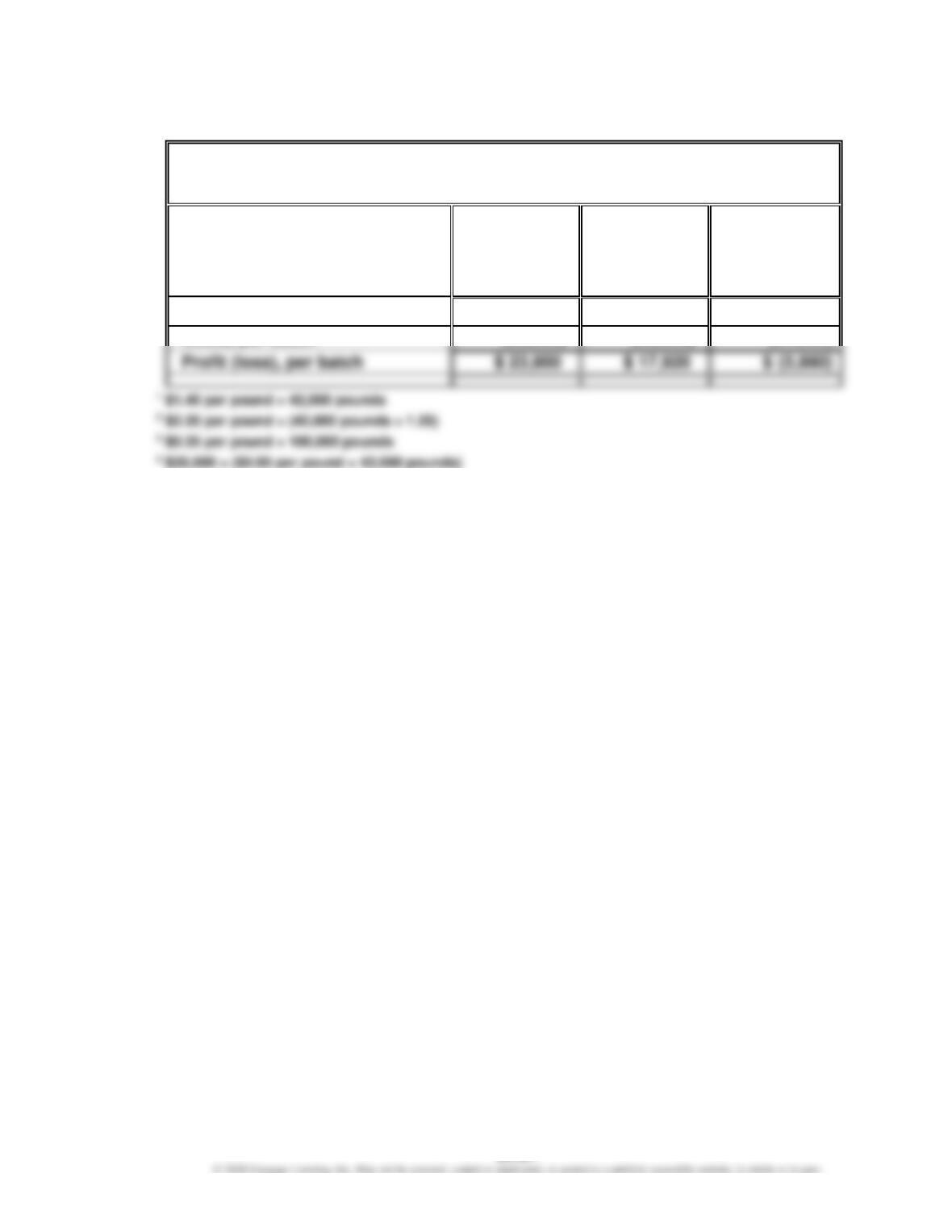
CHAPTER 25 (FIN MAN); CHAPTER 11 (MAN) Differential Analysis and Product Pricing
Prob. 25–4A (FIN MAN); Prob. 11–4A (MAN)
1.
Differential Analysis
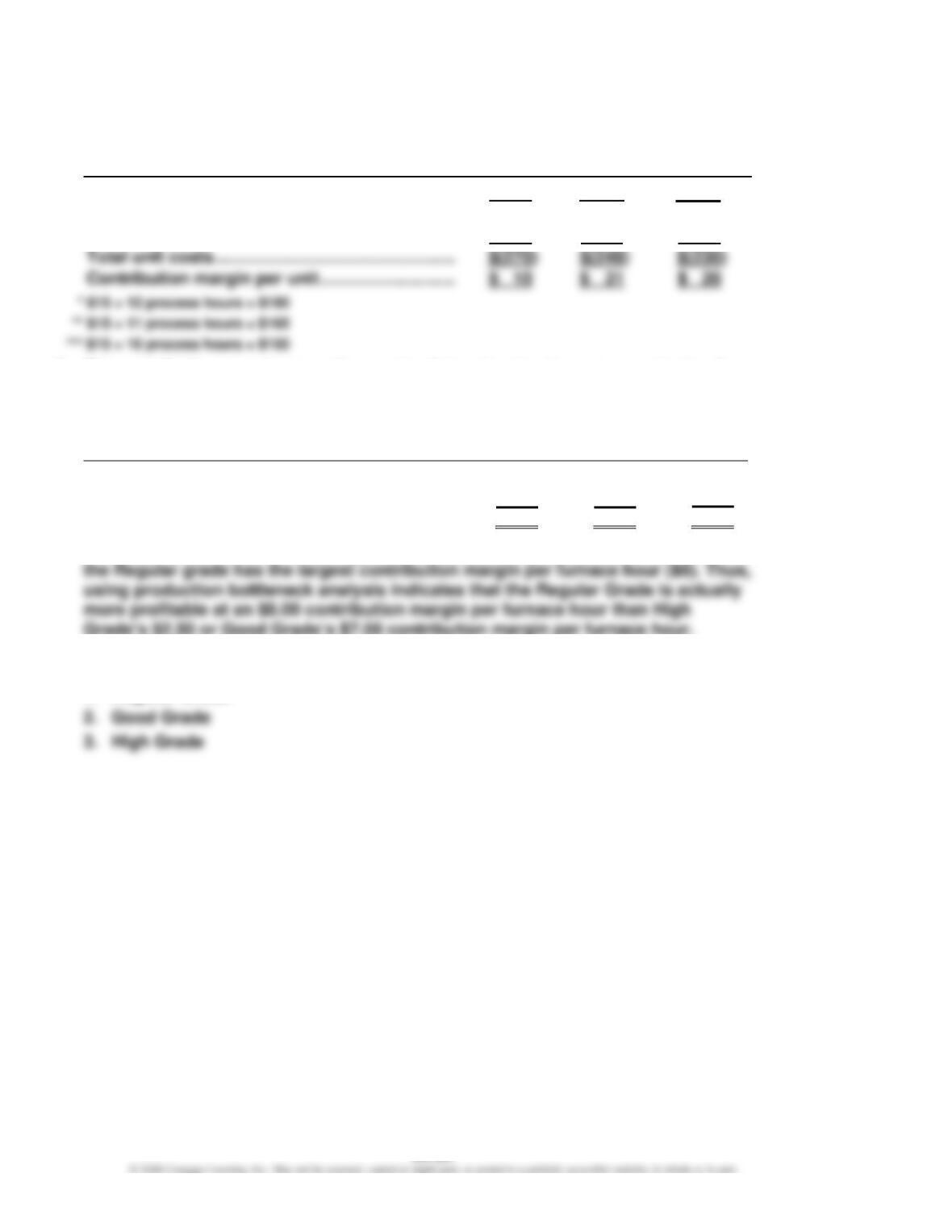
Sell Raw Sugar (Alt. 1) or Process Further into Refined Sugar (Alt. 2)
March 24
Sell Raw
Sugar
(Alternative 1)
Process
Further into
Refined
Sugar
(Alternative 2)
Differential
Effects
(Alternative 2)
Revenues, per batch
$ 58,8001
$ 73,9202
$ 15,120
Costs, per batch
Profit (loss), per batch
2. Dominican Sugar Company should not process raw sugar further to produce refined
sugar because profits would be reduced by $5,880 per batch.
CHAPTER 25 (FIN MAN); CHAPTER 11 (MAN) Differential Analysis and Product Pricing
Prob. 25–5A (FIN MAN); Prob. 11–5A (MAN)
1.
High
Grade
Good
Grade
Regular
Grade
Selling price ……………………………………………….
$ 280
$ 270
$ 250
Variable conversion cost per unit ………………..
$(180)*
$(165)**
$(150)***
Direct materials cost per unit ………………………
(90)
(84)
(80)
Total unit costs…………………………………………..
Contribution margin per unit ……………………….
2. The contribution margin per unit may give false signals when an organization has
production bottlenecks. Instead, Hercules should use the contribution margin per
bottleneck hour to determine relative product profitability, as follows:
High
Grade
Good
Grade
Regular
Grade
Contribution margin per unit ……………………….
$ 10
$ 21
$ 20
Furnace (bottleneck) hours per unit …………….
÷ 4
÷ 3
÷ 2.5
Contribution margin per furnace hour ………….
$2.50
$7.00
$8.00
The Good Grade steel has the largest contribution margin per unit ($21); however,
Grade’s $2.50 or Good Grade’s $7.00 contribution margin per furnace hour.
Therefore, the company would want to sell product in the following preference
order:
1. Regular Grade
CHAPTER 25 (FIN MAN); CHAPTER 11 (MAN) Differential Analysis and Product Pricing
Appendix Prob. 25–6A (FIN MAN); Appendix Prob. 11–6A (MAN)
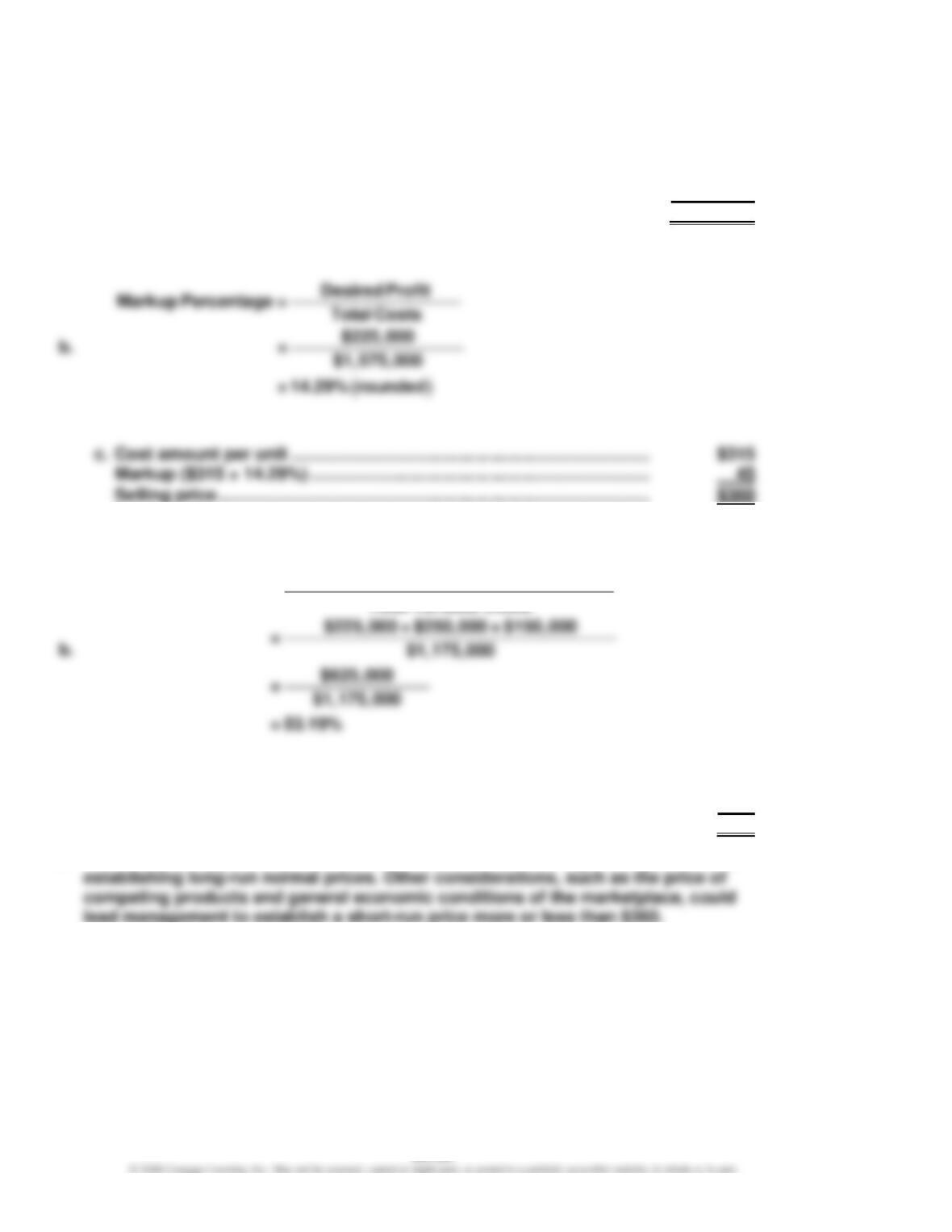
1. $225,000 ($1,500,000 × 15%)
2.
a.
Total manufacturing costs:
Variable ($200* × 5,000 units) ………………………………………………..
$1,000,000
Fixed factory overhead …………………………………………………………
250,000
Total …………………………………………………………………………………
$1,250,000
Cost amount per unit: $1,250,000 ÷ 5,000 units …………………………...
$ 250
* $120 + $30 + $50
Markup ($250 × 44%) …………………………………………………………………
Selling price ……………………………………………………………………………..
CHAPTER 25 (FIN MAN); CHAPTER 11 (MAN) Differential Analysis and Product Pricing
Appendix Prob. 25–6A (FIN MAN); Appendix Prob. 11–6A (MAN) (Continued)
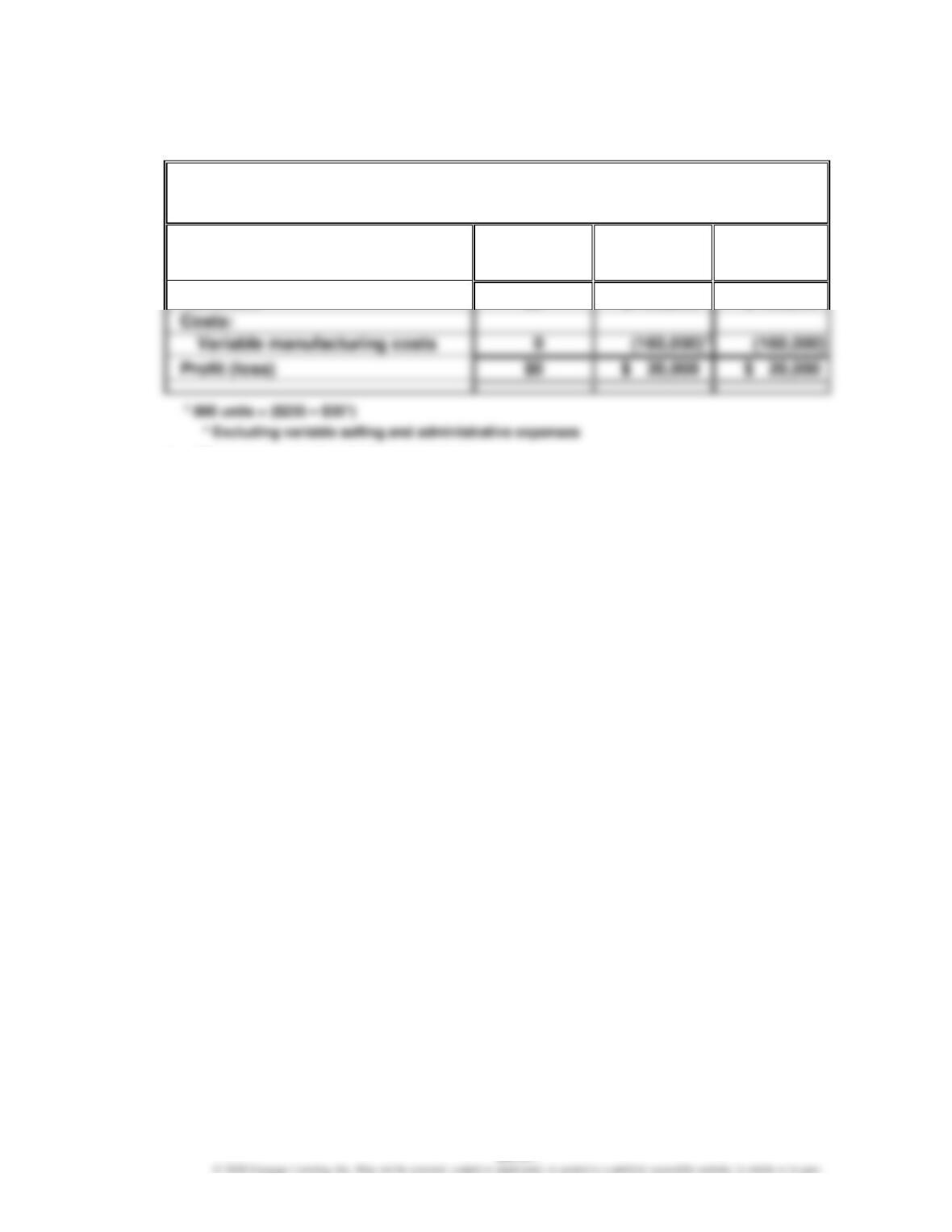
3.
a.
Total costs:
Variable ($235 × 5,000 units) …………………………………………………
$1,175,000
Fixed ($250,000 + $150,000) ………………………………………………….
400,000
Total …………………………………………………………………………………
$1,575,000
Cost amount per unit: $1,575,000 ÷ 5,000 units
$ 315
Cost amount per unit ………………………………………………………………..
$315
Markup ($315 × 14.29%) …………………………………………………………….
Selling price ……………………………………………………………………………..
$360
4. a. Variable cost amount per unit: $235
Total variable costs: $235 × 5,000 units = $1,175,000
Desired Profit + Total Fixed Costs
Markup Percentage = Total Variable Costs
c.
Cost amount per unit …………………………………………………………………
$235
Markup ($235 × 53.19%) ……………………………………………………………..
125
Selling price ……………………………………………………………………………..
$360
5. The cost-plus approach price of $360 should be viewed as a general guideline for
CHAPTER 25 (FIN MAN); CHAPTER 11 (MAN) Differential Analysis and Product Pricing
Appendix Prob. 25–6A (FIN MAN); Appendix Prob. 11–6A (MAN) (Concluded)
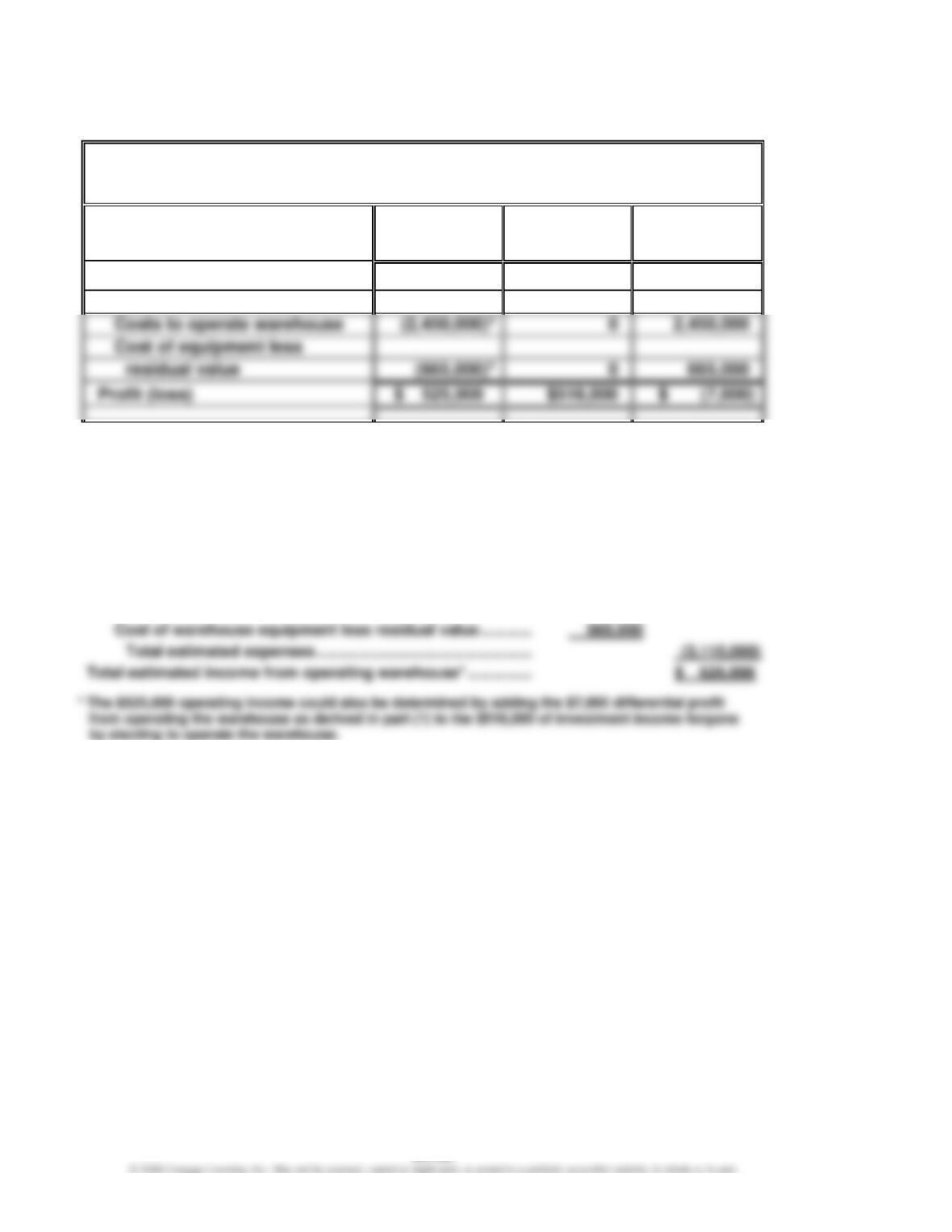
6. a.
Differential Analysis
Reject (Alt. 1) or Accept (Alt. 2) Order
August 3
Reject
Order
(Alternative 1)
Accept
Order
(Alternative 2)
Differential
Effects
(Alternative 2)
Revenues
$0
$ 180,000
$ 180,000
Costs:
Variable manufacturing costs
$0
b. The proposal should be accepted.
CHAPTER 25 (FIN MAN); CHAPTER 11 (MAN) Differential Analysis and Product Pricing
Prob. 25–1B (FIN MAN); Prob. 11–1B (MAN)
1.
Differential Analysis
Operate Warehouse (Alt. 1) or Invest in Bonds (Alt. 2)
July 1
Operate
Warehouse
(Alternative 1)
Invest in
Bonds
(Alternative 2)
Differential
Effects
(Alternative 2)
Revenues
$ 3,640,0001
$518,0002
$(3,122,000)
Costs:
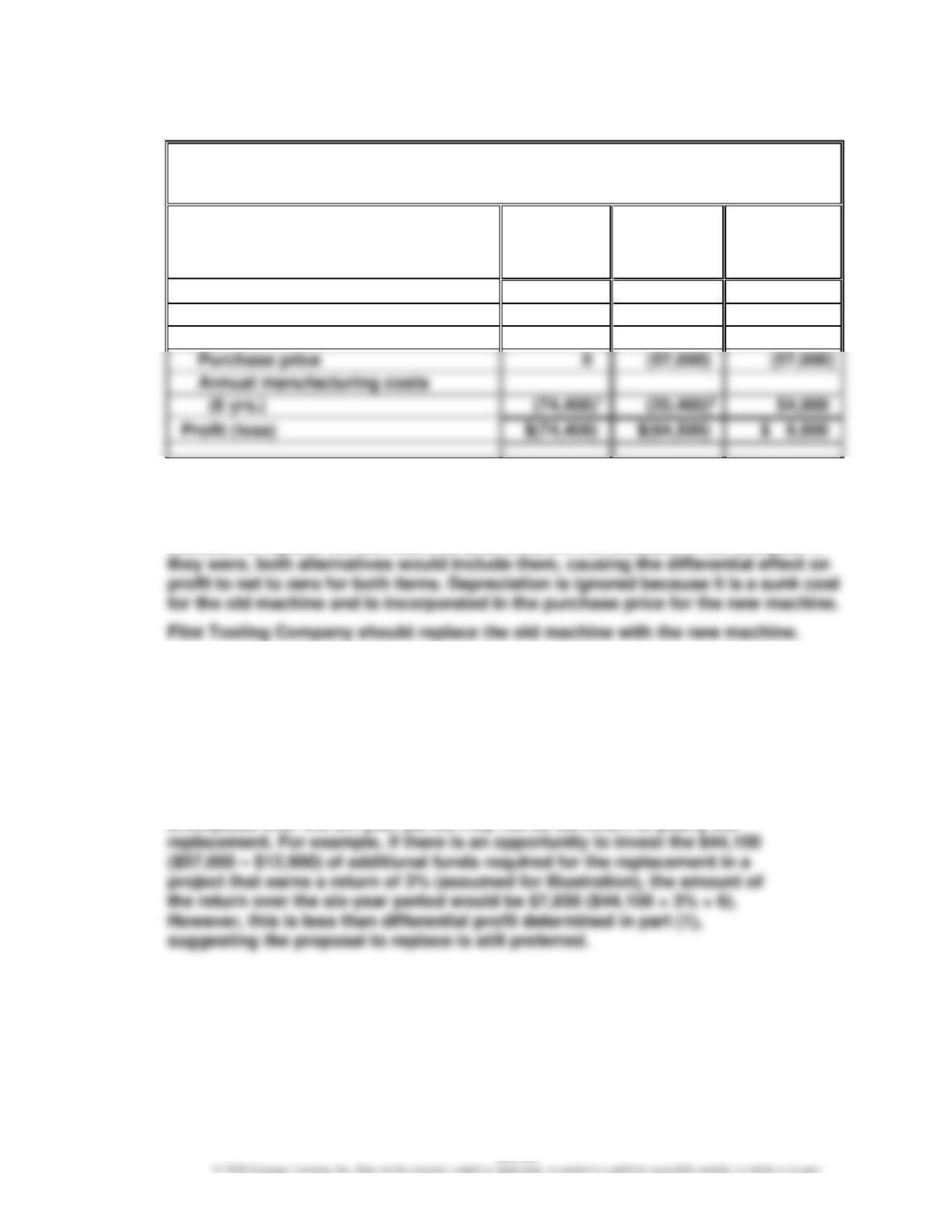
1 (7 yrs. × $280,000) + (7 yrs. × $240,000)
2 5% × $740,000 × 14 years
3 $175,000 × 14 years
4 $740,000 – $75,000
2. The proposal to operate the warehouse should be accepted.
3.
Total estimated revenue from operating warehouse ……………
$ 3,640,000
Total estimated expenses to operate warehouse:
Costs to operate warehouse, excluding depreciation …….
$2,450,000
Cost of warehouse equipment less residual value …………
Total estimated income from operating warehouse* ……………
CHAPTER 25 (FIN MAN); CHAPTER 11 (MAN) Differential Analysis and Product Pricing
Prob. 25–2B (FIN MAN); Prob. 11–2B (MAN)
1.
Differential Analysis
Continue with (Alt. 1) or Replace (Alt. 2) Old Machine
November 8
Continue
with Old
Machine
(Alternative 1)
Replace
Old
Machine
(Alternative 2)
Differential
Effects
(Alternative 2)
Revenues:
Proceeds from sale of old machine
$ 0
$ 12,900
$ 12,900
Costs:
Purchase price
Annual manufacturing costs
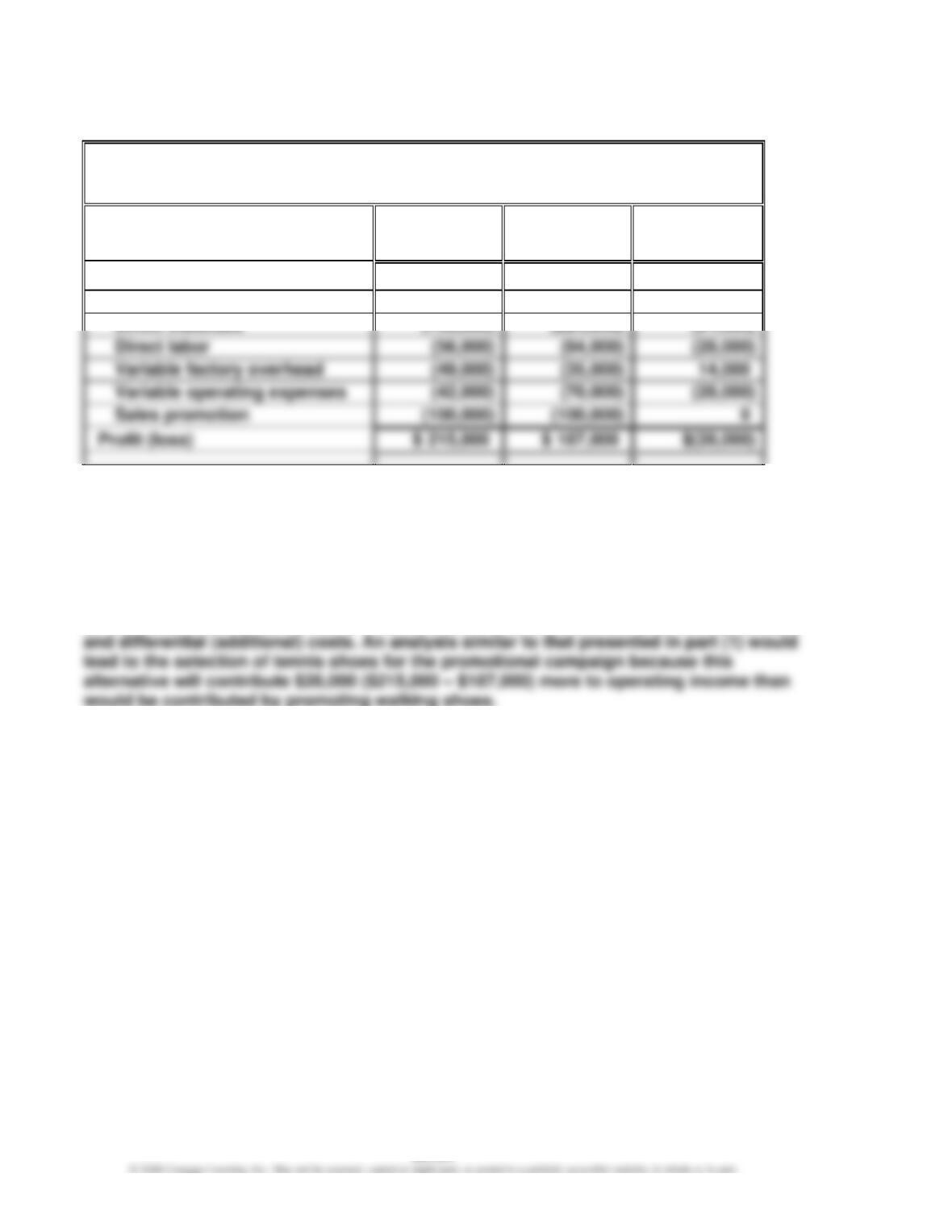
1 $12,400 × 6 years
2 $3,400 × 6 years
Note: Revenues and nonmanufacturing operating expenses are not affected by the
2. Other factors to be considered include the following:
a. Are there any improvements in the quality of work turned out by the new machine?
b. What effect does the federal income tax have on the decision?
c. What opportunities are available for the use of the $44,100 of funds ($57,000 less
$12,900 proceeds from the old machine) that are required to purchase the new
machine?
After considering such factors as those listed above, the net cost reduction
CHAPTER 25 (FIN MAN); CHAPTER 11 (MAN) Differential Analysis and Product Pricing
Prob. 25–3B (FIN MAN); Prob. 11–3B (MAN)
1.
Differential Analysis
Promote Tennis (Alt. 1) or Walking (Alt. 2) Shoes
June 19
Promote
Tennis Shoes
(Alternative 1)
Promote
Walking Shoes
(Alternative 2)
Differential
Effects
(Alternative 2)
Revenues
$ 595,0001
$ 700,0002
$105,000
Costs:*
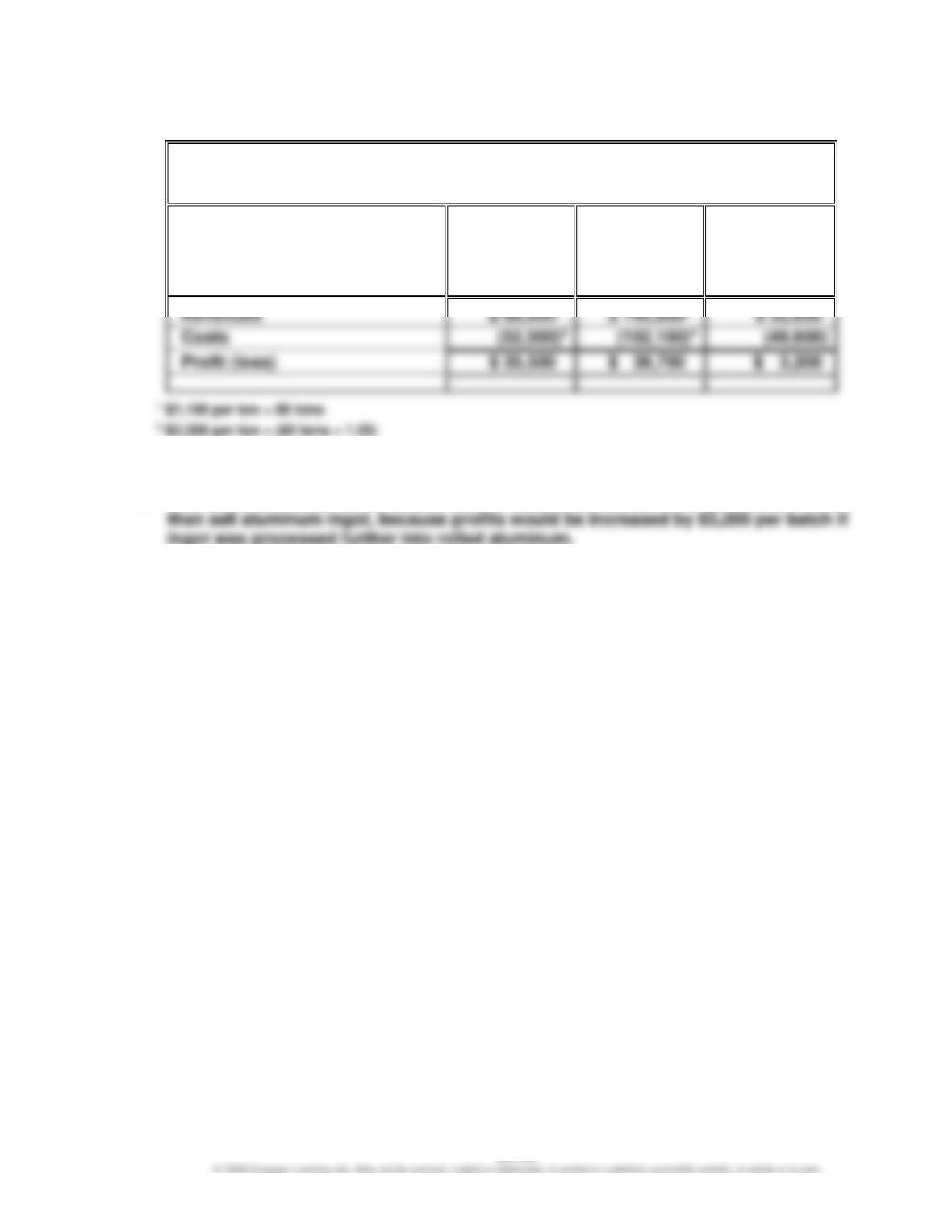
1 7,000 shoes × $85
2 7,000 shoes × $100
* Costs, except sales promotion, are the costs per unit multiplied by the increase in unit volume for each pair of
shoes. Fixed costs are not relevant to the decision so are not included.
Sole Mates Inc. should promote tennis shoes.
2. The sales manager’s tentative decision should be opposed. The sales manager
erroneously considered the full unit costs instead of the differential (additional) revenue
CHAPTER 25 (FIN MAN); CHAPTER 11 (MAN) Differential Analysis and Product Pricing
Prob. 25–4B (FIN MAN); Prob. 11–4B (MAN)
1.
Differential Analysis
Sell Ingot (Alt. 1) or Process Further into Rolled Aluminum (Alt. 2)
February 5
Sell
Ingot
(Alternative 1)
Process Further
into
Rolled
Aluminum
(Alternative 2)
Differential
Effects
(Alternative 2)
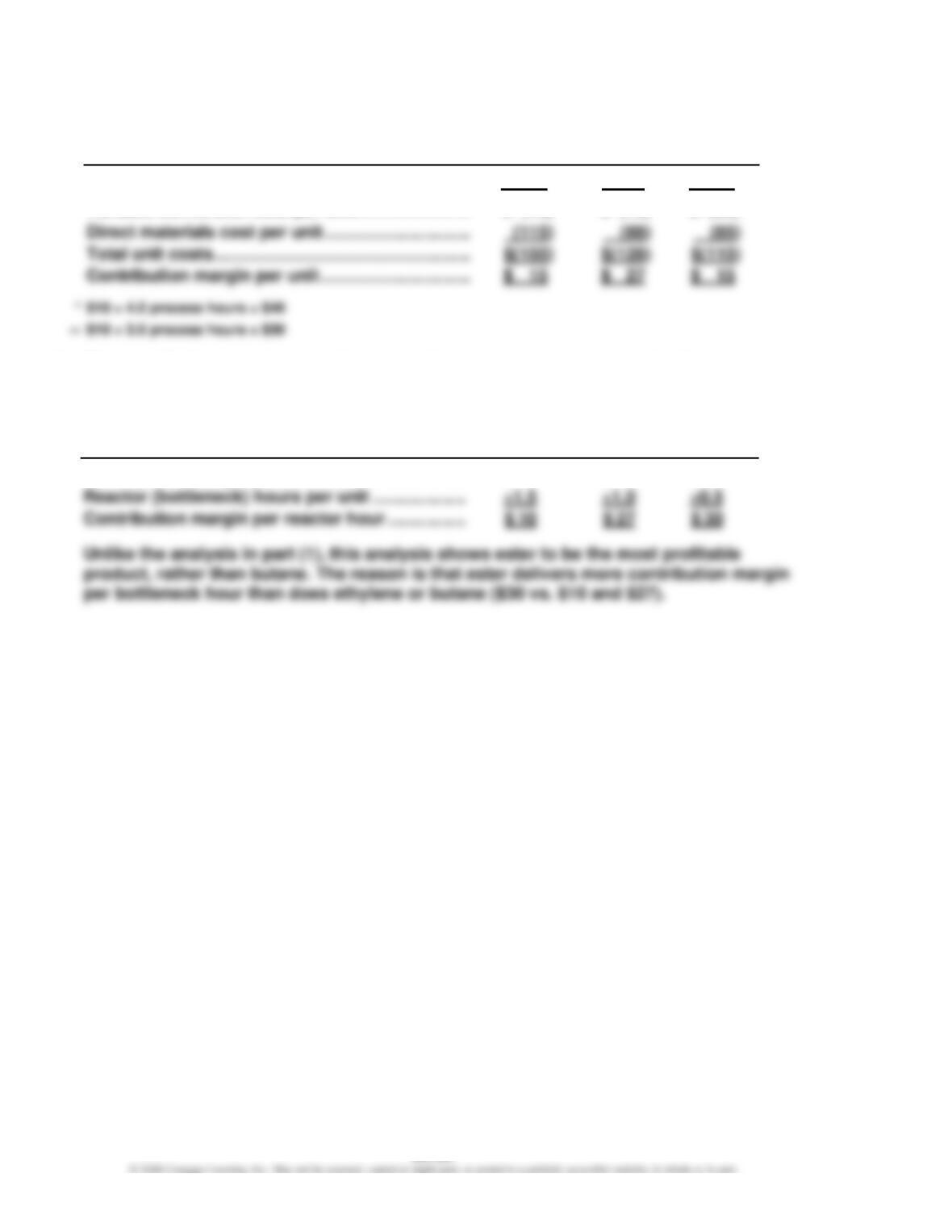
3 $105 per ton × 500 tons
4 $52,500 + ($620 per ton × 80 tons)
2. International Aluminum Co. should decide to process aluminum ingot further, rather
CHAPTER 25 (FIN MAN); CHAPTER 11 (MAN) Differential Analysis and Product Pricing
Prob. 25–5B (FIN MAN); Prob. 11–5B (MAN)
1.
Ethylene
Butane
Ester
Selling price ………………………………………………….
$ 170
$ 155
$ 130
2. The contribution margin per unit may give false signals when an organization has
production bottlenecks. Instead, Wilmington Chemical Company should use the
contribution margin per bottleneck hour to determine relative product profitability
as follows:
Ethylene
Butane
Ester
Contribution margin per unit …………………………
$ 15
$ 27
$ 15
Contribution margin per reactor hour …………….