Chapter 11 – Reporting and Interpreting Owners’ Equity
Chapter 11
Reporting and Interpreting Owners’
Equity
ANSWERS TO QUESTIONS
1. A corporation is a separate legal entity (authorized by law to operate as an individual).
It is owned by a number of persons and/or entities whose ownership is evidenced by
2. The charter of a corporation is a legal document from the state that authorizes its
3. (a) Authorized capital stock—the maximum number of shares of stock that can be
sold and issued as specified in the charter of the corporation.
4. Common stock—the usual or normal stock of the corporation. It is the voting stock
and generally ranks after the preferred stock for dividends and assets distributed
upon dissolution. Often it is called the residual equity. Common stock may be either
Chapter 11 – Reporting and Interpreting Owners’ Equity
5. Par value is a nominal per share amount established for the common stock and/or
preferred stock in the charter of the corporation, and is printed on the face of each
stock certificate. The stock that is sold by a corporation to investors above par
6. The usual characteristics of preferred stock are: (1) dividend preferences, (2)
conversion privileges, (3) asset preferences, and (4) nonvoting specifications.
7. The two basic sources of stockholders’ equity are:
(2) the amount received in excess of par or stated value.
8. Stockholders’ equity is accounted for in terms of source. This means that several
9. Treasury stock is a corporation’s own capital stock that was sold (issued) and
subsequently reacquired by the corporation. Corporations frequently purchase
10. Treasury stock is reported on the balance sheet under stockholders’ equity as a
deduction; that is, as contra stockholders’ equity. Any “gain or loss” on treasury
Chapter 11 – Reporting and Interpreting Owners’ Equity
11. The two basic requirements to support a cash dividend are: (1) cash on hand or the
ability to obtain cash sufficient to pay the dividend and (2) a sufficient balance in
12. Cumulative preferred stock has a dividend preference such that, should the
dividends on the preferred stock for any year, or series of years, not be paid,
13. A stock dividend involves the issuance to the stockholders of a dividend in the
corporation’s own stock (rather than cash). A stock dividend is significantly different
14. The primary purposes for issuing a stock dividend are: (1) to maintain dividend
consistency; that is, to pay dividends each year either in cash or in capital stock,
and (2) to capitalize retained earnings; that is, a stock dividend requires a transfer
from the Retained Earnings account to the permanent contributed capital accounts
15. When a dividend is declared and paid, the three important dates are:
Declaration date—the date on which the board of directors votes the dividend. In
the case of a cash dividend, a dividend liability comes into existence on this date
and must be recorded as a debit to Retained Earnings and as a credit to Dividends
Chapter 11 – Reporting and Interpreting Owners’ Equity
11-4
16. Retained earnings is the accumulated amount of all net income of the corporation
ANSWERS TO MULTIPLE CHOICE
Chapter 11 – Reporting and Interpreting Owners’ Equity
11-5
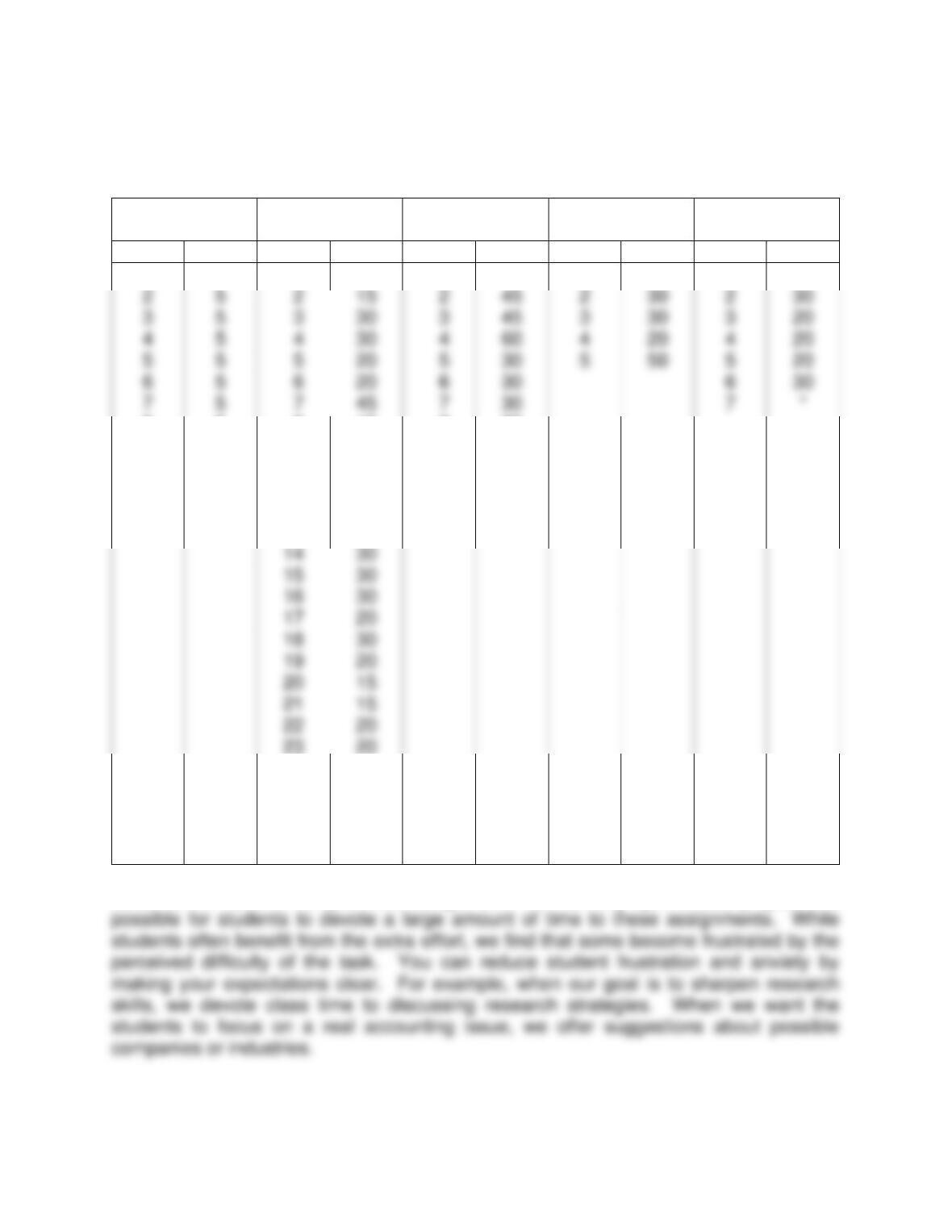
Authors’ Recommended Solution Time
(Time in minutes)
Mini exercises
Exercises
Problems
Alternate
Problems
Cases and
Projects
No.
Time
No.
Time
No.
Time
No.
Time
No.
Time
1
5
1
15
1
45
1
45
1
30
8
5
8
15
8
30
9
5
9
30
9
45
10
5
10
15
10
20
11
20
11
30
12
20
12
30
13
20
13
45
14
30
15
30
16
30
17
20
18
30
24
25
26
27
28
15
15
15
20
20
* Due to the nature of this project, it is very difficult to estimate the amount of time
students will need to complete the assignment. As with any open-ended project, it is
2
5
2
15
2
45
2
30
2
30
3
5
3
30
3
45
3
30
3
20
4
5
4
30
4
60
4
20
4
20
5
5
5
20
5
30
5
50
5
20
7
5
7
45
7
30
7
Chapter 11 – Reporting and Interpreting Owners’ Equity
MINI- EXERCISES
M11–1.
Stockholders may:
a) Vote in the stockholders’ meeting (or by proxy) on major issues concerning
management of the corporation.
M11–2.
Unissued shares = 90,000 (268,000 – 178,000)
M11–3.
Cash (170,000 $21) (+A) …………………………………………….
3,570,000
Common Stock (170,000 $1) (+SE) ………………………….
170,000
Capital in Excess of Par (+SE) …………………………..
3,400,000
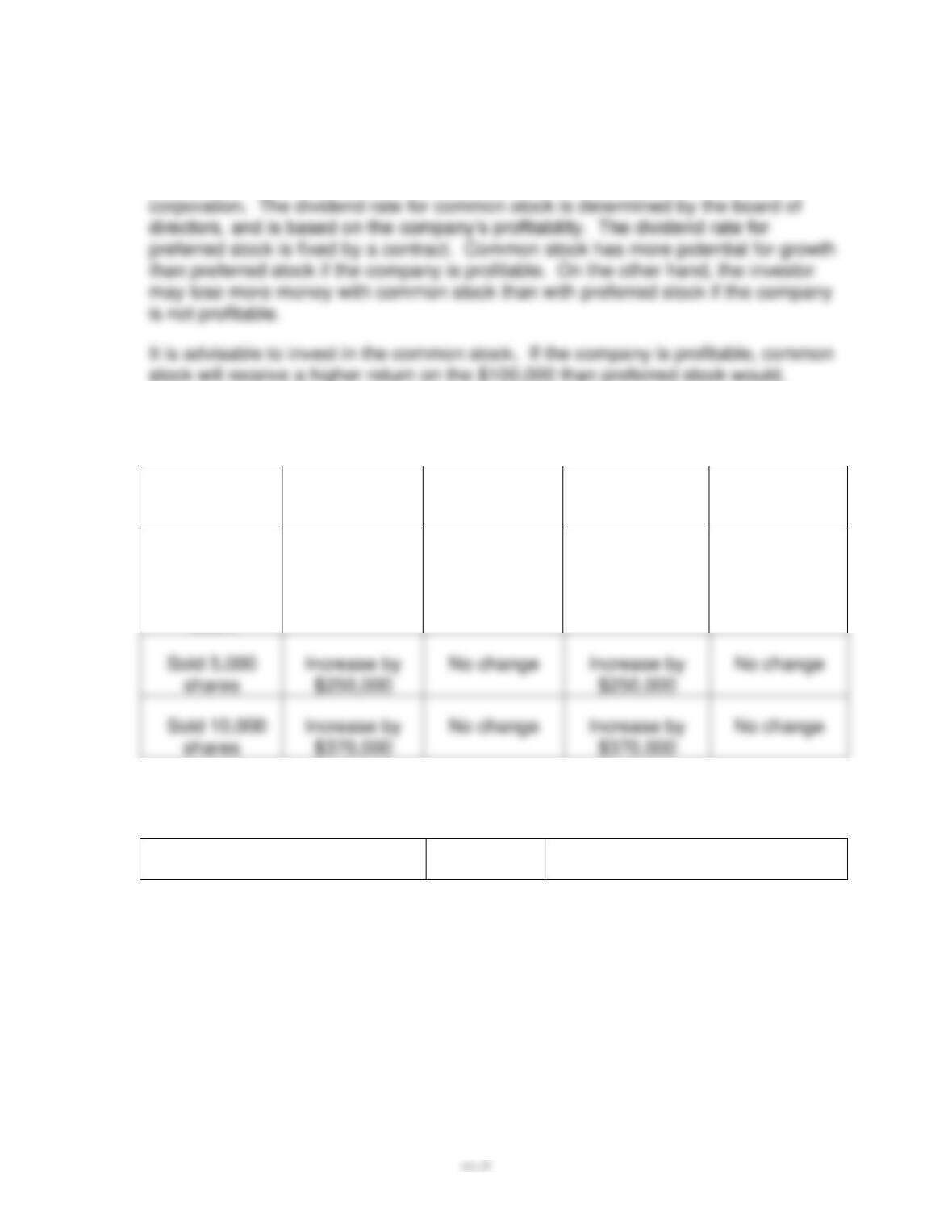
Cash (170,000 $21) (+A) …………………………………………….
Common Stock (100,000 $2) (+SE) ………………………….
340,000
Capital in Excess of Par (+SE) …………………………..
3,230,000
Chapter 11 – Reporting and Interpreting Owners’ Equity
M11–4.
Common stock is the basic voting stock issued by a corporation. It ranks after
preferred stock for dividends and assets distributed upon liquidation of the
M11–5.
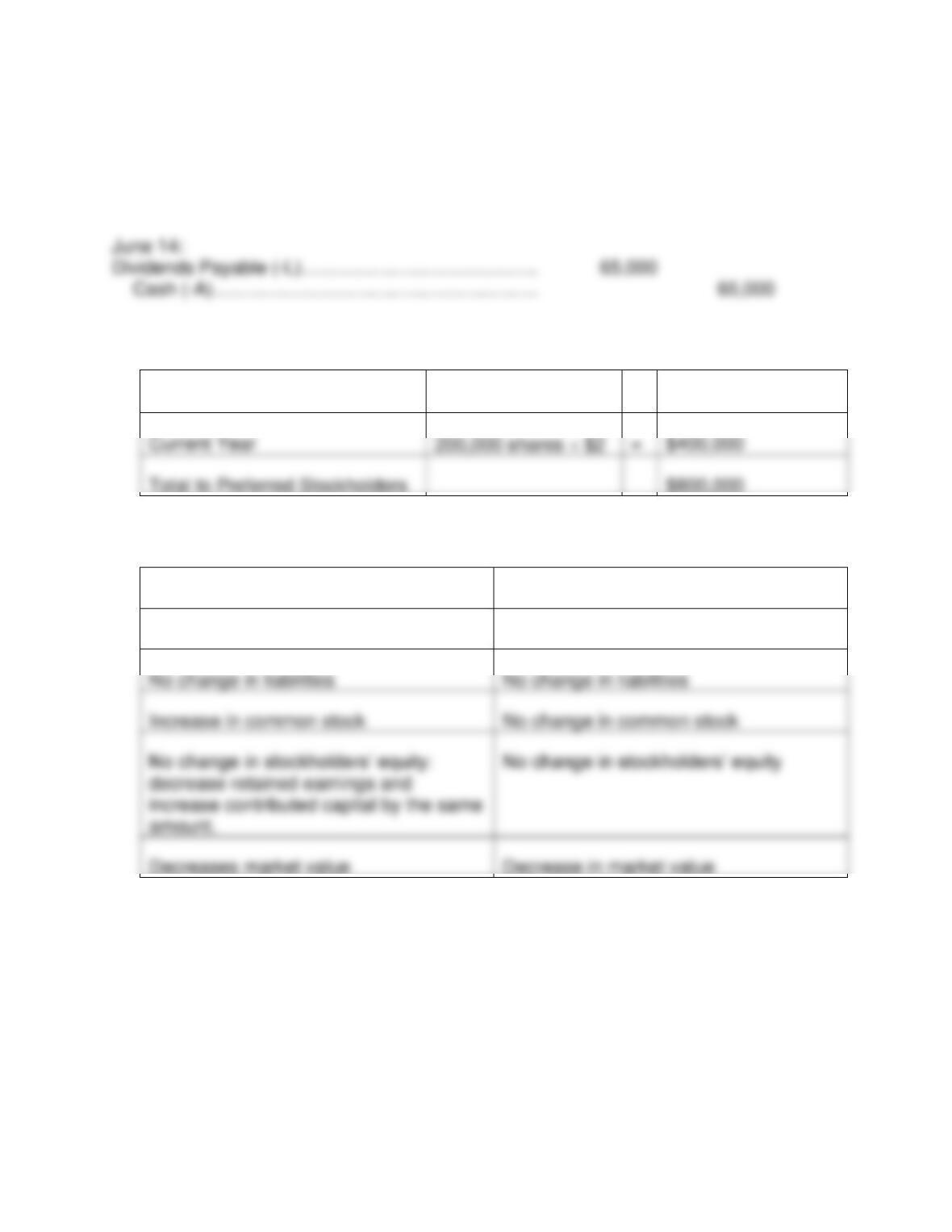
Assets
Liabilities
Stockholders’
Equity
Net Income
Purchased
20,000 shares
of treasury
stock
Decrease by
$900,000
No change
Decrease by
$900,000
No change
Increase by
Increase by
M11–6.
200,000 X $0.65
=
$130,000
Chapter 11 – Reporting and Interpreting Owners’ Equity
11-8
M11–7.
April 15:
Retained Earnings (-SE) ……………………………………………….
65,000
Dividends Payable (+L) ……………………………………………..
65,000
M11–8.
Past Year
200,000 shares $2
=
$400,000
200,000 shares $2
Total to Preferred Stockholders
$800,000
M11–9.
Stock Dividend
Stock Split
No change in assets
No change in assets
No change in liabilities
No change in liabilities
Increase in common stock
No change in common stock
amount.
Decreases market value
Decrease in market value
M11–10.
Retained Earnings (-SE) ……………………………………………….
800,000
Common Stock (+SE) ……………………………………………….
800,000
Dividends Payable (-L) ………………………………………………….
65,000
Cash (-A) ……………………………………………………….
65,000
Chapter 11 – Reporting and Interpreting Owners’ Equity
11-9
EXERCISES
E11–1.
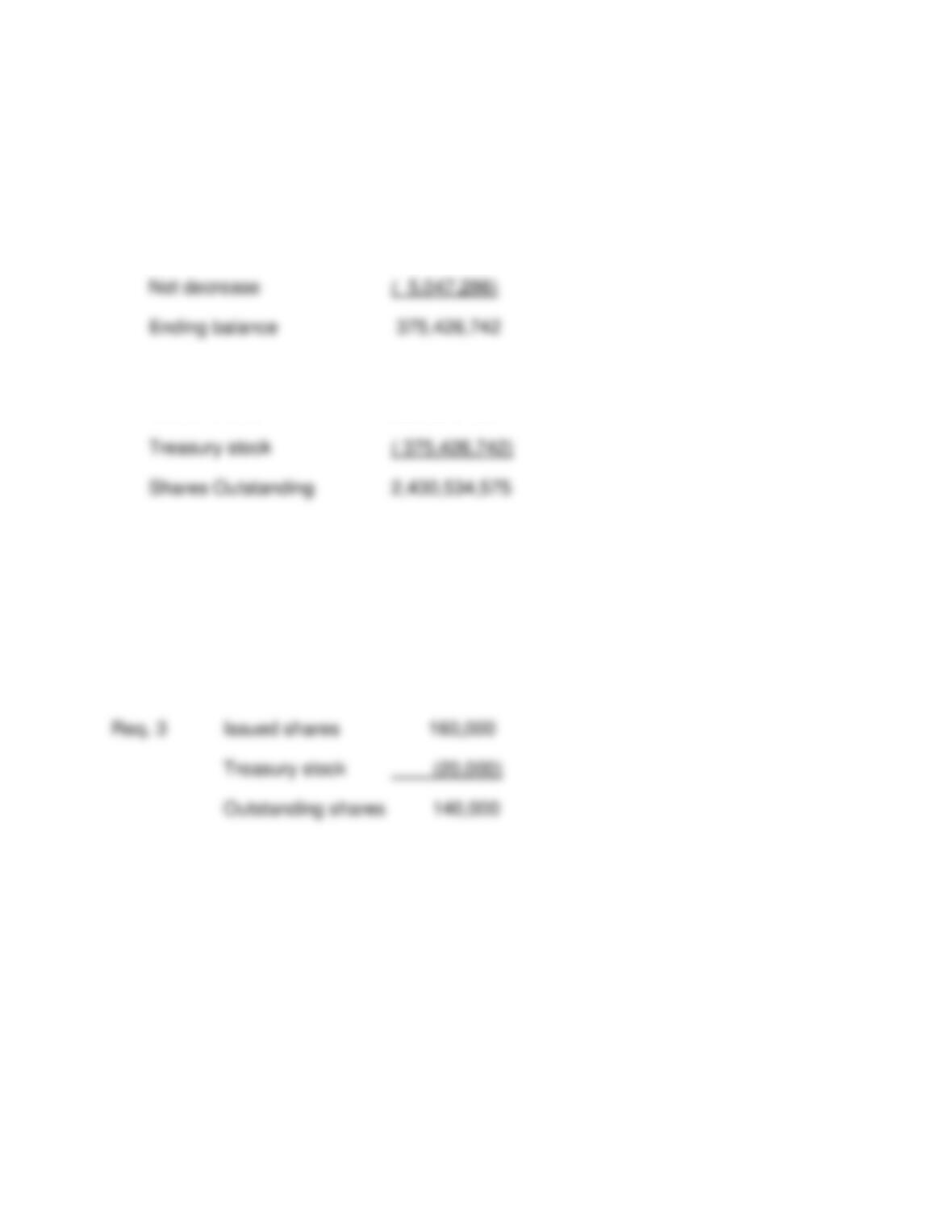
Computation of End of Year Balance for Treasury Stock:
Beginning balance 380,474,028
Computation of Shares Outstanding:
Issued shares 2,805,961,317
E11–2.
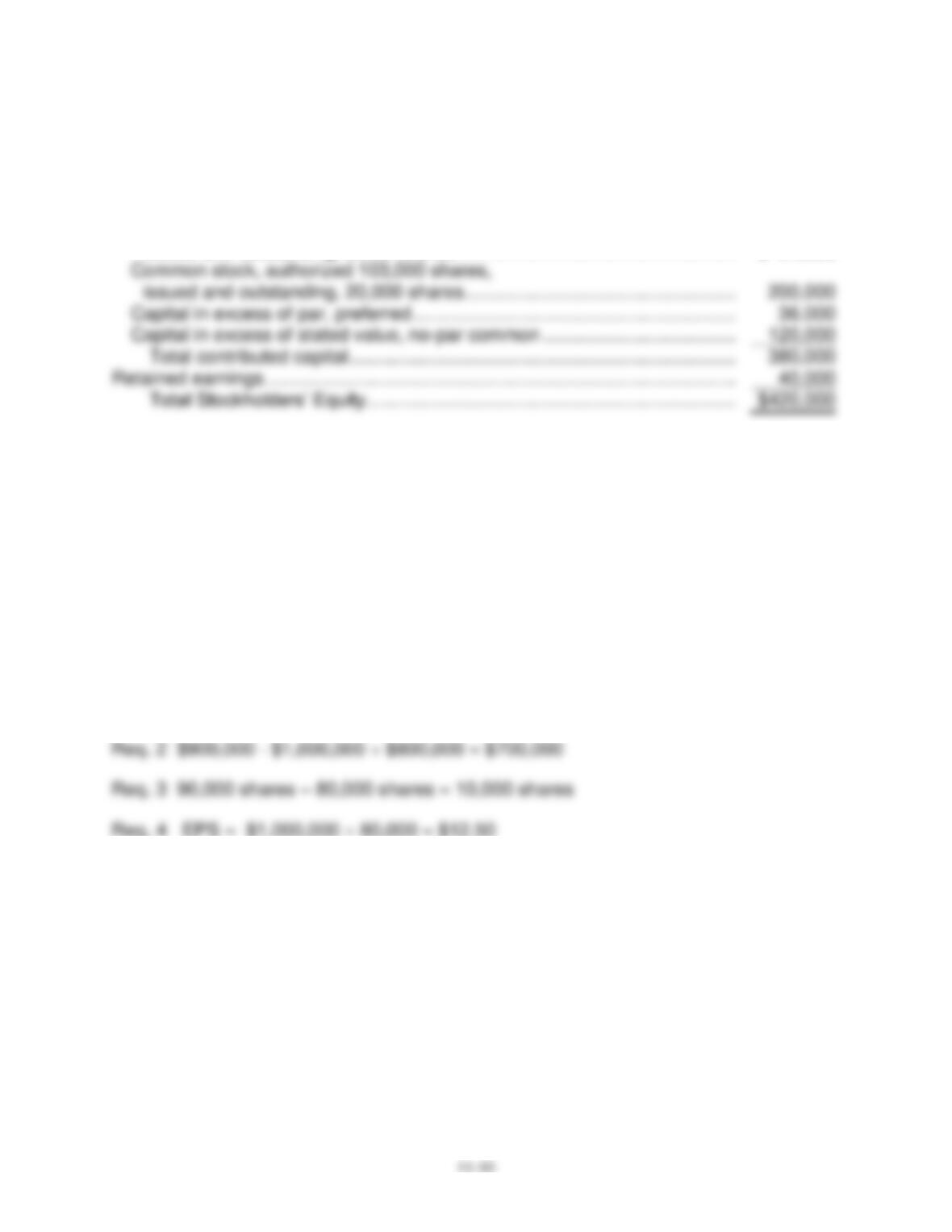
Req. 1 The number of authorized shares is specified in the corporate charter: 200,000.
Req. 2 Issued shares are the shares sold to the public: 160,000
Chapter 11 – Reporting and Interpreting Owners’ Equity
E11–3.
Req. 1
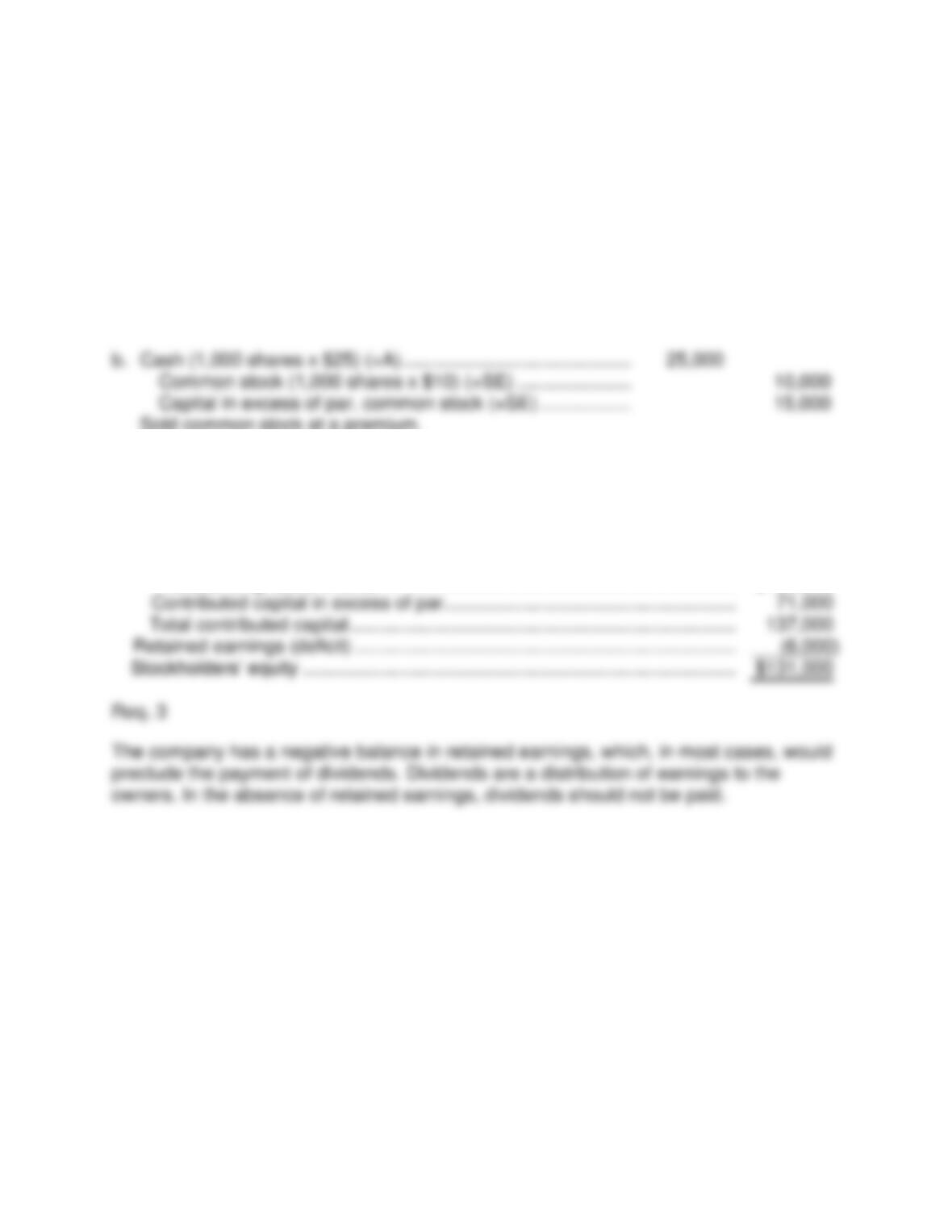
Stockholders’ Equity
Contributed capital:
Preferred stock, authorized 4,000 shares,
issued and outstanding, 3,000 shares ………………………………………………
$ 24,000
Common stock, authorized 103,000 shares,
issued and outstanding, 20,000 shares …………………………………………….
Capital in excess of par, preferred ……………………………………………………..
Capital in excess of stated value, no-par common ……………………………….
Total contributed capital ………………………………………………………………..
Retained earnings ………………………………………………………………………………
$420,000
Req. 2
The answer would depend on the profitability of the company and the stability of its
earnings. The preferred stock has a 9% dividend rate. If the company earns more than
9%, the additional earnings would accrue to the current stockholders. If the company
earns less than 9%, it would pay a higher rate to the preferred stockholders.
E11–4.
Req. 1 ($20 x 90,000 shares) – $1,600,000 = $200,000
Chapter 11 – Reporting and Interpreting Owners’ Equity
11–11
E11–5.
Req. 1
a.
Cash (5,600 shares x $20) (+A) ……………………………………..
112,000
Common stock (5,600 shares x $10) (+SE) ………………….
56,000
Capital in excess of par, common stock (+SE) ………………
56,000
Sold common stock at a premium.
Sold common stock at a premium.
Req. 2
Stockholders’ Equity
Contributed capital:
Common stock, par $10, authorized 11,500 shares,
outstanding 6,600 shares …………………………………………………………..
$ 66,000
Total contributed capital ………………………………………………………………..
Retained earnings (deficit) ……………………………………………………………….
(6,000
)
$131,000
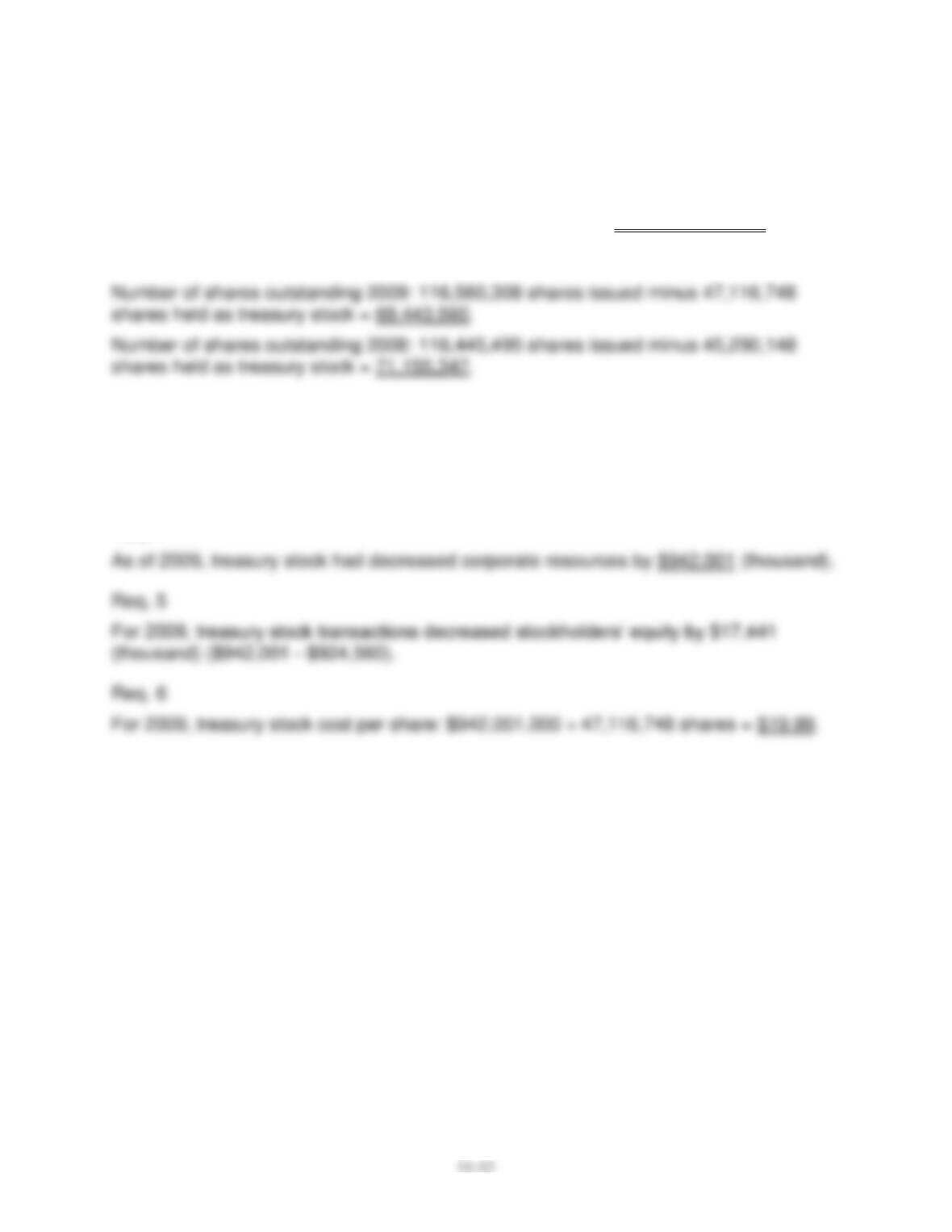
b.
Cash (1,000 shares x $25) (+A) ……………………………………..
25,000
Capital in excess of par, common stock (+SE) ………………
15,000
Chapter 11 – Reporting and Interpreting Owners’ Equity
E11–6.
Req. 1
Common stock, class A at par value: 116,560,308 X $0.01 = $1,166 (thousand)
Req. 2
Req. 3
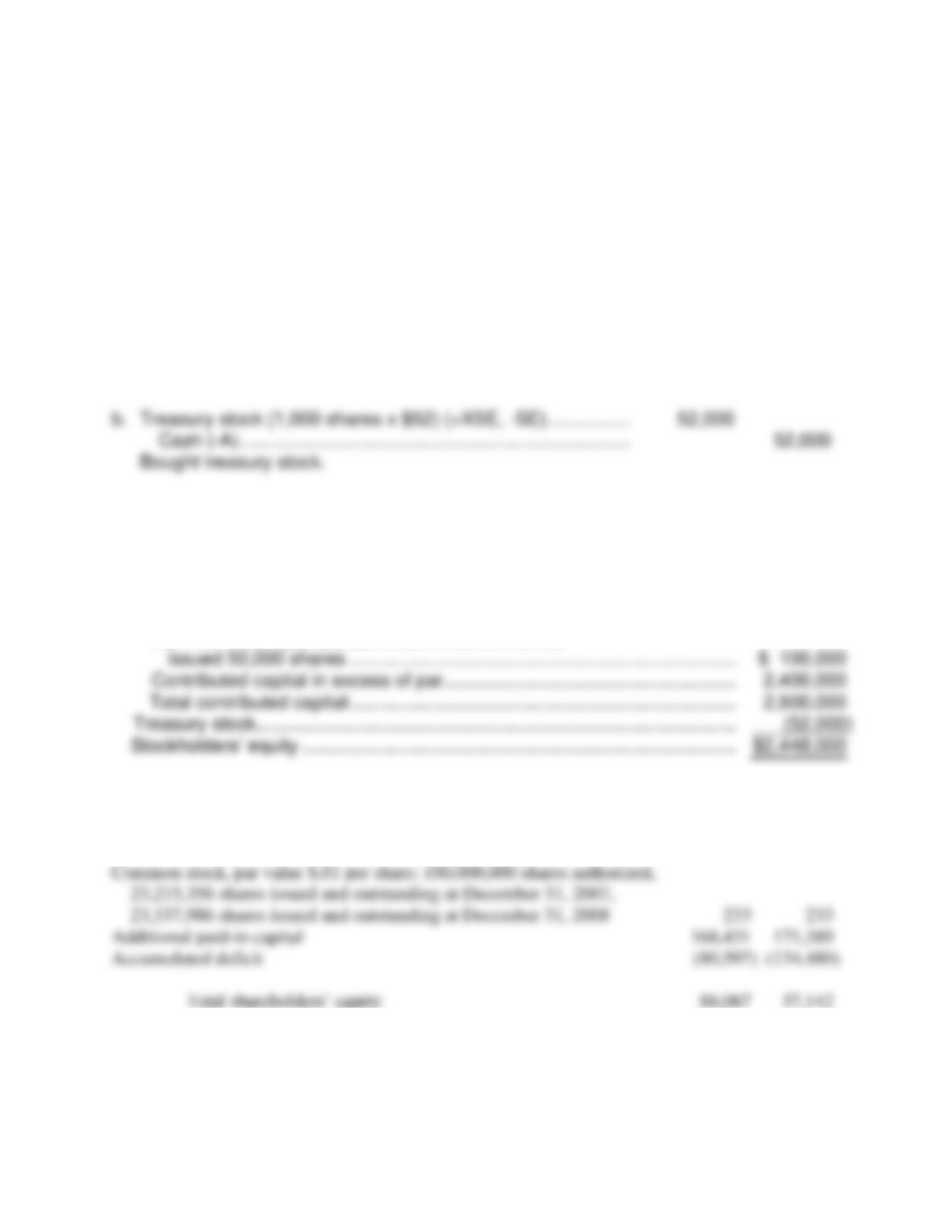
(In thousands) Retained earnings for 2008: $2,427,727 plus net loss for 2009 $241,065
plus dividends for 2009 $11,898 = $2,680,690
Req. 4
Chapter 11 – Reporting and Interpreting Owners’ Equity
11–13
E11–7.
Req. 1
a.
Cash (50,000 shares x $50) (+A) ……………………………………
2,500,000
Common stock (50,000 shares x $2) (+SE) ………………….
100,000
Capital in excess of par, common stock (+SE) ………………
2,400,000
Sold common stock at a premium.
Req. 2
Stockholders’ Equity
Contributed capital:
2,400,000
Total contributed capital ………………………………………………………………..
2,500,000
)
Common stock, par $2, authorized 80,000 shares,
E11–8.
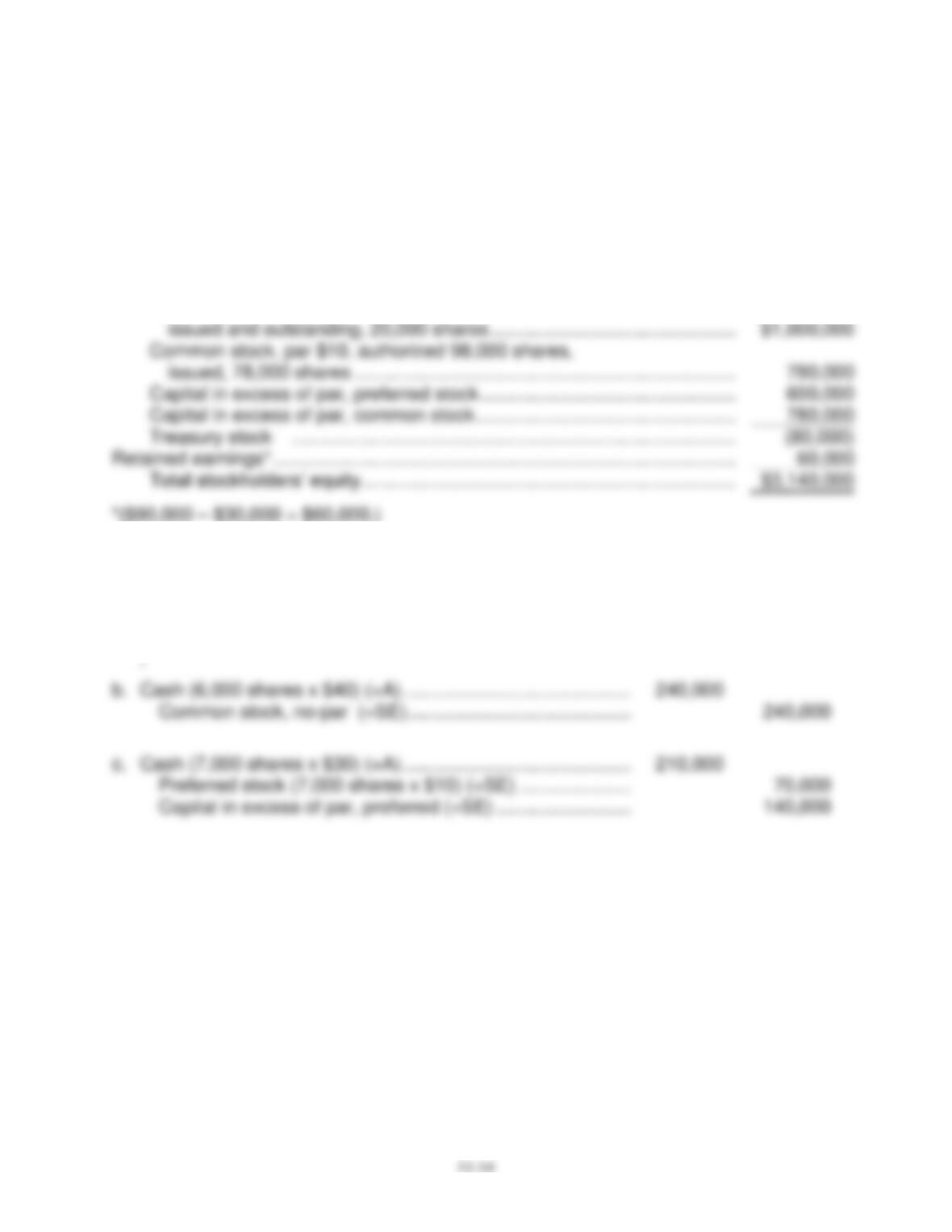
Shareholders’ equity (deficit) in thousands:
2007
2008
Additional paid-in capital
168,431
Accumulated deficit
)
(134,480
)
b.
Treasury stock (1,000 shares x $52) (+XSE, –SE) …………….
Cash (-A) …………………………………………………………………
Bought treasury stock.
Chapter 11 – Reporting and Interpreting Owners’ Equity
E11–9.
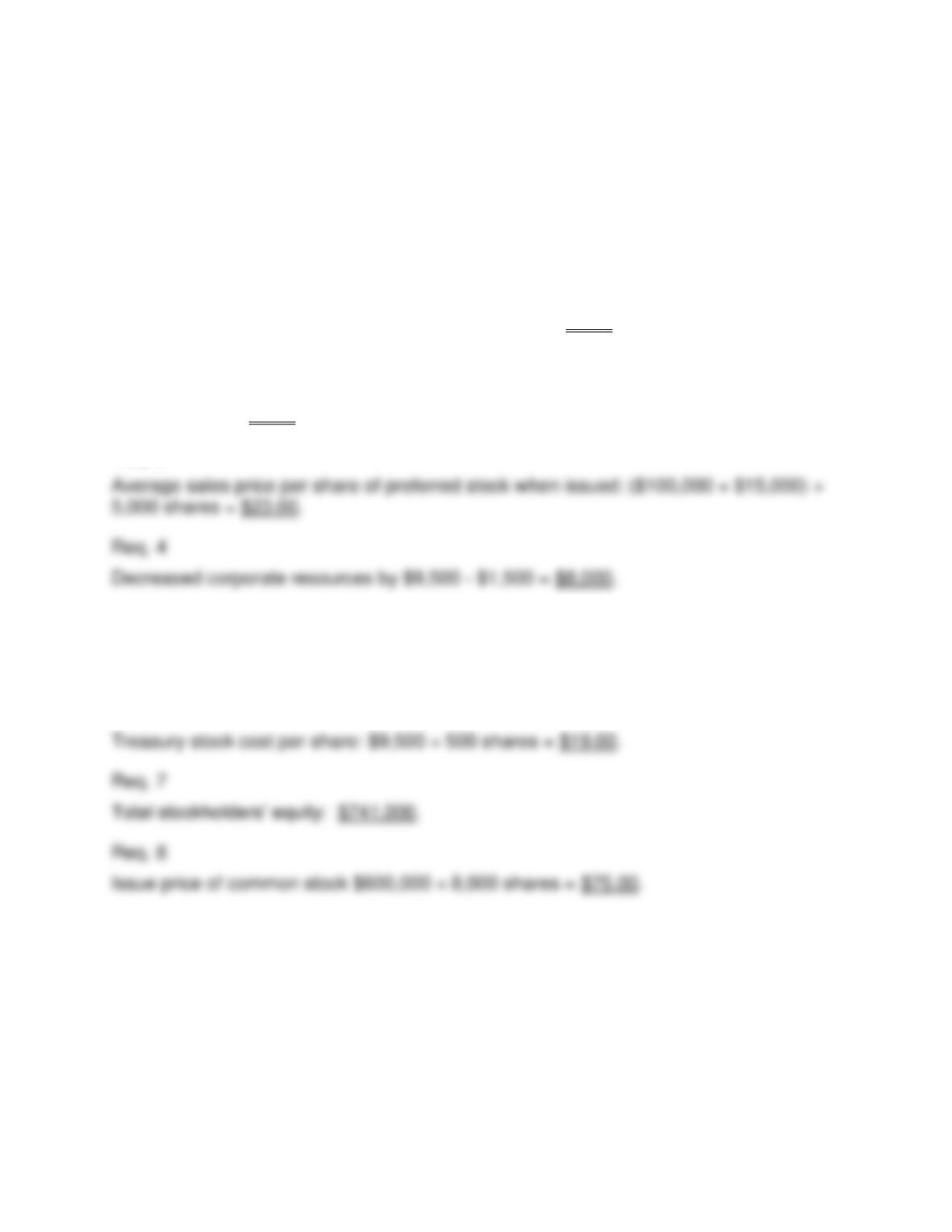
Stockholders’ Equity
Contributed capital:
issued and outstanding, 20,000 shares ………………………………………..
Common stock, par $10, authorized 98,000 shares,
issued, 78,000 shares ……………………………………………………………….
Capital in excess of par, preferred stock …………………………..……………..
Capital in excess of par, common stock …………………………………………..
Treasury stock ………………………………………………………………………….
Retained earnings* ……………………………………………………………………………..
Preferred stock, 8%, par $50, authorized 59,000 shares,
E11–10.
Req. 1
a.
Cash (20,000 shares x $20) (+A) ……………………………………
400,000
Common stock, no-par (+SE) ……………………………………..
400,000
b.
Cash (6,000 shares x $40) (+A) ……………………………………..
240,000
Common stock, no-par (+SE) …………………………………….
240,000
c.
Cash (7,000 shares x $30) (+A) ……………………………………..
210,000
Preferred stock (7,000 shares x $10) (+SE) ………………….
Capital in excess of par, preferred (+SE) ……………………..
140,000
Req. 2
Yes, it is ethical as long as there is a full disclosure of relevant information. In any arm’s
length transaction, an informed buyer will pay the market value of the stock.
Chapter 11 – Reporting and Interpreting Owners’ Equity
11–15
E11–11.
Req. 1
Number of preferred shares issued: $100,000 $20 = 5,000
Req. 2
Number of preferred shares outstanding: 5,000 shares issued minus 500 shares held as
treasury stock = 4,500.
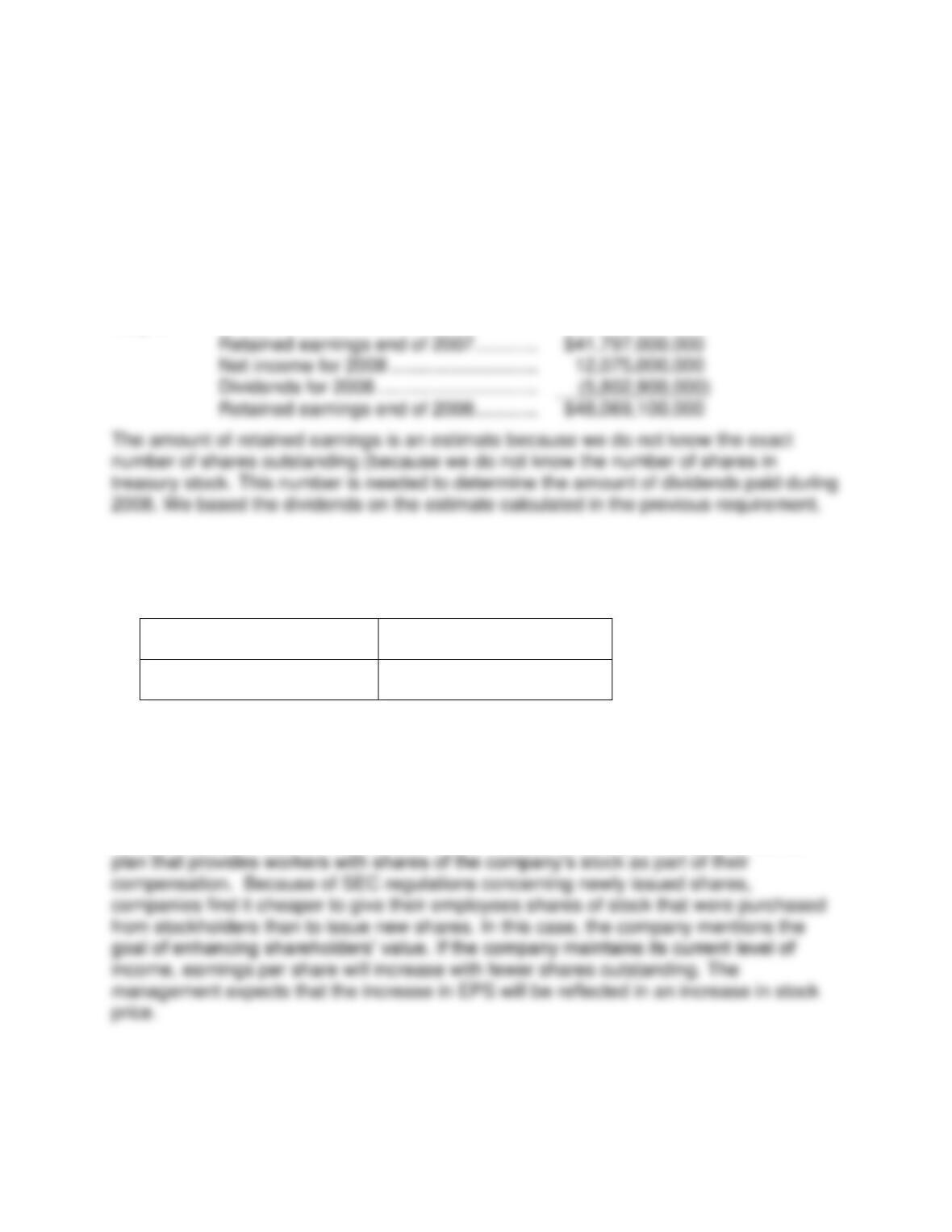
Req. 3
Req. 5
Treasury stock transactions decreased stockholders’ equity by $8,000 (same as the
decrease in corporate resources in 4 above).
Req. 6
Chapter 11 – Reporting and Interpreting Owners’ Equity
11–16
E11–12.
Req. 1
The number of shares that have been issued is computed by dividing the common stock
account ($4,002 million) by the par value of the shares ($1 per share) or approximately
4,002,000,000 shares.
Req. 2
E11–13.
Req. 1
Assets
– $133,750,000
Stockholders’ Equity
– $133,750,000
The treasury stock account is a contra equity account, meaning that it subtracts
from the total stockholders’ equity. Cash also decreases on the balance sheet by
the same amount.
Req. 2
Many companies repurchase common stock in order to develop an employee bonus
Req. 3
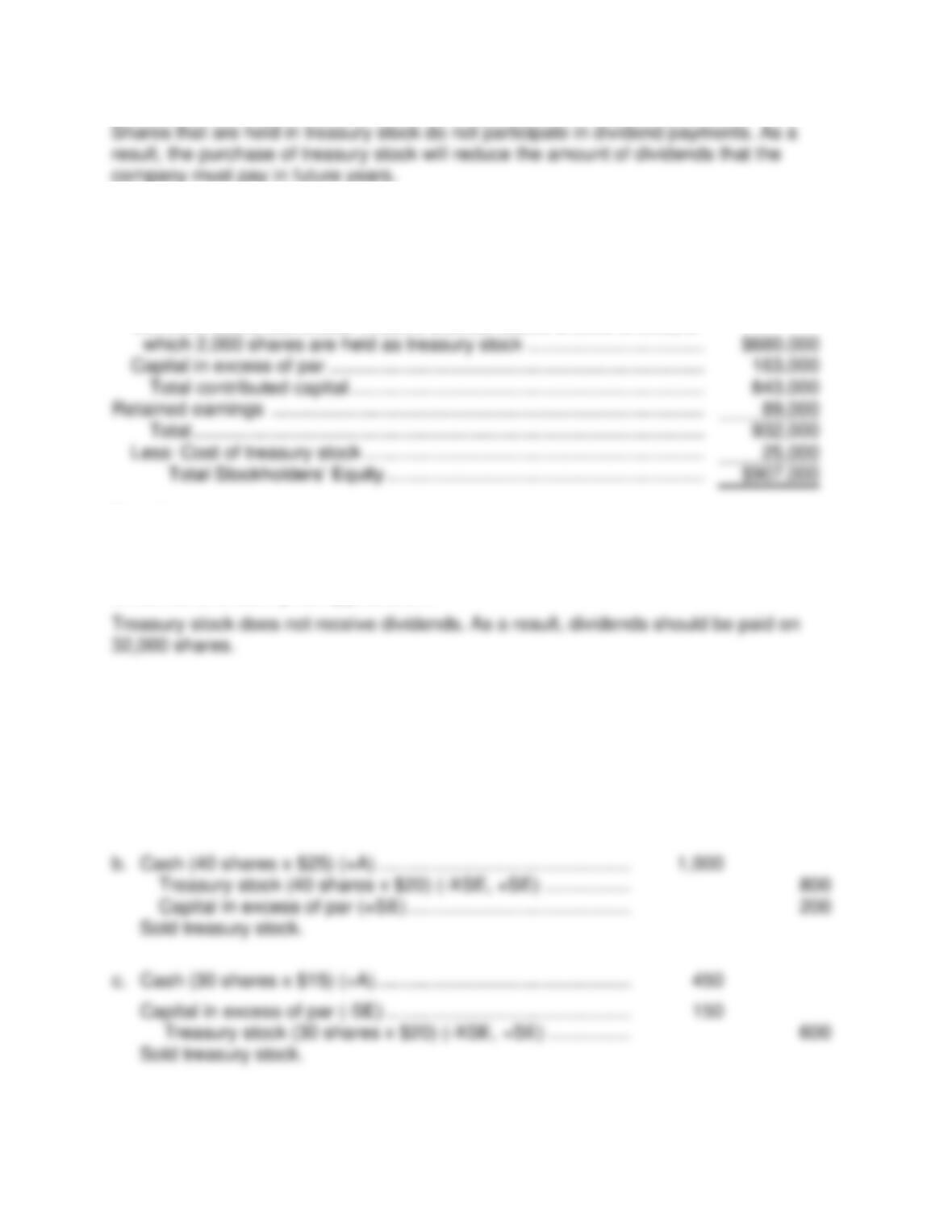
Chapter 11 – Reporting and Interpreting Owners’ Equity
11–17
E11–14.
Req. 1
Stockholders’ Equity
Contributed capital:
Capital in excess of par ………………………………………………………………
Total contributed capital …………………………………………………………..
Retained earnings ………………………………………………………………………..
Total ……………………………………………………………………………………..
Less: Cost of treasury stock …………………………..…………………………...
Common stock, authorized 100,000 shares, issued 34,000 shares, of
Req. 2
The dividend yield ratio is 2.24% ([$16,000 32,000 shares] $22.29). While this yield
seems small, it is a typical return on common stock. Investors receive a return from both
dividends and stock price appreciation.
E11–15.
Req. 1
a.
Treasury stock (200 shares x $20) (+XSE, -SE) ……………….
4,000
Cash (-A) …………………………………………………………………
4,000
Bought treasury stock.
b.
Cash (40 shares x $25) (+A) ………………………………………….
1,000
Treasury stock (40 shares x $20) (-XSE, +SE) ……………..
Capital in excess of par (+SE) …………………………………….
Sold treasury stock.
c.
Cash (30 shares x $15) (+A) ………………………………………….
Capital in excess of par (-SE) ………………………………………..
Treasury stock (30 shares x $20) (-XSE, +SE) …………….
Sold treasury stock.
Req. 2
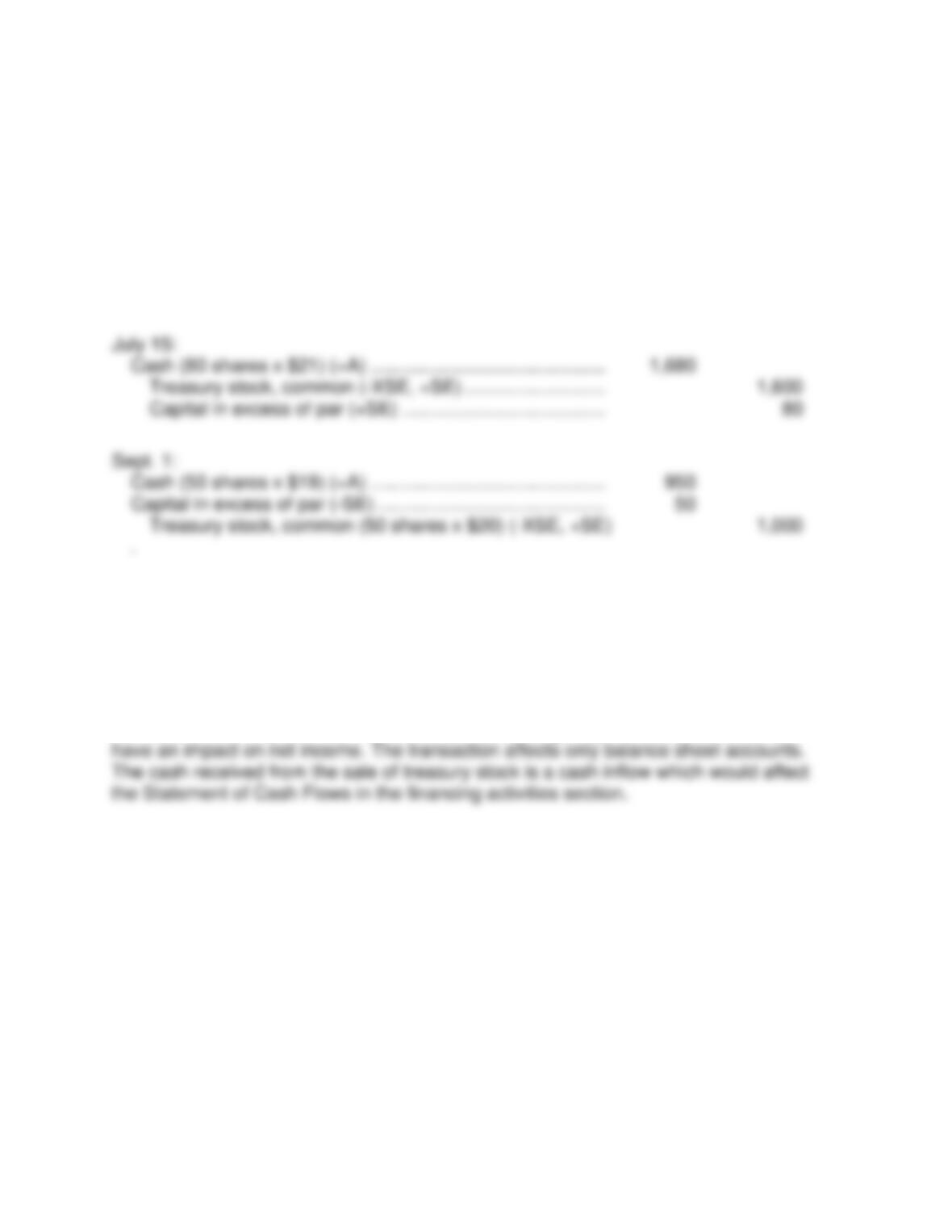
Chapter 11 – Reporting and Interpreting Owners’ Equity
11–18
It is not possible to make a “profit” or “loss” on treasury stock transactions. Therefore,
these transactions do not affect the income statement.
E11–16.
Req. 1
Feb. 1:
Treasury stock, common (160 shares x $20) (+XSE, –SE)
3,200
Cash (-A) ………………………………………………………………
3,200
Req. 2
Dividends are not paid on treasury stock. Therefore, the amount of total cash dividends
paid is reduced when treasury stock is purchased.
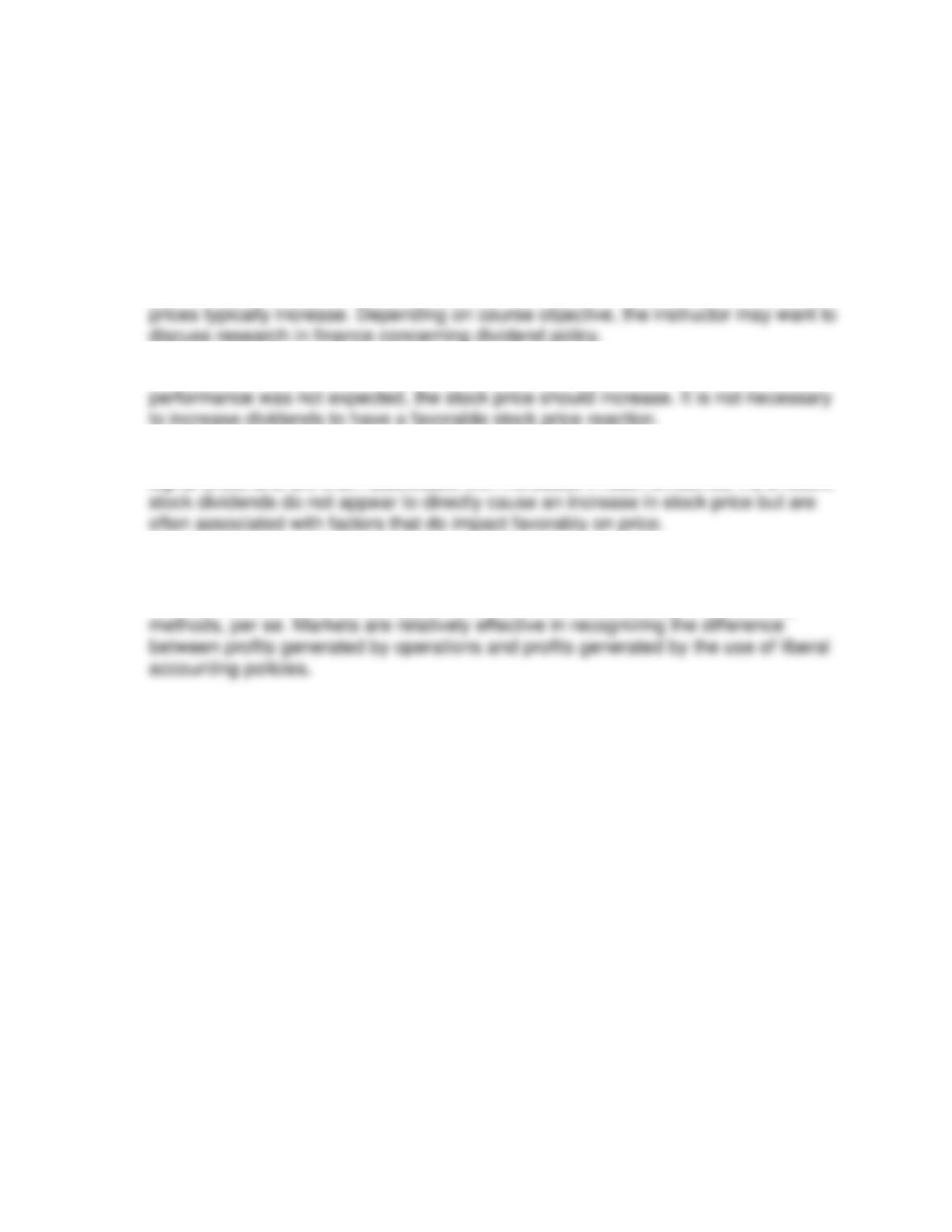
Req. 3
The sale of treasury stock for more or less than its original purchase price does not
July 15:
Cash (80 shares x $21) (+A) ………………………………………
1,680
Treasury stock, common (-XSE, +SE) ………………………
1,600
Capital in excess of par (+SE) …………………………………
Sept. 1:
Cash (50 shares x $19) (+A) ………………………………………
Capital in excess of par (-SE) ……………………………………..
Treasury stock, common (50 shares x $20) (-XSE, +SE)
1,000
.
Chapter 11 – Reporting and Interpreting Owners’ Equity
11–19
E11–17.
Req. 1
Case 1: When companies unexpectedly announce increases in dividends, stock
Case 2: Stock price is based on expectations. If the increase in operating
Case 3: Stock dividends do not provide any economic value but they may have a
signal effect and are often associated with increases in cash dividends. As a result,
Req. 2
Stock prices react to underlying economic events and not changes in reporting
Chapter 11 – Reporting and Interpreting Owners’ Equity
E11–18.
Req. 1
Preferred
(5,000
Shares)
Common
(30,000
Shares)
Total
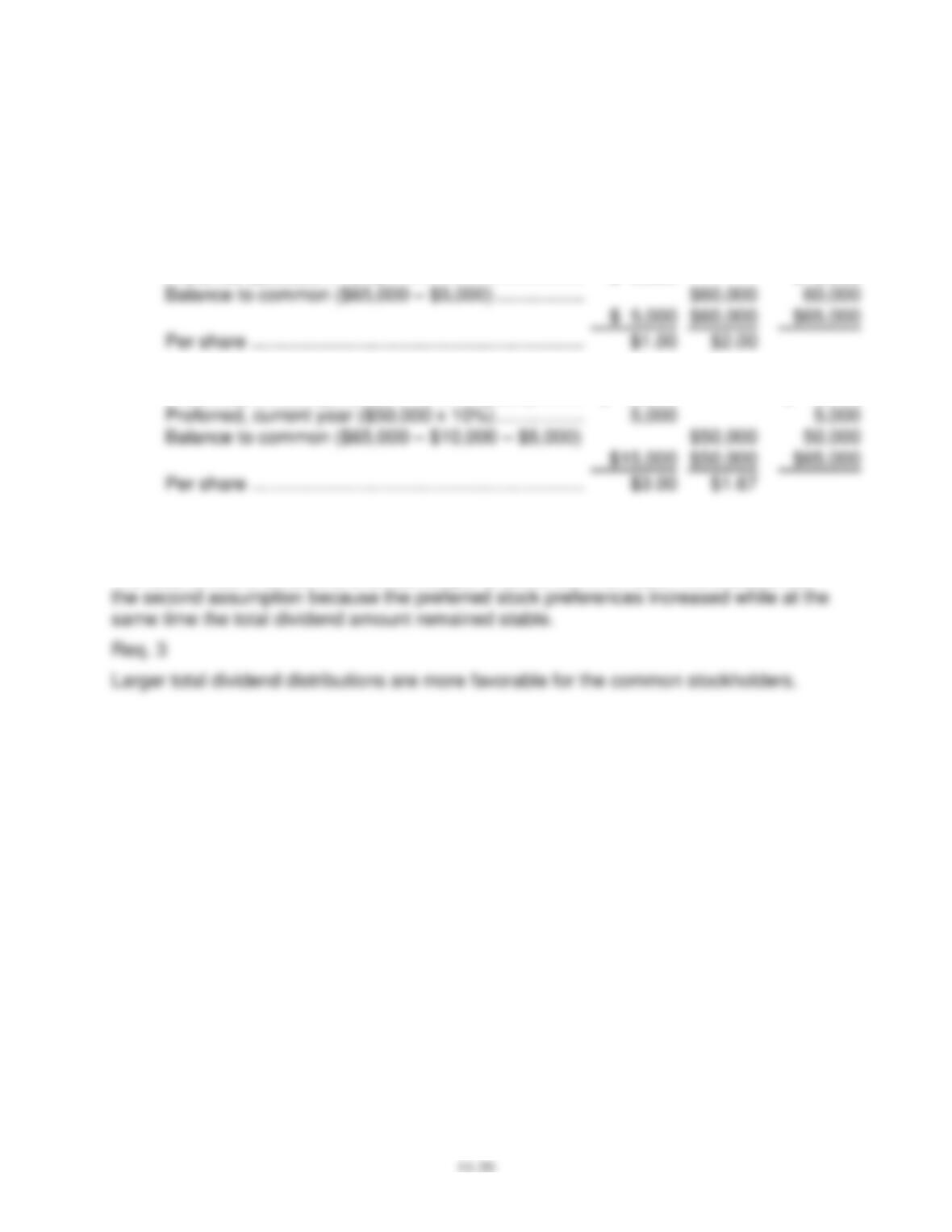
a)
Noncumulative:
Preferred ($50,000 x 10%) ………………………………..
$ 5,000
$ 5,000
$ 5,000
Per share ……………………………………………………….
b)
Cumulative:
Preferred, arrears ($50,000 x 10% x 2 years) ………
$ 10,000
$ 10,000
Preferred, current year ($50,000 x 10%) ……………..
$15,000
Per share ……………………………………………………….
Req. 2
The total dividend amount and dividends per share of common stock were less under