John J. Wild, Financial Accounting: Information for Decisions, 8th Edition
11-1
CHAPTER 11
REPORTING AND ANALYZING EQUITY
Related Assignment Materials
Student Learning Objectives
Questions
Quick
Studies*
Exercises*
Problems*
Beyond the
Numbers
Conceptual objectives:
C1. Identify characteristics of
corporations and their
organization.
1, 2, 3, 4
11-1
11-1
11-5
C2. Explain characteristics of, and
distribute dividends between
common and preferred stock.
5, 6, 7,8, 9,
20, 21, 22
11-9, 11-10
11-7, 11-8,
11-9
11-1, 11-5,
SP 11
11-1, 11-7
11-18
SP 11,
GL 11-1,
GL11-2
11-9
Analytical objectives:
A1 Compute earnings per share
and describe its use.
17
11-14, 11-15
11-12, 11-13
11-1, 11-2,
11-4, 11-8,
11-9
and describe its use in analysis.
11-8
A3. Compute dividend yield and
explain its use in analysis.
11-17
11-15
11-2, 11-8
explain its use in analysis.
19
11-18
11-16
11-5
11-1, 11-2
A2. Compute price-earnings ratio
11-16
11-14
11-2, 11-4,
Procedural objectives:
P1. Record the issuance of
corporate stock.
11-2, 11-3,
11-4, 11-5,
11-19
11-2, 11-3,
11-4, 11-17
11-1, SP 11
P2. Record transactions
involving cash dividends, stock
dividends and stock splits.
10, 11, 12,
13, 14, 18
11-6, 11-7,
11-8, 11-12
11-5, 11-6,
11-18
11-2, 11-3,
11-4,
GL11-1,
GL11-2
11-7
of treasury stock and the
retirement of stock.
15, 16, 23
11-11, 11-12
11-10, 11-18
11-2, 11-4,
GL 11-1,
11-6
John J. Wild, Financial Accounting: Information for Decisions, 8th Edition
11-2
Additional Information on Related Assignment Material
Connect
Available on the instructor’s course-specific website) repeats all numerical Quick Studies, all Exercises and
Problems Set A. Connect also provides algorithmic versions for Quick Study, Exercises and Problems. It allows
instructors to monitor, promote, and assess student learning. It can be used in practice, homework, or exam mode.
The Serial Problem for Success Systems continues in this chapter.
General Ledger
Assignable within Connect, General Ledger (GL) problems offer students the ability to see how transactions post
from the general journal all the way through the financial statements. Critical thinking and analysis components are
added to each GL problem to ensure understanding of the entire process. GL problems are auto-graded and provide
instant feedback to the student.
Excel Simulations
Assignable within Connect, Excel Simulations allow students to practice their Excel skills—such as basic formulas
Synopsis of Chapter Revisions
• NEW opener—Alibaba
• Updated dividend tax rates.
John J. Wild, Financial Accounting: Information for Decisions, 8th Edition
11-3
Chapter Outline
Notes
I. Corporate Form of Organization—An entity created by law that is
separate from its owners. Owners are called stockholders. A publicly
held corporation offers its stock for public sale (organized stock
market) whereas a privately held (closely held) corporation does not.
A. Characteristics of a Corporation—Advantages
have the power to bind the corporation to contracts.
1. Separate legal entity—a corporation, through its agents
(officers and managers), may conduct business affairs with the
same rights, duties, and responsibilities of a person.
B. Characteristics of a Corporation—Disadvantages
1. Governmental regulation—must meet requirements of a state’s
incorporation laws.
C. Corporate Organization and Management
1. Incorporation—A corporation is created by obtaining a charter
from a state government. A charter application, signed by
3. Management of a Corporation
a. Stockholders have ultimate control through vote to elect
board of directors.
John J. Wild, Financial Accounting: Information for Decisions, 8th Edition
11-4
Chapter Outline
Notes
c. Executive officers (appointed by the BOD) manage the
D. Stockholders of Corporations
1. Rights of Stockholders—Specific rights are granted by the
charter and general rights by state laws. State laws vary but
common stockholders general rights usually include right to:
paid when and if in liquidation.
a. Vote at stockholders’ meeting.
b. Sell or otherwise dispose of their stock.
2. Stock Certificates and Transfer
a. Stock certificate is sometimes received as proof of share
ownership.
b. Certificates show the company name, stockholder name,
number of shares and other crucial information.
c. Issuances of stock certificates is becoming less common.
3. Registrar and Transfer Agents—if stock is traded on a major
E. Basics of Capital Stock—shares issued to obtain capital (owner
financing).
1. Authorized stock—the total amount of stock that the charter
authorizes for sale.
2. Issuing stock—can be sold directly/indirectly to stockholders.
John J. Wild, Financial Accounting: Information for Decisions, 8th Edition
11-5
Chapter Outline
Notes
3. Market value of stock—the price at which a stock is bought
and sold.
4. Classes of stock
5. Par value stock—a class of stock that is assigned a value per
share by the corporation in its charter.
b. In many states, used to establish minimum legal capital.
7. Stated value stock—no–par stock that is assigned a “stated”
legal capital.
8. Stockholders’ (Shareholders’) Equity—has two parts:
a. Paid-in capital (contributed capital)—the total amount of
II. Common Stock—Issuance of stock affects only paid-in capital
accounts, not retained earnings accounts.
A. Issuing Par Value Stock
1. At par for cash—debit Cash for # shares issued x market price
and credit Common Stock for # shares issued x par value
2. Issuing par value stock at a premium. (Premium on stock is an
amount paid in excess of par by the purchasers of newly
John J. Wild, Financial Accounting: Information for Decisions, 8th Edition
11-6
Chapter Outline
Notes
3. Issuing par value stock at a discount— Discount occurs when
a corporation sells its stock for less than its par value
(prohibited by most states).
a. Debit Cash (# shares issued x market price).
account. If stock is issued at an amount in excess of stated value,
this excess is credited to Paid-In Capital in Excess of Stated Value,
B. Issuing No Par Value Stock
When no-par stock is not assigned a stated value, the entire
C. Issuing Stated Value Stock
Stated value becomes legal capital and is credited to a no-par stock
D. Issuing Stock for Noncash Assets
1. Issuing par value stock for other assets
a. Record the transaction at the market value of the noncash
2. Issuing par value stock for organizational costs—stock is
issued in exchange for services (from promoters, lawyers,
accountants) in organizing the corporation
III. Dividends
A. Cash Dividends—decision to pay these dividends rest with board
of directors and is based on evaluating the amounts of retained
earning and cash as well as many other factors.
1. Accounting for cash dividends involves three important dates.
John J. Wild, Financial Accounting: Information for Decisions, 8th Edition
11-7
Chapter Outline
Notes
2. Cash Dividend Entries—reduce in equal amounts both cash
and the retained earnings component of stockholders’ equity.
a. At declaration—Debit Retained Earnings and credit
3. Deficit and Cash Dividends—a debit (abnormal) balance in
retained earnings is called a deficit
a. Arises when cumulative losses and/or dividends are
greater than total profits earned in prior years.
B. Stock Dividends—Distribution of additional shares of stock to
stockholders without receipt of any payment in return. They do not
reduce assets or total equity, just the components of equity.
1. Reasons for a stock dividend
2. Accounting for stock dividends—transfers a portion of equity
from retained earnings to contributed capital (called
capitalizing retained earnings)
a. Small stock dividend is 25% or less of the issuing
corporation’s previously outstanding shares; the market
John J. Wild, Financial Accounting: Information for Decisions, 8th Edition
11-8
Chapter Outline
Notes
C. Stock Splits
The distribution of additional shares of stock to stockholders
according to their percent of ownership. Involves “calling in” the
outstanding shares of stock and replacing them with a larger
number of shares that have a lower par value.
1. Reason for stock splits is similar to those for stock dividends..
IV. Preferred Stock—Has special rights that give it priority over common
stock in one or more areas such as preference for receiving dividends
and for the distribution of assets if the corporation is liquidated.
Usually does not have right to vote.
A. Issuance of Preferred Stock
Usually has a par value; can be sold at a price different from par.
B. Dividend Preference of Preferred Stock
Preferred stockholders are allocated their dividends before any
dividends are allocated to common stockholders. The dividends
allocated per share is usually expressed as a set dollar amount per
share or a percent applied to the par value.
1. Cumulative or Noncumulative Dividend
a. Cumulative preferred stock has a right to be paid both
current and all prior periods‘ unpaid dividends before any
John J. Wild, Financial Accounting: Information for Decisions, 8th Edition
11-9
Chapter Outline
Notes
2. Participating or Nonparticipating Dividend
a. Nonparticipating—dividends are limited each year to a
maximum amount determined by applying the preferred
C. Convertible Preferred Stock
1. Gives holders the option of exchanging their preferred shares
D. Callable Preferred Stock
1. Gives the issuing corporation the right to purchase (retire) this
stock from its holders at specified future prices and dates.
3. Dividends in arrears must be paid when stock is called.
E. Reasons for Issuing Preferred Stock
1. To raise capital without sacrificing control of the corporation.
V. Treasury Stock—A corporation acquires their own shares for several
reasons such as to acquire another company, or to avoid a hostile
takeover, or to use for employee compensation, or to maintain a strong
market for their stock.
A. Purchasing Treasury Stock—Cost Method
1. Reduces the corporation’s assets and stockholders’ equity by
equal amounts.
John J. Wild, Financial Accounting: Information for Decisions, 8th Edition
11–10
Chapter Outline
Notes
B. Reissuing Treasury Stock
account. The paid-in Capital, Treasury Stock account can
4. A company ever reports a loss or gain from the sale of
1. Sale at cost—Treasury stock is reduced (credited) for the cost
of the reissued shares and Cash is debited for the amount
received.
3. Sale below cost—entry depends on whether the Paid-in
Capital, Treasury Stock account has a balance. If it has no
C. Retiring Stock—results in a reduction in assets and equity equal to
the amount paid for the retired stock. Reduces the number of
issued shares.
1. When stock is purchased for retirement, all capital amounts
VI. Reporting of Equity
A. Statement of Retained Earnings—Retained Earnings is total
cumulative amount of reported net income less any net losses and
dividends declared since the company’s inception. It is part of
stockholders’ equity (claim to the assets) and is not implying that
any certain amount of cash or other assets actually exists.
1. Restrictions and Appropriations
a. Restricted retained earnings refers to both statutory and
John J. Wild, Financial Accounting: Information for Decisions, 8th Edition
11–11
Chapter Outline
Notes
2. Prior Period Adjustments
a. Corrections of material errors made in prior periods.
2. Closing Process
a. Close credit balances in revenue accounts to Income
B. Statement of Stockholders’ Equity
1. Provided by most companies rather than a separate statement
C. Reporting Stock Options
2. Stock options are said to motivate employees and managers..
1. Stock options are rights to purchase common stock at a fixed
VII. Global View—Compares U.S. GAAP to IFRS
Differences also exist in reporting convertible preferred stock.
applied to treasury stock purchases, reissuances, and retirements.
B. Accounting for Dividends—consistent under both systems for
John J. Wild, Financial Accounting: Information for Decisions, 8th Edition
11–12
Chapter Outline
Notes
VIII. Decision Analysis
A. Earnings per Share (EPS)
1. Amount of income earned by each share of outstanding
B. Price-Earnings Ratio (PE ratio)
1. Used to gain understanding of the market’s expected receipts
for the stockholders.
3. Can be based on current or expected EPS.
C. Dividend Yield
2. Calculated as annual cash dividends per share divided by
1. Used to determine whether a company’s stock is an income
D. Book Value per Share—stockholders’ claim to the assets on a per
share basis.
1. Book value per common share
a. If only one class outstanding, equals total stockholders’
equity divided by the number of common shares
2. Book value per preferred share
a. The stockholders’ equity applicable to preferred shares
equals the preferred share’s call price (or par value if the
outstanding.

John J. Wild, Financial Accounting: Information for Decisions, 8th Edition
11–13
Alternate Demonstration Problem #1
Chapter 11
Uzi Company received a charter granting the right to issue 200,000 shares
of $1 par value common stock and 10,000 shares of 8% cumulative and
nonparticipating, $50 par value preferred stock that is callable at $80 per
share. Selected transactions are presented below.
2017
Feb.
19
Issued 45,000 shares of common stock at par for cash.
22
Gave the corporation’s promoters 30,000 shares of common
stock for their services in getting the corporation organized.
The directors valued the services at $50,000.
Mar
30
Exchanged 100,000 shares of common stock for the
following assets at fair market values: land, $25,000;
building, $100,000; and machinery, $125,000.
Dec.
31
Closed the Income Summary account. A $25,000 loss was
incurred.
2018
Jan.
12
Issued 1,000 shares of preferred stock at $75 per share.
Dec.
15
The board of directors declared an 8% dividend on preferred
shares and $0.10 per share on outstanding common shares,
payable on January 31 to the January 17 stockholders of
record.
31
Closed the Income Summary account. A $69,000 net income
was earned.
2019
Jan.
31
Paid the previously declared dividends.
Required:
1. Prepare general journal entries to record the selected transactions.
2. Prepare a stockholders’ equity section as of the close of business on
December 31, 2018.
3. Determine the book value per preferred share and per common stock
as of December 31, 2018.
John J. Wild, Financial Accounting: Information for Decisions, 8th Edition
11–14
Solution: Alternate Demonstration Problem #1
Chapter 11
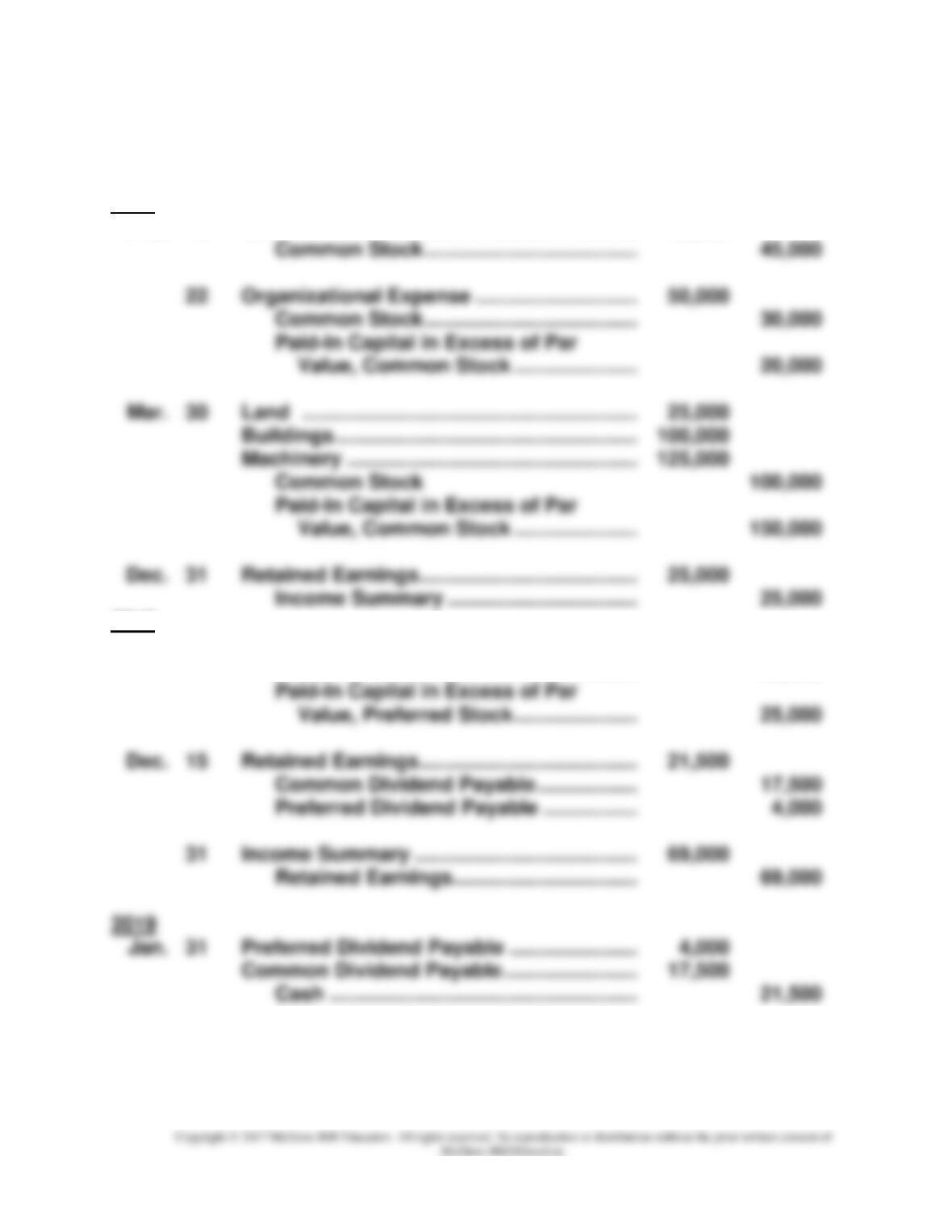
Part 1
2017
Feb.
19
Cash …………………………………………………….
45,000
Common Stock ………………………………..
45,000
22
Organizational Expense ………………………..
50,000
Common Stock ………………………………..
30,000
Value, Common Stock ………………….
20,000
30
25,000
Buildings ………………………………………………
Machinery …………………………………………….
Common Stock
Value, Common Stock ………………….
31
Retained Earnings …………………………………
25,000
Income Summary …………………………….
25,000
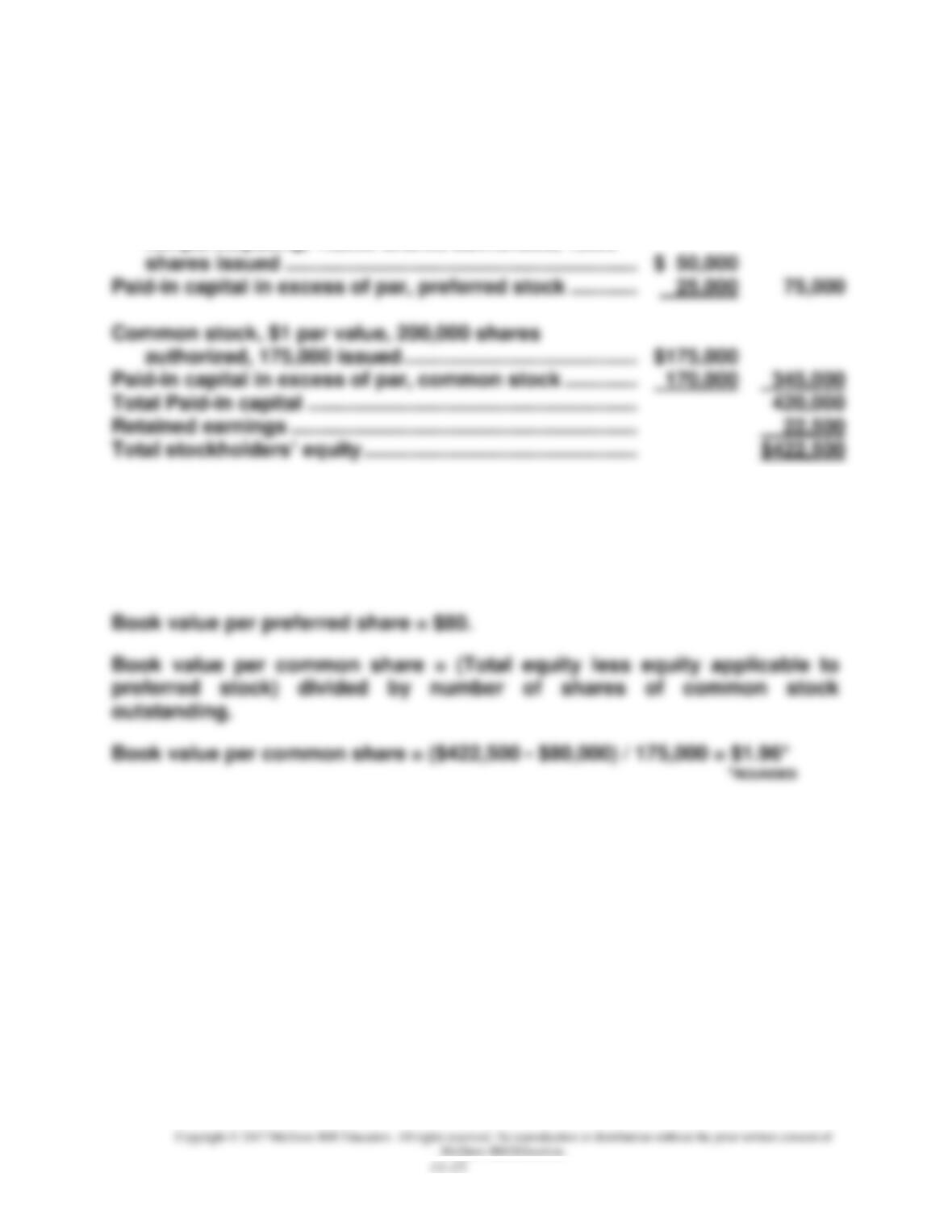
2018
Jan.
12
Cash …………………………………………………….
75,000
Preferred Stock ……………………………….
50,000
Value, Preferred Stock ………………….
25,000
15
Retained Earnings …………………………………
21,500
Common Dividend Payable ………………
17,500
Preferred Dividend Payable ……………..
31
Income Summary ………………………………….
69,000
Retained Earnings …………………………...
69,000
2019
Jan.
31
Preferred Dividend Payable …………………..
Common Dividend Payable ……………………
17,500
21,500
John J. Wild, Financial Accounting: Information for Decisions, 8th Edition
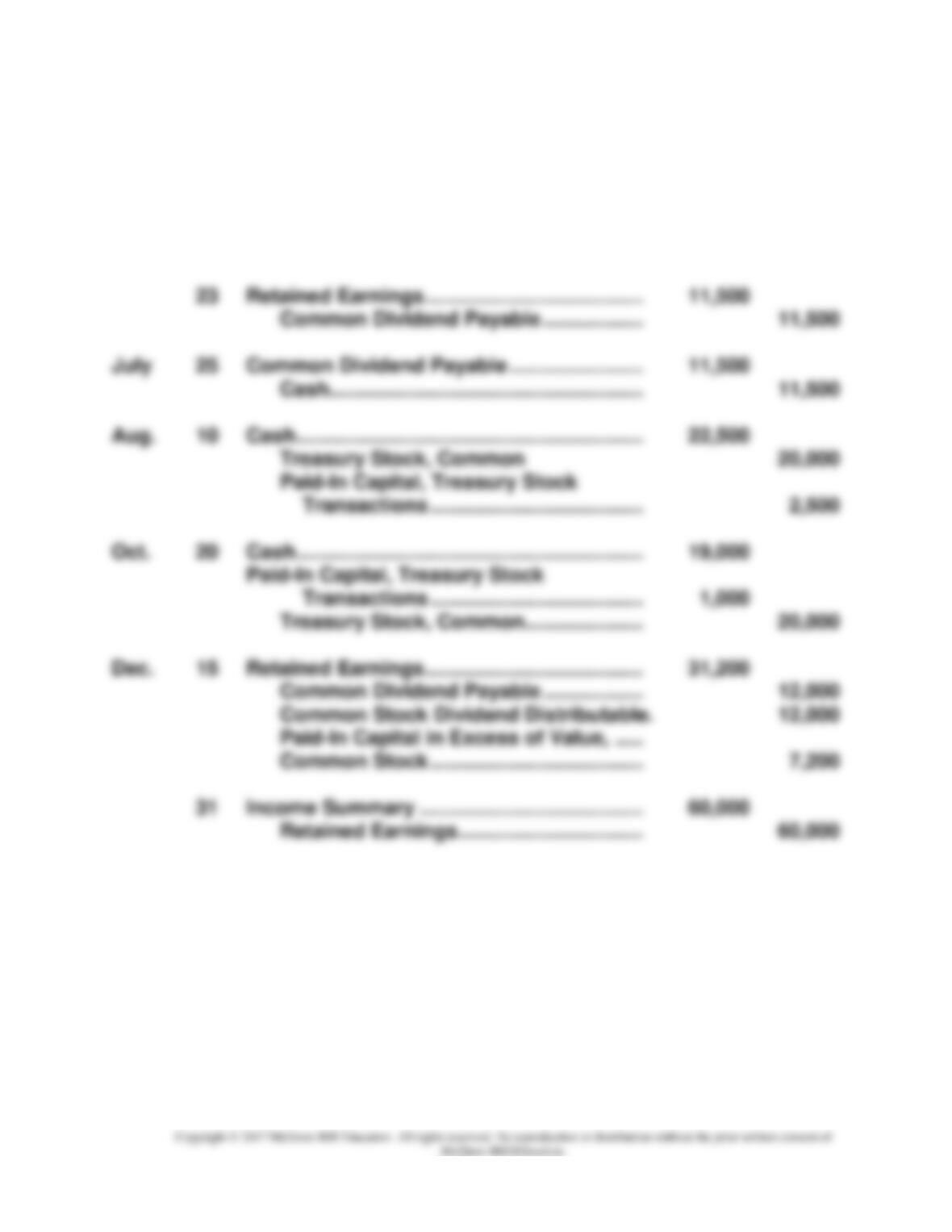
Part 2
Stockholders’ Equity
Preferred stock, $50 par value, 8% cumulative and
nonparticipating, 10,000 shares authorized, 1,000
shares issued ………………………………………………………
Common stock, $1 par value, 200,000 shares
authorized, 175,000 issued ……………………………………
Total Paid-in capital …………………………………………………..
Retained earnings ……………………………………………………..
Part 3
Book value per preferred share = call value (or par value if stock does not
have a call value) plus any dividends in arrears if cumulative stock. There
are no arrears.

John J. Wild, Financial Accounting: Information for Decisions, 8th Edition
11–16
Alternate Demonstration Problem #2
Chapter 11
At the beginning of 2017, Austin Corporation’s stockholders’ equity
consisted of the following:
Common stock, $25 par value, 30,000 shares authorized,
24,000 shares issued ……………………………………………………..
$600,000
Paid–In capital in excess of par value common stock ……………
90,000
Retained earnings ……………………………………………………………….
230,000
Total stockholders’ equity ………………………………………………
$920,000
During the year, the company completed these transactions:
June
6
Purchased 1,000 shares of treasury stock at $40 per share.
23
The directors voted a $0.50 per share cash dividend payable
on July 25 to the July 20 stockholders of record.
July
25
Paid the dividend declared on June 23.
Aug.
10
Sold 500 of the treasury shares at $45 per share.
Oct.
20
Sold 500 of the treasury shares at $38 per share.
Dec.
15
The directors voted a $0.50 per share cash dividend payable
on January 20 to the January 15 stockholders of record, and
they voted a 2% stock dividend distributable on January 30 to
the January 20 stockholders of record. The market value of
the stock was $40 per share.
31
Closed the Income Summary account and carried the
company’s $60,000 net income to Retained Earnings.
Required:
1. Prepare general journal entries to record the transactions.
2. Prepare a retained earnings statement for the year and the
stockholders’ equity section of the company’s year-end balance sheet.
John J. Wild, Financial Accounting: Information for Decisions, 8th Edition
11–17
Solution: Alternate Demonstration Problem #2
Chapter 11
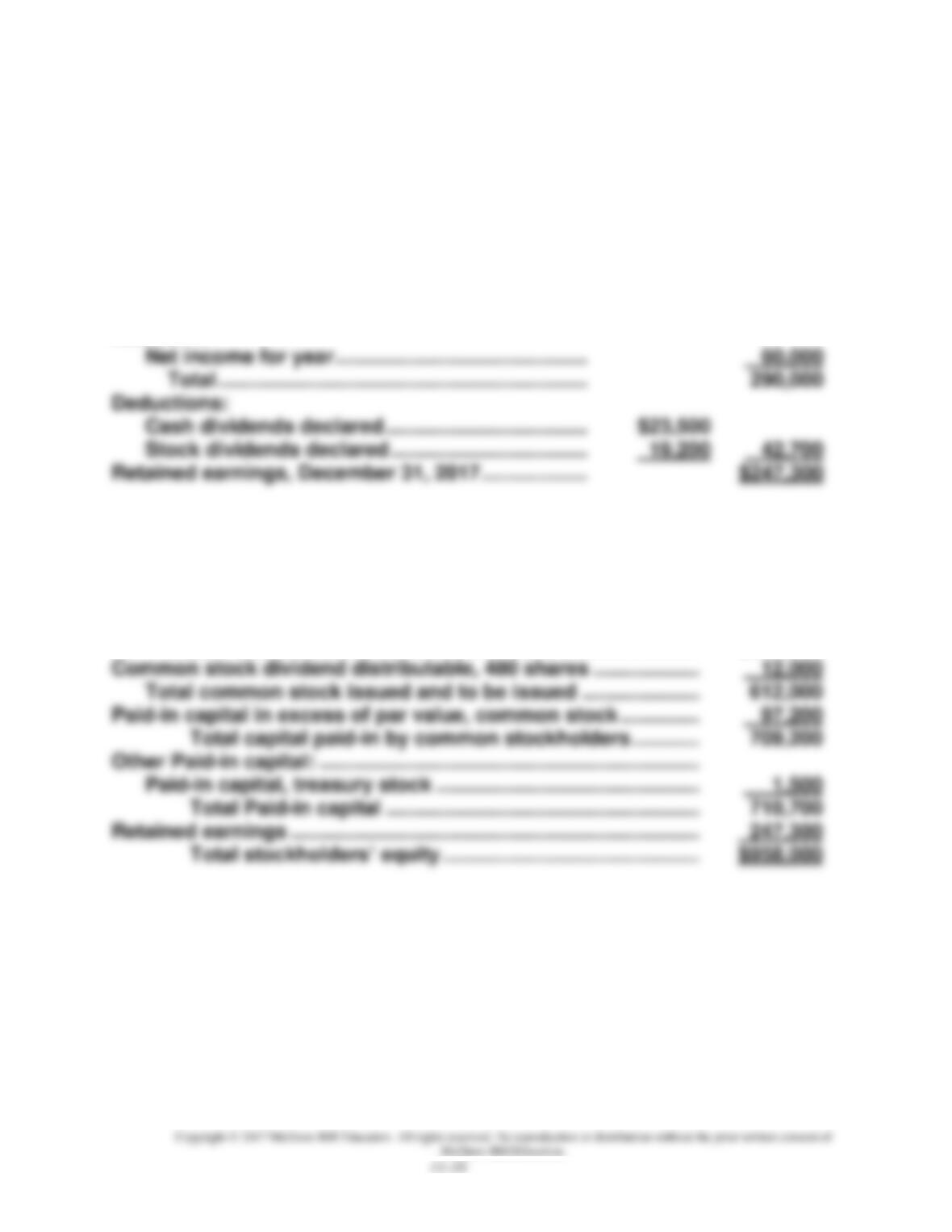
Part 1
June
6
Treasury Stock, Common ………………………
40,000
Cash ………………………………………………..
40,000
23
Retained Earnings …………………………………
11,500
Common Dividend Payable ………………
11,500
25
Common Dividend Payable ……………………
11,500
Cash ………………………………………………..
11,500
10
22,500
Treasury Stock, Common
20,000
Transactions ………………………………..
20
19,000
Transactions ………………………………..
Treasury Stock, Common …………………
20,000
15
Retained Earnings …………………………………
31,200
Common Dividend Payable ………………
12,000
Common Stock Dividend Distributable.
12,000
Common Stock ………………………………..
31
Income Summary ………………………………….
60,000
Retained Earnings …………………………...
60,000
John J. Wild, Financial Accounting: Information for Decisions, 8th Edition
Part 2
AUSTIN CORPORATION
Statement of Retained Earnings
For Year Ended December 31, 2017
Retained earnings, January 1, 2017 ……………………
$230,000
Additions:
Deductions:
Cash dividends declared ………………………………
Retained earnings, December 31, 2017 ……………….
$247,300
Stockholders’ Equity
Common stock, $25 par value, 30,000 shares authorized,
24,000 shares issued ………………………………………………….
$600,000
Common stock dividend distributable, 480 shares ……………….
Total common stock issued and to be issued …………………
Total capital paid-in by common stockholders …………
Other Paid-in capital: …………………………………………………………..
Total Paid-in capital ………………………………………………..
Retained earnings ……………………………………………………………….
Total stockholders’ equity ……………………………………….
$958,000