CHAPTER 11
Reporting and Analyzing Stockholders’ Equity
Learning Objectives
1. Identify and discuss the major characteristics of a corporation.
2. Record the issuance of common stock.
3. Explain the accounting for the purchase of treasury stock.
4. Differentiate preferred stock from common stock.
5. Prepare the entries for cash dividends and understand the effect of stock dividends and stock splits.
6. Identify the items that affect retained earnings.
7. Prepare a comprehensive stockholders’ equity section.
8. Evaluate a corporation’s dividend and earnings performance from a stockholder’s perspective.
*9. Prepare entries for stock dividends.
Summary of Questions by Learning Objectives and Bloom’s Taxonomy
Item LO BT Item LO BT Item LO BT Item LO BT Item LO BT
Questions
1. 1 C 7. 2, 3 AP 12. 6 C 17. 5 C 22. 8 C
Brief Exercises
1. 1 K 4. 4 AP 7. 5 K 9. 8 C 11. 8 AP
Do It! Review Exercises
1. 1 C 3. 3 AP 4. 4 AP 5. 5 AP 6. 7 AP
Exercises
1. 2 AP 4. 2, 3, 6. 5 AP 10. 7 AP 14. 8 AN
Problems: Set A
1. 2, 4, 2. 2, 3, 3. 7 AP 5. 2, 3, 7. 8 AP
Problems: Set B
1. 2, 4, 2. 2, 3, 3. 7 AP 5. 2, 3,
8. 5, 7,
ASSIGNMENT CHARACTERISTICS TABLE
Problem
Number
Description
Difficulty
Level
Time
Allotted (min.)
1A Journalize stock transactions, post, and prepare paid-in
capital section.
Simple 30–40
2A Journalize transactions, post, and prepare a stockholders’
equity section; calculate ratios.
Moderate 40–50
3A Prepare a stockholders’ equity section. Moderate 20–30
4A Reproduce retained earnings account, and prepare
a stockholders’ equity section.
Moderate 30–40
1B Journalize stock transactions, post, and prepare paid-in
capital section.
Simple 30–40
2B Journalize transactions, post, and prepare a stockholders’
equity section; calculate ratios.
Moderate 40–50
3B Prepare a stockholders’ equity section. Moderate 20–30
4B Reproduce retained earnings account, and prepare
a stockholders’ equity section.
Moderate 30–40
ANSWERS TO QUESTIONS
1. (a) Separate legal existence. A corporation is separate and distinct from its owners and it acts
(b) Limited liability of stockholders. Because of its separate legal existence, creditors of a corpo–
(c) Transferable ownership rights. Ownership of a corporation is shown in shares of capital stock.
The shares are transferable units. Stockholders may dispose of part or all of their interest
2. (a) Corporate management is an advantage to a corporation because it can hire professional
(b) Two other disadvantages of a corporation are government regulations and additional taxes.
A corporation is subject to numerous state and federal regulations. For example, state laws
3. Janie is incorrect. A corporation must be incorporated in only one state. It is to the company’s ad-
vantage to incorporate in a state whose laws are favorable to the corporate form of business
4. In the absence of restrictive provisions, the basic ownership rights of common stockholders are
the rights to:
(1) vote in the election of the board of directors and in corporate actions that require stock-
holders’ approval.
5. Legally, a corporation is an entity, separate and distinct from its owners. As a legal entity, a corpo-
ration possesses most of the privileges and is subject to the same duties and responsibilities as a
Questions Chapter 11 (Continued)
7. The maximum number of shares that a corporation is legally allowed to issue is the number
authorized. Gagne Corporation is authorized to sell 100,000 shares. Of these shares, 70,000
8. The relative par values should have no effect on the investment decision. The par value of
common stock has no effect on its market value. Par value used to be a legal amount per share
9. A corporation may acquire treasury stock (1) to reissue the shares to officers and employees
under bonus and stock compensation plans, (2) to increase trading of the company’s stock in the
10. When treasury stock is purchased, Treasury Stock is debited and Cash is credited at cost ($11,000
in this example). Treasury stock is a contra stockholders’ equity account and cash is an asset.
11. (a) Common stock and preferred stock both represent ownership of the corporation. Common
stock signifies the basic residual ownership; preferred stock is ownership with certain
12. The debits and credits to retained earnings are:
Questions Chapter 11 (Continued)
13. The answers are summarized in the table below:
Account Classification
(a) Common Stock Paid-in capital—capital stock
(b) Paid-in Capital in Excess of Par Value Paid-in capital—additional paid-in capital
14. For a cash dividend to be paid, a corporation must have retained earnings, adequate cash, and a
dividend declared by the board of directors.
15. May 1 is the date on which the board of directors formally declares (authorizes) and announces
the cash dividend. May 15 is the record date which marks the time when ownership of outstanding
16. A cash dividend decreases assets, retained earnings, and total stockholders’ equity. A stock divi-
17. Angie is incorrect. A corporation generally issues stock dividends for one of the following reasons:
(1) To satisfy stockholders’ dividend expectations without spending cash.
18. In a stock split, the number of shares is increased in the same proportion that par value
is decreased. Thus, in Deane Corporation the number of shares will increase to 30,000 (10,000 X
19. The different effects of a stock split versus a stock dividend are:
Item Stock Split Stock Dividend
Total paid-in capital No change Increase
Questions Chapter 11 (Continued)
21. (a) The purpose of a retained earnings restriction is to indicate that a portion of retained earnings
is currently unavailable for dividends.
23. The payout ratio is computed by dividing cash dividends declared on common stock by net
income. The payout ratio indicates the percentage of earnings distributed as cash dividends to
common stockholders.
24. Debt financing will increase the return on common stockholders’ equity when the return on assets
SOLUTIONS TO BRIEF EXERCISES
BRIEF EXERCISE 11-1
The advantages and disadvantages of a corporation are as follows:
Advantages Disadvantages
Separate legal existence Corporate management—
Limited liability of stockholders separation of ownership
BRIEF EXERCISE 11-2
May 10 Cash (2,500 X $13) …………………………………. 32,500
BRIEF EXERCISE 11-3
BRIEF EXERCISE 11-4
BRIEF EXERCISE 11-5
Nov. 1 Cash Dividends (7,000 X $1) ……………….. 7,000
BRIEF EXERCISE 11-6
Before After
Dividend Dividend
(a) Stockholders’ equity
Paid-in capital
BRIEF EXERCISE 11-7
Transaction
Total
Assets
Total
Liabilities
Total
Stockholders’
Equity
(a) Declared cash dividend N/A +
–
(b) Paid cash dividend declared in (a)
–
–
N/A
BRIEF EXERCISE 11-8
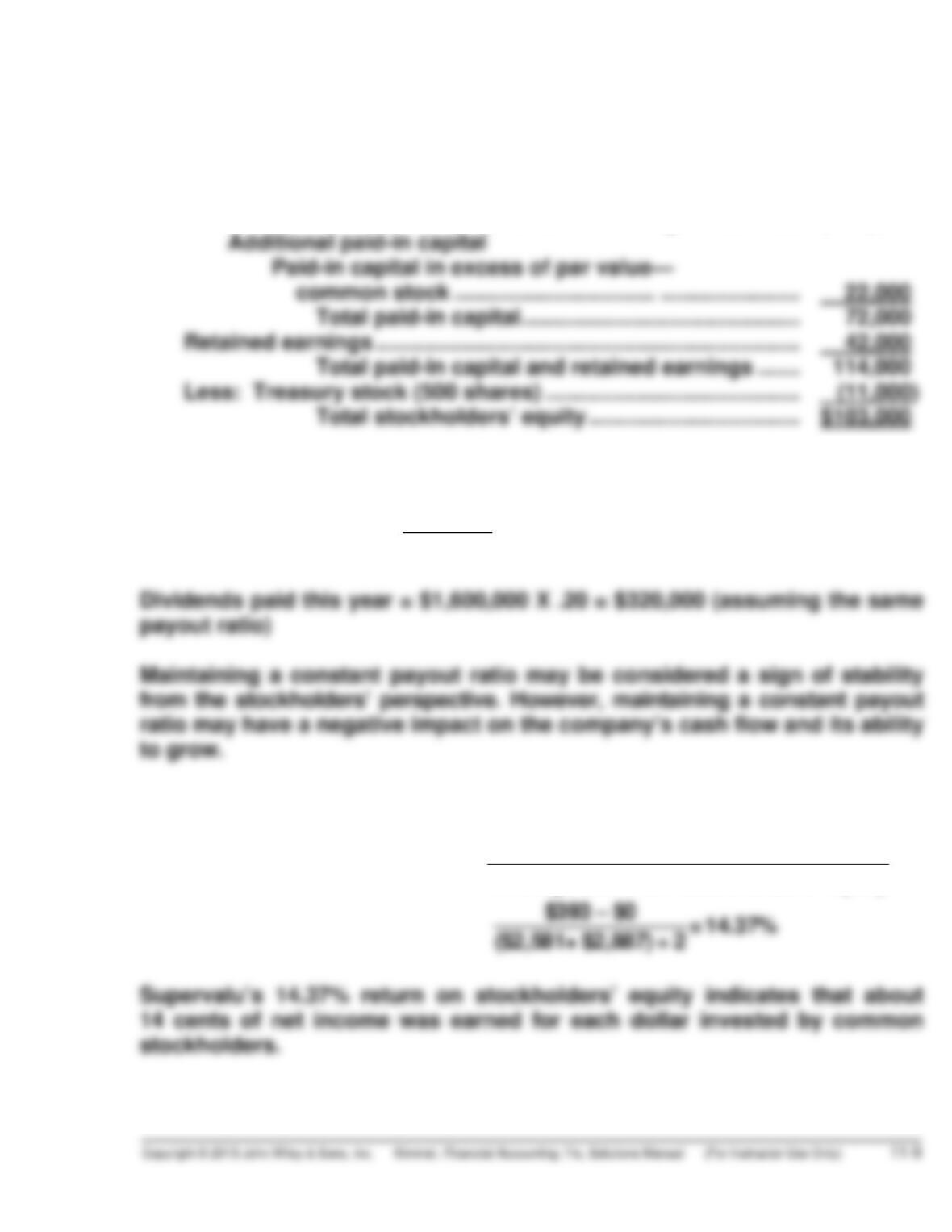
Stockholders’ equity
Paid-in capital
Capital stock
Common stock, $10 par value, 5,000 shares
issued and 4,500 shares outstanding ……………….. $ 50,000
BRIEF EXERCISE 11-9
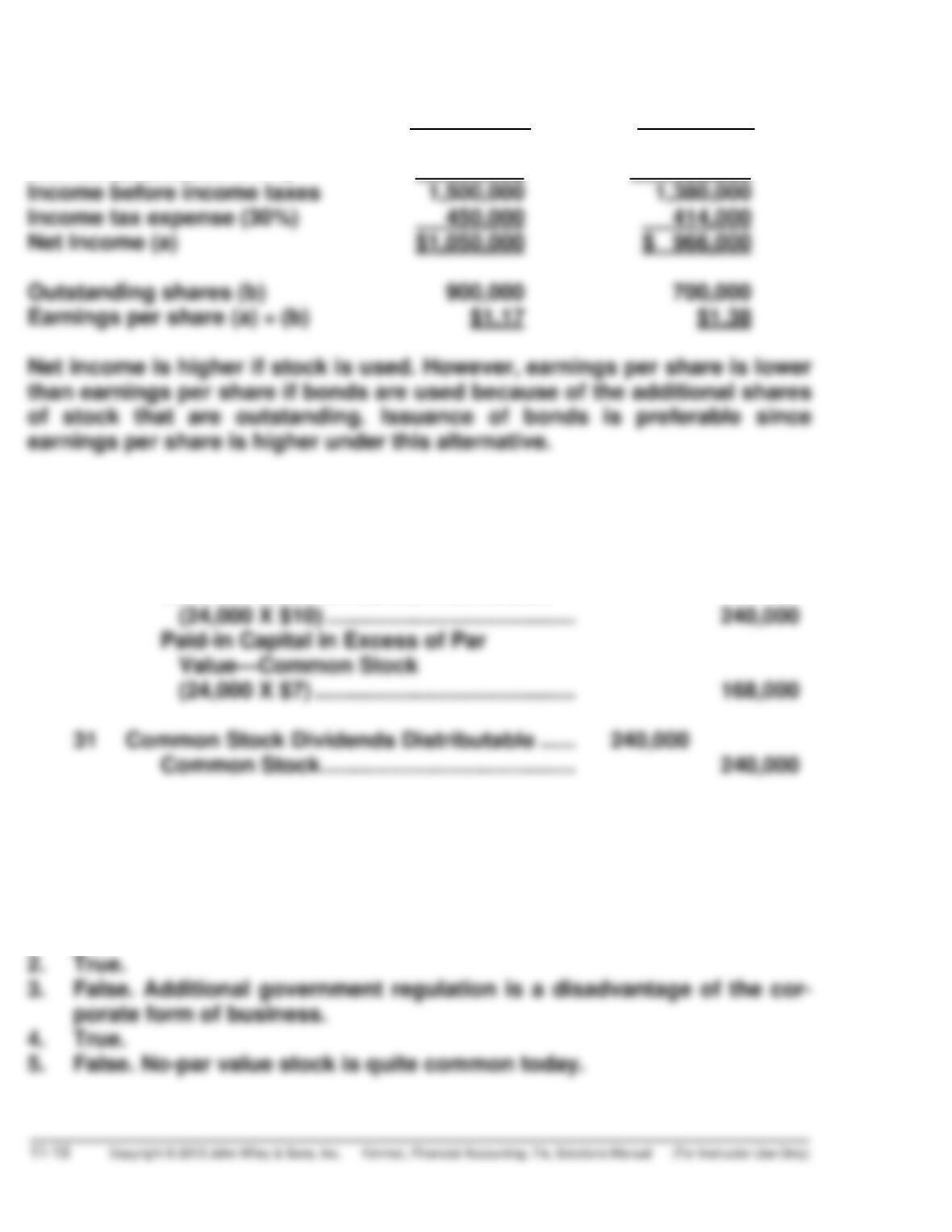
Payout ratio—last year = $120,000
$600,000 =20%
BRIEF EXERCISE 11-10
Return on stockholders’ equity = Net income–Preferred dividends
A
verage common stockholders’ equity
BRIEF EXERCISE 11-11
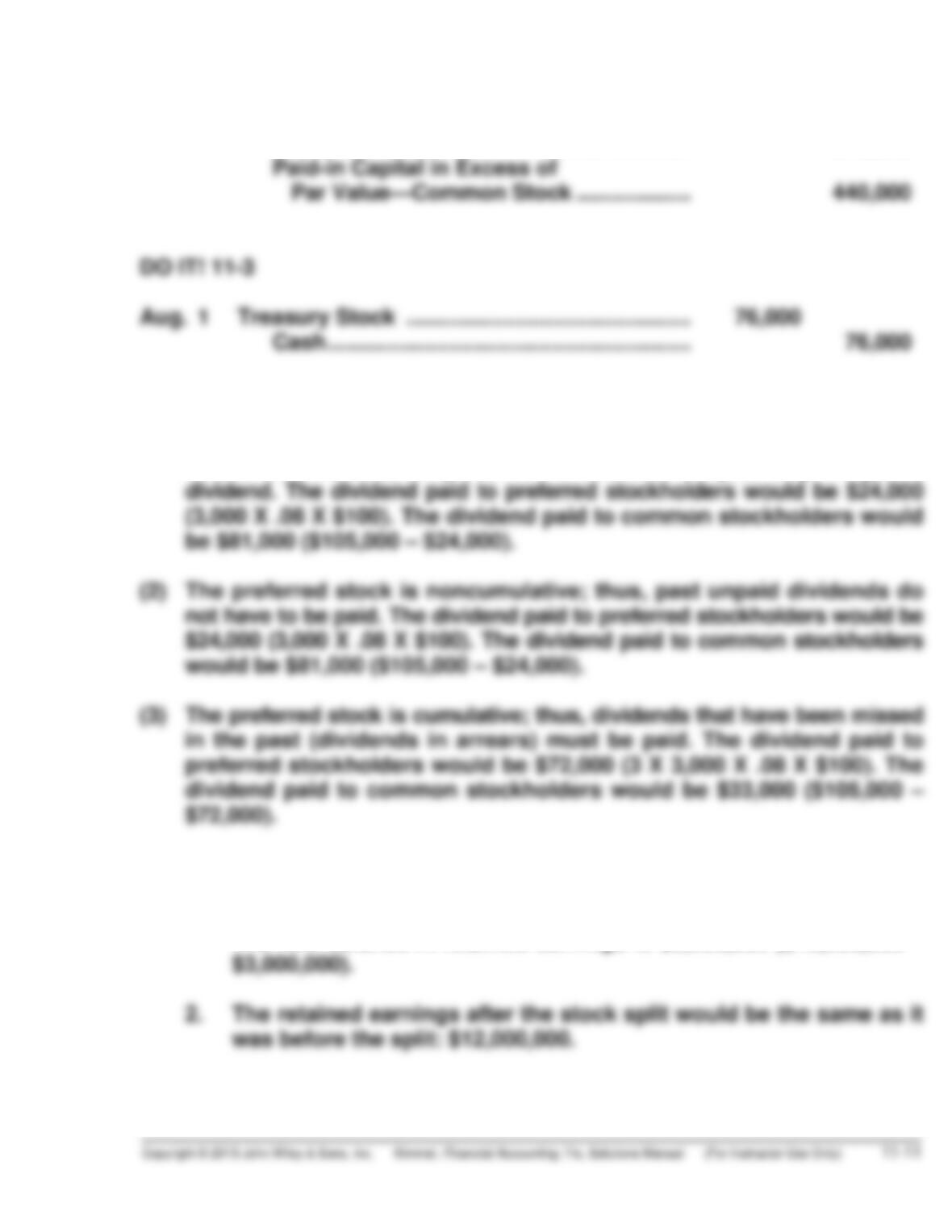
Issue Stock Issue Bond
Income before interest and taxes $1,500,000 $1,500,000
Interest ($2,000,000 X 6%) 0 120,000
*BRIEF EXERCISE 11-12
Dec. 1 Stock Dividends (24,000 X $17) ………………… 408,000
Common Stock Dividends Distributable
SOLUTIONS TO DO IT! REVIEW EXERCISES
DO IT! 11-1
1. True.
DO IT! 11-2
Apr. 1 Cash ……………………………………………………….. 715,000
Common Stock …………………………………… 275,000
DO IT! 11-4
(1) The company has not missed past dividends and the preferred stock is
noncumulative; thus, the preferred stockholders are paid only this year’s
DO IT! 11-5
(a) 1. The stock dividend amount is $3,000,000 [(400,000 X 15%) X $50].
The new balance in retained earnings is $9,000,000 ($12,000,000 –
DO IT! 11-5 (Continued)
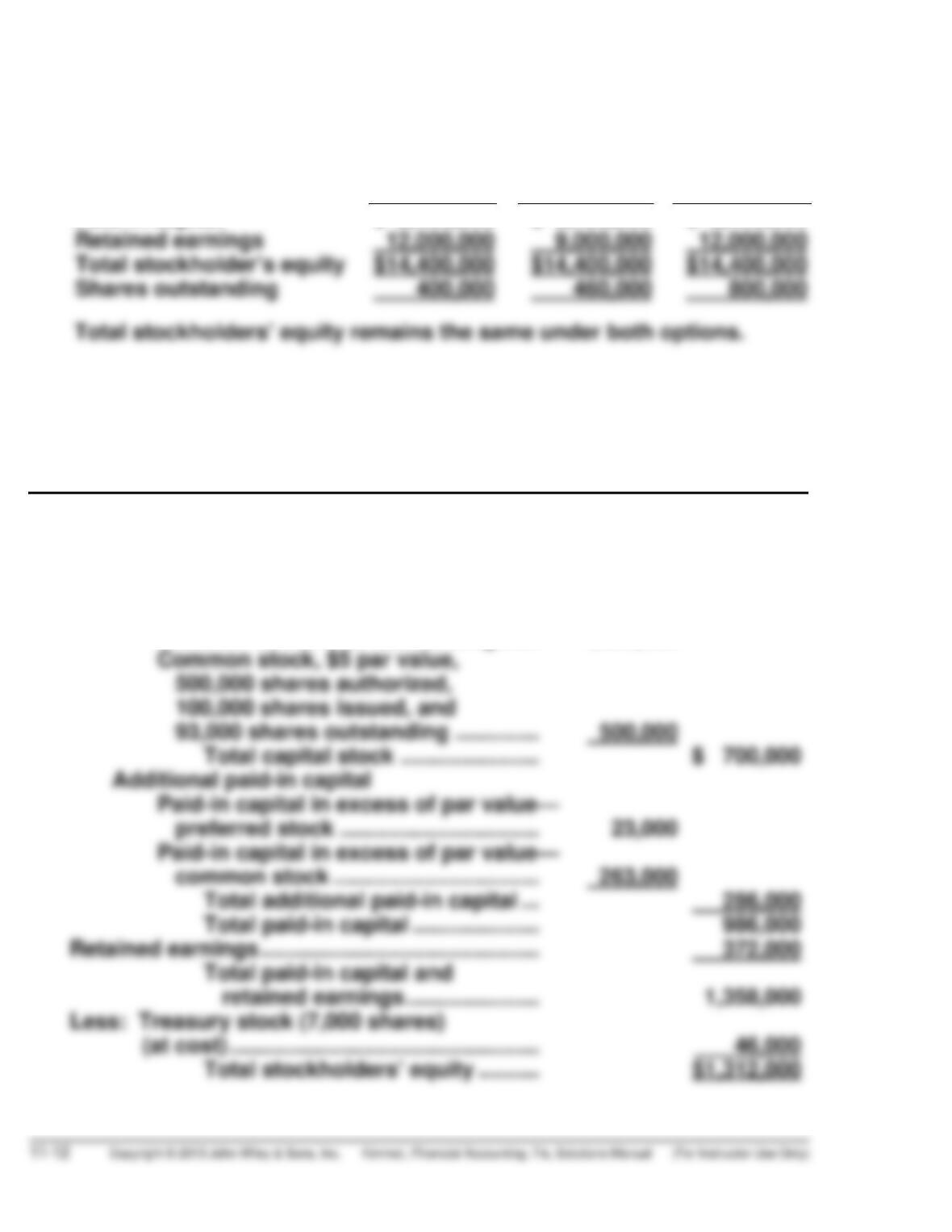
(b) (1) and (2) The effects on the stockholders’ equity accounts are as follows:
Original
Balance
A
fter
Dividend
After
Split
Paid-in capital $ 2,400,000 $ 5,400,000 $ 2,400,000
DO IT! 11-6
FOYLE CORPORATION
Balance Sheet (Partial)
Stockholders’ equity
Paid-in capital
Capital Stock
9% preferred stock, $100 par value,
10,000 shares authorized, 2,000
shares issued and outstanding ……. $200,000
SOLUTIONS TO EXERCISES
EXERCISE 11-1
(a) Jan. 10 Cash (30,000 X $5) ………………………….. 150,000
Common Stock ………………………… 150,000
July 1 Cash (60,000 X $7) ………………………….. 420,000
Common Stock (60,000 X $5) …….. 300,000
EXERCISE 11-2
June 12 Cash ………………………………………………….. 300,000
Common Stock (80,000 X $1) ……….. 80,000
EXERCISE 11-3
(a) Feb. 1 Cash (40,000 X $51) …………………………. 2,040,000
Preferred Stock (40,000 X $50) ….. 2,000,000
(b)
Preferred Stock
Paid-in Capital in Excess of
Par Value—Preferred Stock
2/1 2,000,000 2/1 40,000
EXERCISE 11-4
(a) Common stock outstanding is 574,000 shares. (Issued shares 580,000
less treasury shares 6,000.)
EXERCISE 11-5
May 2 Cash (8,000 X $13) ………………………………. 104,000
Common Stock (8,000 X $10) ………… 80,000
10 Cash (10,000 X $53) …………………………….. 530,000
Preferred Stock (10,000 X $20)………. 200,000
EXERCISE 11-6
(a) June 15 Cash Dividends (69,000* X $1.50) ….. 103,500
Dividends Payable …………………. 103,500
(b) In the retained earnings statement, dividends of $220,300 will be
EXERCISE 11-7
Before
Action
A
fter Stock
Dividend
After Stock
Split
Stockholders’ equity
Paid-in capital $ 648,000 $ 716,850 $ 648,000
EXERCISE 11-8
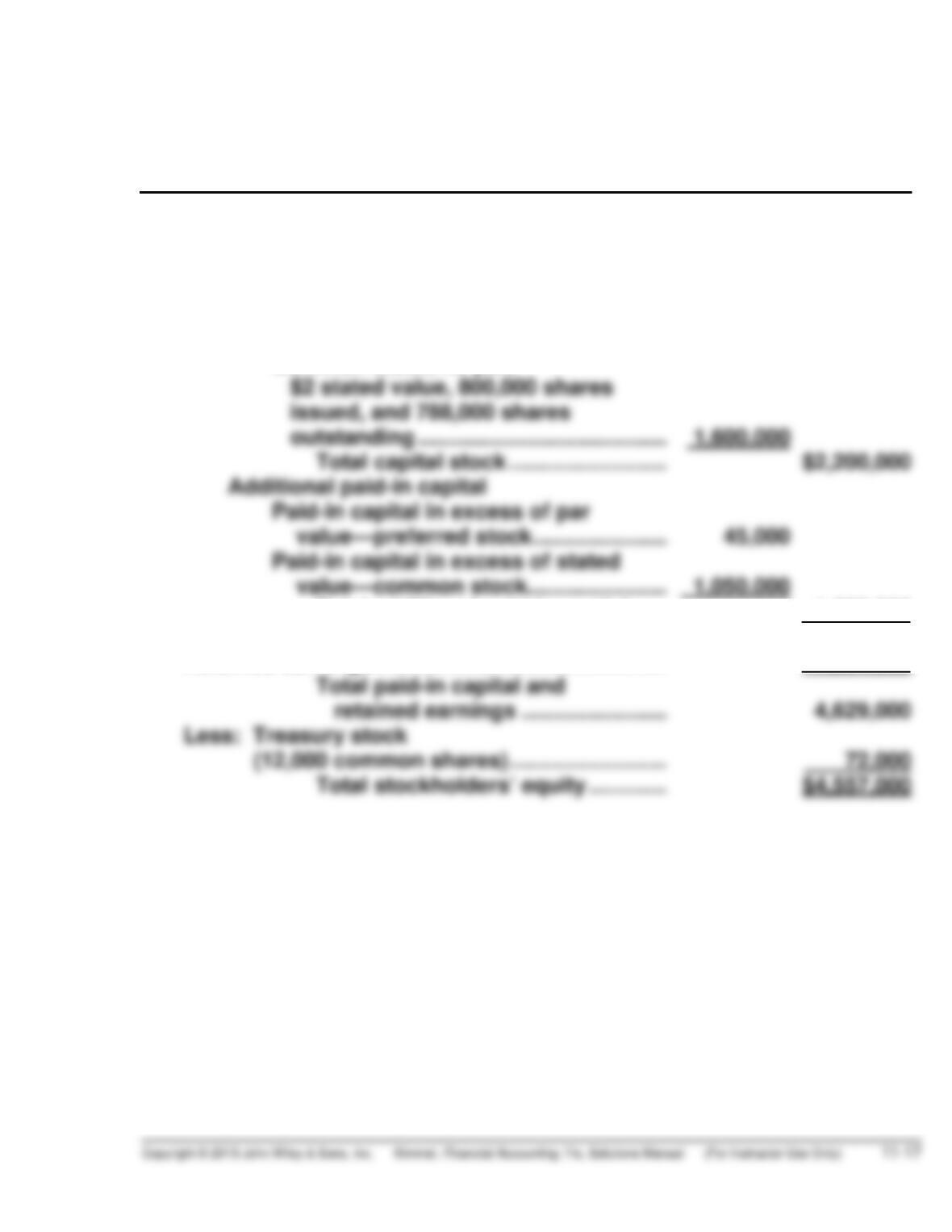
WELLS FARGO & COMPANY
Partial Balance Sheet
December 31, 2014
(in millions)
Stockholders’ equity
Paid-in capital
Capital stock
Total capital stock ………………………………… $ 17,228
Additional paid-in capital
Paid-in capital in excess of par value—
common stock ………………………………………. 52,878
Total paid-in capital ……………………………… 70,106
EXERCISE 11-9
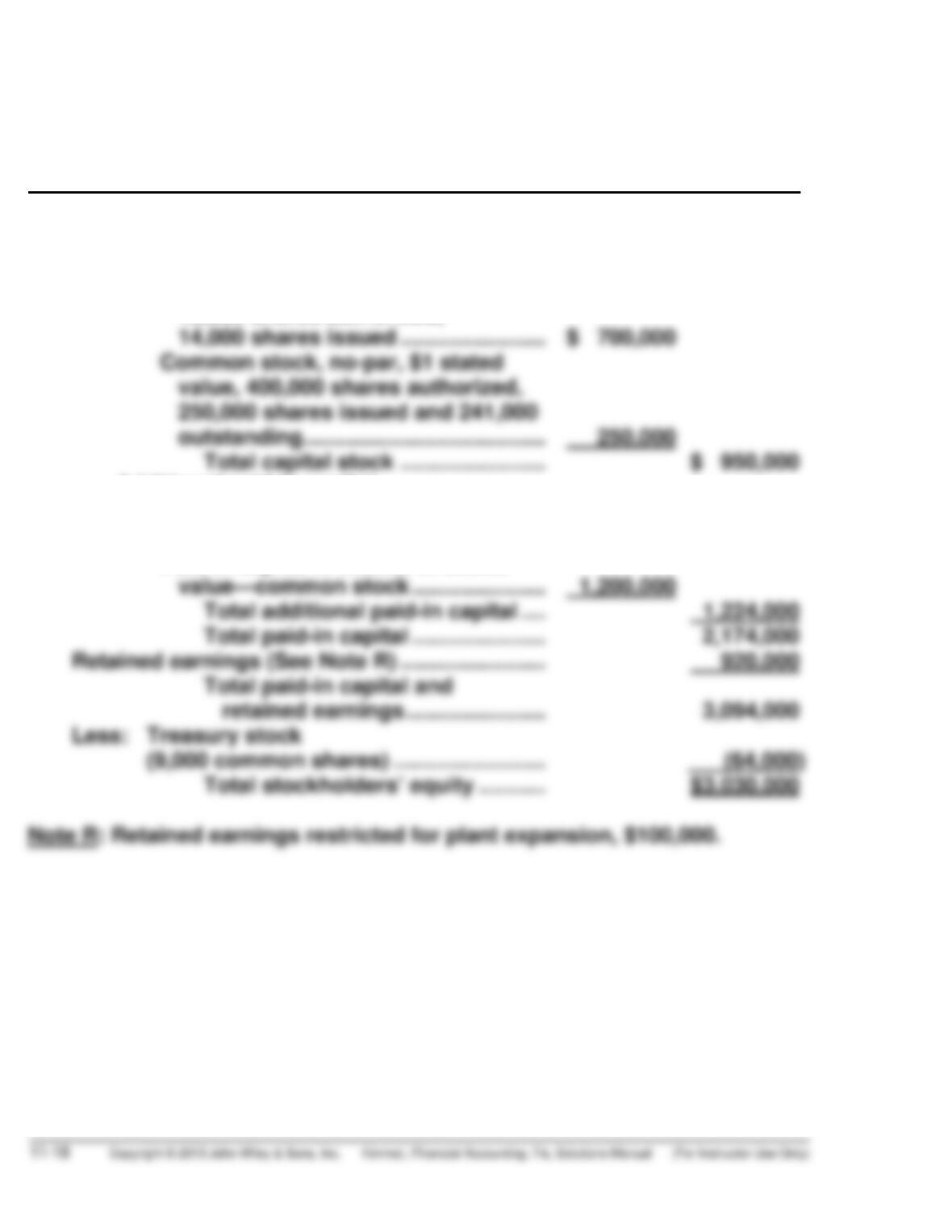
RODER CORPORATION
Partial Balance Sheet
December 31, 2014
Stockholders’ equity
Paid-in capital
Capital stock
8% Preferred stock, $100 par
value, noncumulative,
6,000 shares issued ………………………. $ 600,000
Common stock, no par,
Total additional paid-in capital …… 1,095,000
Total paid-in capital …………………… 3,295,000
Retained earnings ………………………………………… 1,334,000
EXERCISE 11-10
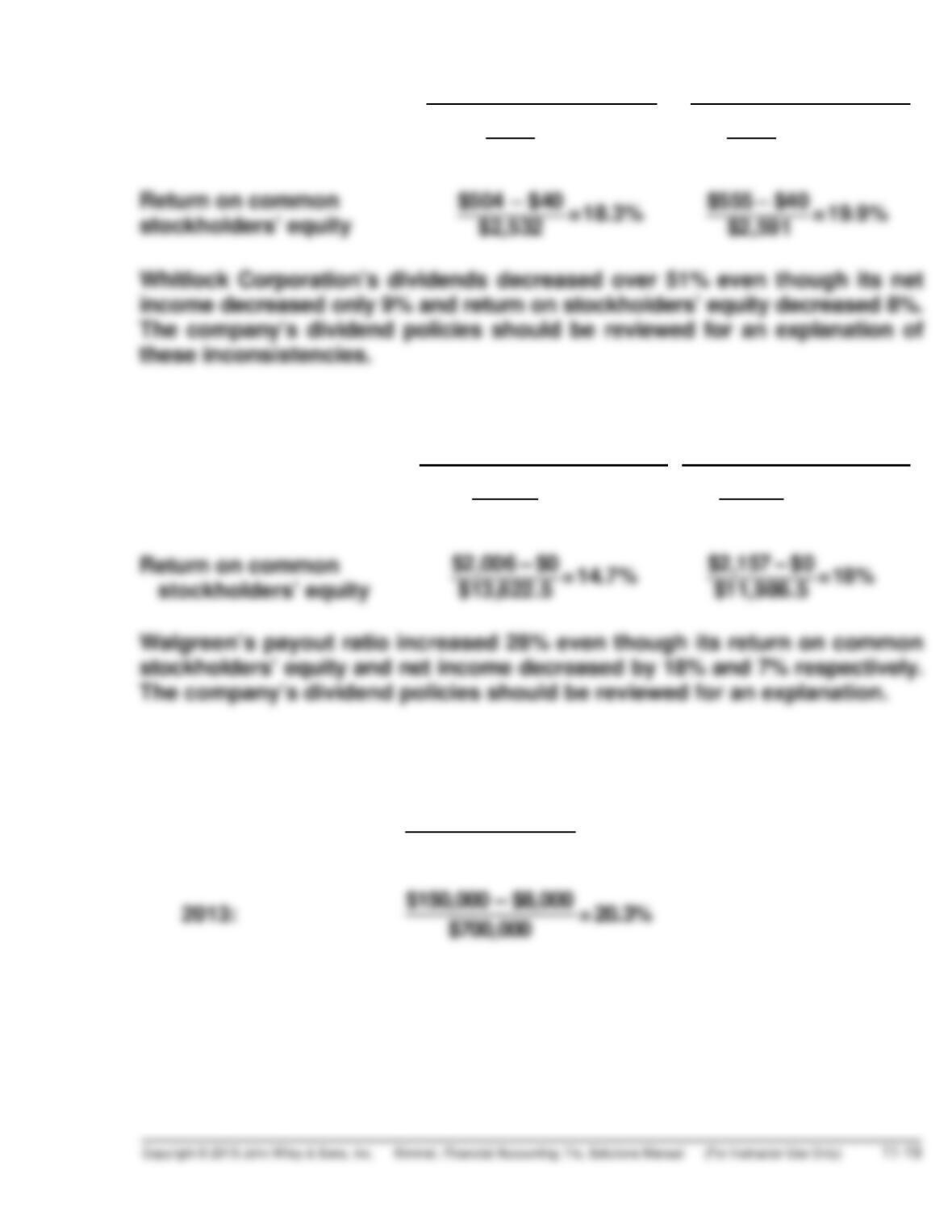
POLZIN INC.
Partial Balance Sheet
December 31, 2014
Stockholders’ equity
Paid-in capital
Capital stock
8% Preferred stock, $50 par value,
40,000 shares authorized,
Additional paid-in capital
Paid-in capital in excess of par
value—preferred stock ………………… 24,000
Paid-in capital in excess of stated
EXERCISE 11-11
2014 2013
Payout ratio $298
$504 =59.1% $611
$555 =110.1%
EXERCISE 11-12
2014 2013
Payout ratio $471
$2,006 =23.5% 394
$2,157 =18.3%
EXERCISE 11-13
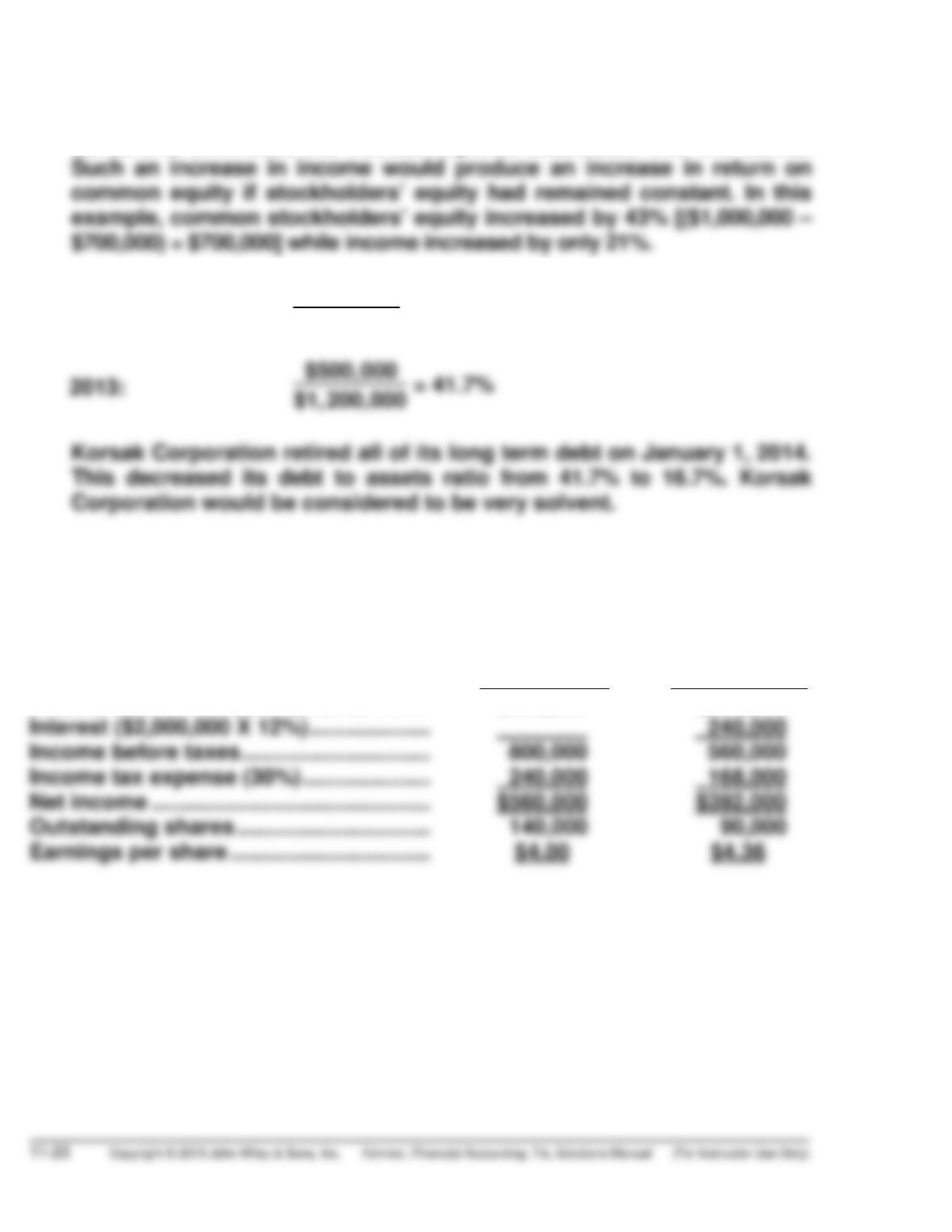
(a) 2014: $182,000 – $8,000
$1,000,000 =17.4%
EXERCISE 11-13 (Continued)
(b) Korsak Corporation’s net income increased in part because it retired
bonds and eliminated the interest expense associated with the bonds.
(c) 2014: $200,000
$1,200,000 =16.7%
EXERCISE 11-14
(a)
Plan One
Issue Stock
(b)
Plan Two
Issue Bonds
Income before interest and taxes ……… $800,000 $800,000